International Journal of Engineering Research and Generic Science (IJERGS) Available Online at www.ijergs.in
Volume -3, Issue-1, January – February 2017, Page No. 26 - 33
Corresponding Author: Rajkumar Kaushik, Page No. 26 - 33
Pag
e26
ISSN: 2455 - 1597
Study & Analysis of Incremental Conductance Method of Maximum Power Point Tracking System
Rajkumar kaushik1, Alok kumar Singh2, Jitendra Sharma3
1
M.Tech. 4th Semester in Power System
2
Associate Professor in EE department
3
Assistant Professor in EE department
Jaipur Institute of Technology, Jaipur, (Rajasthan), India
E-Mail Id: [email protected],[email protected], [email protected] Abstract
Solar energy is one of the most important source of energy but due to a large amount of transmission losses these devices
are not used generally. So to transmit a large amount of power, various techniques are used. The incremental conductance
method is one of the best methods to deliver maximum power from photovoltaic module to load due to its simple
implementation and fast tracking accuracy. This paper presents the analysis of incremental conductance method. To find
out the maximum power point by power voltage (P-V) and current-voltage (I-V) graph are drawn by using MATLAB.
Keywords: Solar Energy, Photovoltaic cell, Incremental Conductance, Maximum Power Point (MPP).
1. Introduction
As we know, after a long period of time all conventional sources of energy like petrol, diesel, LPG etc. will finish from
the earth surface. But the conventional source will never be finished from earth surface so; it means that the life of human
being will completely depend on non-conventional source of energy. To use the conventional source for a long time we
are concentrating towards the renewable sources.
The consumption of different energy sources and overall generation as on 31.12.2016 shown below;
© IJERGS, All Rights Reserved.
Pag
e27
Pag
e27
Pag
e27
Pag
e27
Pag
e27
Pag
e27
Pag
e27
Pag
e27
Pag
e27
Pag
e27
Pag
e27
Pag
e27
Pag
e27
Pag
e27
Pag
e27
Pag
e27
Pag
e27
Pag
e27
Pag
e27
Pag
e27
Pag
e27
Renewable is now established around the world as main- stream sources of energy. Rapid growth, particularly in the
power sector, is driven by several factors, including the improving cost-competitiveness of renewable technologies,
dedicated policy initiatives, better access to financing, energy security and environmental concerns, growing demand for
energy in developing and emerging economies, and the need for access to modern energy.”[1].
The solar energy is playing a vital role in generation of electricity. The main application of solar energy is to generate the
electrical power by using photovoltaic cell.
From the following figure we can observe that solar energy is the best source out of various renewable energy sources
which is showing the Potential & Achievement of renewable energy sources in India as on 31.12.2015.
Figure.2: Ministry of Renewable Energy Sources[6]
2. Working of Solar Cell
Rajkumar Kaushik, et al. International Journal of Engineering Research and Generic Science (IJERGS)
© IJERGS, All Rights Reserved.
Pag
e28
Pag
e28
Pag
e28
Pag
e28
Pag
e28
Pag
e28
Pag
e28
Pag
e28
Pag
e28
Pag
e28
Pag
e28
Pag
e28
Pag
e28
Pag
e28
Pag
e28
Pag
e28
Pag
e28
Pag
e28
Pag
e28
Pag
e28
Pag
e28
……….. (i)
Figure 3: Photo-Electric Effect
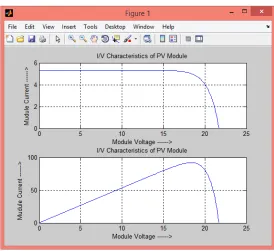
The I-V and P-V characteristic of photovoltaic cell is shown in following figure;
Figure 5: I-V & P-V Curve of Photovoltaic Module
The generated electrical energy by the PV cell is in very less amount and their large amount of generated energy is wasted during the transmission to the load. To deliver the maximum power to the load various techniques are used. Still total seventeen techniques are going to use in the field out of them incremental conductance method is the most preferable method due to its accuracy and fast tracking properties.
Rajkumar Kaushik, et al. International Journal of Engineering Research and Generic Science (IJERGS)
© IJERGS, All Rights Reserved.
Pag
e29
Pag
e29
Pag
e29
Pag
e29
Pag
e29
Pag
e29
Pag
e29
Pag
e29
Pag
e29
Pag
e29
Pag
e29
Pag
e29
Pag
e29
Pag
e29
Pag
e29
Pag
e29
Pag
e29
Pag
e29
Pag
e29
Pag
e29
Pag
e29
Block diagram of Incremental Conductance Method:
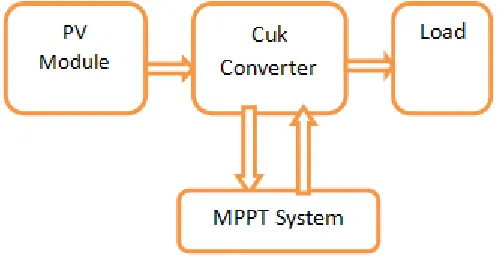
Figure 4: Block Diagram of Optimization of PV Module using MPPT Algorithm
From above figure, it is clear that when solar radiations are incident over solar arrays the generated d.c power is not uniform. So to make it uniform we will use MPPT algorithm over their after applying MPPT algorithm we will compare tracked output voltage and current with the reference voltage and current. If tracked parameters are not like the same as reference parameters then, we track the parameters again and get the maximum power point.
MPPT stands for maximum power point tracking. This topic is very needful for PV system and this also brings various applications of power electronics for a photovoltaic system. MPPT is equally valid for cells, modules and arrays but MPPT system is used at PV array level.
To get maximum power delivered by the PV module we should operate the system in such a manner that the operating point should be corresponding to the maximum power and that point is known as the maximum power point.
This point is present at the peak of PV curve and at the knee of I-V curve. When a radiations or temperature varies then maximum power point (MPP) also varies so to get again maximum power point we have to change in I-V curve. This process is called MPPT.
3. Different Methods for MPP
Generally there are two types of MPPT techniques that are given below:
1. Indirect Techniques:
i) Fixed voltage method,
ii) Fractional open circuit
2. Direct Techniques:
i) Perturb and observe method
ii) Incremental conductance
Incremental Conductance Method:
Rajkumar Kaushik, et al. International Journal of Engineering Research and Generic Science (IJERGS)
© IJERGS, All Rights Reserved.
Pag
e30
Pag
e30
Pag
e30
Pag
e30
Pag
e30
Pag
e30
Pag
e30
Pag
e30
Pag
e30
Pag
e30
Pag
e30
Pag
e30
Pag
e30
Pag
e30
Pag
e30
Pag
e30
Pag
e30
Pag
e30
Pag
e30
Pag
e30
Pag
e30
Before explaining the incremental conductance method we should know the relation between incremental conductances instant an eon’s conductance. Conductance is the ratio of current to resistance. We can say conductance is reciprocal to the resistance.
The necessary condition of incremental conductance method to deliver the maximum power from PV module to the load is determined as below;
As we know;
……… (i)
………..(ii)
Above is the required expression.
The above condition can be explained through the P-V characteristics of PV array as shown below:
© IJERGS, All Rights Reserved.
Pag
e31
Pag
e31
Pag
e31
Pag
e31
Pag
e31
Pag
e31
Pag
e31
Pag
e31
Pag
e31
Pag
e31
Pag
e31
Pag
e31
Pag
e31
Pag
e31
Pag
e31
Pag
e31
Pag
e31
Pag
e31
Pag
e31
Pag
e31
Pag
e31
4. Algorithm of Incremental Conductance Method
Figure 7: Algorithm of Incremental Conductance Method
For the algorithm of this method, we will compare the incremental conductance of the PV array to the instantaneous conductance for each In above flow chart it is shown that first of all we will measure the output voltage and current from solar panels and determine the If incremental conductance is curve to instantaneous conductance then maximum will generate this point.
𝑑𝐼/ 𝑑𝑉= − 𝐼/ 𝑉 at MPP (1)
If incremental conductance is less than instantaneous conductance then we will lie at the left of MPP.
𝑑𝐼 /𝑑𝑉> − 𝐼/ 𝑉 Left of MPP (2)
If incremental conductance is more than instantaneous conductance then we will lie at the right of MPP.
Rajkumar Kaushik, et al. International Journal of Engineering Research and Generic Science (IJERGS)
© IJERGS, All Rights Reserved.
Pag
e32
Pag
e32
Pag
e32
Pag
e32
Pag
e32
Pag
e32
Pag
e32
Pag
e32
Pag
e32
Pag
e32
Pag
e32
Pag
e32
Pag
e32
Pag
e32
Pag
e32
Pag
e32
Pag
e32
Pag
e32
Pag
e32
Pag
e32
Pag
e32
In above flow chart it is shown that first of all we will measure the output voltage and current from solar panels and determine the instantaneous conductance (I/v). Now we will vary the duty cycle and determine the variable value of voltage and current and thus, determine the incremental conductance (di/dv).
The Incremental Conductance successfully determines that the MPPT has reached the MPP and stop perturbing the operating point. If this condition is not met, the direction in which the MPPT operating point must be perturbed can be calculated using the differential equation of the VI characteristic of PV module [3].
5. Conclusion
From the above observations, we concluded that incremental conductance is a simple MPPT method that determines the maximum power point by comparing incremental conductance with instantaneous conductance at variations in temperature. The result of the paper indicates that by using incremental conductance method on maximum power point tracking system improves the applications of solar power by the solar array and thus efficiency of the PV system also increased. This method also has the other benefits like fast breaking, simplicity, low power loss.
6. References
[1]. Atallah, Ahmed M., Almoataz Y. Abdelaziz, and Raihan S. Jumaah. "Implementation of perturb and observe MPPT
of PV system with direct control method using buck and buck-boost converters." Emerging Trends in Electrical,
Electronics & Instrumentation Engineering: an International Journal (EEIEJ) 1.1 (2014): 31-44.
[2]. Safari, Azadeh, and Saad Mekhilef. "Simulation and hardware implementation of incremental conductance MPPT
with direct control method using cuk converter." IEEE Transactions on Industrial Electronics 58.4 (2011): 1154-1161.
[3]. Dolara, A., R. Faranda, and S. Leva. "Energy comparison of seven MPPT techniques for PV systems." Journal of
Electromagnetic Analysis and Applications 2009 (2009).
[4]. Kumar, Ashwani, et al. "Renewable energy in India: current status and future potentials."Renewable and Sustainable
Energy Reviews 14.8 (2010): 2434-2442
[5]. Ramaprabha, R., et al. "Maximum power point tracking using GA-optimized artificial neural network for Solar PV
system."electrical energy systems (ICEES), 2011 1st international conference on. IEEE, 2011.
[6]. Fu, Qiang, and Nan Tong. "A complex-method-based PSO algorithm for the maximum power point tracking in
photovoltaic system." information technology and computer science (ITCS), 2010 second international conference on.
IEEE, 2010.
[7]. Durgadevi, A., S. Arulselvi, and S. P. Natarajan. "Study and implementation of Maximum Power Point Tracking
(MPPT) algorithm for Photovoltaic systems."Electrical Energy Systems (ICEES), 2011 1st International Conference on.
IEEE, 2011.
[8]. Sridhar, R., et al. "Performance improvement of a photo voltaic array using MPPT (P&O) technique." Communication
© IJERGS, All Rights Reserved.
Pag
e33
Pag
e33
Pag
e33
Pag
e33
Pag
e33
Pag
e33
Pag
e33
Pag
e33
Pag
e33
Pag
e33
Pag
e33
Pag
e33
Pag
e33
Pag
e33
Pag
e33
Pag
e33
Pag
e33
Pag
e33
Pag
e33
Pag
e33
Pag
e33
[9]. Maheshappa, H. D., J. Nagaraju, and MV Krishna Murthy. "An improved maximum power point tracker using a
step-up converter with current locked loop." Renewable energy 13.2 (1998): 195-201.
[10]. Hua, Chihchiang, Jongrong Lin, and Chihming Shen. "Implementation of a DSP-controlled photovoltaic system with
peak power tracking."IEEE Transactions on Industrial Electronics 45.1 (1998): 99-107.
[11]. Huynh, Phuong, and Bo H. Cho. "Design and analysis of a microprocessor-controlled peak-power-tracking system
[for solar cell arrays]."IEEE Transactions on Aerospace and Electronic Systems 32.1 (1996): 182-190.
[12]. Phimmasone, Vanxay, et al. "Evaluation of extracted energy from PV with PSO-based MPPT against various types
of solar irradiation changes." Electrical Machines and Systems (ICEMS), 2010 International Conference on. IEEE, 2010.
[13]. Umesh Krishniya, Vibhor Chauhan, Alok Kr. Singh “Design Simulation and Yield Analysis of 1Mwp Grid
Connected Photovoltaic System at Jodhpur, Kolkata and Chennai”,Presented in IEEE Sponsored Ist International
Conference on Power Electronics, Intelligent Control and Energy Systems (IEEE ICPEICES) 4 -6 July 2016 at Delhi
Technological University, Delhi, India. ISSN No. 978-1-4673-8587-9, pp. 1413-1418.
[14]. Narayan Lal Purohit, Dr. Ravi Kumar Goyal, Alok Kumar Singh“Customize Solution of Grid Tied Solar PV System
with Data Acquisition and Monitoring”published in International Journal of Engineering Trends and Technology (IJETT)
– Volume 36 Number 1- June 2016, ISSN No.- 2231-5181, pp. 29-32.
[15]. Alok Kumar Singh, Prabhat Kumar, S A Nayar, Prashant Singh, “Renewable Energy Senario in India: Present and
Future”2nd International Conference on Advances Trend in Engineering and Technology, ICATET-14” ACE&IT, Jaipur,
![Figure 6: Power Vs Voltage Characteristics of PV Module [9]](https://thumb-us.123doks.com/thumbv2/123dok_us/8784579.1763383/5.612.174.444.470.719/figure-power-vs-voltage-characteristics-pv-module.webp)