2015 3rd AASRI Conference on Computational Intelligence and Bioinformatics (CIB 2015) ISBN: 978-1-60595-308-3
An Efficient Data Gathering Protocol for Mobile Wireless
Sensor Networks
Yinggao Yue, Jianqing Li
*, QinQin
School of Instrument Science and Engineering, Southeast University, Nanjing, China
Hehong Fan
National Research Center for Optical Sensing/Communications Integrated Networking,
Southeast University, Nanjing, China
[email protected]; [email protected]; [email protected]; [email protected]
*
Corresponding author: Jianqing Li; [email protected]
ABSTRACT: Data gathering is a hot research issue of mobile wireless sensor networks. In order to ensure maximum data gathering, minimize the total energy consumption and optimize network reliability, from Sink dynamic selection of movement path to the life cycle of the entire sensor network. Through the study found that the problem is NP- hard. We then propose a mobile wireless sensor network data gathering strategy based on ant colony algorithm. Before Sink carries out the next round of data gathering, ant colony algorithm is used to estimate and selectively optimize the next hop destination according to the current network environment parameters and moving strategy. Simulation results show that compared with other data gathering methods, the proposed algorithm can produce balanced network energy, reduce the total energy consumption, improve network efficiency and reliability, prolong network lifetime.
KEYWORDS: Mobile Wireless sensor network; Data gathering; Ant colony algorithm; Low-energy
1 INTRODUCTION
Wireless sensor network is consisted of a large number of low-power, low-speed, low-cost, high-density sensing nodes, which compose the perception network through self-organization and multi-hop methods, and achieve quantitative data gathering, processing and integration, and transmission application. It has extensive application in smart home, intelligent medical, intelligent transportation, military and industrial control field, and improves people's quality of life and production efficiency [1].
Clustering data gathering algorithm is the most widely applied periodic data gathering algorithm in research and practice. The clustering structure of traditional wireless sensor network has inherent characteristics, the surrounding nodes of Sink need to transfer large amounts of data, moreover, they often cause premature depletion of energy and form energy bottlenecks [2]. In view of this, people have proposed a variety of mobility solutions to balance the energy consumption of many nodes in the whole network. According to the differences of mobile
subjects, the mobile sensor network can be divided into two types: sink mobile and node mobile, which have different application fields. Node mobile data gathering program is very difficult, the application field is small, therefore, the paper focuses on how to use sink mobility to improve data gathering performance of sensor network, reduce energy consumption, and improve network lifetime and reliability.
2 RELATED WORK
Currently the researches on the data gathering of mobile wireless sensor network, which can be divided into two categories: one is the data gathering method based on mobile data collector; the other is mobile Sink data gathering [3].
enables mobile Sink to move forward at uniform speed along the fixed rail, and collect data from the encountered sensor nodes, thus the static nodes can predict the arrival time of mobile Sink node, efficiently switch between waking and sleeping status, thus saving energy consumption. Some researchers start from that perspective of shortening mobile path and reducing data delay [6,7], turn the traditional TSP problem into TSPN length, thereby reducing data delay. Literature [8] proposed PBS scheduling algorithm based on partition to regulate Sink’s movement, in order to ensure that the sensor node buffer in each partition area does not overflow.
3 PROBLEM DESCRIPTION
[image:2.612.358.553.114.348.2]The data gathering diagram of mobile wireless sensor network is shown in Figure 1. Sink dynamic selection of movement path is to estimate and selectively optimize the next hop destination according to the current network environment parameters and moving strategy before the next round of data gathering. Therefore, Sink dynamical selection of movement path can balance the network energy consumption, and improve the life cycle of overall sensor network.
Figure 1. Mobile WSNs data gathering schematic.
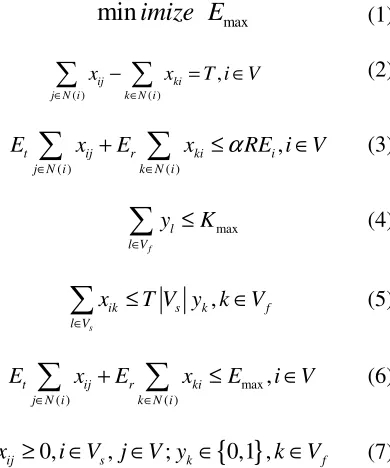
In order to minimize the maximum energy consumption of each sensor node and the total energy consumption in the next round, with linear constraints, the optimal location of Sink’s next hop can be calculated. The target function takes minimizing the maximum energy consumption of single sensor node as example, the target function is shown as Formula (1). Xij represents the number of information that node i passes to node j (j∈N(i)) in a round of data gathering, the Restrictive Constraint (2) is to balance each node information, the output information of node i is equal to the input information plus the information produced by node i. Er (resp. Et) represents the energy consumption of sensor node for receiving (sending) a data packet. Condition (3) constrains that the energy consumption of node i should be less than αREi(0 <α≤ 1). Condition (4) constrains that Sink has at
most Kmax viable positions. Constraint (5) ensures that the node i with Sink only can send information at the viable position. The restrictions on target function and Constraint (6) minimize the maximum energy consumption of each node in each round of data gathering.
max
min
imize E
(1)
( ) ( )
,
ij ki j N i k N i
x x T i V
∈ ∈
− = ∈
∑
∑
(2)( ) ( )
,
t ij r ki i
j N i k N i
E x E x αRE i V
∈ ∈
+ ≤ ∈
∑
∑
(3)
max f
l l V
y K
∈ ≤
∑
(4),
s
ik s k f
l V
x T V y k V
∈
≤ ∈
∑
(5)max
( ) ( )
,
t ij r ki
j N i k N i
E x E x E i V
∈ ∈
+ ≤ ∈
∑
∑
(6){
}
0, , ; 0,1 ,
ij s k f
x ≥ i∈V j∈V y ∈ k∈V (7)
In the process of data gathering, Mobile Sink can find as many cluster head nodes and the shortest traversal path; besides, it can also find the shortest route from common sensor node to mobile Sink path. After investigation, it is proved that mobile wireless sensor network data gathering is a NP-hard problem. Ant colony algorithm is an efficient intelligent optimization algorithm, which is characterized by fast speed and distributed computing, it is simple and easy to implement. In the NP-hard problem, the function combination optimization TSP path planning and other issues have achieved good effect. The paper proposes the energy-saving and reliable study on mobile wireless sensor network data gathering method based on ant colony algorithm, optimizes the movement path of mobile Sink, reduces energy consumption, improves network data gathering efficiency and network reliability, and prolongs the network lifetime.
4 ACO ALGORITHM FOR DATA GATHERING
application in workshop job scheduling, data mining, network routing, robot path planning and other fields. In this paper, the improved ant colony algorithm is applied to optimize the path of mobile Sink in mobile wireless sensor network, in order to enhance the efficiency of mobile wireless sensor network data gathering and network reliability, reduce energy consumption and prolong the network lifetime.
Assuming that m is ant colony size, τij(t) refers to the pheromone size at path (i , j ) at time t, ant k (k =1, 2,…, m) selects the hop destination by the amount of information on each path in the crawling process. Here tabuk (k =1, 2,…, m) is adopted to record all the nodes traversed by ant k, the set is adjusted according to the evolutionary process of tabuk. In the search process, ant calculates the state transition probability according to the information on each route and the heuristic information of route.
( ) k ij
p t
represents the transition probability of ant k from element i to element j at time t, it can be represented by Formula (8):
[ ( )] [ ( )]
, j
[ ( )] [ ( )]
( )
0,
k
ij ij
k k
ij ij
ij
s allowed
t t
if allowed
t t
p t
others
α β
α β
τ η
τ η
⊂
⋅
⊂
⋅
=
∑
(8)In the updating process of pheromone, the remaining energy of node is used as the factor for pheromone updating, as shown in Formula (9) and Formula (10):
1
( ) (1 ) ( ) ( )
m k
ij ij ij
k
t n t t
τ
ρ
τ
ρ
τ
=
+ = − ⋅ +
∑
(9)( )
, j ( , ) ( )
0,
k
ij k k
energy k Q
allowed i j
t L count
others
σ τ
+ ∈
=
∑
(10)
Wherein
∑
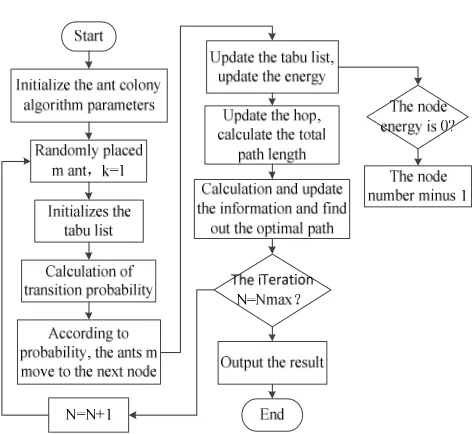
energy k( ) is the total remainingenergy of node which is passed by ant k, countk is the number of hops of the path. If the remaining energy of node is used as a pheromone updating factor, if the path node has large remaining energy, it will accumulate more pheromone on the edge of the path, the probability that ant selects the path will increases. This can effectively prevent nodes from dying due to excessive energy consumption, achieve the purpose of balancing energy consumption of the entire network, and extend the lifetime of the entire network. When selecting the optimal path, comprehensive consideration shall be given to the remaining energy of node and the path length. The
[image:3.612.321.557.124.341.2]mobile wireless sensor network data gathering based on ant colony algorithm is shown in Figure 2.
Figure 2. Data gathering based on ACO algorithm.
The specific procedures of improved wireless sensor network route algorithm based on ant colony are shown as follows:
Step1: Initialization of parameters. Assuming that the initial time t = 0, the initial energy of node is E(i), the number of cycles is Nmax, the number of surviving nodes is m. The initial information amount of (i, j) is τij(0)=const, (const is a constant), Δ τij(0)= 0.
Step2: m ants are placed randomly in n sensor nodes; supposing k = 1.
Step3: Initialization tabu list tabuk (k =1, 2,…, m), if the number of jumping countk = 0, the path length Lk = 0. The initial node of k-th ant is put in the taboo list.
Step4: Transition probability is calculated according to heuristic information probability formula (1), the probability of ant moves from node i to node j is calculated. Skip to Step5.
Step5: The roulette method is used to select the next node j. Update tabu list, path length, number of hop, node energy, number of survival nodes and other information. Calculation is made until the ant reaches Sink node.
Step6: Ant k completes a cycle. If k <m, then k=k+1, jump to Step3; if k=m, then Formula (2) is applied to update and adjust pheromone on each path, empty taboos, skip to Step7.
sensor nodes. Detect whether the number of iterations N is equal to Nmax, if equal, then jump to Step8, otherwise N=N+1, empty the taboo list, and jump to Step2.
Step8: End the cycle, output the calculation results.
5 PERFORMANCE ANALYSIS
5.1 Simulation Environment
We use MATLAB simulator for the performance analysis. In our simulation scenarios, 200 sensor nodes and mobile sink were deployed uniformly at random initially in a 500×500 m2 square area. The size of data packets and that of control packets are both 4000 bit, Sink node moving speed is 5m/s. For each experiment, the simulation time is 1000 seconds. In this paper, the proposed algorithm is compared with the data gathering method based on random walk and DDRP (Data-Driven routing Protocol) algorithm [9]. We study the performance of average energy consumption, network lifetime, network latency, network connectivity, network load balance, as well as reliability in this section.
5.2 Performance analysis
1) Average energy consumption
[image:4.612.337.546.147.303.2]Figure 3 shows that comparison of the average energy consumption of three algorithms. As can be seen from Figure 3, with the increase of the number of rounds of simulation, network average energy consumption of the three algorithms are increasing, but the random walk of mobile Sink the maximum power consumption, followed by the DDRP algorithm, the proposed algorithm in this paper of minimum energy consumption.
Figure 3. Average energy consumption.
2) Cluster head number
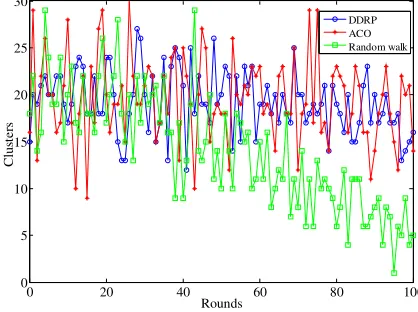
The number of nodes in the cluster is closely related to the energy consumption of the network, if the cluster head is too small, the coverage area of a cluster is too large, and the member nodes are too far from the cluster head. The data transmission will
consume too much energy. If the cluster head is too much, the energy consumed by the cluster head is much greater than the member nodes, which also increases the energy consumption of the network. Therefore, we should select the appropriate number of cluster heads, so that the minimum energy consumption per round of the network. The number of cluster heads produced by the three algorithms is shown in Figure 4.
Figure 4. The comparison of cluster head number.
As can be seen from Figure 4, the random walk of mobile Sink, the number of clusters is too small, and the number of DDRP algorithm and the proposed algorithm in this paper is reasonable.
3) Network load balance
[image:4.612.62.282.499.663.2]Figure 5 is the contrast of network load balance for the three algorithms, the greater of the load balance factor, the better of network load balance. It can be seen that, with the increase of the number of rounds of simulation, the load balance of random walk is poor, appeared behind random fluctuations, the stochastic volatility of network performance is very high, and the proposed algorithm is better than the DDRP algorithm.
Figure 5. Network load balance.
4) Transmission latency
Figure 6 is the contrast of network transmission latency for the three algorithms. At the beginning, the three algorithms start to build the network; the data transmission delay is very large, after the latency is relatively small. Due to the randomness of 0 10 20 30 40 50 60 70 80 90 100
200 210 220 230 240 250 260 270 280 290 300
Rounds
A
v
e
ra
g
e
e
n
e
rg
y
c
o
n
su
m
p
ti
o
n
(
m
J)
DDRP ACO Random walk
0 20 40 60 80 100
0 5 10 15 20 25 30
Rounds
C
lu
st
e
rs
DDRP ACO Random walk
0 10 20 30 40 50 60 70 80 90 100 0
200 400 600 800 1000 1200
Rounds
N
e
tw
o
rk
l
o
a
d
b
a
la
n
ce
[image:4.612.320.543.501.665.2]the random walk way, leading to a large data transmission delay. The algorithm proposed in this paper is the minimum time delay, the DDRP algorithm is the second, and the random movement is the worst.
Figure 6. Transmission latency.
5) Network connectivity
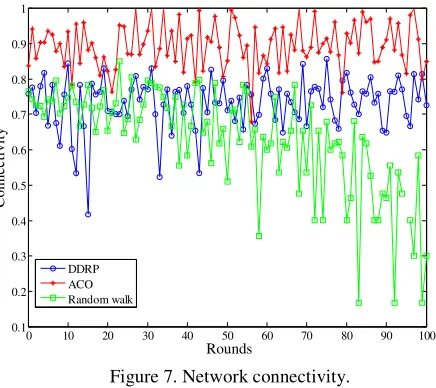
Network connectivity is an important index for evaluating the performance of mobile wireless sensor network. The network connectivity of the three algorithms is shown in Figure 7.
Figure 7. Network connectivity.
As can be seen in Figure 7, the random walk method of network connectivity is getting worse, the change range of connectivity for DDRP algorithm is larger, the proposed algorithm of network connectivity is relatively stable. Random walk, DDRP and the proposed algorithm in this paper of average network connectivity are 0.5, 0.8, and 0.9, respectively, the proposed algorithm in this paper is the best, and the network is the most reliable.
6 CONCLUSIONS
Data gathering is one of the most important research directions of mobile wireless sensor networks. In this paper, we optimized the Sink node movement path in the process of data gathering for mobile wireless sensor network, and proposed the research on mobile wireless sensor network data gathering method based on ant colony algorithm. The simulation results indicate that the ant colony algorithm is poorer than the optimal path length, number of hops compared with other algorithms; in terms of energy, ant colony algorithm cannot only reduce energy consumption, but also improve the effect of balancing the energy consumption, improve data gathering efficiency and network reliability, and extend the network lifetime. Sensor nodes are often used in harsh environment. In order to improve the reliability and validity of data gathering, the next step is to study the security and tolerance of data gathering based on swarm intelligence optimization algorithm.
7 ACKNOWLEDGMENT
This work was supported by International S&T Cooperation Program of China (2015DFA10490), the Natural Science Foundation of China (61240032) and the Specialized Research Fund for the Doctoral Program of Higher Education (No.20130092110060). This study was also supported by the Special Fund for Public Industry research and development of Ministry of Water Resources (201301014).
REFERENCES
[1] M. di Francesco, S. K. Das, G.Anastasi, “Data collection in wireless sensor networks with mobile elements: a survey,” ACM Transactions on Sensor Networks, vol. 8, no. 1, pp.1-31. article 7, 2011.
[2] K. Tian, B. Zhang, K. Huang, and J. Ma, “Data Gathering Protocols for Wireless Sensor Networks with Mobile Sinks,” accepted to present on IEEE GLOBECOM’10-Ad Hoc and Sensor Networks Symposium, Miami, FL, December 2010.
[3] Madhumathy, P.; Sivakumar, D., "Enabling energy efficient sensory data collection using multiple mobile sink," China Communications, vol.11, no.10, pp.29-37, Oct. 2014.
[4] Lei Shi; Baoxian Zhang; Kui Huang; Jian Ma, "An Efficient Data-Driven Routing Protocol for Wireless Sensor Networks with Mobile Sinks," Communications (ICC), 2011 IEEE International Conference on , vol., no., pp.1-5, 5-9 Jun. 2011.
[5] Kanzaki, A.; Nishio, S., "Communication Techniques for Mobile Sensor Networks," Advanced Information Networking and Applications Workshops (WAINA), 2014 28th International Conference on, vol., no., pp.221-226, 13-16 May 2014.
10 20 30 40 50 60 70 80 90 100 0
0.2 0.4 0.6 0.8 1 1.2 1.4 1.6 1.8
Rounds
L
a
te
n
c
y
(S
)
DDRP ACO Random walk
0 10 20 30 40 50 60 70 80 90 100
0.1 0.2 0.3 0.4 0.5 0.6 0.7 0.8 0.9 1
Rounds
C
o
n
n
e
c
ti
v
it
y
[image:5.612.61.279.378.572.2][6] Xinxin Liu; Han Zhao; Xin Yang; Xiaolin Li, "SinkTrail: A Proactive Data Reporting Protocol for Wireless Sensor Networks," IEEE Transactions on Computers, vol.62, no.1, pp.151-162, Jan. 2013.
[7] Shibo He; Jiming Chen; Yau, D.K.Y.; Youxian Sun, "Cross-Layer Optimization of Correlated Data Gathering in Wireless Sensor Networks," IEEE Transactions on Mobile Computing, vol.11, no.11, pp.1678-1691, Nov. 2012.
[8] Yi Xu; Wenye Wang, "Scheduling Partition for Order Optimal Capacity in Large-Scale Wireless Networks," IEEE Transactions on Mobile Computing, vol.12, no.4, pp.666-679, April 2013.