1970
OPEN AND CLOSED EYES CLASSIFICATION IN
DIFFERENT LIGHTING CONDITIONS USING NEW
CONVOLUTION NEURAL NETWORKS
ARCHITECTURE
NOOR D. Al-SHAKARCHY
1, ISRAA HADI ALI21Ph.D. postgraduate - College of Information Technology, University of Babylon, Iraq 2College of Information Technology, University of Babylon, Iraq
E-Mail: [email protected] E-Mail: [email protected]
ABSTRACT
A classification of eyes status (open and closed) is a most important step in various application, such as drivers fatigue detection, psychological states analysis. Monitoring a driver to detect inattention is one of the important application can be achieved base on the period that the eyes staying closed. Therefor the core of these systems is the perfect classification of the status of eyes open or closed. Traditional methods to classify open and closed eyes suffer from the luminance information. These systems performed inadequately if images of eyes obtained with various resolutions and elimination conditions. Most computer vision applications deal with images in different lighting conditions and resolutions as well as the real life applications must take into account the accuracy and time of execution. Deep Neural Network presented the efficient method to extract robust feature such as eye features, which determine the status of eyes closed or open. The proposed method for classification the eyes status which those open or closed in images of eyes with various elimination conditions based on new architecture of Deep Neural Networks (DNNs). The proposed Deep Neural Network Classification (DNNC) performed accuracy with reasonable training and simulation time. Performance speed is the most crucial point in real-time applications when the training and performance time of existing methods have long times. The primary goals of the proposed (DNNC) can be achieved the less time spend for execution as well as this system can be implemented in reasonable hardware capability. The proposed system can achieve accuracy with training set reach to 96%. The values of loss function reach to 0.01.
Keywords:Deep Neural Network (DNN), Convolution Layer, Maxpooling Layer, Relu Activation Function, Sigmoid Activation Function
1. INTRODUCTION
In the last years, the traffic accidents increased and most of these traffic accidents due to the driver inattention. Monitoring a driver to detect inattention is a complex problem that involves physiological and behavioral elements. A computer vision system for driver monitoring uses eye status by extracted eye features and tracked for decision making of the driver’s vigilance [1, 2]. [image:1.612.315.519.528.650.2]
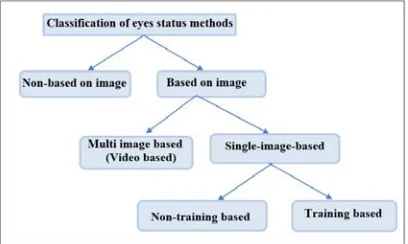
Monitoring a driver inattention can be considered as classification problem to detect the status of the driver’s eyes if they closed or open over the time. A classification of eyes status which those open or closed can be categorize to two category non- image- based and images-based methods [3] as shown in figure 1 below.
Figure 1: Eyes Status Classification Methods
1971 convolution layers as a feature extractor to construct the features maps of input image. That’s mean the convolution layer of CNN play the role of local filters over the input space and the filter kernel weights determined during the training process [4]. The convolutional layers eliminate the receptive fields of the hidden layers to be local that’s helps to extracted local features by convolutional layers. In the other hand, due to the CNN structures the requirements of memory as well as the computation complexity is reduced. But with applications that deal with local correlation inputs such as images and videos, the CNN can achieve better performance [3]. The contribution of this paper is develop a computer vision method able to detect the status of the eye image, which is open or closed, with the highest precision as possible. It is an important and basic step to serve as an automatic computer vision application system. The proposed model maximize the accuracy and minimize the loss functions as well as minimize the error predictions
The paper organization can be illustrate as follows. Section 2 presented methods for eyes status classification. Section 3 illustrate the main concepts and layers of Deep Convolution Neural Networks (DCNNs). Section 4 presented and discussed some significant related works to the proposed system. Section 5 and 6 describes the proposed system architecture and steps and the experimental results which compared the proposed one with different approaches. Section 7 presented the ways to improve the Performance of proposed system. Finally, Section 8 presented the conclusion of this work.
2. CLASSIFICATION OF EYES STATUS
METHODS
2.1 Non-based on image methods[4,6]:
These methods based on using sensors on the
muscles around the eyes to measure then analyze the electrical signals from them. Although these methods have advantages on fast collection of data, in contrast it is more disturbing; where the sensors used must be attached the muscles around the eyes. Also the measures can be distortion by noise when the user is movement, which causes low accuracy in addition to the high expensive of sensors.
2.2 Based on image methods:
Image-based methods based on obtaining information from captured images. These methods can be divid into three types:
2.2.1 Video-based methods [5]:
Several images can be used by these methods to extract features and thus provide high accuracy. In the other side, it required extensive time and computations because using multiple images to extract necessary properties.
2.2.2 Algorithms based on Single image (without-training process):
These algorithms used single image to extract features without implemented a training process. Many operations can be do on image such as convert image in binary mode and used topology operations, operation of edge, analysis of texture. These methods presented good performance to distinguish eyes status is open or closed but that performance influenced by varies in lighting condition of the image-acquisition. Some examples of these methods are detection of iris based on compute a variance of the maximum iris locations [7]. Methods based on matching the template [8], and Methods based on a fuzzy-system that using eye segmentation [9].
2.2.3 Algorithms based on Single image (with training process):
These methods considered more robust to extract
features and classify open and closed images when the images is complex or low resolution [10,13, 24]. This paper employed one of these methods (Deep Neural Networks DNNs) in eyes status classification problem.
3. DEEP CONVOLUTION NEURAL
NETWORKS (DCNNS)
1972 Convolution layers employed as feature extractor to construct the features maps of input image. That’s mean the convolution layer of CNN play the role of local filters applied on the input space and the filter kernel coefficient determined during the training process [3].
A non-linear “trigger” function used in general neural networks as well as CNN’s; to distinguish special signal of useful features on each hidden layer. Many functions can be implement with CNN as activation function or non-linear layers likely ‘Rectified Linear Units (ReLUs) and continuous trigger (non-linear) functions’ [15]. The proposed system used Rectified Linear Units (ReLUs) function to implemented a non-linear triggering [15]
The pooling/subsampling layer responsible for making the features robust against noise and blurring by reduces the resolution of the features. The outputs of neuron; which are clusters at one layer combined in some manner into a single neuron in the next layer; concluded the reduction in features resolution [16].
Many models of CNN can be use, which various in layers numbers and types and the method used to initialize a training parameters. Most common CNN models that can be used for classification purpose although these model have good accuracy but these models have a lot of time and computational requirement. These models are AlexNet [17]; which considered less deep and accuracy than other models. VGG-16 [18] is the other model, which used filter in convolution layers of size 3 x 3 pixels and the architecture of VGG-16 has more layers than AlexNet.
In this paper, a proposed architecture and model for classifying eyes status which is open or closed can be present by using some convolutions operation, sub-sampling and Dense layers. Reasonable accuracy and loss functions can be provide by a proposed system in addition to a more crucial parameter with real time (life) application represented by reduced the time of training.
3.1 Rectified Linear Units (ReLU)
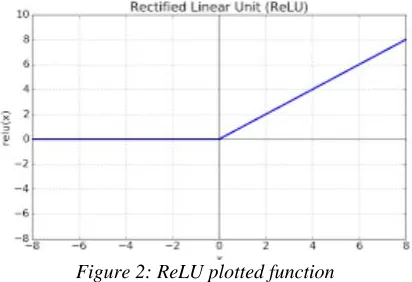
It is a non-linear “trigger” function used from a general neural networks as well as CNNs as an activation function composed the non –linear layer concatenated to the convolution layer. The rectifier can be defin as the positive part of its argument [3, 15]:
[image:3.612.315.521.259.400.2]A ReLU implements with same size of input and output in that layer. While the ReLU used the positive part of its argument, the nonlinear properties of the decision function are increases. The convolution layer receptive fields cannot be effect. In in addition to that it can provide many times faster in the training process of the network. ReLU function widely used with computer vision and speech recognition application based on using deep neural networks. A ReLU plotted function can be illustrated in Figure 2 [16].
Figure 2: ReLU plotted function
4. RELATED WORKS
As illustrated in the previous subject many methods can be used to classify the status of the eyes which is closed or open. This eyes classification can be considered the main important step in many application such as real life application.
Non-based on image methods include Electro-OscilloGraphy (EOG) [4], ElectroMyoGraphy (EMG) [19] and ElectroEncephaloGrams (EEG) [20]. Although these methods achieve reasonable results with the least number of false positives, they suffer from several limitations such as these methods based on wearing the sensing devices which causes discomfort. Also, physiological signals are generally very weak and can easily be contaminated by artifacts that are caused by muscle movements of different body parts and finally they need intricate and expensive hardware systems to sense, amplify and preprocess the signal for analysis.
1973 occlusion and clutter but they required complicated mathematical operations and heavy computations. As well as these methods very sensitive to the illumination conditions so that they have poor performance with lighting changes and blur. More robust methods are base on training steps to extract features useful in the classification process. These methods include ‘Support Vector Machine (SVM) [10], Active Appearance Models (AAM) [11], a method using Principal Component Analysis (PCA) subspace analysis [12] and methods using neural networks [13]’.
These methods can achieve more accuracy for eyes status classification than non-training-based methods. But the optimal feature extraction method is difficult to determine. Additionally, these algorithms can be training either on daily training images or night training images (IR images) not both. And in the real life application such as detecting drivers drowsiness the images can be captured in too day and night scenario; therefore its important improve the algorithms to deal with both scenario in the same algorithm.
One of the most deep neural network that can be widely use for images classification and recognition is Convolution Neural Networks (CNNs). In CNN, the optimal feature extracted automatically from training data during the training process and then classify the image based on these optimal features. Traditional methods other than CNN, manually determined the optimal filters by using techniques based on conventional supervised learning intensive experiments.
Many models of CNN can be use in image classification such as Alex Net [17], VGG-16 [18] and others. These modes can be use for classifying eyes images status (open or closed) based on a deep CNN and transfer learning, and the performance of them is reasonable in term of accuracy and loss functions, but these modes have very large training time due to the large deep of the network and size of the original images. In the other hand eyes images have fewer features than all facial expression in face images. Therefore proposed new Deep Neural Network architecture based on CNN which is more suitable for eyes images status classification that provides reasonable accuracy and loss as well as achieves less training and execution time than other existing CNN modes.
In this paper a the proposed system based on deep learning employs the Convolution Neural Network CNN as most promising approach to deal with lighting condition (difference in elimination), distortion and noise in addition to detect and classify the status of the eyes which it open or closed. The
CNN filters and optimal feature extracted without any post-processing from training dataset. The Closed Eyes in the Wild (CEW) dataset used for proposed system and provided large number of images with different image conditions and subjects.
5. PROPOSED SYSTEM
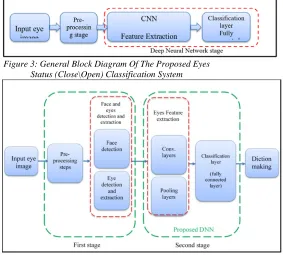
[image:4.612.311.594.246.501.2]Proposed eyes status (close\open) classification system block diagram can be describ as shown in figure 3. The details stages of the proposed system described in the figure 4. Then the proposed Deep Neural Network based on CNN architecture shown in figure 5 below.
Figure 3: General Block Diagram Of The Proposed Eyes Status (Close\Open) Classification System
[image:4.612.313.597.543.674.2]Figure 4: Stages Details Block Diagram Of Proposed Eyes Status (Close\Open) Classification System
Figure 5: The Architecture Of Proposed Deep Neural Network
1974 face and eyes detection and extraction and the second stage is the eyes feature extraction and eye status classification model.
The first stage (the face and eyes detection and extraction), this stage can be done based on employing ‘Multi-Task Cascaded Convolutional Networks (MTCNN)’, which is the fastest and accurate detector for face and facial parts. Two main landmark points of face which are locations of left-eye and right-left-eye can be obtaine and saved as a result of this step based on face boundary coordinates detection. The proposed system can take in account the face shifting and partial occlusion to determine the face in addition to the different lighting conditions.
The second stage (Eye Closed\ Open Detection Network (ECODN))
This stage mention the proposed model for discover and classify the status of the eyes which are closed or open. The output of the first stage (face and eyes detection, alignment and extraction) used as input to the ECODN takes (second step).
This stage can also consist of two steps based on the proposed architecture of deep neural network; feature extraction step and classification step:
First step (feature extraction) consist of three steps each sub- step represented by two convolution layer – nonlinear layer followed by one pooling layer. Convolution layers employed as feature extractor to construct the features maps of input image. That’s mean the convolution layer of CNN is Synonyms to local filters applied on the input space and the filter kernel coefficient determined during the training process. A set of primitive patterns; represented low-level features in the input images such as edges and lines; can be extracted by the first convolution layer. The second convolution layer detects patterns of patterns by combining these primary features such as corners. The third convolution layer extract higher-level features based on detecting patterns of those patterns by combining these secondary features obtained from previous layer, and so on.
A non-linear “trigger” function used in a general neural networks as well as CNNs to distinguish signal distinct of useful features on each hidden layer. Many functions can be implement with CNN as activation function or non-linear layers likely “Rectified Linear Units (ReLUs) and continuous trigger (non-linear) functions”. The proposed system used Rectified Linear Units (ReLUs) function to implemented a non-linear triggering
The pooling/subsampling layer responsible for making the features robust against noise and blurring by reduces the resolution of the features. The outputs
of neuron clusters at one layer combined in some manner into a single neuron in the next layer which concluded the reduction in features resolution. The proposed model used max pooling function which inters a cluster of neurons at the prior layer and used the maximum value as output. These clusters of neurons produced by divided the input images into non-overlapping two-dimensional spaces, and each space considered as cluster and maximum value is selected.
Second step (classification)
The classification step of proposed model represent by two fully connected layer (dense layer) followed by one output layer (decision making) layer.
Fully connected layers is a traditional neural networks that’s all neuron in one layer connect to all neuron in next layer. A specific target output result can be represented mathematically as a weighting sum of the previous layer of features. The input of each fully connected layer is vector of values that can be determined by the multiplication of the high and width form output of last max pooling layer with the neurons depth ( the number of filters used in last convolution layer). The activation function that use by a FC layers of proposed system can be determine as ReLUs.
Output (decision making) layer is the final layer in the proposed system. The goal of the proposed model is to classify the images to open eye and closed eye therefore there are one neuron in the output layer according to the binary category with sigmoid activation function.
6. RESULTS
The experimental conditions of proposed system are including the dataset, accuracy, loss functions and execution speed. The effectiveness of the proposed algorithms compares with experimental results on AlexNet and VGG-16, which are the well-known existing models for object recognition and classification, on dataset.
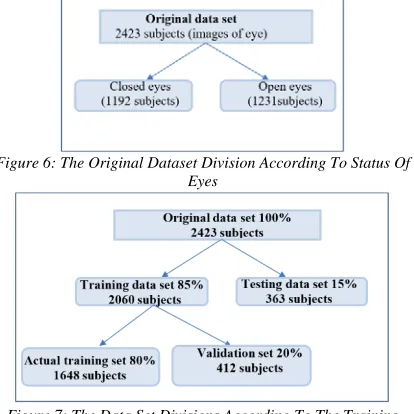
1975 eye position. The original dataset divided to two sub-datasets; training dataset and testing dataset. The training set represented 85% of the original dataset and also divided into actual training dataset, represented 80% of training dataset, and validation dataset represented 20% of the training dataset. The second portion of the original dataset is testing dataset which represents 15% of the complete dataset and used for testing the system on unseen images. Each sub-datasets must contain both open and closed eye images with different elimination condition and different eyes forms. The original dataset division according to status of eyes can be sketched as in figure 6. The division of dataset can be illustrates in figure 7.
Figure 6: The Original Dataset Division According To Status Of Eyes
Figure 7: The Data Set Divisions According To The Training And Testing Process
The proposed system of eyes images status classification implemented in the following steps
The training step
In this step the proposed model of DCNN learned on the actual training dataset which contain images of both closed and open eyes. The proposed DCNN adjusting the weights of each layers during the training process.
Validate the Network
After the network reached to convergence during the training with minimum error rate, it must checked the validate work by simulation of this net with validation data as input to trained network. The network used the saved weights and calculate the output class of each input image as matrix (X), if the output matrix( X ) same as the natural matrix of the actual label of the input images then the network is validation. In this case the proposed system become ready to use for eye status classification.
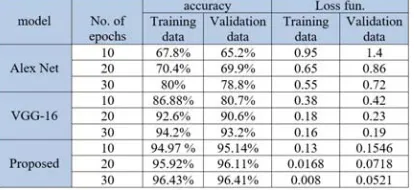
[image:6.612.315.578.214.700.2]The performances of the training and evaluation steps checks with two key point (metrics), accuracy and loss functions. The proposed system summary can be illustrate in the table 1 below. A quick way to understanding the behavior for learning of the proposed model on specific dataset is to evaluate it on the training and a validation dataset each epoch, and plot the results as can be shown in the figures 7.
Table 1: The Summary Of Proposed System Models In Each Layer
[image:6.612.93.300.269.476.2]1976
The testing (emulation \simulation) step
This step emulate (simulate) the proposed system for prediction by used the trained proposed DCNN to predict the status of eyes which is open or closed in unseen testing dataset.
The system with proposed deep neural network architecture applied on specific data set and compare the results with some existing deep neural network architecture which are Alex Net and VGG-16 by pre-trained them on the same data set based on transferring training. These experimental results determined with accuracy and loss function are show in Table 2. Experiments were performed and compared with the existing types of CNN models which are ‘Alex Net and VGG-16’.
[image:7.612.315.527.120.385.2] [image:7.612.315.526.127.387.2]The testing accuracies of the proposed system with new CNN architecture for classifying open and closed eye images compared with other methods of the conventional CNN models of AlexNet [16], GoogLeNet [38], VGG-16[36] and Residual [3]. The same databases were used for the proposed system and the other methods and the average accuracies were measured using two-fold cross validation. These comparison made with two type of errors, first type when the closed eye images classified incorrectly as open eye, and second type of errors when open eye images classified incorrectly as closed eye. The Comparative testing errors for proposed system and other methods illustrates in table 3 below.
Table 2: The Experimental Results Comparison Of Proposed System With Two Other Pre-Trained CNN
Table 3: The Comparative testing errors for proposed system and other methods
7-IMPROVE THE PROPOSED SYSTEM
PERFORMANCE
The performance of proposed system can be improved based on two sub-topics:
7.1 Improve Performance With Data.
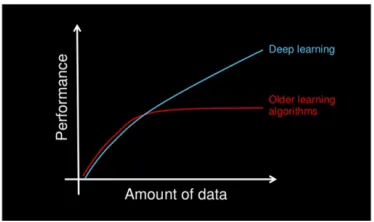
Changes to the training data and problem definition can get big wins. The quality, size and comprehensive of training data set indicate an distinct topic in the performance of deep learning and other modern nonlinear machine learning techniques. Therefore the performance quality of proposed model is get better with more training data. These proportional related between the performance of the system and amount of data can be describe in figure 8. The proposed system improved the performance with data by:
- Get more data by adding more data (images of eyes with different condition and poses) to the original training dataset.
[image:7.612.93.300.485.580.2]1977 shifting and rotating existing images such that this process presented the generalization of the model. Adding noise represent a regularization method to eliminate the overfitting in the training dataset.
Figure 8: The Performance Of DCNN System With Amount Of Data
7.2 Improve Performance with Algorithm diagnostic:
The algorithm of proposed system can be tuning based on examine the testing and validation figure for primary training as well as diagnostic the observations the output of network which it right or wrong “false negative and false positive”. Various techniques can take in account to improve performance based on the plotting observation: - The probability that the network suffer from
overfitting, if training set is much better than the validation set. Then regularization techniques can be used to skip the probability of overfitting. - The probability that the network suffer from
under fitting, if training set and validation set are both low. Training more can be done based on increase the proposed network capacity. The improved of propose system accuracy and loss functions can be show in figure 9.
Figure 9: Improved Accuracy And Loss Functions Of Proposed Model After Improvement
8. CONCLUSIONS
The main goal of the proposed Deep Neural Network is establishing the approximate mapping to some desired accuracy. System classification using
neural networks can be considered a problem of finding some weights matrices that represent the transfer function of the unknown system. Then the final weights matrices represent the transfer function describing the system internally. Eyes status detection based deep neural network model is designed and implemented with highly optimized used for the embedded system. The raw images are utilize as inputs to the proposed system then decision making can be implemented on the real-time embedded system. The proposed system achieved reasonable accuracy and loss values. The time spent on training and implementation of the proposed system is much less than another existing system which has more time. The proposed system provides a good convergence equal to 10-5 as shown in figure (5) and figure (7). The error propagation in Black-Box system is very less such that the traditional methods depend on the dependence between the values from each step on the previous step. These dependence increase the probability of error happened in any step to other steps when the Black-Box system provides independent steps.
The experimental results under various circumstances showed that eyes images play the major roles in classification. The proposed system provided robust against lighting conditions varies. The proposed network architectures are more sensitive and robust than others to batch size.
The proposed convolutional neural network architecture are becoming more important as shown in table 2 because:
- The structures of proposed CNNs lead to reduction in the memory requirements as well as the computation complexity requirements by using same coefficients across all space and reduced the numbers of layers as well as the size of input images.
- Achieve better performance for applications that deal with local correlation in inputs such as images as shown in this works in table 2. - Provide robust against shifting and distortion
images which always cases in real time (life) application such as different lighting conditions, partial occlusions, different poses, etc.
[image:8.612.90.313.551.644.2]1978
REFERENCES:
[1] Eyosiyas T., “Drowsiness Detection for Driver Assistance”, thesis for the degree of MASTER OF SCIENCE, December, 2013 [2] Vandna Saini and Rekha Saini, “ Driver
Drowsiness Detection System and Techniques: A Review”, (IJCSIT) International Journal of Computer Science and Information Technologies, Vol. 5 (3), 2014, 4245-4249
[3] Ki Wan Kim at al., “ A Study of Deep CNN-Based Classification of Open and Closed Eyes Using a Visible Light Camera Sensor”, MDPE, Sensors 2017, 17, 1534; doi:10.3390/s17071534
[4] Hsieh, et al., “An improved and portable eye-blink duration detection system to warn of driver fatigue”. Instrum. Sci. Technol. 2013, 41, 429–444. [CrossRef]
[5] Yin Fan, Xiangju Lu, Dian Li, Yuanliu Liu, “Video-Based Emotion Recognition using CNN-RNN and C3D Hybrid Networks “, ICMI '16 Conference Paper ꞏ November 2016, Tokyo, Japan
[6] Bulling, A.; Ward, J.A.; Gellersen, H.; Tröster, G., “Eye movement analysis for
activity recognition using
electrooculography”. IEEE Trans. Pattern Anal. Mach. Intell. 2011, 33, 741–753. [CrossRef] [PubMed]
[7] Colombo, C.; Comanducci, D.; Bimbo, A.D., “Robust tracking and remapping of eye appearance with passive computer vision”, ACM Trans. Multimed. Comput. Commun. Appl. 2007, 3, 20:1–20:20. [CrossRef]
[8] Królak, A.; Strumiłło, P., “Eye-blink detection system for human– computer interaction. Univ. Access. Inf. Soc. 2012, 11, 409–419.
[9] Kim, K.W.; Lee, W.O.; Kim, Y.G.; Hong, H.G.; Lee, E.C.; Park, K.R., “Segmentation method of eye region based on fuzzy logic system for classifying open and closed eyes. Opt. Eng. 2015, 54, 033103. [CrossRef]
[10] Jo, J.; Lee, S.J.; Jung, H.G.; Park, K.R.; Kim, J., “Vision-based method for detecting driver drowsiness and distraction in driver monitoring system”. Opt. Eng. 2011, 50, 127202. [CrossRef]
[11] Trutoiu, L.C.; Carter, E.J.; Matthews, I.; Hodgins, J.K., “Modeling and animating
eye blinks”. ACM Trans. Appl. Percept. 2011, 8, 17:1–17:17. [CrossRef]
[12] Wu, J.; Trivedi, M.M., “An eye localization, tracking and blink pattern recognition system: Algorithm and evaluation”. ACM Trans. Multimed. Comput. Commun. Appl. 2010, 6, 8:1–8:23. [CrossRef]
[13] Lenskiy, A.A.; Lee, J.-S., “Driver’s eye blinking detection using novel color and texture segmentation algorithms”, Int. J. Control Autom. Syst. 2012, 10, 317–327. [CrossRef]
[14] A. S. Razavian, H. Azizpour, J. Sullivan, and S. Carlsson, “CNN features off-the-shelf: an astounding baseline for recognition,” CoRR, vol. abs/1403.6382, 2014.
[15] Keiron O’Shea1 and Ryan Nash2, “ An Introduction to Convolutional Neural Networks”, arXiv:1511.08458v2 [cs.NE] 2 Dec 2015
[16] A. Krizhevsky, I. Sutskever, and G. E. Hinton, “Imagenet classification with deep convolutional neural networks,” in Advances in Neural Information Processing Systems 25, F. Pereira, C. Burges, L. Bottou, and K. Weinberger, Eds. Curran Associates, Inc., 2012, pp. 1097– 1105.
[17] Krizhevsky, A.; Sutskever, I.; Hinton, G.E., “Imagenet classification with deep convolutional neural networks”, In Advances in Neural Information Processing Systems 25; Curran Associates, Inc.: New York, NY, USA, 2012; pp. 1097–1105.
[18] Simonyan, K.; Zisserman, A., “ Very deep convolutional networks for large-scale image recognition”, In Proceedings of the 3rd International Conference on Learning Representations, San Diego, CA, USA, 7– 9 May 2015; pp. 1–14.
[19] Champaty, B.; Pal, K.; Dash, A., “ Functional electrical stimulation using voluntary eyeblink for foot drop correction”, In Proceedings of the International Conference on Microelectronics, Communication and Renewable Energy, Kerala, India, 4–6 June 2013; pp. 1–4.
1979 [21] Lalonde et al., “Real-time eye blink
detection with GPU-based SIFT tracking”. In Proceedings of the Fourth Canadian Conference on Computer and Robot Vision, Montreal, QC, Canada, 28–30 May 2007; pp. 481–487.
[22] Mohanakrishnan et al., “novel blink detection system for user monitoring”. In Proceedings of the 1st IEEE Workshop on User-Centered Computer Vision, Tampa, FL, USA, 15–17 January 2013; pp. 37–42. [23] Lee et al., “Blink detection robust to
various facial poses”. J. Neurosci. Methods 2010, 193, 356–372. [CrossRef] [PubMed] [24] Nabeel Hashem Kaghed, Tawfiq A. Abbas, Samaher Hussein Ali, “ Design and Implementation of Classification System for Satellite Images based on Soft Computing Techniques”, IEEE Xplore, 2nd International Conference on Information & Communication Technologies, 2006.
[25] Eman Shamery and Ameer Haq Al-Shamery, “A New Deep Neural Network Regression Predictor Based Stock Market”, Journal of Engineering and Applied Sciences 13 (Special Issue 5): 4794-4801, 2018.
[26] Szegedy et al., “Going deeper with convolutions”. In Proceedings of the IEEE Conference on Computer Vision and Pattern Reconition, Boston, MA, USA, 7– 12 June 2015; pp. 1–9.