ISSN: 1992-8645 www.jatit.org E-ISSN: 1817-3195
FORMULATION AND SOLUTION TO CONTROL
PROBLEMS OF OPERATION MODES IN DELAYED COKING
UNIT IN FUZZY ENVIRONMENT BASED ON THE
HEURISTIC METHOD
B.B. ORAZBAYEV1, G.B. IMANGAZIEVA1, K.N. ORAZBAYEVA2 1L.N. Gumilyov Eurasian National University, Astana, Kazakhstan
2Kazakh University of Economy, Finance and International Trade, Astana, Kazakhstan
Email: [email protected]
ABSTRACT
This paper presents a formulation to the optimal control problems of operation modes for technological systems in the fuzzy environment and proposes a heuristic approach for solutions to the introduced problems. For the purposes of formalization and mathematical problem formulation, we employ methods of fuzzy set theory and various compromise schemes, methods of multi-criteria selection and optimality principles. By modifying and adapting the methods of main criteria, maximin and the principle of Pareto optimality, new formulations to the optimal control problems are obtained and effective heuristic methods for their solutions are developed. The uniqueness and novelty of the proposed approach to solving the control problems of operation modes in the fuzzy environment provides more efficient solutions without prior conversions of a fuzzy problem into an equivalent deterministic problem, i.e. maximizes the use of initial fuzzy information. This is justified by the fact that, in contrast to well-known approaches, problems are set in a fuzzy environment without replacing them with equivalent deterministic tasks, and they are solved using the original fuzzy information. The authors' research contribution refers to the fact that for the first time mathematical formulations of optimization problems are formulated during the control of operation modes for a delayed coking unit (DCU), and heuristic methods for the problems are developed based on various optimality principles (main criterion, maximin and Pareto optimality). Moreover, the developed method based on maximin and Pareto optimality are employed in solving the problem of controlling the operation modes for delayed coking unit of the Atyrau Oil Refinery (AOR).
We present and analyze the results of applying the proposed heuristic method-based maxi-min method and Pareto optimality principle, considering possible concessions during solving the problem of decision-making on the optimal control of operating modes for the delayed coking unit in Atyrau Oil Refinery, which works in the fuzzy environment. The obtained results of applying heuristic methods show the effectiveness of the proposed method for solving the control problem of operation modes for DCU in the fuzzy environment. In comparison with the results of known methods, the proposed method gives the best results, as well as calculates the membership functions of fuzzy constraints, i.e. allows controlling the extent to which the fuzzy constraints are met. For verifying the claims and the adequacy of the obtained decisions, we apply scientifically-based methods of multi-criteria optimization, decision-making methods, theories of fuzzy sets, the software package "Delayed coking unit" developed by participation of the author, modern computers with Pentium V processors, as well as real, i.e. experimental production data from the existing delayed coking unit.
Keywords: Pareto, Operation Model, Fuzzy Environment, Heuristic Method, Control Problem, Decision Maker
1. INTRODUCTION
The use of heuristic methods involving a human interaction, i.e. knowledge and experience of the decision maker (DM), specialists-experts, is considered as the most effective approach to the operation mode control of technological systems, characterized by multi-criteria and fuzziness of
initial information. Such methods are implemented based on the expert assessments method [1-3] and the fuzzy set theory (FST) [4-10].
multi-criteria decision-making problems, which are solved based on knowledge of specialists-experts and mathematical models of an object, designed taking into account the fuzziness of initial information [5, 7, 10, 11]. During the mathematical formulation and solution of multi-criteria decision-making problems, often problems arise, which are associated with the presence of contradictory and fuzzily described criteria, assessing the quality of control object, and the fuzziness of imposed constraints. For such objects, during the development of mathematical models and the selection of optimal modes, the primary source of information is fuzzy information in a form of knowledge, experience and intuition of decision-makers (DM) and specialists-experts. Therefore, at the moment, an actual task is to develop new heuristic methods for solving operation mode control problems of technological systems, which are based on the use of fuzzy information in the form of human judgment on the operation of the control object and taking into account the preferences of a decision maker in the process of selection of optimal solutions [6, 7, 10, 12].
It becomes necessary to conduct this study, since in real conditions many production facilities work in the fuzzy environment, including our object of study - a delayed coking unit, their functioning is described by specialists-experts on the basis of their knowledge, experience and intuition in the form of fuzzy information. The results of this study enable to formalize and effectively solve the problems of controlling the operating modes for fuzzy objects in the fuzzy environment based on expert assessment methods, theories of fuzzy sets and using the capabilities of modern computer technology.
The aim of the paper is to formulate a control problem of DCU operation modes, which are characterized by fuzziness, to develop an efficient method of solutions based on the heuristic approach, and to find the application of research results in practice.
2. PROBLEM FORMULATION
Firstly, let us present the formalization to a general control problem of operation modes for complex technological systems, which include delayed coking unit (USI), functioning in the fuzzy environment. Define
f
(
x
)
(
f
1(
x
),...,
f
m(
x
))
as a vector of criteria, that evaluate the effectiveness of operation modes of the control object. These criteria for the technological systems, as a rule, are indicators of economic efficiency and environmental safety of production. In this work,Atyrau Oil Refinery is considered as a control object. Each of local criteria:
f
i(
x
),
i
1
,
m
is dependent on a vector of n variables:1
( ,..., )
nx
x
x
,which are the mode parameters (temperature, pressure, etc.). By changing these parameters, the optimum modes of operation are determined, i.e. object control is realized. Dependencies between mode parameters (1
( ,..., )
nx
x
x
) and criteria (f
i(
x
),
i
1
,
m
) are described as a system of mathematical models of the object [13]. In practice, there is always a variety of constraints, which are usually described by functions called constraint functions:L
q
b
x
qq
(
)
,
1
,
. These constraints alsodepend on mode parameters. Mode parameters
1
( ,..., )
nx
x
x
, in general, have their change intervals, i.e. constraints, defined by technologicalregulations of the object:
min max min max
[
,...,
],
,
i j j j j
x
x
x
x
x
- lowerand upper limits of change in the mode parameter j
x
. These constraints, or part of them may be fuzzy, whose description is implemented with notations
, ,
(sign represents the fuzziness).It is required to determine an optimum operation mode of the object, i.e. such values of
parameters
(
*,...,
*)
1 *
n
x
x
x
that provideextremum values of local criteria
f
1(
x
),...,
f
m(
x
)
when the predefined constraints in the fuzzy environment are satisfied, as well as the preferences of decision-makers in assessing and selecting the modes are considered.In the available literature, the known formulations of decision-making problems in the fuzzy environment and the methods of solving them mostly examine single-criterion cases and there is no flexibility in the decision-maker preferences, as a result, the final decision is drawn, i.e. operation modes of the control object [14-18]. Moreover, fuzzy problems, as a rule, arereplaced by an equivalent deterministic problem at the stage of the formulation using level sets. This leads to the loss of a substantial portion of the initial fuzzy information.
ISSN: 1992-8645 www.jatit.org E-ISSN: 1817-3195
the conversion of the fuzzy description into the quantitative one is not always possible or is impractical. Consequently, the most promising approach to solving such problems in the fuzzy environment, adapted to the human interactions and the human selection procedures of decision-making is to develop methods in which the problems are posed and solved in the fuzzy environment without converting them to the equivalent deterministic tasks. This approach ensures the maximum use of the collected initial fuzzy information (experience, knowledge, preferences of decision-maker). For this purpose, in this paper for formulating and solving the problem of the control modes selection for the control object, new combined optimality principles, modified to work in the fuzzy environment, are studied and proposed.
To maximize the use of initial fuzzy information and its application based on methods of the fuzzy set theory, let us reformulate the original problem. Define
0(
x
)
(
01(
x
),...,
0m(
x
))
asa normalized vector of criteria
f x i
i( ),
1,
m
, evaluating the effectiveness of DCU operation modes. Assume that for each of fuzzy constraintsL
q
b
x
qq
,
1
,
~
)
(
, we determine themembership function of its fulfillment
L
q
x
q
(
),
1
,
. Moreover, we consider that anumber of priorities for the local criteria
{1,..., }
k
I
m
and constraintsI
r
{1,..., }
L
is identified or a weight vector, reflecting the mutual importance of the criteria
(
1,...,
m)
and constraints
(
1,...,
L)
, is known.In this case, by modifying various ideas of
optimality principle (compromise schemes) for their functioning in the fuzzy environment, we can derive different formulations of multi-criteria selection problems for optimal mode parameters of control objects and develop heuristic methods of their solutions, providing flexibility during consideration of DM preferences [7, 13, 19].
On the basis of the fuzzy problem formalized above, let us present the formulation of optimization and operation modes control problems for the control object. Using the ideas of the methods of main criterion (MC), the maximin
(MM), and modifying them to work in the fuzzy environment, the problem of DCU operation mode control can be written in a form of the following problem of fuzzy
mathematical programming:
),
(
max
10
x
X
x
(1)
x
i
m
q
L
x
x
x
X
q qL q x i
R
i
(
)
)
arg
max
min
(
(
))
,
2
,
,
1
,
arg(
:
0
(2)Here and below, sign
denotes logical operator "and", demanding all related statements to be true,
Ri - boundary values (defined by DM and experts) for localcriteria
0i(
x
),
i
2
,
m
, which are included in the constraints. Domain of xvariables (mode parameters) and fulfilment offuzzy constraints are determined by the maximin method.
In solving the problem (1) - (2) by changing i
R
and weight coefficients of constraintsL
1,...,
, we obtain a family of solutions to the problemx
(
R,
)
, from which a DM selects the best solution.At the next stage, based on a combination of principles of absolute (relative) concession and Pareto optimality [19] under the fuzzy conditions, we obtain the following formulation of control problem for DCU operation modes:
im
i i m
i i i X
x
x
x
x
x
x
1 0 0
1 0 0
0
(
),
where
(
)
(
)
(
or
(
)
(
)
max
(3)
x
q
L
x
x
X
qL
q
L
q q q
q
x
(
)
1
0
,
1
,
max
arg
:
1 1
(4))
,...,
(
1
L
- weight vectors that reflect the mutual importance of the criteria(
)
and constraints(
)
.Combining modified methods of maximin (MM)
and Pareto optimality (ON) with taking into account concessions defined by DM, we can write the formulation of control problem for DCU operation modes with fuzzy constraints in the following form:
),
(
max
1 0x
Xx
(5)}
,
1
},
,...
2
{
,
0
1
)
)
(
(
max
)
(
arg
)
(
min
max
arg
:
{
0 1 1 0 0L
q
m
I
x
x
x
X
q L q q L q q q q x q i R i I i x
(6)In the formulation of control problem for operation modes (5) - (6), for each of constraints maximum extent of its fulfillment is determined, considering the importance of the given constraint, we define concessions
q,
q
1
,
L
(allowed tolerances for deviations from maximum values of constraints fulfillment) and the problem is solved on the obtained set of allowed values.3. SOLUTION METHODS
For an effective solution of the described formulation of control problems for DCU operation modes in fuzzy environment, we propose the following heuristic methods, which are based on preferences (experience, knowledge) of decision-makers in the process of decision-making on control.
In order to effectively address the problem (1) - (2) in the fuzzy environment by modifying the methods of main criterion and maximin, we use a heuristic solution method that works by involving decision-makers (his preferences, experience, knowledge) in the process of solving the problem. In this method, DM selects (determines) the principal criterion that is optimized during decision-making on mode control, whereas other criteria are entered into the system of constraints. For them (other criteria), boundary values are defined using DM. Let us describe the developed heuristic method, which consists of the following main steps:
Method MC+MM
1. Set
p
q,
q
1
,
L
- the number of steps for eachq coordinate and a number of priorities for the local criteria Ik={1,…,m} (the main criterion should have
priority 1);
2. DM introduces the values for the weight vector of
(
1,...,
L)
constrains, taking into account the importance of each constraint.3. DM declares boundary values for
m
i
i
R
,
2
,
local criteria, listed in theconstraints.
4. Calculate
q
L
p
h
q
q
,
1
,
1
, i.e. the values ofsteps for changing coordinates of the weight vector.
5. Construct a set of weight vectors N
1,
2,...,
.(
1
)(
1
)...(
1
)
2
1
p
p
p
LN
, with varying the coordinates in the interval [0,1] with a step of hq.
6. Define term-sets Т(Х,У), which describe the qualitative (fuzzy) parameters of the control object. 7. With the involvement of decision-makers, experts, build the membership function of fuzzy constraints fulfillment
q(
x
),
q
1
,
L
.8. Maximize main criterion (1) on the set X,
determined on the basis of maximin principle (2) and the current solutions are:
(
i,
);
R
x
));
,
(
(
)),...,
,
(
(
0 10
i R m i Rx
x
andm
i
x
x
i R L iR
,
)),...,
(
(
,
)),
2
,
(
(
1
.9. The resulting solutions are presented to the decision maker. If the current results do not satisfy the decision-makers, they correct values of
m
i
i
R
,
2
,
and (or) weight vector of the constraints , and then return to step 3, otherwise go to the next step 10.10.Stop the solution finding process,display the results of the final selection of decision-makers: the optimal values of mode parameters *
(
i,
);
R
x
best values of local criteria
));
,
(
(
)),...,
,
(
(
* 0 * 10
ISSN: 1992-8645 www.jatit.org E-ISSN: 1817-3195
maximum extent of fuzzy constraints fulfillment
)),...,
,
(
(
*1
iR
x
(
*(
i,
)).
R L
x
For more validity in the assignment by decision-makers of the boundary values
m
i
i
R
,
2
,
for local criteria, listed in the constraints and weight vector of constraints , we can build dialog procedures [20, 21] for assigning different boundary values, weight vectors, analysis of obtained results by DMP and selection of new values.The description of the algorithm, which can be applied to solve the problem (3) - (4) is given in the work [20]. Let us demonstrate the structure of the proposed heuristic method for solving the problem (5) - (6).
Method MC+PO-.
1. In a dialogue mode with DM, determine values of weight coefficients of local criteria
m
i
x
i
(
),
1
,
0
:
(
1,...,
m),
m
i
i
0
,
1
,
.
1
2
...
m
1
. DM introduces boundary values for local criteria}
,...,
2
{
,
,
0 00
i
I
I
m
i
R
.2.Normalize local criteria in the interval [0,1] and determine by using models of DCU units [13]. 3. In a dialogue mode with DM and specialists-experts, determine values of weight coefficients for constraints
q(
x
),
q
1
,
L
and set the tolerances for deviations from the maximum values of the extent of constraints fulfillment
q,
q
1
,
L
4. Sets
p
q,
q
1
,
L
- the number of steps for each q coordinate.5. Calculate
h
q
1
/
p
q,
q
1
,
L
i.e. the values ofsteps for changing coordinates of the weight vector
.
6. Determine a set of weight vectors N
1,
2,...,
.
N
(
p
1
1
)(
p
2
1
)...(
p
L
1
)
, with varying the coordinates in the interval [0,1] with a step of hq.7. Determine term-set and build the membership function for each fuzzy constraints fulfillment
L
q
x
q
(
),
1
,
.
8. On the basis of models describing the dependence of the local criteria on mode parameters: x=(x1,…,xm) the problem
max
10(
x
)
X x
(5) is solved on the set X, defined by the expression
(6). Criteria are maximized on the set X, taking into account the importance coefficients defined in step 1. Define the current solutions of mode parameters
)
,
,
(
x
, providing appropriate values of criteria
01(
x
(
,
.
)),...,
0m(
x
(
,
,
))
and membership functions of constraints fulfillment)),...,
,
,
(
(
1
x
L(
x
(
,
,
))
. The most appropriate method can be used to solve this problem.9. The resulting solution is presented to the decision makers. If the current results do not meet the decision-makers, they assign new values or correct values of and (or) and or) , and return to the step 4. Otherwise, go to the next step 10.
10. Stop solution finding process, display the results of the final selection of decision-makers providing optimal DCU modes: values of mode parameters
x
i*(
,
.
),
i
1
,
m
; optimal valuesof local criteria
0i(
x
*(
,
,
)),
i
1
,
m
and the maximum extent of fuzzy constraints fulfillmentL
q
x
q
(
*(
,
,
)),
1
,
.4. RESULTS OF THE HEURISTIC APPROACH APPLICATION TO SOLVING THE CONTROL PROBLEM OF DCU OPERATION MODES AND DISCUSSION OF THE RESULTS
Let us present the results of applying the proposed heuristic approach to solving the control problems of DCU operation modes in Atyrau Oil Refinery.
DCU is designed for production of various substances from heavy oil residues. The main ones
are coke, benzene, light gas oil. In conditions of market relations, decision-makers often have to select various DCU operation modes for ensuring customer requirements for products. Typically, the main purpose of DCU modes control is to provide a maximum or a required volume of target products, such as petroleum coke and gasoline, and quality indicators of generated products should not be less than or more than the specified (desired) values.
Using the aforementioned results, the control problem of DCU operation modes in Atyrau Oil Refinery can be formalized and presented as follows:
output
01(
x
)
; benzene output
02(
x
)
; light gasoil output
03(
x
)
from DCU. Assume that membership functions of fuzzy constraints fulfillment are constructed
(
x
)
~
b
q,
q
1
,
2
:coke volatility no more than(
~
) 15% -
1(
x
)
; coke ash composition no more than (
~
) than 0.8 wt% -
2(
x
)
. Likewise, the weight coefficients ofcriteria (
1,
2,
3) and constraints (
1,
2) are determined by involving decision-makers, experts. Therefore, based on the modified method of maximin and the principle of Pareto optimality including possible concessions, the given formulation of control problem for DCU operation modes can be written in the following form:),
(
max
10
x
X
x
(7)}
2
,
1
},
3
,
2
{
,
0
1
)
)
(
(
max
)
(
arg
)
(
min
max
arg
:
{
0 2
1
2
1 0
0
q
I
x
x
x
X
q q
q
q
q q
q x
q i
R i I i x
(8)
where - logical sign 'and', that requires all related statements to be true,
0iR -boundary values (defined by DM and experts) for local experts criteria 0(
x
),
i
2
,
3
i
. By varying the values of weight vectors for criteria = (1.2. 3) andconstraints β = (β1, ..., β2), we obtain different solutions of the problem (7) - (8), i.e. it is possible to search for optimal values of mode parameters
6
,
1
),
.
,
(
*
i
x
i
that provide the maximumvalues of the criteria without violating constraints.
To solve the problem of selecting the optimal values of mode parameters, i.e. controllingDCU operation modes (7) - (8), we employ the aforementioned heuristic method based on modified methods of maximin (MM)and Pareto Optimality (PO), taking into account the possible concessions
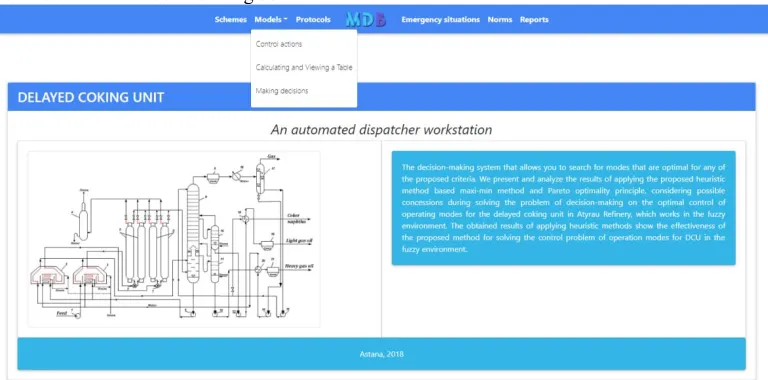
[image:6.612.116.500.437.627.2]() on the technological constraints (MM+PO-). In this study, to solve the proposed problem (7) - (8), we use software package "Delayed coking unit". (Main menu is presented in Figure. 1).
Figure. 1. Main Menu Of Decision-Making Support System For Controlling DCU Modes
Let us present the results of application of heuristic method MM + PO- for solving the problem (7) - (8) using the given system:
1. In a dialogue mode with DM, determine the values of weight coefficients for local criteria, evaluating the output (generation amount) of coke, benzene and light gas oil from DCU
3
,
1
),
(
0
x
i
i
: = (0.7, 0.2, 0.1), as well as boundary values for the local criteria}
,...,
2
{
,
,
0 00
i
I
I
m
i
R
:
0R2
12;
0R3
35.
ISSN: 1992-8645 www.jatit.org E-ISSN: 1817-3195
possible value and determine using system of DCU main unit models.
3. In a dialogue mode with DM and specialists-experts, determine the values of weight coefficients for constraints
q(
x
),
q
1
,
2
: β=(0.4,0.6) and set the tolerances for deviations from the maximum values of the extent of constraints fulfillment2
,
1
,
q :
1
0.5;
2
1 as well as the define tolerances of mode parameters from standard values according to technological regulations: temperature at the reactor inlet (coking chamber) up to 1 ° C; pressure in the reactor up to 0.15 kg / cm2, noting that concessions of these regulations are admissible for 3 hours.4. Set pq, q=1,2 - number of steps for each q
coordinate: p1=5; p2=2.
5. Determine
h
q
1
/
p
q,
q
1
,
2
- the values of steps for changing coordinates of the weight vector βq: h1=1/p1= 1/5=0.2: h2=1/p2= 1/2=0.5.6. Build a set of weight vectors
1,
2,...,
N,N = (5 + 1) (2 + 1) = 18 with varying the coordinates in the interval [0,1] with a step of hq, q=1,2.
7. Define term-sets and construct membership functions of constraints fulfillment µq(x), q=1,2.
The problem is described by two fuzzy constraints: coke volatility
~
15%; coke ash
~
than 0.8wt%. For describing these fuzzy constraints, the following term-set is defined: T (X, Y) = {low, medium, high}. Using the defined term-set, we design membership functions that describe the extent to which the fuzzy constraints are met [7]:);
|
5
.
2
|
5
.
0
exp(
)
(
0,604 1
1
x
y
);
|
1
.
0
|
3
.
0
exp(
)
(
0,155 1
2
x
y
);
|
0
.
7
|
5
.
0
exp(
)
(
0,554 2
1
x
y
);
|
5
.
0
|
3
.
0
exp(
)
(
0,125 2
2
x
y
);
|
17
|
5
.
0
exp(
)
(
0,504 3
1
x
y
);
|
9
.
0
|
3
.
0
exp(
)
(
0,105 3
2
x
y
where 1
(
x
),
2(
x
),
p
1
,
3
p
p
- membershipfunction describing the extent to which the fuzzy constraints are met for quant p on coke volatility
)
(
1
x
p
and coke ash composition
2p(
x
)
, у4and
у5 -numerical values of fuzzy indicators of coke
quality, obtained based on a set oflevel , the remaining coefficients are described in work [13]. 8. On the basis of DCU models describing the dependence of the local criteria on mode parameters x=(x1,x2,x3,x4,x5,x6): x1 – crude
consumption (tar); x2 - reactor inlet temperature; x3 -
pressure in the reactor; x4 - recirculation coefficient; x5 - coking ability of crude; x6 - temperature of light
gas oil output. The problem
max
10(
x
)
Xx
(7) issolved on the set of X, defined by the expression (8). It is possible to use the most appropriate method to solve this problem, in this case, we use a modified method of penalty functions for the fuzzy environment. Criteria are maximized on the set X, considering the coefficients of importance, defined in steps 1 and 3. Current solutions are identified: mode parameters values
x
(
,
,
)
, corresponding values of local criteria 1(
(
,
,
))
0
x
)),
,
,
(
(
20
x
3( ( , , ))0
x and extent to
which the fuzzy constraints are met
)),
,
,
(
(
1
x
2(x(
,
,)).9. The resulting solution is presented to decision-makers. Current results of the first 6 cycles did not satisfy the decision maker, new values of , and
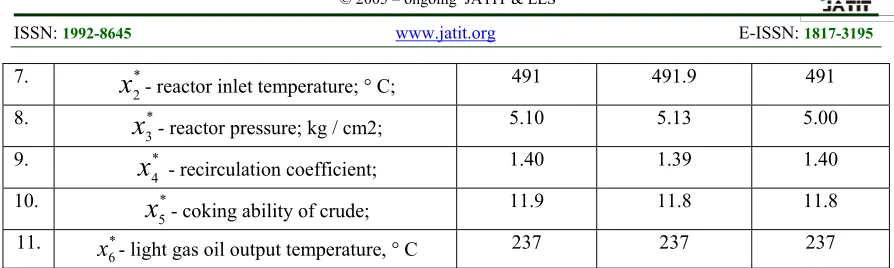
were assigned, and the procedure was returned to step 4. At the 7th cycle the transition to step 10 is done. In this example, solution selected by DM after the 7th cycle is recorded in Table 1 and shown in Figure. 2 and 3.
10. Search for solutions is terminated, results of the final selection ofdecision-makers are obtained ensuring optimal DCU modes: the values of mode parameters
x
1*(
,
.
)
.x
*2(
,
,
)
.)
,
,
(
*
3
x
.x
4*(
,
,
)
. *(
,
,
)
5
x
.)
,
,
(
*6
x
; optimal values of the local criteria)),
,
,
(
(
* 10
x
2(
*(
,
,
)),
0
x
))
,
,
(
(
* 30
x
and maximum extent of fuzzyconstraints fulfillment
))
,
,
(
(
)),
,
,
(
(
* 2 *1
x
x
(See TableFigure 2. Interface Of Decision-Making System On Control Of DCU Operation Modes For Maximizing Coke Output
Figure. 3. Results Ofmaximization Of Coke Output And Constraint Checking
Table 1. Comparison Of The Results Of Solving The Multi-Criteria Optimization Problem For DCU Parameters Using A Known Method [22], The Proposed Heuristic Method (MM + PO-) And Experimental Data From AOR
No. Local criteria and fuzzy constraints Deterministic method Heuristicmethod MM + PO-
Experimental data
1. Coke output t/h - y1 criterion; 23.5 25.2 24.0
2. Benzene output, t/h – y2 criterion; 12.5 12.7 12.7
3. Light gas oil output, t/h – y3 criterion; 35.0 35.2 35.0
4. MF of fuzzy constraints fulfillment "Coke volatility
~
15%;(
*(
,
,
))
1
x
; - 1.0 ()l5. MF of fuzzy constraints fulfillment "Coke ash
~
0.8 wt%:(
*(
,
,
))
2
x
; - 1.0 ()l6. Optimal values of DCU mode
parameters
(
,
,
,
,
,
*)
6 * 5 * 4 * 3 * 2 * 1
*
x
x
x
x
x
х
x
:* 1
[image:8.612.85.529.563.743.2]ISSN: 1992-8645 www.jatit.org E-ISSN: 1817-3195
7. *
2
x
- reactor inlet temperature; ° C; 491 491.9 4918. *
3
x
- reactor pressure; kg / cm2; 5.10 5.13 5.009. *
4
x
- recirculation coefficient; 1.40 1.39 1.4010. *
5
x
- coking ability of crude; 11.9 11.8 11.811. *
6
x
- light gas oil output temperature, ° C 237 237 237Note: (-) indicates that the corresponding parameters are not determined by this method; ()l - these
indicators are determined at the test laboratories with involvement of experts.
5. DISCUSSION OF THE RESULTS
[image:9.612.83.530.62.196.2]Analyzing the obtained results, shown in Table 1, the following conclusions can be drawn: 1) The proposedheuristic method MM +
PO-solves the original problem with fuzzy constraints without prior convertion of them to the deterministic version, in comparison with deterministic methods, for some indicators, it provides the best results.
2) When solving multi-criteria problems in the fuzzy formulation, the adequacy of solutions improves through the use of more fuzzy information (knowledge, experience of decision-makers, experts), allowing adequately describe the real situations without idealizations.
3) Method MM + PO-allows to determine the membership function, i.e. the degree of fuzzy constraints fulfillment, provides a solution to the problem with fuzzy constraints that often occur in industrial conditions.
The tabulated results show the effectiveness of the proposed heuristic method for solving multi-criteria problems in the fuzzy formulation, as compared with the results of known methods [16, 22, 23] all indicators do not show worse results, whereas in terms ofcoke and benzene, results are improved. Furthermore, themethod
MM+PO-allows to determine the extent to which the fuzzy
constraints are met. As can be seen, the membership function of fuzzy constraints
))
,
,
(
(
*1
x
and ( *( , , ))2
x are equal to
1, i.e. during the solution of the optimization problem we ensure the total fulfillment of fuzzy constraints.
As can be seen from Figureures 1 and 2, in order to maximize coke output with complying the requirements of quality and to fulfill constraints on the criteria 2 and 3 (output of benzene and light gas oil), decision-makers made allowable concessions in accordance with the method of MM+PO. The temperature at the inlet of the reactor is declined to the allowable concession of 0.9 оС and the reactor
pressure to 0.13 kg/cm2.
In practice, in solving real control problems of operation modes and their optimization it is often enough that some of the principles are satisfied approximately, i.e. with certain concessions. In this case, the following formulation ofmode control problem of technological objects can be made. For example, for criteria it is proposed to use a new principle – quasi-maximin principle, and for constraints - the idea of ideal point method, then the problem can be written as follows:
),
(
max
10
x
X
x
(9)), , 1 }, ,..., 2 { , || ) ( || min ) ( arg( ) ) ( ( min max arg :
{ 0 0
0
L q m I x x
x x
X D
u q
i i i I i
x
(10)
where
D
- used D metric,
)),
(
),...,
(
(
)
(
x
1x
Lx
u
(max
1(
x
),...,
)).
(
max
Lx
It is possible to use ideal point of u
units as coordinates:
u
(
1
,...,
1
)
.
- initial set of definitions of x variables, I0 -set ofindices for criteria, transferred to the constraints. In the problem (9) - (10) criterion 1 is maximized, other criteria are entered in constraints according to quasi-maximin principle (QMM), i.e.
considering concessions
i, fuzzy constraints are taken into account based on a modified method ofideal point (IP).
of Atyrau Oil Refinery. We can conclude that the proposed approach to the formulation and solution of the problem is more efficient, since the results of the comparison, i.e., the criterion for analyzing the results of the study, obtained using the proposed heuristic method match the real data better for all production indicators, i.e. more adequate than the known results of the problem being compared. Furthermore, as can be seen from Table 1, when applying the developed heuristic method, all the criteria describing the output of the target products are improved. It is also can be highlighted that the proposed approach to solving the problem allows us to take into account and evaluate the degree of fulfillment of fuzzy restrictions, which is impossible in the well-known deterministic methods for solving the formulated problem.
6. DIFFERENCES OF RESEARCH FROM OTHER STUDIES.
The following are the primary differences for the results of studies on the formulation and solution of problems of optimizing DCU parameters when controlling the operation modes of the installation:
- in contrast to the results of other studies, mathematical models of problems for optimizing the object parameters when controlling the operation modes of DCU are formulated in the fuzzy environment, with the preservation and maximum use of the collected fuzzy information. This approach to solving the fuzzy problem allows achieving high adequacy of the results and real data, by the maximum use of additional fuzzy information;
- in conventional studies for solving a fuzzy problem, the initial problem at the formulation stage is replaced by a system of equivalent deterministic problems, then it is solved using well-known methods for solving deterministic problems. In contrast, in this paper, the problem is posed and solved by fuzzy methods based on the methods of expert assessment and theories of fuzzy sets. In this type of scenario, various principles of optimality and their combination are selected depending on the current situation at the production;
- unlike the known results, in this work the application of the principles of optimality and compromise schemes is adapted and applied after modification to work in the fuzzy environment.
This ensures high adequacy of the results obtained when solving problems in the fuzzy environment.
7. CONCLUSION
New formulations of control problems for operation modes in the fuzzy environment in a form of multi-criteria selection are obtained and heuristic methods of their solutions based on the modification of various methods and optimality principles are developed: the method of main criterion to the criteria and the method maximin (guaranteed result) to the constraints; the method of maximin to criteria and Pareto optimality principle with concessions to the fuzzy constraints.
The aim of the study is fully achieved, i.e. mathematical models of optimization problems are formulated when controlling the DCU operation modes in the fuzzy environment. On the basis of the modified principles of optimality for the main criterion, maximin and Pareto optimality, heuristic methods of the tasks are developed, which allow obtaining effective solutions with high adequacy to production situations, as well as the research results are applied in practice when optimizing operating parameters when controlling the DCU the Atyrau Oil Refinery.
The theoretical significance of the research results is determined by the fact that the new formulations obtained and the methods developed for their solution allow extending the optimization theory to the case of fuzzy initial information. It is a definite contribution to the development of methods for solving fuzzy problems. The practical significance of the research results is that the application of the proposed fuzzy approach and the solution for real fuzzy described production problems by the maximum consideration of fuzzy information enables to achieve more adequate solutions to fuzzy problems. As the results of applying the proposed approach to solving the problem of optimal control of the DCU operation modes show, it provides better solutions in comparison with other known methods and it has results highly adequate to reality.
ISSN: 1992-8645 www.jatit.org E-ISSN: 1817-3195
The developed fuzzy approach to solving the control problem for operation modes by the multi-criteria optimization in fuzzy environment is implemented on basis of optimum control for DCU operation modes in Atyrau Oil Refinery. The control problem for DCU operation modes is formulated in a form of fuzzy mathematical programming problem based on the modification of maximin method and Pareto optimality principle with acceptable concessions. The proposed heuristic method MM+PO- is used to solve the obtained fuzzy problem. Comparison of the results of solving the control problem for DCU operation modes based on the deterministic approach and the fuzzy approach show the effectiveness of the proposed heuristic method for solving the control problem of optimal modes in the fuzzy formulation, since in terms of all major indicators it gives the best results, in addition, it determines the extent to which the fuzzy constraints are met.
Thus, in relation to our research contribution, the following conclusions can be drawn:
The novelty and originality of the formulated mathematical models of optimization problems for controlling the DCU operation modes and the developed methods for solving them is that the problmes are posed and solved in the fuzzy environment without converting them to a system of deterministic problems as in the well-known methods for solving fuzzy problems. This fact allows getting more adequate solutions to the formulated problems in real production conditions, since the collected fuzzy information is used to the maximum;
- based on the analysis, it is possible to select various principles of optimality and their combination to the criteria and constraints to production situations that arise delayed coking unit of the Atyrau Oil Refinery;
- the developed heuristic method based on the modification of the principles of maximin and Pareto optimality for work in the fuzzy environment is applied to solve the problem of controlling the operating modes of the investigated delayed coking unit and the better results are obtained in comparison with the results of known methods
.
REFERENCES
[1] Soloviev, N.A. and Semenov, A.M. (2009).
Expert systems. Orenburg.
[2] Jarratino, D. (2007). Expert systems: principles of development and programming. Moscow: OOO "I.D. Williams".
[3] Orazbaev, B.B., Kulzhanov, D.U. and Orazbaeva, K.N. (2015). Investigation and de-scription of the process of benzene production based on expert assessment methods. Science News of Kazakhstan, vol. 2(124), pp. 172-186. [4] Kahraman, C. (2008). Fuzzy Multi-Criteria
Decision Making. Theories and Applications with Recent Developments. New York: Springer, pp. 592-608.
[5] Dubois, D. (2011). The role of fuzzy sets indecision sciences: Old techniques and new directions. Fuzzy Sets and Systems, vol. 184, pp. 3-17 (2011).
[6] Suleimenov, B.A. (2009). Intelligent and hybrid process control systems. Almaty: "Pikula and K".
[7] Orazbayev, B.B., Orazbayeva, K.N., Kurmangaziyeva, L.T. and Makhatova, V.E. (2015). Multicriteria optimisation problems for chemical engineering systems and algorithms for their solution based on fuzzy mathematical methods. EXCLI Journal, vol. 14, pp. 984-998. [8] Orazbaev, B.B. (20214). Theory and practice
of methods of fuzzy sets. Textbook for university students. Almaty: Bastau.
[9] Ryzhov, A.P. (2003). Elements of the theory of fuzzy sets and its applications. Moscow: Moscow State University.
[10]Grossmann, I.E. (2014). Challenges in the Application of Mathematical Programming in the Enterprise-wide Optimization of Process Industries. Theoretical Foundations of Chemical Engineering, vol. 48(5), pp. 500-518. [11]Orazbayev, B.B., Orazbayeva, K.N. and Utenova, B.E. (2014). Development of Mathematical Models and Modeling of Chemical Engineering Systems under Uncertainty. Theoretical Foundations of Chemical Engineering, 48(2), 138-147.
[12]Rykov, A.S. and Orazbaev, B.B. (1995). Tasks and methods of decision-making. A multi-criteria fuzzy choice. Moscow: MISIS.
[13]Orazbaev, B.B. (2016). Methods of modeling and decision-making for the management of production in a fuzzy environment. Astana: ENU them. L.N. Gumilev.
[14]Volin, Yu.M. and Ostrovsky, G.M. (2007). Multicriteria optimization of technolog-ical processes under uncertainty. Avtomatika i telemekhanika, vol. 53(3), pp. 165.
uncertainty. Computers & Chemical Engineering, vol. 32, pp. 3090-4005.
[16]Zaichenko, Yu.P. (1991). Operations research: fuzzy optimization. Kyiv: High School.
[17]Ostrovsky, G.M., Ziyatdinov, N.N., Lapteva, T.V. and Pervukhin, D.D. (2009). One-step optimization problem with soft constraints.
Teoretical basis of chemical technologies,
43(4), 441-457 (2009).
[18]S.A. Orlovsky, Problems of decision-making with fuzzy source information, Science, Moscow (1991).
[19]Yu. Pershin, Pareto-optimal and lexicographic solutions of mixed-integer problems that are linear with respect to continuous variables, Automation and Remote Control, vol. 55(2), pp. 263-270.
[20]Rykov, A.S. (1993). Search engine optimization. Methods of deformable conFigureurations. Moscow: Science.
[21]Ostrovsky, G.M., Ziyatdinov, N.N., Lapteva, T.V. and Silvestrova, A. (2015). Optimization of Chemical Process Design with Chance Constraints by an Iterative Partitioning Approach. Industrial & Engineering Chemistry Research, vol. 54(13), pp. 3412.
[22]Biegler, L.T., Lang, Y.D. and Lin, W.J. (2014). Multi-scale Optimization for Process Systems.
Engineering, Computers & Chemical Engineering, vol. 10, pp. 17-33.
[23]Shumsky, V.M. and Zyryanova, L.A. (1991).
![Table 1. Comparison Of The Results Of Solving The Multi-Criteria Optimization Problem For DCU Parameters Using A Known Method [22], The Proposed Heuristic Method (MM + PO-) And Experimental Data From AOR](https://thumb-us.123doks.com/thumbv2/123dok_us/8898369.953943/8.612.102.529.52.307/comparison-results-criteria-optimization-parameters-proposed-heuristic-experimental.webp)