http://dx.doi.org/10.4236/jct.2014.57079
How to cite this paper: Marcy, P.Y., et al. (2014) Patient Satisfaction with and Acceptance of Their Totally-Implanted Cen-tral Venous Catheter: Construction and First Validation of a Questionnaire. Journal of Cancer Therapy, 5, 706-716. http://dx.doi.org/10.4236/jct.2014.57079
Patient Satisfaction with and Acceptance
of Their Totally-Implanted Central
Venous Catheter: Construction
and First Validation of a
Questionnaire
Pierre Yves Marcy1*, Véronique Mari2, Andréa Figl3, Isabelle Ben-Taarit1, Yves Fouché3, Frédéric Peyrade2, Philippe Follana2, Cécile Michel4, Emmanuel Chamorey4
1Department of Radiology, Centre Antoine Lacassagne, Nice, France 2Department of Medical Oncology, Centre Antoine Lacassagne, Nice, France 3Department of Surgery, Centre Antoine Lacassagne, Nice, France
4Department of Clinical Research, Innovation and Statistics, Centre Antoine Lacassagne, Nice, France Email: *[email protected]
Received 15 April 2014; revised 12 May 2014; accepted 10 June 2014
Copyright © 2014 by authors and Scientific Research Publishing Inc.
This work is licensed under the Creative Commons Attribution International License (CC BY).
http://creativecommons.org/licenses/by/4.0/
Abstract
Rationale: Most cancer patients require a totally-implanted Central Venous Catheter (CVC) for their treatment. We develop and validate a French-language questionnaire dubbed QASICC (Ques-tionnaire for Acceptance of and Satisfaction with Implanted Central Venous Catheter) assessing patient satisfaction with and acceptance of their CVC. Method: The construction and first validation of the questionnaire was made using validated methodology consisting in four phases. Phase 1 aimed at collecting a comprehensive list of relevant items. Phase 2 consisted in converting items into questions followed by a first item selection procedure. Phase 3 tested the acceptance of the provisional module to a small number of patients. Phase 4 involved a first validation on patients to determine its psychometric characteristics. Results: Responses to the questionnaire were col-lected from 215 patients. The final tool included 27 questions assessing seven dimensions: pain, contribution to the comfort of the treatment, esthetics and privacy, impact on professional activi-ties, social and sports, impact on daily activiactivi-ties, local discomfort and overall satisfaction. Conclu-sions: This first statistical validation seems very promising and allows us to confirm the structure and the psychometric properties of the tool. Further validation studies are required on standard and specific populations in order to confirm these first results.
Keywords
Central Venous Catheter, Patient Satisfaction, Questionnaire, Cancer, Quality of Life
1. Introduction
Patient satisfaction with or acceptance of care assessment is increasingly taken into account in oncology. Most cancer and other critically-ill patients require a totally-implanted Central Venous Catheter (CVC) for their treatment consisting of a reservoir connected to a central venous catheter, which may or may not be valved. It is impossible to estimate the number of CVC used in oncology. However, some authors claim that, in 2005, over 7 million CVCs were placed in the United States [1] in both chronic and acute care. Although many patients fitted with a CVC are able to undertake activities which are hindered with other external vascular access devices, they are often physically or psychologically anxious about their device [2]. To our knowledge, no validated ques-tionnaire measuring patient acceptance of and satisfaction with their CVC has been reported in the literature. Based on these observations, the aim of our study was to develop and to validate a French-language question-naire dubbed QASICC (Questionquestion-naire for Acceptance of and Satisfaction with Implanted Central Venous Ca-theter) assessing patient satisfaction with and acceptance of their CVC. QASICC is designed as a multi-dimen- sional, self-administered questionnaire comprising approximately 30 items related to the use, appearance and pros and cons of the device as well as quality of life as perceived by patients using one for treatment.
2. Materials and Methods
The questionnaire construction and first validation process followed both the guidelines of the European Organ-ization Research [3] and the recommendations of B. Falissard [4]. The procedure consisted in four phases. Phase 1 aimed at collecting a comprehensive list of relevant items in the field of CVC acceptance, satisfaction and quality of life. Phase 2 consisted in converting items into understandable questions followed by a first item selection procedure using the Delphi method [5]. Phase 3 administered the provisional module to a small num-ber of patients belonging to the target population. The aim was to identify and solve potential problems and evaluate the overall level of appeal, attention and interest. We also submitted the questionnaire to the French National League Against Cancer for review. Phase 4 involved the first validation of the questionnaire by field- testing it on a large group of patients in order to determine its psychometric characteristics. Phase 1, 2 and 3 can be considered as a qualitative step designed for item generation and construction, phase 4 as a quantitative step designed for questionnaire validation. A Steering Committee (SC) including 3 physicians (one surgeon, one radiologist and one medical oncologist), a nurse and a psychometrician/methodologist was created in order to coordinate the study.
2.1. Qualitative Step
2.1.1. Phase 1
the CVC were invited to refocus on the questions. Each patient was then examined by the physician and could express other feelings related to their CVC. All the different formulations of a given idea were recorded and a second list of items was generated from their statements during a SC meeting. All these new items were worded by seeking maximum respect for the idea expressed by the patient. This yielded 55 additional items.
2.1.2. Phase 2
The final list of 102 items was then converted into questions. The SC transformed the items into precise, intui-tive, understandable and unbiased sentences in French. Each item was scored on a Likert-type scale, a yes/no checkbox or an Analogic Visual Scale from 0 to 10. The questionnaire comprising 102 items was sent to a group of 30 experts representing a broad cultural mix of professional backgrounds and regions of France. The experts included physicians, radiologists, surgeons, nurses, epidemiologists and patients who were selected for their knowledge of and interest in the CVC or in cancer treatment, for their reputation, number of publications, and their experience in the field. This group was invited to provide feedback on the first survey content using the Delphi method [5]. The aim was to reach a consensus on the list of 102 items. All items were sent by email to the experts, who were asked to score the relevance of each item on a scale from 0 to 10. The level of under-standing was also assessed on a scale ranging from 0 to 10 and the median for each item was then calculated. If the median relevance score was <3 (0 - 3), the item was rejected; if median relevance was comprised between 3 and 7 (3 - 7), the item was resubmitted to the experts; if median relevance was >7 (7 - 10), the item was included in the final questionnaire. The choice of these intervals was proposed according to the consensus opinion of the SC. All incomprehensible or confusing items were reformulated and resubmitted. If no consensus was found, they were removed. Thereafter, the process was iterative and three rounds were needed to obtain a consensus on 62 items.
2.1.3. Phase 3
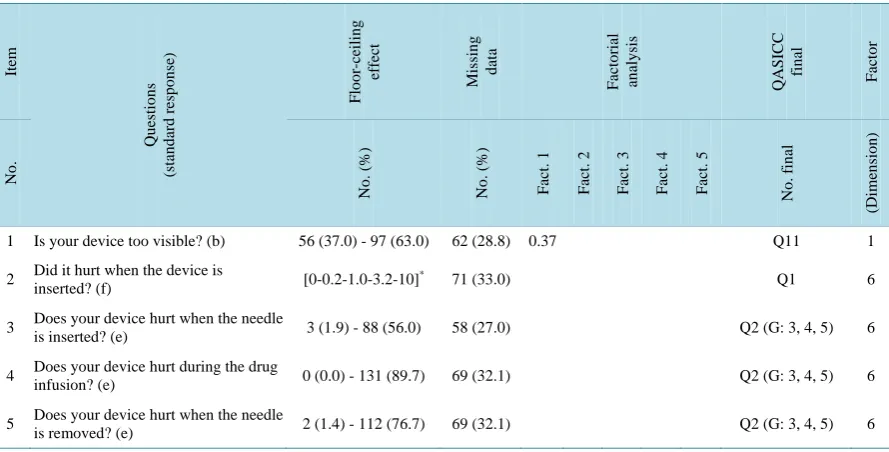
[image:3.595.93.538.495.721.2]This 62-item questionnaire was sent to the National League Against Cancer for review. This French nonprofit association is recognized as being of public interest as the first private and independent funder of cancer re-search in France. They checked acceptability, interest, wording and exhaustiveness of the item list. Then, the provisional module was tested on 20 patients representative of the target population. This was followed by structured interviews with each patient after completion of the questionnaire. This pilot study was conducted to check the comprehensibility, acceptability and response patterns. The list of 62 items extracted from this qualit-ative phase and the response modalities are shown inTable 1. The questionnaire also comprised data on patient characteristics, socio-demographic profile and medical status.
Table 1. Results of the quantitative step of QASICC validation (items, results from factorial analysis, dimensions).
Item Qu es tio n s (s ta nda rd r es pons e) Flo o r-ceilin g ef fect M is sin g d ata Facto rial an aly sis QASI C C fin al Facto r N o. N o. (% ) N o. (% ) Fact. 1 Fact. 2 Fact. 3 Fact. 4 Fact. 5 N o. f in al (Dim en sio n )
1 Is your device too visible? (b) 56 (37.0) - 97 (63.0) 62 (28.8) 0.37 Q11 1
2 Did it hurt when the device is inserted? (f) [0-0.2-1.0-3.2-10]* 71 (33.0) Q1 6
3 Does your device hurt when the needle
is inserted? (e) 3 (1.9) - 88 (56.0) 58 (27.0) Q2 (G: 3, 4, 5) 6
4 Does your device hurt during the drug
infusion? (e) 0 (0.0) - 131 (89.7) 69 (32.1) Q2 (G: 3, 4, 5) 6
5 Does your device hurt when the needle
Continued
6 Does your device produce a feeling of:
pulsing? (e) 2 (1.4) - 105 (74.4) 74 (34.4) 0.90 Q23 2
7 Penetration? (e) 1 (0.7) - 117 (85.4) 78 (36.3) (R)
8 Stabbing? (e) 3 (2.1) - 124 (89.8) 77 (35.8) (F/C)
9 Crushing? (e) 1 (0.7) - 130 (94.8) 78 (36.3) (F/C)
10 Tugging? (e) 2 (1.4) - 97 (71.3) 79 (36.7) 0.73 Q24 2
11 Burning? (e) 2 (1.4) - 122 (86.5) 74 (34.4) 0.78 Q25 2
12 Pins and needles? (e) 1 (0.7) - 117 (84.1) 76 (35.3) 0.72 Q26 2
13 Heaviness? (e) 2 (1.4) - 123 (89.1) 77 (35.8) (F/C)
14 Exhaustion? (e) 1 (0.7) - 133 (96.3) 77 (35.8) (F/C)
15 Agony? (e) 1 (0.7) - 118 (86.1) 78 (36.3) 0.52 Q21 4
16 Obsessiveness? (e) 1 (0.7) - 123 (89.1) 77 (35.8) (F/C)
17 Intolerableness? (e) 0 (0.0) - 129 (94.8) 79 (36.7) (F/C)
18 Annoyance? (e) 2 (1.4) - 114 (82.0) 76 (35.3) 0.76 Q22 4
19 Troublesomeness? (e) 1 (0.7) - 130 (95.5) 79 (36.7) (F/C)
20 Wretchedness? (e) 3 (2.1) - 124 (89.8) 77 (35.8) (R)
21 Do you perceive your device as a
foreign body? (c) 57 (36.3) - 100(63.7) 58 (27.0) 0.60 Q6 1
22 Physically. How easy is it for you to
show your device for care? (d) 0 (0.0) - 87 (55.0) 57 (26.5) 0.39 Q5 (G: 22, 23) 1
23 Psychologically. How easy is it for
you to show your device for care? (d) 1 (0.65) - 84 (54.2) 60 (27.9) 0.39 Q5 (G: 22, 23) 1
24
How easily do you feel the nurses manage to insert or remove the needle? (d)
9 (5.8) - 147 (94.2) 59 (27.4) 0.44 Q3 (G: 24, 44) 5
25
Does your device causes you any trouble when you’re:
Doing strenuous activities like carrying a heavy shopping bag or a suitcase? (e)
12 (8.2) - 76 (52.1) 69 (32.1) 0.84 Q14
(G: 25, 26, 27) 3
26 Wearing a bag with a shoulder strap?
(e) 7 (5.1) - 83 (60.1) 77 (35.8) 0.84 Q14 (G: 25, 26, 27) 3
27 Wearing car seat belt? (e) 12 (7.8) - 105 (68.6) 62 (28.8) 0.84 Q14 (G: 25, 26, 27) 3
28 Doing physical activities or sports? (e) 7 (5.2) - 88 (65.7) 81 (37.7) 0.83 Q20 3
29 Sitting at rest watching TV or reading? (e) 2 (1.3) - 126 (81.8) 61 (28.4) 0.89 Q16 (G: 29, 30) 4
30 Sleeping? (e) 3 (2.0) - 107 (70.4) 63 (29.3) 0.89 Q16 (G: 29, 30) 4
31
Does your device causes you any trouble when you’re:
Engaged in social activities (shopping, going to movies, going out with friends…)? (e)
0 (0.0) - 125 (87.4)
72 (33.5) 0.57 Q18 (G: 31, 32) 3
32 Engaged in professional activities? (e) 5 (4.5) - 101 (90.2) 103 (47.9) 0.57 Q18 (G: 31, 32) 3
33 Concentrating on activities such as
writing, reading a newspaper, …? (e) 0 (0.0) - 138 (93.9) 68 (31.6) (F/C)
34 Speaking or eating in public? (e) 1 (0.7) - 135 (93.8) 71 (33.0) (F/C)
35 When someone watching you or when
someone talking to you? (e) 1 (0.7) - 136 (89.5) 63 (29.3) (F/C)
Continued
37 Engaged in intimacy with your
spouse? (e) 6 (4.2) - 109 (76.2) 72 (33.5) 0.72 Q19 1
38 For aesthetic reasons? (e) 9 (0.1) - 98 (65.3) 65 (30.2) 0.80 Q17 (G: 38, 41) 1
39 Wearing a bra? (e) 4 (3.1) - 100 (78.1) 87 (40.5) (R, M)
40 Dressing and undressing? (e) 2 (1.4) - 113 (76.4) 67 (31.2) 0.47 Q15 4
41 Looking at yourself in a mirror? (e) 3 (2.0) - 112 (75.7) 67 (31.2) 0.89 Q17 (G: 38, 41) 1
42 Do you feel inferior to others? (e) 2 (1.3) - 129 (0.9) 65 (30.2) (F/C)
Advantages of your CVC
43 Does it spare your veins? (a) 77 (49.7) - 78 (50.3) 60 (27.9) (O)
44 Does it facilitate the process for drug
infusion? (b) 88 (56.8) - 67 (43.2) 60 (27.9) 0.44 Q3 (G: 24, 44) 5
45 Bothers you when you do your local
hygiene? (b) 106 (68.4) - 49 (31.6) 60 (27.9) 0.65 Q12 (G: 45, 47) 5
46 Is it discrete? (b) 122 (78.7) - 33 (21.3) 60 (27.9) (R)
47 Does it make washing yourself easier?
(b) 127 (81.9) - 28 (18.1) 60 (27.9) 0.65 Q12 (G: 45, 47) 5
48 Is it quick to use? (b) 128 (82.6) - 27 (17.4) 60 (27.9) (R)
49 Is it comfortable during injections? (b) 96 (61.9) - 59 (38.1) 60 (27.9) 0.42 Q4 5
50 Does it give you freedom of
movement? (b) 125 (80.7) - 30 (19.4) 60 (27.9) (R)
5a Can you use it at home? (a) 142 (91.6) - 13 (8.4) 60 (27.9) (F/C, R)
52 Is it stressful? (b) 139 (89.7) - 16 (10.3) 60 (27.9) (F/C, R)
Disadvantages of your CVC
53 Reminder of the disease? (c) 118 (76.6) - 36 (23.4) 61 (28.4) 0.49 Q8 1
54 It is difficult to find it? 151 (98.1) - 3 (2.0) 61 (28.4) (F/C)
55 Globus sensation? (b) 137 (89.0) - 17 (11.0) 61 (28.4) 0.27 Q13 3
56 Fear of hurting or damaging CVC? (c) 131 (85.1) - 23 (14.9) 61 (28.4) 0.34 7 5
57 Fear of your CVC being blocked? (c) 142 (92.2) - 12 (7.8) 61 (28.4) Q10 5
58 Vulnerability and fragility of the
CVC? (c) 153 (99.4) - 1 (0.7) 61 (28.4) (F/C)
59 Discomfort on touching the CVC? (b) 141 (91.6) - 13 (8.4) 61 (28.4) Q9 3
60 Discomfort in the shower? (b) 149 (96.8) - 5 (3.3) 61 (28.4) (F/C, R)
61 Always thinking of your CVC? (c) 151 (98.1) - 3 (2.0) 61 (28.4) (F/C, R)
62 Overall satisfaction with your CVC?
(f) [1.6-6.2-7.3-7.8-10]
* Q27 7
Item: Number of the 62 items collected in phases 2 and 3 of the qualitative step. Items retained for the final QASICC questionnaire are shown in bold.
Question (response type): Questions have been translated into English only for the purpose of the article. The response types are described in brack-ets. Response types: (a) Binary (yes/no). (b) Likert: 0 (Not at all), 1 (Somewhat), 2 (A lot), 3 (Extremely). (c) Likert: 0 (Never), 1 (Sometimes), 2 (Often), 3 (Always). (d) Likert: 0 (Very easy), 1 (Rather easy), 2 (Rather difficult), 3 (Very difficult). (e) Likert: 0 (No), 1 (Low), 2 (Moderate), 3 (High). (f) Analogic Visual Scale (0 - 10). Floor-Ceiling effect: The floor and ceiling effects are described by using range and quartile for quantita-tive data (Analogic visual scale) or by showing the extreme response absolute and relaquantita-tive frequency for Likert scales. Missing data: Absolute and relative frequency for missing data. Factorial analysis: Factorial analysis with varimax rotation; only the highest factor is given in the table.
2.2. Quantitative Step
Phase 4
The module of 62 items was then evaluated on a large cohort of patients (215). The questionnaire was adminis-tered during a monocentric randomized controlled trial aimed to compare surgically-inserted chest ports and ra-diologically-inserted arm ports for CVC in terms of mechanical, thrombotic and infectious adverse events. The questionnaire was administered once, four weeks after CVC placement. Were eligible: adults with a diagnosisof solid tissue malignancy, beginning a course of intermittent bolus intravenous chemotherapy with an expected life expectancy of 3 months or longer, WHO staging criteria <3. The type of catheter consisted of totally im-plantable ports with silicone-coated catheters (Districath 225PM, Districlass médical SA Saint-Etienne France) in the surgical group, and MRI-low profile BardPort, (Bard Access Systems, Salt Lake City UT, USA), in the radiological group. Qualified nurses were responsible for maintaining all of the catheters, which were flushed with heparin solution after each infusion using positive pressure at Huber needle retrieval. Before use, the checking procedure included blood return control at syringe suction and subsequent 10 ml saline solution flush-ing, and device filling with 5 ml of a solution containing 50 UI/ml of heparin sodium (Heparine Sodique; Dakota, Créteil, France). The study was approved by a French ethical committee. Informed written consent was obtained from all participants before enrolment in the study.
2.3. Statistical Analysis
Item quality was evaluated using non-response, saturation effects (ceiling effect, floor effect) and redundancies. These features were evaluated using descriptive statistics: percentage of missing values, response rates, mini-mum, maximini-mum, median, standard deviation, histograms, and paired correlations of items. The dimensional structure of the questionnaire was obtained using exploratory approaches such as diagrams of eigenvalues and eigenvalues, and maximum-likelihood factor analysis with varimax rotation. We also used multi-trait and multi- method analysis. This latter method is simpler and more robust and can be used to confirm the proposed struc-ture of the instrument. The principle is that items belonging to the same subscale should be highly correlated with one another. The consistencies of the dimensions are estimated by Cronbach’s alpha and 95% confidence interval evaluated by the bootstrap method. Reliability of the questionnaire is not evaluated in this first valida-tion procedure. Descriptive statistics and analysis were made by R.2.12.2 with a significance level of 5% in bi-lateral hypothesis. All these analyses were computed with both the original data and extrapolated missing data using multiple imputations. All the results presented are from database including data extrapolated by using multiple imputations. OnlyTable 1 is from the original data set.
3. Results
3.1. Qualitative Step (Phases 1, 2, 3)
ST literature searches and FG interviews revealed 47 relevant items. This provisional list was then completed with 55 items from patient interviews. At this step, the first draft of our questionnaire included 102 items of va-rying relevance or redundancy. Each item was then carefully evaluated and worded in precise question form by the ST. These 102 items were then presented to the group of experts to obtain feedback on the first survey con-tent using the Delphi method [5]. At this stage, 42 of the 47 items proposed by the ST/FG and 20 of the 55 items proposed by patients were retained. Finally, the questionnaire was tested on 20 patients using CVC for their treatment at our anticancer center. All questions seemed to be well-accepted and understood and no item was omitted or modified.
3.2. Quantitative Step (Phase 4)
of tumor site was: 69 breast (32.1%), 44 head and neck (20.5%), urology/gynecology 32 (14.9%), brain 28 (13.0%), lung 16 (7.4%), digestive 15 (7.0%) and other cancer 11 (5.1%).
3.3. Item Selection
A first selection of items was made by observing their characteristics and the distribution of each of them. All are summarized in Table 1 using descriptive statistics and figures. Criteria for selection or rejection of items were first based on rates of non-response and missing data (M). The distribution of each item was evaluated in order to detect ceiling (C) and floor effects (F). The redundancy (R) between items was evaluated using an inter- item Spearman matrix correlation table. When Spearman Rho was <0.30, the two questions were suspected to be redundant. All descriptive statistics were presented by the methodologist to the steering committee. All selected or rejected items were carefully analyzed. The decision to reject item was made taking into account both analyt-ical data and healthcare arguments. All items were analyzed independently, but also by placing each within its respective item family. When questions concerned the same area, the data were analyzed taking into account each object relative to others. This first item selection was conducted taking into account all of the characteris-tics for each item and for each group of items. If an item was considered essential by the steering committee but the descriptive analysis seemed poor, the question was still kept in the questionnaire. Following the phase of item selection, the steering committee retained 27 of the 62 initially proposed questions (Table 1).
3.4. Factorial Structure of the Tool
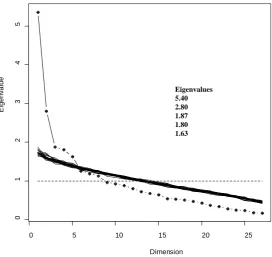
[image:7.595.178.451.418.675.2]The number of dimensions of the instrument was first revealed by using scree plot analysis.Figure 1 shows that five factors can be expected. Eigenvalues of the first 5 dimensions of the scree plot analysis were: 5.40; 2.80; 1.87; 1.80 and 1.63, respectively. We then analyzed analytical results from the factorial analysis with varimax rotation including 5 factors (dimensions) (Table 1). The five main factors seemed relatively well-identified ex-cept for items 2, 3, 4, 5 measuring pain and item 62 evaluating overall satisfaction. These five items were ana-lyzed precisely, two of them were left unchanged and the other three were grouped into a single item relative to pain.
Figure 1. Scree plot of eigenvalues and 20 simulated data (multiple
imputa-tion). Graphical representation of eigenvalues of the correlation matrix. Si- mulations are proposed to assist interpretation. The graph shows a structure comprising 5 dimensions.
0 5 10 15 20 25
0
1
2
3
4
5
Dimension
E
igenv
al
ue
3.5. Internal Validity of the Tool Subscales
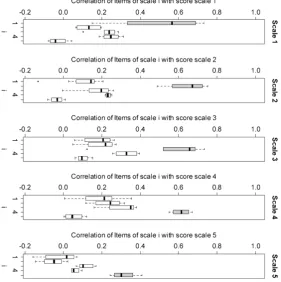
The validity of our tool subscales was evaluated using a MultiTrait-Multimethod Matrix (MTMM).Figure 2 shows the graphical MTMM for the 5 factors in the questionnaire. The Cronbach coefficient and 95% confi-dence interval were 0.77 [0.72 - 0.81], 0.77 [0.73 - 0.79], 0.79 [0.74 - 0.84], 0.81 [0.73 - 0.87] and 0.52 [0.38 - 0.61], respectively for scales 1, 2, 3, 4, 5.
3.6. First Validated Questionnaire and Scoring Manual
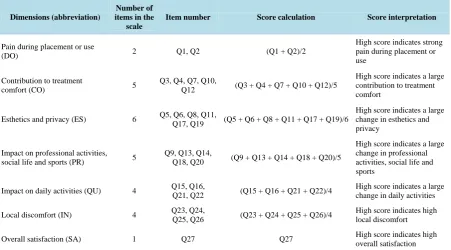
[image:8.595.173.455.372.655.2]After this first validation, the final tool shown in Table 1 included 27 questions (Q) assessing seven dimensions: pain during placement or use (Q1, Q2), contribution to the comfort of the treatment (Q3, Q4, Q7, Q10, Q12), esthetics and privacy (Q5, Q6, Q8, Q11, Q17, Q19), the impact on professional activities, social and sports (Q9, Q13, Q14, Q18, Q20), the impact on daily activities (Q15, Q16, Q21, Q22), local discomfort (Q23, Q24, Q25, Q26) and overall satisfaction (Q27). The device-related answers were of two types: Likert or visual analogic scale. Four types of Likert response were available: “no”, “low,” “moderate,” “significant,”/“never,” “some-times,” “often,” “always”/“very easy”, “easy”, “difficult”, “very difficult”/“not at all”, “somewhat”, “a lot”, “extremely”. These questions are scored 0, 33, 67, 100, respectively, when the scores are correlated with symp-toms, or 100, 67, 33, 0 when the scores are inversely correlated with symptoms. Visual analogic scales (VAS) have a length of 100 mm. The score represents the number of mm measured on the scale. A mean score of ac-ceptance and satisfaction can be calculated on a scale of 0 to 100 for all seven dimensions using the following formula: {(100-score DO) + CO + score (score ES-100) + (100-PR score) + (100-ES score) + (score 100-IN) + SA score}/7. Plus the overall score, the higher the acceptance and patient satisfaction is high. Missing data entail elimination of the issue from the scale score. The number of missing items is subtracted from the denominator when calculating the score.Table 2 summarizes the scoring manual used with the instrument.
Figure 2. Internal validity of the QASICC subscales by MultiTrait
Table 2. QASICC questionnaire scoring manual.
Dimensions (abbreviation)
Number of items in the
scale
Item number Score calculation Score interpretation
Pain during placement or use
(DO) 2 Q1, Q2 (Q1 + Q2)/2
High score indicates strong pain during placement or use
Contribution to treatment
comfort (CO) 5
Q3, Q4, Q7, Q10,
Q12 (Q3 + Q4 + Q7 + Q10 + Q12)/5
High score indicates a large contribution to treatment comfort
Esthetics and privacy (ES) 6 Q5, Q6, Q8, Q11, Q17, Q19 (Q5 + Q6 + Q8 + Q11 + Q17 + Q19)/6
High score indicates a large change in esthetics and privacy
Impact on professional activities, social life and sports (PR) 5
Q9, Q13, Q14,
Q18, Q20 (Q9 + Q13 + Q14 + Q18 + Q20)/5
High score indicates a large change in professional activities, social life and sports
Impact on daily activities (QU) 4 Q15, Q16,
Q21, Q22 (Q15 + Q16 + Q21 + Q22)/4
High score indicates a large change in daily activities
Local discomfort (IN) 4 Q23, Q24,
Q25, Q26 (Q23 + Q24 + Q25 + Q26)/4
High score indicates high local discomfort
Overall satisfaction (SA) 1 Q27 Q27 High score indicates high
overall satisfaction
4. Discussion
pa-tients reported minor catheter-related feelings of anxiety. Distress during placement has been related to feelings of anxiety and procedural pain. This highlights the urgent need for good routines to prevent, identify and alle-viate pain and distress during central venous placement.
Maurer et al. [11] evaluated patient satisfaction with their central venous port catheter with respect to implan-tation under local anesthesia. One hundred patients were evaluated using an eleven-item questionnaire. No in-formation was given concerning the construction or validation of this questionnaire. Similar to the previous study, this inquiry also analyzed the level of patient information. In another field, Caljouw et al. [12] developed a validated and reliable self-reporting multidimensional questionnaire assessing patient satisfaction with peri-operative care. They also explored the quality and amount of information given. Consequently, we believe that it could be beneficial to incorporate additional items for the assessment of the quality and amount of patient in-formation in the next version of our questionnaire.
Our instrument could be used in routine practice or in clinical trials by most nurses or by physicians prescrib-ing, placing or using CVC, by psychologist in order to assess patient acceptance of and satisfaction with their care or by pharmacists in order to help select the best material for their patients. This is the first self-adminis- tered French multi-dimensional validated questionnaire measuring the use, appearance and pros and cons of the device as well as quality of life as perceived by patients using a CVC for treatment. This questionnaire was con-structed using validated methodology. The Steering Committee monitored the whole construction procedure and followed the work of the focus and patient groups. This first statistical validation on 215 patients seems very promising and the questionnaire shows very satisfactory psychometric properties. Further validation studies are required on standard or specific populations and with different devices/trade manufactured product in order to confirm this first validation phase.
The construction and validation of the QASICC questionnaire was a secondary objective of the clinical trial presented here. The main objective was to compare surgically-inserted chest ports and radiologically-inserted arm ports for CVC in terms of mechanical, thrombotic and infectious events. So, in order to conclude more pre-cisely, a large prospective multicenter study was launched in 2011 and was completed in December 2012. We hope that this study designed specifically for QASICC validation and involving nearly 1000 patients will con-firm these first results.
Acknowledgements
We thank M. Yann Chateau, data manager of Antoine Lacassagne Cancer Center for data management.
Conflict of Interests
None declared.References
[1] Galloway, M. (2010) Insertion and Placement of Central Catheters in the Oncology Patient. Seminars in Oncology Nursing, 26, 102-112. http://dx.doi.org/10.1016/j.soncn.2010.02.004
[2] Gallieni, M., Pittiruti, M. and Biffi, R. (2008) Vascular Access in Oncology Patients. CA: A Cancer Journal for Clini- cians, 58, 323-346. http://dx.doi.org/10.3322/CA.2008.0015
[3] Sprangers, M.A., Cull, A., Groenvold, M., Bjordal, K., Blazeby, J. and Aaronson, N.K. (1998) The European Organi- zation for Research and Treatment of Cancer Approach to Developing Questionnaire Modules: An Update and Over- view. EORTC Quality of Life Study Group. Quality of Life Research, 7, 291-300.
http://dx.doi.org/10.1023/A:1008890401133
[4] Falissard, B. (2008) Mesurer la subjectivité en santé: Perspective méthodologique et statistique. 2nd Edition, Masson, Paris.
[5] Hasson, F., Keeney, S. and McKenna, H. (2000) Research Guidelines for the Delphi Survey Technique. Journal of Advanced Nursing, 32, 1008-1015.
[6] Niederhuber, J.E., Ensminger, W., Gyves, J.W., Liepman, M., Doan, K. and Cozzi, E. (1982) Totally Implanted Ven- ous and Arterial Access System to Replace External Catheters in Cancer Treatment. Surgery, 92, 706-712.
[8] Kock, H.J., Pietsch, M., Krause, U., Wilke, H. and Eigler, F.W. (1998) Implantable Vascular Access Systems: Experi- ence in 1500 Patients with Totally Implanted Central Venous Port Systems. World Journal of Surgery, 22, 12-16. http://dx.doi.org/10.1007/s002689900342
[9] Lilienberg, A., Bengtsson, M. and Starkhammar, H. (1994) Implantable Devices for Venous Access: Nurses’ and Pa- tients’ Evaluation of Three Different Port Systems. Journal of Advanced Nursing, 19, 21-28.
http://dx.doi.org/10.1111/j.1365-2648.1994.tb01046.x
[10] Johansson, E., Engervall, P., Bjorvell, H., Hast, R. and Bjorkholm, M. (2009) Patients’ Perceptions of Having a Central Venous Catheter or a Totally Implantable Subcutaneous Port System—Results from a Randomised Study in Acute Leukaemia. Supportive Care in Cancer, 17, 137-143. http://dx.doi.org/10.1007/s00520-008-0449-6
[11] Maurer, M.H., Beck, A., Hamm, B. and Gebauer, B. (2009) Central Venous Port Catheters: Evaluation of Patients’ Sa-tisfaction with Implantation under Local Anesthesia. Journal of Vascular Access, 10, 27-32.
[12] Caljouw, M.A., van Beuzekom, M. and Boer, F. (2008) Patient’s Satisfaction with Perioperative Care: Development, Validation, and Application of a Questionnaire. British Journal of Anaesthesia, 100, 637-644.