http://dx.doi.org/10.4236/nr.2014.54013
How to cite this paper: Roy, R. and Chan, N.W. (2014) A Multi-Level Evaluation of Policy Integration of Human Resource Development in Agriculture Sector. Natural Resources, 5, 119-129. http://dx.doi.org/10.4236/nr.2014.54013
A Multi-Level Evaluation of Policy
Integration of Human Resource
Development in Agriculture Sector
Ranjan Roy1,2*, Ngai Weng Chan11School of Humanities, Universiti Sains Malaysia, Penang, Malaysia
2Faculty of Agriculture, Sher-e-Bangla Agricultural University, Dhaka, Bangladesh
Email: *[email protected]
Received 19 December 2013; revised 22 January 2014; accepted 6 February 2014
Copyright © 2014 by authors and Scientific Research Publishing Inc.
This work is licensed under the Creative Commons Attribution International License (CC BY). http://creativecommons.org/licenses/by/4.0/
Abstract
Human resource development assumes as a golden key for a knowledge-based economy and com- petitiveness. This study evaluates policy integration of human resource development (HRD) in ag-ricultural sector within the context of multi-level governance (i.e., interdependence of administra-tive levels in decision making) and suggests means to enhance policy integration in Bangladesh. Conducting a critical review of major policy instruments, key informant interview and two case studies, this study concluded that HRD issue has fairly included and observed consistency (be-tween the aim of HRD and policy) in all policies and strategies; majority of policy instruments have significantly addressed the significance of HRD and added plans for its development; reporting, monitoring and evaluation of policies and strategies are rather weak and there is no adequate flow of financial arrangement that is largely determined by the availability of government project. Based on the findings, the following means should be useful for improving HRD policy integration such as providing a handsome amount of development budget at the sub-district agricultural of-fice, formulating coherent strategies to build effective cooperation, coordination and participation among stakeholders, initiating special capacity building programmes for rural women, young farmers and smallholders and mainstreaming HRD issue in governmental planning and pro-grammes, and accordingly crafting policies and implementation.
Keywords
Policy Integration; Human Resource Development; Strategy; Bangladesh; Sustainable Agriculture
120
1. Introduction
Bangladesh has an agrarian structure dominated by the smallholders who are heavily involved with rice farming. Agriculture is the single largest producing sector of the economy as it contributes to about 18.6% of the coun-try’s GDP and employs around half of the total labour force [1]. This sector, particularly councoun-try’s rice economy has made notable progress [2] [3]. This achievement is primarily attributed to the revolution of minor irrigation (e.g., shallow tube wells) and introduction of numerous high yielding rice varieties [4]. However, overall, coun-try’s agriculture is at the crossroads [5]-[7], due to conventional farming since time immemorial, indiscriminate use of agro-chemicals, declination of natural resource and visible impacts of climate change. These constrains require calibrated policy responses to achieve farming sustainability and feed the ever-growing population. In the context of environmental uncertainty, many researchers e.g., [8]-[10] reported that human capital (e.g., adap-tive capacity) development is one of the best solutions for promoting sustainable agricultural development in Bangladesh.
Majority of the rural farmers are poor, less educated and conducting subsistence farming. They partially adopt modern farming systems, integrated natural resource management (e.g., applying IPM) and environmentally sound agricultural practices such as cultivating green manures. The absence of these factors is responsible for unsustainable agricultural systems and the problems have been exacerbated by inadequate extension and training services, ineffective regulation of agro-chemicals and subsidy policies [4].
Moreover, although the development of more resource conserving practices and technologies has occurred, their utilisation and dissemination are not well embraced by farmers, expectantly [11]. This phenomenon hap-pens not only for financial limitations but also for shortage of sufficient technical knowledge, lacking of confi-dence and competence. Gaunt et al. [12] found that poor knowledge of efficient practices for maintaining soil fertility has been identified as an important component of the low yields achieved by rice farmers. In the era of climate change, adjustments and adaptation of agriculture mainly require strengthening the capacity of farming communities.
Despite research on the significance of human capital in agricultural development is available [8], literature on the evaluation of policy integration of human capital development is very scarce. This study fulfils the re-search gap. Here, capital means farming knowledge, skills and adaptive capacity of farmers. To capture the broader gamut of development, the term “human resource development” will be used instead of “human capital development” hereafter. The purpose of this study is to evaluate the degree of policy integration of human re-source development (PIHRD) in agriculture sector within the context of multi-level governance (i.e., principally refers to the interdependence of administrative levels, e.g., national, regional, district in decision making). This study suggests means to enhance HRD policy integration as well.
The remainder of this study is: after presenting a brief background of the study, the understanding of PIHRD will be elaborately discussed. Then stating research planning and methodology, the result of evaluation of policy integration will be presented according to the four administrative levels in four sections with discussion. Finally, conclusions and policy implications will be drawn.
2. Understanding Human Resource Development Policy Integration:
Environmental Policy Integration Revisited
The main objective of PIHRD is to ensure that the agricultural sector covered by the policy area is able to grow crop production sustainably (by improving knowledge, skills, attitude and capacities of growers to pro-mote integrated management of natural resource, nutrients, pests and diseases; adopt climate-smart practices and foster farm mechanisation) even within the circumstances of a changing environment. It has been reported in key documents [e.g., Sixth Five-Year Plan (FY 2011-15)] that there is a political commitment to integrate HRD policy objectives into other policies and this should be reflected at the policy strategies and at the level of in-struments such as laws, taxes, support schemes and information material by which the strategies are imple-mented. For example, if HRD is integrated into agricultural policies, this should be reflected in the plan, pro-grammes and strategies of this sector and ultimately in the exposure of farmers.
Policy integration (PI) is two types, namely horizontal and vertical policy integration. Adopting definition from the study of Lafferty and Hovden [18], horizontal policy integration (HPI) of HRD refers to cross-sectoral measures and procedures by the government or some governmental body, carried out to comprehensively inte-grate HRD plans, programmes and strategies into public policies. Typical means include country’s sustainable development strategy, climate change strategy and integration of HRD programmes in the preparation and adop-tion of new regulaadop-tions and the annual state budget. In the same way, vertical policy integraadop-tion (VPI) of HRD means the integration of plans, programmes and strategies of HRD into specific sector—agriculture. It includes sector-specific strategies and decisions made at the ministerial level as well as HRD integration into strategies, measure and actions taken by the different agencies under the supervision of a ministry.
3. Research Planning
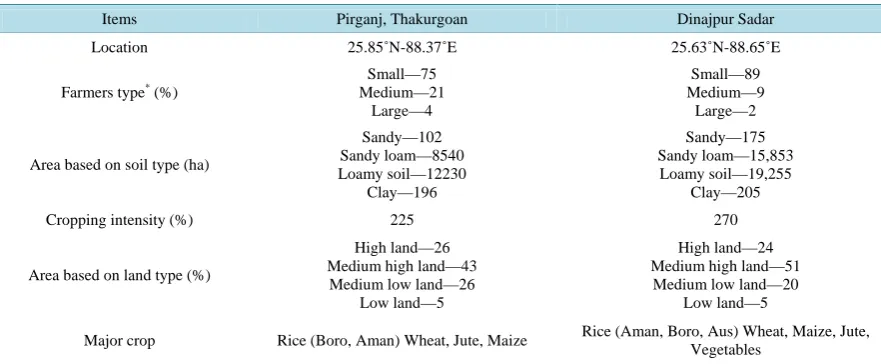
An evaluation of horizontal and vertical policy integration of HRD will be conducted within the context of multi-level governance [19]. This evaluation will be supplemented by the case studies research at the Sub-district and Union level, which are the second lowest and the lowest tier of administrative level of the gov-ernment of Bangladesh, respectively. Table 1 presents the research planning for evaluating PIHRD in agricul-tural sector.
4. Research Methods
This study employs three research methods: policy documents review, key informant interview and case study research. Policy instruments review (see the result section) was accomplished following the established criteria developed by researchers [20] [21]. Name of criteria and questions against each criterion were presented in Ta-ble 2. Key informants were academicians, extension workers, policy makers, local leaders, researchers and farmers. Case study, a method of study in depth rather than breadth, explored detailed information of plans, pro-grammes and strategies of HRD at the sub-district and union level Agricultural Extension Office. A case study research is important form of qualitative analysis that involves careful and complete observation of a per-son/social unit/institution [22]. This method is not beyond shortcomings, for instance, the findings cannot be generalising to other people with similar issues and problems. However, careful case selection, formulating a set of empirical questions and minimising the biasness in data gathering can be produced good research insights for discussion.
5. Study Area
122
Table 1. Planning for evaluating PIHRD in agricultural sector across the administrative levels.
Tiers of PI Governance Level Example of reviewing document
HPI National National Sustainable Development Strategy 2008; Climate Change Strategy and Action Plans 2009.
VPI National National Agriculture Policy 1999; National Agriculture Extension Policy 2012; National IPM Policy 2002.
HPI Regional Coastal Zone Policy 2005; Coastal Development Strategy 2006 (Emphasis will be on the coastal agriculture).
VPI Sub-district/ Union
Two case studies will be conducted in areas that represent irrigated and rainfed rice* growing ecosystem.
Note:HPI and VPI refer to horizontal and vertical policy integration, respectively. *Agriculture in Bangladesh is highly dominated by rice farming.
Table 2. Criteria and its question uses in evaluating policy integration.
Criterion Key question
Inclusion To what extent policy instrument are directly and indirectly covered plans, programmes and strategies of HRD?
Consistency Is there a consistency between the overall aim
* of HRD and policy instrument? Is instrument positive for or laid emphasis on plans, programmes and strategies of HRD?
Weighting Has the issue of HRD compared to other policy aims been addressed significantly?
Reporting Are there clearly stated evaluation and reporting requirements for HRD (including deadlines) ex-ante and have such evaluations for reporting happened ex-post? Have indicators been defined, followed up and used?
Resources Are internal as well as external resources for HRD available and used or are there any indications for arranging fund for HRD programmes?
*
Promoting sustainable agricultural development is the main aim.
Table 3. Socio-economic and bio-physical information of the case studies area.
Items Pirganj, Thakurgoan Dinajpur Sadar
Location 25.85˚N-88.37˚E 25.63˚N-88.65˚E
Farmers type* (%) Medium—21 Small—75 Large—4
Small—89 Medium—9
Large—2
Area based on soil type (ha)
Sandy—102 Sandy loam—8540 Loamy soil—12230
Clay—196
Sandy—175 Sandy loam—15,853
Loamy soil—19,255 Clay—205
Cropping intensity (%) 225 270
Area based on land type (%)
High land—26 Medium high land—43
Medium low land—26 Low land—5
High land—24 Medium high land—51
Medium low land—20 Low land—5
Major crop Rice (Boro, Aman) Wheat, Jute, Maize Rice (Aman, Boro, Aus) Wheat, Maize, Jute, Vegetables
Source: Concerned Agricultural Office. *The amount of landless and marginal farmers is merged with small farmer type. Note: Aus, Aman and Boro refer to direct seeded or transplanted rice in pre-monsoon season, transplanted rice in monsoon and irrigated rice in dry season, respectively.
6. Results and Discussion
6.1. Horizontal Policy Integration at the National Level1
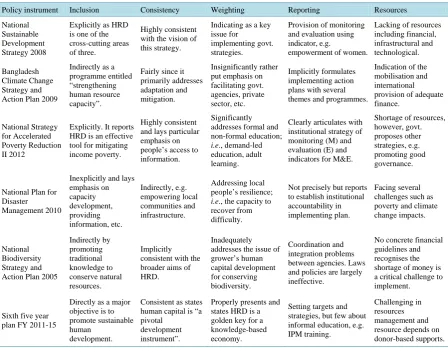
As mentioned earlier, this type of policy integration can be measured through analysing cross-sectoral policy in-struments. Table 4 shows that HRD succinctly integrated in the major strategies, for example, National Sus-tainable Development Strategy (NSDS) 2008 and National Strategy for Accelerated Poverty Reduction (NSAPR) 2012 have included programmes on human capital development (through farmer’s field school) to enhance
Table 4. Horizontal policy integration of HRD in cross-sectoral policy instruments.
Policy instrument Inclusion Consistency Weighting Reporting Resources
National Sustainable Development Strategy 2008
Explicitly as HRD is one of the cross-cutting areas of three.
Highly consistent with the vision of this strategy.
Indicating as a key issue for
implementing govt. strategies.
Provision of monitoring and evaluation using indicator, e.g.
empowerment of women.
Lacking of resources including financial, infrastructural and technological. Bangladesh Climate Change Strategy and Action Plan 2009
Indirectly as a programme entitled “strengthening human resource capacity”.
Fairly since it primarily addresses adaptation and mitigation.
Insignificantly rather put emphasis on facilitating govt. agencies, private sector, etc.
Implicitly formulates implementing action plans with several themes and programmes.
Indication of the mobilisation and international provision of adequate finance.
National Strategy for Accelerated Poverty Reduction II 2012
Explicitly. It reports HRD is an effective tool for mitigating income poverty.
Highly consistent and lays particular emphasis on people’s access to information.
Significantly addresses formal and non-formal education;
i.e., demand-led education, adult learning.
Clearly articulates with institutional strategy of monitoring (M) and evaluation (E) and indicators for M&E.
Shortage of resources, however, govt. proposes other strategies, e.g. promoting good governance.
National Plan for Disaster
Management 2010
Inexplicitly and lays emphasis on capacity development, providing information, etc. Indirectly, e.g. empowering local communities and infrastructure. Addressing local people’s resilience;
i.e., the capacity to recover from difficulty.
Not precisely but reports to establish institutional accountability in implementing plan.
Facing several challenges such as poverty and climate change impacts.
National Biodiversity Strategy and Action Plan 2005
Indirectly by promoting traditional knowledge to conserve natural resources. Implicitly consistent with the broader aims of HRD.
Inadequately addresses the issue of grower’s human capital development for conserving biodiversity. Coordination and integration problems between agencies. Laws and policies are largely ineffective.
No concrete financial guidelines and recognises the shortage of money is a critical challenge to implement.
Sixth five year plan FY 2011-15
Directly as a major objective is to promote sustainable human
development.
Consistent as states human capital is “a pivotal
development instrument”.
Properly presents and states HRD is a golden key for a knowledge-based economy.
Setting targets and strategies, but few about informal education, e.g. IPM training.
Challenging in resources management and resource depends on donor-based supports.
farmer’s skills and capacities for better land and water management. NSDS reports that vital issues in this strat-egy are “improvement of quality of human resources and better management” with a view to obtain agricultural and rural development as well as sustain economic growth [24], since human lives and livelihood are intricately intertwined with nature. Likewise, climate change strategy and NSAPR states HRD as an adaptive strategy for avoiding climate vulnerabilities and a key tool for poverty alleviation, respectively. However, the Sixth Five Year Plan (FY 2011-15) not only includes HRD as a major objective but also figure out a fully-fledged strategy to achieve it [25].
Integrating policy objectives, to some extent inclusion is mandatory. Bangladesh is an agrarian country that dominates by smallholder (about 81%). The typical features of majority farmers are poor, less educated (no education or up to primary school) and largely disadvantaged in terms of receiving public services, particularly agricultural extension services [7]. However, government has been implementing numerous projects through several agencies such as Department of Agricultural Extension, Bangladesh Rural Development Board, NGOs and partner organisations, e.g., FAO, UNDP to uplifting the socio-economic condition of farmers. Paying due attention on the challenges (e.g., poverty alleviation, minimising environmental degradation), an overriding ob-jectives has been embedded in policy instruments to improve farmer’s skills and capacity building so that they can play a vital role in increasing agricultural productivity and profitability as well as fostering sustainable socio-economic development. Moreover, other initiatives on addressing gender equity, empowering of women and rural youth through improving technical know-how-based education, training and research illuminates the inclusion of HRD in different strategies.
124
between the aims of National Plan for Disaster Management and Bio-diversity Strategy and Action Plan and HRD. Disaster management plan lays emphasis on management of both risks and consequences of disaster that allude to strengthen human, financial and social capital. This plan identifies developing and implementing dis- aster management training, education, research and awareness programmes as the priority areas for action [26]. Besides, biodiversity strategy discusses importantly the sustainable use and sharing the benefits of biodiversity [27]. It can be improved and enhanced through the conserving and restoring the biodiversity for well-being of the present and future generations, and certainly it needs a greater awareness and knowledge of conservation and management [28] [29].
The issue of HRD significantly addresses in NSSD 2008 and Sixth Five-Year plan (FY 2011-15), as this plan point out that HRD is a “golden key” for a knowledge-based economy and competitiveness [25]. However, in biodiversity and climate change strategy it receives less priority in terms of setting necessary plans and pro-grammes (Table 4). The provision of reporting as well as impact assessment or evaluation (e.g., environmental impact assessment) of most of the strategies are not structured and loosely discussed, for example, National Disaster Management Plan does not have any indicators or indicator systems [30] [31] so that the progress can be evaluated. Similarly, these shortcomings are reported in biodiversity as well as climate change strategy. De-spite the fact that environmental impact assessment (EIA) rules were enacted since more than two decades back in this country, practically it application is non-existent in most of the sectors including agriculture, and imple-mentation of EIA was largely dependent on the requirements of donor agencies [32]. However, the Sixth Five-Year Plan (2011-2015) stresses that the significance of EIA and drafting of EIA guidelines for all sectors under the Environment Conservation Act 1995 [25].
In terms of arranging financial resources, PIHRD is in the worst situation. All most all strategies (e.g., Na-tional Biodiversity Strategy 2005) do not provide funding information on how they implement the documented plans and programmes (Table 4). This financial shortage indicates an adverse situation where programmes im-plementation is difficult at the field level. The results are consistent with others report e.g. [25], as the govern-ment recognizes resource problem is one of the major challenges of this country. Bangladesh is still a low in-come country with widespread poverty; estimating 17.6% people live below the national poverty line of US $2 per day [33]. In fact, this country is experiencing “resource crunch” as a result of rapid population growth.
6.2. Vertical Policy Integration at the National Level
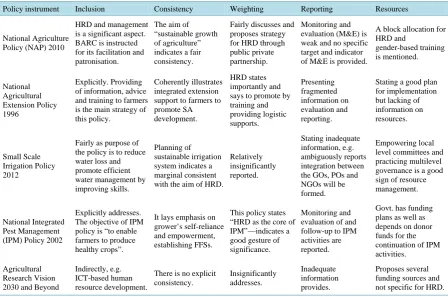
Vertical policy integration is assessed in agricultural sector that is reflected by its several policies, strategies and instruments including National Agriculture Policy (NAP) 2010, National IPM Policy and others. The first crite-ria of policy integration is “inclusion” that is clearly reflected in all policies (Table 5). For instance, National Agricultural Extension Policy 1996 reported a concrete plan for human capital development by providing in-formation, services and training. Similarly, IPM policy has taken a big vision to enhance farmer’s knowledge, skills and capacities to use and disseminate IPM technologies across the farmers (i.e., small medium and large) and country.
Around half of rice growers produce rice by traditional way and to some extent this approach hampers in producing maximum yield. Some researchers argue that the total rice production reached a plateau and the trend is gradually declining [34] [35]. A new strategy and new approach with appropriate technological breakthrough is now a reality to feed the ever increasing population. Currently, average per hectare output of rice remains measurably lower than India and about half that of China [36]. It is logistically realistic to develop farmer’s skill, capacities and competencies to adopt modern ecological farming, climate-smart technologies and diversified and integrated food—energy systems as well as to promote the sustainable intensification of crop production at dif-ferent levels.
Table 5. Vertical policy integration of HRD in agricultural sector at the national level.
Policy instrument Inclusion Consistency Weighting Reporting Resources
National Agriculture Policy (NAP) 2010
HRD and management is a significant aspect. BARC is instructed for its facilitation and patronisation.
The aim of “sustainable growth of agriculture” indicates a fair consistency.
Fairly discusses and proposes strategy for HRD through public private partnership.
Monitoring and evaluation (M&E) is weak and no specific target and indicator of M&E is provided.
A block allocation for HRD and gender-based training is mentioned. National Agricultural Extension Policy 1996 Explicitly. Providing of information, advice and training to farmers is the main strategy of this policy.
Coherently illustrates integrated extension support to farmers to promote SA development.
HRD states importantly and says to promote by training and providing logistic supports. Presenting fragmented information on evaluation and reporting.
Stating a good plan for implementation but lacking of information on resources.
Small Scale Irrigation Policy 2012
Fairly as purpose of the policy is to reduce water loss and promote efficient water management by improving skills.
Planning of sustainable irrigation system indicates a marginal consistent with the aim of HRD.
Relatively insignificantly reported. Stating inadequate information, e.g. ambiguously reports integration between the GOs, POs and NGOs will be formed.
Empowering local level committees and practicing multilevel governance is a good sign of resource management.
National Integrated Pest Management (IPM) Policy 2002
Explicitly addresses. The objective of IPM policy is “to enable farmers to produce healthy crops”.
It lays emphasis on grower’s self-reliance and empowerment, establishing FFSs.
This policy states “HRD as the core of IPM”—indicates a good gesture of significance.
Monitoring and evaluation of and follow-up to IPM activities are reported.
Govt. has funding plans as well as depends on donor funds for the continuation of IPM activities.
Agricultural Research Vision 2030 and Beyond
Indirectly, e.g. ICT-based human resource development.
There is no explicit consistency. Insignificantly addresses. Inadequate information provides. Proposes several funding sources and not specific for HRD.
Notes: HRD means human resource development; BARC refers to Bangladesh Agricultural Research Council; SA means sustainable agriculture, GO and POs mean Government and private organisation, respectively, FFS means farmers’ field school.
Most of polices insignificantly addresses HRD issue except IPM policy which stated HRD as a “core issue” for pest and disease management. National Agriculture Policy 2010 fairly mentioned the significance of knowl-edge and skills development but lacking of necessary information on how to build and strengthen public private partnership for adoption and dissemination agricultural innovation [37]. Similar to horizontal policy integration in cross-sectoral policy measures, the reporting system (ex-ante evaluation and follow up activities) and ar-rangement of funding is rather weak, in terms of providing concrete guidelines.
Monitoring, evaluation and reporting system in agriculture sector is rather weak as ever due to the weaker in-stitutional system [38]. Similarly, no cooperation and coordination among different administrative tiers have observed. In agriculture, ex-ante or ex-post evaluation is hardly applied before project evaluation; for instance, National Agricultural Extension Policy 1996, theoretically proposes a statement for applying EIA to monitor the environmental impacts of agricultural practices. It is elucidated in discussion that majority of agricultural insti-tutions suffering different extent of shortage of manpower and physical facilities due to the shrinkage of devel-opment budget. This finding is consistent with the results of other research, e.g. [38].
6.3. Vertical Policy Integration of HRD at the Regional Level
126
Table 6. Vertical policy integration of HRD at the regional level (the emphasis is on the coastal farming and natural resource management).
Policy instrument Inclusion Consistency Weighting Reporting Resources
Coastal Zone Policy (CZPo) 2005 Improving people’s capacity by creating awareness, ensuring participation and enhancing gender equity. Having harmonised aims to uplift socio-economic developments as well as contribute national development.
Receives an important attention under the heading of “empowerment of communities”.
No guidelines for monitoring and assessing performances are provided.
No information reported on funding rather stated that “Coastal Development Strategy” will present financial strategy.
Coastal Development Strategy (CDS) 2006
Empowering people’s through knowledge management as well as sustainable livelihood approach.
Observing coherent features as proper management of natural resources, e.g.,
agro-biodiversity.
Discuss as a significant programme “investment in human development” for adaptive farming, e.g., soil-less and bio-saline agriculture.
Formulates three aspects of governance, e.g., legal frameworks that states to perform monitoring and assessment with a set of inputs, outputs and outcome indicators.
Provides concrete five financial strategies, e.g. public and private investments as well as said to facilitate small and medium enterprises by NGOs.
National Programme of Action (NPA) for the Protection of the Marine (Coastal) Environment 2007
Includes as a major strategy entitled “promotion of awareness and capacity building”.
Diversified coastal cropping systems are stated as an important approach for sustainable livelihood. Judicious use of agro-chemicals is crucial strategy of NPA.
Significantly discussed the key issues of HRD, e.g., training, awareness, research and monitoring.
Reviewing and monitoring is done by a steering committee, consisting of 18 members. Little information on ex-ante or ex-post evaluation and particularly on indicators.
Inadequate funding information. The UNEP and Global Programme of Action partially provide project based funding.
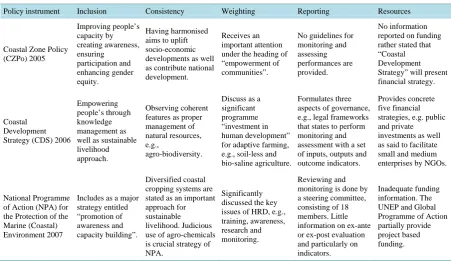
The coastal zone is highly vulnerable due to over exploitation of natural resources (e.g., hill cutting), increas-ing unplanned urbanization, pollutincreas-ing and declinincreas-ing land and water resources and visible climate change impacts [23]. However, it has huge potentials and opportunities and some unique ecosystems. Justifiably, this zone can make a substantial contribution to achieve the national goals of accelerated poverty reduction and sustainable economic growth by harnessing and exploiting its opportunities in a systematic and coordinated way. Thus, there are valid reasons for empowering the local communities through knowledge management and improving livelihood condition. However, other issues need to be addressed such as monitoring, evaluation and reporting of development activities with an accountable and manageable financial system where government has to play a proactive role through coordinating and organising other stakeholders including NGOs, multi-national compa-nies, donor agencies and development partners.
6.4. Vertical Policy Integration at the Sub-District Level
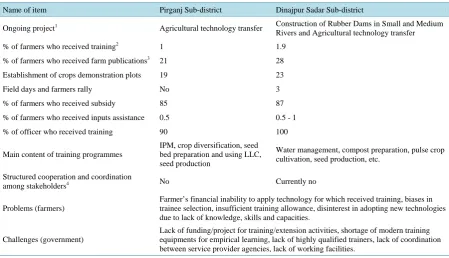
Table 7 presents a realistic picture of HRD initiatives at the sub-district level. It is not wise to draw general con-clusion from the case study research. The results indicate that shortage of funding is a major hindrance of sur-veyed agricultural office for initiating and conducting HRD programmes as well as of farmers to adopt new technologies. The number of officers and famers is another big challenge for providing services to all growers (ratio of farmers and officers is 900:1). Moreover, besides their own duties and responsibilities, agricultural ex-tension officers serve other governmental duties (e.g., taking public examination) that create extra burden for them which was revealed in discussion. The results indicate that although the issue of HRD is documented ade-quately in different policies and strategies, at the field level, it is not implementing properly.
Table 7. Summary of the case study results.
Name of item Pirganj Sub-district Dinajpur Sadar Sub-district
Ongoing project1 Agricultural technology transfer Construction of Rubber Dams in Small and Medium Rivers and Agricultural technology transfer
% of farmers who received training2 1 1.9
% of farmers who received farm publications3 21 28
Establishment of crops demonstration plots 19 23
Field days and farmers rally No 3
% of farmers who received subsidy 85 87
% of farmers who received inputs assistance 0.5 0.5 - 1
% of officer who received training 90 100
Main content of training programmes
IPM, crop diversification, seed bed preparation and using LLC, seed production
Water management, compost preparation, pulse crop cultivation, seed production, etc.
Structured cooperation and coordination
among stakeholders4 No Currently no
Problems (farmers)
Farmer’s financial inability to apply technology for which received training, biases in trainee selection, insufficient training allowance, disinterest in adopting new technologies due to lack of knowledge, skills and capacities.
Challenges (government)
Lack of funding/project for training/extension activities, shortage of modern training equipments for empirical learning, lack of highly qualified trainers, lack of coordination between service provider agencies, lack of working facilities.
Source: Respective agricultural office and key informant interview. Note: LLC means Leaf colour chart. 1Most of the HRD programmes depend on the availability of project as there is no development fund for these programmes. 2Generally, the duration of training programme are 3 to 8 hours. It is a formal way to improve farmer’s skills. Besides training there are several ways to enhance farmer’s knowledge, skills, attitude and innovation adop-tion. 3Leaflet, bulletin, folders and so on. 4Government, private and non-government organisations and farmer.
it is realised that several development works going on at the field levels, patronising by the different agencies (e.g., GOs, and NGOs). However, a strong structured coordination and cooperation can serve in a more holistic way since some farmers (e.g., large farmers) are being involved with several agencies (e.g., receiving agricul-tural loan from the government banks and NGOs and producing seeds as a delegate of contract farmer of the government) and marginal farmers as well as share tenants cannot manage access to such services.
6.5. Conclusions and Implications
The issue of policy integration of particular objective such as environment, regional development, climate change attracts scholarly interest as well as receives adequate political backing. This study evaluates policy in-tegration of human resource development (HRD) in agricultural sector. Conducting a critical review of policy documents, key informant interview of stakeholders and two case studies at the field level, this study has drawn the following conclusions: 1) HRD issue has fairly included and observed consistency (between the overall aim of HRD and policies) in all policies and strategies, 2) majority of policy instruments have significantly ad-dressed the significance of HRD and added the plans for its further development, 3) reporting, monitoring and evaluation of policies and strategies are rather weak and institutional strategies for HRD are very poor, which alludes a link of the unavailability of financial resource and 4) there is no adequate flow of resource arrangement that is mainly determined by the availability of government project.
128
agro-ecological zones (30 in Bangladesh) and agricultural challenges emerging from the impact of climate change, “one-size-fits all solutions” will not work. Therefore, a range of socio-economically and technologically feasible human capacity building initiatives can play a leading role in promoting sustainable agricultural devel-opment in rice producing regions.
Acknowledgements
The authors wish to acknowledge the Long Term Research Grant “Urban Water Cycle Processes, Management and Societal Interactions: Crossing from Crisis to Sustainability” 203/PKT/6720004 that supported this study.
References
[1] BBS (Bangladesh Bureau of Statistics) (2012) Statistical Yearbook of Bangladesh. BBS Division, Ministry of Planning (MoP), Government of Bangladesh (GoB).
[2] Ahmed, R.A. (2001) Prospects of the Rice Economy in Bangladesh. The University Press, Ltd., Dhaka.
[3] Dorosh, P. (2006) Accelerating Income Growth in Rural Bangladesh. World Bank, Washington, D.C.
[4] Hossain, M. (2009) The Impact of Shallow Tube Wells and Boro Rice on Food Security in Bangladesh. IFPRI Discus-sion Paper 00917, IFPRI.
[5] CPD (Centre for Policy Dialogue) (2000) Bangladesh Agriculture at the Crossroads: Current Challenges. Report No. 36, Dhaka.
[6] IAASTD (International Assessment of Agricultural Knowledge, Science and Technology for Development) (2009) Global Report: Agriculture at a Crossroads. Island Press, Washington, DC.
[7] Asaduzzaman, M., Ringler, C., Thurlow, J. and Alam, S. (2010) Investing in Crop Agriculture in Bangladesh for Higher Growth and Productivity, and Adaptation to Climate Change. Bangladesh Food Security Investment Forum, Dhaka.
[8] World Bank (2005) Revitalizing the Agricultural Technology System in Bangladesh. Bangladesh Development Series- Paper No. 7. The World Bank Office, Dhaka.
[9] Roy, R., Chan, N.W. and Rainis, R. (2014) Rice Farming Sustainability Assessment in Bangladesh. Sustainability Sci-ence, 9, 31-44. http://dx.doi.org/10.1007/s11625-013-0234-4
[10] Roy, R., Chan, N.W. and Rainis, R. (2013) Development of an Empirical Model of Sustainable Rice Farming: A Case Study from Three Rice-Growing Ecosystems in Bangladesh. American-Eurasian Journal of Agricultural & Environ-mental Sciences, 13, 449-460.
[11] Pretty, J., Noble, A.D., Bossio, D., Dixon, J., Hine, R.E., Penning, R.E., De Vries, F.W.T. and Morison, J.I.L. (2006) Resource Conserving Agriculture Increases Yields Developing Countries. Environment Science and Technology, 40, 1114-1119. http://dx.doi.org/10.1021/es051670d
[12] Gaunt, J.L., Best, S.K., Sutherland, J.R., Norrish, A.J. and Robinson, P. (2003) The Researcher-Farmer Interface in Rice Wheat Systems: Moving from Agricultural Productivity to Livelihoods. In: Improving the Productivity and Sus-tainability of Rice-Wheat Systems: Issues and Impacts. ASA Special Publ. 65, Am. Soc. Agron., Madison.
[13] WCED (World Commission on Environment and Development) (1987) Our Common Future. Oxford University Press, Oxford.
[14] UNCED (United Nations Conference on Environment and Development) (1992) Agenda 21. United Nations, New York.
[15] Persson, A. (2005) Environmental Policy Integration: An Introduction. PINTS Background Paper. SEI, Stockholm.
[16] Mickwitz, P. and Kivimaa, P. (2007) Evaluating Policy Integration: The Case of Policies for Environmentally Friend-lier Technological Innovations. Evaluation, 13, 68-86. http://dx.doi.org/10.1177/1356389007073682
[17] Jordan, A. and Lenschow, A. (2010) Environmental Policy Integration: A State of the Art Review. Environmental Pol-icy and Governance, 20, 147-158. http://dx.doi.org/10.1002/eet.539
[18] Lafferty, W.M. and Hovden, E. (2003) Environmental Policy Integration: Towards an Analytical Framework. Envi-ronmental Politics, 12, 1-22. http://dx.doi.org/10.1080/09644010412331308254
[19] Bache, I. and Flinders, M. (2005) Themes and Issues in Multi-Level Governance. In: Bache, I. and Flinders, M., Eds.,
Multi-Level Governance, Oxford University Press, Oxford, 1-11.
[21] Kivimaa, P. and Mickwitz, P. (2009) Making the Climate Count—Climate Policy Integration and Coherence in Finland. Finnish Environment Institute, Helsinki.
[22] Kothari, C.R. (2004) Research Methodology—Methods and Techniques. 2nd Edition, New Age,New Delhi.
[23] WRPO (Water Resources Planning Organization) (2004) Coastal Development Strategy 2006. Ministry of Water Re-sources, GoB, 2006. International Publisher, New Delhi, 414.
[24] DoE (Department of Ministry) (2008) National Sustainable Development Strategy Bangladesh. Ministry of Environ-ment and Forests, GoB.
[25] MoP (Ministry of Planning) (2011) Sixth Five-Year Plan FY2011-2015: Accelerating Growth and Reducing Poverty (Part-1 Strategic Directions and Policy Framework). Planning Commission, Government of Bangladesh (GoB).
[26] DMB (Disaster Management Bureau) (2010) National Plan for Disaster Management 2010-2015. Government of Bangladesh (GoB).
[27] MoEF (Ministry of Environment and Forests) (2005) National Biodiversity Strategy and Action Plan for Bangladesh 2005. GoB.
[28] MEA (Millennium Ecosystem Assessment) (2005) Ecosystems and Well-Being. Island Press, Washington, DC.
[29] Fubusa, Y.J. (2010) Conservation from the Bottom-Up: Human, Financial, and Natural Capital as Determinants of Re-silient Livelihoods in Kigoma Rural Tanzania. Ph.D. Thesis, Utah State University.
[30] Roy, R., Chan, N.W. and Rainis, R. (2013) Development of Indicators for Sustainable Rice Farming in Bangladesh: A Case Study with Participative Multi-Stakeholder Involvement. World Applied Science Journal, 22, 672-682.
[31] Roy, R. and Chan, N.W. (2012) An Assessment of Agricultural Sustainability Indicators in Bangladesh: Review and Synthesis. Environmentalist, 32, 99-110.
[32] Momtaz, S. (2002) Environmental Impact Assessment in Bangladesh: A Critical Review. Environmental Impact As-sessment Review, 22, 163-179. http://dx.doi.org/10.1016/S0195-9255(01)00106-8
[33] MoF (Ministry of Finance) (2012) Bangladesh Economic Survey 2012. Economic Adviser’s Wing, Finance Division, Ministry of Finance, Government of Bangladesh (GoB).
[34] Hazell, P.B.R. (2008) An Assessment of the Impact of Agricultural Research in South Asia since the Green Revolution. CGIAR Science Council Secretariat, Rome.
[35] Asaduzzaman, M. (2009) Getting Agriculture Moving Once Again: Strategic Options for Post-HYV Agriculture in Bangladesh. UK Department for International Development, Dhaka.
[36] Ziauddin, A.T.M. and Ahmmed, S. (2010) Agricultural Research: Vision 2030 and Beyond. In: A Final Report on Re-search Priorities in Farm Machinery, Irrigation & Water Management and Post-Harvest Technology. BARC, Dhaka. [37] MoA (Ministry of Agriculture) (2010) National Agricultural Policy 2010. GoB.
[38] Roy, R., Chan, N.W., Uemura, T. and Imura, H. (2013) The Vision of Agri-Environmental Sustainability in Bangla-desh: How the Policies, Strategies and Institutions Delivered? Journal of Environmental Protection, 4, 40-51.