Volume 27
Issue 3
September-October
Article 3
Fall 1936
Measuring Parole Violation
Harry Willbach
Follow this and additional works at:
https://scholarlycommons.law.northwestern.edu/jclc
Part of the
Criminal Law Commons,
Criminology Commons, and the
Criminology and Criminal
Justice Commons
This Article is brought to you for free and open access by Northwestern University School of Law Scholarly Commons. It has been accepted for inclusion in Journal of Criminal Law and Criminology by an authorized editor of Northwestern University School of Law Scholarly Commons.
Recommended Citation
HARRY WILLBACH'
When the criminologists of the future will record the history of the development of parole it is likely that the present controversy as to whether parole is a success or failure will be spoken of as being second only to the more ancient and therefore more venerable controversy as to which is the mightier-the pen or the sword. These students will probably indicate extreme impatience at the lengthy polemics resulting from attempts to bolster a position and make out a complete case without first reaching agreement on the meaning of terms or setting up standards to measure the value and efficiency of parole.
Parole is undoubtedly a failure and an utter and complete fail-ure if it is to be assumed that the whole system may be justifiably condemned because of the inability or the unwillingness of a num, ber of parolees to comply with the rules, conditions and restrictions imposed upon them by the paroling authority.
Parole is a signal failure if the concept of success is predicated on the complete and permanent non-violation of laws.
Parole has undoubtedly pioven itself inadequate if it is to be assumed that a person released from a penal institution emerges therefrom as a model citizen impressed with the nobility of right-eousness and possessed with a consuming desire to make a con-tribution to the forward march of society.
But these conditions or premises are idealistic if not fantastic. Necessarily they fall of their own weight because they imply higher standards and more crucial tests for Parolees than for the general so-called law-abiding citizen who has not been caught in the meshes of the law.
On the other hand it is equally erroneous for a parole authority to proclaim or even to consider itself efficient or successful because not more than a certain percentage of its charges violated their parole If this figure does not remain constant from one period to another, the parole authority will be forced to continually change the percentage on which it bases its claims to success. The implica-tion in this is that any experience or result is a success. We are
3New York State Division of Parole.
then treated to the misleading proposition that everything is a success but that success varies in degrees and is always greater or less than the immediately preceding period. But logically and scientifically the term less success at some point becomes synony-mous .with failure.
It is therefore imperative that before laying claims to either the success or the failure of an institution or of a system there should be developed or constructed a standard or normal expec-tancy. This normal expectancy would be the average, and devia-tions from this average that fall outside a statistically determined range could then be referred to as being better or worse- than the average or as success and failure.
While it is important to know that a parole system has operated successfully or unsuccessfully during a period under observation, these determinations are not ends in themselves but have value only if detailed analy.es are made in order to ascertain the reasons for variations from the standard.
A further advantage of constructing standards or norms of expectancy will be the possibility of making comparisons between different units of the parole authority or even between different parole officers. These comparisons will doubtlessly suggest the advisability of analyses that may reveal the methods and the tech-niques that have consistently been observed wherever the highest degrees of success were found. These methods and techniques can then be applied more generally and the standard of normal ex-pectancy will be raised. Conversely, the further analysis of the divisions or sectors where the poorest results have been experienced will probably result in discarding methods and procedures which appear to predominate.
Parole supervision has hitherto been carried on in blind fashion and has utilized the antiquated, costly and time consuming trial and error method. It has adopted procedures and techniques because of the reputation of the sponsor or of the school of thought to which they belonged. By the utilization of standards of normal
expec-tancy, scientific evaluation will replace the hit and miss method and facilities will be introduced to continually compare practices, thus ultimately yielding a body of knowledge which will more likely have more satisfactory results.
the New York State Division of Parole and can therefore be ap-plied only to results obtained by that parole set-up.
An analysis was made of all persons released from penal in-stitutions during the calendar year of 1932, who were placed under parole supervision. This group was held under observation until July 1, 1935. Thus on the valid assumption that the average date of release for the entire group of 2880 parolees was the mid-point of the calendar year of their release, or July 1, 1932, the period of observation was three years. Because of this limitation in time most of the tabulations shown in this paper have been made to terminate at the end of three years.
Parole violation, or the failure of a prisoner under parole super-vision to abide by the conditions of his release and the rules im-posed by the parole authority, must be interpreted and defined in connection with the powers of the parole authority and the meas-ures, procedures and techniques which are employed. It is well known that parole has different meanings and imposes different obligations upon released prisoners in different jurisdictions. Until these differences and others that result either from statutory differ-ences or from procedural method have been eliminated, studies made of the operation of parole and of the results of parole cannot be used for purposes of comparing different set-ups but must be used only for the jurisdiction on whose data they are based, or to point the way to approaches that can advantageously be followed
by other jurisdictions in making analyses of their work and their
problems.
In order to comprehend the full significance of parole violation a brief summary is given of the powers and methods of the New York Division of Parole.
The parole set-up in existence at present in New York was established on July 1, 1930. It was created because of the convic-tion that the responsibility for parole rested with. the state. Its cardinal principle is that supervision of parolees must rest with the body that is vested with the power of determining what prisoners should be released on parole and when and under what conditions such release is to be granted. It places supervision of parolees in the hands of state employees instead of delegating this duty to religious, social or other private cooperating groups.
more hopeful offenders who have never before been convicted of felonies. Their sentences contain no statement of minimum terms and carry the maximum terms provided by statute for the crimes of which they were convicted. The determination' of the time of release of these persons is placed by statute in the discretion of the Board of Parole and is not restricted in any manner as to conditions or date, save the provision that the inmate may not be detained beyond the date of expiration of the maximum term.
The state prisons are for felons who are given either inde-terminate sentences or definite terms by the committing magistrate. Definite sentence prisoners are prisoners who had previously been convicted of felonies. The date of their release is fixed by the term imposed and is modified by the approval of the governor of good time allowances recommended by prison boards for good conduct and diligent performance of duties assigned. Upon their release they are placed under parole supervision and remain under the control of the Board- of Parole, and are subject to its rules and orders for the periods for which their terms were reduced by allow-ance of good time.
Indeterminate sentence prisoners are persons never before con-victed of felonies. They are received in the prisons with stated minimum and maximum terms. They may be released, at the dis-cretion of the Board of Parole, at any date after the expiration of their minimum terms less the good time allowances granted them. The Board of Parole has the right however to withhold release for any period up to the termination of the full maximum sentence. These prisoners are, upon their release, placed under parole super-vision and remain under the control of the Board of Parole until the expiration of their full maximum terms.
During the period for which the individual is under the juris-diction of the Division of Parole he is required to conform with a number of conditions specified at the time of his release. These conditions apply to all paroled prisoners and relate to his general conduct while on parole. Failure to comply with any of the con-ditions so set forth or with any order of the parole officer may result in the person being declared a parole violator and subject to reimprisonment.
required to visit the parolee both at his home and his place of em-ployment at intervals determined by the needs of the individual case. In addition to these contacts, arrangements are often made for the parolee to report at the office of the parole officer.
These measures and procedures provide for frequent contacts with the parolee and with members of his household. This condi-tion, and the fact that jurisdiction is maintained over the parolee until the date his full sentence expires, provide careful and con-tinuing supervision of a parolee. The careful supervision of the parolee for the entire unexpired part of his term probably results in more numerous recordings of parole violations than where the supervision is lax or of short duration.
The annual reports of the New York State Division of Parole contain various tables concerning parolees who were declared de-linquent (violated their parole) during the year covered by the report. These tables, however, relate to all parolees carried dur-ing the year who violated their parole regardless of when they were released from the institutions.
A consolidation of one of these tables for the four-year period extending from January 1, 1931 to December 31, 1934, is given below.
TABLE I
ACTUAL PERIOD OF COMLETED PAROLE FOR PERSONS WHO VIOLATED PAROLE DuanRia FouR YEARS FROss JAN. 1, 1931 TO DEc. 31, 1934 (CossLrmar PAioLE REPRESENTS THE
PERIOD OF TME ELAPsED FROm DATE OF PAROLE TO DATE OF VIOLATION)
Indeterminate Elmira Definite Period of Completed Sentence Reformatory Sentence Parole Total Parolees Parolees Parolees
No. % No. % No. % No. % Less than 3 months ... 1173 31 514 30.3 279 20.3 380 54.6 3 mos., but less than 6 mos. 640 17.0 279 16.5 249 18.1 112 16.1 6 mos., but less than 9 mos. 466 12.4 229 13.5 179 13.0 58 8.3 9 mos., but less than 1 year 368 9.7 156 9.2 171 12.4 41 5.9
1 yr., but less than 11 yrs. 526 14.0 241 14.2 234 17.0 51 7.3
1% yrs., but less than 2 yrs. 327 8.7 151 8.9 150 10.9 26 3.7
2 yrs., but less than 2% yrs. 170 4.5 81 4.8 70 5.1 19 2.7
2 % yrs., but less than 3 yrs. 97 2.6 44 2.6 43 3.1 10 1.4
Total less than 3 years..3767 100.0 1695 100.0 1375 100.0 697 100.0
solely to intervals of a year. If the first year is broken down into four periods of three months each there is evident the same char-acteristic of decreasing numbers of parole violations as the length of time is increased.
In order to provide even periods of time and to test more ade-quately the phenomenon of decreasing parole violations as the length of completed parole increases, the parole violations were tabulated by six month intervals of the period of parole completed before the parolees were declared delinquent. The distribution for each of the three types of parolees-indeterminate sentence, Elmira and definite sentence-indicates continually decreasing percentages of parole violations as the period of completed parole was increased. The preponderance of declarations of delinquency in the shorter periods of completed parole while evident for all types of parolees, is much more striking as regards definite sentence parolees than for the other types. While 46.8 per cent of the indeterminate sen-tence parolees were declared delinquent before completing three years of parole violated their parole within six months of their release from prison and 38.4 per cent of the Elmira parolees were declared delinquent during the same period, the corresponding percentage of definite sentence parolees who violated their parole within six months of their release was 70.7.
Further examination of the preceding table shows that there is no very marked difference among the parole violators of the three groups as regards the percentages where delinquency was estab-lished during the interval of from three to six months following release from the institutions. It is clearly indicated that of the parolees who violated their parole within three years from the date
of their release, such action was taken more frequently within the first three months than during any other interval of time shown. The disparity between the definite sentence parolees and the others is most apparent as more than half of the 697 parole violations of this type of parolee occurred before three months of parole had been completed.
This table yields the inescapable conclusion that there is a tendency for parole violations to occur more frequently within the shorter periods following the date of release.
The compilation of the data for parolees who were declared de-linquent during the four years of 1931-1934 suggests further the possibility of beginning to taper off in stringency of supervision somewhere between six and nine months from the date of release. Finally, on the basis of the comparatively small percentages of de-linquencies established after two years of parole supervision, it would appear that at the end of such period marked changes could safely be made in the nature of the supervision exercised.
Thus far the discussion has centered about the period of com-pleted parole of all persons who violated their parole during the four year period extending from 1931 to 1934 regardless of the actual dates on which they were released from the institutions.
By holding under continued observation a constant group
com-posed of all persons released to parole supervision during the cal-endar year of 1932 the analysis of parole delinquency or parole violation can be extended. It will then permit of interpretations unrestricted by the reservations that are necessarily involved in parole violation data based on groups the composition of which is unknown.
It has been shown that for all persons maintained under juris-diction for any part of the period extending from January 1, 1931 to December 31, 1934, who violated their parole during that period, the numbers decreased as the period of completed parole increased. This group, contained however, a number of parolees who had been released to parole supervision at dates preceding 1931. In order to test the validity of the conclusions based on that tabulation, a similar analysis was made of the parolees released to supervision during 1932 who were declared parole violators prior to July 1,
TABLE H
Dvn~quwT Pmouzs WHo Wzxz FRz To PAzorz SupnviIoN DuRIN 1932--AcruAL PEUoD or COMPLEE PAorz PrIoR To DATE or VIOLAroN
Indeterminute Elmira Definite Period of Completed Sentence Reformatory Sentence
Parole Total Parolees Parolees Parolees
No. % No. % No. % No. %
Less than 3 months ... 246 29.3 98 27.3 71 21.5 77 51.6 3 mos., but less than 6 mos. 137 16.3 51 14.2 58 17.5 28 18.8 6 mos., but less than 9 mos. 107 12.7 55 15.3 41 12.3 11 7.4
9 mos, but less than 1 year 94 11.2 41 11.4 41 12.3 12 8.1 1 yr., but less than 1% yrs. 96 11.4 43 12.0 43 13.0 10 6.7 1% yrs., but less than 2 yrs. 77 9.2 34 9.5 38 11A 5 3.4
2 yrs., but less than 2% yrs. 58 6.9 29 8.1 27 8.1 2 1.3
2% yrs., but less than 3 yrs. 25 3.0 8 2.2 13 3.9 4 2.7
1935. This table, based on a definite and constant group, shows marked similarity with the results obtained in the combined tabula-tion of parole violatabula-tions of the four years. It therefore confirms the finding as to the distribution of parole violators in so far as their periods of completed parole are concerned.
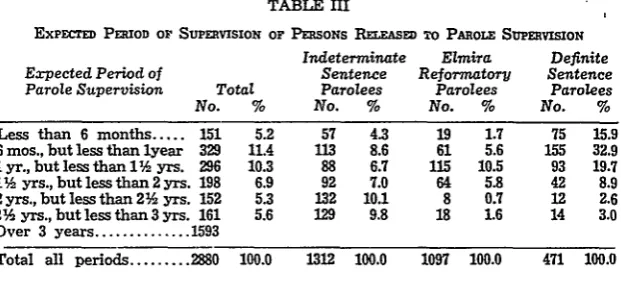
Persons released to parole supervision remain under the juris-diction of the paroling or supervising authority for varying and unequal periods of time. Some of these are for very short intervals while others are for the remainder of the natural lives of the of-fenders. Between these two extremes there is a continuous series with small gradations of periods of time, each having some fre-quencies. When tabulated for the persons released to parole super-vision during 1932 these show the distribution given in the following table:
TABLE III
ExPwECE Pmuon or SUPERVISION or P JMFASED Lsoss to PARoLE SUPERVISION
Indeterminate Elmira Definite
Expected Period of Sentence Reformatory Sentence Parole Supervision Total Parolees Parolees Parolees
No. % No. % No. % No. %
Less than 6 months ... 151 5.2 57 4.3 19 1.7 75 15.9 6 mos., but less than lyear 329 11.4 113 8.6 61 5.6 155 32.9 1 yr., but less than 1% yrs. 296 10.3 88 6.7 115 10.5 93 19.7 1% yrs., but less than 2 yrs. 198 6.9 92 7.0 64 5.8 42 8.9
2 yrs., but less than 2Y yrs. 152 5.3 132 10.1 8 0.7 12 2.6 2A yrs., but less than 3 yrs. 161 5.6 129 9.8 18 1.6 14 3.0
Over 3 years ... 1593
Total all periods ... 2880 100.0 1312 100.0 1097 100.0 471 100.0
The above table gives for persons released on parole, the dis-tribution of the expected periods of parole supervision, or the inter-val from the date of release from the institution to the date of the expiration of the full or maximum term. The periods indicated represent the length of time that the various individuals would be continued under the jurisdiction of the parole authority if they were not removed therefrom by death or parole violation.
[image:9.431.63.374.276.422.2]six months, yet 45.6 per cent of the parolees who violated within three years of their release were declared delinquent within six months.
In order to throw additional light on the relationship of the expected period of parole supervision to parole violation the fol-lowing table has been prepared:
TABLE IV
PAROLE VIOLATORS By ExPEcTED PERIOD OF PAROLE SUPERVISION FOR PERSONS RELEASED TO PAsoRL SuPERvIsioN DummG 1932.
Indeterminate Total Sentence Parolees Expected Period of Re- Delin- Re-
Delin-Parole Supervision leased quent leased quent
No. % No. %
Less than 6 months.. 151 17 11.3 57 6 10.5 6 mos., but less than
1 year ... 329 72 21.9 113 20 17.7 1 year, but less than
1% years ... 296 81 27.4 88 21 23.9 1.; years, but less
than 2 years ... 198 56 28.3 92 22 23.9
2 years, but less than
2111 years ... 152 53 34.9 132 35 26.5 2'% years, but less
than 3 years ... 161 63 39.1 129 48 37.2
Elmira Reform-atory Parolees Re-
Delin-leased quent No. %
19 3 15.8
61 13 21.3
115 32 27.8
64 21 32.8
Definite
Sentence Parolees
Re- Delin-leased quent No. %
75 8 10.7
155 39 25.2
93 28 30.1
42 13 31.0
8 7 87.5 12 11 91.7
18 12 66.7 14 3 21.4
It will be noted that this table does not show any time intervals beyond three years from the date of parole although many parolees were released to remain under supervision for longer periods of time. In fact, the total release shown above is 1,287 while all re-leases to parole supervision during 1932 amounted to 2,880. This procedure was however adopted here and in the succeeding tables as the analysis must necessarily concern itself with periods of time that do not exceed three years, because the releases of 1932 have been under observation only for that length of time.
This table gives the number and per cent of parolees from within each interval of expected period of parole supervision who were declared violators at any time prior to their final discharge by the expiration of their sentences. The regularity of the increase in the percentages as the expected period of parole supervision increases gives positive evidence of the fact that the probability of parole violation increases as the length of the expected period of parole supervision increases.
condi-tions of parole, can for convenience be grouped into three classes:
1. arrest for another crime, 2. absconding or leaving without
ad-vising the parole authority of ones whereabouts, and 3. violation of some other specific order set forth in the parole conditions or imposed by the parole officer. The tabulation below gives for parolees released during 1932, the reasons for parole violation and
the expected period of parole supervision.
TABLE V
PAROLE VIOLATORS WHO WERE RELEASED To PAROIE SUPERviSION DuRiNG 1932-REAsoNs
FOR DECLARATION OF DLNQuNCY Am EXPEcD PERIOD OF P AOLE SUMRVISION
No. of Reason for Declaration of Delinquency
Parolees Arrest Absconding Gen. Violation Released No. % No. % No. %
Less than 6 months ... 151 3 2.0 12 7.9 2 1.3 6 mos. but less than I yr ... 329 29 8.8 35 10.6 8 2.4
1 yr. but less than 13h yrs .... 296 36 12.2 36 12.2 9 3.0 1% yrs. but less than 2 yrs... 198 31 15.7 19 9.6 6 3.0
2 yrs. but less than 2% yrs... 152 27 17.8 20 13.2 6 3.9 2% yrs. but less than 3 yrs.. 161 39 24.2 18 11.2 6 3.7
The violations for failure to comply with a specific parole con-dition exclusive of arrest or absconding represents a small group and does not therefore lend itself to valid interpretations. There is suggested however the probability of more complete compliance with these rules when the parole authority exercises its control over short periods than when the expected period of supervision is for longer intervals. It is also possible, however, that parole officers may not be as strict or as ready to take disciplinary action as regards this type of parole transgressor when their period of responsibility is short.
A comparison of the percentages of parole violations established because of arrest, and of those due to absconding, indicates that for parolees whose expected period of supervision was less than one year the ratio who violated their parole by committing acts which resulted in arrest was considerably less than that for the group who took "french leave." For parolees with expected periods of parole supervision of one to two years and two to three years the converse is true. Among these two groups parole violations due to the ar-rests of the parolees are greater than those established because of absconding.
be-came violators because of arrests. It is possible that one of the reasons for this is that parolees with longer expected periods of parole supervision are largely persons who had been given longer terms and therefore, presumably, had committed more serious of-fenses and perhaps were more inured to crime.
For each parolee released during 1932 who violated his parole, the actual period from the date of parole to the date the violation occurred was known. These periods were added together for all delinquent parolees falling within the same expected period of parole supervision. These sums when divided by the number of parolees from within the group who had been declared parole violators, yielded average periods of completed parole prior to the establishment of parole violation.
TABLE VI
PERIOD OF FuLL ExPcTED DuRATIoN OF PAROLE As ACNTuAL AVERAGE PERIOD OF
COMPLETED PAROLE FOR DmrNQunEn PARoLEES WHO WERE RELxAsED DusNc 1932
Indeterminate Elmira Definite
Total Sentence Parolees Reformatory Parolees Sentence Parolees Per Cent Per Cent Per Cent Per Cent Months of Av- Months of Av- Months of Av- Months of
Av-of Av- erage of Av- erage of Av- erage of Av- erage erage Parole erage Parole erage Parole eragg Parole No. Corn- to Ex- No. Corn- to Ex- No. Corn- to Ex- No. Coin- to Ex-Delin- pleted pected Ex-Delin- pleted pected Ex-Delin- pleted pected Ex-Delin- pleted pected quent Parole Parole quent Parole Parole quent Parole Parole quent Parole Parole
Less than 6 mos... 17 1.7 55.6 6 1.5 50.0 3 2.5 83.3 8 1.5 50.0 6 months but less
than 1 year ... 72 3.8 34.3 30 3.0 33.3 13 4.5 50.0 39 2.7 30.0 1 year but less
than 1 years... 81 5.2 34.7 21 5.0 33.3 32 5.6 37.3 28 4.7 31.3
11h years but less
than 2 years.... 56 6.1 29.0 22 6.3 29.7 21 6.5 30.9 13 5.2 24.8 2 years but less
than 21 years... 53 8.3 30.7 35 7.8 28.9 7 10.0 37.0 11 8.6 31.9
2 years but less
than 3 years.... 63 11.5 34.9 48 11.4 34.6 12 13.5 40.8 3 1.5 5.0
It will be seen that with one exception the average period of completed parole for these delinquent parolees was less than one year, although the greater part of persons released to parole super-vision during 1932 were expected to be retained under such su-pervision for periods in excess of one year.
two months for every six months in the expected period of parole supervision.
There is a forceful indication in this table that where parole violation does occur, it is most likely to be encountered in com-paratively short periods following release from the institution.
The average number of months of completed parole for the delinquents falling within each group was compared with the mid-point of the range of time for each interval. The results of this comparison are shown in the third column for each of the different types of parolees. An examination of these figures leads to the conclusion that except for delinquents who had expected periods of parole of less than six months, the average period of completed parole hovered around one-third of the mid-point of the expected period of parole. It is therefore obvious that the critical period of parole apparently falls within the first third of the period during which the person is to be continued under supervision. It is during this critical period that the greatest amount of supervision is re-quired and during which the various techniques must be fruitfully employed. It is during this critical third that the parolee adjusts himself and during which he needs the active and continued interest and assistance of his parole officer.
Upon constructing a similar table for these delinquent parolees according to the nature of the parole violation-arrest, absconding, and violations of some other condition of parole-it is clearly indi-cated that violations because of absconding occur much earlier in the parole life of delinquent parolees than either of the other two types.
The fact that arrest as the cause of parole violation shows the highest ratios of actual completed parole as compared with the full expected period of parole supervision may have two explanations. The first is that the parolee has consciously and conscientiously endeavored to be law abiding but finds the going so very difficult that he finally succumbs to the forces and the behavior patterns that controlled and determined his previous criminal activities. The other, and perhaps the more plausible, is that for one reason or another, but largely because of excessive case loads, the parole officer has insufficient contacts with the parolee and inadequate knowledge of him and his affairs and is therefore unable to observe the deflections of the parolee until actual arrest results.
super-TABLE VII
ExPECTD PERiOD oF FuLL DuRATioN OF PAROLE AND TH AVERAGE PEaIOD OF AcTuAL COLm PAROLE
FOR DEUmQUENTs WHO WERE RELEAsED TO PAROLE SUPERVISioN DURMNG 1932-BY NATURE OF VIOLATION
Total Arrest Absconding General Violation PerCent PerCent PerCent PerCent
Months of Av- Months of Av- Months of Av- Months of Av-of Av- erage of Av- erage of Av- erage of Av- erage erage Parole erage Parole erage Parole erage Parole No. Corn- to No. Corn- to No. Corn- to No. Corn- to Ex-Delin- pleted ipected Ex-Delin- pleted pected Ex-Delin- pleted pected Ex-Delin- pleted pected quent Parole Parole quent Parole Parole quent.Parole Parole quent Parole Parole
Less than 6 mos... 17 1.7 55.6 3 1.5 50.0 12 1.8 58.3 2 1.5 50.0
6 months but less
than 1 year ... 72 3.8 34.3 29 3.8 41.7 35 2.3 25.5 8 3.7 41.7
1 year but less
than 1 years.. 81 5.2 34.7 36 8.0 53.2 36 3.8 25.0 9 6.5 43.3
1% years but less
than 2 years ... 56 6.1 29.0 31 7.2 34.3 19 4.2 19.8 6 6.5 31.0
2 years but less
than 2 years.. 53 8.3 30.7 27 9.7 35.9 20 6.6 24.5 6 8.0 29.6
2% years but less
than 3 years.... 63 11.5 34.9 39 12.0 36.4 18 10.5 31.9 6 11.5 34.9
vision and no consideration has been given to the period of actual completed parole of violators for each of these groups. Inasmuch as parole supervision is a continuing exercise of authority through-out the period for which the parolee is subject to the control of the parole body there are possibilities of parole violation during this entire period.
It is therefore important to construct an experience table, simi-lar to a life table which might indicate the probability of parole violation after completing specified periods of parole as non-viola-tors. Putting the situation differently it should be possible to con-struct a table which would indicate for parolees who completed six months of their parole the probability of parole violation within each succeeding six month period.
The experience table designed to yield this result is offered tentatively and with reservations due to the fact that the popula-tion on which it is based is comparatively small. It blazes a trail however and is justified both because it can be added to as more data is accumulated and because even a poor experience table is far better than none.
Since the group under observation is a constant group there can be no additions to it but only decreases. As the period of ob-servation under supervision is increased from one day to longer periods of time there is a gradual reduction in the number of differ-ent individuals under observation.
The period of time used as intervals being six months it may similarly be said that all of the 2,880 persons released to supervision during the year were under observation for this length of time. At the end of six months from the date of release some of the 2,880 parolees who were under observation at the start of the inquiry were eliminated because of the expiration of their full terms. A previous table shows that 151 of the persons released during the year had expected parole periods of less than six months. Upon deduct-ing this number from 2,880 it will be seen that 2,729 parolees should have been under supervision for the period beginning with six months from the date of their parole and extending to one year from the time they were released. The number that should have been under supervision during each successive interval is obtained in the same manner.
If, in addition to deducting the parolees who passed from su-pervision because of the expiration of their sentences, there are also deducted the number of parolees who became violators during each of these periods the actual number under observation during each period is arrived at.2
With this number as a base it is possible to prepare violation rates for each period.
Thus for the entire group of 2,880 parolees it was found that during the first six months of supervision the parole violation rate was 13.4 per cent. For the 2,361 parolees who completed six months of supervision and were carried over for supervision for the period from six months to a year the parole violation rate was 8.5 per cent. Reference to the following table will show that in each six month interval the parole violation rate showed a decrease from the rate of the previous period:
TABLE VIII
PAnoLE VioLAio RAs By Six Moma IiTmvAzs or ACTuAL Su rvision
Indeterminate , Elmira Definite Total Sentence Parolees Reformatory Parolees Sentence Parolees
No. Parole No. Parole No. Parole No. Parole Under Vio- Under Vio- Under Vio- Under Vio-From Date of Super- Delin- lation Super- Delin- lation Super- Delin- lation Super- Delin- lation
Parole vision quent Rate vision quent Rate vision quent Rate vision quent Rate
Less than 6 mos... 2880 385 13.4 1312 149 11.7 1097 130 11.8 471 106 22.5 6 months but less
than 1 year ... 2361 201 8.5 1112 96 8.6 951 83 8.7 298 22 7.4
1 year but less
than 1% years.. 1903 130 6.8 923 77 8.3 820 43 5.2 160 10 6.2 1% years but less
thanx 2 years ... 1592 77 4.8 813 34 4.2 694 38 5.5 85 5 5.9
2 years but less
than 21 years.. 1373 58 4.2 709 29 4.1 613 27 4.4 51 2 3.9
2A years but less
than 3 years.... 1216 25 2.1 583 8 1.4 585 13 2.2 48 4 8.3
The continuity of the decrease in the delinquency, or parole violation rates applies not only to the total group under observa-tion but also to the parolees of each of the three types. There is, however, one exception which occurs among the definite sentence parolees under observation for the period of from two and a half to three years following their release. The increase found here is un-doubtedly due to the fact that the percentage is based on a popu-lation of 48 and is therefore subject to a large error.
The table indicates, for example, that for an indeterminate sen-tence parolee the probability of violating parole during the first six months after release from prison is 11.7 per cent. Stated differ-ently, it is indicated that approximately one out of every nine of this type of parolee will become delinquent within six months from the date of parole. For those who weather the difficulties of the first six months of parole there is a likelihood that about one out of twelve will violate parole during the succeeding six month period. Among the indeterminate sentence prisoners who complete one
year of parole and are continued under supervision there is a prob-ability that one out of twelve will violate at some time between one year and one and a half years of parole supervision.
[image:16.431.19.405.116.269.2]and also because they are recidivists and more fixed in criminal tendencies.
The probability of successfully completing any given period of parole is the difference between 100 per cent and the probability of parole violation during that period. Thus, while 11.7 per cent is the probability of parole violation of an indeterminate sentence parolee during the first six months after release from prison, 88.3 per cent is the probability of successfully completing the first six months of parole.
SUMMARY
1. Due to lack of knowledge of composition of all parolees under supervision parole violation rates havd heretofore been based on mass figures with the result that there was lacking the necessary basic information for interpreting the meaning or for evaluating the rate.
2. Tabulations have shown that for parolees who were de-clared violators during a given period the distribution of these by period of completed parole indicated the largest percentage in the shortest periods with continually decreasing percentage as the period of completed parole was increased.
3. These tabulations have doubtful value because there is complete absence of data descriptive of parolees who did not violate their paroles during the period under examination.
4. Analysis of periods of completed parole for violators from among the releases of a given year yields results markedly similar to those secured by analyzing parole violations among a group com-posed of parolees released to supervision during an extended period. 5. These results indicated that the greatest degree of parole supervision was required up to between six and nine months from the date of release and that thereafter supervision could begin to be tapered off in stringency until two years from the date of release after which time only a modicum of supervision was necessary.
6. By holding under continued observation a constant group of parolees it was found that although 5.2 per cent of the group had expected periods of parole supervision of less than six months from the date of their release until the expiration of their sentences, 45.6 per cent of all the violators of the group violated their parole before completing six months of supervision.
7. The probability of parole violation increased as the length
8. Among parolees whose expected periods of supervision were less than one year violation resulted more frequently because of absconding than because of arrest.
9. Among parolees whose expected periods of supervision were one year or longer violation resulted more frequently because of arrest than because of absconding.
10. The actual period of completed parole for parole violators was about one-third of the full expected period of parole.
11. Where parole violation is established there is a tendency for this to occur in comparatively short periods following release from the institution.
12. It is possible to construct an experience table that would yield the probability of parole violation after a parolee has com-pleted various parts of his entire expected parole period.