Research Article
A High Efficiency Chlorophyll Sensitized Solar Cell with
Quasi Solid PVA Based Electrolyte
H. C. Hassan, Z. H. Z. Abidin, F. I. Chowdhury, and A. K. Arof
Centre for Ionics University Malaya, Department of Physics, University of Malaya, 50603 Kuala Lumpur, Malaysia
Correspondence should be addressed to A. K. Arof; [email protected] Received 5 November 2015; Revised 5 January 2016; Accepted 13 January 2016 Academic Editor: Juan M. Coronado
Copyright © 2016 H. C. Hassan et al. This is an open access article distributed under the Creative Commons Attribution License, which permits unrestricted use, distribution, and reproduction in any medium, provided the original work is properly cited.
The objective of this work is to investigate the performance of chlorophyll sensitized solar cells (CSSCs) with gel electrolyte based on polyvinyl alcohol (PVA) with single iodide salt (potassium iodide (KI)) and double salt (KI and tetrapropylammonium iodide (TPAI)). Chlorophyll was extracted from the bryophyteHyophila involuta. The CSSC with electrolyte containing only KI salt produced a short circuit current density (𝐽sc) of 4.59 mA cm−2, open circuit voltage (𝑉oc) of 0.61 V, fill factor (FF) of 0.64, and efficiency (𝜂) of 1.77%. However, the CSSC with double salt electrolyte exhibited𝐽scof 5.96 mA cm−2,𝑉ocof 0.58 V, fill factor FF of 0.58, and𝜂of 2.00%. Since CSSC with double salt electrolyte showed better efficiency, other cells fabricated will use the double salt electrolyte. On addition of 0.7 M tetrabutyl pyridine (TBP) to the double salt electrolyte, the cell’s efficiency increased to 2.17%,
𝐽sc= 5.37mA cm−2,𝑉oc= 0.55V, and FF = 0.73. With 5 mM chenodeoxycholic acid (CDCA) added to the chlorophyll, the light to
electricity efficiency increased to 2.62% with𝐽scof 8.44 mA cm−2,𝑉ocof 0.54 V, and FF of 0.58.
1. Introduction
One of the renewable energy sources that can fulfill the global energy demands is the dye sensitized solar cell (DSSC). It is simple, environmentally friendly, and relatively cheap to fabricate [1]. Among the many factors that affect the overall light to electricity conversion efficiency are the type of cat-alyst employed in the counter electrode, light transmission, substrate conductivity, dye sensitizer, the blocking substrate, and the band gap of the semiconductor used. DSSCs comprise a sealed assembly of dye-coated mesoporous semiconducting oxide nanoparticle photoanode covered with a redox couple containing gel electrolyte and a counter electrode [2]. Energy conversion in DSSCs begins when the photoexcited electrons of the dye are injected into the semiconducting layer and finally transported through the external circuit to the counter electrode. At the counter electrode, the electrons are returned to the hole in the dye molecule by the redox mediators. The dye is regenerated and produces electricity [3].
Commercial dyes in DSSCs are usually synthetic dyes, such as di-tetrabutylammonium cis-bis(isothiocy-anato)bis(2,2-bipyridyl-4,4-dicarboxylato) ruthenium (II),
commercially coded as N719, and cis-bis(isothiocyanato) bis(2,2-bipyridyl-4,4-dicarboxylato) ruthenium (II), com-mercially coded as N3, both of which enhance the light to electricity conversion efficiency. Unfortunately, these dyes are expensive, environmentally unfriendly and contain ruthe-nium metal. In order to avoid using such dyes, natural dyes have been sought for as alternatives. Dyes and pigments derived from plants, for example, chlorophyll, anthocyanin, tannin, and carotene, are cheap and do not pose any environ-mental issues [4].
The use of liquid electrolytes in solar cells makes the device prone to leakage. Liquid electrolytes may contain volatile and corrosive components that can affect longevity of the solar panel. To overcome these problems, gel or quasi solid polymer electrolytes have been used by the researchers [5]. As an example, our group have successfully fabricated quasi solid state DSSCs using gel polymer electrolytes (GPEs) based on polyvinyl alcohol (PVA) [6]. PVA is nontoxic, biocompatible, biodegradable, easy to prepare, and chemically and thermally stable and has excellent mechanical strength [7].
Iodide salts and KI with iodine are used to produce the I−/I3− redox couple which is employed for solar cell Volume 2016, Article ID 3685210, 9 pages
Table 1: Composition of the GPEs.
Sample PVA (g) DMSO (g) EC (g) PC (g) KI (g) TPAI (g) I2(g) TBP (g) TBP (molar)
PVA + single salt 0.200 2.200 0.300 0.400 0.420 0.000 0.065 — —
PVA + double salt 0.200 2.200 0.300 0.400 0.294 0.126 0.055 — —
PVA + double salt + 0.3 M of TBP 0.200 2.200 0.300 0.400 0.294 0.126 0.055 0.091 0.3 PVA + double salt + 0.5 M of TBP 0.200 2.200 0.300 0.400 0.294 0.126 0.055 0.152 0.5 PVA + double salt + 0.7 M of TBP 0.200 2.200 0.300 0.400 0.294 0.126 0.055 0.213 0.7
fabrication. Tetrabutyl pyridine (TBP) is an additive in the redox electrolyte that can influence the open circuit voltage [8], the electron injection yield, and the electron diffusion coefficient. It has been reported that TBP increases 𝑉oc significantly, while𝐽scis not affected considerably or slightly decreased in DSSCs [9].
The natural dye, chlorophyll, can be extracted from a bryophyte species Hyophila involuta and used as the pho-tosensitizer in DSSC. Hyophila involuta is a common and widespread species of the bryophyte moss [10]. This species is easy to obtain and it has high chlorophyll concentrations [11]. Hence, there is potential for its use in dye sensitized solar cells. The chlorophyll was extracted using ethanol. Chang et al. [12] reported 0.9% photoelectric conversion efficiency (𝜂) of DSSC using chlorophyll extracted from wormwood and electrolyte containing LiI and 4-tert-butylpyridine in acetonitrile (ACN). Various attempts have been undertaken to enhance the performance of DSSCs using natural sensi-tizers in view of their being environmental friendly and low cost. Incorporation of different additives or coadsorbents has become an effective effort for further improvement of the performance of DSSC. For instance, Kay and Gr¨aetzel [13] observed that cholic acid (CA) with porphyrin derivatives can upgrade both photocurrent and photovoltage of DSSC. Moreover, there are other reports which address a number of coadsorbents such as hexadecylmalonic acid (HDMA) [14], 1-decyl phosphonic acid (DPA) [15], 3-phenylpropionic acid (PPA) [16], deoxycholic acid (DCA) [17], and chenodeoxy-cholic acid (CDCA) [18]. Among all the coadsorbents in DSSC devices, CDCA is the most effective agent as it has a huge hydrophobic tail and a hydrophilic head (–COOH group). It efficiently reduces dye aggregation and electron recombination via the formation of a thin passivation layer on the vacant TiO2surface resulting in improvement of photon-to-electron conversion efficiency [19–22]. Though CDCA has been used extensively in DSSC by different researchers, so far to our knowledge no or very few systematic works were done on the effect and functionality of CDCA in chlorophyll sensitized solar cell. The present work aims to fill this gap and to understand the role of coadsorbent CDCA in chlorophyll sensitized solar cell.
In this work, we fabricated DSSCs employing PVA based GPE doped with single salt (KI) and double salt (KI and TPAI) electrolytes. Chlorophyll extracted from a species of a
Hyophila involutawas used as sensitizer. TBP and CDCA have
been added in the various ways mentioned in the following sections in order to improve performance of the CSSCs.
2. Experimental
2.1. Materials. Poly(vinyl alcohol) or PVA (99% hydrolyzed),
ethylene carbonate (EC), propylene carbonate (PC), tetra-butyl pyridine (TBP), and ferulic acid (99%) were pur-chased from Sigma Aldrich. Potassium iodide (KI) was procured from Univar Analytical Reagent. Dimethyl sul-foxide (DMSO) was purchased from Friendemann Schmidt Chemical. Chenodeoxycholic acid (CDCA) was purchased from Solaronix.
2.2. Gel Polymer Electrolyte Preparation. The composition of
the optimized PVA based gel polymer electrolytes (GPEs) was taken from Aziz et al. (2013) [23]. For the single salt electrolyte preparation, 2.2 g DMSO solvent was mixed with 0.42 g potassium iodide (KI), 0.3 g ethylene carbonate (EC), and 0.4 g propylene carbonate (PC). The mixture was stirred until a homogenous solution was obtained. An amount of 0.2 g PVA was then added into the homogenous solution. The mixture was stirred at 110∘C until a homogeneous gel is formed. When the hot gel has cooled to ambient, iodine, I2, was added and stirred until iodine has completely diffused in the gel. Tetrapropylammonium iodide (TPAI) was added to the previous GPE system at specific ratios that have been tabulated in Table 1 to prepare the double salt PVA based GPE. Another comparative study was also conducted by adding TBP to the photoanode TiO2. The photoanode was soaked in TBP for 1 h.
2.3. Electrode Preparation
2.3.1. Substrate Cleaning Process. The fluorine-doped tin
oxide (FTO) conducting substrate was cleaned using a detergent. The substrate was then rinsed to remove excess detergent with distilled water. Finally it was washed with acetone and dried. The dried conducting substrate was then soaked in propanol until boiling to remove residual dirt. The dried FTO glass was then kept in a petri dish to be used later.
2.3.2. TiO2Paste Preparation. The compact or blocking layer
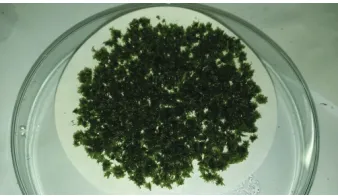
Figure 1: The moss species ofHyophila involuta.
layer of TiO2(P-25) was then applied on the blocking layer. The size of P-25 TiO2after drying is 21 nm. For the porous layer, 0.5 g P-25 TiO2 powder was ground in 2 mL HNO3 (pH = 1) for 30 min. HNO3 was added dropwise into the P-25 TiO2 powder. Poly(ethylene glycol) carbowax (0.1 g) was added to create porosity upon heating. A few drops of surfactant were added to the acidified TiO2powder and ground using a mortar and pestle. The paste obtained was applied to blocking layer using the doctor blade method. The active area was 0.25 cm2. The assembly was heated at 450∘C for another 30 min. The carbowax will be evaporated and the second layer will become porous providing more surface area for the dye to adsorb on the surface of the porous TiO2.
2.3.3. Sensitizer Preparation. The chlorophyll was
solvent-extracted from theHyophila involuta moss (Figure 1). The
Hyophila involuta moss was chosen as the chlorophyll
source. The moss sample was cleaned three times to remove unwanted materials. A 5 g mass of the cleaned moss was soaked in 5 g alcohol overnight for the extraction of chloro-phyll. The extract was kept at 4∘C.
2.4. Fabrication of Solar Cells. The coated FTO glass was
soaked in the chlorophyll solution. To ensure chloro-phyll adsorption, immersion was prolonged to 12 hours. A small amount of the prepared GPE was applied on the dried photoanode. A platinum (Pt) counter electrode was then placed over the electrolyte. Chenodeoxycholic acid was also added to the chlorophyll and their interactions were studied through absorption spectroscopy. The chloro-phyll sensitized solar cells fabricated had the configura-tion glass/FTO/TiO2/sensitizer/electrolyte/Pt/FTO/glass as shown in Figure 2.
2.5. Characterizations
2.5.1. Electrochemical Impedance Spectroscopy. In order to
determine the bulk impedance of the GPE, it was inserted into a coin cell and mounted in a conductivity mount. The diameter of the cell was 2 cm. The electrodes and electrolyte were held under spring pressure. The conductivity of the electrolyte can be calculated from the equation below:
𝜎 = 𝑅𝑡
𝑏𝐴. (1)
Here, 𝐴 is the electrode-electrolyte contact area and 𝑡 is thickness of the film.𝑅𝑏is the bulk resistance of the material
Platinum electrode
Compact layer FTO glass
Polymer electrolyte
FTO glass
Coated dye Counter
Electrolyte
Photoelectrode
Porous TiO2
Figure 2: The DSSC assembly.
which can be obtained from the intersection of complex impedance plot with the real impedance axis.
2.5.2. UV-Vis Spectroscopy. The UV-Vis spectra of the
chloro-phyll-ethanol solution and the chlorochloro-phyll-ethanol solution added with chenodeoxycholic acid were taken using the UV-3101PC Shimadzu UV-Vis-NIR scanning spectrophotometer. The chlorophyll-ethanol solution was scanned from 200 nm to 900 nm. The chlorophyll-ethanol solution added with chenodeoxycholic acids was also taken in the same range.
2.5.3.𝐽-𝑉Measurements. The photocurrent
density-photovolt-age (𝐽-𝑉) characteristics of the DSSCs under 100 mW cm−2 illumination were studied with a Keithley 2400 electrometer. The short circuit current density (𝐽sc), open circuit voltage (𝑉oc), fill factor (FF), and energy conversion efficiency (𝜂) were calculated from the following equations:
FF=𝐽opt𝑉opt
𝐽sc𝑉oc
. (2)
Here,𝐽opt is optimum current density and𝑉opt is optimum
voltage. Consider
𝜂 (%) = 𝐽sc𝑉ocFF
𝑃in
× 100%. (3)
Here,𝑃inis the total incident power density.
3. Results and Discussion
3.1. Electrochemical Impedance Spectroscopy. GPEs using LiI
[image:3.600.313.544.74.197.2]PVA double salt electrolyte PVA single salt electrolyte
T = 328K
2.8 3 3.2 3.4
2.6
1000/T(K−1)
−2.2 −2.1 −2 −1.9 −1.8 −1.7 −1.6 −1.5 −1.4
L
og co
nd
uc
ti
vi
ty
,
𝜎
(S
cm
−
[image:4.600.54.291.70.271.2]1 )
Figure 3: The log conductivity for PVA single and double salt varied temperature (298 K–373 K).
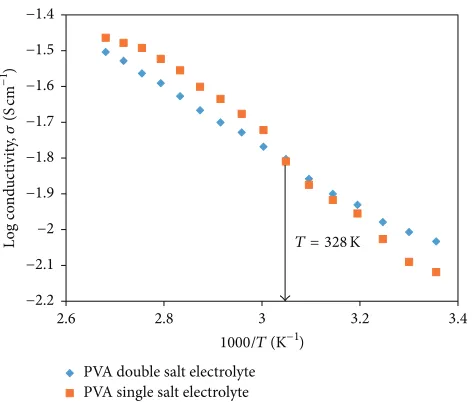
The graphs of conductivity with temperature for the single and double salt electrolytes were plotted and shown in Figure 3 from room temperature until 373 K. It can be observed that, from 298 K until 328 K, the conductivity of PVA double salt electrolyte is higher than the PVA single salt electrolyte but when the temperature increased above 328 K, the conductivity of PVA single salt electrolyte is higher than the conductivity of the PVA double salt electrolyte.
Above 328 K, conductivity of the PVA single salt elec-trolyte is higher than that of the double salt elecelec-trolyte. This could be attributed to the immobilization of some TPA+ cations in the double salt electrolyte due to the interaction between TPA+and oxygen in PVA. This reduces the number density of charge carriers in the double salt electrolyte. Another probable reason is the higher ion mobility of K+ion in the single salt electrolyte compared to the lower mobility of the TPA+ cations and the reduced number density of K+ ions in the double salt electrolyte.
3.2. Absorption Spectroscopy. Figure 4 shows the absorption
spectrum of chlorophyll solution in ethanol. The spectrum shown is in the visible wavelength range from 400 nm to 700 nm. The chlorophyll in ethanol solution shows three distinct peaks at 436, 470, and 664 nm. From the spectrum, we can also see that the absorption from 500 nm to 650 nm is low. The absorption in this region of the spectrum could also be contributed by ethanol solvent since ethanol shows a peak between 550 nm and 600 nm [26]. The spectrum is attributed to chlorophyll𝑎.
The absorption results in Figure 4 are in reasonable agreement with that of Amao and Komori [27]. This dye will be then applied to the DSSC for the𝐽-𝑉measurement to see its performance. It can be seen that there are three maxima in the absorbance spectrum of chlorophyll. The absorptions are observed to peak at 436 and 470 nm representing𝜋 → 𝜋∗ transition and 664 nm absorbance peak represents the n →
Chlorophyll in ethanol solution 0
0.2 0.4 0.6 0.8 1 1.2 1.4 1.6 1.8 2
A
b
so
rba
n
ce
,
A
(a.u
.)
450 500 550 600 650 700
400
Wavelength,𝜆(nm)
10 8
2 4
6
12 3
5 7
11
13 17
19
1 9
15 14 18
20
O N N
N N
O
I II
III IV
CO2C20H39
Mg2+
131
132
171
172
664nm
470nm
436nm
O
[image:4.600.312.543.72.253.2]Figure 4: The absorption spectra of chlorophyll in ethanol solution.
Table 2
Mass of TiO2electrode before soaking in chlorophyll
solution 1.5245 g
Mass of TiO2electrode after soaking in chlorophyll and
drying 1.5251 g
Mass of chlorophyll adhered 0.0006 g
𝜋∗ transition. Compared to nonconjugated systems, transi-tions in chlorophyll require lesser energy for an electronic transition [28]. The amount of adsorbed dye on the TiO2film was estimated as shown in Table 2.
Assuming the molecular weight of chlorophyll to be 893.5 g/mol, the amount of chlorophyll molecules adhered to the TiO2electrode is∼4×10¹⁷molecules. The next attempt is to add an organic acid as stabilizer to the chlorophyll solution. Chenodeoxycholic acid (CDCA) was used because it has a carboxylic group as in bis(isothiocyanato) bis(2,2 -bipyridyl-4,4-dicarboxylato) ruthenium (II) or N3 dye by which it can be attached onto TiO2. Intramolecular charge transfer can then be promoted from the donor region of the dye to the region in the vicinity of the TiO2 substrate. A good number of reports on the structures and roles of carboxylic acid on optoelectronic performance of DSSC have been found elsewhere [13–18, 29]. CDCA has been extensively used for devices sensitized with dye [30] and to enhance the open circuit photovoltage, the short circuit photocurrent density, and the efficiency of DSSC [31].
0 0.2 0.4 0.6 0.8 1 1.2 1.4 1.6 1.8 2
A
b
so
rba
n
ce
,
A
(a.u
.)
270 320 370
220
Wavelength (nm) 0
0.2 0.4 0.6 0.8 1 1.2 1.4 1.6 1.8
A
b
so
rba
n
ce (a.u
.)
292nm 325nm
234nm 296nm
322nm
664nm 470nm
437nm
Ethanol+ 10mM of CDCA
Ethanol+ 5mM of CDCA
Ethanol+ 1mM of CDCA
Chlorophyll+ 10mM of CDCA
Chlorophyll+ 5mM of CDCA
Chlorophyll+ 1mM of CDCA
Chlorophyll+ 0mM of CDCA
450 500 550 600 650 700
400
[image:5.600.315.541.71.263.2]Wavelength,𝜆(nm)
[image:5.600.56.285.73.286.2]Figure 5: The absorption spectra of chlorophyll with various concentrations of CDCA.
Table 3: Photoelectrochemical parameters of DSSCs with PVA electrolytes containing single and double salts.
Electrolyte 𝐽sc
(mA cm−2)
𝑉oc
(V) FF 𝜂(%)
PVA + single salt 4.59 0.61 0.64 1.77
PVA + double salts 5.96 0.58 0.58 2.00
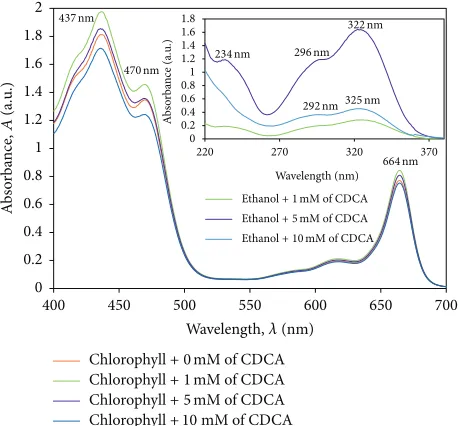
the highest absorbance at all significant peaks of chlorophyll. Therefore, it is expected that the DSSC fabricated by chloro-phyll with 1 mM CDCA would lead to the highest efficiency as more light is absorbed by the dye. However, on extending the absorbance curve into the UV region (220 nm–370 nm) (inset of Figure 5), highest absorbance peaks at 322 nm, 296 nm, and 234 nm are found for 5 mM CDCA + chlorophyll sample which may exhibit highest efficiency in corresponding DSSC. It can be seen that the intensity of absorption spectrum of chlorophyll for various concentrations of CDCA is higher compared to that of the CDCA-free chlorophyll. Even with addition of 5 mM CDCA, absorbance is still higher than that observed for chlorophyll without the additive. The absorption results show that the CDCA is a good stabilizing agent for chlorophyll dye [31].
3.3. 𝐽-𝑉Measurement on DSSCs. The DSSCs sensitized with
pure chlorophyll were illuminated with white light of inten-sity 1000 W/m2 and the photocurrent-photovoltage (𝐽-𝑉) curves were obtained. Figure 6 shows the𝐽-𝑉characteristics of DSSCs with PVA based single and double salt electrolytes. The short circuit current density (𝐽sc), open circuit voltage (𝑉oc), fill factor (FF), and efficiency (𝜂) obtained are listed in Table 3.
From Figure 6 and Table 3, it can be seen that the DSSC with PVA electrolyte containing double salts showed a higher efficiency of 2.00% compared to the DSSC with
PVA single salt electrolytes PVA double salt electrolytes 0
1 2 3 4 5 6 7
C
u
rr
en
t den
si
ty (mA
cm
−
2)
0.1 0.2 0.3 0.4 0.5 0.6 0.7
0
Voltage (V)
Figure 6:𝐽-𝑉characteristics of DSSCs with PVA based electrolytes containing single and double salts.
PVA electrolyte containing single salt which exhibited an efficiency of only 1.77%. It is to be noted that DSSC with gel polymer electrolytes and chlorophyll as the sensitizer usually exhibits efficiencies less than 1% [32–38]. The short circuit current density for DSSC with PVA double salt electrolyte is 5.96 mA cm−2. This is higher than DSSC using PVA single salt electrolyte, 4.59 mA cm−2. This is due to the addition of TPAI salt to the electrolyte which may lower the Fermi level of TiO2. As a result, the rate of electron injection into the conduction band increased giving rise to a higher current density for the DSSC with PVA double salt electrolyte. This can also imply that the rate of electron recombination to the hole in the dye and to the triiodide ion in the electrolyte has been reduced. However, the open circuit voltage for DSSC with PVA double salt electrolyte is lower than the open circuit voltage of DSSC with PVA single salt electrolyte by 5%. This result confirms that the Fermi level has been lowered towards the redox mediator potential. It can also be inferred from this result that the iodide ion conductivity is an important factor that contributes to𝐽scof solar cells with I−/I3−mediator. In terms of number density of charge carriers PVA double salt electrolyte has higher I−ions compared to the PVA single salt electrolyte. This shows that PVA double salt electrolyte can produce faster I−to I3−and I3−to I−ion exchange leading to faster regeneration of the dye molecules. The number of I−in PVA single salt electrolyte as well as the rate of redox process is lower than that in PVA double salt electrolyte.
[image:5.600.51.292.360.412.2]Photoanode soaked in TBP
0.7M of TBP
0.5M of TBP
0.3M of TBP
0.0M of TBP
0.1 0.2 0.3 0.4 0.5 0.6 0.7
0
Voltage (V) 0
1 2 3 4 5 6 7
C
u
rr
en
t den
si
ty (mA
cm
−
2)
[image:6.600.59.283.67.269.2]Figure 7: The𝐽-𝑉characteristics for DSSCs with double salt PVA electrolyte containing various amounts of TBP and that of the DSSC with photoanode soaked in TBP for 1 h.
Table 4: Performance parameters of DSSCs with double salt PVA electrolyte containing various amounts of TBP and that of the DSSC with photoanode soaked in TBP for 1 h.
Sample 𝐽sc
(mA cm−2)
𝑉oc
(V) FF 𝜂(%)
0.0 M of TBP 5.96 0.58 0.58 2.00
0.3 M of TBP 5.70 0.52 0.69 2.05
0.5 M of TBP 5.39 0.54 0.69 2.00
0.7 M of TBP 5.37 0.55 0.73 2.17
Photoanode soaked in TBP 3.71 0.64 0.72 1.69
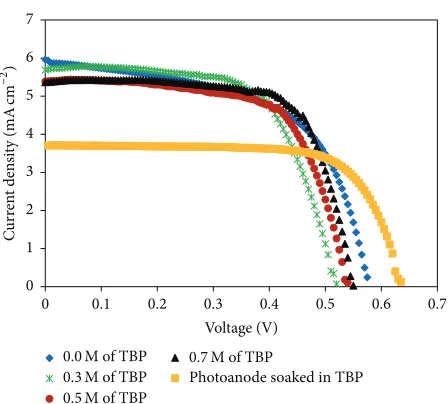
characteristics of the chlorophyll-ethanol based DSSCs with double salt electrolyte added with 0.3 M, 0.5 M, and 0.7 M TBP and the corresponding performance parameters which are also depicted in Table 4.
From Table 4, addition of 0.7 M TBP in the electrolyte increased the efficiency of DSSC by 8.5% compared to the DSSC without TBP added.
The𝐽-𝑉characteristics in Figure 7 showed that the DSSCs with double salt PVA electrolyte added with TBP exhibit a slight decrease of𝑉oc compared to the DSSC with TBP-free electrolyte. From the results, it can be inferred that the Fermi level of the TiO2 has been lowered towards the redox potential therefore leading to lower 𝑉oc. It can also
be observed that increasing the molarity of TBP to 0.5 M resulted in 𝑉oc increase. This implied that the TiO2 Fermi
level has been moved towards the conduction band edge of the semiconducting metal oxide and increased the difference between the Fermi and redox levels resulting in higher
𝑉oc, at the expense of 𝐽sc that decreased with increase in TBP concentration. The decrease in 𝐽sc also implied that less photons are being absorbed because the chlorophyll harvest has decreased. Therefore, less electrons are excited and injected into the conduction band of the metal oxide
Table 5: Performance parameters of DSSCs with PVA based double salt electrolyte and chlorophyll added with various concentrations of CDCA.
Sample 𝐽sc
(mA cm−2)
𝑉oc
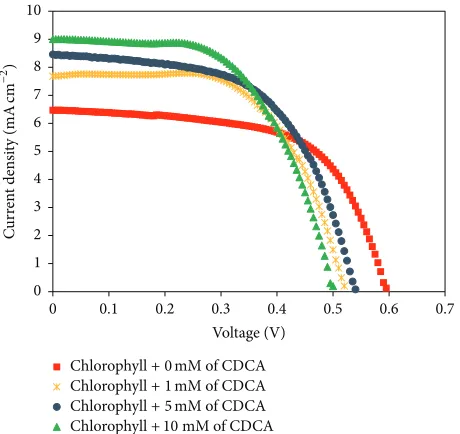
(V) FF 𝜂(%) Chlorophyll + 0 mM of CDCA 6.47 0.60 0.63 2.43 Chlorophyll + 1 mM of CDCA 7.69 0.52 0.62 2.46 Chlorophyll + 5 mM of CDCA 8.44 0.54 0.58 2.62 Chlorophyll + 10 mM of CDCA 9.00 0.50 0.58 2.60
(TiO2) semiconductor. Although 𝑉oc of the DSSC with TBP added electrolyte is lower than 𝑉oc in the DSSC with TBP-free electrolyte,𝑉ocincreases with TBP concentration, though slightly, in DSSCs containing TBP. As can be seen the DSSC with TBP-free electrolyte gives 5.96 mA cm−2 of current density, 0.58 V of open circuit voltage, 0.58 of fill factor, and 2.00% of efficiency but when the electrolyte was added with 0.7 M of TBP, the highest efficiency of 2.17% with 5.37 mA cm−2of current density, 0.55 V of voltage, and 0.73 of fill factor was obtained.
In this work, the photoanode was also soaked in TBP. For the DSSC prepared by soaking the photoanode in TBP,
𝑉ocincreased and𝐽scdecreased. This showed that the surface states of TiO2, which governed the position of the Fermi level, were more affected by soaking the photoanode with TBP compared to the addition of TBP to the electrolyte. The efficiency of the DSSC with the photoanode soaked in TBP is low because of the reduced𝐽sc, which may be attributed to the reflection and scattering of light by TBP resulting in less photon harvest by the chlorophyll. The adsorption on the TiO2surface by the pyridine ring induces electrons into the TiO2creating a surface dipole. The band edge movement reduces the driving force for electron injection and thus𝐽scis a little bit lower than in untreated cells [41]. By adding TBP to the electrolyte, this work has shown that, adding 0.7 M TBP into the electrolyte, the efficiency can be enhanced by 8.5% from 2.00% to 2.17%.
So far the strategy in enhancing the efficiency of the DSSC is by using two salts and adding TBP to the electrolyte that acted to increase the open circuit voltage and increasing the ratio of maximum obtainable power to the product of the open circuit voltage and short circuit current. It is to be remembered that chlorophyll obtained is a natural pigment that is usually unstable but has strong adhesion to rocky surface.
Figure 8 shows the 𝐽-𝑉 characteristics of DSSCs with double salt electrolyte and chlorophyll sensitizer added with different amounts of CDCA. No TBP was added to the elec-trolyte as the aim is to observe the effect of CDCA addition to the sensitizer. Table 5 lists the performance parameters of the DSSCs.
The𝐽-𝑉characteristics for chlorophyll sensitizer added with CDCA showed best performance when 5 mM of CDCA was added to chlorophyll. This cell has𝐽sc = 8.44mA cm−2,
[image:6.600.309.549.109.186.2]0.1 0.2 0.3 0.4 0.5 0.6 0.7 0
Voltage (V)
Chlorophyll+ 10mM of CDCA
Chlorophyll+ 5mM of CDCA
Chlorophyll+ 1mM of CDCA
Chlorophyll+ 0mM of CDCA
0 1 2 3 4 5 6 7 8 9 10
C
u
rr
en
t den
si
ty (mA
cm
−
2)
Figure 8: The𝐽-𝑉characteristics of DSSCs with PVA based double salt electrolytes and chlorophyll added with various concentrations of CDCA.
TiO2film decreased as the CDCA concentration in the dye sensitizer increased. This can be attributed to the competition between chlorophyll and CDCA molecules to assemble on the restricted TiO2surface although an improvement in cell performance was observed using CDCA [30]. As mentioned CDCA has large hydrophobic tail and a hydrophilic head (–COOH group) for adsorption to the TiO2surface and can reduce dye aggregation and electron recombination through the formation of a thin resistive layer on the vacant TiO2 sur-face [19–22]. Furthermore, CDCA reduces the intermolecular attraction between chlorophyll molecules resulting in dye stabilization. Li et al. [19] and Wooh et al. [20] also pointed out that adsorption of CDCA reduces the surface tension of TiO2 surface causing efficient suppression of electron recombination by hindering charged species coming from the electrolyte towards bare TiO2 sites. According to Sun et al. [42] and Garcia-Martin et al. [43] the peripheral H-bonding through carbonyl groups of chlorophyll (C-131, C-132, and C-173) can regulate spin density of chlorophyll and electron density may be redistributed around porphyrin ring; that is, porphyrin ring can be distorted from its planar shape. Subsequently, the chlorophyll molecule can be attached to TiO2surface through C-131=O⋅ ⋅ ⋅TiO2coordination (Figures 9 and 10) making electron transfer route. Kay and Gr¨aetzel [13] also pointed out the importance of free carboxyl groups for adsorption and photosensitization on TiO2. Similarly, CDCA molecules are adsorbed through –COO−⋅ ⋅ ⋅TiO2 coordination in parallel with chlorophyll. The hydrophobic portion of CDCA may insulate electron recombination and isolate individual chlorophyll molecule preventing coagula-tion. Also, the CDCA molecule may create H-bond with C-132and C-173sites which stabilize the porphyrin ring.
Therefore, the overall injection of the electron into the conduction band of TiO2[44] is increased leading to higher
O
10 8 2
4 6
12 3
5
7
11
13 17
19
1 9
15 14 18
20
O N N
N N
I II
III IV
O OH O
OH HO
O
Ti
Chlorophyll-TiO2interaction
Chenodeoxycholic acid- (CDCA-) TiO2interaction
CO2C20H39
Mg2+
131
132
171
172 O
[image:7.600.57.287.72.289.2]O O Ti
Figure 9: Chlorophyll-TiO2and CDCA-TiO2interaction on TiO2 surface.
Chlorophyll CDCA
Ti O
O CD
CA
O
Ti O O
Chlo
ro
p
h
yll
O
Ti O O
Chlo
ro
p
h
yll
O
[image:7.600.312.542.389.489.2]Ti O O
Figure 10: Schematic diagram of adsorption of Chlorophyll and CDCA molecule on TiO2surface.
𝐽scwith increasing CDCA concentration.𝐽scof the DSSC is also governed by CDCA due to suppression of dark current at the semiconductor/electrolyte junction, since CDCA blocks the surface states Ti(IV) ions that are active in the charge transfer. Due to the insulating molecular layer, the charge recombination process can be shielded, and this increases the efficiency [45]. Consequently, CDCA also shifts the Fermi level of TiO2 to more negative potential which reduces the distance with the redox potential resulting in the decrease of
𝑉occompared to the CDCA-free DSSC [46].
4. Conclusions
DSSCs with high photoelectric conversion efficiency have been prepared using chlorophyll dye extracted fromHyophila
involuta. The absorption spectrum on chlorophyll sensitizer
sensitizer produced a high power conversion efficiency of 2.00% when a PVA based double salt electrolyte was used. An addition of 0.7 M TBP to the electrolyte has improved the efficiency up to 2.17%. Addition of chenodeoxycholic acid (CDCA) can stabilize the chlorophyll and improve the efficiency of the chlorophyll based DSSCs. Much better performance was obtained with the addition of 5 mM CDCA to chlorophyll with efficiency reaching 2.62% due to better anchoring of the modified dye to the surface of TiO2.
Conflict of Interests
The authors declare that there is no conflict of interests regarding the publication of this paper.
Acknowledgments
The authors thank University of Malaya for the UMRG Programme RP003-13AFR for the funding in this project and Dr. Yong Kien Thai from Institute of Biological Sciences who confirmed the moss species.
References
[1] V. Shanmugam, S. Manoharan, S. Anandan, and R. Murugan, “Performance of dye-sensitized solar cells fabricated with extracts from fruits of ivy gourd and flowers of red frangipani as sensitizers,” Spectrochimica Acta Part A: Molecular and Biomolecular Spectroscopy, vol. 104, pp. 35–40, 2013.
[2] W. Yanmin, “Recent research progress on polymer electrolytes for dye-sensitized solar cells,”Solar Energy Materials and Solar Cells, vol. 93, no. 8, pp. 1167–1175, 2009.
[3] V. Somsongkul, C. Saekung, S. H. Thang, A. Wongchaisuwat, and M. Arunchaiya, “Composite poly(ethylene oxide) elec-trolyte modified with ethanol for dye-sensitized solar cells,” Chiang Mai Journal of Science, vol. 38, no. 2, pp. 223–230, 2011. [4] R. Kushwaha, P. Srivastava, and L. Bahadur, “Natural pigments
from plants used as sensitizers for TiO2based dye-sensitized solar cells,”Journal of Energy, vol. 2013, Article ID 654953, 8 pages, 2013.
[5] J. Wu, Z. Lan, S. Hao et al., “Progress on the electrolytes for dye-sensitized solar cells,”Pure and Applied Chemistry, vol. 80, no. 11, pp. 2241–2258, 2008.
[6] A. K. Arof, M. Naeem, F. Hameed et al., “Quasi solid state dye-sensitized solar cells based on polyvinyl alcohol (PVA) elec-trolytes containing I−/I−3 redox couple,”Optical and Quantum Electronics, vol. 46, no. 1, pp. 143–154, 2014.
[7] K. P. Radha, S. Selvasekarapandian, S. Karthikeyan, M. Hema, and C. Sanjeeviraja, “Synthesis and impedance analysis of proton-conducting polymer electrolyte PVA:NH4F,”Ionics, vol. 19, no. 10, pp. 1437–1447, 2013.
[8] K. Ryuzi, K. Motohiro, S. Kodate, A. Furube, N. Fuke, and N. Koide, “Effects of 4-tert-butylpyridine and li ions on pho-toinduced electron injection efficiency in black-dye-sensitized nanocrystalline TiO2films,”Journal of Physical Chemistry C, vol. 113, no. 48, pp. 20738–20744, 2009.
[9] X.-L. Wang, M. Wu, J. Ding, Z.-S. Li, and K.-N. Sun, “Periodic density functional theory study on the interaction mode and mechanism of typical additives with TiO2 substrates for dye-sensitized solar cell applications,”Journal of Power Sources, vol. 246, pp. 10–18, 2014.
[10] E. Alan,A Handbook of Malesian Mosses, Vol. 2: Leucobryaceae to Buxbaumiaceae, Natural History Museum Publications, Lon-don, UK, 1989.
[11] L. L. Tieszen and P. L. Johnson, “Pigment structure of some arctic tundra communities,”Ecology, vol. 49, no. 2, pp. 370–373, 1968.
[12] H. Chang, M.-J. Kao, T.-L. Chen, C.-H. Chen, K.-C. Cho, and X.-R. Lai, “Characterization of natural dye extracted from wormwood and purple cabbage for dye-sensitized solar cells,” International Journal of Photoenergy, vol. 2013, Article ID 159502, 8 pages, 2013.
[13] A. Kay and M. Gr¨aetzel, “Artificial photosynthesis. 1. Photosen-sitization of titania solar cells with chlorophyll derivatives and related natural porphyrins,”The Journal of Physical Chemistry, vol. 97, no. 23, pp. 6272–6277, 1993.
[14] P. Wang, S. M. Zakeeruddin, P. Comte, R. Charvet, R. Humphry-Baker, and M. Gr¨atzel, “Enhance the performance of dye-sensitized solar cells by co-grafting amphiphilic sensitizer and hexadecylmalonic acid on TiO2nanocrystals,”Journal of Physical Chemistry B, vol. 107, no. 51, pp. 14336–14341, 2003. [15] P. Wang, S. M. Zakeeruddin, R. Humphry-Baker, J. E. Moser,
and M. Gr¨atzel, “Molecular-scale interface engineering of TiO2nanocrystals: improve the efficiency and stability of dye-sensitized solar cells,”Advanced Materials, vol. 15, no. 24, pp. 2101–2104, 2003.
[16] P. Wang, S. M. Zakeeruddin, R. Humphry-Baker, and M. Gr¨atzel, “A binary ionic liquid electrolyte to achieve≥7% power conversion efficiencies in dye-sensitized solar cells,”Chemistry of Materials, vol. 16, no. 14, pp. 2694–2696, 2004.
[17] Z.-S. Wang, Y. Cui, Y. Dan-oh, C. Kasada, A. Shinpo, and K. Hara, “Thiophene-functionalized coumarin dye for efficient dye-sensitized solar cells: electron lifetime improved by coad-sorption of deoxycholic acid,”Journal of Physical Chemistry C, vol. 111, no. 19, pp. 7224–7230, 2007.
[18] S. Qu, W. Wu, J. Hua, C. Kong, Y. Long, and H. Tian, “New diketopyrrolopyrrole (DPP) dyes for efficient dye-sensitized solar cells,”Journal of Physical Chemistry C, vol. 114, no. 2, pp. 1343–1349, 2010.
[19] J. Li, W. J. Wu, J. B. Yang, J. Tang, Y. T. Long, and J. L. Hua, “Effect of chenodeoxycholic acid (CDCA) additive on phenoth-iazine dyes sensitized photovoltaic performance,”Science China Chemistry, vol. 54, no. 4, pp. 699–706, 2011.
[20] S. Wooh, T.-Y. Kim, D. Song et al., “Surface modification of TiO2photoanodes with fluorinated self-assembled monolayers for highly efficient dye-sensitized solar cells,” ACS Applied Materials & Interfaces, vol. 7, no. 46, pp. 25741–25747, 2015. [21] Y.-S. Yen, T.-Y. Lin, C.-Y. Hsu et al., “A remarkable enhancement
of efficiency by co-adsorption with CDCA on the bithiazole-based dye-sensitized solar cells,”Organic Electronics: Physics, Materials, Applications, vol. 14, no. 10, pp. 2546–2554, 2013. [22] J. H. Yum, S. J. Moon, R. Humphry-Baker et al., “Effect of
coad-sorbent on the photovoltaic performance of squaraine sensi-tized nanocrystalline solar cells,”Nanotechnology, vol. 19, no. 42, Article ID 424005, 2008.
[23] M. F. Aziz, M. H. Buraidah, and A. K. Arof, “Dye-sensitized solar cells using binary iodide-PVA gel electrolyte,” in Pro-ceedings of the International Conference on Transparent Optical Networks, Cartagena, Spain, June 2013.
[25] A. Subramania, E. Vijayakumar, N. Sivasankar, A. R. Sathiya Priya, and K.-J. Kim, “Effect of different compositions of ethylene carbonate and propylene carbonate containing iodide/ triiodide redox electrolyte on the photovoltaic performance of DSSC,”Ionics, vol. 19, no. 11, pp. 1649–1653, 2013.
[26] B. C. Mphande and A. Pogrebnoi, “Impact of extraction methods upon light absorbance of natural organic dyes for dye sensitized solar cells application,”Journal of Energy and Natural Resources, vol. 3, no. 3, pp. 38–45, 2014.
[27] Y. Amao and T. Komori, “Bio-photovoltaic conversion device using chlorine-e6 derived from chlorophyll from Spirulina adsorbed on a nanocrystalline TiO2film electrode,”Biosensors & Bioelectronics, vol. 19, no. 8, pp. 843–847, 2004.
[28] P. Y. Bruice, Organic Chemistry, Pearson Education, Upper Saddle River, NJ, USA, 2004.
[29] A. Hagfeldt, G. Boschloo, L. Sun, L. Kloo, and H. Pettersson, “Dye-sensitized solar cells,”Chemical Reviews, vol. 110, no. 11, pp. 6595–6663, 2010.
[30] K.-M. Lee, C.-Y. Chen, S.-J. Wu, S.-C. Chen, and C.-G. Wu, “Surface passivation: the effects of CDCA co-adsorbent and dye bath solvent on the durability of dye-sensitized solar cells,”Solar Energy Materials and Solar Cells, vol. 108, pp. 70–77, 2013. [31] C.-L. Lee, W.-H. Lee, and C.-H. Yang, “High efficiency of
dye-sensitized solar cells based on ruthenium and metal-free dyes,” International Journal of Photoenergy, vol. 2013, Article ID 250397, 6 pages, 2013.
[32] G. R. A. Kumara, S. Kaneko, M. Okuya, B. Onwona-Agyeman, A. Konno, and K. Tennakone, “Shiso leaf pigments for dye-sensitized solid-state solar cell,”Solar Energy Materials and Solar Cells, vol. 90, no. 9, pp. 1220–1226, 2006.
[33] B.-Q. Liu, X.-P. Zhao, and W. Luo, “The synergistic effect of two photosynthetic pigments in dye-sensitized mesoporous TiO2 solar cells,”Dyes and Pigments, vol. 76, no. 2, pp. 327–331, 2008. [34] H. Chang, H. M. Wu, T. L. Chen, K. D. Huang, C. S. Jwo, and Y. J. Lo, “Dye-sensitized solar cell using natural dyes extracted from spinach and ipomoea,”Journal of Alloys and Compounds, vol. 495, no. 2, pp. 606–610, 2010.
[35] H. Zhou, L. Wu, Y. Gao, and T. Ma, “Dye-sensitized solar cells using 20 natural dyes as sensitizers,”Journal of Photochemistry and Photobiology A: Chemistry, vol. 219, no. 2-3, pp. 188–194, 2011.
[36] K. I. Kimpa, M. Momoh, K. U. Isah, H. N. Yahya, and M. M. Ndamitso, “Photoelectric characterization of dye sensitized solar cells using natural dye fromPawpaw LeafandFlame Tree Floweras Sensitizers,”Materials Sciences and Applications, vol. 3, no. 5, pp. 281–286, 2012.
[37] S. A. Taya, T. M. El-Agez, H. S. El-Ghamri, and M. S. Abdel-latif, “Dye-sensitized solar cells using fresh and dried natural dyes,” International Journal of Materials Sciences and Applications, vol. 2, pp. 37–42, 2013.
[38] N. A. Ludin, A. M. A.-A. Mahmoud, A. B. Mohamad, A. A. H. Kadhum, K. Sopian, and N. S. Abdul Karim, “Review on the development of natural dye photosensitizer for dye-sensitized solar cells,”Renewable and Sustainable Energy Reviews, vol. 31, pp. 386–396, 2014.
[39] T. Stergiopoulos, E. Rozi, C.-S. Karagianni, and P. Falaras, “Influence of electrolyte co-additives on the performance of dye-sensitized solar cells,”Nanoscale Research Letters, vol. 6, article 307, 2011.
[40] B. Lee, D. B. Buchholz, P. Guo, D.-K. Hwang, and R. P. H. Chang, “Optimizing the performance of a plastic dye-sensitized solar
cell,”The Journal of Physical Chemistry C, vol. 115, no. 19, pp. 9787–9796, 2011.
[41] L. Yafeng, Z. Xiangzhen, Z. Huixing, G. Binbin, P. Aiying, and W. Mingdeng, “Improving the efficiency of dye-sensitized Zn2SnO4solar cells: the role of Al3+ions,”Electrochimica Acta, vol. 56, pp. 9257–9261, 2011.
[42] Y. Sun, H. Wang, F. Zhao, and J. Sun, “The effect of axial Mg2+ ligation and peripheral hydrogen bonding on chlorophylla,” Chemical Physics Letters, vol. 387, no. 1–3, pp. 12–16, 2004. [43] A. Garcia-Martin, L. G. Kwa, B. Strohmann, B. Robert, A. R.
Holzwarth, and P. Braun, “Structural role of (bacterio)chloro-phyll ligated in the energetically unfavorable𝛽-position,”The Journal of Biological Chemistry, vol. 281, no. 15, pp. 10626–10634, 2006.
[44] K. D. Seo, M. J. Lee, H. M. Song, H. S. Kang, and H. K. Kim, “Novel D-𝜋-A system based on zinc porphyrin dyes for dye-sensitized solar cells: synthesis, electrochemical, and photo-voltaic properties,”Dyes and Pigments, vol. 94, no. 1, pp. 143– 149, 2012.
[45] S. Ito, H. Miura, S. Uchida et al., “High-conversion-efficiency organic dye-sensitized solar cells with a novel indoline dye,” Chemical Communications, no. 41, pp. 5194–5196, 2008. [46] N. R. Neale, N. Kopidakis, J. van de Lagemaat, M. Gr¨atzel,
Submit your manuscripts at
http://www.hindawi.com
Hindawi Publishing Corporation
http://www.hindawi.com Volume 2014
Inorganic Chemistry
International Journal of
http://www.hindawi.com Volume 2014
Hindawi Publishing Corporation
http://www.hindawi.com Volume 2014
Carbohydrate
Chemistry
International Journal of
Hindawi Publishing Corporation
http://www.hindawi.com Volume 2014 Journal of
Chemistry
http://www.hindawi.com Volume 2014
Hindawi Publishing Corporation http://www.hindawi.com
Analytical Methods in Chemistry
Journal of
Volume 2014
Bioinorganic Chemistry and Applications Hindawi Publishing Corporation
http://www.hindawi.com Volume 2014
Spectroscopy
International Journal ofHindawi Publishing Corporation
http://www.hindawi.com Volume 2014
The Scientific
World Journal
Hindawi Publishing Corporation
http://www.hindawi.com Volume 2014
http://www.hindawi.com Volume 2014
Chromatography Research International Hindawi Publishing Corporation
http://www.hindawi.com Volume 2014
Applied ChemistryJournal of Hindawi Publishing Corporation
http://www.hindawi.com Volume 2014
Hindawi Publishing Corporation
http://www.hindawi.com Volume 2014
Theoretical Chemistry
Journal of Hindawi Publishing Corporation
http://www.hindawi.com Volume 2014 Journal of
Spectroscopy
http://www.hindawi.com Volume 2014
Journal of
Hindawi Publishing Corporation
http://www.hindawi.com Volume 2014 Quantum Chemistry
http://www.hindawi.com Volume 2014
Electrochemistry
International Journal ofHindawi Publishing Corporation
http://www.hindawi.com Volume 2014
Hindawi Publishing Corporation
http://www.hindawi.com Volume 2014