Sutcliffe, R and Linfield, R and Riley, G and Nabb, D and Glazzard, J (2019) The search for 100% satisfaction with feedback. Teacher Education Advancement Network Journal, 11 (3). pp. 35-47. ISSN 2054-5266
Link to Leeds Beckett Repository record: http://eprints.leedsbeckett.ac.uk/6145/
Document Version: Article
The aim of the Leeds Beckett Repository is to provide open access to our research, as required by funder policies and permitted by publishers and copyright law.
The Leeds Beckett repository holds a wide range of publications, each of which has been checked for copyright and the relevant embargo period has been applied by the Research Services team.
We operate on a standard take-down policy. If you are the author or publisher of an output and you would like it removed from the repository, please contact us and we will investigate on a case-by-case basis.
FEEDBACK
Citation
Sutcliffe, R., Linfield, R., Riley, G., Nabb, D. & Glazzard, J. (2019) ‘The search for 100% satisfaction with feedback’, TEAN journal 12(1), pp.
The search for 100% satisfaction with feedback
Teacher Education Advancement Network Journal
Copyright © 2019 University of
Cumbria Vol 12(1) pages
Ruth Sutcliffe, Rachel Linfield, Gaynor Riley, Debbie Nabb and Jonathan Glazzard Leeds Beckett University
Abstract
The National Student Survey (NSS) frequently highlights students’ dissatisfaction with feedback. Data
collected over the past two years by tutors working on a Batchelor of Arts (Honours) Primary Education 5-11 programme, leading to Qualified Teacher Status (QTS), shows increasing satisfaction as students engage with and use feedback. The initiatives outlined in this longitudinal, action research study have shown that face-to-face, oral communication is at the heart of student satisfaction. Speaking with students is key in helping them to reflect upon the variety of feedback, understand its relevance and consequently to act upon it in practical ways. The research suggests that rather than searching for a perfect model of feedback, we should work towards changing the way that students view, access and respond to the variety of feedback offered. The study shows enhancing student engagement with feedback through a range of improved measures, can impact on student satisfaction ratings such as those in the NSS. The paper argues that by working together in partnership, students and tutors could move closer to achieving the elusive 100% satisfaction for feedback.
Key words
Accountability; feedback; league tables; National Student Survey (NSS); student engagement; student satisfaction
Introduction
It is well known that providing feedback for assessments, that informs learning, can be challenging. This is frequently illustrated in the United Kingdom (UK) by results from the annual National Student Survey (NSS), which is completed by students in their final year of study at all publicly funded Higher Education Institutions (HEIs) in England, Wales, Northern Ireland, and the majority in Scotland (Office for Students, 2019, online). This survey consistently shows that not all students find the feedback that they receive effective. Similarly, league tables produced by UK national newspapers such as The Guardian (The Guardian, 2018, online) show that even universities with high overall course satisfaction ratings of 80+% still fail to gain similar satisfaction ratings when it comes to assessment and feedback. This study considers what students enrolled on a Batchelor of Arts, (BA) Honours Primary Education (5-11) with Qualified Teachers Status, (QTS) perceive ‘helpful’ feedback to be and how they can be encouraged to engage with and use that feedback.
Literature review
FEEDBACK
significant impact on improving student satisfaction ratings in UK surveys (Nicol, Thomson & Breslin, 2014). Rather, it is the way in which the feedback is discussed, with dialogue at the heart, that could further impact student satisfaction ratings.
Effective feedback for students is a critical strategy within teaching and learning and is usually associated with feedback that is timely and appropriate, (Ramsden, 2003), and suited to the needs of the student (Knight & Yorke, 2003). Several studies suggest that feedback that is timely and constructive will enhance student achievement, (Gibbs and Simpson, 2004) as the feedback will provide students with appropriate skills and knowledge to apply to subsequent assessments (Boud, 2007). Equally, feedback that is delivered too late or does not provide clear guidance to support improvements, may be considered not useful by students and not used for future work, (Weaver, 2006; Bevan, Badge & Cann, 2008).
Research shows that student engagement with feedback is one of the critical elements for successful student learning and achievement, (Price, Handley & Millar, 2010). However, research suggests that students do not always make the most of their feedback, and there is evidence that this leads to frustration for tutors, (King, McGugan & Bunyan, 2008). Yet some students, particularly first year students, may not know how or why to engage with feedback (Thompson & Lee, 2012). This may be particularly so when feedback is provided online, via Turnitin, which is an online service to detect plagiarism and used as a tool for tutors to mark and grade assignments (Turnitin, 2019, online). For students to learn successfully from feedback, they need to understand it, interrogate it and apply it to subsequent assessments (Price, Handley & Millar, 2011). This suggests that learning successfully stems from a readiness to understand feedback in order to feed-forward (Dann, 2019). Students should also understand the rationale and criteria for the assessment to engage constructively with feedback (Duncan, 2007). Nicol (2010) advocates providing students with opportunities to assess previous
students’ work against the assessment criteria to identify strengths and weaknesses. This active
engagement with the assessment criteria enables students to understand and demonstrate the features required for different levels of performance.
A socio-constructivist approach to assessment through which students peer assess each other’s work
against the assessment criteria and then share their feedback, supports students to engage actively with the assessment criteria, (Price et al., 2011). Peer feedback has gained increasing interest in recent years (Cartney, 2010). It is a process through which students evaluate and make judgements about the work of their peers (Nicol, Thomson & Breslin, 2014). Research indicates that students find peer feedback more beneficial than tutor feedback as it is often written using more accessible language (Falchikov, 2005) whilst tutor feedback tends to include generic strengths and weaknesses rather than commenting on the specifics (Nicol, Thomson & Breslin, 2014). Research suggests that the process of evaluating the work of their peers triggers a reflective process for themselves, allowing them to use the feedback they have generated for others to update their own thinking and assessments (ibid, 2014). This is supported by Cowan (2010) who stated that the ability to make judgements of others’
work and produce a written evaluation is a professional skill that underpins critical thinking and reflective capabilities, and is perceived very positively in the workplace. Self-assessment of work against the assessment criteria is also another strategy for facilitating student engagement with assessment criteria. Tutors are usually skilled at preparing students for assessment tasks but may pay less attention to being explicit about the standards that students need to demonstrate to achieve specific levels of performance and may give less attention to increasing the visibility of what
performance ‘looks like’ across different grade bands. The processes of peer and self-assessment facilitate these processes very effectively.
FEEDBACK
Targets on summative assessments need to be sufficiently generic so that students can apply these to their next assignment. Encouraging students to reflect in each assignment on how they have addressed the targets on the previous assessment is one way of encouraging students to engage with feedback, (ibid).
Literature suggest that students value feedback which is easy to read (Hepplestone & Chikwa, 2014), and in written format. However, although most feedback is provided in a written format, a variety of modes can be used including dialogic, audio and video feedback. Whilst dialogic feedback was once a common practice in higher education, written feedback is now more common (Nicol, 2010), possibly due to the massification and marketisation of higher education. However, research suggests that students prefer verbal feedback through dialogue between students and tutors. Dialogic feedback can facilitate negotiation, clarify misconceptions and create discussion (Yang & Carless, 2013). Feedback
dialogues are defined as ‘a collaborative discussion about feedback between a tutor and student, or student and students, which enables a shared understanding and provides opportunities for further
development’ (Blair & McGinty, 2013, pp.1-2).
Seminal research has highlighted the importance of dialogic feedback in raising standards for many years (Black & Wiliam, 1998). Blair & McGinty (2013) and Sutcliffe, Linfield & Geldart (2015) found that students valued being able to discuss feedback in one-to-one tutorials with a tutor, and that creating a conversation about the assessment could provide feedback that enabled students to expand their ideas through asking questions and seeking clarification. However, the use of academic jargon by tutors could result in students not being able to engage with feedback (Ivanic, Clark and Rimmershaw, 2000) and so it is critical that tutors support their feedback with examples to which students can
relate. Blair & McGinty (2013) use the term ‘feedback negotiation’ to represent a two-way discussion between the tutor and the student. In this process, power differentials are eradicated and students are supported to contribute actively to the feedback. Students may initially resist this process by assuming a passive rather than an active role (Blair and McGinty, 2013) in feedback. They may assume that feedback is something that they should receive rather than something they should contribute to, and they may view the tutor rather than themselves as the expert. Tutors therefore need to support students to understand that assessment and feedback is most effective when students and academic staff work in partnership. This switch from a transmission paradigm to a social constructivist paradigm was advocated nearly two decades ago (Barr & Tagg, 1995), although this area is still largely under-researched (Blair & McGinty, 2013).
FEEDBACK
Feedback is within the top ten influences of learning (Hattie, 2009) and different forms of feedback can have strikingly different consequences. It is important that no matter in what format feedback is given, there must be opportunities for feed-forward (Morris & Chikwa, 2016); principally through meaningful discussion. Overall, there is a paucity of research which explores students’ perspectives of
feedback (Poulos & Mahony, 2008).
Aims of the study
This longitudinal study adds to existing literature by investigating, from a socio-constructivist perspective, student satisfaction with feedback. It examines students’ perspectives of feedback from
one cohort in the School of Education in a Higher Education Institution. In the National Student Survey,
students are asked to consider whether they have received ‘helpful’ comments on their work. This
study uses an action research model to investigate what they perceive to be ‘helpful’ and ‘less helpful’ feedback; whether there is an element of ‘readiness’ when receiving and engaging with feedback and
how tutors can best support student engagement to ensure that feedback is at its most efficacious. In deepening our understanding of these perceptions, an aim is also to improve the NSS score for student satisfaction with feedback on the BA (Hons) Primary Education (5-11) course. Through thematic analysis, several areas for discussion emerged. Knowledge of student expectations for receiving and acting upon feedback and the responsibility for both tutors and students to engage with the process is developed. A model for responsibilities within the ‘feedback cycle’ is proposed.
Research methodology
The longitudinal study took place over a two-year period. The research questions were:
• What do students perceive as ‘helpful feedback’?
• Is there a notion of ‘readiness’ for students to engage with and understand feedback?
• How can tutors provide effective support to enable students to engage with, and use, feedback?
• Is it possible to achieve 100% student satisfaction with feedback in Higher Education (HE)?
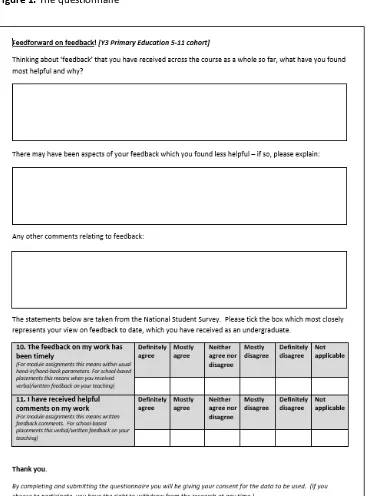
The participant sample was opportunistic consisting of a cohort of 96 undergraduate students studying on a Bachelor of Arts (BA) Honours Primary Education (5 – 11) with Qualified Teacher Status (QTS) course. Data was collected using a questionnaire administered at the start of the students’
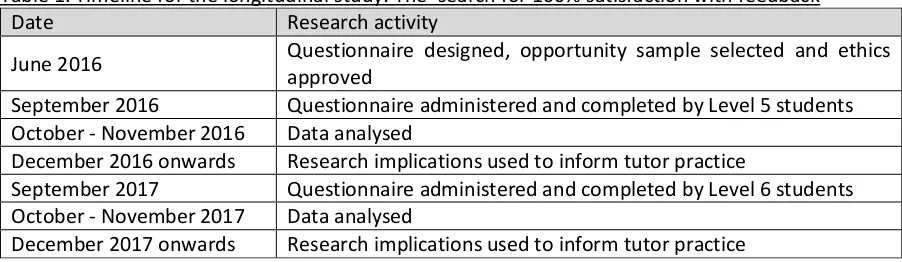
[image:5.595.72.523.544.675.2]second year of study (Level 5 students), when they had already experienced receiving feedback from one year of the course (Figure 1). It was then repeated with the same cohort of students at the start of the third, and final, year of their undergraduate degree (Level 6) (Table 1).
Table 1. Timeline for the longitudinal study: The ‘search for 100% satisfaction with feedback’
Date Research activity
June 2016 Questionnaire designed, opportunity sample selected and ethics
approved
September 2016 Questionnaire administered and completed by Level 5 students
October - November 2016 Data analysed
December 2016 onwards Research implications used to inform tutor practice
September 2017 Questionnaire administered and completed by Level 6 students
October - November 2017 Data analysed
December 2017 onwards Research implications used to inform tutor practice
FEEDBACK
Qualitative questions were:
1. Thinking about feedback that you have received across the course as a whole, so far, what have you found most helpful and why?
2. There may have been aspects of your feedback that you found less helpful – if so, please explain.
3. Any other comments relating to feedback.
Quantitative data was collected through asking students to respond to two statements taken from the
previous year’s National Student Survey:
• Q10: The feedback on my work has been timely.
• Q11: I have received helpful comments on my work, (NSS, 2016).
[image:6.595.75.443.259.755.2]Students were asked to rate the statements using a 6-point Likert scale of agreement ‘definitely agree’, ‘mostly agree’, ‘neither agree nor disagree’, ‘mostly disagree’, ‘definitely disagree’, and ‘not applicable’.
FEEDBACK
Before administering the questionnaires, students were informed of the ethics governing the research. All were made aware that the questionnaires were anonymous, participation was voluntary and that they had the right to withdraw from the research at any point. All the questionnaires administered were returned and used within the analysis of data. Throughout the research ethical guidelines, as outlined by the British Educational Research Association (BERA) were adhered to, (BERA, 2018, online).
Following the six phases of thematic analysis, as identified by Braun & Clarke (2006), all student responses from the questions seeking qualitative data were listed, read by all the researchers and through an initial process of open coding, themes were established. The NSS questions, (quantitative data) were analysed to discover the degree to which students were satisfied with feedback. The
responses ‘definitely agree’ and ‘mostly agree’ were combined to give a percentage satisfaction. Results and discussion
Year one of the study, (Level 5 students)
Analysis of the questionnaires showed an overall 75% satisfaction rating. A diverse range of qualitative responses was collected and it could be seen that some types of feedback were rated both ‘helpful’
and ‘less helpful’.
Thematic analysis highlighted three types of feedback as sources for comments by students, namely written, oral and peer. When asked for examples of ‘helpful feedback’, the majority of students found
written feedback helpful, as illustrated by the comment ‘written feedback is something you can keep
going over - I found it very useful’. However, another student commented that when written feedback was received, they did not find it helpful because ‘I just skim through it.’ A number of students mentioned ‘peer feedback’ as being valuable, commenting they liked it because ‘we can compare what
we have done and collect ideas’. In contrast, one student stated bluntly ‘peer feedback’ was an example of ‘less helpful feedback’. Many students indicated that they ‘valued’ and ‘welcomed’ spoken
feedback and tutorials. Personal sessions with tutors were highlighted as being beneficial: ‘written
feedback can be orally explained to me … I find this incredibly useful’ (Table 2).
Table 2.Examples of feedback designated by students to be both helpful and unhelpful, from year 1 of the study.
Feedback Type
Aspects of feedback students received that was found helpful
Aspects of feedback students received that was found less helpful
Writt
en
• Written feedback referring specifically to my own work.
• Written feedback is something you can keep going over – found very useful.
• Clear and thought out critique that pinpoints mistakes.
• Annotations for written work.
• Written feedback – I just skim through it.
• When it’s not specific enough - says what to improve, not how.
• Words such as ‘reflect’, ‘critically evaluate’…’
FEEDBACK
Oral (
Sp
o
ke
n
)
• Personal sessions with tutors where written feedback can be orally explained.
• Actually speaking to the teacher about a particular piece of written work.
• Sessions where tutors have answered any questions or misunderstandings positively and have taken the time to help.
• Formative feedback on drafts.
• Oral feedback, particularly in groups.
• Tutorials.
• Don’t like to be forced to go to tutorials if I don’t feel like I need feedback.
• Very simple and blunt replies (to emails) and during tutorials.
P
ee
r • Peer assessment – we can compare what we have done with others and collect ideas.
• Class group discussions
• Peer assessments.
• Peer to peer – feedback not detailed/ consistent /accurate.
Thus, for each aspect of feedback highlighted as ‘helpful’ a counter comment could be found within the questionnaires; no single method satisfied all students. In addition, within the questionnaire comments, a notion of ‘readiness’ emerged where all students did not always appear to want to
engage with or take responsibility to use the offered feedback. It was also debatable whether some students understood fully, how to use and interpret feedback as they struggled to translate the
‘academic’ feedback vocabulary. The following phrases are typical examples of terminology used within UK HEIs linked to module learning outcomes: ‘demonstrate an ability to synthesise theory and
practice’; ‘critically interpret evidence’; ‘critically reflect upon …’. Furthermore, some students were unable to recognise how generic feedback terms taken from assessment criteria, given for many within the cohort, still had meaning and value for them as individuals.
These findings correspond with the literature. Improving student satisfaction with feedback is less to do with enhancing the quality of feedback per se, for example, promptness, clarity and level of detail (Nicol, Thomson & Breslin, 2014) and more about the levels to which students engage with existing feedback types. As Price, Handley and Millar, (2011) suggest, for students to learn successfully from feedback they need to understand, interrogate and apply it to subsequent assessments. It is suggested that informed conversations with tutors, who know students on both a personal and academic level and can therefore assess levels of ‘readiness’, is key to unlocking students’ understanding of their
strengths and areas for development. Indeed, it is understood that to preserve worth and self-esteem, motivation and confidence, tutors need to consider the psychological impact of their feedback (Poulos & Mahony, 2008). Informed conversations with known tutors brokers the space between the meta-language of feedback in all its forms, including both academic feedback and feedback from professional placements, and the meaningful developmental messages it contains.
Following these conclusions, findings were shared with senior leaders in the School of Education in order to inform development on helpful feedback through the Personal Tutoring system. (In the School of Education, Personal Tutors are tutors responsible for supporting a number of students academically and pastorally throughout the course of the degree.) The following actions were agreed:
• The School of Education’s Personal Tutor Handbook was developed further with guidelines on meeting structure and content at various points throughout the academic year; these included focused conversations on feedback and implications for professional and academic practice.
• As a pilot year, additional deployment hours were given (one hour per student, per year) for Personal Tutors to meet with Personal Tutees to allow for in-depth discussion of feedback received.
FEEDBACK
[image:9.595.74.520.144.298.2]
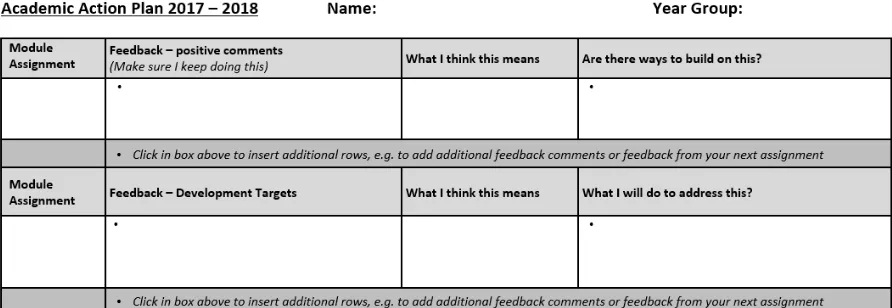
with, understand and use, feedback received over the course. The proforma encouraged students to recognise positive elements of feedback in addition to using it constructively for future development, (Wheatley, 2015).
Figure 2: The Academic Action Plan proforma
Year two of the study, (Level 6 students)
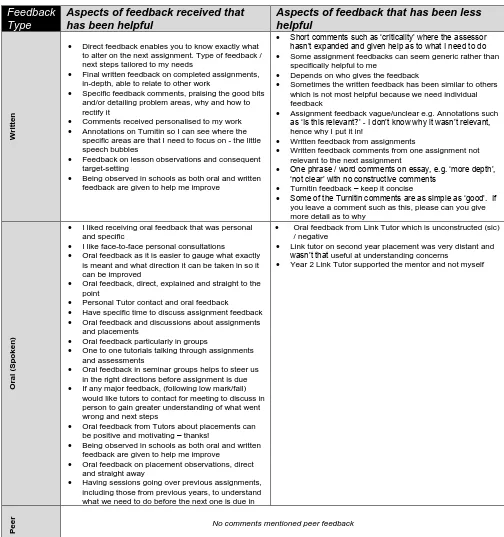
Analysis of the questionnaires from the second year of the research showed an overall 91% satisfaction rating, an increase of 16% from the previous year. Once again, written feedback was
viewed as both ‘helpful’ and ‘less helpful’. There was a significant increase in the number of comments made relating to oral feedback. In contrast to written feedback, oral feedback received minimal negative comments; only three students expressed dislike for the oral feedback they had received, whilst on a professional placement. Peer feedback was not mentioned by the students, even though peer assessment and feedback remained a feature of the taught programme. (Table 3)
FEEDBACK
[image:10.595.76.580.102.639.2]
Table 3.Examples of feedback designated by students to be both helpful and less helpful, from year 2 of the study.
Feedback Type
Aspects of feedback received that has been helpful
Aspects of feedback that has been less helpful W ri tt e n
• Direct feedback enables you to know exactly what to alter on the next assignment. Type of feedback / next steps tailored to my needs
• Final written feedback on completed assignments, in-depth, able to relate to other work
• Specific feedback comments, praising the good bits and/or detailing problem areas, why and how to rectify it
• Comments received personalised to my work
• Annotations on Turnitin so I can see where the specific areas are that I need to focus on - the little speech bubbles
• Feedback on lesson observations and consequent target-setting
• Being observed in schools as both oral and written feedback are given to help me improve
• Short comments such as ‘criticality’ where the assessor hasn’t expanded and given help as to what I need to do
• Some assignment feedbacks can seem generic rather than specifically helpful to me
• Depends on who gives the feedback
• Sometimes the written feedback has been similar to others which is not most helpful because we need individual feedback
• Assignment feedback vague/unclear e.g. Annotations such as ‘Is this relevant?’ - I don’t know why it wasn’t relevant, hence why I put it in!
• Written feedback from assignments
• Written feedback comments from one assignment not relevant to the next assignment
• One phrase / word comments on essay, e.g. ‘more depth’, ‘not clear’ with no constructive comments
• Turnitin feedback – keep it concise
• Some of the Turnitin comments are as simple as ‘good’. If you leave a comment such as this, please can you give more detail as to why
Ora
l
(S
poke
n)
• I liked receiving oral feedback that was personal and specific
• I like face-to-face personal consultations
• Oral feedback as it is easier to gauge what exactly is meant and what direction it can be taken in so it can be improved
• Oral feedback, direct, explained and straight to the point
• Personal Tutor contact and oral feedback
• Have specific time to discuss assignment feedback
• Oral feedback and discussions about assignments and placements
• Oral feedback particularly in groups
• One to one tutorials talking through assignments and assessments
• Oral feedback in seminar groups helps to steer us in the right directions before assignment is due
• If any major feedback, (following low mark/fail) would like tutors to contact for meeting to discuss in person to gain greater understanding of what went wrong and next steps
• Oral feedback from Tutors about placements can be positive and motivating – thanks!
• Being observed in schools as both oral and written feedback are given to help me improve
• Oral feedback on placement observations, direct and straight away
• Having sessions going over previous assignments, including those from previous years, to understand what we need to do before the next one is due in
• Oral feedback from Link Tutor which is unconstructed (sic) / negative
• Link tutor on second year placement was very distant and wasn’t that useful at understanding concerns
• Year 2 Link Tutor supported the mentor and not myself
P
e
e
r
No comments mentioned peer feedback
Results from the second year of the study once again illustrated that no single method of feedback suited all students. There was, however, evidence that many students were appreciative of the feedback they received, with questionnaires revealing a greater proportion of comments relating to
FEEDBACK
comments indicated that students failed to realise that feedback from one assignment might be applicable in the future to assignments of a similar nature, rather than as a chronological stepping-stone from one assignment to another. Furthermore, students did not always recognise that short
comments such as ‘good’ or ‘not clear’, perhaps given through online comments within the body of an essay via Turnitin, necessitate the need to apply independent thought. One student wrote ‘If you
leave a comment such as this, please can you give more detail as to why.’ The student had not considered why the comment had been made within the context of the assignment brief and marking criteria.
In Year 1 of the study, comments on feedback tended to relate to summative feedback, following an assignment. In Year 2 there appeared to be greater recognition of the variety of types of feedback given on professional degree courses. Thus, comments related to helpful feedback included:
• Oral formative feedback: ‘Oral feedback in seminar groups helps to steer us in the right
directions before assignment is due’
• Summative feedback: ‘Final written feedback on completed assignments, in-depth, able to
relate to other work’
• Feedback given on professional placements: ‘Oral feedback from tutors about placements can be positive and motivating – thanks!’
This recognition is an important development for students on a professional course such as teacher training, where feedback is given in multiple forms and contexts. In the future, student responses to
the NSS question ‘I have received helpful comments on my work’ may reflect these nuances. Indeed, an upturn is already evident in the formal NSS rating for this question, for this course, with a 24% increase from 2017 to 2018, resulting in an overall score of 84%. It is suggested that the increase in overall satisfaction with feedback in both this longitudinal study and the NSS score is clearly related. The enhanced Personal Tutoring system from Year 1 to Year 2 of this study supports students in their
‘readiness’ to engage with the developmental messages their feedback contains.
As with the first year of the study, the key results were shared with senior leaders and colleagues and led to the following actions:
• Additional deployment hours given for Personal Tutor meetings, initially as a pilot, were continued.
• The School of Education’s Personal Tutor Handbook included increased detail relating to the use of feedback for targets and students’ further academic and professional development.
• The Academic Action Plan proforma (Figure 2) became further embedded as part of the Personal Tutoring system.
FEEDBACK
[image:12.595.69.508.108.268.2]
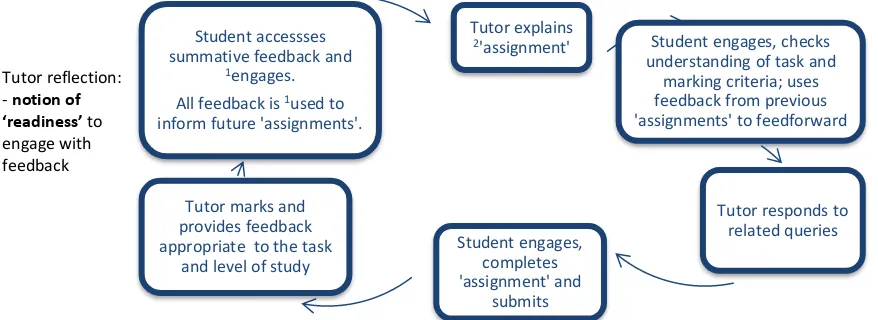
Figure 3: Responsibilities for Student and tutor Engagement in the Feedback Cycle
1 Includes tutorial with Personal Tutor to check students understand, and use, the feedback
from a term/year of assignments
2‘Assignment’ includes written tasks, presentations and professional placements. Conclusion
The results for this longitudinal study investigating feedback that students perceive as ‘helpful’, may appear initially as unsurprising. Students are individuals and each is likely to have a preferred way of learning, matched to a desired method and type of feedback. Clearly, within a large cohort it is unlikely that we can ever provide all students with their own preferences 100% of the time and for that reason, 100% satisfaction with feedback is arguably impossible. We should therefore start to view the data from research, surveys and league tables, which provide information on student satisfaction in a more realistic way and accept that we are never likely to be able to change our methods of feedback to satisfy all students. The study has shown that rather than search for a perfect model of feedback, in terms of types of feedback, we should work towards changing the way that students view, access and respond to the variety of feedback offered.
The initiatives outlined in this study have shown that ensuring positive engagement with a range of feedback through active discourse with students on this professional course, forces the notion of student ‘readiness.’ Face-to-face, oral communication is at the heart of student satisfaction with feedback. This could be through one-to-one conversations, small group and whole class times and, as described within this longitudinal study, Personal Tutor meetings. Speaking with students is key in helping them to reflect upon the variety of feedback, understand its relevance and consequently to act upon it in practical ways. By working together in partnership, students and tutors could come closer to achieving the elusive 100% satisfaction for feedback.
Acknowledgements
Thanks are given to Ros Geldart who contributed to the first year of the study when working as a Senior Lecturer at Leeds Beckett University.
Tutor explains
2'assignment' Student engages, checks
understanding of task and marking criteria; uses feedback from previous 'assignments' to feedforward
Tutor responds to related queries Student engages,
completes 'assignment' and
submits Tutor marks and
provides feedback appropriate to the task
and level of study Student accessses summative feedback and
1engages.
All feedback is 1used to
inform future 'assignments'.
FEEDBACK
References
Bandura. A. (ed.) (1997), Self-efficacy in Changing Societies, Cambridge University Press, Cambridge Barr, R. B., & Tagg, J. (1995) From teaching to learning – a new paradigm for undergraduate education.
Change, 27, pp.12-25.
Bevan, R., Badge, J., & Cann, A. (2008) Seeing eye-to-eye? Staff and student views on feedback. Bioscience Education, 12(1), pp.1-15.
Black, P., & Wiliam, D. (1998) Assessment and classroom learning. Assessment in Education: Principles, Policy and Practice, 5(1), pp.7-74.
Blair, A. A., & McGinty, S. (2013) Feedback-dialogues: exploring the student perspective. Assessment & Evaluation in Higher Education, 38(4), 466-476. doi:10.1080/02602938.2011.649244 Boud, D. (2007) Reframing assessment as if learning were important. In D. Boud & N. Falchikov. (Eds.)
Rethinking assessment in higher education: Learning for the longer term. pp.14-25. London: Routledge
Boud, D., & Molloy, E. (2012) Rethinking models of feedback for learning: The challenge of design. Assessment & Evaluation in Higher Education, 38, 698–712. doi:10.1080/ 02602938.2012.691462.
Braun, V. and Clarke, V. (2006) Using thematic analysis in psychology. Qualitative Research in Psychology, 3 (2). pp. 77-101.
British Educational Research Association (BERA) (2011) Ethical guidelines for educational research. Available at: https://www.bera.ac.uk/researchers-resources/publications/ethical-guidelines-for-educational-research-2011 (Accessed: 1 June 2016).
Brunit, S., Huguet, P., & Monteil, J. M. (2000) Performance feedback and self-focused attention in the classroom: When past and present interact. Social Psychology of Education, 3, 277-293. Cartney, P. (2010) Exploring the Use of Peer Assessment as a Vehicle for Closing the Gap Between
Feedback Given and Feedback Used. Assessment & Evaluation in Higher Education, 35(5), pp.551-564.
Cowan, J. (2010) Developing the Ability for Making Evaluative Judgements. Teaching in Higher Education, 15(3), pp.323-334.
Dann, R. (2019) Feedback for Learning: reconciling policy and practice in the classroom. Association for the Study of Primary Education Bulletin, Issue 4.
Dempsey, V. J., Driscoll, M. P., & Litchfield, B. C. (1993) Feedback, retention, discrimination, error and feedback study time. Journal of Research on Computing in Education, 25(3), pp.303-326. Duncan, N. (2007) Feed-forward: Improving students’ use of lecturers’ comments. Assessment and
Evaluation in Higher Education, 32.pp.271-283.
Falchikov, N. (2005) Improving Assessment through Student Involvement. London: Routledge-Falmer. Garrison, D. R., & Anderson, T. (2003) E-Learning in the 21st century: A framework for research and
practice. London, UK: Routledge/Falmer
Gibbs, G., & Simpson, C. (2004) Conditions under which assessment supports learning. Learning and Teaching in Higher Education, 1(1), pp.3-31.
Hattie, J., & Timperley, H. (2007) The Power of Feedback. Review of Educational Research, 77(1), pp.81-112. doi: 10.3102/003465430298487.
Hattie, J. A. C. (2009) Visible learning: A synthesis of 800+ meta-analyses on achievement. Oxford, UK, Routledge.
Hepplestone, S., & Chikwa, G. (2014) Understanding how students process and use feedback to support their learning. Practitioner Research in Higher Education, 8(1), pp.41-53.
Ivanic, R., Clark, R., & Rimmershaw, R. (2000) What am I supposed to make of this? The messages
conveyed to students by lecturers’ written comments. In Student writing in higher education. New Contexts, ed. Lea M. R. and Stierer B. 47-65. Buckingham: Open University Press. King, D., McGugan, S., & Bunyan, N. (2008) Does it make a difference? Replacing text with audio
FEEDBACK
Kluger, A. N., & DeNisi, A. (1996) The effects of feedback interventions on performance: A historical review, a meta-analysis, and a preliminary feedback intervention theory. Psychological Bulletin, 119(2), pp.254-284.
Knight, P., & Yorke, M. (2003) Assessment, learning and employability. Maidenhead, UK: SRHE/Open University Press.
Morris, C., & Chikwa, G. (2016) Audio versus written feedback: Exploring learners’ preference and the impact of feedback format on students’ academic performance. Active Learning in Higher Education, 17(2), pp.125-137. doi:10.1177/1469787416637482
Nicol, D. (2010) From Monologue to Dialogue: Improving Written Feedback in Mass Higher Education. Assessment & Evaluation in Higher Education, 35(5), pp.501-517.
Nicol, D., Thomson, A., & Breslin, C. (2014) Rethinking feedback practices in higher education: a peer review perspective. Assessment & Evaluation in Higher Education, 39(1), pp.102-122. doi:10.1080/02602938.2013.795518.
Office for Students, (2019) National Student Survey
https://www.officeforstudents.org.uk/advice-and-guidance/student-information-and-data/national-student-survey-nss/ (Accessed 1
February 2019)
Poulos, A., & Mahony, M. J. (2008) Effectiveness of feedback: The students’ perspective. Assessment & Evaluation In Higher Education, 33(2), pp.143-154.
Price, M., Handley, K., & Millar, J. (2010) Feedback all that effort but what is the effect? Assessment & Evaluation in Higher Education, 35(3), pp.277-289.
Price, M., Handley, K., & Millar, J. (2011) Feedback: Focusing Attention on Engagement. Studies in Higher Education, 36(8), pp.879-896.
Ramsden, P. (2003) Learning to teach in higher education. London: Routledge/Falmer.
Sutcliffe, R., Linfield, R. & Geldart, R.A. (2015) Overcoming Assessment Challenges - Tipping the Balance. In: 5th International Assessment in Higher Education Conference, 24th - 25th June 2015, Birmingham.
The Guardian, (2018) University League Tables. https://www.theguardian.com/education/ng-interactive/2017/may/16/university-league-tables-2018 (Accessed: 17 February 2018) Thompson. R., & Lee, M. J. (2012) Talking with students through screencasting: Experimentations with
video feedback to improve student learning. Journal of Interactive Technology and Pedagogy. Retrieved from: http://jitp.commons.gc.cuny.edu/2012/talking-with-students-throughscreencasting-experimentationswith-video-feedback-to-improve-studentlearning/ Thompson, T., & Richardson, A. (2001) Self-handicapping status, claimed self-handicaps and reduced
practice effort following success and failure feedback. British Journal of Educational Psychology, 71, pp.151-170.
Turnitin (2019) We are passionate about helping students learn. https://www.turnitin.com/about (Accessed: 17 July 2019)
Weaver, M. R. (2006) Do students value feedback? Student perceptions of lecturers’ written
responses. Assessment & Evaluation in Higher Education, 31(3), pp.379-394.
Wheatley, L. I., McInch, A. A., Flemind, S. S., & Lord, R. R. (2015) Feeding back to feed forward: Formative assessment as a platform for effective learning. Kentucky Journal of Higher Education Policy & Practice, 3(2), pp.34-63.