AN EFFICIENT CLUSTER BASED ROUTING IN WIRELESS
SENSOR NETWORKS
1K.E.KANNAMMAL, 2T.PURUSOTHAMAN, 3M.S.MANJUSHA
1Sri Shakthi Institute of Engineering and Technology, Department of Computer Science and Engineering,
Tamilnadu,India
2Government College of Technology, Department of Computer Science and Engineering, Tamilnadu,India
3
Sri Shakthi Institute of Engineering and Technology, Department of Computer Science and Engineering, Tamilnadu,India
E-mail: [email protected],, [email protected] , [email protected]
ABSTRACT
Wireless Sensor Network (WSN) consists of hundreds or thousands of sensor nodes which have limited energy, computation and memory resources. These sensors are randomly deployed in a specific area to collect useful information periodically for few months or even few years. The applications of WSN in some extreme environment make sensor nodes difficult to replace once the battery lifetime expires. Since the wireless transmission is the most energy consuming operation, designing an energy efficient routing protocol becomes the main goal for the wireless sensor network. LEACH is considered as the most popular routing protocol which has better performance in saving the energy consumption. However, the cluster head choosing formula neglects the change of node’s energy will make the nodes acting as cluster heads too many times leading the cluster head die early by consuming too much energy. This paper presents K means clustering approach for clustering and a two level fuzzy logic approach to Cluster Head (CH) election based on four parameters namely - number of neighbor nodes, remaining energy, energy dispersion and distance from the base station. The proposed method has proved that it prolong the network lifetime than the LEACH protocol by comparison simulations using Matlab.
Keywords: Wireless Sensor Networks, Clustering, LEACH, K means, Fuzzy Logic.
1. INTRODUCTION
WSN consists of hundreds or even thousands of small tiny devices called sensor nodes distributed autonomously to monitor physical or
environmental conditions like atmospheric
pressure, temperature, sound, vibration etc. Each node in a sensor network is equipped with one sensor, wireless communication device such as a radio transceiver, a microcontroller and a battery as an energy source. Since the nodes are battery operated energy plays an important role.
The WSN are applicable in many fields, such as the area monitoring for military battlefield, forest fire
detection, air pollution detection, landslide
detection and some other extreme environments. [2] In these situations, replacing the dead nodes caused by energy’s depletion with new ones to supply energy is difficult. So making the sensor nodes working as long as possible is the best method to maximize the lifetime of the network. Because the energy consumption of sensor node mainly caused by the long distance transmission of data , an
efficient routing scheme formed by the routing protocol will have a great impact on the energy consumption. So designing an energy efficient routing protocol becomes the main goal for the wireless sensor network.
The basic objective on any routing protocol is to make the network useful and efficient. A cluster based routing protocol which groups the sensor nodes; in each group of nodes has a CH. All the nodes send the sensed data to the CH rather than sending it to the BS; CH performs some aggregation function on data it receives then it sends to the Base Station (BS). LEACH [1] is considered as the most popular routing protocol that use cluster based routing in order to minimize the
energy consumption. LEACH divides the
the CH and then transmitted to the BS. However, due to the inherent characteristic of LEACH, the unnecessary energy consumption caused by the unreasonable choosing formula will cause the uneven energy distribution and waste of certain amount of energy in the whole network.
In order to balance the energy consumption for extending the lifetime of network, formation of clusters among sensor nodes is given the top most priority. So for cluster formulation, K-means clustering approach is used to determine a set of k
clusters in d-dimensional space Rd from a given set
of n nodes so as to minimize the mean squared distance from each node to its nearest center. The proposed study also implements a two-way fuzzy logic approach to evaluate the qualification of sensors becoming a cluster head. The two level cluster head election provides modularity for the sensor groups by utilizing intelligent technique to improve the efficiency of WSN. This method allows a cluster head election based on factors including number of neighboring sensor nodes, remaining energy of nodes, distance from base station and the energy consumption rate of each sensor node. In local level the qualified nodes are selected based on number of neighbors of them. Then, in the global level it is necessary to find the best node as cluster head considering the remaining energy, consumption rate and the distance to sink. Appropriate evaluation for cluster-head node election based on encounter of wireless nodes in a dynamic framework can drastically reduce the energy consumption and enhance the lifetime of the network. In this work, evaluated LEACH which uses K-means approach [3] and use of Fuzzy approach [4] by simulation results through Matlab are compared for the performance to find the energy dissipation outputs in 1000 rounds for energy routing. It is found that the fuzzy based approach performs better than K Means LEACH and LEACH as shown through simulation results. The Organization of the paper is as follows; related works are discussed in Section II, proposed methods and simulation Results are discussed in Section III-IV and conclusions are presented in Section V.
2. RELATED WORKS
Number of clustering protocols have been explored in order to obtain the effective energy usage in WSNs. Kumar et al. [5] proposed energy-efficient heterogeneous clustered (EEHC) scheme in heterogeneous environment in which a percentage of nodes are equipped with more energy than other nodes. The cluster head are selected
based on the weighted election probabilities according to the residual energy. This protocol does not consider different parameters for the selection
of CHs because of the introduction of
heterogeneity. Distributed hierarchical
agglomerative clustering (DHAC) [6] classifies sensor nodes into appropriate groups instead of simply gathering nodes to some randomly selected CHs. The hybrid energy efficient distributed protocol (HEED) [7] is single-hop clustering protocol in which CHs are selected based on a hybrid metric consisting of residual energy and proximities of neighbors. Nodes that are operating under low communication cost and having high residual energy can become CHs. Multiple number of CHs is used for transferring the data to the base station. But HEED does not guarantee the optimum number of CHs. Multicriteria decision-making-based approach, trapezoidal fuzzy AHP (FAHP), and hierarchical fuzzy integral [8], have been investigated in clustering. The cluster head selection is optimized to develop a distributed energy efficient clustering algorithm using three criteria including energy status, QoS impact and location.
3. PROPOSED METHODS
The most important part of the proposed method is Fuzzy Inference System (FIS) [9]. The FIS has four parts and the architecture of the model is shown in Figure 1.
Figure 1: FIS Architecture
1. Fuzzification module: System inputs, which are crisp numbers, are transformed into fuzzy sets by applying a fuzzification function.
2. Knowledge base: It stores IF-THEN rules.
3. Inference Engine: By making fuzzy inference on the inputs and IF-THEN rules it simulates the human reasoning process.
There are several methods for inference processes are proposed by Mamdani, Takagi and Sugeno. Mamdani’s method [9] is employed for the inference process in the proposed method. Mamdani’s method is most commonly used one, due to its simple structure. There are four steps to get the crisp value from the FIS system. The first step is to evaluate the antecedent for each rule. The second step is to obtain the conclusion of each rule. The third step is to aggregate conclusions and the last step is defuzzification.
In the proposed system the sink is located at the centre of the sensing field. K-means clustering approach for clustering the sensor nodes and fuzzy logic for selecting the cluster head for each cluster which are formed using the K-means approach. The proposed fuzzy logic is based on four parameters- Number of neighbor nodes, Remaining energy, Distance to the sink and the energy dispersion.
There are some assumptions made for the system model. .
All nodes are heterogeneous, with the different nodes model and different energy resources.
The base station is fixed in a particular location and it should be far from the sensor nodes.
K- Means LEACH
K- Means algorithm divide all the sensor nodes into clusters in WSN. In k-means clustering, from a given set of n nodes in d-dimensional space
Rd and an integer k for the number of clusters
determine a set of k points in Rd, which are called centers, so as to minimize the mean squared distance from each node to its nearest center. Clustering based on K-means is closely related to the Euclidean K-medians in which the objective is to minimize the sum of distances to the nearest center or to minimize the maximum distance from every point to its closest center. There are a number of variants to the K-means algorithm and one of the versions of the K means algorithm called generalized Lloyd's algorithm is used.
Lloyd's algorithm is based on the fact that the optimal placement of a center is at the centroid of the associated cluster. Given a set of k centers C, for each center c € C, let V(c) denote its neighborhood, that is, the set of nodes for which c is the nearest neighbor. In this algorithm at each stage, moves every center point c to the centroid of V(c) and then updates V(c) by recomputing the distance from each point to its nearest center. These
steps are repeated until some conditions are met. Lloyd's algorithm is very popular in statistical analysis because of its simplicity and flexibility. Using the Lloyd’s K-means based algorithm, forms different clusters from the sensor nodes and these clusters are differentiated with different colors. So it is easy to identify the different clusters during simulation. After performing clustering using K- means LEACH, the CH is selected in a random basis as LEACH. Even though the cluster head selection is random the proposed K means LEACH ,avoids possibility of being the cluster head close to each other which is one of the drawbacks of the LEACH protocol.
Fuzzy LEACH
The model of the two level fuzzy controlled systems for cluster head selection is shown in Figure 2. The number of neighbor nodes has been considered to be one determining parameter because CH must be chosen from an area where sufficient neighbor nodes are available. So in the local level the qualified nodes are selected based on number of neighbors of them. Remaining energy has also been considered because cluster head must have enough energy. So in the global level remaining energy is considered as the first
determining parameter. Since the energy
consumption rate is different for each and every node, it is considered as the second parameter in the global level. The distance of the CH from the sink is important for energy efficiency. Thus, distance to sink has been kept to be the third determining parameter in global level.
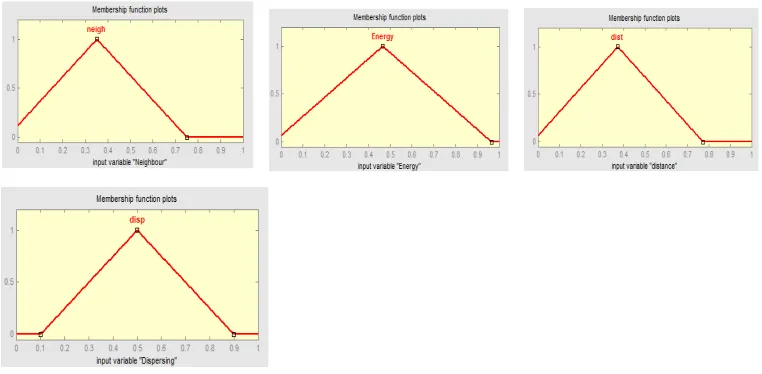
The input crisp values for the number of neighbor nodes is given as [-0.04815 0.3519 0.7519] for the corresponding linguistic variables SPARSE, MEDIUM and DENSE. For the remaining energy it is given as [-0.03439 0.4656 0.9656] and for the energy consumption rate as [0.1 0.5 0.9] for the corresponding linguistic variables LOW, MEDIUM and HIGH. For the distance to the sink it is given as [-0.02698 0.373 0.773] for the
corresponding linguistic variables NEAR,
MEDIUM and FAR. Membership functions for the input parameters are shown in Figure 3 .
Manuscripts must be in English (all
[image:4.612.88.527.70.428.2]
Figure 2: Two Level Fuzzy Controlled System
Figure 3: Membership Functions For The Input Fuzzy Variables A) Number Of Neighbor Nodes B) Remaining Energy C) Energy Dispersion D) Distance To The Sink
Fuzzy Mamdani
Local
No of neighbor nodes
Cost
Remaining energy
Energy dispersion
Cost Fuzzy
Mamdani Global
Distance from sink
In the first level (Local Level), the qualified nodes are selected based on their number of neighbors of them
[image:4.612.121.502.456.643.2]Based on the knowledge on the linguistic variable 3 IF THEN ELSE fuzzy rules are used to take decision for chance to be elected as cluster head. Linguistic rules used here is a fuzzy rule based system (FRBS) called Mamdani because it provides a natural framework to include expert knowledge. This expert knowledge describes the relation between system inputs and output, can be easily combined with rules. Madmani’s FRBS provides an easier way to select the most suitable fuzzification and defuzzification interface components as well as the interface method itself. All the nodes are compared on the basis of chances and the node with the maximum chance is then elected as the cluster-head.
The membership function for the output fuzzy parameter is defined as in Figure 4.
Figure 4: Membership function for the output fuzzy parameter
4. SIMULATION RESULTS
Simulations are performed using Matlab [10] to verify the proposed methods. Simulations are performed in two different scenarios, 100 nodes are randomly distributed in 100×100. The initial energy of the sensors is 0.5J. Simulation was run for 1000 rounds. The sink node is assumed in position (50, 50). K-means clustering shows different clusters by using different colors. Nodes, cluster head and sink are differentiated as circles, plus sign and cross sign respectively. Figure 5 shows the clustering and cluster head selection of LEACH and K- means LEACH. In the LEACH protocol there is no differentiation between the clusters but by using the K-means the clusters are differentiated with colors. Even though in both methods cluster heads are selected at random the possibility of cluster head close to each other is reduced in the K means LEACH but possibility of
cluster head to be located at the edge of the cluster is present.
[image:5.612.347.536.125.340.2]
Figure 5a: Clustering And Cluster Head
Selection- Leach
Figure 5b: Clustering And Cluster Head
[image:5.612.90.299.311.422.2] [image:5.612.339.536.420.640.2]In the proposed two level fuzzy systems the local level consider the numbers of neighbor nodes as the inputs to the fuzzy system and sensors qualification parameter for becoming a CH as the output. Then, in the global level, the best node as CH is found considering the remaining energy, consumption rate and the distance to sink. By applying this two level fuzzy system in the K- means LEACH, the possibility of cluster head to be located at the edge is rectified. The clustering and the CH selection by using two level fuzzy systems are shown in Figure 6.
Figure 6: Fuzzy LEACH cluster head selection
Figure 7: a) K means and Fuzzy LEACH with 4
[image:6.612.312.517.105.340.2]and 6 clusters (100 nodes)
Figure 7: b Fuzzy LEACH with 4 and 6 clusters (100 nodes)
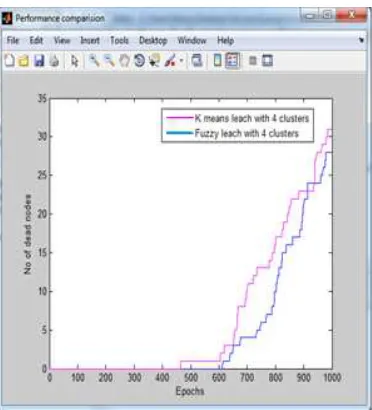
Figure 7(a) shows the number of dead nodes of the K- means LEACH compared with that of the fuzzy LEACH. In the K means LEACH the nodes start to dead earlier than the Fuzzy LEACH. Also the number of nodes dead in K means LEACH is also greater than the Fuzzy LEACH. Figure 7(b) shows the number of dead nodes of Fuzzy LEACH having four clusters compared with the Fuzzy LEACH having 6 clusters. In Fuzzy LEACH with increased clusters the node starts to die later than the Fuzzy LEACH with reduced clusters. So lifetime of the network is increased by using proposed methods.
Some networks have the environment of densely nodes, so evaluated the proposed method for the networks with 200 nodes. The figure 8(a) &(b), the result shows better performance by using the proposed Fuzzy LEACH method. So the proposed method is well suited for the environment of dense nodes.
5. CONCLUSION
[image:6.612.91.295.247.440.2] [image:6.612.92.278.461.666.2]level fuzzy logic for CH selection based on number of neighbor nodes, remaining energy, distance to sink and energy dispersion attributes. The simulation results show that the proposed protocol increases the network lifetime and performs better
than the LEACH protocol
.
Figure 8: a) K- means and Fuzzy -LEACH with 4 and 6 clusters (200 nodes)
Figure 8: b Fuzzy LEACH with 4 and 6 clusters (200 nodes)
REFRENCES:
[1] W. Heinzelman, A. Chandrakasan and H. Balakrishnan, “Energy-efficient communication protocol for wireless micro sensor networks,” in Proc. of the 33rd Annual Hawaii International Conference on System Sciences (HICSS), Maui, HI, Jan. 2000, pp. 3005 – 3014.
[2] J. Li and H. Gao, “Research advances in wireless
sensor networks,” Journal of Computer
Research and Advances, vol. 45, no. 1, pp. 1– 15, 2008.
[3] Tapas Kanungo, Nathan S. Netanyahu, Angela Y. Wu ,“An Efficient k-Means Clustering Algorithm: Analysis and Implementation,” IEEE Transactions on Pattern Analysis and Machine Intelligence, vol. 24, no. 7, July 2002 [4] Puneet Azad1, Vidushi Sharma,” Cluster Head
Selection in Wireless Sensor Networks under Fuzzy Environment,” Hindawi Publishing Corporation, ISRN Sensor Networks, Volume 2013, Article ID 909086.
[5] D. Kumar, T. C. Aseri, and R. B. Patel, “EEHC:
energy efficient heterogeneous clustered
scheme for wireless sensor networks,”
Computer Communications, vol. 32, no. 4, pp. 662–667, 2009.
[6] C. H. Lung and C. Zhou, “Using hierarchical agglomerative clustering in wireless sensor networks: an energy-efficient and flexible approach,” Ad Hoc Networks, vol. 8, no. 3, pp. 328 344, 2010.
[7] O. Younis and S. Fahmy, “HEED: a hybrid, energy-efficient, distributed clustering approach for ad hoc sensor networks,” IEEE Transactions on Mobile Computing, vol. 3, no. 4, pp. 366– 379, 2004.
[8] T.Gao, R. C. Jin, J. Y. Song, T. B. Xu, and L. D. Wang, “Energy efficient cluster head selection scheme based on multiple criteria decision making for wireless sensor networks,” Wireless Personal Communication, vol. 63, no. 4, pp. 871–894, 2012.
[9] http://www.dma.fi.upm.es
[image:7.612.89.527.119.704.2]