272
A
NEW QFD-BASED QUANTITATIVE MODEL FOR
ADAPTABILITY EVALUATION OF ENTERPRISE
INFORMATION SYSTEMS
1HAIWANG CAO, 2 LIUYANG WU, 2CHAOGAI XUE
1
Asstt Prof., Department of Electronic and Communication Engineering, Zhengzhou Institute of Aeronautical Industry Management, Zhengzhou, China
2 Department of Management Engineering, Zhengzhou University, Zhengzhou, China
E-mail: [email protected], 2myrayy@
zzu.edu.cn
ABSTRACT
This paper deals with a new quantitative model for adaptability evaluation of enterprise information systems (EIS). Firstly, a new evaluation model based on QFD is proposed, and the corresponding evaluation algorithm is given. Secondly, the procedures of EIS adaptability evaluation are discussed. Finally, the application of the evaluation model and algorithm is verified through an example, which provides quantitative references for optimizing EIS adaptability.
Keywords: Adaptability Evaluation, Quality Functional Deployment (QFD)Enterprise Information
Systems
1. INTRODUCTION
With the development of information technology, the market competition is increasingly intense and the uncertainty of environment has increased. In order to enhance management efficiency and add management function, enterprise information systems (EIS) should have the ability to adapt to the changing environment inside and outside at any time, i.e., enterprise information systems’ adaptability (EISA). At present, there is little reference to EISA, mainly including the analysis of EISA’s influencing factors, EISA’s evaluation, EISA’s empirical study and how to enhance EISA. So far, the researches on EISA enhancement mainly focus on software system: (1) study on self-adaptability of software [1]-[2]. (2) study on adaptive mechanism of software system [3]-[4]. As an example of (1) above, Huang Shuangxi [1] etc.
studied the generic adaptive software architecture style, and as an example of (2) Yu Chun [3] etc.
studied an architecture-oriented mechanism for self-adaptation of software systems. These researches have laid foundation for the adaptability of EIS, but there are differences between software systems’ adaptability and EISA. Firstly, EIS not only include software but also business process; secondly, software systems’ environment means software’s the operation carrier or the development platform, but EIS’ environment means the market, policies
outside and the operation environment inside. Hence, it is necessary to carry out further study on the adaptability of EIS.
QFD is a product design method driven by customer requirement, and its essence is to transform customer requirement into design language of engineering staff. At present, researches on the QFD theory focus on the following aspect: (1) deep research on the quality of house construction [5]-[7]. (2) combines QFD with other theories. (3) is the application of QFD [8]. As an example of (1) above, Li Yanlai [5] etc. studied the construction of quality of house, and built 10-step model to avoid the inconsistency. As an example of (2) above, Xiong Wei [7] etc. studied the combination of quality theory with the QFD, and represented the relationship between product quality properties and requirement. In terms of (3), Gu Yingkui [8] etc. studied the application of QFD in product life cycle design. These studies have enriched the QFD theory, and expanded the application of QFD. However, it is mainly about product design, and there is little reference to the quality property of EIS.
273 helps enterprises to make better decision on how to analyze customer requirements and design better plan. To this end, the evaluation model based on the QFD is proposed firstly, and evaluation algorithm is given as follows.
2. QFD-BASED EVALUATION MODEL
AND ALGORITHM
2.1 Evaluation model
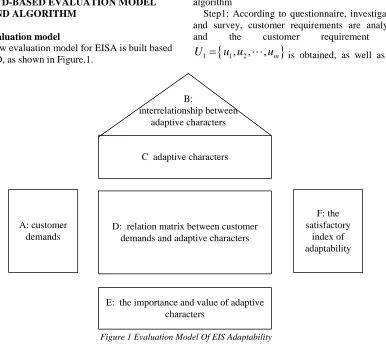
A new evaluation model for EISA is built based on QFD, as shown in Figure.1.
The evaluation model of EISA is composed as follows.
(1) A: It is posed by the customer demands, which can be obtained by interview or questionnaire.
(2) B: It is posed by the interrelationship between adaptive characters.
(3) C: It is posed by the adaptive characters, which are obtained according to the customer requirements.
(4) D: It is posed by the relationship matrix between customer requirements and adaptive characters.
(5) E: It’s posed by the importance and values of adaptive characters.
(6) F: It’s posed by the satisfactory index of adaptability for each plan.
2.2 Evaluation algorithm
An algorithm is proposed to evaluate EIS adaptability based on the evaluation model above. The specific steps are as follows:
Algorithm 1: EIS adaptability evaluation
algorithm
Step1: According to questionnaire, investigation and survey, customer requirements are analyzed and the customer requirement set
{
}
1 1
,
2,
,
mU
=
u u
u
is obtained, as well as theadaptive character set
U
2=
{
u u
1',
2',
,
u
m'
}
and the adaptive character values.Step2: Compute the importance of adaptive characters according to certain methods (as can be seen in Algorithm 2).
Step3: Build relationship matrix of adaptive characters. Assuming that the relative degree is described by the following five levels: 1,2,3,4,5, and from 1 to 5, the importance is increasing. The interrelationship between adaptive characters is described by three types: positive relation (+), negative relation (-) and no relation (blank). Thus, relationship matrix and interrelationship matrix between adaptive characters are obtained, and then the normalized matrix can be obtained according to the following equation.
A: customer demands
C adaptive characters
D: relation matrix between customer demands and adaptive characters
E: the importance and value of adaptive characters
F: the satisfactory
index of adaptability B:
[image:2.612.120.506.161.505.2]interrelationship between adaptive characters
274 * 1
1 1
n
ih hj h
ij n n
ih hj
j h
R Y
R
R Y
=
= =
=
∑
∑∑
(1)Where
1, 2,
, ;
i
=
m
j h
,
=
1, 2,
, ;
n
ij
R
: The relationship matrix between customer requirements and adaptive characters;kj
Y
: The interrelationship matrix between adaptive characters.Step4: Conduct evaluation according to the following equations.
* 0
0 0
l
ij k k
i
i k
R x
x
d
x
−
=
∑
(2)
(
0)
1
1
m km i
i
AM
I
d
=
=
∑
±
(3) Where
0 k
x
: The thk
adaptive character;l k
x
: The thk
adaptive character value of the thl
project;
0 i
d
: The distance between the values of adaptive character at present and each plan;* ij
R
: The normalized relationship matrix;k
AM
: The satisfactory index of each plan.Step5: Make optimal decision according to the satisfactory index.
Algorithm 2: the Importance degree of adaptive characters.
Step1: Normalize index matrix
R
.Step2: Construct index weight matrix
A
throughm
methods.Step3: Obtain matrix
RA
.Step4: Compute the maximum eigenvalue
max
λ
of( ) ( )
T
RA
RA
and maximum eigenvector*
X
.Step5: Compute the vector
W
*=
AX
*
, and obtain the normalized vector**
* /
T*
W
=
W
e W
, ande
T=
(1,1,
,1)
T.3. ADAPTABILITY EVALUATION OF EIS
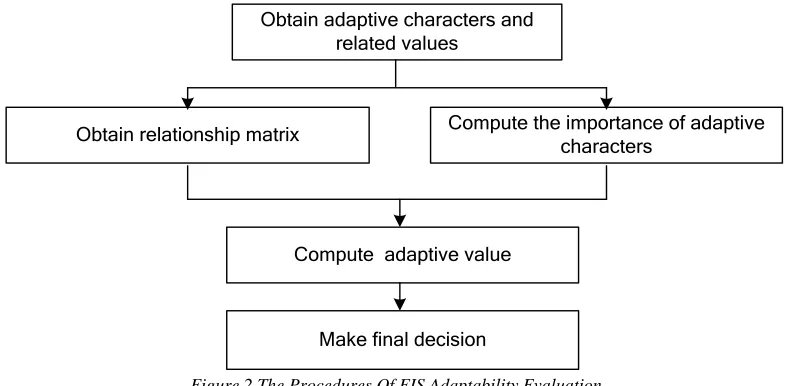
Based on the evaluation model and evaluation algorithm, the procedures of EIS adaptability evaluation are shown in Figure.2.
The specific steps are shown as follows:
Step1: According to questionnaire and interview,
1
U
andU
2 are obtained, as well as the value ofadaptive characters at present and different design plans.
Step2: Establish the relation matrix between customer demands and adaptive matrix and obtain the interrelationship between adaptive characters, then according to Eq. (1) in Algorithm 1,
R
ij* isobtained.
Step3: According to Algorithm 2, the importance
of adaptive characters is obtained.
Step4: According to Eq.(2) and Eq.(3), the satisfactory index of each plan is obtained.
Obtain adaptive characters and related values
Obtain relationship matrix Compute the importance of adaptive characters
Compute adaptive value
[image:3.612.102.497.484.677.2]Make final decision
275 Step5: Make final decision according to the satisfactory indices. The higher the index is, the better the plan is.
4. EXAMPLE
According to the interview and questionnaire, the customer requirement set is
U
1 = {meetingcustomer needs rapidly, little cost, little dependence between modules, easy to transform to actual system, not easy failure}, and the customer requirements are transformed to the adaptability set, i.e.,
U
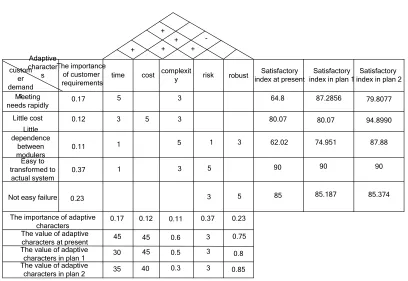
2= {time, cost, complexity, risk, robust}, andthe satisfactory index at present and the plans can be obtained, as shown in Figure.3. Then, according to the evaluation model, the adaptability of an enterprise information system is evaluated through
Algorithm 1.
According to algorithm 2, the importance of adaptive characters is
(
0.17 0.12 0.11 0.37 0.23)
.
W =
The current adaptive character value is
(
)
0
45 45 0.6 3 0.75 ;
Y = and the adaptive character values of improved plan 1 and plan 2 are
(
)
(
)
1
2
30 45 0.5 3 0.8 , 35 40 0.3 3 0.85
,
==
Y
Y
and the satisfaction index is
(
)
0
64.8 80.07 62.02 90 85
.
X =
According to Step3 in algorithm 1, the normalized relationship matrix is shown as follows:
*
0.238 0.381 0.143 0.381 -0.143 0.229 0.314 0.229 0.314 -0.086 0.118 0.412 0.353 0.235 -0.118 0.207 0.310 0.276 0.310 -0.103 0.25 0.25 0.25 -0.167 0.417
ij R =
Then according to Step4, the customer satisfaction degree to plan 1 and 2 are:
(
)
(
)
1
2
87.2856 80.07 74.951 90 85.187 ,
79.8077 94.8990 87.88 90 85.374
.
= = j j AM AM The importance of customer
requirements time cost complexity risk robust
Satisfactory
index at present index in plan 1Satisfactory index in plan 2Satisfactory custom er demand s Adaptive character s Meeting needs rapidly Little cost Little dependence between modulers Easy to transformed to actual system
Not easy failure
The importance of adaptive characters The value of adaptive characters at present The value of adaptive
characters in plan 1 The value of adaptive
characters in plan 2 0.17 0.12 0.11 0.37 0.23 30 35 45 40 0.5 0.3 3 3 0.8 0.85
45 45 0.6 3 0.75
+ + + + + 5 3 1 1 5 3 3 5 3 1 5 3 3 5 -64.8 80.07 62.02 90 85 87.2856 80.07 74.951 90 85.187 79.8077 94.8990 87.88 90 85.374
[image:4.612.104.512.340.621.2]0.17 0.12 0.11 0.37 0.23
276 Therefore, the overall satisfaction indices are:
1 2
85.5846, 87.5580 AM = AM =
As can be seen from the final result, the adaptability satisfaction of plan 2 is better than that of plan 1, i.e., it satisfies customer requirements better. So the enterprise should adopt plan 2 in order to improve the adaptability of its information system.
5. CONCLUSION
The rapid development of information technology means both opportunities and challenges to enterprises, and an adaptable information system is important to an enterprise. Based on the QFD theory, a new quantitative model for adaptability evaluation of EIS is proposed, which gives more consideration on the relationship between customer requirements and adaptive characters. This model helps related staff to make decisions, realizes the transformation between customer requirements and adaptive characters, and quantitatively represented their relationships. Combined with the case study, the evaluation is explained. This study enriches the adaptability evaluation of EIS, and in the meanwhile, expands the application of the QFD theory. This QFD-based method can solve decision making problems of plan selection, and can be used in evaluation problems of other fields.
ACKNOWLEDGEMENT
This research is supported by the National Natural Science Foundation of China under Grant numbers 70901066 and 70971119.
REFRENCES:
[1] Huang Shuangxi, Fan Yushun and Zhao Yu, “Research on Generic Adaptive Software Architecture Style”, Journal of Software, vol.17, no.6, 2006, pp.1338-1347.
[2] Kokar M M, Baelawski K and Eraear Y A., “Control theory based foundations of self-controlling software”, IEEE Intelligent Systems, vol.14, no.3, 1999, pp. 37-45.
[3] Yu Chun, Ma Qian, Ma Xiaoxing etc., “An Architecture-oriented Mechanism for Self-adaptation of Software System”, Journal of
Nanjing University(Natural Sciences), vol. 42, no.2, 2006, pp.120-129.
[4] Pan Jian, Zhou Yu, Luo Bin etc., “An ontology-based Software Self-adaptation Mechanism”, Computer Science, vol.34, no.11, 2007, pp.264-269.
[5] Li Yanlai, Tang Jiafu, Yan Jianming and Xu Jie, “Progress of researches on building house of quality”, Journal of Mechanical Engineering, vol.45, no.3, 2009, pp. 57-70.
[6] John J. Cristiano, Jeffrey K. Liker, and Chelsea C. White, III, Fellow, IEEE, “Key Factors in the Successful Application of Quality Function Deployment (QFD)”, IEEE Transactions on Engineering Management, vol. 8, no.1, 2001. [7] Xiong Wei, Wang Juanli and Wang Xiaotun,
“The quantitative research on charm quality based on QFD”, Science & Technology Progress and Police, vol.27, no.24, 2010, pp.119-122.