Automatic Repeated Rule Acquisition from Similar Web
Sites using Rule Ontology
Soumya.S
M.Tech (IT), Second YearVivekanandha College of Engineering for Women, Tiruchengode, Namakkal
H. Swathi
Assistant Professor, Department of IT Vivekanandha College of Engineering for Women,
Tiruchengode, Namakkal
ABSTRACT
The Semantic Web, which is the basic component of two websites Web 2.0 and Web 3.0, it is a development of the World Wide Web in which the semantics of information and services on the Web are defined. Inferential rules can be a quality source of rule acquisition. Rule acquisition is an important as ontology acquisition, even though rule acquisition is still a slowdown process in the deployment of rule-based systems. However, sometimes rules have already been implied in Web pages, and it is possible to acquire them from Web pages in the same manner as ontology learning. In the rule acquisition procedure that automates repeated rule acquisition from similar sites by using the rule ontology RuleToOnto. Before rule acquisition procedure, this paper proposed a screening method for automatically extract rules parts from web pages. RuleToOnto procedure, which is extracts rules from various domains and web pages not particular domain. This rule acquisition procedure includes various domains and webpage’s. The results show that this ontology model is successful.
Keywords
Data mining, Rule acquisition, Rule ontology, Best-First Search (A* Algorithm)
.
1.
INTRODUCTION
Knowledge is an essential part of most Semantic Web applications and ontology, this is a formal explicit description of concepts or classes in a domain of discourse [2], is the most important part of the knowledge. However, ontology is not sufficient to represent inferential knowledge [16]. This is because ontology-based reasoning has limitations compared with rule-based reasoning, even though ontology-based reasoning with description logic [3], is a popular issue of the Semantic Web. Many attempts have been made at knowledge acquisition in order to obtain enough knowledge for Semantic Web applications. Ontology learning, which refers to extracting conceptual knowledge from several sources and building ontology from scratch, enriching, or adapting an existing ontology [7].
Rule acquisition is as essential as ontology acquisition, even though rule acquisition is still a bottleneck in the deployment of rule-based systems [14][13]. This is time consuming and laborious, because it requires knowledge experts as well as domain experts, and there are communication problems between them. Let us suppose that, if they have to acquire rules from several sites of the same domain. The sites have similar Web pages explaining similar rules from each other. A comparison-shopping portal can be an example. The comparison of simple data such as book prices does not need rules, but delivery cost calculation with various options and applying free shipping rules and return policies needs rules [11].
The portal should acquire rules about delivery options, shipping rules, and return policies from shopping malls if it wants to provide an intelligent service comparing more than just prices. In this case, the portal should repeatedly acquire similar rules from multiple malls and the rules are very similar to each other in terms of their shape and content.
There are repeat the rule acquisition process across several sites; it can accumulate rules [11]. However, as the size of rule base increases, it becomes hard to reuse rules. Therefore, it used an ontology named RuleToOnto, which represents the information about rules including terms, rule component types, and rule structures.
The main objective of these researches is to propose a rule acquisition procedure that automates repeated rule acquisition from similar sites by using the rule ontology RuleToOnto. This paper proposed a screening method and two main steps of rule acquisition, which consists of rule component identification and rule composition with the identified rule components.
1.1
Motivation for Data mining
Data mining is the process of analyzing data from different perspectives and summarizing it into useful information - information that can be used to increase revenue, cuts costs, or both. Data mining software is one of a number of analytical tools for analyzing data. It allows users to analyze data from many different dimensions or angles, categorize it, and summarize the relationships identified. Technically, data mining is the process of finding correlations or patterns among dozens of fields in large relational databases.
Companies with a strong consumer focus - retail, financial, communication, and marketing organizations, primarily use data mining today. It enables these companies to determine relationships among "internal" factors such as price, product positioning, or staff skills, and "external" factors such as economic indicators, competition, and customer demographics. And, it enables them to determine the impact on sales, customer satisfaction, and corporate profits.
2.
RELATED WORK
The knowledge acquisition in current approaches can be grouped into two types, ontology acquisition and rule acquisition. There research is about an automatic knowledge acquisition procedure from the web that consists of unstructured texts. Acquiring knowledge is based on the type of ontology, and using ontology as a knowledge schema in the knowledge acquisition is more common than rule acquisition. [20].
2.1
Semantic Web
diverse sources, where on the original Web mainly concentrated on the interchange of documents. It is also about language for recording how the data relates to real world objects. That allows a person, or a machine, to start off in one database, and then move through an unending set of databases which are connected not by wires but by being about the same thing.
The Semantic Web is not a separate Web but an extension of the current one, in which information is given well-defined meaning, better enabling computers and people to work in cooperation. The first steps in weaving the Semantic Web into the structure of the existing Web are already under way [22]. The resulting infrastructure will spur the development of automated Web services such as highly functional agents. The challenge of the Semantic Web [22], therefore, is to provide a language that expresses both data and rules for reasoning about the data and that allow rules from any existing knowledge-representation system to be exported onto the Web.
2.2 Rule Acquisition
Learning by examples is a very different concept from rule acquisition from texts, which imply IF-THEN rules. Therefore, it is impossible to apply those methods in this paper problem, because their target is structured data while there target is unstructured text. Compared to rich studies of ontology learning, rule acquisition from the Web is not popular. Moreover, acquired rules are limited to a certain purpose and type [17], [8], and are not general-purpose inference rules. Most significantly, studies about automatic rule acquisition from text are quite rare while there are some studies that discover rules from existing data.
Even though these can be separated by the Related Works section into ontology learning and rule acquisition, the extraction of rules is one of the research areas in ontology learning, because the inference rules could be an outcome of ontology learning. The term “inference rule” means the relationship between two phrases in entailment rule approaches. Moreover, the rules are generated with statistical methods by calculating frequencies and probabilities while the rules are directly generated from the Web in this approach.
The eXtensible Rule Markup Language (XRML) approach is a framework for extracting rules from texts and tables of Web pages [9]. The core of the XRML framework is rule identification, in which a knowledge engineer identifies various rule components such as variables and values from the Web pages with a rule editor [9]. The effectiveness of the rule acquisition procedure of the XRML approach depends on the rule identification step, which also depends on the large amount of manual work done by the knowledge engineer.
2.2
Semantic Web Rule Language
Semantic Web Rule Language (SWRL) was designed to be the rule language of the Semantic Web. SWRL is based on a combination of the OWL DL and OWL Lite sublanguages of the OWL Web Ontology Language the Unary/Binary Data log sublanguages of the Rule Markup Language. SWRL allows users to write Hornlike rules expressed in terms of OWL concepts to reason about OWL individuals. The rules can be used to infer new knowledge from the existing OWL knowledge bases [19].
For example, the most popular one, a SWRL rule expressing that a person has a male sibling, has a brother would require capturing the concepts of ‘person’, ‘male’, ‘sibling’ and
‘brother’ in OWL. Intuitively, the concept of person and male can be captured using an OWL class called Person with a subclass Man; the sibling and brother relationships can be expressed using OWL properties has Sibling and has Brother, which are attached to Person. The rule in SWRL would then be [19]:
Person (? a1) ^ hasSibling (? a1, a2)
^ Man (? a2) → hasBrother (? a1, a2)
Executing this rule would have the effect of setting the hasBrother property to a2 in the individual that satisfies the rule, named a1.
2.4 Best-First Search and Constraint-
Directed Search
Best-first search is a widely used problem solving technique in the field of artificial intelligence [23]. Best-first search is a graph-based search algorithm [10], meaning that the search space can be represented as a series of nodes connected by paths. It is applicable to a discrete optimization problem in which they can assume that the state space is represented in the form of a tree. Best-first search estimates the promise of node n with a heuristic evaluation function f(n), which may depend on the information gathered by the search up to that point on any extra knowledge about the problem domain[12].
The A* search algorithm is a variant of best-first search. It is guaranteed to find the least-cost path from a given initial node to one goal node out of one or more possible goals [24]. It uses a distance-plus-cost heuristic function f (n) to determine the order in which the search visits nodes in the tree. The distance-plus-cost heuristic is a sum of two functions: the path-cost function g (n), which is the actual shortest distance traveled from the initial node to the current node and a heuristic estimate h (n) of the distance from the current node to the goal. The h (n) must not overestimate the distance to the goal.
1
[image:2.595.383.494.485.594.2]1 3
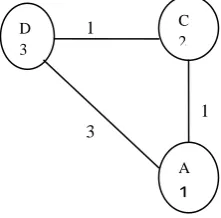
Figure 1. Best First Search
Constraint-directed search is an approach to solving Constraint Satisfaction Problems (CSPs). It explores the problem space under the guidance of the relationships, limitations, and dependencies among problem objects [1]. Traditionally, in a CSP, a heuristic commitment is the assignment of some value to some variable [1]. Heuristics focus on variable ordering and value ordering: what is the next variable to assign and to what value will it be assigned? One popular variable ordering heuristic is to choose the variable with the fewest number of possible remaining values, which implies the smallest domain size.
Fig 1 said that, when node D is closed, node A will be added to the open queue with a value of ĥ (A) = 1, and node C will
D 3
C 2
2
2
be added to the open queue with a value of ĥ(C) = two. Since one < 2, node A will be closed with the cost of 3. However, the shortest path to node A is DCA, which has a cost of 2. Because the Best-First Search Algorithm only relies upon ĥ when choosing the next node to close, it closed node A before finding the shortest path. Therefore, the Best-First Search is not guaranteed to find the optimal path from the start node to the goal node and can be misled by an errant heuristic function.
2.4.1. A*Algorithm
A* is the most popular choice for path finding, because it’s fairly flexible and can be used in a wide range of contexts. A* is like other graph-searching algorithms in that it can potentially search a huge area of the map. It is like Dijkstra’s algorithm in that it can be used to find a shortest path.
the summation of variances of already assigned rule instances {RI1;RI2; . . .;RIr} is the past-cost function g(n). As they
mentioned before, Dist (VIi,RIp) is always smaller than or
equal to the variance of a complete rule instance. Moreover, Dist (VIi, RIp) calculates the distance for only the current rule,
not the other remaining rules. Therefore, the heuristic estimate Dist (VIi,RIp) does not overestimate the summation of
variances of the current and remaining rule instances[20].
2.5
Ontology Learning
The algorithm builds the taxonomy with linguistic analysis and identifies relevant candidates of classes and instances based on statistical analysis [4]. The Ontologies are composed from automatically obtained taxonomies. Some approaches used somewhat different learning methods for identifying instances and relations. For example, WEBfiKB [6] used Bayesian and First Order Logic learning methods, and Sanchez and Moreno [25] suggested a knowledge acquisition technique that built ontologies with a multiagent system. TextOntoEx[5] defined and used semantic patterns to identify not only simple taxonomic relations but also non taxonomic conceptual relations (e.g. causes, caused by, treat, contain, etc.).The approach using the Multiple Classification Ripple-down Rules (MCRDR) methodology [15], in ontology, learning is somewhat similar to this approach in its framework. They use a graph search algorithm instead of MCRDR to extract inference rules. In addition, they accumulate the rule ontology by repeating rule acquisition across different sites.
3.
BASIC IDEAS OF ONTOLOGY IN
RULE ACQUISITION
Ontologies capture the structure of the domain, i.e. conceptualization. This includes the model of the domain with possible restrictions. The conceptualization describes knowledge about the domain, not about the particular state of affairs in the domain. In other words, the conceptualization is not changing, or is changing very rarely. Ontology is then specification of this conceptualization - the conceptualization is specified by using particular modeling language and particular terms. Formal specification is required in order to be able to process ontologies and operate on ontologies automatically. Ontology describes a domain, while a knowledge base (based on ontology) describes particular state of affairs. Each knowledge based system or agent has its own knowledge base, and only what can be expressed using ontology can be stored and used in the knowledge base
.
3.1
To Expanding an Ontology
To developing, Ontology includes[21],
Defining classes in the ontology,
Arranging the classes in a taxonomic (subclass– super class) hierarchy,
Defining slots and describing allowed values for these slots,
Filling in the values for slots for instances.
3.2
OntoLT
The OntoLT approach [4], is available as a plug-in for the widely used Protégé ontology development tool , which enables the definition of mapping rules with which concepts (Protégé classes) and attributes (Protégé slots) can be extracted automatically from linguistically annotated text collections. A number of mapping rules are included with the plug-in, but alternatively the user can define additional rules.
OntoLT provides a precondition language, with which the user can define mapping rules. Preconditions are implemented as XPATH expressions over the XML-based linguistic annotation. If all constraints are satisfied, the mapping rule activates one or more operators that describe in which way the ontology should be extended if a candidate is found.
3.3 Semi-Automatical Ontology Acquisition
Method
[18]The process of acquiring ontology can be divided into two stages: acquiring ontological structure and acquiring ontological instances. In the stage of acquiring ontological structure, it is necessary to capture information about database schema firstly, and then based on the information ontological structure can be constructed. Since the constructed ontological structure may not be ideal, the evaluation and refinement about it is needed.
SOAM, which consists of four steps.
Step1.Capture the information about relational database schema;
Step2.Acquire ontological structure according to the database schema information;
Step3 Refine the obtained ontological structure;
Step4.Acquire ontological instances based on refined ontological structure.
SOAM tries to balance the cooperation between user contributions and machine learning in order to ensure the quality of constructed ontology and improve the automatic degree of acquiring process.
3.3
Text2Onto
[26]Text2Onto is a framework for ontology learning from textual resources. Three main features distinguish Text2Onto from there earlier framework TextToOnto as well as other state-of-the-art ontology learning frameworks. First, by representing the learned knowledge at a meta-level in the form of instantiated modeling primitives within a so-called Probabilistic Ontology Model (POM), they remain independent of a concrete target language while being able to translate the instantiated primitives into any knowledge representation formalism.
change discovery, it can avoid processing the whole corpus from scratch each time it changes, only selectively updating the POM according to the corpus changes instead. Besides increasing efficiency in this way, it also allows a user to trace the evolution of the ontology with respect to the changes in the underlying corpus.
4. PROPOSED WORK
[image:4.595.325.537.229.405.2]This article proposed a method, which is automatically extracting the rule from Webpage’s. Rule acquisition procedure that automates repeated rule acquisition from similar sites by using the rule ontology RuleToOnto. The rule acquisition procedure consists of two steps. Rule component identification step and rule composition step. Before rule acquisition procedure, this paper introduce screening method for automatically extract rules from webpage. In RuleToOnto procedure, extract rules from various domains and web pages not particular domain. RuleToOnto can use both synonyms and semantic similarity between identified variables. WordNet is used to calculate the semantic similarity between variables.
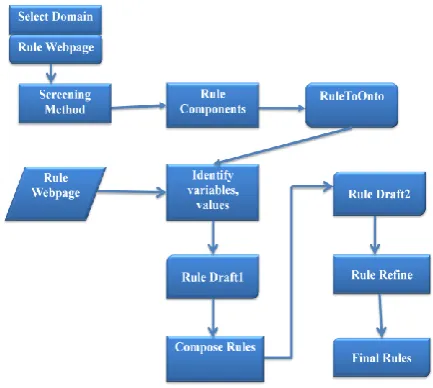
Figure 2. System Architecture
For rule composition, this paper using A*algorithm.. Automatically extract rules from similar site. Rules can e acquire from different domains. In order to automatically acquire rules through ontology, this paper divided the rule acquisition procedure into two main steps in order to apply proper methods to each step. The two methods are the rule component identification step and the rule composition step.
4.1 Extract Rule from Websites
First, select the particular domain and select the Input Rule webpage from the particular domain. Then acquire the rule from input webpage. From the webpage, the rule can automatically extract by using screening method and display the webpage rule. Get the source from the rule webpage and identify variables and values (see Figure 2).
4.2 Construct Ontology
After acquired the rules from webpage, then this article can construct the ontology based on identified variables and values. In addition, get another similar rule webpage related to input webpage by using this ontology information, there can be identify rule component in new input site.
4.3 Rule Component Identification
This article expanded RuleToOnto by adding synonyms of each term using WordNet. In the comparison between the terms of RuleToOnto and the terms of the Web page[29], if there is used semantic matching instead of simple string comparison. In order to find the semantic similarity between two terms used WordNet. Identified components are denoted in the format of variable instances with variable abbreviation and number. If there are, rules acquired from Amazon. com (in short Amazon), as shown in the upper-left part of Fig. 3, lt can make an ontology which shows the variables and values used in the rules, such as that shown in the Fig. 3 .By using the information, there can be identify rule components in a new site such as Barnes&Noble.com (in short BN)[20].
Figure 3. Example of rule acquisition using ontology From the ontology, there are easily recognize that refund and days of the shipment of the Web page in the middle of Fig. 3 are variables and books, CDs, and VHS tapes are values [27]. The basic algorithm of identification is based on text matching between ontology and the text on a Web page [28]. Moreover, this paper can use information about omitted variables and the relations between the variables and values described in the ontology [28]. For example, this paper can perceive that item is omitted from the Web page shown in Fig.3, because books, CDs, and VHS tapes are values of item in the ontology shown in Fig.3. In addition, it is possible to assign variables to corresponding values, because every value has its matching variable in the ontology.
This measure is calculated only when one term is a hyponym of the other term, and the path length is the path length between the two terms in the hyponym hierarchy. There are decided that two terms are semantically related when the measure is larger than 0.25[20].
4.4 Preparation & Ordering
[image:4.595.53.270.299.493.2]
Every variable of each rule candidate should be matched to the variable instances of VI. Number of all instances of each variable count is calculated. The objective of rule ordering is to decrease the complexity of making rules with identified variable instances. Therefore, calculate the number of possible combinations of assigning variables for each rule.
4.5 Evaluation Function
The distance among a set of instances in a text can be calculated with a variance of instance positions. A low value of variance means that the instances are gathered around one place in the text [27]. That is, the variable instance with the lower variance is more suitable for a rule instance. This paper evaluate the distance between a variable instance V Ii and the
already assigned instances to RIp with the function which is very similar to the variance. = { , …. } and by assigning the variable instance to
rule candidate = { , …. ,… }[20].
Where the position of instance is is text and µ is
Average ( , … ).
The Best-First Search (BFS) is used in the evaluation function. The Initialization step includes choosing candidate rules, rule ordering, and variable ordering. When the algorithm succeeds in assigning variable instances to every variable of TotalOrder (RC), the loop ends and prints the path for the currentVI. It is a list of recommended rule instances.
4.6 Rule Refinement
Once the rules are determined, the next step is to complete the rules by assigning variable and value pairs to IF or THEN. The identified rule instances can be converted to the variable-value pairs by matching variables and variable-values with identified values and the ontology. Assigning the pairs to IF or THEN is very simple. If the variable belongs to an IF part in the rule instance of RuleToOnto, this can be assign the pair to the IF part of the rule. Otherwise, if it belongs to a THEN part, this paper assign it to the THEN part. The rules automatically generated are not complete in most cases, so they need to refine them. The knowledge engineer checks the rules and modifies connectives and values.
[20]The following rule is an example of the refined rule. The knowledge engineer changed the operator of days_of_shipment from “=” to “<=” and added the value full by referencing the ontology and the target Web page.
IF days_of_shipment <= 40
AND returen_status = “original condition” AND item = “book”
THEN
Refund = “full”
5. EXPERIMENTAL RESULTS
5.1 Execution Time/Sec
.
This graph contains execution time of proposed and existing system. The execution time of existing time is very high compared with the proposed system.
Using ontology in this approach automate the rule acquisition procedure. The initial point of this approach there using a
screening method it will be helpful for automatically acquiring rule from a site, and acquired similar rules from other similar sites of same domain automatically. Rule ontology, can be use in this paper, it includes the information about the rules including terms, rule component type and rule structures.
6.2 Accuracy
The above graph shows that the accuracy of proposed system is high. In proposed system, this paper automatically extract rules from websites then the accuracy is also very important.
RuleToOnto represent the IF and THEN part of each rule by connecting rule with variables with the IF and THEN relation. If there are some information about the variables and values, and the connection between the variables and values. The instance variable must have at least one value instance and rule have at least one variable for each IF and THEN properties
6. CONCLUSION
Ontology is used to propose an automatic rule acquisition procedure, named RuleToOnto that includes information about the rule components and their structures. This paper started from the idea that it will be helpful to acquire rules from a site if we have similar rules acquired from other similar sites of the same domain. RuleToOnto includes information about the rule components and their structures. RuleToOnto is a generalized, condensed, and specifically rearranged version of the existing rules. The rule acquisition procedure consists of the rule component identification step and the rule composition step. This paper used stemming and semantic similarity in the former step and developed the A* algorithm. To demonstrated the potential of the ontology-based rule acquisition approach with experiments. The results show the potential of this approach, even though the experiments were very limited in terms of the domain setting.
0 10 20 30 40
1 2 3
4 5
Proposed
Existing
0 20 40 60 80 100
1 2 3
4 5
Existing
On elimination of this approach is that the experiment results do not show that the performance of this approach is better than others, because there is no other rule acquisition study that they can directly compare these results with. Several challenging research issues must be addressed in order to meet the ultimate goal of this research.
7. ACKNOWLEDGMENTS
I thank the God almighty for blessing me with the mental and physical strength that was needed to carry out the project work. The authors wish to thank the reviewers for their helpful comments.
8. REFERENCES
[1] J.C. Beck and M. Fox, “A Generic Framework for Constraint Directed Search and Scheduling,” AI Magazine, vol. 19, no. 4, pp. 101-130, 1998.
[2] T. Gruber, “A Translation Approach to Portable Ontology Specifications,” Knowledge Acquisition, vol. 5, no. 2, pp. 199-220, 1993.
[3] F.M. Donini, M. Lenzerini, D. Nardi, and A. Schaerf, “Reasoning in Description Logics,” Principles of Knowledge Representation, G. Brweka, eds. CSLI Publications, 1996.
[4] P. Buitelaar, D. Olejnik, and M. Sintek, “A Prote´ge´ Plug-in for Ontology Extraction from Text Based on Linguistic Analysis,” Proc. First European Semantic Web Symp. (ESWS), 2004.
[5] M.Y. Dahab, H.A. Hassan, and A. Rafea, “TextOntoEx: Automatic Ontology Construction from Natural English Text,” Expert Systems with Applications, vol. 34, no. 2, pp. 1474-1480, 2008.
[6] M. Craven, D. DiPasquo, D. Freitag, A.K. McCallum, T.M.Mitchell, K. Nigam, and S. Slattery, “Learning to Construct Knowledge Bases from the World Wide Web,” Artificial Intelligence,vol. 118, no. 1/2, pp. 69-113, 2000. [7] R. Gacitua, R. Sawyer, and P. Rayson, “A Flexible Framework to Experiment with Ontology Learning Techniques,” Knowledge-Based Systems, vol. 21, no. 3, pp. 192-100, 2008.
[8] I. Hatzilygeroudis and J. Prentzas, “Using a Hybrid Rule-based Approach in Developing an Intelligent Tutoring System with Knowledge Acquisition and Update Capabilities,” Expert Systems with Applications, vol. 26, no. 4, pp. 477-492, 2004.
[9] J. Kang and J.K. Lee, “Rule Identification from Web Pages by the XRML Approach,” Decision Support Systems, vol. 41, no. 1, pp. 205-227, 2005
[10] N.J. Nilsson, Principles of Artificial Intelligence. Tioga Publishing Company, 1980.
[11] S. Park, J. Kang, and W. Kim, “Rule Acquisition Using Ontology Based on Graph Search,” J. Korean Intelligent Information System ,vol. 12, no. pp. 95-110, 2006. [12] Heuristics: Intelligent Search Strategies for Computer
Problem Solving, J. Pearl, eds. Addison-Wesley, 1984. [13] D. Richards, “Addressing the Ontology Acquisition
Bottleneck Through Reverse Ontological Engineering,” Knowledge and Information Systems, vol. 6, no. 4, pp. 402-427, 2004.
[14] Y.Y. Tang, C.D. Yan, and C.Y. Suen, “Document Processing for Automatic Knowledge Acquisition,” IEEE Trans. Knowledge and Data Eng. vol. 6, no. 1, pp. 3-21, Feb. 1994.
[15] R. Valencia-Garcia, J.T. Fernandex-Breis, J.M. Ruiz-Martinez, F.Garcia-Sanchez, and R. Martinez-Bejar, “A Knowledge Acquisition Methodology to Ontology Construction for Information Retrieval from Medical Documents,” Expert Systems, vol. 25, no. 3, pp. 314-334, 2008.
[16] F. van Harmelen and D. Fensel, “Practical Knowledge Representation for the Web,” Proc. 16th Int’l Joint Conf. Artificial Intelligence, 1999.
[17] Y. Xu, J. Liu, and D. Ruan, “Rule Acquisition and Adjustment Based on Set-Valued Mapping,” Information Sciences, vol. 157, no. 1/2, pp. 167-198, 2003.
[18] M. Li, X. Du, and S. Wang, “A Semi-Automatic Ontology Acquisition Method for the Semantic Web,” Proc. Sixth Int’l Conf. Advances in Web-Age Information Management (WAIM), pp. 209-220,2005. [19] D.Plineare and A.Borisov, “ SWRL: Rule Acquisition
using Ontology”, Scientific journal of riga technical university,2009.
[20] Sangun Park and Juyoung Kang, “Using Rule Ontology in Repeated Rule Acquisition from Similar Web Sites”, Ieee Transactions On Knowledge And Data Engineering, Vol. 24, No. 6, June 2012.
[21] K.Remya and K. Saravanan, “Using Rule Ontology In Frequent Rule Attainment For Akin Web Sites”, International Research Journal of Computer Science Engineering and Applications Vol 1 Issue 2 November 2012.
[22] Tim Berners-Lee, James Hendler And Ora Lassila, “The Semantic Web”, Scientific American Special Online Issue April 2002 Copyright 2002 Scientific American, Inc.
[23] K.V. Viswanathan and A. Bagchi, “Best-First Search Methods for Constrained Two-Dimensional Cutting Stock Problems,” Operations Research, vol. 41, no. 4, pp. 768-776, 1993.
[24] R. Dechter and J. Pearl, “Generalized Best-First Search
Strategies and the Optimality of A*,” J. the Assoc. for Computing Machinery, vol. 32, no. 3, pp. 505-536, 1985. [25] D. Sanchez and A. Moreno, “A Methodology for
Knowledge Acquisition from the Web,” Int’l J. Knowledge-Based and Intelligent Eng. Systems, vol. 10, no. 6, pp. 453-475, 2006.
[26] P.Cimiano and J. Volker “Text2Onto-A Framework for Ontology learning and data-driven change discovery”,2005.
[27] S. Park, J.K. Lee, and J. Kang, “A Framework for Ontology Based Rule Acquisition from Web,” Proc. First Conf. Web Reasoning and Rule Systems, pp. 229-238, 2007.
[28] S. Park and J.K. Lee, “Rule Identification Using Ontology While Acquiring Rules from Web Pages,” Int’l J. Human-Computer Studies, vol. 65, no. 7, pp. 644-658, 2007.