130
ACCOUNTING STUDENTS’ PERCEPTIONS OF FACULTY
EVALUATION PROCESS AT UiTM PERLIS
Assoc. Prof. Dr. Rosiatimah binti Mohd Isa
Accounting Research Institute and Faculty of Accountancy Universiti Teknologi MARA Perlis
Contact no.: 04-9882523
Abstract
The primary purpose of this research is to survey accounting students’ perceptions of faculty evaluation process. The study surveyed over 100 bachelors of accountancy students enrolled at UiTM Perlis in 2010. The study provides evidence that results of evaluations is perceived important and necessary to faculty members for formative purposes (improving in teaching performance and advancement) and not summative reason. More than fifty percent of the students wanted the results to be published. They felt that other methods of evaluations should be employed along with the students’ evaluations. There are some elements of biasness in rating the faculty members by students namely, leniency and favorable personality.
Keywords: accounting students, perceptions, evaluation process, formative and summative reasons
1. Introduction
Student evaluations of teaching (SET) in most universities and colleges in Malaysia are now very common and become routine. Universiti Teknologi MARA (UiTM) which is the largest university in Malaysia has no exception for it. Students are asked to complete evaluation forms manually for their classes each semester before the full implementation of SuFO (Students Feedback Online) in 2011. The evaluations are used for a few reasons, most of which focus upon faculty and administrative purposes. Faculty usually uses the student ratings for feedback concerning the effectiveness of classroom teaching from students’ point of view. Academic staff may use this feedback in a formative manner, i.e. to improve instructions that will enhance their professional growth. Generally, this idea has been accepted by academic staff in UiTM Perlis (Rosiatimah, Susilawani, and Salwana, 2009). The evaluations may also be used in decision making at administrative level concerning retention and promotion. This practice in summative manner may increase the chances that ‘excellence’ teaching will be recognized and rewarded.
Despite the benefits of the SET, there are some concerns regarding their value. Some members of faculty criticize the evaluations made by students. They argue that the students are not able to make adequate judgment on the class or its method since they are not trained in the course material. Other faculty members notice that those who are known to be easier graders and with best personalities receive higher scores. Hence, SET seems to become just a form of customer satisfaction survey rather to determine merit.
131
Given the mixed feelings on the faculty evaluations, this topic deserves further research. This research used survey methodology and student respondent groups. It focused on accounting student perceptions on SET process in an attempt to evaluate students’ beliefs that color the process and extent of usefulness of its information.
2. Literature review
The volume of studies on SET is overwhelming but most of the results are conflicting and inconclusive. According to Ahmadi, Helms, and Raiszadeh (2001) the main reason why previous research on SET has resulted to contradictory and inconclusive outcomes is due to the use of different methodologies and statistical procedures. This arises from the issue of how accurate SET to measure instructor effectiveness. For example, Lowman and Mathie (1993) identify two factors of effective teaching as clear instructional presentation, and management of student behavior. Other studies like Brown and Atkins (1993) identify three factors of effective instructors i.e. caring, systematic, and stimulating whereas Patrick and Smart (1998) identify the following factors; respect for students, organization and presentation skills, and ability to challenge students. Other researchers like Ramsden (1991) suggested seven factors while Marsh & Dunkin (1992) suggested nine factors. Therefore it appears to be little agreement on the nature and number of dimensions that represent effective teaching.
The other issue of using SET is the concern of its validity. Sheehan (1975) suggests several potential sources of invalidity of SET: (i) the extent to which student ratings reflects effective instruction, (ii) the construction of the rating instrument, and (iii) the susceptibility of student ratings to variations in instructions and to both subtle and overt instructor influence tactics. For the first source of invalidity, Rodin and Rodin (1972) found a significant negative correlation between what students learned and their evaluation of teaching. They concluded that students resent instructors that force them to work hard and learn more than students wish. Therefore students were less than perfect judges of teaching effectiveness.
Reliability and validity of SET has been challenged due to numerous reasons that affect student rating, such as class size, gender of instructor and student, student age, subject matter and course content, student achievement and expected grades, faculty leniency, and instructor characteristics.
Empirical evidence on the gender effects student evaluations as been inconsistent. For example, Feldman (1993) conducted a meta-analysis in the USA and Canada found that women were rated higher than men, and students tend to rate same-gendered teachers a little higher than opposite-gendered teachers. Contradictory, Basow (1995, 1998) whom examined four years of faculty evaluations, found that female teachers were rated less favorably overall than male. She noted that female teaching in faculty with predominantly male students may be significantly disadvantaged. The evidence on gender of student, Tatro (1995) found the female students give higher rating than males while Koushki and Kuhn (1982) found evidence supporting the reverse.
132
advanced level of subject matter or the students being older and more mature. This area received far less empirical attention so far.
In relation to student characteristics, Kidd and Latif (2004), Marsh (1987) and Feldman (1976) reported a positive association between expected grades and ratings of teaching effectiveness. Marsh and Roche (1997) reported similar relationships between ratings and the prior subject interest of the student and the reason for taking the course.
Regarding the relationship between instruction characteristics and course evaluation, prior research concluded that an actor with no training in the content area able to garner high evaluation from both students and faculty by posing as a charismatic instructor (Naftulin, Ware, and Donnelly (1973). This demonstrates that an instructor’s personality and enthusiasm for the course content may influence student ratings.
Numerous studies examined the ‘leniency’ hypothesis have been empirically reported. Chacko (1983) for example, showed that strict grading led students to rate the instructor lower on components relating to grading fairness and attitude to students. Nimmer and Stone (1991) found that the biasness on SET was more pronounced when evaluation was administered close to an assessment date. In a study by Worthington and Wong (1979) found that instructors who influence grades are much more likely to receive better evaluation. This is supported by Greenwald (1997) whom surveyed the classroom experiments on the effect of grade manipulation whom concluded that there was evidence that grade manipulation did affect students’ rating.
3. Methodology and Analysis
Individual students enrolled in part five, six, and eight of bachelor of accountancy that took MAF 620 (corporate finance) during second semester of 2009/2010 serve as the units of analysis of this study. None representative from part seven students due to the fact that all of them were on practical training. The total number of students involved was 135 students. The participation of the survey was voluntary.
All respondents were administered with a short questionnaire adopted from Mohammad Ahmadi, Helms, and Farhad Raieszadeh (2001) with minor amendments to make it adaptable to local environment. The questionnaire contained closed questions that polled students on the frequency of completion of the teaching evaluation form, time to complete, their perceptions of the value of the evaluations, level of satisfaction with the process, and other general demographic questions including overall GPA, and gender. The questionnaire also allowed for general comment in addition to a series of five-point Likert-scaled (33 questions) and multiple choice (7 questions) questions. It was issued to respective students during class time. The data analysis for this survey was merely descriptive.
4. Results and Discussion 4.1 Profile
133
About two third of them were in part five, twelve percent form part six, 21 percent from part eight of Bachelor of Accountancy(BACC) students. In term of CGPA, 45 percent of them were above 3.00.
4.2 Completing the SET form
A large portion (73 percent) of students sampled had completed SET forms more than three times. Forty five students (42 percent) indicated that they had completed the SET more than 10 times. This group of students was believed to fill out the evaluation forms since their diploma years without fail. However, 59 percent of respondents commented that the purpose of the SET had never been explained to them. This could be due to the reason that HEA often assigned a class representative to administer the SET forms.
When students asked about the time to complete the evaluation form, 45 percent took 3 – 5 minutes and 23 percent took 6 – 8 minutes. Therefore, more than half of the respondents took between 3 – 8 minutes to complete the SET form while 32 percent required more time. In addition, students were also asked if they were given adequate time to complete the evaluation form and only 32 percent indicated they’ always’ had. Twelve percent and 44 percent reported ‘often’ and ‘sometimes’ respectively. Thus, it indicates that some of the students may be rushing through the questions in the SET form without paying much attention to the details.
4.3 Objectivity and importance of the evaluations
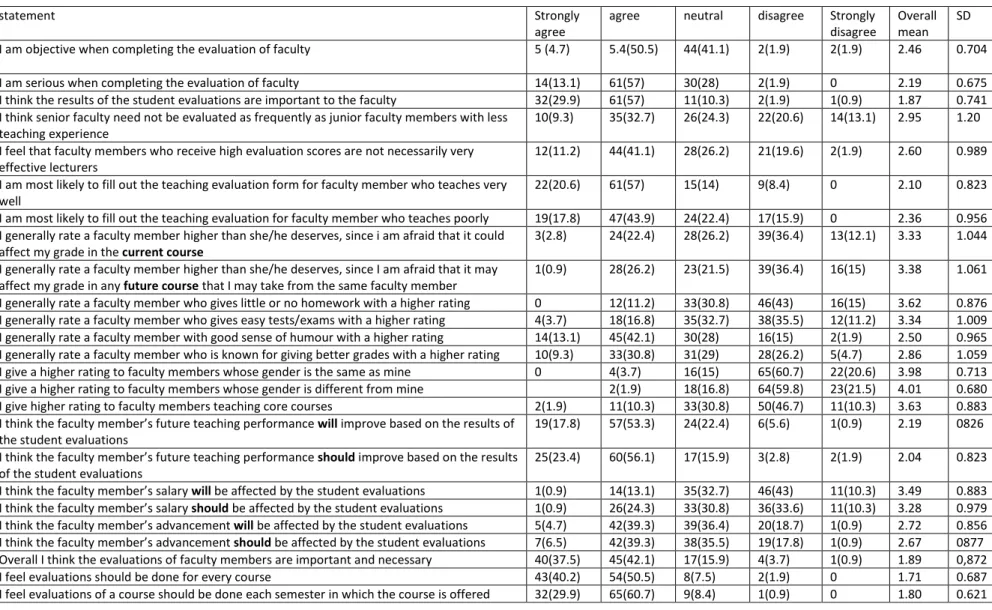
The next series of questions polled students on their objectivity and seriousness in answering the SET form. Overall mean scores (2.46 and 2.19) in Table 1 indicated that the students agreed that they were objective and serious when completing the teaching evaluation form (statement 1 and 2). In addition, majority (86.9 percent) of students acknowledged that the results of student evaluations are important and necessary to the lecturers in accountancy faculty (statement 3 and 23). Furthermore they strongly agreed that evaluations should be done for every course and every semester (statement 24 and 25). However, more than 60 percent of the students felt that the lecturers should not be evaluated solely by the students but also by other methods. The methods of their choices were evaluations by Dean (24.3 percent) and evaluations by other faculty members (18.7 percent).
4.4 Students’ perceptions
134
(Wachtel, 1998) that states more lenient grading standards will receive more favorable rating. Therefore, the expression of customer satisfaction and grade-driven motivation may bias students’ judgment in making SET rating decision.
The survey also include questions on other factors that make a faculty member gets higher rating, like leniency, gender, and fear. The students disagreed that having less homework and easy tests impacted their evaluation ratings (statement 10 and 11). They also strongly felt that gender did not impact their evaluation scores (statement 14 and 15). Therefore, this sample of students did not exhibit gender biasness in the teaching evaluations as majority of students did not give higher rating to faculty members just because they were the same or opposite gender of the students. Students also indicated that they did not rate the faculty any higher than she/he deserves due to fear of having their grades affected in the current course or future courses taken from the same lecturer (statement 8 and 9).
This survey also found that the students agreed to fill out teaching evaluation for both lecturers who teach very well and poorly. But they were more likely to fill out the teaching evaluation who teaches very well as compared to the faculty member who teaches poorly (statement 6 and 7) as indicated in the mean scores of 2.10 and 2.36.
The next survey finding is concerned with the implementation of results of teaching evaluation. The students believed that teaching performance should and will improve based on the results of the student evaluations (statement 17 and 18). When asked about the faculty member’s advancement, they agreed that it should and will be affected by the student evaluations too. However, they disagreed that the faculty member’s salary will and should be affected by the student evaluations. Therefore they felt that the results should be used for formative and not summative purposes. This finding shows that these students are moving in the directions of more accountability.
When asked whether they discussed opinions of the lecturer with other classmates, the mean score indicated that it is not always been practiced. More than thirty percent said that they never discuss and only 14 percent and 40.2 percent reported seldom and sometimes respectively. Only a minority (12.1 percent) did it often and always.
As to the appropriateness of the questions of the teaching evaluation, the students varied in their responses. Answers ranged from somewhat appropriate (37.4 percent), appropriate (36.4 percent), and very appropriate (17.4 percent). The survey also revealed that 43 percent of the students sometimes writing comments on their lecturers, 25.2 percent admitted they never and 23.4 percent reported seldom. The students did this because they believed that writing comments were useless (31.8 percent), they do not care (22.4 percent), and thirdly due to reason of time constraint (18.7 percent). The students strongly felt that the best time to fill out the SET was at the end of the semester (84.1 percent). This is in line with the normal practice of UiTM Perlis to ask the students completing the evaluation forms in the final lecture week of the each semester.
135
HEA (Student Academic Affairs) notice board (30.8 percent) and student portal (20.6 percent). These are the two most popular venues that the students usually visit for any new information release.
5. Conclusion and Limitations
SET serves for many purposes like allocating faculty resources, diagnosing and improving teaching performance, and others. Whatever the objectives are, it must clearly define and inform the students about it purposes because more than half of respondents commented that the purpose of SET never been explained to them. Therefore they completed the evaluation without knowing the purpose. As a result, only a small percent of them frequently wrote comments on their lecturers because one third of them felt that it useless.
However, the results demonstrate that they serious and objective when answering the SET questions. A large majority agreed that the evaluation is important and necessary, and as well they wanted it to be conducted for every course and every semester in which the course is offered. The student ratings is not the only way or the best way to evaluate lecturers and therefore the students felt that other methods of evaluation the teaching should also be conducted and combined using various methods such as evaluation by dean and peer-review.
If student evaluations were to be used to provide feedback to faculty members for performance improvement and advancement, then it needs to be used with cautious because the survey reveals that there are some elements of biasness in completing the SET that resulted higher rating i.e. favorable personalities and leniency. Thus, they did not agree the results of the teaching evaluations to be used for summative purpose. In contrast, students did not have gender bias in rating their lecturer’s performance.
The survey also found that the best time perceived for the students to fill out the SET was at the end of each semester. Regarding the publication/disclosure of the results of the student evaluations, two third of them felt that the results should be published at two main venues: firstly HEA (Student Academic Affairs) notice board, and secondly student portal. The reasons for the publication were not been explored.
There are two main limitations to the current study. First, the study only surveyed accounting students who are studying in UiTM Perlis and hence the results of the study cannot be used to generalize to all faculties in the university. Secondly, respondents’ responses may not be what they think or believe but instead they gave socially desirable response. To reduce social desirability bias, the assurance of confidentiality was used when the survey conducted.
References
Rosiatimah Mohd Isa, Susilawani Ayob, and Salwana Selamat. (2009). Attitude of UiTM academic staff to student evaluation of teaching (SET). Paper presented at International
Conference on Innovation in Teaching and Management of Higher Education (ICITM
136
Ahmadi , M., Helms, M.M., and Raizadeh, F. (2001). Business students’ perceptions of faculty evaluations. The International Journal of Educational Management, Vol. 15, No. 1, pp.12-22.
Basow, S. (1995). Student evaluations of college professors: when gender matters. Journal of Educational Psychology, Vol. 87, pp. 656-665.
Basow, S. (1998). Student evaluations: the role of gender bias and teaching styles. In Collins, L.H., Chrisler, J.C., and Quina, K. (Eds) Career Strategies for Women in Academia:
Arming Athena, Thousand Oaks: Sage.
Brown, G., and Atkins, M. (1993). Effective Teaching in Higher Education (London, Routledge).
Chacko, T.I. (1983). Students ratings of instruction: a function of grading standards. Educational Research Quarterly, Vol. 8, No. 2, pp. 19-25.
Feldman, K.A. (1976). Grades and college student: evaluation of their courses and teachers.
Research in Higher Education, Vol. 18, No. 1, pp. 3-124.
Feldman, K.A. (1993). College students’ views of male and female college teachers: part II – evidence from students’ evaluations of their classroom teachers. Research in Higher Education, Vol. 34, pp. 151-211.
Greenwald, A.G. (1997). Validity concerns and usefulness of student ratings of instruction.
American Psychologist, Vol. 52. No. 11, pp. 1182-1186.
Kidd , R.S., and Latif, D.A. (2004). Student evaluations: are they valid measures of course effectiveness? American Journal of Pharmaceutical Education, Vol. 68, No. 3, Article 61.
Koushki, P.A., and Kuhn, H.A.J. (1982). How reliable are student evaluations of teachers?
Engineering Education, Vol. 72, No. 3, pp. 362-367.
Lowman, J., and Mathie, V.A. (1993). What should graduate teaching assistants know about teaching? Teaching of Psychology, Vol. 20, No. 2, pp.84-88.
Marsh, H.W. (1987). Students evaluations of university teaching: research findings, methodological issues and directions for future research. International Journal of
Educational Research, Vol. II (Whole issue No.3)
Marsh , H.W., and Dunkin, M.J. (1992). Students evaluations of university teaching: a multidimensional perspective, in Smart, J.C. (Ed.), Higher Education: Handbook of
137
Marsh, H.W., and Roche, l.A. (1997). Making students’ evaluation of teaching effectiveness effective: the critical issues of validity, bias and utility. American Psychologist, Vol. 52, No. 11, pp. 1187-1197.
Naftulin, D.H., Ware, J.F., and Donnelly, F.A. (1973). The doctor fox lecture: a paradigm of educational education seduction. Journal of Medical Education, Vol. 48, pp.630-635.
Nimmer, J.C., and Stone, E.F. (1991). Effects of grading practices and time of rating on student ratings of faculty performance and student learning. Research in Higher Education, Vo/. 32, No. 2, pp. 195-215.
Patrick, J., and Smart, R.M. (1998). An empirical evaluation of teacher effectiveness: the
emergence of three critical factors. Assessment and Evaluation in Higher Education, Vol. 23, No. 2, pp. 165-178.
Ramsden, P. (1991). A performance indicator of teaching quality in higher education: the course experience questionnaire. Studies in Higher Education, Vol. 16, No. 2, pp.129-150.
Rodin, M., and Rodin, B. (1972). Student evaluations of teachers. Science, Vol. 177, pp. 1164-1167.
Sacks, P. (1996). Generation X goes to college: an eye-opening account of teaching in
postmodern America. Chicago, IL: Open Court Publishing Co.
Sheehan, D.S. (1975). On the invalidity of student ratings for administrative personnel decisions.
Journal of Higher Education, 46(6), 687-700.
Tatro, C.N. ((1995). Gender effects on students evaluations of faculty. Journal of Research and Development in Education, Vol. 28, No. 3, pp. 169-173.
Wachtel, H.K. (1998). Student evaluation of college teaching effectiveness: a brief review.
Assessment and Evaluation in Higher Education, Vol. 23. No. 2, pp. 191-211.
138
Table 1: Students’ Responses to Questionnaire Items
No .
statement Strongly
agree
agree neutral disagree Strongly
disagree
Overall mean
SD
1 .
I am objective when completing the evaluation of faculty 5 (4.7) 5.4(50.5) 44(41.1) 2(1.9) 2(1.9) 2.46 0.704
2. I am serious when completing the evaluation of faculty 14(13.1) 61(57) 30(28) 2(1.9) 0 2.19 0.675
3. I think the results of the student evaluations are important to the faculty 32(29.9) 61(57) 11(10.3) 2(1.9) 1(0.9) 1.87 0.741 4. I think senior faculty need not be evaluated as frequently as junior faculty members with less
teaching experience
10(9.3) 35(32.7) 26(24.3) 22(20.6) 14(13.1) 2.95 1.20
5. I feel that faculty members who receive high evaluation scores are not necessarily very effective lecturers
12(11.2) 44(41.1) 28(26.2) 21(19.6) 2(1.9) 2.60 0.989
6. I am most likely to fill out the teaching evaluation form for faculty member who teaches very well
22(20.6) 61(57) 15(14) 9(8.4) 0 2.10 0.823
7. I am most likely to fill out the teaching evaluation for faculty member who teaches poorly 19(17.8) 47(43.9) 24(22.4) 17(15.9) 0 2.36 0.956 8. I generally rate a faculty member higher than she/he deserves, since i am afraid that it could
affect my grade in the current course
3(2.8) 24(22.4) 28(26.2) 39(36.4) 13(12.1) 3.33 1.044
9. I generally rate a faculty member higher than she/he deserves, since I am afraid that it may affect my grade in any future course that I may take from the same faculty member
1(0.9) 28(26.2) 23(21.5) 39(36.4) 16(15) 3.38 1.061
10. I generally rate a faculty member who gives little or no homework with a higher rating 0 12(11.2) 33(30.8) 46(43) 16(15) 3.62 0.876 11. I generally rate a faculty member who gives easy tests/exams with a higher rating 4(3.7) 18(16.8) 35(32.7) 38(35.5) 12(11.2) 3.34 1.009 12. I generally rate a faculty member with good sense of humour with a higher rating 14(13.1) 45(42.1) 30(28) 16(15) 2(1.9) 2.50 0.965 13. I generally rate a faculty member who is known for giving better grades with a higher rating 10(9.3) 33(30.8) 31(29) 28(26.2) 5(4.7) 2.86 1.059
14. I give a higher rating to faculty members whose gender is the same as mine 0 4(3.7) 16(15) 65(60.7) 22(20.6) 3.98 0.713
15. I give a higher rating to faculty members whose gender is different from mine 2(1.9) 18(16.8) 64(59.8) 23(21.5) 4.01 0.680
16. I give higher rating to faculty members teaching core courses 2(1.9) 11(10.3) 33(30.8) 50(46.7) 11(10.3) 3.63 0.883
17. I think the faculty member’s future teaching performance will improve based on the results of the student evaluations
19(17.8) 57(53.3) 24(22.4) 6(5.6) 1(0.9) 2.19 0826
18. I think the faculty member’s future teaching performance should improve based on the results of the student evaluations
25(23.4) 60(56.1) 17(15.9) 3(2.8) 2(1.9) 2.04 0.823
19. I think the faculty member’s salary will be affected by the student evaluations 1(0.9) 14(13.1) 35(32.7) 46(43) 11(10.3) 3.49 0.883 20. I think the faculty member’s salary should be affected by the student evaluations 1(0.9) 26(24.3) 33(30.8) 36(33.6) 11(10.3) 3.28 0.979 21. I think the faculty member’s advancement will be affected by the student evaluations 5(4.7) 42(39.3) 39(36.4) 20(18.7) 1(0.9) 2.72 0.856 22. I think the faculty member’s advancement should be affected by the student evaluations 7(6.5) 42(39.3) 38(35.5) 19(17.8) 1(0.9) 2.67 0877 23. Overall I think the evaluations of faculty members are important and necessary 40(37.5) 45(42.1) 17(15.9) 4(3.7) 1(0.9) 1.89 0,872
24. I feel evaluations should be done for every course 43(40.2) 54(50.5) 8(7.5) 2(1.9) 0 1.71 0.687