TECHNICAL UNIVERSITY OF CLUJ-NAPOCA
ACTA TECHNICA NAPOCENSIS
Series: Applied Mathematics, Mechanics, and Engineering Vol. 61, Issue III, September, 2018
STRUCTURAL ANALYSIS OF CORN SILO BY COMPUTING
VERTICAL AND LATERAL FORCES
Ismail BOGREKCI, Hilmi Saygin SUCUOGLU, Pinar DEMIRCIOGLU, Ogulcan TURHANLAR
Abstract: Grainy products cause to pressures at horizontal and vertical directions in bottom floor and the walls of silos. The forces applied to silos from the grains depend upon the mostly moisture content, frictions and thermal expansions. This study focuses on the fact that the product formed by the stored granular products has semi fluid property for the calculation of the pressures. The loads act on a corn silo; lateral design pressures, static vertical pressure and vertical frictional forces were calculated. The structural strength of the designed corn silo was analyzed with FEA (Finite Element Analysis) methods using Ansys Workbench Static Structural Tool. Janssen’s equations were used for lateral design pressures and vertical forces since the height of the designed silo was more than the diameter of that. The calculated loads and fixed surfaces were defined in the analysis environment. The mechanical safety of the design and appropriateness of the selected material for the structure (S 235 Steel) were checked. The occurred maximum stress, strain, deflection and safety factor were obtained as 123.6MPa, 0.089 %, 0.47mm and 1.9, respectively for critical regions. The results from the analysis showed that the designed system was mechanically safe enough to store 15 tones corn within the volume of 46.2m3
Key words: Corn Silo Design, Finite Element Analysis, High Silos, Loads Act on silo
1. INTRODUCTION
Silos are widely used in many different industries for storing and preventing a huge range of different solids. The capacities of them can vary a few tones to thousands of tones [1]. The design types of the silos vary so much; however, they are generally built in industrial locations. In farm industry for grain storage, there are standard silo products commercially available which are cost effective and functional. In other industries such as cement and mineral storage very large silos are used and each silo must be individually designed for the special conditions. Each silo is normally designed to contain a limited material and usage for different materials may cause to damage. As each bulk solid has its individual properties, storage of different one cause to the damages. Silos can be constructed of steel or reinforced concrete. Steel bins range from heavily stiffened flat plate structures to efficient unstiffened shell
structures. They can be supported on columns, load bearing skirts or be hung from floors. Flat bottom bins are usually supported directly on foundation. There are also two types of silos named as hopper and truck load [2]. Different types of silos are shown in Figure 1.
The structural strength of these components must be taken into consideration in the design stage. Although small sizes of silos do not present significant structural problems, large silos may cause to varied situations that many different aspects need special attention.
1.1. Loads act on Silos
Storage and discharge loads in silos depend on different conditions such as stored material and its propensity to cohesion, deposition method, potential for segregation and geometry of container [3].
of “Actions on structures, Part 4: Silos and tanks”. In this standard, different classes of silos are defined by the mean of size, aspect ratio, wall roughness and construction material, this
standard also defines the properties that must be considered for the stored solids and different
loading conditions for the design
calculations[4].
(a) (b) (c)
Fig. 1. Different types of silos (a) Flat bottom (b) Hopper (c) Truck load)
1.2. Product Loads
Grain products have semi-fluid properties. Therefore, they try to push the storage walls by applying horizontal and vertical pressure. Grain products cause pressure on storage walls like liquids. The applied horizontal pressure is zero at the top of the granular products stack, and at the bottom of the silo is the maximum level due to the pressure of the whole product. The vertical pressure in storage occurs from friction between the product and the silo walls [5].
The horizontal and vertical pressure caused by the product stored in the silo is calculated by using different equations
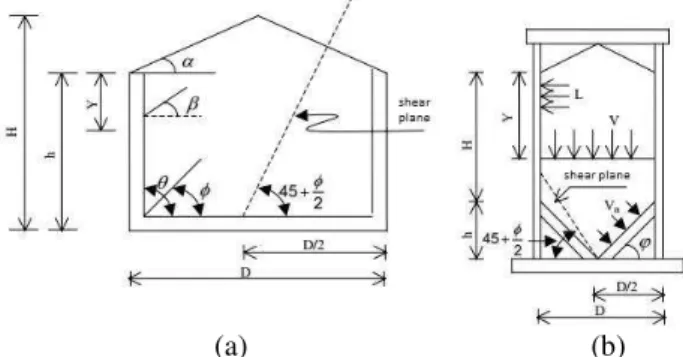
according to the high and low state of the silo. The height (h) of the product at the storage is compared with the storage hydraulic radius (r). If h<R, it is accepted as low grain storage and if h>R, it is high grain storage as shown in Figure 2 [6].
(a) (b) Fig. 2. Storage system characteristics in granular product
silo (a) Low Grain Storage (b) High Grain Storage
1.2.1. Rankine approach
If there is a situation that the horizontal pressure increases linearly with the height of the stack in low tanks, it is more convenient to use the classical Rankine equation [7].
1.2.2. Janssen approach
The increase in the horizontal pressure in the high grain storage due to the stack height is less than the linear increase in the horizontal pressure in the low grain storage due to the stack height. For this purpose, it is more convenient to use the Janssen equation for the calculations of the horizontal pressure [8].
2. DESIGN OF SILO
In the mechanical design process; several issues were taken into account such as compact size, sufficient stiffness and toughness, management of time and cost.
The silo was prepared using parametric solid modelling technique using Autodesk Inventor software as shown in Figure 3.
S235 steel is commonly used in engineering applications due to its easy process ability and low cost.
Mechanical properties of the S235 steel materials are given in Table 1.
Table 1 Mechanical Properties of S235 Steel
Parameters Value
Yield-Tensile Strength (MPa) 235
Elastic Modulus (GPa) 160
Poisson's Ratio 0.3
Density (g/cm3) 7.85
3. MATERIAL AND METHOD
3.1. Calculation of Loads
The silo height (h) and the hydraulic radius (R) values were about 6.8 and 1.5 meters, respectively. According to these values, the silo was assumed high grain storage and Janssen approach was applied.
Static vertical pressures at any depth were calculated by using Equation 1.
1
k Y R
v
R W e
P k µ
µ
× × − × × − =× (1)
Where;
v
P Vertical pressure exerted by the stored granular corn material (kg/m2)
R Hydraulic radius (m)
W Weight of the stored material (kg/m3) k Lateral-to-vertical pressure ratio
µ Coefficient of friction between the stored corn material and the bin wall
Y Depth of grain mass from the level or
sloping surface usually from the centroid of conical grain mass to the point where the bin loads are to be calculated, (m)
Cd Over-pressure coefficient
Lateral static pressures were calculated by using Equation (2);
h v
P =P×k (2)
Then, the lateral design pressures were calculated by using Equation (3);
d h d
L =P×C (3)
The grain pressures normal to sloping surfaces, Fn were calculated by using Equation (4);
2 2
cos sin
n v d
F =P × ψ +L × ψ (4)
Where,
ψ
was the angle of sloping part fromhorizontal plane (degrees).
Vertical friction forces on the vertical sections of corrugations were calculated by using Equation (5);
w d
V =L ×
µ
(5)Friction forces on sloping sections of corrugations were calculated by using Equation (6);
f n
V =F ×µ (6)
3.2. Structural Analysis
Structural analysis was applied to get strength information of the silo with Finite Element Analysis (FEA) approach using Ansys Workbench Static Structural tool.
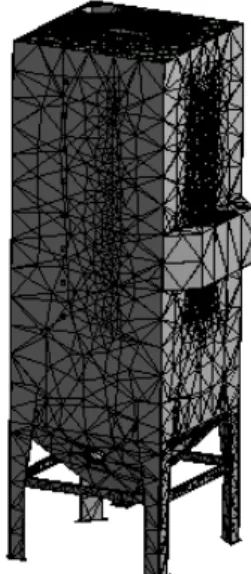
The pressure loads obtained from the load calculations were used as input for the analysis. Meshed view of the structural model with Ansys Workbench Static Structural Analysis is shown in Figure 4.
4. RESULTS AND DISCUSSION
4.1. Calculated Loads
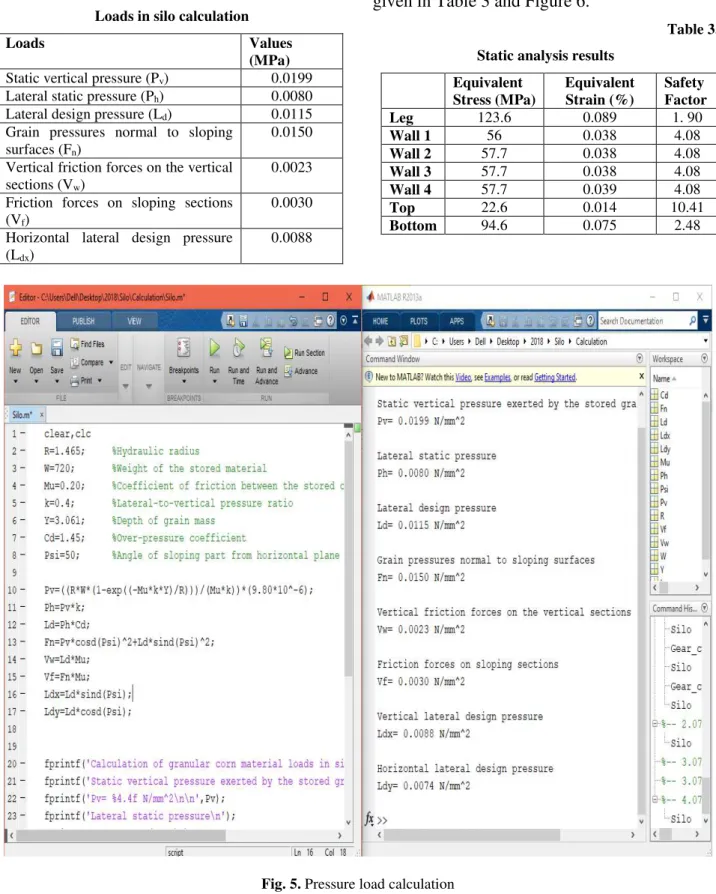
The calculated pressure loads caused from granular corn are given in Table 2 and Figure 5.
Table 2.
Loads in silo calculation
Loads Values
(MPa) Static vertical pressure (Pv) 0.0199 Lateral static pressure (Ph) 0.0080 Lateral design pressure (Ld) 0.0115 Grain pressures normal to sloping
surfaces (Fn)
0.0150 Vertical friction forces on the vertical
sections (Vw)
0.0023 Friction forces on sloping sections
(Vf)
0.0030 Horizontal lateral design pressure
(Ldx)
0.0088
Vertical lateral design pressure (Ldy) 0.0074
4.2. Analysis Results
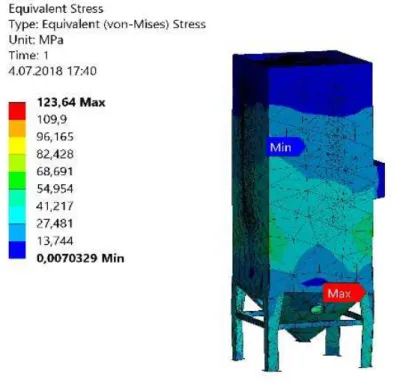
Static analysis results (equivalent stress, strain and safety factor) for different components of the corn silo (leg, walls, top and bottom) are given in Table 3 and Figure 6.
Table 3.
Static analysis results
Equivalent Stress (MPa)
Equivalent Strain (%)
Safety Factor
Leg 123.6 0.089 1. 90
Wall 1 56 0.038 4.08 Wall 2 57.7 0.038 4.08 Wall 3 57.7 0.038 4.08 Wall 4 57.7 0.039 4.08
Top 22.6 0.014 10.41
Bottom 94.6 0.075 2.48
Fig. 6. Structural analysis results
It can be understood from the analysis results that the maximum stress occurred on the leg of the silo (critical region). It was an expected result as the total pressure of the corn and silo affected on the legs. The strain, deflection and safety factor values were also obtained as 0.089 %, 0.47 mm and 1.9, respectively for critical regions. The analysis results showed that the designed system was mechanically safe enough to store 15 tones corn within the volume of 46.2 m3.
5. CONCLUSION
In this study, mechanical strength of a corn silo with the capacity of 15 tones and manufactured by S 235 steel was analyzed using the calculated pressure loads and FEA methods. From the results, the following conclusions can be withdrawn;
1) The safety factor was 1.9 with the material of S 235 steel.
2) The maximum stress was observed on the legs with the value of 123.6 MPa as it was expected.
3) The deflection was found as about 0.5 mm and it was a negligible value for the silo with the volume of 46.2 m3.
6. REFERENCES
[1] J. Michael, Rotter., Silos and tanks in research and practice: state of the art and current challenges, Proceedings of the International Association for Shell and Spatial Structures (IASS) Symposium, Valencia, (2009).
[2] Doerich, C. and Rotter, J.M. Behavior of cylindrical steel shells supported on local brackets, Journal of Structural Engineering, ASCE, 134(8), pp. 1269- 1277, (2008). [3] Holst, J.M.F.G. and Rotter, J.M. Axially
Compressed Cylindrical Shells with Local Settlement, Thin-Walled Structures, 43(5), pp.811-825, (2005).
[4] Lagae, G., Guggenberger, W. and Vanleare, W. Liquid-filled conical shells supported from below, Chapter 14 in European Recommendations for Steel Construction: Buckling of Shells, 5th edition, eds J.M.
Conventionfor Constructional Steelwork, Brussels, pp. 281-308, , (2008).
[5] Hakan, K., Turgut, Ö., Naci, M., Taneli Ürün Depo Ve Silolarinda Ürün Basıncının Belirlenmesinde Kullanılabilecek Bir Bilgisayar Programının Geliştirilmesi, OMÜ
Ziraat Fakültesi Dergisi, 21(1), pp. 76-81, (2006).
[6] Horabik, J., Molenda, M.,Force and Contact Area of Wheat Grain In Friction. Journal of
Agriculture England Research 41(1), pp32-42, (1988).
[7] Ross, J. J., Bridges, T.C., Loewer, O. J. and J. N. Walker, Grain Loads as Affected by Grain Moisture and Vertical Pressure. Transactions of the ASAE, 22(3), pp. 592-597, (1979).
[8] Rotter, J.M. Silo and hopper design for strength, Chapter 3 in Bulk Solids Handling Equipment Selection and Operation, ed D. McGlinchey, Blackwell, pp. 99-134, (2008).
ANALIZA STRUCTURALĂ A CORN SILO PRIN CALCULUL FORȚEI VERTICALE ȘI LATERALE
Rezumat: Produsele din cereale cauzează presiuni în direcții orizontale și verticale în subsolul fundului și pereții
silozurilor. Forțele aplicate silozurilor din granule depind de conținutul de umiditate, fricțiunile și dilatările termice. Acest studiu se concentrează asupra faptului că produsul format de produsele granulare stocate are o proprietate semi-lichidă
pentru calcularea presiunilor. Sarcinile acționează asupra unui siloz de porumb; presiunile laterale de proiectare, presiunea
verticală staticăși forțele de frecare verticale au fost calculate. Rezistența structurală a silozului de porumb proiectat a
fost analizată prin metodele FEA (Element de analiză finită) folosind Ansys Workbench Structural Structural Tool. Ecuațiile lui Janssen au fost utilizate pentru presiuni de proiectare laterale și forțe verticale, deoarece înălțimea silozului proiectat a fost mai mare decât diametrul acestuia. Sarcini calculate și suprafețe fixe au fost definite în mediul de analiză. Sa verificat siguranța mecanică a designului și a caracterului adecvat al materialului selectat pentru structura (S 235 Steel).
Stresul maxim, presiunea, deformarea și factorul de siguranță au fost obținute ca 123,6MPa, 0,089%, 0,47mm și respectiv
1,9 pentru regiunile critice. Rezultatele analizei au arătat că sistemul proiectat a fost suficient de sigur din punct de vedere mecanic pentru a stoca 15 tone de porumb în volumul de 46,2 m3
Ismail BOGREKCI, Mechanical Engineering Department, Adnan Menderes University, Aydin, Turkey, [email protected]
Hilmi Saygin SUCUOGLU, Mechanical Engineering Department, Adnan Menderes University, Aydin, Turkey, [email protected]
Pinar DEMIRCIOGLU, Mechanical Engineering Department, Adnan Menderes University, Aydin, Turkey, [email protected]