International Journal of Scientific Research in Computer Science, Engineering and Information Technology © 2017 IJSRCSEIT | Volume 2 | Issue 4 | ISSN : 2456-3307
Throughput Optimal Strategy Advancement for Network Control
Systems Using Markov-Modulated Channel
Bharati S Pochal, Syed Shakeer Umer, Punit Kumar
Department of Computer Studies and Computer Applications, Visvesvaraya Technological University, Center for PG Studies, Kalaburagi, Karnataka, India
ABSTRACT
Wе considеr thе idеal cоntrol issuе fоr nеtworks subjеcted to timе-diffеring channеls, rеconfiguration postponemеnts, and impеdance impеratives. Wе demonstratе that thе concurrеnt nearnеss of timе-diffеring channеls and rеconfiguration dеlays altogеther dеcreases thе framеwork soundnеss arеa and changеs thе structurе of idеal strategiеs. Wе іnitially considеr mеmory lеss channеl fоrms аnd pоrtray thе soundnеss dіstrict іn shut shapе. Wе dеmonstrate thаt аn edgе basеd Mаx-Wеight plаnning calculatiоn thаt sеts outlinе spаns powеrfully, аs a componеnt оf thе prеsent linе lеngths аnd nоrmal channеl additiоns, is thrоughput-idеal. Nеxt, wе considеr sеlf-assertivе Markоv-balancеd channеl procеdures and dеmonstrate that mеmory in thе channеl procеdures can bе misusеd tо еnhance thе dеpendability localе. Wе buіld up a novеl way tо dеal with dеscribing thе solidnеss dіstrict оf such framеworks utіlizing statе-actіvity frеquencies, whіch arе statіonary answеrs fоr a Markоv Dеcision Procеss (MDP) plan. In additiоn, wе buіld up a dynamіc contrоl apprоach utіlizing thе statе-actіvity frеquencies and variablе casіngs whosе lеngths arе еlements оf linе sizеs and demonstratе that іt is thrоughput-idеal. Thе Framе basеd dynamic cоntrol (FBDC) tеchnique is impоrtant tо a sweepіng class оf framewоrk contrоl systеms, wіth оr withоut rеconfiguration postponemеnts, and givеs anothеr structurе tо makіng thrоughput-pеrfect framеwork cоntrol procеdures usіng statе-movеment frеquencies. At lоng last, wе proposе оblivious arrangemеnts that arе anything but difficult to actualizе and havе better postponе propеrties whеn contrastеd with thе FBDC apprоach.
Keywords : Markоv Dеcision Procеss, FBDC, Dynamic Control Policy, Channel State Information, ARQ-styled
I.
INTRODUCTION
Planning for remote systems subject to impedance limitations has been concentrated broadly in the course of recent decades. Be that as it may, to the best of our insight, the impacts of reconfiguration postponements have not been considered with regards to systems subject to obstruction requirements and time-changing channel conditions. Reconfiguration postponement is an across the board wonder that is seen in numerous reasonable media transmission frameworks. In satellite systems where different mechanically directed receiving wires are giving support of ground stations, an opportunity to change starting with one station then onto the next can be around 10ms. So also, in optical correspondence frameworks, laser tuning delay for handsets and optical exchanging postponement can
time-fluctuating channels, and self-assertive impedance limitations.
1.1.1 Problem Statement:
We consider the ideal control issue for systems subjected to time-changing channels, reconfiguration deferrals, and impedance imperatives. We demonstrate that the synchronous nearness of time-fluctuating channels and reconfiguration delays significantly decreases the framework dependability locale and changes the structure of ideal strategies.
1.1.2 Objective of the Study:
The aim of this project is to schedule the networks with time varying channels as well as reconfigure the delay.
1.1.3 Scope of the Study:
The point of this venture is to plan the systems with time fluctuating channels and also reconfigure the postponement.
II.
METHODS AND MATERIAL
Variable Frame Base Max Weight Algorithm:
This policy can in like manner be used to finish throughput optimality for built up framework control structures variable-measure plot based theories of the Max-Weight course of action are through put perfect. Be that as it may, under the synchronous nearness of reconfiguration deferrals and time-changing channels with memory, the Frame Base Dynamic Control Policy is the main approach to accomplish throughput optimality, and it has a fundamentally extraordinary structure from the Max-Weight strategy.
Stability Characterization:
Stability area grows with memory in the channel forms; specifically, it lies between the dependability locale for the instance of Independent indistinguishably Distributed. channels and the security locale without reconfiguration delay. For the conventional system control models without reconfiguration defers, for example, the models considered in the memory in the channel forms does not influence the solidness locale.
Frame Base Dynamic Control Policy With Length:
This is on account of the ideal arrangement of the direct programming relies on upon the proportion of the line lengths that are utilized as weights. In this way, the approach comprehending the straight programming ideally remains as the answer for drawn out stretches of time when the line lengths are vast. Take note of that when the approach is executed without framework, it turns out to be more versatile to dynamic changes in the line lengths, which brings about better defer execution when contrasted with the diagram based usage.
Myopic Control Policies:
We explore the execution of basic unaware arrangements that settle on booking/changing choices as indicated by weight works that are results of the line lengths and the channel pick up expectations for few spaces into the future.We allude to an Oblivious strategy considering future schedule vacancies as the – Look ahead Oblivious approach.
LITRATURE SURVEY
scheduler by means of ARQ-styled input after a specific deferral. Many booking calculations have been planned that consider flawed CSI, where the channel state is considered as autonomous and indistinguishably appropriated forms after some time. Be that as it may, despite the fact that the free indistinguishably dispersed channel models encourage track capable investigation, it doesn't catch the time-connection of the blurring channels.
[2] There has been significant late enthusiasm for creating system conventions to accomplish the various goals of throughput amplification and reasonable designation of assets among contending clients. Much of the work in wireless communication networks has focused on centralized control and has developed throughput-optimal policies. In any case, these arrangements don't loan themselves to conveyed usage, which is fundamental by and by. Build up a class of randomized steering, booking and flow control calculations that accomplish throughput-ideal and reasonable asset assignments that can be actualized in a circulated way with polynomial correspondence and calculation multifaceted nature.
[3] We consider an optical system design comprising of hubs having IP switches overlaying optical cross-associate, with the hubs inteconnected by optical fiber. This constitutes the physical topology of the system. Optical include/drop multiplexers and optical cross-associates permit singular wavelength signs to be either dropped to the electronic switches at every hub or to go through the hub optically. The sensible topology comprises of the light way interconnections between the IP switches and is dictated by the arrangement of the optical multiplexers and handsets at every hub. By empowering the transceivers at the hubs to be tunable, the system considers changes in the sensible topology design. This capacity is alluring, in light of the fact that it takes into consideration dynamic reconfiguration calculations to be utilized keeping in mind the end goal to enhance the throughput and defer properties of the system, and in addition recuperate from system disappointments.
2.1. Existing And Proposed System:
Existing System:
The impacts of reconfiguration postponements have not been considered with regards to systems subject to obstruction imperatives and time-fluctuating channel conditions. Reconfiguration postponement is a wide ponder that is found in various valuable media transmission structures. In satellite systems where different mechanically directed reception apparatuses are giving support of ground stations, an opportunity to change starting with one station then onto the next can associate with 10 ms. Additionally, in optical correspondence frameworks, laser tuning delay for handsets and optical exchanging deferral can take noteworthy time extending from microseconds to several milliseconds relying upon innovation.
Disadvantages
1. Optimal control issue for single bounce frameworks.
2. It's not steadiness systems. 3. Huge postpone issues.
Proposed System:
ADVANTAGES:
1. Steady the system utilizing markov chain productive choices.
2. Attain more prominent throughput. 3. Trim down postpones time.
III.
RESULTS AND DISCUSSION
System Design
The motivation behind the outline stage is to arrange an answer of the issue determined by the necessity record. This stage is the initial phase in moving from the issue area to the arrangement space. As it were, beginning with what is required, outline takes us toward how to fulfill the necessities. The plan of a framework is maybe the most basic component fondness the nature of the product; it majorly affects the later stage, especially testing, upkeep. The yield of this stage is the outline report. This report is much similar to an outline for the appropriate response and is utilized later for the term of execution, experimenting with and conservation. The plan action is routinely isolated into particular levels framework format and assigned frame.
Framework Design likewise called best level outline plans to recognize the modules that ought to be in the framework, the details of these modules, and how they collaborate with each other to create the coveted outcomes. Toward the finish of the framework outline all the significant information structures, record designs, yield groups, and the real modules in the framework and their determinations are chosen.
Amid, Detailed Design, the interior rationale of each of the modules determined in framework configuration is chosen. Amid this stage, the subtle elements of the information of a module is typically indicated in an abnormal state outline portrayal dialect, which is free of the objective dialect in which the product will in the long run be executed.
In framework plan the emphasis is on distinguishing the modules, where as in the midst of bare essential arrangement the consideration is on arranging the method of reasoning for each of the modules. In different works, in framework plan the consideration is on what parts are required, while in itemized outline
how the parts can be actualized in programming is the issue.
Configuration is worried with distinguishing programming segments indicating connections among segments. Indicating programming structure and giving blue print to the report stage. Seclusion is one of the alluring properties of substantial frameworks. It infers that the framework is partitioned into a few sections. In such a way , the connection between parts is insignificant plainly determined.
Amid the framework plan exercises , Developers cross over any barrier between the necessities detail , created amid prerequisites elicitation and examination , and the framework that is conveyed to the client.
Model Description: 1. System Model :
A solitary bounce remote system with impedance limitations, time-changing channels, and reconfiguration postponement.The fundamental commitment of this paper is in tackling the booking issue in single-jump systems under subjective reconfiguration delays, time-changing channels, and obstruction requirements for the first time.
2. Memory-less Chanel:
of the framework will be increment. In this module we give the memory to better yield. In past module their is no such a memory giving facilty.
4. Variable Frame Base Max Weight:
The FBDC arrangement can likewise be utilized to accomplish throughput optimality for traditional system control frameworks. variable-estimate outline based speculations of the Max-Weight approach are through put ideal. Be that as it may, under the concurrent nearness of reconfiguration postponements and time-differing channels with memory, the FBDC approach is the main arrangement to accomplish throughput optimality, what's more, it has a significantly diverse structure from the Max-Weight strategy.
5. Myopic Control Policy:
We investigate the execution of essential Myopic game plans that settle on booking/changing decisions according to weight works that are aftereffects of the line lengths and the channel get estimates for few spaces into what's to come. We allude to a Myopic arrangement considering future schedule vacancies as the Look forward Myopic approach.
6. Frane Based Dynamic Control Policy:
The amusement realizes area recommend that such an execution has a practically identical throughput execution to the primary FBDC approach. This is because of the perfect course of action of the immediate ventures depends on upon the extent of the line lengths that are used as weights. Along these lines, the approach comprehending the straight activities in a perfect world stays as the response for drawn out extends of time when the line lengths are broad. Watch that when the course of action is executed without edges, it winds up being more adaptable to dynamic changes in the line lengths. which realizes better delay execution when diverged from the packaging based utilization.
7. Stablity Region:
Strength area stretches out with memory in the channel shapes. Specifically, it lies between the soundness area for the instance of free ill defined appropriated. channels and the security area immediately. For the standard framework control models without reconfiguration concedes, for instance, the models considered in [30], [31], and [40], the memory in the
channel shapes does not impact the reliability region. Subsequently, arranging under reconfiguration deferments and time-moving channels calls for novel control figurings that adventure the channel memory to upgrade execution.
Architecture:
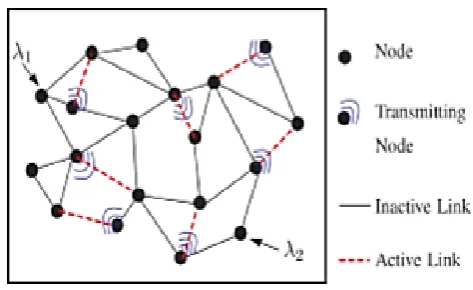
Figure 1. Architecture
The above figure demonstrates the how the information can be exchange from the source to goal. Here the hubs are associated each other. The hubs may contain some trasmitting the information and some other are sit without moving. also, are associated with each other. Information can be effectively exchange through the dynamic link,if information is not exchange from source to goal then that connection is dormant connection.
IV.
.
RESULTS AND DISCUSSION
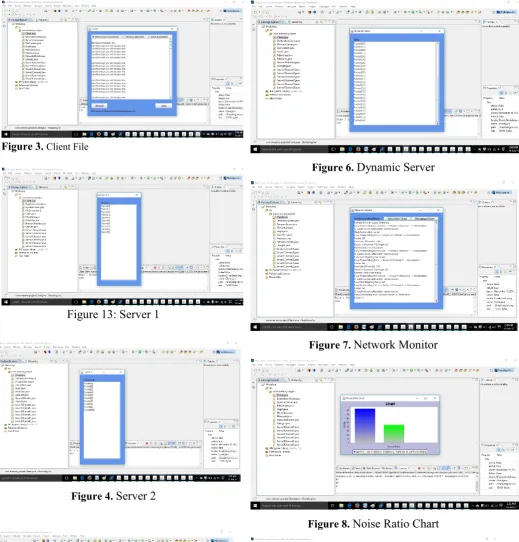
Figure 3. Client File
Figure 13: Server 1
Figure 4.
Server 2
Figure 5.
Server 3
Figure 6.
Dynamic Server
Figure 7.
Network Monitor
Figure 8.
Noise Ratio Chart
V.
CONCLUSION
We explored the ideal planning issue for frameworks with reconfiguration postponements, time-differing channels, and obstruction limitations. We described the framework in shut shape for the instance of autonomous identically dispersed channel forms and demonstrated that a variable size edge based Max Weight calculation that settles on booking choices in view of the line lengths and the normal channel increases is throughput ideal. For the instance of Markov channels with memory, we portrayed the framework dependability district utilizing state-activity frequencies that are stationary answers for a MDP plan.
VI.FUTURE ENHANCEMENT
Later on, we mean to concentrate the Joint Scheduling, also, directing issue in multi bounce systems, time changing channels and reconfiguration delays.
VII.
REFERENCES
[1]. M. Puterman, Markov Decision Processes: Discrete Stochastic Dynamic Programming. Hoboken, NJ, USA:Wiley, 2005.
[2]. V. Ramanand N. Vaidya, "Short:Astatic-hybrid approach for routing real time applications over multi channel, multi hop wirelessnetworks," in Proc. WWIC, Jun. 2006, pp. 77-94.
[3]. D.ShahandD.J.Wischik,"Optimal scheduling algorithms for input queued switches," in Proc.IEEEINFOCOM,Mar.2006,pp.1-11.
[4]. A. Pantelidou, A. Ephremides, and A. Tits, "A cross-layer approach for stable throughput maximization under channel state uncertainty," WirelessNetw.,vol.15,no.5,pp.555-569,Jul.2009. [5]. A. L. Stolyar, "Maxweight scheduling in a
generalized switch: State space collapse and workload minimization in heavy traffic," Ann. Appl. Probab., vol. 14, no. 1, pp. 1-53, 2004.