Dissolution
of
Committed
Partnerships
during
Incarceration
and
STI/HIV-Related
Sexual
Risk
Behavior
after
Prison
Release
among
African
American
Men
MariaR.Khan & JoyD.Scheidell & CarolE.Golin & SamuelR.Friedman & AdaoraA.Adimora & CarlW.Lejuez & HuiHu & KellyQuinn & DavidA.Wohl
Publishedonline:2August2018
Abstract Incarceration is strongly associated with post-release STI/HIV risk. One pathway linking incarceration and STI/HIV risk may be incarceration-related dissolu-tion of protective network ties. Among African Ameri-can men released from prison who were in committed partnerships with women at the time of incarceration (N= 207), we measured the association between com-mitted partnership dissolution during incarceration and STI/HIV risk in the 4 weeks after release. Over one-quarter (28%) experienced incarceration-related partner-ship dissolution. In adjusted analyses, incarceration-related partnership dissolution was strongly associated
with post-release binge drinking (adjusted odds ratio (AOR) 4.2, 95% confidence interval (CI); 1.4–15.5). Those who experienced incarceration-related partner-ship dissolution were much more likely to engage in multiple/concurrent partnerships or sex trade defined as buying or selling sex (64%) than those who returned to the partner (12%; AOR 20.1, 95% CI 3.4–175.6). Pol-icies that promote maintenance of relationships during incarceration may be important for protecting health.
Keywords Incarceration . STI . HIV. African American . Partnerships
Electronic supplementary material The online version of this
article (https://doi.org/10.1007/s11524-018-0274-2) contains supplementary material, which is available to authorized users.
M. R. Khan (*)
:
J. D. Scheidell:
K. QuinnDivision of Comparative Effectiveness and Decision Science, Department of Population Health, NYU School of Medicine, New York, NY, USA
e-mail: [email protected]
C. E. Golin
Division of General Internal Medicine and Epidemiology, Department of Medicine, UNC School of Medicine, University of North Carolina at Chapel Hill, Chapel Hill, NC, USA
C. E. Golin
Department of Health Behavior, UNC Gillings School of Global Public Health, University of North Carolina at Chapel Hill, Chapel Hill, NC, USA
S. R. Friedman
National Development and Research Institutes, Inc., New York, NY, USA
A. A. Adimora
:
D. A. WohlDivision of Infectious Disease, UNC School of Medicine, University of North Carolina at Chapel Hill, Chapel Hill, NC, USA
A. A. Adimora
Department of Epidemiology, UNC Gillings School of Global Public Health, University of North Carolina at Chapel Hill, Chapel Hill, NC, USA
C. W. Lejuez
Cofrin Logan Center for Addiction Research and Treatment, Department of Psychology, College of Liberal Arts & Sciences, University of Kansas, Lawrence, KS, USA
H. Hu
Introduction
Incarceration is considered a social determinant of STI/ HIV in the US [1] given its consistent association with post-release sexual risk behavior and STI/HIV [2–8]. One pathway that may link incarceration and STI/HIV risk is incarceration-related disruption of protective network ties. Incarceration disrupts substantial proportions of commit-ted partnerships [9,10]. If an inmate loses a partner during incarceration, he may seek new partners upon release. Partnership dissolution may impact mental health [11], leading to self-medication with substance use [12]; both mental disorders and substance use are established risk factors for sexual risk-taking and infection [13–15].
The purpose of this study was to describe the associ-ation between dissolution of committed partnerships dur-ing incarceration and former inmates’post-release STI/ HIV-related sex risk-taking. We describe 1-month follow-up findings of Project DISRUPT, a study conducted among African American men incarcerated in North Carolina who were in heterosexual committed partner-ships at prison entry and who were followed during community re-entry. We measure 1-month post-release outcomes given this is a period of instability and drug risk-taking [16,17]; substantial proportions initiate sexual activity within weeks of release [18] and evidence sug-gests risky behaviors during this time period are common [19]. We recruited incarcerated men, because men expe-rience a disproportionate burden of incarceration [20] and understanding STI/HIV determinants among men has relevance to risk among women given of the majority of women are infected as a result of sex with a male partner [21]. The study focused on heterosexual partner-ships given strong extant evidence suggesting incarcera-tion influences sexual risk behavior and STI/HIV among former male inmates and their female partners [2–8]. The aim of this study was to measure associations between incarceration-related committed partnership dissolution and STI/HIV-related sex risk [9,10], as well as mental health and substance use factors given the association of these factors with STI/HIV risk [13–15].
Methods
Study Setting and Population
As previously described [22], Project DISRUPT recruit-ed participants from minimum and mrecruit-edium security
facilities in the North Carolina Department of Public Safety (NCDPS) from September 2011 to January 2014. Participants were African American men at least 18 years of age scheduled to be released within 2 months; incarcerated less than 36 months; HIV-negative at prison entry based on testing at prison intake; not held in segregation; not currently incarcerated for rape, murder, or kidnapping; in a committed partnership with a woman at prison entry (i.e.,Ba woman in your life who you were having sex with regularly and who you felt committed to^); residing in the community for at least 6 months before the current incarceration; able to read and write in English; and willing to provide in-formed consent and post-release contact information. Of 477 eligible individuals, 207 enrolled. The Institutional Review Boards of NCDPS, New York University School of Medicine, the University of North Carolina at Chapel Hill, and the University of Florida approved all study activities.
Data Collection
At the baseline (in-prison) and follow-up study visit, trained research assistants (RAs) administered a survey that measured sociodemographics, mental health, sub-stance use, sexual risk behavior, partner characteristics, and relationship characteristics. The 1-month follow-up visit window was 2–14 weeks after release; the median number of days after release that 1-month visits oc-curred was 43 days. Participants completing the visit in the window were asked to report on experiences and behaviors in the past 4 weeks. Among 14 participants who participated in a follow-up visit outside the study visit window, we administered aBone month catch-up^ module and asked participants to report on behaviors and experiences in the 4 weeks after release from incarceration.
Measures
Exposure Committed partnership dissolution was based on report of the relationship status at baseline. However, to prevent exposure misclassification, additional infor-mation from follow-up was used to code exposure status among 29% of participants who were unaware of the relationship status during the incarceration (i.e., the partner may have ended the relationship yet the partic-ipant was not yet aware of this until after release).
Outcomes
Mental disorder symptoms, substance use, sexual risk-taking in the 4 weeks after release.
Mental Disorder Symptoms
Depressive symptoms were measured using a five-item version of the Centers for Epidemiologic Studies De-pression (CES-D) scale, with scores ≥4 indicating symptoms indicative of major depressive disorder, the cut-point proportional to that for complete 20-item CES-D [13, 14, 22,23]. Participants rated stress assessing domains including overall stress and stress about hous-ing, food security, health, employment, and violence on a one to 10 scale [24]; responses to each of six topics were summed to create a score and dichotomized at the 75th percentile given the strong associations with psy-chopathology using this cut-point [14].
Substance Use
Binge drinking was defined as consuming≥5 standard drinks on a typical day. We analyzed use of marijuana, the most commonly used drug, and crack/cocaine given the high prevalence and consistent correlations with sexual risk behaviors at baseline [22]. Use of these drugs was assessed using a modified version of the National Institute on Drug Abuse Risk Behavior Assessment (RBA) Tool [25].
Sexual Risk-Taking
We examined a combined indicator of multiple/ concurrent sex partners or sex trade (concurrent partner-ships, non-concurrent multiple partnerpartner-ships, or buying or selling sex). Inconsistent condom use with new/ casual partners was defined as failure to use a condom
100% of the time when having sex with these partners. Participants who reported having sex while drunk and/ or high were considered to have had sex while intoxi-cated. Participants who reported sex with partners who Bdefinitely^ or Bprobably^ had other sexual partners currently, had ever engaged in sex work, or had ever been diagnosed with an STI were coded as having sex with a partner at elevated risk of infection.
Potential Confounders
Antisocial personality disorder (ASPD) was measured using the Structured Clinical Interview for DSM-IV module [13,26] and executive function (EF) with the Wisconsin Card Sorting Test [27] in which a raw per-severative error score at the highest quartile (score≥14) was considered indicative of impaired executive func-tion; history of perpetration of intimate partner violence by report of whether the participant and/or his partner used physical violence and/or a weapon against the other in the 6 months before the incarceration; and relationship happiness at baseline by report of being Bvery happy,^ Bextremely happy,^ orBperfect^ in the relationship. We considered the baseline measure of each outcome as a potential confounder. Because age, socioeconomic factors (education, employment), length of incarceration, and the number of children/dependents were not associated with partnership loss and/or the outcomes, these factors were not assessed as con-founders to optimize statistical power.
Baseline Characteristics to Evaluate Differences by Follow-up Participation
We compared potential confounders and background factors including baseline age, education, employment, most serious offense for the current incarceration, mari-tal status, and biologically confirmed STI based on urine nucleic acid amplification testing (NAAT) for detection of Chlamydia trachomatis, Neisseria gonorrhoeae (Aptima Combo 2, Hologic|Gen-Probe, Inc.), and Trich-omonas vaginalis(Aptima T. vaginalis analyte-specific reagents, Hologic|Gen-Probe, Inc.) by follow-up partic-ipation status and relationship dissolution status.
Analyses
chi-Table 1 Baseline characteristics among participants who partici-pated in follow-up versus did not participate in follow-up (n= 207)
*Individual indicator percentages may not sum to totals due to missing value
†In the 6 months before
partici-pant’s incarceration
Characteristic Participated in follow-up (n= 94)* n(%)/ mean ± std
Did not participate in follow-up (n= 113)* n(%)/mean ± std
pvalue
Age 36.9 ± 9.6 32.4 ± 9.0 < 0.001
Education status 0.84
Completed high school 58 (67.4) 70 (66.0) Did not complete high school 28 (32.6) 36 (34.0)
Employment status† 0.99
Employed full/part-time 49 (61.3) 62 (61.4) Not employed 31 (38.8) 39 (38.6)
Current incarceration for a violent crime 0.99 Yes 25 (26.6) 30 (26.6)
No 69 (73.4) 83 (73.4)
Married to committed partner 0.11 Yes 20 (23.8) 15 (14.6)
No 64 (76.2) 88 (85.4)
Degree of relationship happiness† 0.82 Happy 29 (34.9) 34 (33.3)
Unhappy 54 (65.1) 68 (66.7)
Participant perpetrated IPV† 0.07 Yes 36 (45.0) 32 (31.7)
No 44 (55.0) 69 (68.3)
Committed partner perpetrated IPV† 0.46 Yes 45 (55.6) 50 (50.0)
No 36 (44.4) 50 (50.0)
Depressive symptoms† 0.64
Yes 32 (34.0) 42 (37.2)
No 62 (66.0) 71 (62.8)
Elevated stress† 0.29
Yes 21 (25.0) 33 (32.0)
No 63 (75.0) 70 (68.0)
Antisocial personality disorder 0.07 Yes 17 (20.0) 11 (10.7)
No 68 (80.0) 92 (89.3)
Impaired executive function 0.70 Yes 22 (26.2) 29 (28.7)
No 62 (73.8) 72 (71.3)
Binge drinking on typical day† 0.49 Yes 19 (24.4) 19 (20.0)
No 59 (75.6) 76 (80.0)
Lifetime frequent marijuana use 0.03 Yes 50 (60.2) 76 (75.3)
No 33 (39.8) 25 (24.8)
Lifetime crack/cocaine use 0.03 Yes 40 (48.2) 33 (32.4)
No 43 (51.8) 69 (67.6)
squared tests. We estimated unadjusted and adjusted odds ratios (ORs) and 95% confidence intervals (CIs) for associations between committed partnership disso-lution and adverse outcomes. We used backwards elim-ination to identify the set of confounding variables necessary to include in each final model to optimize validity and parsimony [28] ensuring the OR derived from each final model was no greater than 10% different than the OR derived from the fully-adjusted model which included all potential confounders. All analyses were conducted using SAS v9.4 (Cary, NC).
Results
Participant Baseline Characteristics
Approximately 55% were lost to follow-up (LTF). Those who completed follow-up were comparable to those LTF on most factors (Table1). However, partici-pation was associated with higher levels of lifetime crack/cocaine use, and though not significant at the
0.05 level, higher risk of buying and/or selling sex, ASPD, and violence in relationships, suggesting partic-ipators represented a group at elevated STI/HIV risk versus those LTF.
Associations between Partnership Dissolution during Incarceration and Baseline Characteristics
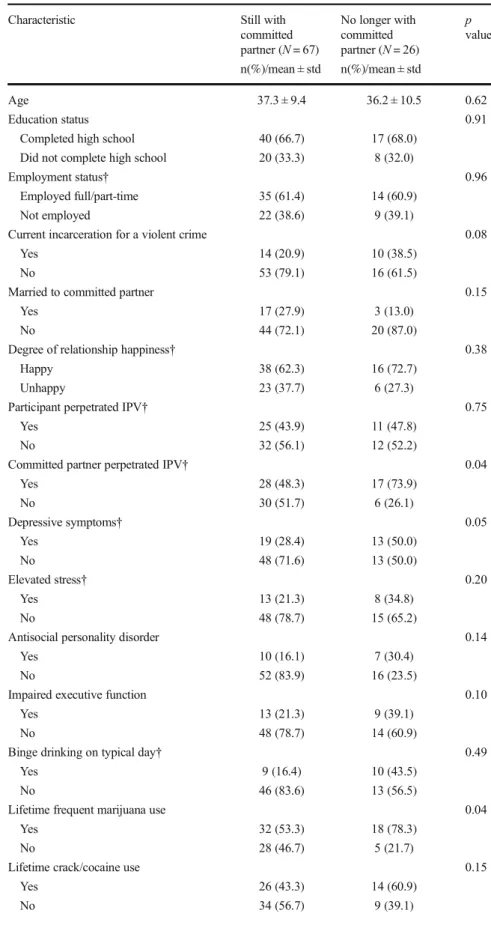
Among those who participated in the follow-up, 28% (n= 26) were categorized as having experienced incarceration-related committed partnership dissolu-tion. Relationship dissolution status was not associated with most characteristics measured on the baseline interview (Table 2). However, those who experienced relationship dissolution during incarceration were more likely to report experience of depressive symptoms, frequent marijuana use, and sexual risk behaviors in the 6 months before incarceration versus those who remained with partners during incarceration.
Relationship dissolution status was not significantly different among those who completed the survey with
Table 1 (continued)
Characteristic Participated in follow-up (n= 94)* n(%)/ mean ± std
Did not participate in follow-up (n= 113)* n(%)/mean ± std
pvalue
No 40 (49.4) 54 (54.5)
Sex trade involvement† 0.15
Yes 12 (14.5) 8 (7.8)
No 71 (85.5) 94 (92.2)
Inconsistent condom use with new/casual partners†
0.53
Yes 37 (46.3) 49 (51.0)
No 43 (53.8) 47 (49.0)
Sex while intoxicated† 0.92 Yes 67 (82.7) 83 (82.2)
No 14 (17.3) 18 (17.8)
Sex with high-risk partners† 0.80 Yes 21 (26.6) 28 (28.3)
No 58 (73.4) 71 (71.7)
Biologically -confirmed STI 0.51
Yes 9 (10.7) 8 (7.9)
No 75 (89.3) 93 (92.1)
Partnership status 0.73
Table 2 Baseline characteristics by incarceration-related partner-ship dissolution status (N= 94)
*Individual indicator percentages may not sum to totals due to missing values
†In the 6 months before
partici-pant’s incarceration
Characteristic Still with committed partner (N= 67) n(%)/mean ± std
No longer with committed partner (N= 26) n(%)/mean ± std
p
value
Age 37.3 ± 9.4 36.2 ± 10.5 0.62
Education status 0.91
Completed high school 40 (66.7) 17 (68.0) Did not complete high school 20 (33.3) 8 (32.0)
Employment status† 0.96
Employed full/part-time 35 (61.4) 14 (60.9) Not employed 22 (38.6) 9 (39.1)
Current incarceration for a violent crime 0.08 Yes 14 (20.9) 10 (38.5)
No 53 (79.1) 16 (61.5)
Married to committed partner 0.15
Yes 17 (27.9) 3 (13.0)
No 44 (72.1) 20 (87.0)
Degree of relationship happiness† 0.38 Happy 38 (62.3) 16 (72.7)
Unhappy 23 (37.7) 6 (27.3)
Participant perpetrated IPV† 0.75 Yes 25 (43.9) 11 (47.8)
No 32 (56.1) 12 (52.2)
Committed partner perpetrated IPV† 0.04 Yes 28 (48.3) 17 (73.9)
No 30 (51.7) 6 (26.1)
Depressive symptoms† 0.05
Yes 19 (28.4) 13 (50.0)
No 48 (71.6) 13 (50.0)
Elevated stress† 0.20
Yes 13 (21.3) 8 (34.8)
No 48 (78.7) 15 (65.2)
Antisocial personality disorder 0.14
Yes 10 (16.1) 7 (30.4)
No 52 (83.9) 16 (23.5)
Impaired executive function 0.10
Yes 13 (21.3) 9 (39.1)
No 48 (78.7) 14 (60.9)
Binge drinking on typical day† 0.49
Yes 9 (16.4) 10 (43.5)
No 46 (83.6) 13 (56.5)
Lifetime frequent marijuana use 0.04 Yes 32 (53.3) 18 (78.3)
No 28 (46.7) 5 (21.7)
Lifetime crack/cocaine use 0.15 Yes 26 (43.3) 14 (60.9)
Fig. 1 Associations between dissolution of committed partnerships during incarceration and mental health, substance use, and sexual risk-taking in the 4 weeks after release*
Table 2 (continued)
Characteristic Still with committed partner (N= 67) n(%)/mean ± std
No longer with committed partner (N= 26) n(%)/mean ± std
p
value
Multiple/concurrent partnerships† 0.002 Yes 23 (39.7) 18 (78.3)
No 35 (60.3) 5 (21.7)
Sex trade involvement† 0.001
Yes 4 (6.7) 8 (34.8)
No 56 (93.3) 15 (65.2)
Inconsistent condom use with new/casual partners†
0.24
Yes 24 (42.1) 13 (56.5)
No 33 (57.9) 10 (43.5)
Sex while intoxicated† 0.01 Yes 44 (75.9) 23 (100.0)
No 14 (24.1) 0 (0.0)
Sex with high-risk partners† 0.02 Yes 11 (19.3) 10 (45.4)
No 46 (80.7) 12 (54.6)
Biologically -confirmed STI 0.22
Yes 5 (8.2) 4 (17.4)
ACASI (28%) versus a phone interview (23%;’ p= 0.61).
Associations between Partnership Dissolution
during Incarceration and Mental Health, Substance Use, and Sexual Risk-Taking in the 4 Weeks after Release
Incarceration-related partnership dissolution was not associated with post-release depressive symptoms (Fig.1) but was strongly associated with stress (OR = 3.44, 95% CI 1.12, 10.74). In adjusted models, the strength of the association appeared to remain, though it became less precise and was not significant at the 0.05 level (adjusted OR = 3.70, 95% CI 0.78, 18.91) (see Supplemental Table for confounders retained in backwards elimination model-building procedure). In both unadjusted and adjusted analyses, incarceration-related partnership dissolution was associated with binge drinking (AOR = 4.24, 95% CI 1.35, 15.54) but was not statistically significantly associated with drug use. Participants who experienced incarceration-related partnership dissolution were much more likely to report having multiple/concurrent sex partners or sex trade (64%) than those who returned to a partner (12%; OR = 13.68, 95% CI 3.46, 63.56). The associa-tion remained in multivariable models though adjust-ment greatly reduced precision (AOR = 20.1, 95% CI 3.44, 175.6). Those who lost a partner during incar-ceration were more likely than those returning to a partner to have sex with someone at elevated infection risk after release (OR = 4.07, 95% CI 1.00, 16.61) but the association was attenuated in adjusted models and became less precise. Loss of a committed partner was not associated with inconsistent condom use with new/ casual partners or sex while intoxicated.
Discussion
In this small cohort, we observed that African American men who experienced incarceration-related partnership dissolution faced disproportionate stress, binge drink-ing, sexual risk behavior, and exposure to high-risk sex partners in the weeks after release compared with those returning to partners. Over 60% who experienced nership dissolution reported multiple/concurrent part-nerships or sex trade upon release versus approximately 10% of those whose partnerships remained intact, and this strong association persisted in multivariable
analyses that considered a broad range of confounders measured at baseline including mood and personality factors, executive function, relationship characteristics, and baseline drug and sexual risk factors. The most important study limitation is the modest cohort size which was further diminished by considerable attrition. Though participators were comparable to those lost to follow-up on most characteristics, analyses suggest those who participated may represent a somewhat higher-risk group. There is no extant literature to inform understanding of the impact of losing a partner during incarceration in higher- versus lower-risk populations hence we cannot make inferences about the direction of the potential bias. Additional important limitations in-clude the potential for social desirability bias which may have been differential by relationship status though underreporting was mitigated by ACASI use across groups and by the potential for residual confounding despite attempts to carefully measure and control for a range of confounders.
Despite study limitations, the results provide pre-liminary evidence to suggest dissolution of partner-ships during incarceration/release plays a role in the established association between incarceration and post-release STI/HIV risk.[2–8]. The results highlight the need for further research on incarceration-related part-nership dissolution and STI/HIV risk in larger samples and different types of couples and for testing of couple-level STI/HIV prevention interventions that foster relationship skills while reducing relationship violence [29–32]. The findings also indicate criminal justice policies that maintain current levels of visitation and reduce barriers to communication during incarcer-ation, important for inmates’ well-being, may protect against post-release STI/HIV risk.
Acknowledgements This study was supported by NIDA
R01DA028766 (Principal Investigator: Khan) and the University of North Carolina Center for AIDS Research (AI050410). Dr Golin’s salary was partially supported by K24 HD06920. Labora-tory testing for sexually transmitted infections was supported, in part, by Southeastern Sexually Transmitted Infections Cooperative Research Center Grant U19-AI031496 from the National Institute of Allergy and Infectious Diseases.
References
2. Hammett TM. HIV/AIDS and other infectious diseases among correctional inmates: transmission, burden, and a n a p p r o p r i a t e r e s p o n se . A m J P u b l i c H e a l t h. 2006;96(6):974–8.
3. Khan MR, Berger A, Hemberg J, O'Neill A, Dyer TP, Smyrk K. Non-injection and injection drug use and STI/HIV risk in the United States: the degree to which sexual risk behaviors versus sex with an STI-infected partner account for infection transmission among drug users.AIDS Behav. 2013;17(3): 1185–94.
4. Khan MR, Doherty IA, Schoenbach VJ, Taylor EM, Epperson MW, Adimora AA. Incarceration and high-risk sex partnerships among men in the United States.J Urban Health. 2009;86(4):584–601.
5. Khan MR, Epperson MW, Mateu-Gelabert P, Bolyard M, Sandoval M, Friedman SR. Incarceration, sex with an STI-or HIV-infected partner, and infection with an STI STI-or HIV in Bushwick, Brooklyn, NY: a social network perspective.Am J Public Health. 2011;101(6):1110–7.
6. Epperson MW, El-Bassel N, Chang M, Gilbert L. Examining the temporal relationship between criminal jus-tice involvement and sexual risk behaviors among drug-involved men.J Urban Health. 2010;87(2):324–36. 7. Epperson MW, Khan MR, Miller DP, Perron BE, El-Bassel
N, Gilbert L. Assessing criminal justice involvement as an indicator of human immunodeficiency virus risk among women in methadone treatment. J Subst Abus Treat. 2010;38(4):375–83.
8. Adimora AA, Schoenbach VJ, Martinson FE, et al. Heterosexually transmitted HIV infection among African Americans in North Carolina. J Acquir Immune Defic Syndr. 2006;41(5):616–23.
9. Khan MR, Behrend L, Adimora AA, Weir SS, Tisdale C, Wohl DA. Dissolution of primary intimate relationships during incarceration and associations with post-release STI/HIV risk behavior in a Southeastern City.Sex Transm Dis. 2011;38(1):43–7.
10. Khan MR, Behrend L, Adimora AA, Weir SS, White BL, Wohl DA. Dissolution of primary intimate relationships during incarceration and implications for post-release HIV transmission.J Urban Health. 2011;88(2):365–75. 11. Kawachi I, Berkman LF. Social ties and mental health. J
Urban Health. 2001;78(3):458–67.
12. Khantzian EJ. Addiction as a self-regulation disorder and the role of self-medication.Addiction. 2013;108(4):668–9. 13. Scheidell JD, Lejuez CW, Golin CE, Adimora AA, Wohl
DA, Keen LD II, et al. Patterns of mood and personality factors and associations with STI/HIV-related drug and sex risk among African American male inmates. Subst Use Misuse. 2017;52:929–38.
14. Scheidell JD, Lejuez CW, Golin CE, Hobbs MM, Wohl DA, Adimora AA, et al. Borderline personality disorder symptom severity and sexually transmitted infection and HIV risk in African American incarcerated men. Sex Transm Dis. 2016;43(5):317–23.
15. Meade CS, Sikkema KJ. HIV risk behavior among adults with severe mental illness: a systematic review.Clin Psychol Rev. 2005;25(4):433–57.
16. Binswanger IA, Blatchford PJ, Mueller SR, Stern MF. Mortality after prison release: opioid overdose and other
causes of death, risk factors, and time trends from 1999 to 2009.Ann Intern Med. 2013;159(9):592–600.
17. Binswanger IA, Nowels C, Corsi KF, Glanz J, Long J, Booth RE, et al. Return to drug use and overdose after release from prison: a qualitative study of risk and protective factors.
Addict Sci Clin Pract. 2012;7:3.
18. Stephenson BL, Wohl DA, McKaig R, Golin CE, Shain L, Adamian M, et al. Sexual behaviours of HIV-seropositive men and women following release from prison.Int J STD AIDS. 2006;17(2):103–8.
19. Morrow KM, Project SSG. HIV, STD, and hepatitis risk behaviors of young men before and after incarceration.
AIDS Care. 2009;21(2):235–43.
20. Carson EA. Prisoners in 2016 US Department of Justice -Bureau of Justice Statistics. 2018. Available at:https://www. bjs.gov/content/pub/pdf/p16.pdf. Accessed 20 June 2017. 21. Centers for Disease Control and Prevention. HIVamong Women.
2017;https://www.cdc.gov/hiv/group/gender/women/index. html. Accessed September, 2017.
22. Khan MR, Golin CE, Friedman SR, Scheidell JD, Adimora AA, Judon-Monk S, et al. STI/HIV sexual risk behavior and prevalent STI among incarcerated African American men in committed partnerships: the significance of poverty, mood disorders, and substance use. AIDS Behav. 2015;19(8): 1478–90.
23. Radloff L. The CES-D scale: a self-report depression scale for research in the general population.Appl Psychol Meas. 1977;1:385–401.
24. Comfort M, Reznick O, Dilworth SE, Binson D, Darbes LA, Neilands TB. Sexual HIV risk among male parolees and their female partners: the relate project.J Health Dispar Res Pract2014;7(6):42–69.
25. National Institute on Drug Abuse. Risk Behavior Assessment. 3rd ed. Rockville: National Institute on Drug Abuse; 1993.
26. First MB, Vettorello N, Frances AJ, Pincus HA. Changes in mood, anxiety, and personality disorders.Hosp Community Psychiatry. 1993;44(11):1034–1036, 1043.
27. Robinson AL, Heaton RK, Lehman RA, Stilson DW. The utility of the Wisconsin Card Sorting Test in detecting and localizing frontal lobe lesions. J Consult Clin Psychol. 1980;48(5):605–14.
28. Maldonado G, Greenland S. Simulation study of confounder-selection strategies. Am J Epidemiol. 1993;138(11):923–36.
29. El-Bassel N, Gilbert L, Terlikbayeva A, et al. Effects of a couple-based intervention to reduce risks for HIV, HCV, and STIs among drug-involved heterosexual couples in Kazakhstan: a randomized controlled trial. J Acquir Immune Defic Syndr. 2014;67(2):196–203.
30. El-Bassel N, Gilbert L, Wu E, et al. Couple-based HIV prevention for low-income drug users from New York City: a randomized controlled trial to reduce dual risks.
Jaids-J Acquir Immune Defic Syndr. 2011;58(2):198–206. 31. El-Bassel N, Witte SS, Gilbert L, et al. The efficacy of a
relationship-based HIV/STD prevention program for hetero-sexual couples.Am J Public Health. 2003;93(6):963–9. 32. El-Bassel N, Witte SS, Gilbert L, et al. Long-term effects of