HETEROGENEOUS ELECTRON TRANSFER KINETICS OF
DIBENZOYLFERROCENE IN APROTIC SOLVENTS
Adnan Ahmed Khan,
[a]Rashida Parveen
[a]*and Maria Ashfaq
[a]Keywords: Dibenzoyl ferrocene, Cyclic voltammetry, Mass transport
The electrochemical behavior of dibenzoyl ferrocene was investigated by cyclic voltammetry in the temperature range 303–333K in the DMSO, DMF and DMA. The experimental results indicated that the redox reaction was quasi-reversible. Mass transport towards the electrode is a simple diffusion process and the diffusion coefficient (D) for redox couple has been also calculated for all the solvents. The diffusion coefficient is sensitive to the viscosity, dipolarizability and temperature of the system. These results indicated that the k0 and D
increase in the following order of solvent DMSO< DMA< DMF.
Corresponding Authors*
E-Mail: [email protected]
[a] Department of Chemistry, University of Karachi, Pakistan.
Introduction
Ferrocene and its derivatives belong to a class of compounds called organo-metallic compounds. These compounds attracted a great deal of interest of researchers due to their unusual stability and electrochemical behavior. Some Ferrocene derivatives have fairly high stability under visible irradiations therefore, they are good quenchers of excited states. De Santis et al.1 studied fluorescence quenching of the excited anthracene unit, after binding of the Ferrocene carboxylate anion by the Zn+2 center.2 Some ferrocene and ferrocenyl derivatives may undergo chemical modifications in the presence of light, or may be used as photosensitizers, that is as catalysts of photochemical reactions (Fery-Forgues and Delavaux-Nicotc, 2000). Electron transfer is so viable for Ferrocene in its more complex molecules that many ferrocene derivatives and ferrocene labeled proteins are used as electrochemical enzyme biosensor.3.The electrochemical reactivity and catalytic activity of Fc-HRP (ferrocenyl horseradish peroxidase) is much higher than HRP (horseradish peroxidase).4. In electrochemical glucose sensors ferrocene derivatives mediate the electron transfer between the catalytic centre of the enzyme and the electrode surfaces.5-8
Ferrocene and its derivatives, being stable, non-toxic9 and electro active, have large applications in medicines and very promising activity in vitro and in vivo against several diseases. 1,1'-disubstituted ferrocene unit with easily rotating Cp-rings seems to be highly beneficial to the desired activity allowing the molecule to adopt a conformation in which the two cooperating groups are situated in optimal distance from each other. Ferrocenyl moiety may increase the biological activity and spectrum of a drug. Ferrocenyl moiety increases cytotoxicity of tamoxifen and hydroxytamoxifen10 and with estradiol in breast cancer treatment.11 Derivatives of polyphenolic compounds containing Ferrocene moiety has good antiproliferative effect on the standard breast cancer cell lines.12-13
Some water soluble ferrocene derivatives appear more effective against cancer cell than water insoluble ferrocene derivatives. Ferrocene-based bis-amide exhibits very important in vitro anticancer activity.14 Other very important examples of water soluble ferrocene derivatives with anticancer activity are ferrocenium tetrafloroborate salt15 and ferrocenium triiodide in Rauscher leukaemia.16 Ferroquine appears more effective against malaria causing parasites than Chloroquine.17
Electroactive labeling of non-electroactive biomolecule with ferrocene enables the electrochemical detection of these biomolecules like cysteine- containing biomolecules18. Ferrocene and its derivatives show reversible oxidation behaviour. Since last three decades, several studies have been made pertaining to the effects of the substituents on the properties of ferrocene.19–24
Early ferrocene couple (Fc+/0) was considered as internal redox standard for reporting electrode potentials,25 due to independent behavior of standard electrode potential of Fc+/0 against nature of different solvents (Strehlow assumption). The potential variations by liquid junction potentials, was then reduced by usage of Fc+/0.26 But in some cases Ferrocenium ion interact with nucleophile which affect the chemical reversibility of Fc+/0 couple.26-28 The interaction of solute and solvent molecules like hydrogen bonding, Lewis acid-base and -stacking of ring system play important role in redox electrode potentials. Kamlet, Abboud and Taft correlate physicochemical quantity with solvent properties for numbers of solvent-solute systems.28
Experimental
Reagents
anhydrous aluminum chloride from Merck Germany, Benzoyl Chloride and Ethanol from Sigma Aldrich USA (99.5%) were used in synthesis. Deionized water was used throughout the synthesis.
Synthesis of 1,1’-dibenzoyl ferrocene
4.32 g (3.5 mL) of benzoyl chloride was added drop wise into solution of 3.61g of anhydrous Aluminum chloride in 12 mL of dichloromethane in 40 minutes with constant stirring. Subsequently, slow addition of 2.5g ferrocene in 12 mL dichloromethane made into the mixture. It took 80 minutes for complete addition with constant stirring. This mixture was then further stirred for 2 hours at room temperature. The reaction mixture was then poured in 80 mL crushed ice. The two aqueous and non-aqueous layers were separated. The aqueous layer was washed twice with 3 mL dichloromethane, separated and collected wit non-aqueous layer. The non-non-aqueous layer was washed twice with 10 mL of 10% NaOH and once with 10 mL of water then dried over sodium sulphate. The red syrup was concentrated in vacuum and recrystallized by ethanol.29
Electrochemical Analysis
All electrochemical measurements were performed with 3 electrode assembly consisting of a platinum electrode as the working electrode, a Ag/AgCl reference electrode and a platinum wire as the counter electrode. A double walled electrochemical cell was used to maintain the temperature during electrochemical observation. Pure N2 was purged for at least 15 minutes before each electrochemical observation. A CHI660 electrochemical workstation was used for electrochemical analysis and scan rates ranging from 25 to 500 mVs−1.
Results and discussions
Reversibility
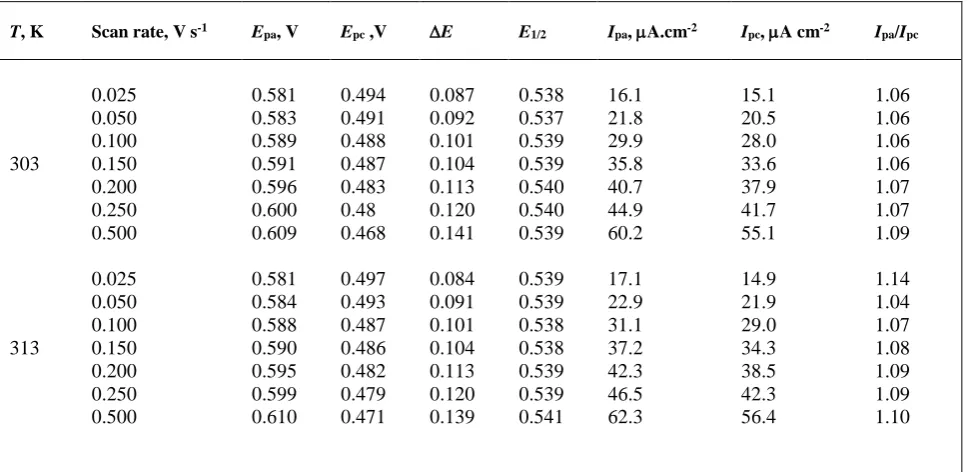
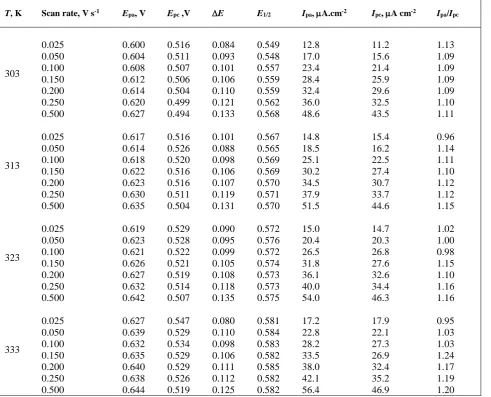
The reversibility of electron transfer of DBF is analyzed by different parameters of cyclic voltammetry. The voltammograms were recorded at platinum versus Ag/AgCl reference electrode. Tetrabutylammonium perchlorate (0.1 mol dm-3) was used as a supporting electrolyte. The peak potentials and peak current density at different scan rates (0.025 V s-1 to 0.5 V s-1) and temperatures (303 K to 333 K) are reported in Table 1.
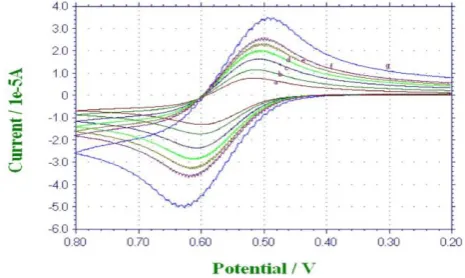
The ratios of Ipa/Ipc were evaluated by varying scan rates range (0.025 V s-1 to 0.5 V s-1) different temperatures (303 K to 333 K), and the solvents (DMF, DMA and DMSO) employed for study. As it is apparent from Fig. 1, CVs are symmetrical with equal cathodic (Ipc) and anodic (Ipa) peak currents and therefore, the Ipa/Ipc ratio approach the unit value during all the course of reactions in DMF, DMA and DMSO. It is indicative of the stability reduced and oxidized species of DBF in the time frame of the reaction and indicative of reversibility of charge-transfer process. In addition, there is no side reaction coupled with electron transfer process. Therefore, corroborate the reversible or quasi reversible nature of electron transfer reaction
The number of electron is calculated by the Eqn. (1).
By using the above equation, the number of electron transfer “n” for electrochemical reaction were calculated
(Table 2). It is evaluated nearly one for various sweep rates at different temperatures and solvents. Therefore heterogeneous reaction is following one electron transfer mechanism.
Figure 1. Cyclic voltamogram of 3 mM DBF at 303 K and scan rates of (a) 0.025 V s-1, (b) 0.05 V s-1, (c) 0.1 V s-1, (d) 0.15 V s-1,
(e) 0.2 V s-1, (f) 0.25 V s-1, (g) 0.5 V s-1.
The donor-acceptor Lewis-type interactions shift the E1/2 values. The E1/2 values show the dependence of redox reaction at electrode over a particular solvent.30 The positive charge of oxidized form of DBF has more Lewis electron pair acceptor and donor interaction with electron pair donor atom of solvents than reduced form. The strength of this attraction depends on the electron pair donor tendency of solvent (donor number of solvent) and the redox pair.Strong electron pair donor tendency will reduce the half wave potential of DBF cation. Therefore DMSO having a higher donor number (124.7 kJ mol-1), has smallest half wave potential E1/2=0.503, DMA with donor number (116.2 kJ mol-1) has E
1/2= 0.559 and DMF with donor number (111.2 kJ mol-1) has E
1/2=0.539. E1/2 values for DBF redox pair were found to be almost independent of the scan rate for a given temperature but increases with temperature. The E1/2 values change considerably with solvents polarity. It is evident that E1/2 shifts toward more positive potentials and following the order DMSO<DMA<DMF
The large value of peak to peak separation in the less polar solvent may be attributed to incomplete iR compensation, since the heterogeneous rate are known to be large.31 The diffusion controlled reversible electron transfer reaction of DBF was established by Randle Sevcik equation.32
where Ip is peak current density, “n” is number of electron transfer, A is surface area of working electrode, D is diffusion coefficient of electroactive substance, is the sweep rate and Co is concentration of electroactive substance.
p p/2
R
2.2 T (1)
E E
nF
3/2 1/2 1/2 1/20.4463 R ν (2)
p o
Table 1a. Voltammetric data for 3 mM 1,1’-dibenzoyl ferrocene in DMSO at different temperatures.
T, K Scan rate, V s-1 Epa, V Epc ,V E E1/2 Ipa, A.cm-2 Ipc, A cm-2 Ipa/Ipc
303 0.025 0.050 0.100 0.150 0.200 0.250 0.500 0.552 0.546 0.546 0.552 0.557 0.562 0.569 0.462 0.458 0.454 0.449 0.449 0.446 0.437 0.09 0.088 0.092 0.103 0.108 0.116 0.132 0.507 0.502 0.500 0.501 0.503 0.504 0.503 9.46 13.90 19.30 22.90 26.00 28.60 37.20 9.23 12.0 16.3 19.9 22.7 25.1 33.8 1.02 1.15 1.18 1.14 1.14 1.14 1.09 313 0.025 0.050 0.100 0.150 0.200 0.250 0.500 0.544 0.543 0.547 0.553 0.557 0.558 0.561 0.459 0.458 0.454 0.451 0.447 0.455 0.436 0.085 0.085 0.093 0.102 0.110 0.103 0.125 0.502 0.501 0.501 0.502 0.502 0.506 0.498 10.5 14.5 19.8 23.9 27.8 30.0 40.8 10.6 13.6 18.5 22.3 25.4 27.8 37.7 0.98 1.06 1.06 1.07 1.09 1.07 1.08 323 0.025 0.050 0.100 0.150 0.200 0.250 0.500 0.546 0.546 0.550 0.555 0.555 0.555 0.575 0.459 0.456 0.453 0.449 0.448 0.448 0.439 0.087 0.090 0.097 0.106 0.107 0.107 0.136 0.502 0.501 0.502 0.502 0.502 0.502 0.507 11.4 15.3 21.1 25.4 29.0 32.4 43.4 11.1 14.6 19.4 23.3 26.7 29.2 39.7 1.02 1.04 1.08 1.08 1.08 1.10 1.09 333 0.025 0.050 0.100 0.150 0.200 0.250 0.500 0.551 0.552 0.550 0.551 0.552 0.558 0.559 0.446 0.455 0.453 0.451 0.446 0.446 0.446 0.105 0.097 0.097 0.100 0.106 0.112 0.113 0.498 0.504 0.502 0.501 0.499 0.502 0.502 13.0 16.7 22.4 27.0 30.8 33.9 35.0 13.4 15.9 20.4 24.6 27.8 30.8 34.5 0.97 1.05 1.09 1.10 1.10 1.10 1.01
Table 1b. Voltammetric data for 3 mM 1,1’-dibenzoyl ferrocene in DMF at different temperatures.
T, K Scan rate, V s-1 Epa, V Epc ,V E E1/2 Ipa, A.cm-2 Ipc, A cm-2 Ipa/Ipc
323 0.025 0.050 0.100 0.150 0.200 0.250 0.500 0.591 0.588 0.588 0.593 0.597 0.597 0.597 0.490 0.494 0.491 0.487 0.486 0.481 0.469 0.101 0.094 0.097 0.106 0.111 0.116 0.138 0.541 0.541 0.540 0.540 0.542 0.539 0.538 18.9 24.8 33.0 39.8 45.0 49.5 66.4 17.8 23.5 30.9 36.4 40.8 45.0 59.4 1.06 1.05 1.06 1.09 1.10 1.10 1.11 333 0.025 0.050 0.100 0.150 0.200 0.250 0.500 0.594 0.594 0.597 0.601 0.601 0.607 0.610 0.494 0.493 0.491 0.490 0.488 0.483 0.481 0.100 0.101 0.106 0.111 0.113 0.124 0.129 0.544 0.544 0.544 0.546 0.545 0.545 0.546 22.5 27.5 36.6 43.2 48.7 53.7 71.3 21.1 26.9 33.5 38.1 43.8 46.6 63.2 1.02 1.06 1.09 1.13 1.11 1.15 1.12
Table 1c. Voltammetric data for 3 mM 1,1’-dibenzoyl ferrocene in DMA at different temperatures.
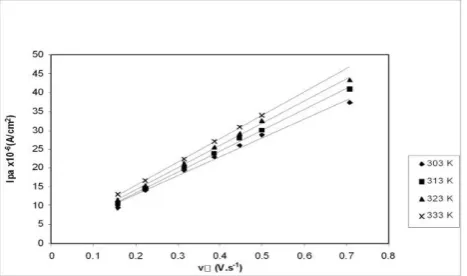
The linear variation of Ipa verses square root of scan rate () was observed for 3 mM concentration of 1,1’-dibenzoyl ferrocene at different temperatures (303 K to 333 K) and
solvents (DMSO, DMA, DMF) shown in Figure 2. No evidence for adsorption process at the surface of electrode was found.
T, K Scan rate, V s-1 Epa, V Epc ,V E E1/2 Ipa, A.cm-2 Ipc, A cm-2 Ipa/Ipc
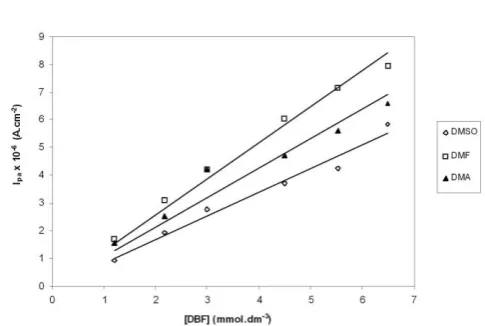
The effect of concentration (1.2 mmol dm-3 to 6. 5 mmol dm-3) of DBF at scan rate of 0.2 V s-1 and 313 K in different solvents (DMSO, DMA, DMF) are reported in Table 3. It shows the linear trend over the above mentioned concentration range (Fig. 3).
Kinetic parameters
The heterogeneous electron transfer rate constant ko was calculated by plotting graph lnIpa vs Ep-Ep/2, according to the equation:33
where Ep is anodic peak potential is transfer coefficient and k0 is a heterogeneous electron transfer rate constant.
Table 2. Cathodic peak potentials, half peak potential and number of electron transferred for 3mM DBF at 303 K and scan rate of 0.2 V s-1.
Solvents Ep Ep/2 Ep-Ep/2 N
DMSO 0.557 0.503 0.054 0.940
DMF 0.596 0.539 0.057 0.992
DMA 0.614 0.559 0.055 0.957
The plot of logarithmic peak current would not linearly relate with Ep −E1/2 that would be the result of ignorance of temperature dependence nature of charge transfer coefficient. At 303 K temperature slope: naF/RT of the linear relation
na equals to be 0.94, 0.99 and 0.957 for DMSO, DMF and DMA respectively (Table 2). As the charge-transfer rate constant evaluated form the intercept of plot so it is not greatly influenced by the curved slope.
Table 3. Effect of concentration change over peak current potential of DBF at 0.2V/s and 313K in DMSO, DMF, DMA.
The k0 was measured at different temperatures ranging from 303 K to 333 K for DMF, DMSO and DMA [Table 4]. The value of k0 increases with increasing the operating temperature in all the solvents. It is attributed to viscosity of the medium, hence, decreases with increasing the operating temperature, resulting in k0 increasing. The value of k0 following the order in different solvents.
DMSO< DMA< DMF
The diffusion coefficients for different solvents were measured in 3mM concentration of DBF at 0.2 V s-1 scan rate and 303 K to 333 K (Table 4). The diffusion coefficients increase with increase in temperature in all cases. An increase in rate constant ko with increase in diffusion coefficient is seen because in a diffusion control reaction, its kinetics will definitely depends upon diffusion coefficient. The similar trend for diffusion coefficient was observed as ko in different solvents.
DMSO< DMA< DMF
The kinetics of heterogeneous electron transfer reaction is influenced by the dynamics of solvent medium. The diffusive characteristic of solute in a particular solvent system is affected by the solvent dipolar relaxation.34 Solvent dipolar relaxation depends upon solute-solvent shell formation which results in concentration change and change in macroscopic viscosity of the system. The dipolar interaction or polarizability of a solvent influence the solvent effects on kinetics of electron transfer.35
[DBF], mM Ipa, A
105 DMSO 105 DMF 105 DMA
1.20 0.933 1.71 1.57
2.18 1.94 3.10 2.52
3.00 2.78 4.23 3.45
4.50 3.72 6.04 4.73
5.53 4.24 7.16 5.63
6.50 5.83 7.95 6.60
0
p
α a 0
ln p p/2 ln 0.227 a (3)
R
n F
I E E n FAC k T
Figure 2a. Peak current density versus square root of scan rate for 3 mM DBF at 303 K, 313K, 323 K, 333 K in DMSO
Figure 2b. Peak current density versus square root of scan rate for 3 mM DBF at 303 K, 313 K, 323 K, 333 K in DMF
Table 4. Kinetic parameter (ko) and diffusion coefficient (D) for 3mM DBF at 0.2 V s-1 in DMSO, DMF and DMA.
Table 5. Activation energy (Ea) for diffusion of 3 mM DBF at 0.2 V s-1 temperature ranging 303 K to 333 K in DMSO, DMA and DMF.
T, K 1/T lnD Ea, kJ mol
-1 lnD Ea, kJ mol-1 lnD Ea, kJ mol-1
DMSO DMF DMA
303 0.00330 -12.1273
14.86
-11.2323
13.56
-11.6789
11.47
313 0.00319 -11.9561 -11.0966 -11.5250
323 0.00309 -11.8428 -10.7559 -11.3996
333 0.00300 -11.6932 -10.8124 -11.2660
Figure 3. Peak current density versus concentration for 3mM DBF at 0.2 V/s in DMSO, DMF and DMA.
The nonspecific electrostatic interactions of the solvent system or empirical π* parameters describe the relative stability of the oxidation state of an analyte.36 The change in the electronic state density by solvent molecules changes solvation of solute. The solvation involving Fe(II) of ferrocene moiety is affected by proton donor tendency (Brönsted acid) of solvent molecule to the non-bonding filled orbital to produce Fe (IV) hydride.37-38 Solvent may strongly behave like Lewis base with Fc+ than Fc. Solvent molecule equatorial to the Fe(III) of Fc+ may form weak bond.39
According to Arrhenius equation:40
here “E” is the activation energy for diffusion of the ferrocene derivative. The slope of the curve plotted between lnD and 1/T gives activation energy for diffusion (Table 5).
The activation energy of 3mM DBF at 0.2 V s-1 in temperature range from 303 K to 333 K for DMF, DMA and DMSO were found to be 12.63kJ mol-1, 11.33 kJ mol-1 and 11.76 kJ mol-1 respectively.
Acknowledgment
We are thankful to Dean Faculty of Science , University of Karachi for providing funds.
References
1Santis, G. De., Fabbrizzi, Licchelli, L., Poggi, M., A., Taglietti, A.,
Angew. Chem. Int. Ed. Engl., 1996,35, 202.
2Fery-Forgues, S., Delavaux-Nicotc, B., J. Photochem. Photobiol.
A: Chemistry 2000, 132, 137.
3Seiwert, B., Karst, U., Anal. Bioanal. Chem., 2008,390, 181. 4Ryabov, A. D., Goral V. N., L. Gorton, Csöregi, E., Chem. Eur. J.,
1999, 5(3), 961.
5Matthews, D. R., Bown, E., Warson, A., Holman, R. R.,
Steemmson, J., Hughes, S., Scott, D., Lancet, 1987, 778.
T, K K
0, 10-6 cm s-1 D, 10-6cm2.s-1 k0, 10-6 cm.s-1 D, 10-6cm2.s-1 k0, 10-6 cm.s-1 D, 10-6cm2.s-1
DMSO DMF DMA
303 0.353 5.41 1.30 13.3 0.550 8.47
313 0.781 6.42 1.41 14.8 0.711 9.88
323 0.942 7.19 2.10 17.3 0.810 11.2
333 1.331 8.35 1.76 20.9 0.986 12.8
/R e o
or
ln ln o
R
E T D D
E D D
T
6Degani, Y., Heller, A., J. Am. Chem. Soc., 1988, 110, 2615. 7Lawrence, N. S., Deo, R. P., Wang, J., Anal. Chem,. 2004, 76,
3735.
8Hocher, T., Cinquantini, A., Zanello, P., Hey-Hawkins, E.,
Polyhedron, 2005,24, 1340.
9Ikeda, T., Bull. Electrochem., 1992, 8, 145.
10Top, S., Vessieres, A., Leclercq, G., Quivy, J., Tang, J.,
Vaissermann, J., Huche, M., Jaouen, G. Chem. Eur. J., 2003,
9, 5223.
11Osella, D., Mahboobi, H., Colangelo, D., Cavigiolio, G.,
Vessie‘res, A., Jaouen, G. Inorg. Chim. Acta, 2005, 358,
1993.
12Vessieres, A., Top, S., Pigeon, P., Hillard, E., Boubeker, L.,
Spera, D., Jaouen, G., J. Med. Chem. 2005, 48, 3937.
13Hillard E, Vessieres A, Le Bideau F, Plazuk D, Spera D, Huch M,
Jaouen G. Chem. Med. Chem. 2006,1, 551.
14Károlyi, I., Bősze, S., Orbán, E., Sohár, P., Drahos, L., Gál, E.,
Csámpai, A., Molecules 2012, 17, 2316.
15Koepf-Maier, P., Koepf, H., Chem. Rev., 1987,87, 1137. 16Popova, L. V., Babin, V. N., Belousov, Y. A., Nekrasov, Y. S.,
Snegireva, A. E., Borodina, N. P., Shaposhnikova, G. M., Bychenko, O. B., Raevskii, P. M., Appl. Organomet. Chem.,
1993,7, 85.
17Seiwert, B., Karst, U., Anal. Bioanal. Chem., 2007,388, 1633.
18Gorton, J. E., Lentzner, H. L., Watta, W. E. Tetrahedron,1971,
27, 4353.
19Britton W. E., Kashyap, R., El-Hashash, M., El-Kady, M.,
Herberhhold, M. J. Organomet. Chem,.1986, 5(5), 1029.
20Hillman, M., Gordon, B., Weiss, A. J., Guzikowska, A. P., J.
Organomet. Chem,.1978, 155, 77.
21Silva M. E. N. P. R. A., Pombeiro A. J. L., da Silva J. J. R. F.,
Herrmann R., Deus N., Bozak R. E., J. Organomet. Chem.
1991, 421, 775.
22Silva M. E. N. P. R. A., Pombeiro A. J. L., da Silva J. J. R. F.,
Herrmann R., Deus N., Bozak R. E., J. Organomet. Chem.,
1994,480, 1281.
23Asahara, M., Natsume, S., Kurihara, H., Yamaguchi, T., Erabi, T.,
Wada, M., J. Organomet. Chem., 2000, 601, 2246.
24Kamlet, M. J., Abboud, J. M., Abraham, M. H., Taft, R.W., J.
Org. Chem. 1983, 48, 2877.
25Gritzner, G.; Kuta, J. Pure Appl. Chem. 1982, 54, 1527-1532. s26 Prins, R.; Korswagen, A. R.; Kortbeek, A. G. T. G. J.
Organomet.Chem. 1972, 39, 335-344.
27Karpinski, Z. J.; Nanjundiah, C.; Osteryoung, R. A. Inorg.
Chem.1984, 23, 3358-3364.
28Zara, A. J.; Machado, S. S.; Bulhoes, L. O. S.; Benedetti, A.
V.;Rabockai, T. J. Electroanal. Chem. 1987, 221, 165-174
29Suh, J. T., US 3,382,267.
30Ranchet, D., Tommasino, J. B., Vittori, O., Fabre, P. L. J.
Solution Chem., 1998, 27(II), 979.
31Wipf, D. O., Kristensen, E. W., Deakin, M. R., Wightman, R. M.,
Anal. Chem. 1988, 60, 306.
32 Bard, A. J. Faulkner, L. R., Electrochemical Methods,
Fundamentals and Applications, John Wiley and Sons, New York, 1980, pp. 218.
33Bard, A. J., Faulkner, L. R., Electrochemical Methods,
Fundamentals and Applications, John Wiley and Sons, New York, 1980, pp. 223.
34Pyati, R. and Murray, R. W., J. Am. Chem. Soc. 1996, 118,
1743-1749
35Reichardt, C. Solvents and solvent effects in Organic Chemistry,
2nd ed.; VCH: Weinheim, Germany, 1988
36Churg, A. K.; Warshel A. Biochemistry 1986, 25, 1675-1681;
Moore, G. R.; Pettigrew, G. W.; Rogers, N. K., Proc. Natl. Acad. Sci. U.S.A. 1985, 82, 3082-3085
37Curphey, T. J.; Santer, J. O.; Rosenblum, M.; Richards, J. H. J.
Am. Chem. Soc., 1960, 82, 5249-5250.
38Lauher, J. W.; Hoffmann, R., J. Am. Chem. Soc., 1976, 98,
1729-1742
39Lay, P. A.; Sasse, W. H. F., Inorg. Chem.,1985, 24, 4707-4710 40Matsumiya, M., Terazono, M., Tokuraku, K., Electrochim. Acta
2006, 51, 1178–1183