ISSN-L: 2501 - 1235 Available on-line at: www.oapub.org/edu
doi: 10.5281/zenodo.2544763 Volume 5 │ Issue 5 │ 2019
REFLECTING THINKING LEVEL
FOR GYMNASTIC STUDENTS IN THE FACULTY OF
SPORT EDUCATION IN YARMOUK UNIVERSITY, JORDAN –
A COMPARATIVE STUDY
Ghada Al-khasawnehi,
Samar Al-shamayleh
Dr. Faculty of Physical Education, Yarmouk University, Irbid, Jordan
Abstract:
The study aimed to identify the level of reflective thinking among physical education students enrolled in gymnastics training classes at Yarmouk University in Jordan, and to identify the impact of gender upon reflective thinking. The sample was taken from the students of the physical education college including males and females enrolled in gymnastics training course, with a total of (80). 40 were male students, whereas 40 were females. They were chosen using the intentional method. The results show a high level of reflective thinking among students enrolled in the gymnastics training course. Also male students was better than female students in reflective thinking just on meditation after the event domain. Whereas the degree of reflective thinking was similar in both male and female student on the total average score of the test and on the other domains.
Keywords: reflective thinking, gymnastic, Yarmouk University
1. Introduction
Thinking is a basic process and precept from which the learner proceeds for research and discovery through performance to reach the creativity during stimulate mental processes in the mind of the student, one of the most important types of thinking that educators seeks for prosper to learners was reflective thinking, scientific development is linked to multiple kinds of thinking skills, including reflective thinking which makes the learner to adapt with the surrounding developments and gives it the ability to deal with problems. Reflective thinking considered mentally activity aiming to meditation through the skills of vision, revealing the fallacies, reach conclusions and give
convincing explanations to reach the proposed solutions to the problems and needs of the scientific, reflective thinking skills needs appropriate strategies for their development, where not only the work of these strategies to deliver updated as soon as to the leaner, but rather to raise the learner's thinking through ask questions which working on the development of observation and interpretation and classification and other operations, which adds an element of suspense in the educational process (Qatrawe, 2010).
Several studies have been devoted on thinking skills teaching, including many of
practical examples, to be used by educators and learners at the different levels of study which emphasized the importance of the role of educational institutions on gain balanced education for developing personal, mental, psychological, physical, emotional, socially and spiritually aspects when applying skills in the educational process. The term "logical meditation" is used to realize the learner why he thinks and feels the way he works. It requires a sharp and in-depth review of the assumptions and linking the existing expertise in the former stage of conscious and unconscious access to learning and consequences, (Kemeber, 2000)
Kitchener (1994) defined reflective thinking as meditating situations and
problems faced the students and formulating appropriate titles by drawing plans, analyzing and taking appropriate actions to achieve goals and evaluate outcomes. Griffith and Frieden (2000 ( define reflective thinking as the study of the ideas and assumptions continuously available to the individual meant to promote a range of views and beliefs.
Reflective thinking is known as the reflection process in three stages: meditation
before the act, meditation during the act, meditation after the act (Hassan, 2011).
Al Khoualdah (2007); Barakat (2005) referred quoted from Shon (1987) that
reflective thinking operations had been restricted in three stages: First: Meditation for Action: follow the instructor plans coincide with the educational objectives set which is expected to be achieved for learners. Secondly: meditation within action: this process is carried out through practice, then the teacher follow knowledge methods to complete tasks effectively. Third: meditation after action: the process of recognition results and lessons, take appropriate decisions to continue implementation process and appropriate modification to achieve the goal.
Zayed, (2001) explain that learn motor skills needed understanding, realizing,
action processes and correct mistake to discover appropriate solutions.
The nature and level of sports differ from each other in terms of mental processes
series , select the music that fits with the nature of the skill, as well as the diversity of performance requirements on different devices.
These things are mentioned earlier impose the important of thinking processes
for teacher and student because of their role in refining the abilities and skills of learners during the educational process within the curriculum, this is what (Ganswah, 2006) confirmed it from where the importance of stimulating the thinking of the learner by asking questions, adding suspense element of the educational process, linking the concepts to each other, acquiring thinking skills and employ them in practice, also contributes to the production of knowledge and development, that is, the student becomes an active learning, and learn how to learn, how to develop skills and expertise, and to think with learned thought elicited, linking him with the real conditions of life.
The recent trends in education seeks and encourages the use of modern
strategies in education, it have a positive effect in improving the educational process and in developing physical and motor capabilities for learners, and emphasizes the need to move from the old roles that depend on the teacher as the sole source of information to make student involved and effective, which in turn, is working to develop and improve the thinking of the educated people, these ideas faced with realization passionate by teachers to use and apply this vision, as stated in many studies such as: (Mawheby, 2016; Al-Hayek & Shamayleh, 2015; Alhayek & Shamayleh, 2014; Alhayek & Allawama, 2016), and through the experience of researchers as instructors for gymnastic course they noted that the gymnastic have privacy features differ from other practical materials they need to focus and accuracy during education and training, the teaching of skills need double efforts such as the employment of a variety methods of teaching, so it is necessary to identify the role of the gymnastics course in acquisition of reflective thinking skills to find out the impact of change and innovation in the process of learning various skills.
So, this study aimed to answer the following research questions:
1) What is the level of reflective thinking among physical education students
enrolled in gymnastics training classes at Yarmouk University in Jordan?
2) What is the impact of gender upon reflective thinking in gymnastics training
classes?
2. Material and Methods
2.1 Methodology
The researcher used the descriptive approach, with the pattern of surveys, given its appropriateness for the nature of the study.
2.2 Participants
course, with a total of (80). 40 were male students, whereas 40 were females. They were chosen using the intentional method.
2.3 Measures
Reflective thinking test used in the study was developed by (Shamayleh, 2015) which consisted 45 items distributed over the following domains: Meditation Event, Meditation during the event, Meditation after the event, with five response level. Validity has been verified through panel of experts.
The content validity of the instrument was established through expert opinions
who assured the suitability of questions and their relation to respective domains of reflective thinking. Further, logical validity was extracted through the square root of the reliability coefficient. And to verify the reliability of instrument, the Cronbach's alpha reliability coefficient was calculated for all the domains and whole scale, table (1) explains.
Table 1: Validity and Reliability coefficients of the domains and whole scale
Domains Coefficient of Validity Reliability of the Correlation Coefficient
Meditation event 0.906 0.82
Meditation during the event 0.938 0.88
Meditation after the event 0.922 0.85
Total score 0.964 0.93
2.4 Data Analysis
To answer the first research question which is to determine the reflective thinking among physical education students enrolled in gymnastics training classes at Yarmouk University in Jordan, means, standard deviations were used. To answer the second research question which is to test for the effect of gender upon reflective thinking in gymnastics training classes, t-test for independent sample was used.
3. Results and Discussion
Table 2: Means standard deviation of reflective thinking domains and total score
Rank No Domain Mean Standard Deviation Level of Evaluation
1 2 Meditation during the Event 4.07 0.61 High
2 1 Meditation in the event 3.95 0.56 High
3 3 Meditation after the event 3.89 0.59 High
Total score 3.96 0.50 High
3.1 Results Pertain to the second research question
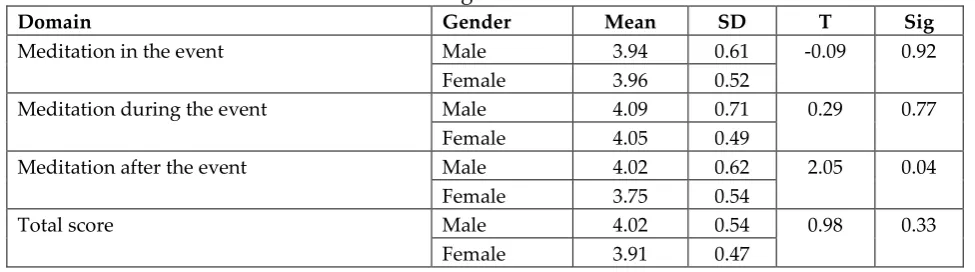
The second research question for this study was to determine the impact of gender upon reflective thinking domains in gymnastics training classes. As shown in Tables 3 there were significant differences appeared for Meditation after the event domain of reflective thinking test in gymnastics training classes with respect to gender variable. This indicates significant differences between male and female students on this domain for the favor of males. Also, as shown in the table, there were no significant differences between males and females on the total average score of the test and on the other domains.
Table 3: T-Test for independent sample for the impact of the gender on reflective thinking domains and total score
Domain Gender Mean SD T Sig
Meditation in the event Male 3.94 0.61 -0.09 0.92
Female 3.96 0.52
Meditation during the event Male 4.09 0.71 0.29 0.77
Female 4.05 0.49
Meditation after the event Male 4.02 0.62 2.05 0.04
Female 3.75 0.54
Total score Male 4.02 0.54 0.98 0.33
Female 3.91 0.47
4. Discussion
the students to think about and become accustomed to being the difficult gymnastics skills are far from the surface.
The researchers explains that Gymnastic have the skills with progressive
difficulty in performance, as well as the ability to perform mastery skills through linked in bringing dynamic, this is imperative for the students to use reflective thinking processes so as to be able to complete the duties required mobility, and also led to encourage each other on reflective thinking when performing and attempting to apply skills. This is consistent with the results of the study (Al-Shakea, 2007), which demonstrated that there is a causal relationship between the reflective thinking phases, including the understanding of wrong and negative performance of scholarship, the results indicated the presence of variables that contribute to the difficulty of learning mapping the activity than usual and expected difficulties in the activities of the deep self-performance in a so there must be incentives for reflective thinking. Then researchers explains that students are keen to increase their knowledge of self, culture and sports through access and search information linked to performance skilled kinesthetic learning and direct dialog with the teacher asking questions about performance skilled and feed it was edited by the performance, and assistance among students during the performance of skills, and the exchange of roles among them through the help in support as well as the exchange of information on performance between students themselves and correcting mistakes helps develop Kinesthetic performance, as well as the activation of the e-learning system and assigning the students some of the duties related to the skills of technical and educational steps kinesthetic skills learned, or the topics associated with sport and gymnastics.
And the results agree with the study of (Al-Shakea, 2007) that graduate and
postgraduate students are characteristically high level or good reflection thinking, and a high level of reflective thinking to the students of the master's degree compared with undergraduate students, the achievement of students deep understanding and focus in the post graduate, this is also consistent with the study of (Lee, 2003) which indicated that the CRITIC and in-depth understanding came in the third when the study sample possessed normal teaching manner the level of understanding came first as it was found that the students in the Bachelor's degree less than in-depth understanding of the subsequent stages, but if the teacher used the usual way in a manner that stresses meditation and focus on the event any sense of routine manner more focused education and depth of being learn skills of gymnastics.
The second purpose of this study was to determine the impact of gender upon
These results agreed with (Shaka, 2007) that referred the absence of statistically significant differences depending on the gender variable for control group. And also, agreed with (Al-Shamaila, 2015; Muhobe, 2016; Leung & Kember, 2003) which pointed out the high level of reflective thinking as a result of subjecting sample to unusual teaching methods such as the method of solving problems and lifestyle directed discovery learning strategies in depth. (Leung & Kember, 2003) pointed out to the existence of a relationship between the level of statistically normal surface learning strategies and the relationship between levels of understanding or meditation, critic and strategies in-depth learning.
4. Recommendations
1) Establishing new study to measures reflective thinking processes and hold its
importance in the educational process.
2) Use a variety of teaching methods linked to deep thinking, which help the
development of reflective thinking processes.
3) Use reflective thinking tests in various courses (Theory and Practice) to
determine the level of learning and work on the development of mental skills, and its impact on the motor learning of skills in various sports.
4) Conduct similar studies to the subject of this study and applying it in other sports games.
5. Conclusion
1) The results show a high level of reflective thinking among students enrolled in
the gymnastics training course.
2) Male students were better than female students in reflective thinking just on
meditation after the event domain.
3) The degree of reflective thinking was similar in both male and female student on
the total average score of the test and on the other domains.
References
Barakat, Ziad (2005). The relationship between the reflective thinking and learning among a sample of university students, Jerusalem University Journal, Vol. 4, No.6.
Al Khoualda, Mahmoud. (2007). The impact of the use of the entrance based on the issues in the development of reflective thinking, and the skills to identify social problems in national and civil education to tenth grade students in Jordan, unpublished doctoral dissertation, Yarmouk University, Irbid, Jordan.
Al-Shamayleh Samar. (2015). the impact of computerized education curriculum design in some gymnastics skills using a strategy to solve the problems at the level of reflective thinking, creativity and performance to the kinesthetic skilled students in Bahrain, PhD thesis. Jordan.
Shehata, Mohammed. (2003). Modern Gymnastics Guide, 2nd ed, The House of
Knowledge, Cairo.
Al-shakea. (2007). The level of reflective thinking to the students of the undergraduate and graduate levels in the Najah National University, Journal PERSA human sciences, Vol. 21, No. 4.
Alasasleh, Gospel & Suhaila, Muwaffaq. (2012). The impact of a training program on the skills of critical thinking in the development of reflective thinking to the tenth-grade students in Jordan, Journal of Human Sciences, Vol. 26, No. 7.
The Reagent, Zayed. (2001). Critical thinking in the field of Physical Education and Sports, the scientific journal of the Faculty of Physical Education, University of mania.
Muhobe, Belkacem. (2016). the impact of Directed Discovery in the development of reflective thinking and motivation to learn about physical education and sports lessons to secondary students, Journal of Social and human sciences, Algeria, No. 26.
Alqatrawy, Abdul Aziz. (2010). The impact of the use of unlawful matters strategy in the development of learning processes of reflective thinking skills in science among students in the eighth grade, the Islamic University, Gaza Strip.
Khasawneh, K. (2001). The effect of using cooperative learning strategy on the level of skilled performance feedback some gymnastics skills for students of the Faculty of sports education, Journal of theories and applications, Faculty of Physical Education for Boys, Al haram, Alexandria.
Griffith, B. & Frieden, G. (2000). Facilitating Reflective Thinking in Counselor Education. Counselor Education and Supervision, 40 (2):82.
Kember D. Jones, A. Loke, A. Mckay, J. Sinclair, K., Tse, H., Webb, C., Wong, F., Wong, M. & Yeung, E. (2000). Development of a Questionnaire to Measure the Level of Reflective Thinking. Assessment and Evaluation in Higher Education, 25(4):381. Kitchener, K. (1994). Assessing Reflective Thinking with in Curricular Contexts Project
Organization University of Denver, College of Education Washington, D.C. Leung, D. & Kember, D. (2003). The Relationship between Approaches to Learning and
Reflective upon Practice. Educational Psychology, 23(1): 61-71.
Lie, L., (2006). Student's Reflective Development in a PBL Environment. Retrieved form
Creative Commons licensing terms
Authors will retain the copyright of their published articles agreeing that a Creative Commons Attribution 4.0 International License (CC BY 4.0) terms will be applied to their work. Under the terms of this license, no permission is required from the author(s) or publisher for members of the community to copy, distribute, transmit or adapt the article content, providing a proper, prominent and unambiguous attribution to the authors in a manner that makes clear that the materials are being reused under permission of a Creative Commons License. Views, opinions and conclusions expressed in this research article are views, opinions and conclusions of the author(s). Open Access Publishing Group and European Journal of Physical Education and Sport Science shall not be responsible or answerable for any loss, damage or liability caused in relation to/arising out of conflict of interests, copyright violations and inappropriate or inaccurate use of any kind content related or integrated on the research work. All the published works are meeting the Open Access Publishing requirements and can be freely accessed, shared, modified, distributed and used in educational, commercial and