Abstract— This paper represents the efficiency of the Ant
inspired Bacterial Foraging Optimization (ABFO), the hybrid technique of Ant Colony Optimization (ACO) algorithm and Bacterial Foraging Optimization (BFO) algorithm from Bio Inspired Computing to solve the Open Shop Scheduling Problems (OSSP). The Ant inspired Bacterial Foraging Optimization (ABFO) was tested on the Open Shop Scheduling benchmark problems from the literature. The computational method of ABFO algorithm has shown improvement in finding the optimal solutions when compared with BFO algorithm for all small level test problems. Although ABFO algorithm has not achieved the best known solutions for larger instances of benchmarks problems, the optimal values are highly comparable to other best performing algorithms.
Index Terms— Open Shop Scheduling Problems, Ant Colony
Optimization, Bacterial Foraging Optimization, Combinatorial Optimization, Metaheuristics.
I. INTRODUCTION
A. Open Shop Scheduling Problems
Scheduling is a process of mapping the jobs and its processing times to machines. The Open Shop Scheduling Problems (OSSP) is the class of NP- Hard problems that can be solved to find optimal solutions. The Combinatorial Optimization (CO) is a computation problem in which, the objective is to find the best of all possible solutions. More formally, find a solution in the feasible region which has the min or (max) value of the objective function [5]. The Open Shop Scheduling Problems can be classified as n x m, where 'n' is the number of Jobs (J= {j1, j2,.., jn}) can be processed on 'm' number of Machines (M= {m1, m2,...,mm}). Each Job „ji‟ consists of „m‟ operations represented as „Oij‟ processed on machine „mj‟ for „Pij‟ time units without pre-emption [7], [18]. In this static problem, the schedules are created before runtime and operations must be known in advance to schedule the jobs to the machines to start the process. Each
Manuscript received July 15, 2012.
Ravibabu. V, MCA, Department of Computer Applications, Bharathiar University, Coimbatore, India, Mobile No: +91-9994664589., (e-mail: [email protected]).
Amudha. T, Assistant professor, Department of Computer Applications, Bharathiar University, Coimbatore, India.,
(e-mail: [email protected]).
job consists of 'm' number of operations to be processed on all machines for a maximum amount of time allocated to each operation on same job in any order. The operations of jobs can be processed on machines in any order. Only one operation can be processed on one machine of same job at a time without interruption. The Open Shop Scheduling Problem calculates the makespan (Cmax), the maximum time between begining of the first operation till the end of the last operation in any order on n x m dimensions.
Constraints of the Open Shop Scheduling Problems are Each machine can process only one job at a time. Each job can be processed by one machine at any time. Once a machine has started processing a job, it will
continue running on that job until the job is finished. Each job consists of equal number of operations and
machines.
The routing of all the operation is free.
Metaheuristics makes assumptions about the problem being optimized and provides unguaranteed optimal solutions. Metaheuristics applied for most of the NP-Hard problems such as search problems, decision making problems and optimizing problems. Optimization problems use Approximization methods to search for an optimal one and Randomization methods to get average running time. The Bio Inspired Computing belongs to the field of Nature Inspired Computing and more broadly to the fields of Computational Intelligence and Metaheuristics.
B. Bacterial Foraging Optimization
Bacterial Foraging Optimization (BFO) algorithm is a novel evolutionary computation algorithm proposed by K.M. Passino in 2002 and implemented on several optimization problems. BFO algorithm technique mimics the foraging behavior of Escherichia Coli (E.Coli) bacteria living in human intestines [15]. BFO algorithm is successfully implemented in several real world problems and improved BFO metaheuristics were applied to optimization problems. The bacterial motion can be modeled based on Swimming and Tumbling process. Swarming is a travelling them to find and
An Ant Inspired Bacterial Foraging
Methodology Proposed to Solve Open Shop
Scheduling Problems
Fig 1: Structure of E.Coli Bacteria
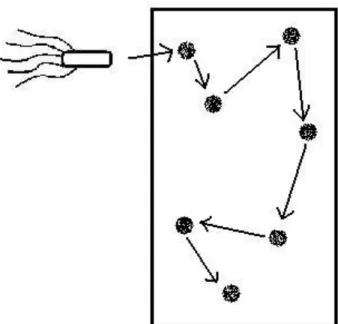
forms a group among themselves with high level of bacterial density. An E.Coli bacterium rotates its flagella on both clockwise and anti-clockwise directions to tumble and swim. These two alternative processes held for its entire lifetime. If the flagella rotate on clockwise direction, E.Coli stops swimming and tumbling takes place to choose any new random direction. If the flagella rotate on anticlockwise direction, E.Coli swims in a new direction for searching nutrients. Tumbling helps bacteria to rotate about an axis.
The foraging behavior of E.Coli bacteria undergoes different stages of process such as Chemotactics, Reproduction and Elimination and Dispersal events [20].
Chemotactics step of E.Coli bacteria is a swimming process after tumbling. The health of bacteria will reflects on the chemotactics steps, the environment for their swimming directions should have healthy nutrients to swim, otherwise E.Coli bacteria stops swimming and tumbling action takes place to choose new direction for foraging.
Reproduction step takes place after the chemotactics steps. The total population of E.Coli bacteria is sorted on basis of nutrients gained during its lifetime. It is assumed that half of the population of E.Coli bacteria is unhealthy and dead. The remaining half of the population of healthiest bacteria gets doubled to make the population count remain same.
Elimination event occurs after the reproduction and disperse the bacteria group due to unexpected change in environments. Since we assume, the number of the chemotactics steps is greater than the reproduction steps, which may have several generations before elimination dispersal takes place.
Fig 2: Foraging behavior of E.Coli Bacteria
C. Ant Colony Optimization
The Ant Colony Optimization algorithm is well known for its shortest path finding technique first proposed by M.Dorigo in 1992. The ACO algorithm is based on food searching behavior of ant colony. Real ants or Ants are capable of finding the shortest path from their nest to food source. Ant deposits pheromone on their path while travelling and information exchanged through environment by particular type of communication. In every ant cycle the pheromone values updated at the end of its tour. Pheromone get evaporated after certain time and calculated based on their density. Ant probably chooses the path that previously chosen by ant based on their density to find the shortest path. Pheromones get updated by the ant if it chooses the same path and improves the pheromone density. The ACO algorithm is a multi-agent approach for solving Combinatorial Optimization problems, searching problem and decision problem to find optimal solution [9].
II. RELATED WORKS
Peter Brucker, Johann Hurink, Bernd Jurisch and Birgit WGstmann (1995), discussed about basic concepts of branch & bound algorithm. A branch & bound method for the open shop problem based on a disjunctive graph formulation of the problem is developed. The problem determined a feasible combination of the machine and job orders which minimizes a certain objective function. They implemented branch & bound algorithms and compared with the best solution given by Brasel et al on Taillard‟s Benchmark problems [5].
Ching-Fang Liaw (1999) has discussed about the development and application of a Hybrid Genetic Algorithm (HGA) to the OSSP is based on Tabu Search (TS) into a basic Genetic Algorithm (GA). The local improvement procedure enables the HGA algorithm to perform genetic search over the subspace of local optima. This algorithm was tested on benchmark problems of the OSSP from the literature. The results were compared to the Scheduling Heuristic, Insertion Heuristic, Simulated Annealing and pure TS algorithms [7].
Jing Dang, Anthony Brabazon, Michael O‟Neill, and David Edition (2008) have proposed a paper about Bacterial Foraging Optimization (BFO) algorithm. This technique was implemented to solve the parameter estimation of an EGARCH-M model. The results from this algorithm were shown to be robust and extendable. It was used for calibration of a volatility option pricing model [12].
Sambarta Dasgupta, Swagatam Das, Ajith Abraham, Senior Member, IEEE, and Arijit Biswas (2009), presenteda mathematical analysis of the chemotactics step in BFOA from the viewpoint of the classical gradient descent search. Two simple schemes for adapting the chemotactics step height have been proposed and investigated. The adaptive variants of BFOA were applied to the frequency-modulated sound wave synthesis problem[20].
Hanning Chen, Yunlong Zhu, and Kunyuan Hu., discussed a new variation, Cooperative Bacterial Foraging Optimization (CBFO) improved the original BFO algorithm to solve the complex optimization problems. They applied two cooperative approaches to the BFO algorithm, namely, the serial heterogeneous on the implicit and hybrid space decomposition levels. This proposed method was compared with Bacterial Foraging Optimization, Particle Swarm Optimization and Genetic Algorithm [10].
Jun Zhang, Xiaomin Hu, X.Tan, J.H Zhong and Q. Huang (2006) presented an investigation into the use of an Ant Colony Optimization (ACO) to optimize the JSSP. In this paper, an improvement of the performance of ACS discussed and the numerical experiments of ACS were implemented in small size instances of the Job Shop Scheduling benchmark problems. The results of the ACS are compared with the traditional optimization methods [13].
E. Taillard [1989] has proposed a paper about Benchmarks‟ for Basic Scheduling Problems. In this paper he discussed about 260 scheduling problems whose size is greater than that of the rare examples published. Such sizes correspond to real dimensions of industrial problems. In this paper he solved the permutation flow shop, the job shop and the open shop scheduling problems [23].
III. ANTINSPIREDBACTERIAL FORAGING METHODOLOGY
The objectives of this research paper are
To propose and implementABFO algorithm to solve OSSP.
To examine the efficiency of ABFO algorithm in solving benchmark instances of OSSP.
To analyze and compare the performance of the proposed ABFO algorithm with BFO algorithm in solving OSSP.
A. Proposed ABFO Algorithm
In BFO algorithm, each bacteria „i‟ provides an individual optimal solutions to the optimization problems that can be represented by Өi
(j,k,l), where bacteria undergoes jth chemotactics step by swimming and tumbling moves and after certain time of foraging the health of each bacteria can
be calculated by
1
1 (, , , )
Nc j i
health ji j k l
j , the k
th
reproduction step takes place by sorting the total bacteria „S‟ in ascending order based on their health. The best half of the bacteria from the population splits by two represented as Sr = S/2 and assumed that the least health bacteria will be dead. The remaining bacteria will be populated to make the count S to remain stable, the lth elimination and dispersal event eliminates the rest of the population and dispersal makes some random replacements in bacterium groups[10], [17], [20].
Chemotactics process can be computed by its step size C(i) during swimming and tumbling and the run length of each bacterium can be represented as
Өi (j+1,k,l) = Өi
(j,k,l) + C(i) (). ()
) (
i i T
i
,where Δ(i) represents
direction vector of the chemotactics.
The minimization of Jisw = Ji +Jcc(θi,θ), which represents the time-varying total cost value for bacterium „i‟. The mathematical swarming function can be represented by
2 2
1 1
,
,
,
0
i k i k
S S
Wa Wr
i
K K
cc
M
e
e
J
withswarm
without swarm
Where M is the magnitude of the cell to cell signaling and Wa and Wr is the size of the attractant and repellent signals represented in Euclidean form [12].
The behavior of ant helps to explore the search space. Each ant moves at random and pheromone deposited on travel path. High pheromone density increases the probability of path followed by ants. Each ant constructs its own tour and updates the pheromone by two strategies are called local pheromone update and global pheromone update. In an ant tour, the ant passes through edges and updates the local pheromone represented by
, 1
. , .0 r s r s (2)
where ρ denotes the pheromone lies between [0, 1].
Once all the ants reached their destination, the amount of pheromone values modified again and the global pheromone update representedby
r,s 1
. r,s .
r,s (3)
where
otherwise
gb if r s global best tour L
s r
, 0
1, ,
,
Where α denotes the pheromone decay parameter lies between [0, 1], Lgb is the length of the globally best tour from the beginning of the trial and ∆τ(r,s) is the pheromone addition on edge (r, s)[13].
Metaheuistics of ACO is to apply an ant tour repeatedly on all nodes to find the shortest path and this method also called stochastic greedy rule for optimal solution.
0
arg max , , , ,
,
u J r r u r u if q q
s
S otherwise
(4)
where (r,u) represents an edge between point r and u, and τ(r, u) stands for the pheromone on edge (r, u). η(r, u) is the desirability of edge (r, u), which is defined as the inverse of the length of edge (r, u). q is a random number uniformly distributed in [0, 1], q0 is a user-defined parameter lies between [0, 1] where q and q0 is exploitation, β is the parameter controlling the relative importance of the desirability. J (r) is the set of edges available at decision point r [13]. S is a random variable selected according to the probability distribution represented by
, , ,
,
, , , ,
0, u J r
r u r u
if S J r
P r s r u r u
otherwise
(5)The Ant inspired Bacterial Foraging methodology is
implemented with no swarming effect. (i.e.) jcc = 0. Here time is considered as cost. Each bacteria undergoes swimming and tumbling in its first chemotactics step to generate a secure random for tumbling. The random number q and user defined parameter q0 are used according to the secure random vector and the next operation in the search space is selected for process. Chemotactics process is initiated after choosing new operations based on the operation size and bacteria swims for all chemotactics steps. In the reproduction phase the bacteria are sorted from the healthiest to least healthy bacteria in ascending order and it was assumed that the least health bacteria cannot survive in the future. The healthy bacteria are made to split into two to keep the population constant. In the Elimination and dispersal phase, the least healthy bacteria removed from population and the remaining healthy bacteria are dispersed by probability and a new group of population is formed in a new environment.
B. NOMENCLATURE
C(i) - Step size
i - Bacterium number
j - Counter for chemotactic step
J(i, j, k, l) - Cost at the location of ith bacterium
Jcc - Swarm attractant cost
J ihealth - Health of bacteria
Jisw - Swarming effect
k - Counter for reproduction step
l - Counter for elimination-dispersal step
Nc - Maximum number chemotactic steps
Ned - Number of elimination dispersal event
Nre - Maximum reproduction steps
Ns - Maximum number of swims
P - Dimension of the optimization
Ped - Probability of occurrence of
elimination-dispersal events
S - Population of the E. coli bacteria θi
(j, k, l) - Location of the ith bacterium at
jth chemotactic step,
kth reproduction step, and
Start
Initialize all variables. Set all loop counters and bacterium index i = 0
Increase elimination –dispersion loop Counter l = l+ 1
Stop and Print the results
Perform elimination dispersal l < Ned ?
Increase reproduction loop counter k = k+ 1
k < Nre ?
Increase chemotactics loop counter j = j+ 1
j < Nc ? Perform
Reproduction
Increase bacterium index i = i+ 1
q < q0?
Tumble: generate secure random vector l∈ operation based on ACO (4)
Move: generate secure random vector lnew∈ operation
Swim
time[job][l]< time[job][lnew] ?
Set current operation = lnew
Tumble: generate secure random vector l∈ operation based on ACO (5)
Set current operation = l
yes no
yes
no
yes no
yes
no
no
yes
IV. EXPERIMENTAL RESULTS AND DISCUSSION
The implementation was done in Java 6.0. The Random class in JAVA generates Pseudo random numbers in non-random way were the numbers looks like real random numbers, but they are not true random. To accomplish this, Secure Random class has been used to provide a strong Pseudo Random Number Generator (PRNG). Secure Hash Algorithm (SHA) computes PRNG by taking initial value (seed) provided through Random object. Here the given seed value is the value of system clock in milliseconds which constantly changes the seed value and different random numbers is being generated. Compared with BFO, ABFO achieves high level of SHA1PRNG algorithm in case of reproduction, elimination-dispersal.
Benchmark problems are gathered in the domain of OSSP and benchmark instances from CSP2SAT: OSS used to test the efficiency of proposed ABFO [28]. The size of benchmark instances were divided into small and large instances, where the dimension of 3x3, 4x4, 5x5 belongs to the small instances which gave feasible solution for most runs for the constant parameter values are shown in table I.
Table I. Constant Parameter values
Parameter ρ β α q0 τ
Value 0.1 1.0 0.1 0.8 0.5
The remaining instance with dimensions of 6x6, 7x7 belongs to the large instances. The result of proposed ABFO algorithm has not obtained the best known solution for larger instances for parameter values mentioned in Table I; it provides comparably best optimal solution with other existing algorithms in literature. However, ABFO algorithm gave a minimum makespan, when compared with the makespan obtained by BFO for small and large benchmark problem of Gueret and Prins, Brucker et al and Taillard. The best known solution is the highest optimal value obtained for the instance from literature and the algorithm which obtained the best optimal is shown followed by a „*‟ symbol in the Results table to compare the values.
A. Results for the Gueret and Prins Instances
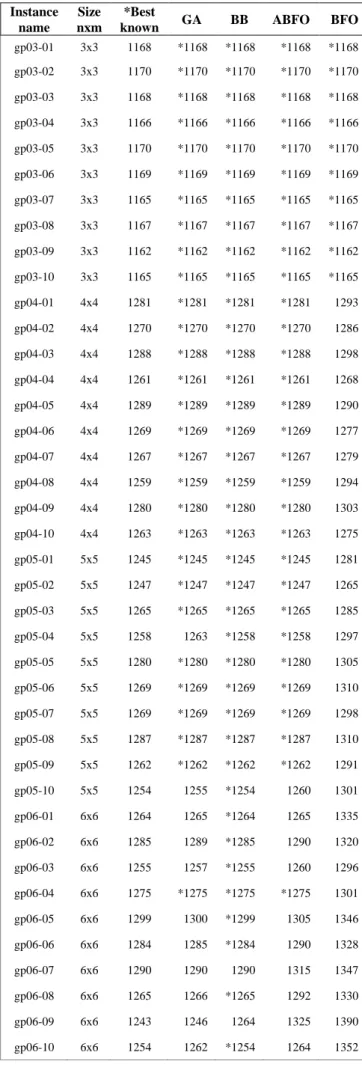
The optimal solutions obtained from proposed ABFO algorithm and BFO algorithms were compared with the optimal solution of the Genetic Algorithm (GA), an improved Branch and Bound algorithm (BB) [28] and the best known solution of Gueret and Prins instance sizes of 3x3, 4x4, 5x5 and 6x6 are shown in Table II.
Table II. Results for the Gueret and Prins Instances
Instance name
Size nxm
*Best
known GA BB ABFO BFO
B. Results for the Brucker et al Instances
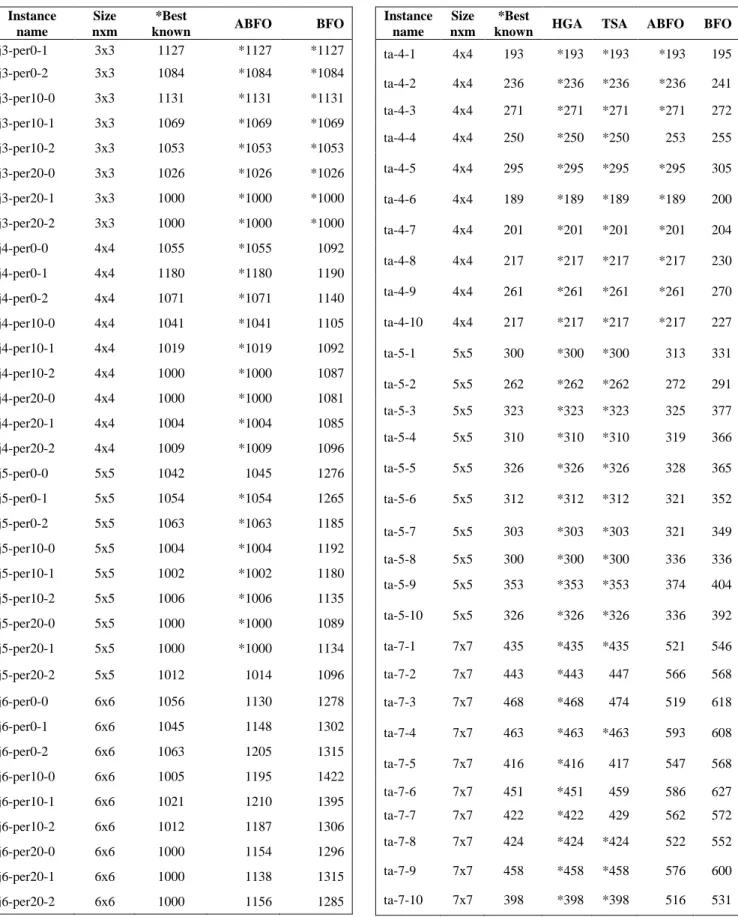
The optimal solutions obtained from proposed ABFO algorithm and BFO algorithms were compared with the best known solution of the Brucker et al instance [28] sizes of 3x3, 4x4, 5x5 and 6x6 are shown in Table III.
Table III. Results for the Brucker et al Instances
Instance name
Size nxm
*Best
known ABFO BFO
j3-per0-1 3x3 1127 *1127 *1127
j3-per0-2 3x3 1084 *1084 *1084
j3-per10-0 3x3 1131 *1131 *1131
j3-per10-1 3x3 1069 *1069 *1069
j3-per10-2 3x3 1053 *1053 *1053
j3-per20-0 3x3 1026 *1026 *1026
j3-per20-1 3x3 1000 *1000 *1000
j3-per20-2 3x3 1000 *1000 *1000
j4-per0-0 4x4 1055 *1055 1092
j4-per0-1 4x4 1180 *1180 1190
j4-per0-2 4x4 1071 *1071 1140
j4-per10-0 4x4 1041 *1041 1105
j4-per10-1 4x4 1019 *1019 1092
j4-per10-2 4x4 1000 *1000 1087
j4-per20-0 4x4 1000 *1000 1081
j4-per20-1 4x4 1004 *1004 1085
j4-per20-2 4x4 1009 *1009 1096
j5-per0-0 5x5 1042 1045 1276
j5-per0-1 5x5 1054 *1054 1265
j5-per0-2 5x5 1063 *1063 1185
j5-per10-0 5x5 1004 *1004 1192
j5-per10-1 5x5 1002 *1002 1180
j5-per10-2 5x5 1006 *1006 1135
j5-per20-0 5x5 1000 *1000 1089
j5-per20-1 5x5 1000 *1000 1134
j5-per20-2 5x5 1012 1014 1096
j6-per0-0 6x6 1056 1130 1278
j6-per0-1 6x6 1045 1148 1302
j6-per0-2 6x6 1063 1205 1315
j6-per10-0 6x6 1005 1195 1422
j6-per10-1 6x6 1021 1210 1395
j6-per10-2 6x6 1012 1187 1306
j6-per20-0 6x6 1000 1154 1296
j6-per20-1 6x6 1000 1138 1315
j6-per20-2 6x6 1000 1156 1285
C. Results for the Taillard Instances
The proposed ABFO algorithm and BFO algorithms were compared with the Hybrid Genetic Algorithm (HGA) and Tabu Search Algorithm (TSA) [7] for Taillard instance sizes of 4x4, 5x5 and 7x7 are shown in Table IV.
Table IV. Results for the Taillard Instances
Instance name
Size nxm
*Best
known HGA TSA ABFO BFO
ta-4-1 4x4 193 *193 *193 *193 195
ta-4-2 4x4 236 *236 *236 *236 241
ta-4-3 4x4 271 *271 *271 *271 272
ta-4-4 4x4 250 *250 *250 253 255
ta-4-5 4x4 295 *295 *295 *295 305
ta-4-6 4x4 189 *189 *189 *189 200
ta-4-7 4x4 201 *201 *201 *201 204
ta-4-8 4x4 217 *217 *217 *217 230
ta-4-9 4x4 261 *261 *261 *261 270
ta-4-10 4x4 217 *217 *217 *217 227
ta-5-1 5x5 300 *300 *300 313 331
ta-5-2 5x5 262 *262 *262 272 291
ta-5-3 5x5 323 *323 *323 325 377
ta-5-4 5x5 310 *310 *310 319 366
ta-5-5 5x5 326 *326 *326 328 365
ta-5-6 5x5 312 *312 *312 321 352
ta-5-7 5x5 303 *303 *303 321 349
ta-5-8 5x5 300 *300 *300 336 336
ta-5-9 5x5 353 *353 *353 374 404
ta-5-10 5x5 326 *326 *326 336 392
ta-7-1 7x7 435 *435 *435 521 546
ta-7-2 7x7 443 *443 447 566 568
ta-7-3 7x7 468 *468 474 519 618
ta-7-4 7x7 463 *463 *463 593 608
ta-7-5 7x7 416 *416 417 547 568
ta-7-6 7x7 451 *451 459 586 627
ta-7-7 7x7 422 *422 429 562 572
ta-7-8 7x7 424 *424 *424 522 552
ta-7-9 7x7 458 *458 *458 576 600
V. CONCLUSIONS
The computational results have shown that the ABFO algorithm for OSSP can achieve the best and near best solution quality for small dimension instance of Gueret and Prins, Brucker et al and Taillard benchmark problems. For large dimension problems, this heuristic can obtain almost comparable solution for each test problem in certain repeated runs; however, the performance comparisons of these metaheuristics have shown that the proposed ABFO algorithm performs better than BFO algorithm. The implementation of the ABFO algorithm for large size instances can be done by increasing the number of iterations and modifying the parameter values to achieve the best optimal solutions. The proposed ABFO algorithm for OSSP can also be improved by including the swarming technique in bacterial foraging methodology to obtain better solutions in the future.
REFERENCES
[1] Ajith Abraham, Arijit Biswas, Sambarta Dasgupta, and Swagatam Das, “Synergy of PSO and Bacterial Foraging Optimization – A Comparative Study on Numerical Benchmarks,” Innovations in Hybrid Intelligent Systems, 2008.
[2] Arnaud Malapert, Hadrien Cambazard, Christelle Guéret, Narendra Jussien, André Langevin, and Louis-Martin Rousseau, “An Optimal Constraint Programming Approach to the Open-Shop Problem.” CIRRELT – 2009-25, June 2009.
[3] Ashwani Kumar Dhingra., “Multi-Objective Flow Shop Scheduling using Metaheuristics,” 2006.
[4] C. Blum, “Beam-ACO-Hybridizing ant colony optimization with beam search: an application to open shop scheduling,” Computers and Operations Research, No 32; pp. 1565-1591, 2005.
[5] P. Brucker, J. Hurink, B. Jirisch, B. Wostmann, “Branch and Bound Algorithm for the Open Shop Problem: Discrete Applied Mathematics,” Volume 76, pp. 43-59, 1997.
[6] Cay S.Horstmann, Gary Cornell., “Core JAVATM ”, Eighth Edition, 2012.
[7] Ching-Fang Liaw., “A hybrid genetic algorithm for the open shop scheduling problem”, European Journal of Operational Research, Volume 124, Issue 1, pp. 28-42, July 2000.
[8] M. Dorigo, L. Gambardella, “Ant colony system: A cooperative learning approach to the traveling salesman problem,” Evolutionary Computation, IEEE Transactions on 1(1), pp. 53–66, 2002.
[9] M. Dorigo, T. Stutzle, “Ant colony optimization,” Boston, MA: MIT Press, 2004.
[10] Hanning Chen, Yunlong Zhu, and Kunyuan Hu ., “Cooperative Bacterial Foraging Optimization,” Hindawi Publishing Corporation, Discrete Dynamics in Nature and Society, Article ID 815247, 17 page, Volume 2009.
[11] Jason Brownlee., “Clever Algorithms: Nature-Inspired Programming Recipes,” First Edition, January 2011.
[12] Jing Dang, Anthony Brabazon, Michael O‟Neill, and David Edition., “Option Model Calibration using a Bacterial Foraging Optimization Algorithm”, LNCS 4974, 2008.
[13] Jun Zhang, Xiaomin Hu, X.Tan, J.H Zhong and Q. Huang., “Implementation of an Ant Colony Optimization Technique for Job Shop Scheduling Problem,” Transactions of the Institute of Measurement and Control 28, pp. 93_/108, 2006.
[14] Katie Kinzler., “Mathematical Modeling of Ant Pheromones: Determination of Optimum pheromone Evaporation Rate and Simulation of Pheromone Tracking Abilities,” BBSI Program, Summer, 2008.
[15] Kevin M. Passino., “Bacterial Foraging for Optimization,” International Journal of Swarm Intelligence Research, 1(1), pp. 1-16, January – March, 2010.
[16] O. Seraj and R. Tavakkoli-Moghaddam., “A Tabu Search Method For A New Bi-Objective Open Shop Scheduling Problem By A Fuzzy
Multi-Objective Decision Making Approach,” IJE Transactions B: Applications Vol. 22, No. 3, October 2009.
[17] K. M. Passino, “Biomimicry of bacterial foraging for distributed optimization and control,” IEEEControl Systems Magazine, vol. 22, pp. 52–67, 2002.
[18] R.Murugesan, S.ThamaraiSelvi., P.Alphonse Rajendran and V.S.SampathKumar., “Identication of a Rank Minimal Optimal Sequence for Open Shop Scheduling Problems, Information and Management Sciences,” Volume 14, Number 1, pp. 37-55, 2003. [19] Rutger Claes and Tom Holvoet., “Cooperative Ant Colony
Optimization in Traffic Route Calculations,” IWT - SBO project „MASE‟ (project no. 060823), 2011.
[20] Sambarta Dasgupta, Swagatam Das, Ajith Abraham, Senior Member, IEEE, and Arijit Biswas., “Adaptive Computational Chemotaxis in Bacterial Foraging Optimization: An Analysis,”IEEE Transactions on Evolutionary Computation, vol. 13, no. 4, August 2009.
[21] S. Subramanian and S. Padma., “Bacterial Foraging Algorithm Based Multiobjective Optimal Design of single phase Transformer,” Journal of Computer Science And Engineering, Volume 6, Issue 2, April 2011. [22] Seda HEZER, Yakup KARA., “Solving Vehicle Routing Problem with Simultaneous Delivery and Pick-up using Bacterial Foraging Optimization Algorithm, ” proceedings of the 41st CIE, Los Angeles,
California, USA, 2011.
[23] E. Taillard, “BenchMarks For Basic Scheduling Problems,” European Journal of Operations Research, 64, pp. 278-285, 1993.
[24] Teofilo Gonzalez and Sartaj Sahni., “Open Shop Scheduling to Minimize Finish Time,” Journal of Association for Computing Machinery. 23(4), pp. 665-679, 1976.
[25] Van Dyke Parunak., “Go to the Ant- Engineering Principles from Natural Multi-Agent Systems,” Annals of Operations Research 75, pp. 69-101, 1997.
[26] Vittorio Maniezzo, Luca Maria Gambardella and Fabio de Luigi., “Ant Colony Optimization,” Addison-Wesley, pp. 101-117, 2004. [27] J. E. Beasley, OR-Library Web page,
http://people.brunel.ac.uk/~mastjjb/jeb/info.html
[28] Naoyuki Tamura, CSP2SAT: Open Shop Scheduling Problems Web page, http://bach.istc.kobe-u.ac.jp/csp2sat/oss/
Mr. V. Ravibabu received his B.Sc Degree in Computer Science and MCA Degree in Computer Applications in 2009 and 2012 respectively, from Bharathiar University, Coimbatore, India. His area of interest includes Agent based computing and Bio-inspired computing. He has attended National Conferences. He is a member of International Association of Engineers.