Real-time Application for Monitoring Human
Daily Activity and Risk Situations in
Robot-Assisted Living
M´ario Vieira, Diego R. Faria and Urbano Nunes?Institute of Systems and Robotics, Department of Electrical and Computer Engineering, University of Coimbra, Portugal
Abstract. In this work, we present a real-time application in the scope of human daily activity recognition for robot-assisted living as an extension of our previous work [1]. We implemented our approach using Robot Operating System (ROS) environment, combining different modules to enable a robot to perceive the en-vironment using different sensor modalities. Thus, the robot can move around, detect, track and follow a person to monitor daily activities wherever the person is. We focus our attention mainly on the robotic application by integrating several ROS modules for navigation, activity recognition and decision making. Reported results show that our framework accurately recognizes human activities in a real time application, triggering proper robot (re)actions, including spoken feedback for warnings and/or appropriate robot navigation tasks. Results evidence the po-tential of our approach for robot-assisted living applications.
1
Introduction
Mobile robots endowed with cognitive skills are able to help and support humans in an indoor environment, providing increased availability, awareness and access, as com-pared to static systems. Thus, a robot can act not only as assistant in the context of robot-assisted living, but also offer social and entertaining interaction experiences be-tween humans and robots. For that, the robot needs to be able to understand human behaviours, distinguishing human daily routine from potential risk situations in order to react in accordance. In this work, we focus our attention on the domain of human-centered robot application, more precisely, for monitoring tasks, where a robot can rec-ognize daily activities and unusual behaviours to react according to the situation. In this context, a robot that can recognize human activities will be useful for assisted care, such as human-robot or child-robot interaction and also monitoring elderly and disabled people regarding strange or unusual behaviours. We use a robot with an RGB-D sensor (Microsoft Kinect) on-board to detect and track the human skeleton in order to extract ?This work was supported by the Portuguese Foundation for Science and Technology (FCT) under the Grant AMS-HMI12: RECI/EEI-AUT/0181/2012. The authors are with Institute of Systems and Robotics, Department of Electrical and Computer Engineering, University of Coimbra, Polo II, 3030-290 Coimbra, Portugal (emails: mvieira, diego, [email protected]).
motion patterns for activity recognition. We present an application that combines differ-ent modules, allowing the robot localization and navigation in an indoor environmdiffer-ent, and also to detect obstacles and human skeleton for motion tracking. In addition, we use modules for voice synthesizer and recognition, that will be triggered by our activity recognition module. The activity recognition module uses a Dynamic Bayesian Mix-ture Model (DBMM) [2] [1] for inference, in order to classify each activity, enabling the mobile robot to make a decision to react accordingly. The main contributions of this work are:
– Combining different ROS modules (navigation, classification and reaction module), towards a real time robot-assisted living application.
– Extending the use of DBMM to real-time applications using proposed discrimina-tive 3D skeleton-based features, which can successfully characterize different daily activities.
– Assessment and validation: (i) leave-one-out cross validation of the activity recog-nition using our training dataset; (ii) comparison of different classification models using our proposed features; (iii) online validation of the integrated artificial cog-nitive system.
The remainder of this paper is organized as follows. Section 2 covers selected re-lated work. Section 3 introduces our approach, detailing the proposed 3D skeleton-based features as well as the classification method. Section 4 describes how the ap-proach is implemented in ROS. In section 5, the performance of the proposed appli-cation is presented. Finally, Section 6 brings the conclusion of this research pointing future directions.
2
Related Work
In order to have a fully operational robot-assisted living application, it is essential that the robot can recognize daily activities in real scenarios, in real-time. In spite of some proposed works that use inertial sensors for human activity recognition [3] [4], the most common approaches use vision-based depth sensors, even more nowadays, with low cost vision sensors (e.g. RGB-D sensors [5] [6]) that can track the entire human body accurately. In [7], a Microsoft Kinect sensor is used to track the skeleton and posteriorly extract the features. The action recognition is done using first order Hidden Markov Models (HMMs) and for every hidden state, the observations were modelled as a mixture of Gaussians. The work presented in [8] uses depth motion maps as fea-tures for activity recognition. Other works on the recognition of human activities focus their research on how to extract the right features in order to obtain better classifica-tion performance [9] [10] [11]. In the context of robot assisted living, [12] describes a behaviour-based navigation system in assisted living environments, using the mobile robot ARTOS. In [13] a PR2 robot is used to assist a person. The robot detects the ac-tivity being performed as well as the object affordances, enabling the robot to figure out how to interact with objects and plan actions. In [14], a mobile robot is used in a home environment to recognize activities in real-time by continuously tracking the pose and motion of the user and combining them with structural knowledge like the current
room or objects in proximity. In our work, we use a Nomad Scout with a laser Hokuyo to assist the localization and navigation module, and an RGB-D sensor on-board to de-tect and track a person. It is a small mobile robot that monitors a person in an indoor environment, recognizing daily and risky activities and reacts with defined actions, as-sisting the person if needed. Our activity recognition module is based on the framework proposed in [1], where the features are also skeleton-based, however, herein we model different skeleton-based features, and in addition, we use a new collected dataset.
3
Activity Recognition Framework
3.1 Extraction of 3D Skeleton-based Features
We have used a Microsoft Kinect sensor and the OpenNi’s tracker package for ROS to detect and track the human skeleton. This package allows the skeleton tracking at 30 frames per second, providing the three-dimensional Euclidean coordinates of fifteen joints of the human body with respect to the sensor. Using this information, we compute a set of features as follows:
– Euclidean distances among the joints, all relative to the torso centroid, obtaining a 15×15 symmetric matrix with a null diagonal. Let(x,y,z)be the 3D coordinates of two body jointsbj with j=1,2, ...,15 andbiwithi=1,2, ...,15, then∀ {bi,bj},
the distances were computed as follows: δ(bj,bi) = q (bx j−bxi)2+ (b y j−b y i)2+ (b z j−b z i)2 (1)
Subsequently, we removed the null diagonal, obtaining a 14×15 matrixMto com-pute itslog-covarianceas follows:
Mlc=U(log(cov(M))), (2)
where cov(Mi,j) = (Mi−µi)(Mj−µj); log(·) is the matrix logarithm function
(logm) and U(·)returns the upper triangle matrix composed by 120 feature ele-ments. The rational behind of log-covariance is the mapping of the convex cone of a covariance matrix to the vector space by using the matrix logarithm as proposed in [15]. A covariance matrix form a convex cone, so that it does not lie in Eu-clidean space, e.g., the covariance matrix space is not closed under multiplication with negative scalers. The idea of log-covariance is based on [16], where examples of manifold Riemannian metrics and log-covariance applied in 2D image features for activity recognition were used.
– The global skeleton velocities, assuming the 3D coordinates of 14 joints in the case of having the torso centroid as origin; and 15 joints in the case of having the sensor frame as origin were computed as follows:
vj= q (bt jx−b t−tw jx ) 2+ (bt jy−b t−tw jy ) 2+ (bt jz−b t−tw jz ) 2 frate×tw , (3)
wherevj is the velocity of a specific skeleton joint j;bjd represents the position
d={x,y,z} of a skeleton body joint j in the current timet, andt−twrepresents
– Differently of the aforementioned velocities in the torso frame of reference, herein, relative to the sensor frame, for all joints, for each dimension individually, we com-puted the differenceδ(btj
d,b
t−tw
jd )between the position at a given frame and the preceding 10th frame. Using these values, we computed the velocities of the same joints for each dimension individually,vj=
btjd−btjd−tw
frate×tw , obtaining additional 45 fea-tures.
– The angles variation of certain joints play a crucial role in carrying out many ac-tivities. We are interested in knowing whether a person is sitting or standing, so we compute the angles of both right and left elbows in the triangle formed by the hands, elbows and shoulders. We also compute the angles of the hip joints in the triangle formed by the shoulders, hips and knees and the angles of the knees in the triangles formed by the feet, knees and hips. The angleθiis given by:
θi=arccos (δ j12) 2+ (δ j23) 2−(δ j13) 2 2×δj12×δj23 , (4)
whereδj12 is the distance between two joints, e.g. j1 and j2, that are forming a
triangle in the skeleton. We have 2+2+2=6 features for angles, since we are con-sidering the left and right side for the body joints. In addition, we compute the difference between these angles at a current frame and the preceding 10th frame,
θvi =θ
t i−θt
−10
i , obtaining additional 2+2+2=6 features.
Thus, in total, we attained a set with 206 spatio-temporal skeleton-based features, useful to discriminate different classes of activities.
Features pre-processing: Before using the features set in the classification module, we perform a pre-processing step. Normalization, standardization or filtering may be a requirement for many machine learning estimators, as they can behave badly if no pre-processing is applied to the features set. So, in the dataset case, we apply a moving average filter with 5 neighbours data points to filter the noise, smoothing the data. Sub-sequently, a normalization step is applied in such a way that the values of minimum and maximum obtained during the training stage were applied on the testing set as follows:
Ftri=
Ftri−min(Ftr)
max(Ftr)−min(Ftr),andFtei=
Ftei−min(Ftr)
max(Ftr)−min(Ftr), (5) whereFtr is the set of features for training and Fte is the set of features for test; i
is an index to describe a set of features in a specific frame; max(·)and min(·) are functions to get the global maximum and minimum value of a feature set. In the real-time case, we did not apply the moving average filter because it returns worse results. The normalization step is done in the same way as in the offline tests because we keep the maximum and minimum values of the training set.
3.2 Probabilistic Classification Model
In this work, we adopt an ensemble of classifiers called Dynamic Bayesian Mixture Model (DBMM) proposed in [2] [1]. DBMM uses the concept of mixture models in a
dynamic form in order to combine conditional probability outputs (likelihoods) from different single classifiers, either generative or discriminative models. A weight is as-signed to each classifier, according to previous knowledge (learning process), using an uncertainty measure as a confidence level, and can be updated locally during the on-line classification. The local weight update assigns priority to the base classifier with more confidence along the temporal classification, since they can vary along the differ-ent frames. The key motivation of using a fusion model is because we are taking into consideration that an ensemble of classifiers is designed to obtain better performance than any of their individual classifiers, once there is diversity of the single components. Beyond of employing this classification model in an on-the-fly robot-assisted living ap-plication, we also compare the activity classification results with different well-known state-of-the-art classification models, such as Naive Bayes Classifier (NBC), Support Vector Machines (SVM) and k-Nearest Neighbours (k-NN). The DBMM general model for each classCis given by:
P(C|A) = β × P(Ct|Ct−1) | {z } dynamic transitions × n
∑
i=1 wti×Pi(A|Ct), | {z }mixture model with dynamic w
with P(Ct|Ct−1)≡ 1 C (uniform),t=1 P(Ct|Ct−1) =P(Ct−1|A), t>1, (6)
whereP(Ct|Ct−1)is the transition probability distribution among class variables over time, which a classCt is conditioned toCt−1. This means a non-stationary behavior applied recursively, then reinforcing the classification at timet;Pi(A|Ct)is the
poste-rior result of eachith base classifier at timet, becoming the likelihood in the DBMM model. The weightwti in the model for each base classifier is initially estimated using an entropy-based confidence on the training set (offline), and afterwards (t>5) it is updated as explained in our previous work [1];β = 1
∑j
P(Ctj|Ctj−1)×∑in=1wi×Pi(A|Ctj)
is a normalization factor, ensuring numerical stability once continuous update of belief is done.
Base Classifiers for DBMM In this work, we have used the NBC, SVM andk-NN as base classifiers for the DBMM fusion. The NBC assumes the features are independent from each other given a class,P(Ci|A) =αP(Ci)∏mj=1P(Aj|Ci). For the linear-kernel
multiclass SVM implementation, we adopted the LibSVM package [17], trained ac-cording to the ‘one-against-one’ strategy, and classification outputs were given in terms of probability estimates. Ak-NN was also combined into the DBMM fusion. An object is classified by a majority vote of its neighbours, with the object being assigned to the class most common among itsknearest neighbours. The classification outputs of the adoptedk-NN were given in terms of probability estimates as well.
4
Robot-Assisted Living Architecture in ROS
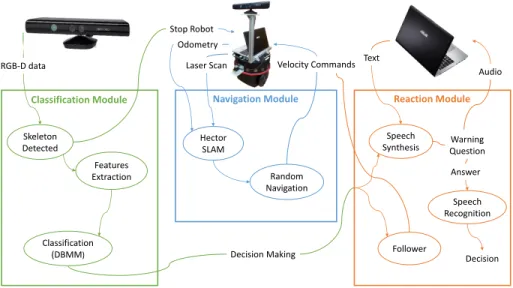
The proposed artificial cognitive system was implemented in ROS and comprises three main modules, as shown in Figure 1: classification, navigation and reaction modules.
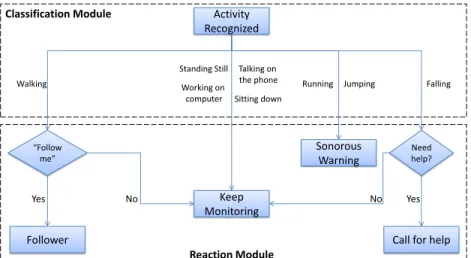
In order to properly test the system in real scenarios, a mobile robot is used. There-fore, a personal robot endowed with cognitive skills, capable of monitoring the be-haviours of a person should be able to autonomously navigate in an indoor environ-ment. The navigation module uses odometry and laser scans from the robot to map the environment and self-localization, randomly navigating, avoiding obstacles. We use the navigation stack available in ROS distributions, more specifically, themove base pack-age to generate an appropriate collision free trajectory. For simultaneous localization and mapping (SLAM) the hector slampackage is used. While the robot is navigat-ing, the MS-Kinect sensor is sending RGB-D data to the classification module. Once a skeleton is detected, the robot stops and the feature extraction process starts. Then, classification is done using the DBMM and an activity is recognized. Once the sys-tem knows the human activity being performed, the reaction module is in charge to select what the robot should do next. For each human activity, a predefined reaction in a lookup-table was associated, including warnings, questions or changes in navigation (Figure 2). In the event of a person telling the robot to follow him/her, a safe distance of 2.5 meters is maintained. A Kalman filter is used to estimate the trajectory of the per-son one second ahead in order to avoid collision between the robot and the human. If a collision trajectory is estimated, the robot will step away, in order to the person walk through safely. For the prediction of the human motion, a position model was adopted, where the state includes position(x(k);y(k))of the human target:
Navigation Module
Classification Module Reaction Module
RGB-D data Skeleton Detected Features Extraction Stop Robot Classification (DBMM) Hector SLAM Laser Scan Odometry Random Navigation Velocity Commands Speech Synthesis Speech Recognition Follower Text Audio Decision Making Warning Question Answer Decision
Activity Recognized Keep Monitoring Sonorous Warning Standing Still Working on computer Talking on the phone Sitting down Running Jumping “Follow me” Walking No Follower Yes Need help?
Call for help Yes No
Classification Module
Reaction Module
Falling
Fig. 2: Decision tree in reaction module.
x(k) =x(k−1) +vx(k−1)×∆t
y(k) =y(k−1) +vy(k−1)×∆t (7)
with∆t=t(k)−t(k−1). Using the torso coordinates as measures, it is possible to com-pute thexvelocityvx andyvelocityvy. For speech synthesis, we use thesound play
package that given a text input, it will be synthesized into sound output. For speech recognition, we use thepocketsphinxpackage. This package recognizes a single word or a stream of words from a vocabulary file previously created. In our work, the vocabu-lary comprises the following words: ”no”, ”yes”, ”please”, ”help”, ”follow”, ”me”. The package can recognize combinations of these words, such as ”please help me”.
5
Experimental Results
5.1 Performance on collected dataset
A new dataset of daily activities and risk situations, more complete and challenging than the one used in our previous work [1], was collected to train the activity recog-nition module. This dataset (Figure 3) comprises video sequences of two male sub-jects and two female subsub-jects performing eight different activities in a living room. The daily activities are:1-walking, 2-standing still, 3-working on computer, 4-talking on the phone, 5 sitting down; and the unusual or risk situations are:6-jumping, 7-falling down, 8- running. This dataset is a challenging one, once there is significant intra-class vari-ation among different realizvari-ations of the same activity. For example, the phone is held with the left or right hand. Another challenging feature is that the activity sequences are registered from different views, i.e., from the front, back, left side, and so on. The classi-fication results are presented in a confusion matrix and with the measures of Accuracy, Precision, Recall of the four tests. The idea is to verify the capacity of generalization of
Fig. 3: Few examples of the dataset (RGB with skeleton joints and depth images) which was created to learn some daily and risk situations.
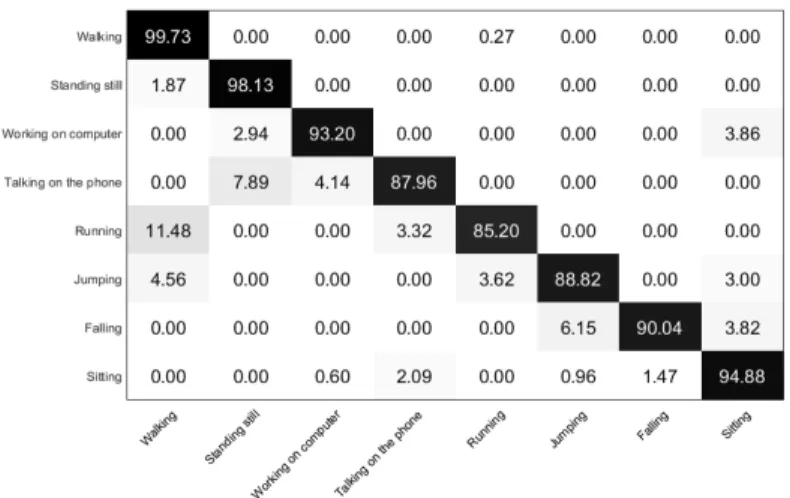
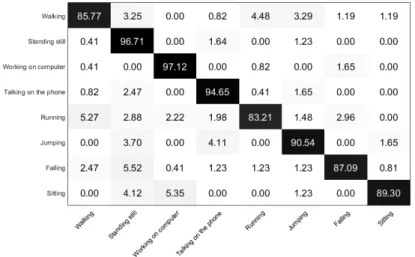
Fig. 4: Confusion matrix obtained from the DBMM classification applied on the dataset
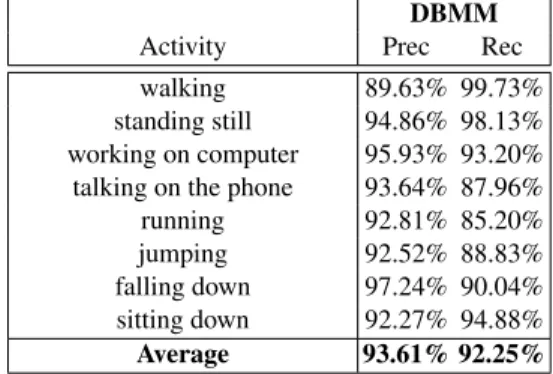
the classifier by using the strategy of ”new person”, i.e., learning from different persons and testing with an unseen person. Figure 4 shows the results in a single confusion ma-trix. Table 1 shows the performance in terms of Precision (Prec) and Recall (Rec) of this approach for each activity. The results show that using DBMM, improvements in the classification were obtained in comparison with using the base classifiers alone. The overall results attained were: accuracy 93.41%, precision 93.61% and recall 92.25%.
Table 1: Performance on the dataset (“new person”). Results are reported in terms of Precision (Prec) and Recall (Rec).
DBMM
Activity Prec Rec
walking 89.63% 99.73%
standing still 94.86% 98.13% working on computer 95.93% 93.20% talking on the phone 93.64% 87.96%
running 92.81% 85.20%
jumping 92.52% 88.83%
falling down 97.24% 90.04% sitting down 92.27% 94.88%
Average 93.61% 92.25%
Table 2: Global results using single classifiers, a simple average ensemble (AV) and the DBMM.
Method Acc. Prec. Rec. NBC 82.90% 85.79% 82.67% SVM 88.47% 89.02% 87.62%
k-NN 87.98% 90.09% 87.06% AV 85.29% 87.74% 84.68%
DBMM 93.41%93.61%92.25%
For comparison purposes, Table 2 summarizes the results from single classifiers and an average ensemble compared with DBMM, showing the improvement achieved using the described skeleton-based features. The SVM was trained withsoft margin(or Cost) parameter set to 1.0, and thek-NN was trained using 20 neighbours.
5.2 Performance on-the-fly using a mobile robot
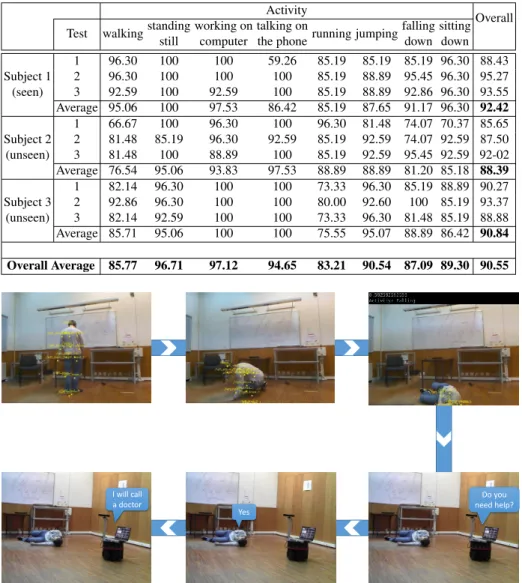
The experimental tests using the proposed approach for a real time application is a little bit different than the experimental tests on the dataset. In this case, the robot will acquire 5 seconds of RGB-D sensor data for features extraction and classification. Only the NBC and SVM were used as base classifiers for the DBMM fusion, because they are enough for obtaining good results, thus, avoiding spending more processing time using other base classifiers. After 5 seconds of frames classification, a final decision is made for activity recognition to trigger a proper robot reaction. The proposed framework is capable of recognizing different activities transitions that happens sequentially in case of a person transit from one activity to another one, e.g., a person that is standing and sequentially pass to a sitting down position and consequentially working on the computer. Figure 5 shows some examples of tests of daily activities and unusual or risk situations that the mobile robot correctly recognized. Three tests were carried out for each activity with three different subjects. One of the subjects was already ”seen” in the training, while the rest are ”unseen” subjects.
Fig. 5: Shots of tests of activity recognition (‘unseen” person) using a mobile robot.
Fig. 6: DBMM on-the-fly classification confidence (average) presented in a confusion matrix
All activities were correctly classified, so that the overall performance of classifica-tion is shown in Figure 6. The overall (average) results attained in real-time experiments were: accuracy 90.55%, precision 90.84% and recall 90.55%. Table 3 shows the results in terms of recall of each test for each subject. Looking at the results attained, it is possi-ble to conclude, as expected, that the best performance is achieved for the ”seen” person (subject 1). However, the difference of results between subjects is not very significant, which indicates that the fact of being or not a ”seen” person is not a key factor for the performance of the classification. The most important factor in a real-time application is that in the end, the activity being performed is correctly recognized. Since the robot correctly classified the activity performed, it also successfully reacted accordingly to the situation. Figure 7 shows a sequence of events from an activity that is being rec-ognized (in this case falling) to react according to this activity. First, the skeleton of a person is detected and tracked, initiating the monitoring stage. Then, the person falls on the floor and the robot correctly recognizes the risk situation ”falling”. Detecting such a behaviour, the robot asks if the person needs help. The robot receives an affirmative answer from the person, recognizes the command and immediately calls for help.
Table 3: On-the-fly results in terms of recall for 3 different subjects. One subject seen and two unseen.
Activity
Overall Test walkingstanding
still
working on computer
talking on
the phonerunning jumping falling down sitting down Subject 1 (seen) 1 96.30 100 100 59.26 85.19 85.19 85.19 96.30 88.43 2 96.30 100 100 100 85.19 88.89 95.45 96.30 95.27 3 92.59 100 92.59 100 85.19 88.89 92.86 96.30 93.55 Average 95.06 100 97.53 86.42 85.19 87.65 91.17 96.30 92.42 Subject 2 (unseen) 1 66.67 100 96.30 100 96.30 81.48 74.07 70.37 85.65 2 81.48 85.19 96.30 92.59 85.19 92.59 74.07 92.59 87.50 3 81.48 100 88.89 100 85.19 92.59 95.45 92.59 92-02 Average 76.54 95.06 93.83 97.53 88.89 88.89 81.20 85.18 88.39 Subject 3 (unseen) 1 82.14 96.30 100 100 73.33 96.30 85.19 88.89 90.27 2 92.86 96.30 100 100 80.00 92.60 100 85.19 93.37 3 82.14 92.59 100 100 73.33 96.30 81.48 85.19 88.88 Average 85.71 95.06 100 100 75.55 95.07 88.89 86.42 90.84 Overall Average 85.77 96.71 97.12 94.65 83.21 90.54 87.09 89.30 90.55 Do you need help? Yes I will call a doctor
Fig. 7: Sequence of events on detecting a person falling and reacting
6
Conclusions and Future Work
The main contribution of this work is a robotic application for real-time monitoring of daily activities and risk situations in indoor environments. A dynamic probabilistic en-semble of classifiers (DBMM) was used for daily activity recognition using a proposed spatio-temporal 3D skeleton-based features. We collected a dataset to endow a robot to recognize daily activities, and we used this dataset to compare our approach with other
state-of-the-art classifiers. Using our proposed skeleton-based features, we attained rel-evant results using the DBMM classification, outperforming other single classifiers in terms of overall accuracy, precision and recall measures. More importantly, the exper-imental tests using a mobile robot presented good performance on the activity classifi-cation, allowing the robot to take appropriate actions to assist the human in case of risk situations, showing our framework has good potential for robot-assisted living. Future work will address addition of contextual information, such as ”who”, ”where”, ”when” in order to fully understand human behaviours, as well as exploitation of our approach with more daily activities, risk situations and robot reactions.
References
1. D. R. Faria, M. Vieira, C. Premebida, and U. Nunes, “Probabilistic human daily activity recognition towards robot-assisted living,” inIEEE RO-MAN’15, 2015.
2. D. R. Faria, C. Premebida, and U. Nunes, “A probalistic approach for human everyday activ-ities recognition using body motion from RGB-D images,” inIEEE RO-MAN’14, * Kazuo Tanie Award Finalist, 2014.
3. C. Zhu and W. Sheng, “Realtime human daily activity recognition through fusion of motion and location data,” inIEEE International Conference on Information and Automation, 2010. 4. ——, “Human daily activity recognition in robot-assisted living using multi-sensor fusion,”
inIEEE ICRA’09, 2009.
5. “Microsoft kinect, Website: https://www.microsoft.com/en-us/kinectforwindows/, accessed on June/2015.”
6. “Asus xtion, Website: http://www.asus.com/multimedia/xtion pro live/, accessed on June/2015.”
7. G. T. Papadopoulos, A. Axenopoulos, and P. Daras,Real-time Skeleton-tracking-based Hu-man Action Recognition Using Kinect Data. Springer International Publishing, 2014, ch. 3D and Augmented Reality, pp. 473–483.
8. C. Chen, K. Liu, and N. Kehtarnavaz, “Real-time human action recognition based on depth motion maps,”Journal of Real-Time Image Processing, 2013.
9. J. Sung, C. Ponce, B. Selman, and A. Saxena, “Unstructured human activity detection from RGBD images,” inICRA’12, 2012.
10. L. Xia and J. Aggarwal, “Spatio-temporal depth cuboid similarity feature for activity recog-nition using depth camera,” inCVPR, 2013.
11. Y. Zhu, W. Chen, and G. Guo, “Evaluating spatiotemporal interest point features for depth-based action recognition,”Image and Vision Computing, 2014.
12. S. A. Mehdi, C. Armbrust, J. Koch, and K. Berns, “Methodology for robot mapping and navigation in assisted living environments,” in2nd International Conference on Pervasive Technologies Related to Assistive Environments, 2009.
13. H. S. Koppula, R. Gupta, and A. Saxena, “Learning human activities and object affordances from RGB-D videos,” inIJRR journal, 2012.
14. M. Volkhardt, S. Mller, C. Schrter, and H.-M. Gross, “Real-time activity recognition on a mobile companion robot,” in55th Int. Scientific Colloquium, 2010.
15. V. Arsigny, P. Fillard, X. Pennec, and N. A. 5, “Log-euclidean metrics for fast and simple calculus on diffusion tensors,”Magnetic Resonance in Medicine, 56(2):411–421., 2006. 16. K. Guo, “Action recognition using log-covariance matrices of silhouette and optical-flow
features,” Ph.D. dissertation, Boston University, College of Engineering, 2012.
17. C.-C. Chang and C.-J. Lin, “LIBSVM: A library for support vector machines,”ACM TIST, 2011, http://www.csie.ntu.edu.tw/ cjlin/libsvm.