서
론
난소암은 한국에서 자궁경부암에 이어 두 번째로 흔 한 부인암으로 여성암 사망의 주요 원인 질환이다 매년. 여명 이상의 새로운 환자가 발생하고 있으며 국내에 900 서는 최근10년간 난소암의 발생률이 점차 증가하는 양 상을 보이고 있다 그러나 난소암이 상당히 진전될 때. , 까지 증상이 발현되지 않는 경우가 많고 아직까지 적절 한 선별검사 방법이 없어 현실적으로 조기 진단에 어려 움이 많다 그러므로 난소암을 예방하거나 생존율을 향. 상시키기 위해 난소암의 발생 위험 인자에 대한 포괄적 접수일 2004. 2. 23.: 주관책임자:김영태 E-mail: [email protected] *본 연구는2005년도 한국여성암 연구재단의 연구비 지원을 받아 수행 되었음.산발성 난소암에서의
BRCA1
과
BRCA2
의 배선 유전자
돌연변이와 유전자다형성
연세대학교 의과대학 산부인과학교실 여성 생명 과학 연구소, , *병리학교실 남은지 김영태 김성훈 김재훈 구자성 김상운 김재욱 김현기․ ․ ․ ․ ․ ․ ․ *Germline Mutations and polymorphisms of BRCA1 and
BRCA2 in Sporadic Ovarian Carcinoma
Eun Ji Nam, M.D., Young Tae Kim, M.D., Sung Hoon Kim, M.D., Jae Hoon Kim, M.D., Ja Seong Koo, M.D., Sang Woon Kim, M.D., Jae Wook Kim, M.D., Hyun Ki Kim, M.D.*
Department of Obstetrics and Gynecology, Institute of Women’s Life Science,
*Department of Pathology, Yonsei University College of Medicine, Seoul, Korea
Objective:Mutations in the BRCA1 and BRCA2 genes predispose women to ovarian and/or breast cancer. The purposes of this study were firstly to investigate the presence of BRCA1 and BRCA2 mutations in women with non-hereditary ovarian cancer and secondly to evaluate the relationship between ovarian cancer susceptibility gene polymorphism and clinicopathological features.
Methods:We studied 37 women who received a diagnosis of sporadic ovarian epithelial cancer and were treated at our hospital between August 2002 and March 2004. Genomic DNA was analyzed for BRCA mutations using PCR-DHPLC-sequencing method. And we examined the relationship between ovarian cancer susceptibility gene polymorphism and clinicopathological features using a high-throughput SNP scoring methods.
Results:Most mutations of BRCA1 and BRCA2 associated with ovarian and/or breast cancer resulted in truncated proteins. We found one frameshift mutation in BRCA1 (3746insA) led to premature termination. She has no family history of breast and ovarian cancer. There was no relationship between ovarian cancer susceptibility gene polymorphisms and clinicopathological features.
Conclusion: Our results were consistent with the concept that there was a limited role of BRCA1 and BRCA2 mutations in ovarian carcinogenesis in Korean population and polymorphisms of some selected ovarian cancer susceptibility genes were not associated with the clinicopathological phenotypes of ovarian cancer.
인 연구는 매우 중요하다. 난소암의 발생 원인은 아직 정확하게 밝혀져 있지 않 다 환경 생식력 유전학적인 인자들이 주요 원인으로. , , 거론되고 있지만 최근 분자 생물학적인 연구들의 결과 점차 유전학적인 측면이 강조되고 있다 난소암이 어떤. 가계에서 집단적으로 발생한다는 사실이 오래 전부터 관찰되어 난소암과 가족력간에 밀접한 관계가 있음이 잘 알려져 있어 왔다 직계 가족 중 유방암이나 난소암. 환자가 있는 여성은 유방암이나 난소암에 걸릴 상대 위 험도가2-3배 증가하며 그 역도 성립함이 보고되는 등 유방암과 난소암에 동시에 작용하는 어떤 유전자가 존 재함이 시사되었다.1 년 등에 의해
1994 Miki Breast Cancer Gene 1
년 에 의해
(BRCA1), 1995 Wooster Breast Cancer
가 가족성 유방암 난소암의 발생과 연 Gene 2 (BRCA2) / 관성이 높음이 발표된 이후 수많은 연구자들이 이들 유 전자에 대해 연구해왔다.2,3BRCA1유전자의 변이가 있 는 경우60세까지 유방암과 난소암이 발병될 가능성은 각각54%, 30%인 것으로 보고되었다.4난소암 환자에 서 유전자 돌연변이가 관찰되는 비율은 인종간에 편차 가 있으나 1980년대 후반에 발표된 분리분석 연구 에 의하면 에서
(segregation analysis studies) 5%
정도의 유방암 난소암 환자가 보통염색체우성유전 10% / 양상의 유전자 돌연변이로 인 (autosomal dominant) 해 암이 발생하는 것으로 보고되었다.5,6BRCA1은 염색 체17q12-q21에 위치하며 전체, 24개의 액손(exon)이
약100 kb의 지놈DNA (genome DNA)에 걸쳐 분포하
고 있으며 이 중22개의 엑손이1,863개의 아미노산을
암호화하고 있다. BRCA1 유전자의 기능은 아직 잘 알
려져 있지 않지만 종양억제 유전자의 역할을 수행하거
나 전사조절 유전자 기능을 하는 것으로 추측된다.2
는 유전자 의 근위
BRCA2 retinoblastoma (RB) (gene)
부인 염색체13q12-q13에 위치하며 전체, 27개의 액손 이3,418개의 아미노산을 암호화하고 있다.3가족성 난 소암에서 현재까지 다수의BRCA1 및BRCA2배선 유 전자 돌연변이가 발견되어 난소암 발생에 중대한 역할 을 담당할 것으로 보고되었다 한편. , first degree나 의 친족 중 난소암이나 유방암 환자가 없 second degree
는 산발성 난소암 (sporadic ovarian cancer)에서도
유전자 돌연변이가 연구되어 등은 산발 BRCA Futreal 성 난소암에서의 BRCA1 배선 유전자 돌연변이를 발 견하여 보고한 바 있어 산발성 난소암에서도 BRCA 유전자 돌연변이가 역할을 할 것으로 추정된다.7난소 암 및 유방암의 발생과 연관된BRCA1 및 BRCA2유 전자의 돌연변이는 유전자 조절부위 상에 프레임 이동 난센스 스프라이스
(frameshift), (nonsense), (splice)
등의 돌연변이여서 돌연변이 된 유전자는 절단 단백질 을 생산하게 되거나 생산된 단백질 (truncated protein) 의 기능 부전을 초래하게 된다.3세계 각지에서 이루어 진 연구들에 의하면, BRCA1및BRCA2유전자의 돌연 변이율 및 특징은 인종마다 차이가 커서 어떤 돌연변이 는 특정 인종에게서 특징적으로 나타나기도 한다.8현재 까지BRCA 1및BRCA2유전자 돌연변이에 대한 연구 는 주로 구미에서 백인(Caucasian)을 대상으로 집중적 으로 이루어졌으나 일본이나 홍콩에서도 소규모 연구가 진행되어 이들 인종에 특이한BRCA 1및 의 유전자 돌2 연변이가 보고되기도 하였다 한국에서는. 1995년도부 터 한 연구진에 의하여 가족성 유방암 난소암 가계에서/ 유전자 돌연변이에 대해 보고되었으나 BRCA1 9-12가족 력과 무관하게 산발적으로 발생한 난소암 환자를 대상 으로 BRCA1 및 BRCA2 유전자 돌연변이를 연구하고 유전자 돌연변이가 난소암 발생에 기여하는 정도 BRCA 를 조사한 연구는 현재까지 전무한 실정이다. 기존의 연구보고들에서 BRCA1 및 BRCA2 유전자 돌연변이율을 살펴보면 가족성 유방암 난소암 가계에, / 서 BRCA1 유전자 배선 돌연변이율은18-67% 였고, 유전자 배선 돌연변이율은 이었다 BRCA2 14-15% .12-15 반면에 가족력과 무관하게 산발적으로 발생한 난소암 환자에서BRCA1및BRCA2유전자의 배선 돌연변이율 은 가족성 난소암환자군에 비해 낮게 보고되었다.16-21 이처럼 기존 연구에서 가족력과 무관하게 산발적으로 발생한 난소암에서BRCA1및BRCA2유전자의 배선 돌 연변이율이 낮다는 것은 난소암 발생에 영향을 미칠 수 있는 낮은 발현도(penetrance)를 갖는 유전자들이 존
재할 수 있음을 시사한다.22 최근 유전자 데이터베이스 가 급격히 확장되고 기술의 발달로 단시간에 자동적으 로 많은(high-throughput)유전형 분석(genotyping) 을 시행할 수 있게 되어 유방암과 같은 영역에서 유전자 다형성(polymorphism),특히 단일염기다형성 (single-과 암발생 및 임상 nucleotide polymorphism, SNP) 병리학적 특징의 연관성을 찾는 연구들이 시행되었 고 유전자 다형증은 암발생, (development) 및 진행 에 영향을 미칠 뿐만 아니라 결과적으로 (progression) 암의 표현형(phenotype) 및 예후 (prognosis)와도 연 관이 있을 수 있음이 보고되었다.23-25 이에 저자들은 본 연구에서 한국인에서 가족력과 무관하게 산발적으로 발생한 난소암 환자의 BRCA1 및 BRCA2의 배선 유전자 돌연변이가 있는 지를 연 구하고 발생율을 구하였으며 이와 아울러 난소암 발 생과 연관된 BRCA1 및 BRCA2 유전자의 다형성 이 난소암의 임상병리학적인 특징과 연 (polymorphism) 관성이 있는지 규명하고자 하였다.
연구 대상 및 방법
대상환자 1. 년 월부터 년 월까지 병기 결정을 위한 2002 8 2004 3 개복술을 시행 받고 조직병리학적으로 난소암을 확진 받은37명을 대상으로 말초 혈액 및 신선 조직을 채 취하여 분석 대상으로 하였다 대상 환자들의. first 나 의 친족 중 난소암이나 유방degree second degree 암
환자는 없었다.
방법 2.
1) PCR amplification
검체로부터 를
EDTA-whole blood genomic DNA
Kit (QIAamp DNA Blood Mini Kit, QIAGEN, USA)
에 따라 분리하였다 과 의 배
protocol . BRCA1 BRCA2
선 돌연변이 (germline mutation)을 확인하기 위하여
개 개의 을 이용하여 전체
BRCA1 33 , BRCA2 48 primer
을 모두 증폭하였다 조건은 다음과 같다
51 exon . PCR .
10 Mm Tris-HCl (pH 8.3), 1.5 mM MgCl2, 50 mM KCl, 200 uM dNTP, 1 uM of each primer, 0.5 units of Taq polymerase (Promega, USA), and 1X concentration of PCR buffer, in a total volume of 25 ul, 1 cycle 94℃5 min, 34 cycle 94℃30 sec, 5 8℃ 30 sec, 72℃ 45 sec and 1 cycle 72℃ 3 min. 을 Applied Biosystems GeneAmp 2700 PCR machine 사용하였다. PCR 산물을 1.5% agarose gel에 loading
한 후 ethidium bromide로 염색하여 확인하였다 전체.
개의 염기 서열은 참고문헌
81 primer 26-28을 참조하였다.
2) DHPLC (Denaturing High Performance Liquid Chromatography)
장치는 제조사
DHPLC (WAVE: Transgenomic, San
에 따라 하였다
Jose, CA, USA) protocol running . 15
를 에서 분 동안 시 ul PCR product 95℃ 5 denature 킨 후 약, 40분 동안55℃까지 천천히 온도를 낮추어 시킨다 이 중 를 장 rennealing . product 5-8 ul DHPLC 치에 사용하며 분석은 약 7-12분이 소요된다. The 는
column mobile phase 0.1 M triethylamine acetate (pH 7.0) with (buffer B) or without (Buffer A) 25%
의 혼합으로 이루어져 있으며 각
acetonitrile product
에 대한 분석 gradient는 제조사의 WAVEmaker
system control software (Transgenomic, San Jose,
에 의해 자동으로 결정된다 의
CA, USA) . Product
상태는 으로
elution chromatogram computer monitor
에 나타나며 일반적으로 heterogenous molecules는
앞에 하나의 가 더
homozygous molecules peak peak
나타나며 homozygous molecules는 하나의 peak만 나
타난다.
3) Sequence Analysis
비정상적인 peak pattern을 보이는 PCR product는
Kit (QIAquick PCR purification Kit QIAGEN, USA) 에 따라 분리하였으며 양방향 염기서열 분석을 protocol
위해 BigDye Terminator Cycle Sequencing Kit 와
(Applied Biosystems, USA) ABI 3100 Genetic
를 이용하였다 및 유전자의
Analyzer . BRCA1 BRCA2
주조직 적합항원염색체 (haplotype)은 Breast Cancer
Information Core (BIC): http://www.nhgri.nih. 로부터 gov/Intramural_research/Lab_transfer/Bic/ 구성하였다. 유세포분석법 4) DNA 유세포분석을 위해 일차적 개복술을 통해 얻은 DNA 신선조직 (fresh tissue)을 이용하였다 검체는. 0.2 g 의 조직을 -70℃에서 냉장보관하였고, Vindelov's 을 이용하여 검체를 고정하였으며 각각 technique 개의 세포를 검사하였다 배수성 및 25,000 .21,22 DNA
합성기 분율은 Phenix flow system을 통해 산출되었
다. DNA histogram 상에서 서로 다른 G0/G1 peak가
개 이상 나타나며 를 구성하는 세포의 최소
2 peak 10%
Table 1. Characteristics of patients with ovarian cancer
n %
Age
Median (years, range)
44 (18-72) <35 7 18.9 35 ≥ 30 81.1 Histology Serous cystadenocarcinoma 21 56.8 Mucinous cystadenocarcinoma 6 16.2
Clear cell carcinoma
3 8.1
Endometrioid carcinoma
3 8.1
Squamous cell carcinoma
2 5.4
Adenocarcinoma, non specific
2 5.4 Histologic grade I-II 9 32.1 III 19 67.9 Stage I 8 21.6 II 4 10.8 III 24 64.9 IV 1 2.7 DNA ploidy Diploidy 11 44.0 Aneuploidy 14 56.0 가 aneuploid cells일 때를 비배수성으로 정의하였다. 변이계수 (coefficient of variation)는 5% 이내인 을 적합한 것으로 판정하였다
histogram . DNA index
값은 정상조직의 함량에 대한 검체조직의 (DI) DNA 함량의 비로 일 때를 이배수성으로 정 DNA 0.96-1.04 의하였고 이 기준에서 제외되는 검체는 비배수성으로 정의하였다. 통계분석 5) 로 및
PCR-DHPLC-sequencing method BRCA1
유전자형 분석 을 하는 중 총 BRCA2 (genotyping) 32 개의 염기다형성 (polymorphisms)를 얻었다 이렇게. 얻어진 다형성 대립유전자(polymorphic alleles)와 난 소암의 임상병리학적인 특성과의 분석은 SPSS version 를 사용하여 로 분석
11.0 software Fisher’s exact test
결
과
대상 환자의 특성 1. 대상 환자의37명의 연령 범위는18세에서72세 였으 며 연령중앙값(median age)는44세 이었고 평균 연령 은47.7세 이었다. FIGO병기(stage)에 따르면 기는I 8 명(21.6%),Ⅱ기는 명4 (10.8%),Ⅲ기는24명(64.9%), 기는 명1 (2.7%)이었다 조직병리학적 유형별 분포. Ⅳ 는 장액성 (serous) 난소암 21명 (56.8%), 점액성 난소암 명 투명세포(mucinous) 6 (16.2%), (clear cell
난소암 명 자궁내막양
type) 3 (8.1%), (endometrioid)
난소암 명3 (8.1%),편평세포(squamous cell type)난
소암 명2 (5.4%),기타 미분화 난소암은 명2 (5.4%)이
었으며 조직학적 분화도(grade)검사가 이루어진28명
중에19명(67.9%)이grade 3에 해당되었다. 25명의 환
자에서 종양 조직의DNA유세포분석(flow cytometry)
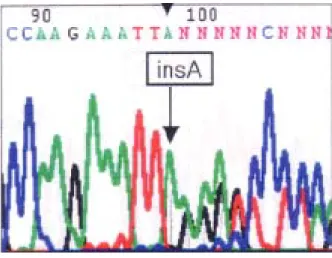
검사를 시행한 결과11예는 이배수성(diploidy)갖았고 예는 비배수성 를 갖는 것으로 확인되었 14 (aneuploidy) 다 (Table 1). 결과 2. PCR-DHPLC-Sequencing 한국인에서 가족력과 무관하게 산발적으로 발생한 난소암 환자37명을 대상으로BRCA1및BRCA2 유 전자의 돌연변이를 찾아내기 위한 PCR-DHPLC-을 유전자 전체 에서 수행하여 그 중 Sequencing exon 1 명의 난소암 환자에서 프레임 이동(frame shift)돌연 변이가 발견되었다 돌연변이는. BRCA1 유전자의 엑손 에 있는 코돈 에서 번째 염기에 11K 1,218 3,746 adenine 이 삽입(insertion)되어 그 결과 프레임이 이동하여 코 돈1,218에 정지(stop) 코돈이 형성되어 절단 단백질 을 생성하게 된다 전체
(truncated protein) (Fig. 1).
환자 중BRCA1유전자 돌연변이율은2.7 %에 해당하였
다. 37명의 난소암 환자의BRCA2유전자에서는 돌연변
이가 발견되지 않았다. BRCA1유전자 돌연변이가 확인
된 환자는49세 여환으로 가족력상 유방암이나 난소암
의 가족력은 없었다.
Fig. 1. Germline mutation of BRCA1 gene in clear cell ovarian cancer patient. Arrow indicates abnormally shifted DNA bands due to adenine insertion in nucleotide sequences of exon 11K of BRCA1 gene, which leads to frame shift change in translation and immature chain termination of BRCA1 protein.
단일염기다형성 와 대상 환자의 임상병리학적
3. (SNP)
특성의 연관성 분석
로 및
PCR-DHPLC-sequencing method BRCA1
유전자형 분석 을 하는 중 얻어진 BRCA2 (genotyping) 총 32개의 염기다형성(polymorphisms)중에 연구 대 상 환자로부터 대립인자빈도가 좀더 적은 쪽이 (rare 이상인 염기다형성 개를 선택 allele frequency) 10% 5
하였다 (Table 2). BRCA1 유전자에서는 Ser694Ser,
이 유전자에서는
Leu771Leu, Pro871Leu , BRCA2
His-의 가
372Asn, Ser2412Ser rare allele frequencies 10%
넘었으며 이들 대립 유전자의 빈도는 거의,
Hardy-을 만족시켰다 이들 중
Weinberg equilibrium .
Pro-871Leu, His372Asn는 단백질의 변화를 초래하였고, 모든 SNP들은 각 유전자들의 코드화 지역 (coding 에 위치하였다 이렇게 얻어진 개의 및 region) . 5 BRCA1 유전자의 염기다형성을 난소암의 임상병리학적인 특 2 징 발생 연령 가족력 병기 조직학적 분화도( , , , , DNA 유세포분석 결과 과 비교하였으나 유의성 있는 차이를) 보이는 결과는 없었다 (Table 3).
Table 2. Gene list and genotype frequencies
Gene Common Rare Rare
Variations n Honozygotes Heterozygotes Homozygotes Allele
N (%) N (%) N (%) Frequency
BCRA1 Ser694Ser C2201T 7 30 (81) 7 (19) 0 0.10
Leu771Leu T2430C 14 23 (63) 14 (37) 0 0.19
Pro871Leu C2731T 15 22 (57) 15 (43) 0 0.21
BRCA2 His372Asn C1342A 21 16 (43) 13 (35) 8 (21) 0.39
Ser2412Ser A7470G 9 28 (76) 9 (24) 0 0.12
Table 3. Association of variants of polymorphism with clinicopathological features of ovarian cancer
Characteristics n N (%) BRCA1 BRCA2 C2201T T2430C C2731T C1342A A7470G Age ≥ 35 yrs 30 5 (16) 11 (36) 11 (36) 12 (40) 6 (20) < 35 yrs 7 1 (14) 2 (28) 3 (42) 3 (42) 1 (14) Family history No 35 5 (14) 11 (32) 12 (35) 13 (38) 6 (17) Yes 2 0 (0) 0 (0) 0 (0) 2 (100) 0 (0) Histologic grade I or II 8 0 (0) 3 (37) 4 (50) 3 (37) 1 (12) III 19 5 (26) 7 (36) 8 (42) 8 (42) 5 (26) Surgical stage I 8 0 (0) 3 (37) 4 (50) 4 (50) 1 (12) II-IV 28 6 (21) 11 (39) 11 (39) 11 (39) 6 (21)
DNA flow Diploidy 11 3 (27) 5 (36) 6 (54) 7 (63) 4 (36)
Cytometry Aneuploidy 14 2 (14) 6 (42) 6 (42) 5 (35) 1 (7)
고
찰
및 유전자 돌연변이는 가족성 난소암 BRCA1 BRCA2 및 유방암의 발생에 중요한 역할을 하고 있는 것으로 여 겨지며1,2,29 산발적으로 발생된 난소암 유방암에서도, 및 유전자 돌연변이가 발견되었다 BRCA1 BRCA2 .16,17 유전자 돌연변이는 현재까지 여 종류가 보 BRCA1 500 고되었으며 전체 유전자의62% 가량을 차지하는 엑손 번에서 의 돌연변이가 발견되었다 11 55% .30BRCA2유전 자 돌연변이는 현재까지300여 종류 이상이 보고되었 고 흥미롭게도BRCA1유전자처럼 엑손11번의 크기가 크지만 특별히 유전자상에 돌연변이가 호발하는 부분 은 존재하지 않는다 및 유전(hot spots) . BRCA1 BRCA2
자의 전체 돌연변이 중 80%가 프레임 이동 (frame
난센스 과오 스프라
shift), (nonsense), (missense),
이스 (splice), 조절부위(regulatory) 돌연변이이므로
이들 유전자는 절단 단백질 (truncated protein)을 생
산하게 된다 이와 같은 사실은 절단 단백질 검사법.
과 같은 간단한 난소암 선 (protein truncation assay)
별 검사 방법의 가능성을 암시한다 그러나 아직까지 절.
단 단백질의 생물학적 활성 유무 세포내의 위치 우성, ,
음성효과 (dominant negative effect), 조절기능의 상
실 여부 등에 대하여는 확실히 알려진 바가 없다.
표현형 사이의 관계는 아직 잘 알려져 있지 않지만 등은 말단 부위의 돌연변이에로 인하여 Johansson C-전체BRCA1단백질 중8%미만이 소실된 경우는 특히 장기특이성 유방암 가계에서 흔히 발견된다고 보고하였 고15 Gayther등도C-말단1/3내에 위치한BRCA1돌 연변이는 난소암의 발생빈도가 낮다고 보고하였다.14현 재까지 외국의 보고에 의하면BRCA1과 연관된 가족성 유방암 난소암 환자들 중 약/ 1/3 내지 2/3 환자에서 유전자의 배선 돌연변이를 발견할 수 있었고 BRCA1 , 유전자의 배선 돌연변이는 내외에서 발견 BRCA2 10% 되었다.12-15 반면에 가족력과 무관하게 산발적으로 발 생한 난소암 환자에서BRCA1유전자의 배선 돌연변이 율은1.4-13.3%였고, BRCA2유전자의 배선 돌연변이 율은0.9-8.0%이었다(Table 4,5).16-21,31,32본 연구의 경우 가족력과 무관하게 산발적으로 발생한 난소암 환 자 중BRCA1유전자의 배선 돌연변이율은2.7%로 외국 연구에 비해 약간 낮은 정도였으나BRCA2유전자의 배 선 돌연변이는 발견하지 못하였다 따라서 난소암. 발생
Table 4. BRCA mutation incidence among ovarian cancer unselected for family history
Reference Year No. of patients
BRCA1 BRCA2 (%) (%) Takahashi et al17,21 1995/1996 115/130 6.1 3.1 Foster et al20 1996 50 - 8.0 Stratton et al18 1997 374 3.5 -Risch et al19 2001 515 7.6 4.1 Khoo et al31 2002 214 1.4 0.9 Liede et al32 2002 120 13.3 2.5
Table 5. Germline BRCA mutation incidence among breast and ovarian cancer families
Reference Year No. of families
BRCA1 BRCA2 (%) (%) Gayther et al14 1995 32 53 -Johannsson et al15 1996 15 67 -Kang et al12 2002 21 18 14 Reedy et al13 2002 26 30 15 에 있어 인종 차이 (racial difference)가 존재할 것 으로 생각되며 백인 (Caucasion)에 비해 한국인에서 및 유전자의 배선 돌연변이가 난소암 발 BRCA1 BRCA2 생에 제한된 역할만을 수행한다고 사료된다. 등의 보고 따르면 또는
Whittemore BRCA1 BRCA2
유전자 돌연변이를 가진 보인자가80세까지 살 경우 유 방암 또는 난소암에 이환될 확률 (lifetime risk)은 유전자 돌연변이 보인자의 경우 BRCA1 73.5%, BRCA2 유전자 돌연변이 보인자의 경우 27.8%로 알려져 있 다.33 그러나 유전학적으로 난소암 또는 유방암에 이, 환될 수 있는 고위험군에 속한 환자들을 선별방법 으로 및 유전자 돌
(screening method) BRCA1 BRCA2
연변이 검사는 실험실 수준을 넘어 일반화시키기는 무 리가 있다 첫째로 난소암 환자를 대상으로 시행한 본. 연구에서 서구보다BRCA1 및BRCA2유전자의 돌연 변이율이 낮게 나타났을 뿐 아니라 돌연변이가 발견된 환자의 경우 난소암이나 유방암의 가족력이 없었고, 둘째, BRCA1 및 BRCA2 유전자가 불완전한 투과도
를 갖기 때문에 비록
(incomplete penetrance) BRCA1
및BRCA2유전자 돌연변이가 있어도 난소암 또는 유방 암에 이환 되지 않는 경우도 있고 셋째 검사상 비용 효, 과적인 면이 아직 평가되지 않았으며 넷째 검사상 위양, 성 및 위음성 문제가 있으며 다섯째, BRCA1및BRCA2 유전자 돌연변이가 발견되었다 해도 고위험군에 속한 환자들의 치료방침은 아직 결정된 것이 없고 예방적 난 소절제술 등34,35의 치료방법을 사용하더라도 원발성 복
막암 (primary peritoneal carcinoma)의 발생을 완전 히 막을 수 없다는 점을 들 수 있다. 높은 투과도 (penetrance)를 갖는 BRCA1 또는 유전자 돌연변이가 난소암 발생의 원인이 되는 BRCA2 사실은 이미 많은 연구에 의해서 확인되었다 하지만. 및 유전자 돌연변이는 일반인에서는 그 BRCA1 BRCA2 빈도가 매우 낮다(<0.5%, 백인여성).8 따라서 난소암 발생에 영향을 미칠 수 있는 낮은 투과도를 갖는 유전자 들이 존재할 수 있음이 시사되었고, BRCA1및BRCA2 유전자의 염기서열다형성은 이를 밝혀내고자 하는 연구 의 후보 대상이 되었다. 유전자 다형성은 전사 산물인 단백의 기능 및 발현 에 영향을 미쳐 암 발생 및 그 표현형에 영향을 미칠 수 있다 현재까지 드문 대립유전자 빈도. (rare allele 가 많은 수의 인구를 대상으로 시행했을 frequencies) 때5%이상 존재하는 것으로 밝혀진 염기서열다형성들 은 BRCA1 유전자에서는 Q356R, P871L, E1038G, 가지가 있고 K1183R, S1613G 5 ,36BRCA2유전자에서는 가 발견되었다 N372H .37 몇몇 연구에서는 이러한 유전 자다형성들이 유방암 및 난소암의 발생을 증가시킨다는 보고도 있었고,36 HH 동형접합체(homologue)의 경우 난소암에서 장액성(serous)유형이 더 많은 경향이 있 다는 보고도 있었다.38 하지만 이에 반해, BRCA1 및2 의 유전자다형성이 난소암 발생을 증가시키지 않는다는 보고39도 있어 아직 유전자다형성의 역할에 대한 연구는 논쟁 중이다 본 연구에서도. BRCA1의P871L, BRCA2
의 N372H의 경우 rare allele frequency가 10%가
넘게 나타나 이들 연구와 일치된 결과를 보였다 하. 지만 주로 백인을 대상으로 한 연구보고들에서는 중 가 이상을 차지하 N372H NN homologue 52-54% 고, HH homologue는5-6%를 차지한데 반해,37-39우 리 연구에서는HH homologue가 43%, NN homoloue 가 21%를 차지해 위 연구들과 차이를 보였다 백인을. 대상으로 한 연구에서는 정상인을 대조군에 포함해 유 전자다형성 빈도를 측정하였고 유전인자 간의 연관불균 형 (linkage disequilibrium)을 고려하여 주조직적합항 원염색체(haplotype)의 빈도를 측정한 것도 있어 우리 연구와 차이를 보였다고 하겠다 그러나 우리 연구에서. 의 비율이 보다 높다 HH homologue NN homologue 는 결과는 유전자 다형성의 빈도에 인종 차이 (racial 가 존재함을 반영한다고 하겠다 우리는 difference) . 및 유전자를 하여
BRCA1 BRCA2 direct sequencing
얻어진SNP와 난소암의 임상 병리학적인 특징과의 연 관성을 분석하고자 하였으나 본 연구에서는 통계적으로 의미 있는 결과를 얻지 못하였다. 결론적으로 저자들은 가족력과 무관하게 산발적으로 발생한 난소암 환자에서BRCA1유전자의 배선 돌연변 이는2.7%에서 관찰하였으며 이는 기존 보고들에서 발 표된 산발성 난소암 환자를 대상으로BRCA1배선 돌연 변이율과 유사하였다 그러나. BRCA2유전자 배선 돌연 변이는 발견하지 못하였으며 난소암 발생에 감수성을 가진BRCA1및BRCA2의 유전자 다형성과 난소암의 임 상병리학적 특징과의 상관관계를 발견하지 못하였다. 따라서BRCA1및BRCA2유전자의 배선 돌연변이 및 다형성은 한국인에서 난소암 발생에 제한된 역할 만을 하고 있다고 사료된다 (limited role) .
참고문헌
1. Houlston RS, Collins A, Slack J, Campbell S, Collins WP, Whitehead MI, et al. Genetic epidemiology of ovarian cancer: segregation analysis. Am Hum Genet 1991; 55: 291-9.
2. Miki Y, Swensen J, Shattuck-Eidens D, Futreal PA, Harshman K, Tavtigian S, et al. A strong candidate for the breast and ovarian cancer susceptibility gene BRCA1. Science 1994; 266: 66-71. 3. Wooster R, Bignell G, Lancaster J, Swift S, Seal S, Mangion J, et al. Identification of the breast cancer susceptibility gene BRCA2. Nature 1995; 378: 789-92.
analysis in familial breast and ovarian cancer: results from 214 families. The Breast Cancer Linkage Consortium. Am J Hum Genet 1993; 52: 678-701.
5. Newman B, Austin MA, Lee M, King MC. Inheritance of human breast cancer: Evidence for autosomal dominant transmission in high-risk families. Proc Natl Acad Sci USA 1988; 85: 3044-8. 6. Schildkraut JM, Risch N, Thompson WD. Evaluating genetic association among ovarian, breast, and endometrial cancer: Evidence for a breast/ovarian cancer relationship. Am J Hum Genet 1989; 45: 521-9.
7. Futreal PA, Liu Q, Shattuck-Eidens D, Cochran C, Harshman K, Tavtigian S. BRCA1 mutations in primary breast and ovarian carcinomas. Science 1994; 266: 120-2.
8. Szabo CI, King MC. Population genetics of BRCA1 and BRCA2. Am J Hum Genet 1997; 60: 1013-20.
9. Oh JH, Noh DY, Choe KJ, Kang SB, Kim LS, Ro MS, et al. Germline mutation of BRCA1 gene in Korean breast and ovarian cancer patients. J Korean Cancer Res Assoc 1995; 27: 1061-9. 10. Won YJ, Oh JH, Huang XH, Noh DY, Choe KJ, Kang SB, et al. Germline mutations of BRCA1 gene in Korean breast and/or ovarian cancer families. J Korean Cancer Assoc 1997; 29: 713-23. 11. Won YJ, Oh JH, Kim JH, Noh DY, Choe KJ, Kang SB, et al. Germline mutations of BRCA2 gene in Korean breast and/or ovarian cancer families. J Korean Cancer Assoc 1998; 30: 242-52 12. Kang HC, Kim IJ, Park JH, Kwon HJ, Won YJ, Heo SC, et al. Germline mutations of BRCA1 and BRCA2 in Korean breast and/or ovarian cancer families. Hum Mutation 2002; 20: 235-9. 13. Reedy M, Gallion H, Fowler JM, Kryscio R, Smith SA. Contribution
of BRCA1 and BRCA2 to familial ovarian cancer: a gynecologic oncology group study. Gynecol Oncol 2002; 85: 255-9. 14. Gayther SA, Warren W, Mazoyer S, Russell PA, Harrington PA,
Chiano M, et al. Germline mutations of the BRCA1 gene in breast and ovarian cancer families provide evidence for a genotype-phenotype correlation. Nat Genet 1995; 11: 428-33.
15. Johannsson O, Ostermeyers EA, Hakansson S, Friedman LS, Johansson U, Sellberg G, et al. Founding BRCA1 mutations in hereditary breast and ovarian cancer in southern Sweden. Am J Hum Genet 1996; 58: 441-50.
16. Matsushima M, Kobayashi K, Emi M, Saito H, Saito J, Suzumori K, et al. Mutation analysis of the BRCA1 gene in 76 Japanese ovarian cancer patients: four germline mutations, but no evidence of somatic mutation. Hum Mol Genet 1995; 4: 1953-6.
17. Takahashi H, Behbakht K, McGovern PE, Chiu HC, Couch FJ, Weber BL, et al. Mutation analysis of the BRCA1 gene in ovarian cancers. Cancer Res 1995; 55: 2998-3002.
18. Stratton JF, Gayther SA, Russell P, Dearden J, Gore M, Blake P, et al. Contribution of BRCA1 mutations to ovarian cancer. N Engl J Med 1997; 336: 1125-30.
19. Risch HA, McLaughlin JR, Cole DE, Rosen B, Bradley L, Kwan E, et al. Prevalence and penetrance of germline BRCA1 and BRCA2 mutations in a population series of 649 women with ovarian cancer. Am J Hum Genet 2001; 68: 700-10.
20. Foster KA, Harrington P, Kerr J, Russell P, DiCioccio RA, Scott IV, et al. Somatic and germline mutations of the BRCA2 gene in sporadic ovarian cancer. Cancer Res 1996; 56: 3622-5.
21. Takahashi H, Chiu HC, Bandera CA, Behbakht K, Liu PC, Couch FJ, et al. Mutation of the BRCA2 gene in ovarian carcinomas. Cancer Res 1996; 56: 2738-41.
22. Goode EL, Dunning AM, Kuschel B, Healey CS, Day NE, Ponder BA, et al. Effect of germline genetic variation on breast cancer survival in a population-based study. Cancer Res 2002; 62: 3052-7. 23. Sjalander A, Birgander R, Hallmans G, Cajander S, Lenner P, Athlin L, et al. p53 polymorphisms and haplotypes in breast cancer. Carcinogenesis 1996; 17: 1313-6.
24. Powell BL, van Staveren IL, Roosken P, Grieu F, Berns EM, Iacopetta B. Associations between common polymorphisms in TP53 and p21WAF1/Cip 1 and phenotypic features of breast cancer. Carcinogenesis 2002; 23: 311-5.
25. Han WS, Kang DH, Park IA, Kim SW, Bae JY, Noh DY, et al. Associations between breast cancer susceptibility gene polymorphisms and clinicopathological features. Clin Cancer Res 2004; 10: 124-30. 26. Arnold N, Gross E, Schwarz-Boeger U, Pfisterer J, Jonat W, Kiechle M. A highly sensitive, fast and economical technique for mutation analysis in hereditary breast and ovarian cancers. Hum Mutat 1999; 14: 333-9.
27. Wagner TM, Hirtenlehner K, Shen P, Moeslinger R, Muhr D, Fleischmann E, et al. Global sequence diversity of BRCA2: analysis of 71 breast cancer families and 95 control individuals of worldwide populations. Hum Mol Genet 1999; 8: 413-23.
28. Wagner T, Stoppa-Lyonnet D, Fleischmann E, Muhr D, Pages S, Sandberg T. Denaturing high-performance liquid chromatography detects reliably BRCA1 and BRCA2 mutations. Genomics 1999; 62: 369-76.
29. Lynch HT, Casey MJ, Lynch J, White TE, Godwin AK. Genetics and ovarian carcinoma. Semin Oncol 1998; 25: 265-80. 30. Couch FJ, Weber BL. Mutations and polymorphisms in the familial
early-onset breast cancer (BRCA1) gene: Breast Cancer Information Core. Hum Mutat 1996; 8: 8-18.
31. Khoo US, Chan KY, Cheung AN, Xue WC, Shen DH, Fung KY, et al. Recurrent BRCA1 and BRCA2 germline mutations in ovarian cancer: a founder mutation of BRCA1 identified in the Chinese population. Hum Mutat 2002; 19: 307-8.
32. Liede A, Malik IA, Aziz Z, Rios Pd Pde L, Kwan E, Narod SA. Contribution of BRCA1 and BRCA2 mutations to breast and ovarian cancer in Pakistan. Am J Hum Genet 2002; 71: 595-606. 33. Whittemore AS, Gong G, Itnyre J. Prevalence and contribution of BRCA1 mutations in breast and ovarian cancer: Results from three U.S. population-based case-control studies of ovarian cancer. Am J Hum Genet 1997; 60: 496-504.
34. Kauff ND, Satagopan JM, Robson ME, Scheuer L, Hensley M, Hudis CA, et al. Risk-reducing salpingo-oophorectomy in women with a BRCA1 or BRCA2 mutation. N Engl J Med 2002; 346: 1609-15. 35. Rebbeck TR, Lynch HT, Neuhausen SL, Narod SA, Van’tVeer L, Garber JE, et al. Prophylactic oophorectomy in carriers of BRCA1 or BRCA2 mutations. N Engl J Med 2002; 346: 1616-22. 36. Durocher F, Shattuck-Eidens D, McClure M, Labrie F, Skolnick MH,
Goldgar DE, et al. Comparison of BRCA1 polymorphisms, rare sequence variants and/or missense mutations in unaffected and breast/ ovarian cancer populations. Hum Mol Genet 1996; 5: 835-42. 37. Healey CS, Dunning AM, Teare MD, Chase D, Parker L, Burn J, et
al. A common variant in BRCA2 is assocated with both breast cancer risk and prenatal viability. Nat Genet 2000; 26: 362-4. 38. Auranen A, Spurdle AB, Chen X, Lipscombe J, Purdie DM, Hopper
JL, et al. BRCA2 Arg372His polymorphism and epithelial ovarian
국문초록
=
=
목적:한국인에서 가족력과 무관하게 산발적으로 발생한 난소암 환자의BRCA1및BRCA2의 배선 유전자 돌연변이를 확 인하고 발생율을 구하여 이 자료를 향후 난소암 환자의 증상발현 전 진단에 활용할 수 있는지 조사하고 난소암 발생과 연관된BRCA1및BRCA2유전자의 다형성(polymorphism)이 난소암 환자의 임상병리학적인 특징과 연관성이 있는지 살펴보고자 하였다.
연구 방법:2002년 월부터8 2004년 월까지 병기 결정을 위한 개복술을 시행 받고 병리학적으로 난소암을 확진 받았으며3 가계도 분석에서 산발성 난소암으로 확인된37명을 대상으로 말초 혈액을 채취하여PCR-DHPLC-Sequencing method를 이용하여BRCA1및 BRCA2유전자를 분석하였다.
결과:1명의 난소암 환자에서 프레임 이동(frame shift)돌연변이가 발견되었다 돌연변이는. BRCA1유전자의 엑손11K에 있는 코돈1,218에서3,746번째 염기에adenine이 삽입(insertion)되어 그 결과 프레임이 이동하여 코돈, 1,218에 정지
코돈이 형성되어 절단 단백질 을 생성하게 된다 전체 환자 중 유전자 돌연변이율은
(stop) (truncated protein) . BRCA1 2.7%
에 해당하였다. 37명의 난소암 환자의BRCA2유전자에서는 돌연변이가 발견되지 않았다. BRCA1및BRCA2유전자형 분석(genotyping)을 하는 중 얻어진 유전자다형성 중rare allele frequency가10%이상인 다형성과 난소암의 임상병리학 적인 특징과 비교하였으나 통계학적으로 유의성 있는 차이를 보이는 결과는 없었다.
결론:이상의 결과를 통하여 한국인에서 가족력과 무관하게 산발적으로 발생한 난소암 환자37명에서 명의1 BRCA1유전 자 돌연변이를 확인하였으며 그 발생율은2.7%이었다 또한 난소암 감수성 유전자인. BRCA1및BRCA2유전자 다형성 과 난소암의 임상병리학적인 특징과는 관련성이 없어 BRCA1및 BRCA2 유전자 돌연변이는 한국인의 난소암 발생
에 제한된 역할 만을 한다고 사료된다
(carcinogenesis) (limited role) .
중심단어:산발성 난소암 배선 돌연변이, , BRCA1, BRCA2, Polymorphism
cancer risk. Int J Cancer 2003; 103: 427-30.
39. Wenham RM, Schildkraut JM, McLean K, Calingaert B, Bentley RC, Marks J, et al. Polymorphisms in BRCA1 and BRCA2 and risk of epithelial ovarian cancer. Clin Cancer Res 2003; 9: 4396-403.