(IJSBAR)
ISSN 2307-4531
(Print & Online)
http://gssrr.org/index.php?journal=JournalOfBasicAndApplied
---
48
Role of Customer Satisfaction Mediated Relationship
Between Service Quality and Price Fairness on
Repurchase Intentions
Luh Anggi Bellyanti
a*, Ketut Rahyuda
ba,bFaculty of Economics and Business, Udayana University, Bali, Indonesia aEmail: [email protected] , bEmail: [email protected]
Abstract
The need for diesel for businesses today is increasing. This increase makes many new companies appear in the field of fuel transport services. The purpose of this study is to examine the effect of service quality, prices fairness, on customer satisfaction and repurchase intentions at PT. Cahaya Putra Jaya Bali. This research uses an associative approach. Purposive sampling was used for sampling in research with a total sample of 54 respondents. Data collection techniques was by distributing questionnaires to customers of PT. Cahaya Putra Jaya Bali. Smart PLS 3.0 was used in processing data. The results of this study indicate the quality of service and the reasonableness of price have a positive and significant effect on customer satisfaction and repurchase intention. Customer satisfaction has a positive and significant effect on repurchase intentions. Customer satisfaction partially mediates the relationship between service quality against repurchase intentions and the price fairness towards repurchase intentions. The practical implication of this study is that this study can be used as a model for evaluating the strategy of PT. Cahaya Putra Jaya Bali to customer satisfaction and repurchase intentions. The theoretical implication of this research is that this research can complement the marketing literature and will contribute a new knowledge about evaluating the influence of a variable on other variables based on the strength of the value of the four variable relationship model (service quality, proce fairness, customer satisfaction and repurchase intention) in the sales business diesel fuel and strengthen previous research.
Keywords: Service quality; price fairness; customer satisfaction; repurchase intentions.
--- * Corresponding author.
49
1.Introduction
The need for diesel fuel is currently increasing. This has led to the emergence of new companies engaged in the fuel transport service. This transportation service and agent of BBM (Petroleum Fuel) is one of the industrial agents or distributors that supply diesel. The more companies in the same field, the selective level of consumers also increases, especially in choosing an agent or distributor of solar suppliers. This decision is certainly in accordance with the quality of service and price offered. Quality that has a close relationship with customer satisfaction is the quality of service. Consistency of service quality is very difficult to maintain. This is due to the service business, the quality of this service occurs during the delivery process to the customer. Based on this, service quality has a high dependency on the performance of workers and organizational resources where they cannot be controlled as easily as components of goods produced [1]. High and low quality of a service depends on how the consumer's acceptance of the real service they get like what they expect. PT. Cahaya Putra Jaya Bali is one of the companies providing transportation services and industrial fuel agents located on Jln. Sari Dana IX no. 3X Cargo with license number 021 / 22-09 / IUBB / DPMPTSP / VII / 2017. Among the many transportation services and industrial solar fuel agents, PT. Cahaya Putra Jaya Bali has advantages in terms of service quality. One example of the quality of service provided by this company is the courtesy and friendliness of employees and drivers to customers so as to make customers feel comfortable. In addition to service quality, according to [2] states prices can build consumer satisfaction. The price given by the company to customers is one of the determinants that can affect customer satisfaction. PT. Cahaya Putra Jaya Bali provides customers with fluctuating price, this is because the company provides customers with prices that are adjusted to Pertamina's prices. Based on customer price data, there is an average price given by the company to customers in the amount of Rp 6,982 in one year. The company experienced price changes twice a month, namely in the first period from the 1st to the 15th and the second period from 16 to 30, it is based on the prevailing world oil prices from Pertamina. Price is an element of the marketing mix that directly affects a resource of expenditure [3]. According to [4], price can be described as a customer's consideration of an average price of a service in comparison to other services. The more reasonable of the price given to the customer, the more satisfied the customer will be. Based on that price becomes the thing that dominates consumer satisfaction. Consumer satisfaction is an appreciation felt by consumers after using a service. The existence of satisfaction felt by consumers will cause effects for customers to buy back to the company repeatedly. Therefore, satisfaction can be defined as a post-consumption evaluation that an alternative chosen meets or exceeds expectations [5]. The existence of satisfaction and dissatisfaction with a product or service will affect subsequent behavior patterns. According to [6], good service quality will greatly affect consumer satisfaction in trading business.When customers feel satisfied and their needs are met, the customers will be willing to establish long-term relationships with the company, one of them through repurchases [7]. More and more customers who buy back or use services will have a great influence on a company, including increasing the profitability of the company which will make the company's survival. Customer behavior of not to buy or reuse a product or service can be caused by several things. One of them is because the customer feels that the service quality felt is no longer in accordance with the sacrifice or cost incurred by the customer [8]. Besides the quality of service, price also affects customers in reusing these services. This is reinforced by [9] which states that price is the most important decision variable taken by customers to buy or use a product or service. This statement is also strengthened by
50
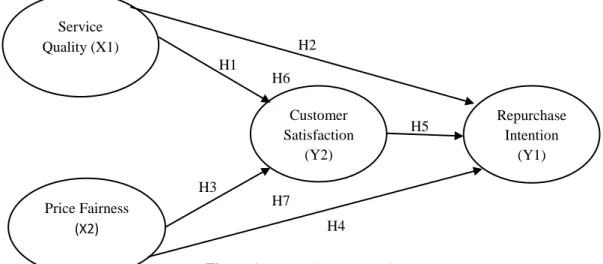
Service Quality (X1) Price Fairness (X2) Customer Satisfaction (Y2) Repurchase Intention (Y1) H1 H3 H5 H2 H4 H7 H6the information collected through the voice of PT. Cahaya Putra Jaya Bali. The pre-survey results state that there are some customers who experience poor service quality and get high prices, which makes customers reluctant to reuse these services. This survey was conducted randomly from 20 customers of PT. Cahaya Putra Jaya Bali. There are 15% of customers experiencing poor service quality from both employees and drivers. The remaining 45% said the quality of service is good and 40% of the quality of service standards. For the reasonableness of high prices there are 25%, low prices of 10% and standard prices of 65%. Based on the survey results, customers who experience poor service quality and high prices experience fraud committed by the company. The customer said that the diesel given by the company to the customer did not match the order but the price to be paid was in accordance with the customer's order. This certainly makes customers feel uncomfortable about cheating by the company. This research was conducted because there are different results between service quality on customer satisfaction and repurchase interest. The results of research conducted by [10] state that there was a significant influence between service quality variables on customer satisfaction and repurchase interest and a significant influence between customer satisfaction variables on repurchase interest. In contrast to the results of [11] states that service quality has a negative and not significant effect on repurchase interest. The results of research from [12] who examined the effect of fairness on prices on consumer satisfaction. The results of this study indicate that the price reasonableness does not affect customer satisfaction, where price is not the main element in determining customer satisfaction. Unlike the case with [13], which states that the prices fairness has a positive and significant effect on customer satisfaction. According to [14] states that the prices fairness has a positive and significant effect on purchase intentions. Reference [15] found the result that the dominant factor that influenced repurchase interest was customer satisfaction. Based on the explanation of the phenomenon that occurs it is stated that the problem of this research was carried out at PT. Cahaya Putra Jaya Bali. This consideration is expected to be able to assist companies in maintaining or increasing customers. In addition, this concept is carried out to assist companies in creating customer satisfaction by providing quality services and reasonable prices. The satisfaction felt by the customer will certainly affect the consumer's interest to buy back the product.
2.Hypothesis Formulation
51
Figure 1. Research Framework
Based on the research framework in Figure 1. the hypothesis can be formulated as follows.
H1: Service quality has a significant positive effect on customer satisfaction.
H2: Service quality has a significant positive effect on repurchase intentions.
H3: Price fairness has a significant positive effect on customer satisfaction.
H4: Price fairness has a significant positive effect on repurchase intention.
H5: Customer satisfaction has a significant positive effect on repurchase intentions.
H6: Customer satisfaction can mediate the effect of service quality on repurchase intentions
H7: Customer satisfaction can mediate the effect of price fairness on repurchase intentions
3.Research Methods
This research used quantitative data types that are analyzed associatively. This research was conducted at PT. Cahaya Putra Jaya Bali. The subjects in this study are customers who buy diesel at PT. Cahaya Putra Jaya Bali. The object of this research is to measure the effect of service quality and fairness of prices on repurchase intentions mediated by customer satisfaction.
The population in this study is all customers of PT. Cahaya Putra Jaya Bali, which uses this service more than twice the use, which amounted to 54 in 2017. Saturated sample is a sampling technique if all populations are sampled [16]. The sample in this study is the entire population of 54 companies or individuals. The data analysis technique used in this study is to use path analysis [17].
Path analysis can be done using the SPSS (Statistical Package for Social Science) program [18].
4.Results and Discussion
Respondents with an age range of 35 to 43 years had the largest number of 13 respondents or 24.1 percent. The most sex is male with 45 respondents or 83.3 percent.
52
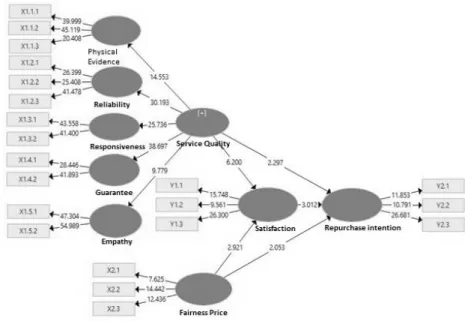
Figure 1: Output Result
The significance of the estimated parameters provides very useful information about the relationship between the research variables. The basis used in testing hypotheses is the value contained in the output result for inner weight. Table 1. provides estimated outputs for testing structural models.
Table 1: Result for Inner Weight
Variables Original Sample (O) Sample Mean (M) Standard Deviation (STDEV) T Statistics (|O/STDEV|) P Values Satisfaction Repurchase Intention 0,517 0,516 0,172 3,012 0,003 Price Fairness Satisfaction 0,328 0,337 0,112 2,921 0,004 Price Fairness Repurchase Intention 0,167 0,171 0,081 2,053 0,041 Service Quality Satisfaction 0,633 0,627 0,102 6,200 0,000 Service Quality Repurchase Intention 0,265 0,265 0,115 2,297 0,022
53
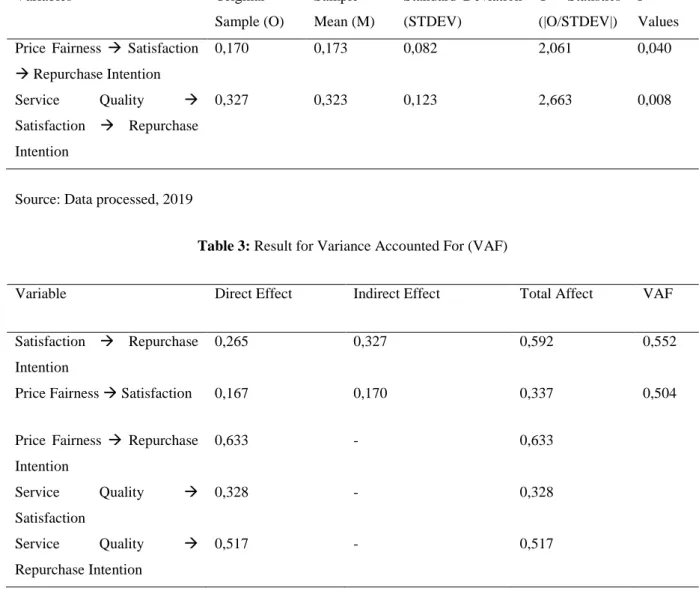
Table 2: Result for Indirect Effect
Variables Original Sample (O) Sample Mean (M) Standard Deviation (STDEV) T Statistics (|O/STDEV|) P Values Price Fairness Satisfaction
Repurchase Intention 0,170 0,173 0,082 2,061 0,040 Service Quality Satisfaction Repurchase Intention 0,327 0,323 0,123 2,663 0,008
Source: Data processed, 2019
Table 3: Result for Variance Accounted For (VAF)
Variable Direct Effect Indirect Effect Total Affect VAF
Satisfaction Repurchase Intention
0,265 0,327 0,592 0,552
Price Fairness Satisfaction 0,167 0,170 0,337 0,504
Price Fairness Repurchase Intention 0,633 - 0,633 Service Quality Satisfaction 0,328 - 0,328 Service Quality Repurchase Intention 0,517 - 0,517
Source: Data processed, 2019
Variance Accounted For or VAF is a measure of how much the mediating variable is able to absorb the direct influence that was previously significant from the non-mediating model. If the VAF value is above 80%, then it can be declared as full mediation, and if it is between 20% and 80%, it can be categorized as partial mediation, but if the VAF is less than 20%, it can be concluded that there is almost no mediating effect. Based on the results from Table 3. The VAF is obtained for testing satisfaction as a mediating relationship between service quality and repurchase intention and the reasonableness of the price between repurchase interest is between 20% to 80%, ie 0.552 or 55.2% and 0.504 or 50.4% so can be categorized as mediating partially. Based on the results of the PLS analysis, this section will discuss the results of the calculations that have been made. This study aims to determine the effect of service quality and prices fairness on customer satisfaction and customer repurchase intention of PT. Cahaya Putra Jaya Bali. Testing is shown through existing hypotheses so that they can find out how the influence of each variable on the other variables.
54
The results of data analysis show that service quality has a positive and significant effect on customer satisfaction. This means that the better the quality of services provided to customers, customer satisfaction will increase. Consumer satisfaction is closely related to the quality of service that is valued or considered good by consumers. It means, the quality of service can be used as a tool in increasing customer satisfaction. Customer satisfaction is the evaluation process by customers used services provided by the company in accordance with customer expectations and the reality received by the customer. Reference [19,20] stated that service quality has a significant positive effect on customer satisfaction, so it can be concluded that the higher the quality of service, the higher the customer satisfaction. Another study conducted by [21] also stated that service quality has a positive effect on customer satisfaction, the positive effect indicates the higher service quality received by respondents, it will lead to high customer satisfaction. Likewise, research conducted by [11,22] states that service quality is proven to have a significant and positive influence on customer satisfaction. This means that in the study mentioned if service quality is improved, customer satisfaction also increases.
4.2.The effect of service quality on repurchase intention
The results of data analysis show that service quality has a positive and significant effect on repurchase intentions. This means that the better the quality of services provided to customers, the repurchase intention will increase. Reference [1,15] show that service quality variables contribute positive and significant influences the repurchase intention variable. Other research conducted by [23] also states that service quality has a positive effect on repurchase interest. Quality service provided by the company will certainly affect consumer behavior. This behavior is judged by the satisfaction felt by the customers. If consumers are satisfied, then the consumer's intention to buy back will be even higher. The statement was also supported by research conducted by [15] stating that service quality variables significantly and positively affected buying interest. The same study was also conducted by [10] who stated that there was a significant influence between service quality on repurchase interest. It can be concluded that from previous studies to improve repurchase intentions by customers, companies must improve the quality of services provided by the company so that consumers will feel satisfied with the services provided.
4.3.The effect of price fairness on customer satisfaction
The results of data analysis show that the price fairness has a positive and significant effect on customer satisfaction. This means that the more reasonable the price given to the customer, the customer satisfaction will increase. Prices often affect customer perceptions of product quality. Price can define as a measure in the buyer's memory where the product is the basis of valuation by comparing the actual price. The pricing decision is very important to determine how far a product or service is valued by customers because in the process of image building, pricing also gives certain perceptions of quality [13]. Reference [24] states that prices can affect customer satisfaction. Price differs according to type and function. Reference [2,25] found that there is a positive relationship between the fairness of prices and customer satisfaction. The same thing was done by [21] stating that price influences repurchase intention. The price offered to the customer can also affect the customer's interest to repurchase the product.
55
4.4.The effect of price fairness on repurchase intention
The results of data analysis show that the price fairness has a positive and significant effect on repurchase intentions. It means that the more fairness of the price given to the customer, the intention to repurchase will increase. According to [15], fair price given by the company is in accordance with customer expectations and in accordance with the prices contained in the market. Costumers have a high perception about prices in purchasing products. Based on these results it can be concluded that the variable price can affect consumer repurchase interest. Reference [26] found that price reasonableness has a significant direct impact on purchase intentions. Consumer perceptions about fairness price are positive, related to consumer purchase intentions. Consumers consider price considerations to be sensitive in purchasing decisions. If the price offered is considered reasonable and in accordance with the quality of the product, then consumers will have a positive attitude towards purchase intentions. This refers to a study conducted by [14] which states that the fairness variable of prices has a positive and significant effect on consumer purchase intentions. The same research was also conducted by [21] states that price influences repurchase intention. But it is different with [27] which shows that price does not significantly influence consumer buying interest.
4.5.The effect of customer satisfaction on repurchase intention
The results of data analysis show that customer satisfaction has a positive and significant effect on repurchase intentions. This means that the more customers are satisfied with the services provided, the intention to repurchase will increase. Reference [13] states that with customer satisfaction, customers will have an interest in reusing services from the same provider. According to [13] to measure customer satisfaction variables, there is the most dominant thing that is performance perception. Perception of performance from the customer perspective certainly can not be separated from customer experience of the use of services in the past and obtain services in accordance with their expectations so that to build positive customer perceptions need to be considered services that focus on customer satisfaction for services consumed. The higher the customer satisfaction, the higher the repurchase interest, so that customer satisfaction positively influences the repurchase intention [20]. Research conducted by [28,29] revealed that the variable customer satisfaction directly affected the repurchase intention. According to [20] states that customer satisfaction variables have a significant influence on repurchase interest.
4.6.The role of customer satisfaction in mediating the effect of service quality on repurchase intention
The results of data analysis show that customer satisfaction mediates the effect of service quality on repurchase intentions. This means that the better the quality of services provided to customers and supported by the satisfaction felt by these customers, the intention to repurchase will increase. The results of research conducted by [20] prove that service quality is the most dominant factor in increasing customer satisfaction, which in turn will indirectly increase repurchase interest. However, research [23] states that service quality can indirectly influence repurchase interest through customer satisfaction. Different according to [30] states that customer satisfaction is able to be a connecting variable between service quality and repurchase interest, so the higher the customer's perception of service quality, the greater the customer satisfaction which will ultimately increase
56
repurchase interest. Reference [15] state that the dominant factor affecting customer satisfaction is service quality and the dominant factor influencing repurchase interest is customer satisfaction. This means that customer satisfaction as a mediating variable is proven to be a mediating variable and has a significant influence. Based on this, so that service quality has an influence on repurchase interest mediated by customer satisfaction.
4.7.The role of customer satisfaction in mediating the effect of prices fairness on repurchase intention
The results of the data analysis show that customer satisfaction mediates the effect of price fairness on repurchase intentions. This means that the more fairness of prices are given to customers and supported by the satisfaction felt by these customers, the intention to repurchase will increase. Reference [5] states that the price felt by the customer influences buying interest which then influences consumer satisfaction. Reference [31] also states that price influences consumer satisfaction which can then influence consumer repurchase intentions. However, it is different with research conducted by [32] which shows that price has a negative effect on consumer repurchase intention, this occurs in his research because separation has not been able to meet the desires of consumers so that there is a perceived consumer dissatisfaction.
5.Conclusion and Recommendation
Based on the results of the research discussion, it can be concluded that service quality has a positive and significant effect on customer satisfaction. Service quality has a positive and significant effect on repurchase intentions. This means that the better the quality of services provided to customers, the repurchase intention will increase. Fairness of price has a positive and significant effect on customer satisfaction. This means that the more fairness of price given to the customer, the customer satisfaction will increase. Fairness of price has a positive and significant effect on repurchase intention. This means that the more reasonable the price given to the customer, the intention to repurchase will increase. Customer satisfaction has a positive and significant effect on repurchase intentions. This means that the more customers feel satisfied with the services provided, the repurchase intention will increase. Customer satisfaction mediates the effect of service quality on repurchase intentions. This means that the better the quality of services provided to customers and supported by the satisfaction felt by these customers, the repurchase intention will increase. Customer satisfaction mediates the effect of fairness on the price of repurchase intention. This means that the more fairness of prices are given to customers and supported by the satisfaction felt by these customers, the intention to repurchase will increase. For further research, it is expected to add other variables that might influence repurchase intentions such as company image and word of mouth. Future studies can make comparisons between repurchase intentions of similar products in two different companies or on different demographics.
References
[1] S. Murwanti and A. P. P., “Pengaruh Kualitas Pelayanan Dan Promosi Terhadap Minat Beli Ulang Jasa Service Motor Dengan Kepuasan Pelanggan Sebagai Variabel Mediasi (Studi Pada Bengkel Motor Ahass Cabang UMS),” in Seminar Nasional Riset Manajemen & Bisnis, 2017, pp. 207–227.
57
[2] L.-T. Bei and Y.-C. Chiao., “An Integrated Model For The Effects Of Perceived Product, Perceived Service Quality, And Perceived Price Fairness On Consumer Satisfaction And Loyalty,” J. Consum. Satisf. Dissatisfaction Complain. Behav., vol. 14, pp. 125–141, 2001.
[3] D. Consuegra, A. Molina, and A. Esteban, “An Integrated Model Of Price, Satisfaction and Loayalty : an Empirical Analysis in Service Sector,” J. Prod. Brand Manag., vol. 16, no. 7, p. 459–468., 2007. [4] P. Adhistian, “Analisis Faktor-Faktor Yang Berpengaruh Terhadap Minat Beli Ulang Pelanggan Kartu
Prabayar Mentari Di Surabaya,” Diponegoro University, 2011.
[5] S. Raharso, “Faktor-Faktor Yang Mempengaruhi Kepuasan Dan Kesetiaan Wisatawan,” J. Bisnis Strateg., 2005.
[6] R. Lupiyoadi, Manajemen Pemasaran Jasa : Berbasis Kompetensi Edisi 3. Jakarta: Salemba Empat.
[7] W. Gusnandar, H., dan Untoro, “Pengaruh Service Quality dan Customer Value Terhadap Repurchase Intention dengan Kepuasan Pelanggan Sebagai Variabel Pemediasi,” Fokus Manajerial, vol. 14, no. 2, pp. 127–134, 2016.
[8] G. Bressolles and F. Durrieu, “Service Quality, Customer Value And Satisfaction Relationship Revisited For Online Wine Websites.,” in 6th AWBR International Conference, BeM – Bordeaux Management School – France, 2011, pp. 1–13.
[9] R. M. Dananjaya, “Analisis Faktor-Faktor Yang Mempengaruhi Minat Beli Ulang Pelanggan Maskapai Batavia Air Di Bandara Ahmad Yani Semarang,” Diponegoro University, 2012.
[10] B. Saidani and S. Arifin, “Pengaruh Kualitas Produk Dan Kualitas Layanan Terhadap Kepuasan Konsumen Dan Minat Beli Pada Ranch Market,” J. Ris. Manaj. Sains Indones., vol. 3, no. 1, pp. 1–22, 2012.
[11] B. Ramadhan, A., G., dan Santosa, S., “Analisis Pengaruh Kualitas Produk, Kualitas Pelayanan, dan Citra Merek terhadap Minat Beli Ulang pada Sepatu Nike Running di Semarang melalui Kepuasan Pelanggan sebagai Variabel Intervening,” Diponegoro J. Manag., vol. 6, no. 1, pp. 1–12, 2017.
[12] N. P. C. D. Atmaja and I. K. Rahyuda, “Pengaruh Kewajaran Harga, Citra Perusahaan Terhadap Kepuasan Dan Loyalitas Pengguna Penerbangan Domestik GIA Di Denpasar,” Ekuitas, vol. 15, no. 3, pp. 370–395, 2011.
[13] A. Ruth, I. P. G. Sukaatmadja, and C. K.N, “Pengaruh Kualitas Layanan, Produk, dan Kewajaran Harga terhadap Kepuasan dan Loyalitas Pelanggan pada LnC SKIN CARE Singaraja,” Choice Rev. Online, vol. 2, no. 1, pp. 22–29, 2013.
58
Kewajaran Harga Terhadap Niat Beli Konsumen Wanita Pada Online Shop Produk Pakaian,” E-JurnalManajemen Univ. Udayana, vol. 3, no. 4, pp. 938–955, 2014.
[15] D. Resti and H. Soesanto, “Pengaruh Persepsi Harga, Kualitas Pelayanan Melalui Kepuasan Pelanggan Terhadap Minat Beli Ulang Pada Rumah Kecantikan Sifra Di Pati,” J. Manag. Diponegoro, vol. 5, no. 1, pp. 1–12, 2016.
[16] K. Rahyuda, Metode Penelitian Bisnis. Denpasar: Udayana University Press, 2016.
[17] Sugiyono, Metode Penelitian Bisnis (Pendekatan Kuantitatif, Kualitatif, dan R&D). Bandung: Alfabeta, 2016.
[18] B. A. Nugroho, Strategi Jitu Memilih Metode Statistik Penelitian dengan SPSS, no. 1707532110. Yogyakarta: Andi, 2005.
[19] B. H. Mulyono, “Analisis Pengaruh Kualitas Produk Dan Kualitas Layanan Terhadap Kepuasan Konsumen (Studi Kasus Pada Perumahan Puri Mediterania Semarang),” J. Stud. Manaj. Organ., vol. 4, no. 2, pp. 91–100, 2007.
[20] D. Puspitasari, “Analisis Pengaruh Persepsr Kualitas Dan Kepuasan Pelanggan Terhadap Minat Beli Ulang (Studi Kasus pada Maskapai Penerbangan Garuda Keberangkatan Semarang).,” Universitas Diponegoro, 2006.
[21] I. Kurniawan, S. B. Santoso, and B. M. Dwiyanto, “Analisis Faktor-Faktor Yang Mempengaruhi Minat Beli Ulang Produk Serta Dampaknya Terhadap Loyalitas Pelanggan (Studi Kasus Pada Produk Sakatonik Liver Di Kota Semarang).,” J. Stud. Manaj. Organ., vol. 4, no. 2, pp. 20–29, 2007.
[22] S. W. Putro, “Pengaruh Kualitas Layanan dan Kualitas Produk Terhadap Kepuasan Pelanggan dan Loyalitas Kosnumen Restoran Happy Garden Surabaya,” J. Manaj. Pemasar., vol. 2, no. 1, pp. 1–9, 2014.
[23] R. Maulana, “Pengaruh Kualitas Produk Dan Kualitas Pelayanan Terhadap Kepuasan Konsumen Untuk Mendorong Minat Beli Ulang Di Gerai (Studi pada Pengguna Smartphone Samsung di Yogyakarta).,” Universitas Muhammadiyah Yogyakarta, 2017.
[24] A. Hermann, K. B. M. Lan Xia, and F. Huber, “The Influence Of Price Fairness On Customer Satisfaction: An Empirical Test In The Contect Of Automobile Purchases.,” J. Prod. Brand Manag., vol. 16, no. 1, pp. 49–58, 2007.
[25] A. Martin-Consuegra, D., Molina, A. and Esteban, “An Integrated Model of Price, Satisfaction, and Loyalty: An Empirical Analysis in the Service Sector,” J. Prod. Brand Manag., vol. 16, no. 7, p. 459– 468., 2007.
59
[26] B. Dai, “The Impact of Perceived Price Fairness of Dynamic Pricing on Customer Satisfaction and Behavioral Intentions: The Moderating Role of Customer Loyalty,” Auburn University, 2010.
[27] I. P. G. I. T. Jaya, M. Wardana, and N. W. S. Suprapti, “Pengaruh Pemasaran Internal Terhadap Orientasi Pasar (Studi Pada Bank Persero di Denpasar),” E-Jurnal Ekon. dan Bisnis Univ. Udayana, vol. 3, no. 12, p. 738–760., 2014.
[28] S. D. Thamrin, “Studi Mengenai Proses Adopsi Konsumen Pasca Masa Tayang Iklan Produk Xon-Ce di Surabaya.,” J. Sains Pemasar. Indones., vol. 2, no. 1, pp. 141–154, 2003.
[29] W. N. P. Sutrisno and Nurhidayati, “Model Minat Membeli Ulang: Suatu Pengujian Paska Masa Tayang Iklan (Studi Kasus pada Produk Deterjen Rinso di Semarang),” KKOBIS, vol. 7, no. 2, pp. 271–291, 2006.
[30] A. D. Putri, “Faktor-Faktor Yang Mempengaruhi Kepuasan Konsumen Serta Dampaknya Terhadap Minat Beli Ulang Konsumen (Studi Pada Blends Pasta & Chocolate Cabang Unika Semarang),” J. Manage., vol. 6, no. 2, pp. 1–10, 2017.
[31] P. Jiang and B. Rosenbloom, “Customer Intention to Return Online: Price Perception, Attribute Level Performance, and Satisfaction Unfolding Over Time,” Eur. J. Mark., vol. 39, no. 1, pp. 150–174, 2005. [32] M. A. Palma, “Pengaruh Kualitas Produk, Kemudahan, Dan Harga Terhadap Niat Beli Ulang Dengan
Kepuasan Sebagai Variabel Intervening (Studi Pada Pelanggan Produk Fashion Melalui Toko online di Surabaya),” J. Ris. Ekon. dan Manaj., vol. 16, no. 1, pp. 84–104, 2016.