Exploring physics beyond the
Standard Electroweak Model in
the light of supersymmetry
Thesis Submitted to
The University of Calcutta
for The Degree of
Doctor of Philosophy (Science)
By
Pradipta Ghosh
Department of Theoretical Physics
Indian Association for the Cultivation of Science
2A & 2B, Raja S.C.Mullick Road, Jadavpur
Kolkata - 700 032, India
A
bstract
Weak scale supersymmetry has perhaps become the most popular choice for explaining new physics beyond the standard model. An extension beyond the standard model was essential to explain issues like gauge-hierarchy problem or non-vanishing neutrino mass. With the initiation of the large hadron collider era at CERN, discovery of weak-scale supersymmetric particles and, of course, Higgs boson are envisaged. In this thesis we try to discuss certain phenomenological aspects of an Rp-violating non-minimal
supersymmetric model, called µνSSM. We show that µνSSM can provide a solution to the µ-problem of supersymmetry and can simultaneously accommodate the existing three flavour global data from neutrino experiments even at the tree level with the simple choice of flavour diagonal neutrino Yukawa couplings. We show that it is also possible to achieve different mass hierarchies for light neutrinos at the tree level itself. InµνSSM, the effect ofR-parity violation together with a seesaw mechanism with TeV scale right-handed neutrinos are instrumental for light neutrino mass generation. We also analyze the stability of tree level neutrino masses and mixing with the inclusion of one-loop radiative corrections. In addition, we investigate the sensitivity of the one-loop corrections to different light neutrino mass orderings. Decays of the lightest supersymmetric particle were also computed and ratio of certain decay branching ratios was observed to correlate with certain neutrino mixing angle. We extend our analysis for different natures of the lightest supersymmetric particle as well as with various light neutrino mass hierarchies. We present estimation for the length of associated displaced vertices for various natures of the lightest supersymmetric particle which can act as a discriminating feature at a collider experiment. We also present an unconventional signal of Higgs boson in supersymmetry which can lead to a discovery, even at the initial stage of the large hadron collider running. Besides, we show that a signal of this kind can also act as a probe to the seesaw scale. Certain other phenomenological issues have also been addressed.
To a teacher who is like the pole star to me and many others
Dr. Ranjan Ray
A
cknowledgment
I am grateful to the Council of Scientific and Industrial Research, Government of India for providing me the financial assistance for the completion of my thesis work (Award No. 09/080(0539)/2007-EMR-I (Date 12.03.2007)). I am also thankful to my home institute for a junior research fellowship that I had enjoyed from August, 2006 to January, 2007.
I have no words to express my gratitude to the members of theoretical high energy physics group of the Department of Theoretical Physics of my home institute, particu-larly Dr. Utpal Chattopadhyay and Dr. Sourov Roy. Their gratuitous infinite patience for my academic and personal problems, unconditional affection to me, heart-rending analysis of my performance, cordial pray for my success, spontaneous and constant motivations for facing new challenges were beyond the conventional teacher-student relation. I am also grateful to Dr. Dilip Kumar Ghosh, Dr. Pushan Majumdar, Dr. Koushik Ray, Prof. Siddhartha Sen and Prof. Soumitra SenGupta of the same group for their encouragement, spontaneous affection, crucial guidance and of course criti-cism, in academics and life beyond it. It is also my pleasure to thank Dr. Shudhanshu Sekhar Mandal and Dr. Krishnendu Sengupta of the condensed matter group. It is an honour for me to express my respect to Prof. Jayanta Kumar Bhattacharjee not only for his marvelous teaching, but also for explaining me a different meaning of academics. I sincerely acknowledge the hard efforts and sincere commitments of my collabora-tors Dr. Priyotosh Bandopadhyay and Dr. Paramita Dey to the research projects. I am thankful to them for their level of tolerance to my infinite curiosity in spite of their extreme busy schedules. I learned several new techniques and some rare insights of the subjects from them. In the course of scientific collaboration I have been privileged to work with Prof. Biswarup Mukhopadhyaya, who never allowed me to realize the two decades of age difference between us. Apart from his precious scientific guidance (I was also fortunate enough to attend his teaching), his affection and inspiration for me has earned an eternal mark in my memory just like his signature smile.
the very basic level till date. It was their kind and hard efforts which help me to reach here. I am especially grateful to Ms. Anuradha SenSarma and Mr. Malay Ghosh for their enthusiastic efforts and selfless sacrifices during my school days. I have no words to express my respect to Prof. Anirban Kundu and Prof. Amitava Raychaudhuri for their precious guidance and unconventional teaching during my post-graduate studies. I am really fortunate enough to receive their affection and guidance till date. In this connection I express my modest gratitude to some of the renowned experts of the community for their valuable advise and encouragement. They were always very generous to answer even some of my stupid questions, in spite of their extremely busy professional schedules. I am particularly grateful to Dr. Satyaki Bhattacharya, Prof. Debajyoti Choudhury, Dr. Anindya Datta, Dr. Aseshkrishna Datta, Dr. Manas Maity, Prof. Bruce Mellado, Dr. Sujoy Poddar, Dr. Subhendu Rakshit and Prof. Sreerup Raychaudhuri for many useful suggestions and very helpful discussions.
I also express my humble thanks to my home institute, Indian Association for the Cultivation of Science, for providing all the facilities like high-performance personal desktop, constant and affluent access to high-speed internet, a homely atmosphere and definitely a world class library. I am also thankful to all the non-teaching staff members of my department (Mr. Subrata Balti, Mr. Bikash Darji, Mr. Bhudeb Ghosh, Mr. Tapan Moulik and Mr. Suresh Mondal) who were always there to assist us. It is my honour to thank the Director of my home institute, Prof. Kankan Bhattacharyya for the encouragement I received from him.
It is a pleasure to express my thanks to my colleagues and friends who were always there to cheer me up when things were not so smooth either in academics or in per-sonal life. My cordial and special thanks to Dr. Naba Kumar Bera, Dr. Debottam Das, Sudipto Paul Chowdhury, Dwipesh Majumder and Joydip Mitra who were not just my colleagues but were, are and always will be my brothers. I am really thankful to them and also to Dr. Shyamal Biswas, Amit Chakraborty, Dr. Dipanjan Chakrabarti, Manimala Chakraborty, Sabyasachi Chakraborty, Anirban Datta, Ashmita Das, Sanjib Ghosh, Dr. R. S. Hundi, Dr. Ratna Koley, Dr. Debaprasad Maity, Sourav Mondal, Subhadeep Mondal, Sanhita Modak, Shreyoshi Mondal, Dr. Soumya Prasad Mukher-jee, Sutirtha MukherMukher-jee, Tapan Naskar, Dr. Himadri Sekhar Samanta, Kush Saha, Ipsita Saha and Ankur Sensharma for making my office my second home.
It is definitely the worst injustice to acknowledge the support of my family as without them I believe it is just like getting lost in crowd.
I cannot resist myself to show my humble tribute to three personalities, who by the philosophy of their lives and works have influenced diverse aspects of my life. The scientist who was born long before his time, Richard P. Feynman, the writer who
showed that field of expertise is not really a constraint, Narayan Sanyal and my old friend, Mark.
L
ist of Publications
In refereed journals.
• Radiative contribution to neutrino masses and mixing in µνSSM
P. Ghosh, P. Dey, B. Mukhopadhyaya and S. Roy
J. High Energy Phys. 05 (2010) 087.
• Neutrino masses and mixing, lightest neutralino decays and a
solution to the µproblem in supersymmetry
P. Ghosh and S. Roy
J. High Energy Phys. 04 (2009) 069.
Preprints.
• An unusual signal of Higgs boson in supersymmetry at the LHC
P. Bandyopadhyay, P. Ghosh and S. Roy
arXiv:1012.5762 [hep-ph] [communicated].
In proceedings.
• Neutrino masses and mixing in µνSSM
P. Ghosh
M
otivation and plan of the thesis
The standard model of the particle physics is extremely successful in explaining the elementary particle interactions, as has been firmly established by a host of experi-ments. However, unfortunately there exist certain issues where the standard model is an apparent failure, like unnatural fine tuning associated with the mass of the hith-erto unseen Higgs boson or explaining massive neutrinos, as confirmed by neutrino oscillation experiments. A collective approach to address these shortcomings requires extension beyond the standard model framework. The weak scale supersymmetry has been a very favourite choice to explain physics beyond the standard model where by virtue of the construction, the mass of Higgs boson is apparently free from fine-tuning problem. On the other hand, violation of a discrete symmetry called R-parity is an intrinsically supersymmetric way of accommodating massive neutrinos. But, in spite of all these successes supersymmetric theories are also not free from drawbacks and that results in a wide variety of models. Besides, not a single supersymmetric particle has been experimentally discovered yet. Nevertheless, possibility of discovering weak scale supersymmetric particles as well as Higgs boson are highly envisaged with the initiation of the large hadron collider experiment at CERN.
In this thesis we plan to study a few phenomenological aspects of a particular variant of R-parity violating supersymmetric model, popularly known as the µνSSM. This model offers a solution for theµ-problem of the minimal supersymmetric standard model and simultaneously accommodate massive neutrinos with the use of a common set of right-handed neutrino superfields. Initially, we aimed to accommodate massive neutrinos in this model consistent with the three flavour global neutrino data with tree level analysis for different schemes of light neutrino masses. Besides, as the lightest supersymmetric particle is unstable due to R-parity violation, we also tried to explore the possible correlations between light neutrino mixing angles with the branching ratios of the decay modes of the lightest supersymmetric particle (which is usually the lightest neutralino for an appreciable region of the parameter space) as a possible check of this model in a collider experiment. Later on we looked forward to re-investigate the tree level analysis with the inclusion of one-loop radiative corrections. We were also keen
to study the sensitivity of our one-loop corrected results to the light neutrino mass hierarchy. Finally, we proposed an unconventional background free signal for Higgs boson in µνSSM which can concurrently act as a probe to the seesaw scale. A signal of this kind not only can lead to an early discovery, but also act as an unique collider signature of µνSSM.
This thesis is organized as follows, we start with a brief introduction of the stan-dard model in chapter 1, discuss the very basics of mathematical formulations and address the apparent successes and shortcomings. We start our discussion in chapter 2 by studying how the quadratic divergences in the standard model Higgs boson mass can be handled in a supersymmetric theory. We also discuss the relevant mathemati-cal formulations, address the successes and drawbacks of the minimal supersymmetric standard model with special attentions on the µ-problem and the R-parity. A small discussion on the next-to-minimal supersymmetric standard model has also been ad-dressed. We devote chapter 3 for neutrinos. The issues of neutrino mass generation both in supersymmetric and non-supersymmetric models have been addressed for tree level as well as for one-loop level analysis. Besides, implications of neutrino physics in a collider analysis has been discussed. Light neutrino masses and mixing in µνSSM both for tree level and one-loop level analysis are given in chapter 4. The µνSSM model has been discussed more extensively in this chapter. We present the results of correlation study between the neutrino mixing angles and the branching ratios of the decay modes of the lightest neutralino in µνSSM in chapter 5. Our results are given for different natures of the lightest neutralino with different hierarchies in light neutrino masses. Finally, in chapter 6 we present an unusual background free signal for Higgs boson in
µνSSM, which can lead to early discovery. We list our conclusions in chapter 7. Vari-ous technical details, like different mass matrices, couplings, matrix element squares of the three-body decays of the lightest supersymmetric particle, Feynman diagrams etc. are relegated to the appendices.
Contents
1 The Standard Model and beyond... 1
1.1 The Standard Model . . . 1
1.2 Apparent successes and the dark sides . . . 9
2 Supersymmetry 18 2.1 Waking up to the idea . . . 18
2.2 Basics of supersymmetry algebra . . . 20
2.3 Constructing a supersymmetric Lagrangian . . . 22
2.4 SUSY breaking . . . 26
2.5 Minimal Supersymmetric Standard Model . . . 29
2.6 The R-parity . . . 35
2.7 Successes of supersymmetry . . . 39
2.8 The µ-problem . . . 41
2.9 Next-to-Minimal Supersymmetric Standard Model . . . 42
3 Neutrinos 58 3.1 Neutrinos in the Standard Model . . . 58
3.2 Neutrino oscillation . . . 59
3.3 Models of neutrino mass . . . 67
3.3.1 Mass models I . . . 68
3.3.2 Mass models II . . . 72
3.4 Testing neutrino oscillation at Collider . . . 83
4 µνSSM: neutrino masses and mixing 103 4.1 IntroducingµνSSM . . . 103
4.2 The model . . . 104
4.3 Scalar sector of µνSSM . . . 108
4.4 Fermions in µνSSM . . . 111
4.5.1 Neutrino masses at the tree level . . . 117
4.5.2 Neutrino mixing at the tree level . . . 119
4.6 Neutrinos at the loop level . . . 123
4.7 Analysis of neutrino masses and mixing at one-loop . . . 125
4.8 One-loop corrections and mass hierarchies . . . 130
4.8.1 Normal hierarchy . . . 132 4.8.2 Inverted hierarchy . . . 137 4.8.3 Quasi-degenerate spectra . . . 139 4.9 Summary . . . 140 5 µνSSM: decay of the LSP 153 5.1 A decaying LSP . . . 153 5.2 Different LSP scenarios inµνSSM . . . 154
5.3 Decays of the lightest neutralino inµνSSM . . . 155
5.4 Light neutrino mixing and the neutralino decay . . . 158
5.4.1 Bino dominated lightest neutralino . . . 160
5.4.2 Higgsino dominated lightest neutralino . . . 163
5.4.3 Right-handed neutrino dominated lightest neutralino . . . 165
6 µνSSM: Unusual signal of Higgs boson at LHC 174 6.1 Higgs boson in µνSSM . . . 174
6.2 The Signal . . . 175
6.3 Collider analysis and detection . . . 178
6.4 Correlations with neutrino mixing angles . . . 182
6.5 Invariant mass . . . 182
7 Summary and Conclusion 186 A 192 A.1 Scalar mass squared matrices in MSSM . . . 192
A.2 Fermionic mass matrices in MSSM . . . 193
B 194 B.1 Scalar mass squared matrices in µνSSM . . . 194
B.2 Quark mass matrices inµνSSM . . . 199
C 200 C.1 Details of expansion matrixξ . . . 200
C.3 See-saw masses with n generations . . . 203 D 204 D.1 Feynman rules . . . 204 E 209 E.1 TheΣeV ij function . . . 209 E.2 TheΠeV ij function . . . 210 F 211 F.1 TheB0, B1 functions . . . 211 G 212
G.1 Feynman diagrams for the tree levelχe0
1 decay . . . 212
H 214
H.1 Feynman rules . . . 214 H.2 Squared matrix elements for h0 →χe0
iχe0j, b¯b . . . 216
I 218
I.1 Three body decays of the χe0
1 LSP . . . 218 I.2 Process χe0 1 →qqν¯ . . . 218 I.3 Process χe0 1 →ℓ+i ℓ−jνk . . . 224 I.4 Process χe0 1 →νiνjνk . . . 235 I.5 Process χe0 1 →u¯idjℓ+k . . . 236 I.6 Process χe0 1 →uid¯jℓ−k . . . 241
Chapter 1
T
he Standard Model and beyond...
1.1
T
he Standard Model
The quest for explaining diverse physical phenomena with a single “supreme” theory is perhaps deeply embedded in the human mind. The journey was started long ago with Michael Faraday and later with James Clerk Maxwell with the unification of the electric and the magnetic forces as the electromagnetic force. The inspiring successful past has finally led us to the Standard Model (SM) (see reviews [1, 2] and [3–6]) of elementary Particle Physics. In the SM three of the four fundamental interactions, namely electromagnetic, weak and strong interactions are framed together. The first stride towards the SM was taken by Sheldon Glashow [7] by unifying the theories of electromagnetic and weak interactions as the electroweak theory. Finally, with pioneer-ing contributions fromSteven Weinberg[8] andAbdus Salam[9] and including the third fundamental interaction of nature, namely the strong interaction the Standard Model of particle physics emerged in its modern form. Ever since, the SM has successfully explained host of experimental results and precisely predicted a wide variety of phe-nomena. Over time and through many experiments by many physicists, the Standard Model has become established as a well-tested physics theory.
z The quarks and leptons
The SM contains elementary particles which are the basic ingredients of all the matter surrounding us. These particles are divided into two broad classes, namely, quarks and leptons. These particles are called fermionssince they are spin 12 particles. Each group of quarks and leptons consists of six members, which are “paired up” or appear in generations. The lightest and most stable particles make up the first generation, whereas the heavier and less stable particles belong to the second and third generations. The six quarks are paired in the three generations, namely the ‘up
quark (u)’ and the ‘down quark (d)’ form the first generation, followed by the second generation containing the ‘charm quark (c)’ and ‘strange quark (s)’, and finally the ‘top quark (t)’ and ‘bottom quark (b)’ of the third generation. The leptons are similarly arranged in three generations, namely the ‘electron (e)’ and the ‘electron-neutrino (νe)’,
the ‘muon (µ)’ and the ‘muon-neutrino (νµ)’, and the ‘tau (τ)’ and the ‘tau-neutrino
(ντ)’.
z There are gauge bosons too
Apart from the quarks and leptons the SM also contains different types of spin-1 bosons, responsible for mediation of the electromagnetic, weak and the strong inter-action. These force mediators essentially emerge as a natural consequence of the the-oretical fabrication of the SM, which relies on the principle of local gauge invariance with the gauge group SU(3)C×SU(2)L×U(1)Y. The force mediator gauge bosons are
n2
−1 in number for an SU(n) group and belong to the adjoint representation of the group.
The group SU(3)C is associated with the colour symmetry in the quark sector and
under this group one obtains the so-called colour triplets. Each quark (q) can carry a colour charge under the SU(3)C group1 (very similar to electric charges under U(1)em
symmetry). Each quark carries one of the three fundamental colours (3representation), namely, red (R), green (G) and blue (B). In a similar fashion an anti-quark (¯q) has the complementary colours (¯3representation), cyan (R), magenta (G) and yellow (B). The accompanying eight force mediators are known as gluons (Gaµ). The gluons belong
to the adjoint representation of SU(3)C. However, all of the hadrons (bound states
of quarks) are colour singlet. Three weak bosons (Wµa) are the force mediators for
SU(2)L group, under which left-chiral quark and lepton fields transform as doublets.
The remaining gauge group U(1)Y provides hypercharge quantum number (Y) to all
the SM particles and the corresponding gauge boson is denoted by Bµ. In describing
different gauge bosons the index ‘µ’ (= 1, ..,4) has been used to denote Lorentz index. The index ‘a’ appears for the non-Abelian gauge groups2 and they take values 1, ..,8
for SU(3)C and 1,2,3 for SU(2)L.
Different transformations for the SM fermions and gauge bosons under the gauge group SU(3)C×SU(2)L×U(1)Y are shown below3
1The colour quantum number was introduced for quarks [10] to save the
Fermistatistics. These
are some hypothetical charges having no connection with the real life colour of light.
2
Yang and Mills [11].
3We choose
Q= T3+Y2, whereQis the electric charge, T3 is the third component of the weak
isospin (±1
LiL = νℓi ℓi ! L ∼(1,2,−1), ℓiR ∼(1,1,−2), QiL = ui di ! L ∼(3,2,1 3), uiR ∼(3,1, 4 3), diR ∼(3,1,− 2 3), Gaµ ∼(8,0,0), Wµa∼(1,3,0), Bµ∼(1,1,0), (1.1)
where ℓi =e, µ, τ, ui =u, c, t and di =d, s, b. The singlet representation is given by 1.
z Massive particles in the SM ?
Principle of gauge invariance demands for massless gauge bosons which act as the force mediators. In addition, all of the SM fermions (quarks and leptons) are sup-posed to be exactly massless, as a consequence of the gauge invariance. But these are in clear contradiction to observational facts. In reality one encounters with mas-sive fermions. Also, the short range nature of the weak interaction indicates towards some massive mediators. This apparent contradiction between gauge invariance and massive gauge boson was resolved by the celebrated method of spontaneous breaking
of gauge symmetry [12–16]. The initial SM gauge group after spontaneous symmetry
breaking (SSB) reduces to SU(3)C ×U(1)em, leaving the colour and electric charges
to be conserved in nature. Consequently, the corresponding gauge bosons, gluons and photon, respectively remain massless ensuing gauge invariance, whereas the weak force mediators (W± and Z bosons) become massive. Symbolically,
SU(3)C ×SU(2)L×U(1)Y SSB−−−→ SU(3)C ×U(1)em. (1.2)
Since SU(3)C is unbroken in nature, all the particles existing freely in nature are forced
to be colour neutral. In a similar fashion unbroken U(1)em implies that any charged
particles having free existence in nature must have their charges as integral multiple of that of a electron or its antiparticle. It is interesting to note that quarks have fractional charges but they are not free in nature since SU(3)C is unbroken.
Spontaneous symmetry breaking
Let us consider a HamiltonianH0 which is invariant under some symmetry
trans-formation. If this symmetry of H0 is not realized by the particle spectrum, the
symmetry is spontaneously broken. A more illustrative example is shown in fig-ure 1.1. Here the minima of the potential lie on a circle (white dashed) rather than being a specific point. Each of these points are equally eligible for being the
minimum and whenever the red ball chooses a specific minimum, the symmetry of the ground state (the state of minimum energy) is spontaneously broken. In other words, when the symmetry of H0 is not respected by the ground state,
the symmetry is spontaneously broken. It turns out that the degeneracy in the ground state is essential for spontaneous symmetry breaking.
Figure 1.1: Spontaneous breaking of symmetry through the choice of a specific degen-erate ground state.
Everything seems to work fine with the massive gauge bosons. But the demon lies within the method of spontaneous symmetry breaking itself. The spontaneous breakdownof acontinuous symmetryimplies the existence ofmassless, spinless particles as suggested by Goldstone theorem.4 They are known as Nambu-Goldstone or simply Goldstonebosons. So the SSB apart from generating gauge boson masses also produces massless scalars which are not yet experimentally detected. This is the crisis point when the celebrated “Higgs-mechanism”5 resolves the crisis situation. The unwanted
massless scalars are now eaten up by the gauge boson fields and they turn out to be the badly needed longitudinal polarization mode for the “massive” gauge bosons. So this is essentially the reappearance of three degrees of freedom associated with three massless scalars in the form of three longitudinal polarization modes for the massive gauge bosons. This entire mechanism happens without breaking the gauge invariance of the theory explicitly. This mechanism for generating gauge boson masses is also consistent with the renormalizability of a theory with massive gauge bosons.6 The
fermion masses also emerge as a consequence of Higgs mechanism.
z Higgs sector of the SM and mass generation
4Initially by Nambu [17], Nambu and Jona-Lasino. [18, 19]. General proof by Goldstone [20, 21]. 5The actual name should read as Brout-Englert-Higgs-Guralnik-Hagen-Kibble mechanism after all
the contributors. Brout and Englert [13], Higgs [14, 15], Guralnik, Hagen and Kibble [16].
6
So the only scalar (spin-0) in the SM is the Higgs boson. Higgs mechanism is incorporated in the SM through a complex scalar doublet Φ with the following trans-formation properties under the SM gauge group.
Φ = φ
+
φ0
!
∼(1,2,1). (1.3)
The potential for Φ is written as
V(Φ) =µ2Φ†Φ +λ(Φ†Φ)2, (1.4)
with µ2 < 0 and λ > 0 (so that the potential is bounded from below). Only a
colour and charge (electric) neutral component can acquire a vacuum expectation value (VEV), since even after SSB the theory remains invariant under SU(3)C × U(1)em (see eqn.(1.2)). Now with a suitable choice of gauge (“unitary gauge”), so that the Goldstone bosons disappear one ends up with
Φ = √1 2 0 v+h0 ! , (1.5)
where h0 is the physical Higgs field and ‘v’ is the VEV for Re(φ0) (all other fields
acquire zero VEVs) with v2 =−µ2
λ. At this moment it is apparent that eqn.(1.2) can
be recasted as
SU(2)L×U(1)Y SSB−−−→ U(1)em, (1.6)
which is essentially the breaking of the electroweak symmetry since the SU(3)C sector remains unaffected. Thus the phenomena of SSB in the context of the SM is iden-tical with the electroweak symmetry breaking (EWSB). The weak bosons, Wa
µ and
U(1)Y gauge bosonBµ now mix together and finally yield three massive vector bosons
(W±
µ, Zµ0) and one massless photon (A0µ):
Wµ± = W 1 µ ∓iWµ2 √ 2 , Zµ0 = cosθWW3µ−sinθWBµ, A0µ= sinθWW3µ+ cosθWBµ, (1.7)
where θW is the Weinberg angle or weak mixing angle.7 In terms of the SU(2)L and
U(1)Y gauge couplings (g2, g1) one can write
g2 sinθW =g1 cosθW. (1.8)
7At present sin2
The W±
µ, Zµ0 boson masses are given by
MW = g2v 2 , MZ = v 2 q g2 1 +g22, (1.9) with v2 = −µ2
λ . The mass of physical Higgs boson (h
0) is given bym2
h0 = 2v2λ. Note
that mh0 >0 since µ2 < 0. Interestingly, ratio of the quantities M2
W and MZ2 cos2θW
is equal to one at the tree level (see eqns. (1.8) and (1.9)). This ratio is defined as the
ρ-parameter, which is an important parameter for electroweak precision test:
ρ= M 2 W M2 Zcos2θW = 1. (1.10)
There exists an alternative realization of the ρ-parameter. The ρ-parameter specifies the relative strength of the neutral current (mediated throughZ-bosons) to the charged current (mediated through W±-boson) weak interactions.
For the purpose of fermion mass generation consider the Lagrangian containing interactions between Higgs field and matter fermions.
−LYukawa=yℓiLiΦei+ydiQiΦdi+yuiQiΦ˜ui+ Hermitian conjugate, (1.11)
where yℓi,ui,di are the Yukawa couplings for the charged leptons, up-type quarks and
down-type quarks, respectively. The SU(2)Ldoublet and singlet quark and lepton fields
are shown in eqn.(1.1). The field ˜Φ is used to generate masses for the up-type quarks and it is given by ˜ Φ = −iσ2Φ∗ =i 0 −i i 0 ! φ− φ0∗ ! = −φ 0∗ φ− ! . (1.12)
The fermion masses and their interactions with Higgs field emerge after the EWSB using eqn.(1.11). For example considering the electron these terms are as follows
LelectronYukawa =−
ye(v+h0)
√
2 (eLeR+eReL), (1.13)
where eL =PLLe (see eqn.(1.1)).
So with four component spinore as eL
eR
!
, eqn.(1.13) can be rewritten as
Lelectron
Yukawa =−meee−
me
v eeh
0, (1.14)
withme= Y√e2v as mass of the electron. The particle spectrum of the SM can be written
Particle mass in GeV Spin Electric Charge Colour charge electron (e) 5.109×10⁻⁴ 1 2 -1 0 muon (µ) 0.105 1 2 -1 0 tau (τ) 1.776 1 2 -1 0 neutrinos (νe,µ,τ) 0 12 0 0 up-quark (u) 2.49×10⁻³ 1 2 2 3 yes down-quark (d) 5.05×10⁻³ 1 2 − 1 3 yes charm-quark (c) 1.27 1 2 2 3 yes strange-quark (s) 0.101 1 2 − 1 3 yes top-quark (t) 172.0 1 2 2 3 yes bottom-quark (b) 4.19 1 2 − 1 3 yes W-boson (W±) 80.399 1 ±1 0 Z-boson (Z0) 91.187 1 0 0 photon (γ) 0 1 0 0 gluon (g) 0 1 0 yes Higgs (h0 ) ? 0 0 0
Table 1.1: The particle spectrum of the SM [24]. Each of the charged particles are accompanied by charge conjugate states of equal mass. The charge neutral particles act as their own antiparticles with all charge like quantum numbers as opposite to that of the corresponding particles. Evidence for Higgs boson is yet experimentally missing and thus Higgs mass is denoted as ‘?’. The neutrinos are presented with zero masses since we are considering the SM only (see section 1.2).
z SM interactions
Based on the discussion above, the complete Lagrangian for the SM can be written as
LSM =L1+L2+L3+L4, (1.15)
where
1. L1 is the part of the Lagrangian which contains kinetic energy terms and
self-interaction terms for the gauge bosons. After the EWSB these gauge bosons are known as W±, Z0, gluons and photon. So we have
L1 = 4 X µ,ν=1 " −14 8 X a=1 GaµνGµνa − 1 4 3 X i=1 Wµνi Wiµν− 1 4BµνB µν # , (1.16)
where
Ga
µν =∂µGaν −∂νGµa−g3fabcGbµGcν,
Wµνi =∂µWνi−∂νWµi −g2ǫijkWµjWνk,
Bµν =∂µBν −∂νBµ, (1.17)
withfabcandǫijkas the structure constants of the respective non-Abelian groups.
g3 is the coupling constant for SU(3)C group.
2. Kinetic energy terms for quarks and leptons belong to L2. This part of the
Lagrangian also contains the interaction terms between the elementary fermions and gauge bosons. Symbolically,
L2 =iχLDχ6 L+iχRDχ6 R, (1.18)
whereD6 =γµD
µwithDµas the covariant derivative.8 The quantityχLstands for
lepton and quark SU(2)L doublets whereas χR denotes SU(2)L singlet fields (see
eqn.(1.1)). The covariant derivative Dµ for different fermion fields are written as
(using eqn.(1.1)) DµQi = " ∂µ+ig1 1 6Bµ+i 3 X i=1 g2 1 2σi.W i µ # Qi, Dµui = ∂µ+ig1 2 3Bµ ui, Dµdi = ∂µ−ig1 1 3Bµ di, DµLi = " ∂µ−ig1 1 2Bµ+i 3 X i=1 g2 1 2σi.W i µ # Li, Dµei = [∂µ−ig1Bµ]ei. (1.19) But these are the information for SU(2)L ×U(1)Y only. What happens to the
SU(3)C part? Obviously, for the leptons there will be no problem since they are
SU(3)C singlet after all (see eqn.(1.1)). For the quarks the SU(3)C part can be
taken care of in the following fashion,
Dµ qiR qiG qiB = " ∂µ+i 8 X a=1 g3 1 2λa.G a µ # qiR qiG qiB , (1.20)
8Replacement of ordinary derivative (
∂µ) byDµ is essential for a gauge transformation, so that Dµψtransforms covariantly under gauge transformation, similar to the matter field,ψ.
where R, G and B are the three types of colour charge and λa’s are eight
Gell-Mann matrices. qi is triplet under SU(3)C, where ‘i’ stands for different types
of left handed or right handed (under SU(2)L) quark flavours, namelyu, d, c, s, t
and b.
3. The terms representing physical Higgs mass and Higgs self-interactions along with interaction terms between Higgs and the gauge bosons are inhoused in L3
L3 = (DµΦ)†(DµΦ)−V(Φ). (1.21)
The expressions for Φ and V(Φ) are given in eqns.(1.3) and (1.4), respectively. For Φ the covariant derivative Dµ is given by
DµΦ = " ∂µ+ig1 1 2Bµ+i 3 X i=1 g2 1 2σi.W i µ # Φ. (1.22)
4. The remaining Lagrangian L4 contains lepton and quark mass terms and their
interaction terms with Higgs field (h0) (after EWSB). The expression for L 4 is
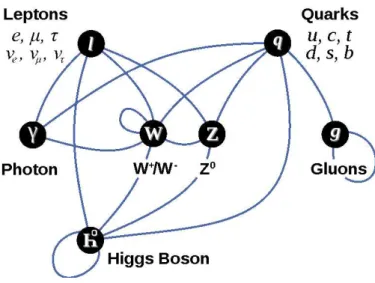
shown in eqn.(1.11). The elementary fermions get their masses through respective Yukawa couplings, which are free parameters of the theory. It turns out that in the SM the flavour states are not necessarily the mass eigenstates, and it is possible to relate them through an unitary transformation. In case of the quarks this matrix is known as the CKM (Cabibbo-Kobayashi-Maskawa) [25,26] matrix. This 3 × 3 unitary matrix contains three mixing angles and one phase. The massless neutrinos in the SM make the corresponding leptonic mixing matrix a trivial one (Identity matrix). All possible interactions of the SM are shown in figure 1.2. The loops represent self-interactions like h0h0h0, h0h0h0h0 (from
the choice of potential, see eqn. (1.4)) W±W±W∓W∓,ggg orgggg(due to
non-Abelian interactions) and also interactions likeW±W∓ZZ,W±W∓γγ,W±W∓Z,
W±W∓γ etc.
1.2
A
pparent successes and the dark sides
The SM is an extremely successful theory to explain a host of elementary particle interactions. Masses of the W± and Z bosons as predicted by the SM theory are very
close to their experimentally measured values. The SM also predicted the existence of the charm quark from the requirement to suppress flavour changing neutral current (FCNC)9 before it was actually discovered in 1974. In a similar fashion the SM also
Figure 1.2: Interactions of the Standard Model. See text for more details. predicted the mass of the heavy top quark in the right region before its discovery. Besides, all of the SM particles except Higgs boson have been discovered already and their masses are also measured very precisely [24]. Indeed, apart from Higgs sector, rest of the SM has been already analysed for higher order processes and their spectacular accuracy as revealed by a host of experiments has firmly established the success of the SM.
Unfortunately, the so-called glorious success of the SM suffers serious threat from various theoretical and experimental perspective. One of the main stumbling blocks is definitely the Higgs boson, yet to be observed in an experiment and its mass. Some of these shortcomings are listed below.
1. The SM has a large number of free parameters (19). The parameters are 9
Yukawa couplings (or elementary fermion masses) + 3 angles and one phase of CKM matrix +3gauge couplingsg1, g2, g310+2parameters (µ, λ) from scalar
po-tential (see eqn.(1.4)) +onevacuum angle for quantum chromodynamics (QCD). The number of free parameters is rather large for a fundamental theory.
2. There are no theoretical explanation why there exist only three generations of quarks and leptons. Also the huge mass hierarchy between different generations (from first to third), that is to say why mass of the top quark (mt) ≫ mass of
the up-quark (mu) (see table 1.1), is unexplained.
3. The single phase of CKM matrix accounts for many Charge-Parity (CP) violating processes. However, one needs additional source of CP-violation to account for
10An alternate set could be
the large matter-anti matter asymmetry of the universe.
4. The most familiar force in our everyday lives, gravity, is not a part of the SM. Since the effect of gravity dominates near the “Planck Scale (MP)”, (∼ 1019
GeV) the SM still works fine despite its reluctant exclusion of the gravitational interaction. In conclusion, the Standard Model cannot be a theory which is valid for all energy scales.
5. There is no room for a cold Dark Matter candidate inside the SM framework, which has been firmly established by now from the observed astrophysical and cosmological evidences.
6. Neutrinos are exactly massless in the Standard Model as a consequence of the par-ticle content, gauge invariance, renormalizability and Lorentz invariance. How-ever, the experimental results from atmospheric, solar and reactor neutrino ex-periments suggest that the neutrinos do have non-zero masses with non-trivial mixing among different neutrino flavours [28, 29]. In order to generate masses and mixing for the neutrinos, one must extend the SM framework by introducing additional symmetries or particles or both.
But in reality the consequence of a massive neutrino is far serious than asking for an extension of the SM. As written earlier, the massive neutrinos trigger a non-trivial mixing in the charged lepton sector just like the CKM matrix11, but
with large off-diagonal entries. It remains to explain why the structure of the mixing matrix for the leptons are so different from the quarks?
7. Perhaps the severe most of all the drawbacks is associated with Higgs boson mass. In the Standard Model, Higgs boson mass is totally unprotected by any symmetry argument. In other words putting mh0 = 0, does not enhance any symmetry of
the theory.12 Higgs mass can be as large as the “Grand Unified Theory (GUT)”
scale (1016GeV) or the “Planck Scale” (1019GeV) when radiative corrections are
included. This is the so called gauge hierarchy problem. However, from several theoretical arguments [30–47] and various experimental searches [24,48,49] Higgs boson mass is expected to be in the range of a few hundreds of GeV, which requires unnatural fine tuning of parameters (∼ one part in 1038) for all orders
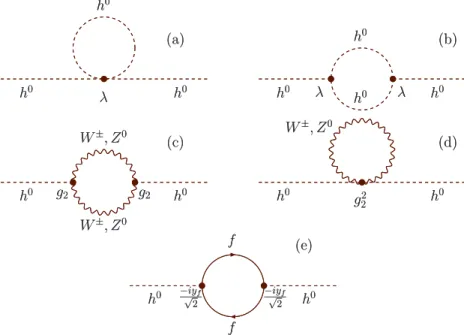
in perturbation theory. Different one-loop diagrams contributing to the radiative correction to Higgs boson mass are shown in figure 1.3.
11Known as the PMNS matrix, will be addressed in chapter 3 in more details.
12Note that putting zero for fermion or gauge boson mass however enhances the symmetry of the
h0 h0 λ h0 (a) h0 h0 g22 W±, Z0 (d) h0 g2 g2 h0 W±, Z0 W±, Z0 (c) h0 λ λ h0 h0 h0 (b) h0 −√iyf h0 2 −√iyf 2 f f (e) h0 h0 λ h0 (a) h0 h0 g22 W±, Z0 (d) h0 g2 g2 h0 W±, Z0 W±, Z0 (c) h0 λ λ h0 h0 h0 (b) h0 −√iyf h0 2 −√iyf 2 f f (e)
Figure 1.3: One-loop radiative corrections to the Higgs boson mass from (a) and (b) self-interactions (c) and (d) interactions with gauge bosons and (e) interactions with fermions (f).
It is clear from figure 1.3, the contribution from the fermion loop is proportional to the squared Yukawa couplings (y2
f). As a corollary these contributions are
negligible except when heavy quarks are running in the loop. Contributions from the diagrams (b) and (c) are logarithmically divergent which is well under control due to the behaviour of log function. The contributions from diagrams (a), (d) and (e) arequadratically divergent, which are the sources of the hierarchy problem.
Loop correction and divergences
Consider the diagram (e) of figure 1.3, which represents the fermionic loop contribution to the scalar two point function. Assuming the loop momentum to be ‘k’ and the momentum for the external leg to be ‘p’ this contribution can be written as
Πfh0h0(p2 = 0) = (−1) Z d4k (2π)4( −iyf √ 2 ) 2Tr i 6 k−mf i 6 k−mf , = (−y 2 f 2 ) Z d4k (2π)4Tr " (k6 +mf)(k6 +mf) (k2−m2 f)2 # , = (−2yf2) Z d4k (2π)4 " (k2+m2 f) (k2−m2 f)2 # , = −2yf2 Z d4k (2π)4 " 1 (k2 −m2 f) + 2m 2 f (k2−m2 f)2 # , (1.23) where the (−1) factor appears for closed fermion loop and ‘i’ comes from the Feynmanrules (see eqn.(1.11)). Fermion propagator is written asi/(k6 −mf).
Here some of the properties of Dirac Gamma matrices have been used. Now in eqn.(1.23) Higgs mass appears nowhere which justifies the fact that setting mh0 = 0 does not increase any symmetry of the Lagrangian. From
naive power counting argument the second term of eqn.(1.23) is logarithmi-cally divergent whereas the first term is quadratilogarithmi-cally divergent. Suppose the theory of the SM is valid upto Planck scale and the cut off scale Λ (scale upto which a certain theory is valid) lies there, then the correction to the Higgs boson mass goes as (using eqn.(1.23)),
δm2h0 ≈ −
y2
f
8π2Λ
2+ logarithmic terms. (1.24)
The renormalized Higgs mass squared is then given by ˜
m2h0 =m2h0,bare+δm2h0, (1.25)
and looking at eqn.(1.24) the requirement of fine tuning for a TeV scale Higgs mass is apparent. Note that mass generation for all of the SM particles solely depend on Higgs. So in a sense the entire mass spectrum of the SM will be driven towards a high scale with the radiative correction in Higgs boson mass.
The list of drawbacks keep on increasing with issues like unification of gauge cou-plings at a high scale and a few more. To summarize, all of these unanswered ques-tions have opened up an entire new area of physics, popularly known as “Beyond the
Standard Model (BSM)” physics. Some of the well-known candidates are supersymme-try13 [50–54], theories with extra spatial dimensions [55–57] and many others. In this
proposed thesis we plan to study some of the problems mentioned earlier in the context of a supersymmetric theory and look for signatures of such a theory at the ongoing Large Hadron Collider (LHC) experiment.
13
Bibliography
[1] Abers E S and Lee B W 1973 Phys. Rept. 9 1–141
[2] Beg M A B and Sirlin A 1982Phys. Rept. 881
[3] Halzen F and Martin A D ISBN-9780471887416
[4] Cheng T P and Li L F Oxford, Uk: Clarendon ( 1984) 536 P. ( Oxford Science Publications)
[5] Griffiths D J New York, USA: Wiley (1987) 392p
[6] Burgess C P and Moore G D Cambridge, UK: Cambridge Univ. Pr. (2007) 542 p
[7] Glashow S L 1961 Nucl. Phys.22 579–588
[8] Weinberg S 1967 Phys. Rev. Lett. 19 1264–1266
[9] Salam A Originally printed in *Svartholm: Elementary Particle Theory, Pro-ceedings Of The Nobel Symposium Held 1968 At Lerum, Sweden*, Stockholm 1968, 367-377
[10] Greenberg O W 1964 Phys. Rev. Lett. 13 598–602
[11] Yang C N and Mills R L 1954 Phys. Rev.96 191–195
[12] Anderson P W 1958Phys. Rev. 112 1900–1916
[13] Englert F and Brout R 1964 Phys. Rev. Lett. 13 321–322
[14] Higgs P W 1964 Phys. Lett. 12 132–133
[15] Higgs P W 1964 Phys. Rev. Lett. 13 508–509
[17] Nambu Y 1960 Phys. Rev.117 648–663
[18] Nambu Y and Jona-Lasinio G 1961Phys. Rev. 122 345–358
[19] Nambu Y and Jona-Lasinio G 1961Phys. Rev. 124 246–254
[20] Goldstone J 1961 Nuovo Cim.19 154–164
[21] Goldstone J, Salam A and Weinberg S 1962 Phys. Rev.127 965–970
[22] ’t Hooft G 1971 Nucl. Phys.B35167–188
[23] ’t Hooft G and Veltman M J G 1972 Nucl. Phys.B44189–213
[24] Nakamura K et al. (Particle Data Group) 2010 J. Phys. G37 075021
[25] Cabibbo N 1963 Phys. Rev. Lett. 10 531–533
[26] Kobayashi M and Maskawa T 1973Prog. Theor. Phys. 49 652–657
[27] Glashow S L, Iliopoulos J and Maiani L 1970Phys. Rev. D21285–1292
[28] Schwetz T, Tortola M A and Valle J W F 2008New J. Phys. 10 113011
[29] Gonzalez-Garcia M C, Maltoni M and Salvado J 2010 JHEP 04 056
[30] Cornwall J M, Levin D N and Tiktopoulos G 1973Phys. Rev. Lett.301268–1270
[31] Cornwall J M, Levin D N and Tiktopoulos G 1974 Phys. Rev. D101145
[32] Llewellyn Smith C H 1973 Phys. Lett. B46233–236
[33] Lee B W, Quigg C and Thacker H B 1977 Phys. Rev. D161519
[34] Dashen R F and Neuberger H 1983 Phys. Rev. Lett. 50 1897
[35] Lindner M 1986 Zeit. Phys.C31 295
[36] Stevenson P M 1985 Phys. Rev.D32 1389–1408
[37] Hasenfratz P and Nager J 1988 Z. Phys. C37 477
[38] Luscher M and Weisz P 1987 Nucl. Phys. B29025
[39] Hasenfratz A, Jansen K, Lang C B, Neuhaus T and Yoneyama H 1987 Phys.
[40] Luscher M and Weisz P 1988 Nucl. Phys. B29565
[41] Kuti J, Lin L and Shen Y 1988Phys. Rev. Lett. 61 678
[42] Sher M 1989 Phys. Rept. 179 273–418
[43] Lindner M, Sher M and Zaglauer H W 1989 Phys. Lett. B228 139
[44] Callaway D J E 1988 Phys. Rept. 167 241
[45] Ford C, Jones D R T, Stephenson P W and Einhorn M B 1993Nucl. Phys.B395
17–34
[46] Sher M 1993 Phys. Lett. B317 159–163
[47] Choudhury S R and Mamta 1997 Int. J. Mod. Phys. A12 1847–1859
[48] Abbiendi G et al. (OPAL) 1999 Eur. Phys. J. C7 407–435
[49] Barate R et al.(LEP Working Group for Higgs boson searches) 2003Phys. Lett.
B565 61–75
[50] Gervais J L and Sakita B 1971 Nucl. Phys.B34632–639
[51] Golfand Y A and Likhtman E P 1971 JETP Lett. 13 323–326
[52] Volkov D V and Akulov V P 1973Phys. Lett. B46109–110
[53] Wess J and Zumino B 1974 Nucl. Phys.B70 39–50
[54] Wess J and Zumino B 1974 Phys. Lett. B49 52
[55] Arkani-Hamed N, Dimopoulos S and Dvali G R 1998 Phys. Lett. B429 263–272
[56] Arkani-Hamed N, Dimopoulos S and Dvali G R 1999 Phys. Rev.D59 086004
Chapter 2
S
upersymmetry
2.1
W
aking up to the idea
The effect of radiative correction drives the “natural” Higgs mass, and therefore the entire SM particle spectra to some ultimate cutoff of the theory, namely, the Planck scale. A solution to this hierarchy problem could be that, either the Higgs boson is some sort of composite particle rather than being a fundamental particle or the SM is an effective theory valid upto a certain energy scale so that the cutoff scale to the theory lies far below the Planck scale. It is also a viable alternative that there exists no Higgs boson at all and we need some alternative mechanism to generate masses for the SM particles1. However, it is also possible that even in the presence of quadratic
divergences the Higgs boson mass can be in the range of a few hundreds of GeV to a TeV provided different sources of radiative corrections cancel the quadratic divergent pieces. It is indeed possible to cancel the total one-loop quadratic divergences (shown in chapter 1, section 1.2) by explicitly canceling contributions between bosonic and fermionic loop with some postulated relation between their masses. However, this cancellation is not motivated by any symmetry argument and thus a rather accidental cancellation of this kind fails for higher order loops.
Driven by this simple argument let us assume that there are two additional complex scalar fields feL and feR corresponding to a fermion f which couples to field Φ (see
eqn.(1.3)) in the following manner
Lfef he0 = fλf|Φ|2(|feL|2+|feR|2), EW SB −−−−−→ 1 2λffh 02 (|feL|2+|feR|2) +vfλfh0(|feL|2+|feR|2) +.., (2.1)
where h0 is the physical Higgs field (see eqn.(1.5)). A Lagrangian of the form of
eqn.(2.1) will yield additional one-loop contributions to Higgs mass. Note that in order to get a potential bounded from below, fλf <0. The additional contributions to
h0 λe h0 f e fL(R) (a) h0 vλef vλef h0 e fL(R) e fL(R) (b) h0 λe h0 f e fL(R) (a) h0 vλef vλef h0 e fL(R) e fL(R) (b)
Figure 2.1: New diagrams contributing to Higgs mass correction from LagrangianLfef he0
(eqn.(2.1)).
the two point function for Higgs mass via the loops (figure 2.1) can be written as
Πfhe0h0(p 2 = 0) = −fλf Z d4k (2π)4 1 k2−m2 e fL + 1 k2−m2 e fR ! + (vfλf)2 Z d4k (2π)4 1 (k2−m2 e fL) 2 + 1 (k2−m2 e fR) 2 ! . (2.2)
Eqn.(2.2) contains two types of divergences, (a) the first line which is quadratically divergent and (b) second line, which is logarithmically divergent. Following similar procedure to that of deriving eqn.(1.24), one can see that the total two point func-tion Πfhe0h0(p2 = 0) + Π
f
h0h0(p2 = 0) (see eqn.(1.23)) is completely free from quadratic
divergences, provided
e
λf =−y2f. (2.3)
It is extremely important to note that eqn.(2.3) is independent of mass of f,feL and e
fR, namely mf, mfeL and mfeR respectively. The remaining part of Π
e
f
h0h0(p2 = 0)
+ Πfh0h0(p2 = 0), containing logarithmic divergences can be explicitly written as (using
eqn.(2.3) and dropping p2)
Πfhe0h0(0) + Π f h0h0(0) = iy2 f 16π2 −2m2f(1−lnm 2 f µ2 R ) + 4m2flnm 2 f µ2 R + iy 2 f 16π2 " +2m2fe(1−lnm 2 e f µ2 R )−4m2felnm 2 e f µ2 R # , (2.4) with mfe
L = mfeR = mfe. µR is the scale of renormalization. If further one considers
mfe = mf then from eqn.(2.4), Π
e
f
h0h0(0) + Π f
functions via the loop vanishes! This theory is absolutely free from hierarchy problem. However, in order to achieve a theory free from quadratic divergences, such cancellation between fermionic and bosonic contributions must persists for all higher orders also. This is indeed a unavoidable feature of a theory, if there exists a symmetry relating fermion and boson masses and couplings2.
2.2
B
asics of supersymmetry algebra
A symmetry which transforms a fermionic state into a bosonic one is known as super-symmetry (SUSY) [1–23] (also see references of [17]). The generator (Q) of SUSY thus satisfies
Q|Bosoni=|F ermioni, Q|F ermioni=|Bosoni. (2.5)
In eqn.(2.5) spin of the left and right hand side differs byhalf-integralnumber and thus
Q must be a spinorial object in nature and hence follows anti-commutation relation. Corresponding Hermitian conjugate (Q) is also another viable generator since spinors are complex objects. It is absolutely important to study the space-time property of
Q, because they change the spin (and hence statistics also) of a particle and spin is related to the behaviour under spatial rotations.
Let us think about an unitary operator U, representing a rotation by 360◦ about
some axis in configuration space, then
UQ|Bosoni=UQU−1U|Bosoni=U|F ermioni,
UQ|F ermioni=UQU−1U|F ermioni=U|Bosoni. (2.6)
However, under a rotation by 360◦ (see ref. [24])
U|Bosoni=|Bosoni, U|F ermioni=−|F ermioni. (2.7)
Combining eqns.(2.6), (2.7) one ends up with
UQU−1 =−Q, ⇛{Q,U}= 0. (2.8)
Extending this analysis for any Lorentz transformations it is possible to show that Q
does not commute with the generators of Lorentz transformation. On the contrary, under space-time translation,
Pµ|Bosoni=|Bosoni, Pµ|F ermioni=|F ermioni. (2.9)
2The hint of such a symmetry is evident from
Eqns.(2.9) and (2.5) together imply that Q (also ¯Q) is invariant under space-time translations. that is
[Q, Pµ] = [ ¯Q, Pµ] = 0. (2.10)
It is obvious from eqns.(2.8) and (2.10), that supersymmetry is indeed a space-time symmetry. In fact now the largest possible space-time symmetry is no longerPoincar´e symmetry but the supersymmetry itself with larger number of generators,3 Mµν (Lorentz
transformation⇛spatial rotations and boosts), Pµ(Poincar´e transformation⇛
trans-lations) and Q,Q¯ (SUSY transformations). It has been argued earlier that the SUSY generatorsQ,Q¯areanti-commutingrather than being commutative. So what is{Q,Q¯}? SinceQ,Q¯ are spinorial in nature, then expression for{Q,Q¯}must be bosonic in nature and definitely has to be another symmetry generator of the larger group. In general, one can expect that{Q,Q¯}should be a combination ofPµ andMµν (with appropriate
index contraction), However, after a brief calculation one gets
{Q,Q¯} ∝Pµ. (2.11)
Eqn.(2.11) is the basic of the SUSY algebra which contains generators of the SUSY transformations (Q,Q¯) on the left hand side and generator for space-time translations,
Pµ on the other side. This suggests that successive operation of two finite SUSY
transformations will induce a space-time translation on the states under operation. The quantity {Q,Q¯} is a Hermitian operator with positive definite eigenvalue, that is h...|{Q,Q¯}|...i=|Q|...i|2+|Q¯|...i|2≥ 0. (2.12) Summing over all the SUSY generators and using eqns.(2.11) and (2.12) one gets
X Q
{Q,Q¯} ∝P0, (2.13)
where P0 is the total energy of the system or the eigenvalue of the Hamiltonian, thus
Hamiltonian of supersymmetric theory contains no negative eigenvalues.
If|0idenotes the vacuum or the lowest energy state of any supersymmetric theory then following eqns.(2.12) and (2.13) one obtains P0|0i = 0. This is again true if Q|0i= 0 and ¯Q|0i= 0 for all Q,Q¯. This implies that any one-particle state with non-zero energy cannot be invariant under SUSY transformations. So there must be one or more supersymmetric partners (superpartners) Q|1i or ¯Q|1i for every one-particle state |1i. Spin of superpartner state differs by 12 unit from that of |1i. The state |1i together with its superpartner state said to form asupermultiplet. In a supermultiplet
3This statement is consistent with the statement of
Coleman-Mandula theorem [25] and
different states are connected in between through one or more SUSY transformations. Inside a supermultiplet the number of fermionic degrees of freedom (nF) must be equal
to that for bosonic one (nB). A supermultiplet must contain at least one boson and one
fermion state. This simple most supermultiplet is known as the chiral supermultiplet which contains a Weyl spinor (two degrees of freedom) and one complex scalar (two degrees of freedom). It is important to note that the translational invariance of SUSY generators (see eqn.(2.10)) imply All states in a supermultiplet must have same mass4.
It must be emphasized here that throughout the calculation indices for Q and ¯Q have been suppressed. In reality Q≡Qi
a where ‘i= 1,2, ...N’ is the number of supercharges
and ‘a’ is the spinor index. To be specific one should explicitly write (for i = 1),
Qα,Q¯α˙, where α,α˙ are spinorial indices belonging to two different representations of
the Lorentz group. We stick to i= 1 for this thesis. Details of SUSY algebra is given in refs. [27, 28].
2.3
C
onstructing a supersymmetric Lagrangian
Consider a supersymmetric Lagrangian with a single Weyl fermion, ψ (contains two helicity states,⇛ nF = 2) and a complex scalar,φ(⇛nB = 2) without any interaction
terms. This two component Weyl spinor and the associated complex scalar are said to form a chiral supermultiplet. The free Lagrangian, which contains only kinetic terms is written as
Lsusy=−∂µφ∗∂µφ+iψ†σµ∂µψ, (2.14)
where σµ =1,−σi. Eqn.(2.14) represents a massless, non-interacting supersymmetric
model known as Wess-Zumino model [5]. The action Ssusy(=R d4xLsusy) is invariant
under the set of transformations, given as
δφ=ǫαψα ≡ǫψ, ⇛δφ∗ =ǫ†ψ†,
δψα =−i(σµǫ†)α∂φ, ⇛δψα†˙ =i(ǫσµ)α˙∂φ∗, (2.15)
where ǫα parametrizes infinitesimal SUSY transformation. It is clear from eqn.(2.15),
on the basis of dimensional argument that ǫα must be spinorial object and hence
anti-commuting in nature. They have mass dimension [M]−1
2. It is important to note that
∂µǫα = 0 for global SUSY transformation. 4It is interesting to note that supercharge
Qsatisfies [Q, P2] = 0 but [ Q, W2] 6 = 0, where Wµ(= 1 2ǫ µνρσM
νρPσ) is thePauli-Lubanskivector. Note that eigenvalue ofW2∝s(s+ 1) wheresis spin of
a particle. Thus in general members of a supermultiplet should have same mass but different spins, which is the virtue of supersymmetry.
z Is supersymmetry algebra closed?
It has already been stated that Ssusy is invariant under SUSY transformations
(eqn.(2.15)). But does it also indicate that the SUSY algebra is closed? In other words, is it true that two successive SUSY transformations (parametrized by ǫ1, ǫ2) is
indeed another symmetry of the theory? In reality one finds
[δǫ2, δǫ1]X = −i(ǫ1σµǫ†2−ǫ2σµǫ†1)∂µX, (2.16)
where X = φ, ψα, which means that commutator of two successive supersymmetry
transformations is equivalent to the space-time translation of the respective fields. This is absolutely consistent with our realization of eqn.(2.11). But there is aflaw in the above statement. In order to obtain eqn.(2.16) one has to use the equation of motion for the massless fermions and therefore the SUSY algebra closes only in on-shell limit. So how to close SUSY algebra even in off-on-shell. A more elucidate statement for this problem should read as how to match the bosonic degrees of freedom to that of a fermionic one in off-shell? The remedy of this problem can come from adding some auxiliary field, F (with mass dimension 2) in the theory which can provide the required extra bosonic degrees of freedom. Being auxiliary, F cannot posses a kinetic term (Lauxiliary =F∗F, Euler-Lagrange equation is F =F∗ = 0). So the modified set
of transformations read as
δφ=ǫψ, ⇛δφ∗=ǫ†ψ†,
δψα =−i(σµǫ†)α∂φ+ǫαF, ⇛δψα†˙ =i(ǫσµ)α˙∂φ∗+ǫ†α˙F∗
δF =−iǫ†σ¯µ∂µψ ⇛δF∗ =i∂µψ†σ¯µǫ. (2.17)
Eqn.(2.14) also receives modification and for ‘i’ number of chiral supermultiplets is given by Lchiral =−∂ µφi ∗ ∂µφi | {z } Lscalar +iψi†σµ∂µψi | {z } Lf ermion + F| {z }i∗Fi Lauxiliary . (2.18) z Gauge bosons
Theory of the SM also contains different types of gauge bosons. So in order to super-symmetrize the SM one must consider some “fermionic counterparts” also to complete the set. The massless spin one gauge boson (Aa
µ) and the accompanying spin 12
super-symmetric partner (two component Weyl spinor, called gauginos (λa)) also belong to
the same multiplet, known as the gauge supermultiplet. The index ‘a’ runs over ad-joint representation of the associated SU(N) group. It is interesting to note that since gauge bosons belong to the adjoint representation, hence a gauge supermultiplet is a
real representation. Just like the case of chiral supermultiplet one has to rely on some auxiliary fields Da to close off-shell SUSY algebra. The corresponding Lagrangian is
written as Lgauge =− Fa µν=∂µAaν−∂νAaµ+gfabcAbµAcν z }| { 1 4F a µνFaµν + iλa†σ¯µDµλa | {z } Dµλa=∂µλa+gfabcAbµλc + 1 2D aDa, (2.19) where Fa
µν is the Yang-Mills field strength and Dµλa is the covariant derivative for
gaugino field, λa. The set of SUSY transformations which leave the action Sgauge(= R
d4xLgauge) invariant are written as
δAaµ=−√1 2(ǫ †σ¯ µλa+λa † ¯ σµǫ), δλaα = i 2√2(σ µσ¯νǫ) αFµνa + 1 √ 2ǫαD a, δDa=−√i 2(ǫ †σ¯ µDµλa−Dµλa † ¯ σµǫ). (2.20)
z Interactions in a supersymmetric theory
A supersymmetrize version of the SM should include an interaction Lagrangian invari-ant under SUSY transformations. From the argument of renormalizability and naive power counting the most general interaction Lagrangian (without gauge interaction) appears to be Lint = [Wij]=[mass]1 −1 2W ijψ iψj | {z } + [Wi]=[mass]2 z }| { WiF i + [xij]=[mass]0 z }| { xijF iFj +c.c− |{z}U [U]=[mass]4 , (2.21)
where xij, Wij, Wi, U all are polynomials of φ, φ∗ (scalar fields) with degrees 0,1,2,4.
However, invariance under SUSY transformations restricts the form of eqn. (2.21) as Lint= (−1
2W
ijψ
iψj+WiFi) +c.c. (2.22)
It turns out that in order to maintain the interaction Lagrangian invariant under supersymmetry transformations, the quantity Wij must to be analytic function of
φi and thus cannot contain a φ∗i. It is convenient to define a quantity W such that
Wij = ∂W
∂φi∂φj and W
i = ∂W
∂φi. The entity W in most general form looks like
W =hiφi+ 1 2M ijφ iφj+ 1 3!f ijkφ iφjφk. (2.23)
First term of eqn.(2.23) vanishes for the supersymmetric version of the SM ashi = 0 in
the absence of a gauge singlet scalar field. It is important to note that in an equivalent language, the quantity W is said to be a function of the chiral superfields [7, 29]. A superfield is a single object that contains as components all of the bosonic, fermionic, and auxiliary fields within the corresponding supermultiplet. That is
Φ⊃(φ, ψ, F), or,
Φ(yµ, θ) =φ(yµ) +θψ(yµ) +θθF(yµ) and,
Φ†(¯yµ,θ¯) =φ∗(¯yµ) + ¯θψ¯(¯yµ) + ¯θθF¯ (¯yµ), (2.24)
whereyµ(=xµ−iθσµθ¯) and ¯yµ(= ¯xµ+iθσµθ¯) represent left and right chiral superspace
coordinates, respectively. It is important to note that in case of the (3 + 1) dimensional field theoryxµrepresents the set of coordinates. However, for implementation of SUSY
with (3 + 1) dimensional field theory one needs to consider superspacewith supercoor-dinate (xµ, θα,θ¯
˙
α). θα,θ¯α˙ are spinorial coordinates spanning the fermionic subspace of
the superspace. Any superfield, which is a function of y and θ (¯y and ¯θ) only, would be known as a left(right) chiral superfield. Alternatively, if one defines chiral covariant derivatives DA and ¯DA¯ as
DAy¯µ= 0, D¯A¯yµ= 0, (2.25)
then a left and a right chiral superfield is defined as
DAΦ=0 and ¯DA¯Φ† =0, (2.26)
The gauge quantum numbers and the mass dimension of a chiral superfield are the same as that of its scalar component, thus in the superfield formulation, eqn.(2.23) can be recasted as W =hiΦi+ 1 2M ijΦ iΦj+ 1 3!f ijkΦ iΦjΦk. (2.27)
The quantity W is now called a superpotential. The superpotential W now not only determines the scalar interactions of the theory, but also determines fermion masses as well as different Yukawa couplings. Note that W(W†) is an analytical function of the
left(right) chiral superfield.
Coming back to interaction Lagrangian, using the equation of motion forF andF∗
finally one ends up with
Lint=−1 2(W ijψ iψj +Wij∗ψ† i ψ†j)−2WiWi∗. (2.28) The last and remaining interactions are coming from the interaction between gauge and chiral supermultiplets. In presence of the gauge interactions SUSY transformations
of eqn.(2.17) suffer the following modification, ⇛ ∂µ → Dµ. It is also interesting to
know that in presence of interactions, Euler-Lagrange equations for Da modify as
Da =−g(φi∗
Taφi) with Ta as the generator of the group.
So finally with the help of eqns.(2.18), (2.19), (2.28) and including the effect of gauge interactions the complete supersymmetric Lagrangian looks like
Ltotal = −∂ µφi ∗ ∂µφi +iψi † σµ∂µψi− 1 4F a µνFaµν +iλa†σ¯µDµλa − {1 2(W ijψ iψj + √ 2g(φ∗iTijaψj)λa}+h.c − V(φ, φ∗) ⇛Wi∗Wi | {z } F∗ iFi + P1 2D aDa z }| { 1 2 X a ga2(φi∗Taφi)2 . (2.29)
In eqn.(2.29) index ‘a’ runs over three of the SM gauge group, SU(3)C×SU(2)L×U(1)Y.
Potential V(φ, φ∗), by definition (see eqn.(2.29)) is bounded from below with minima
at the origin.
2.4
S
USY breaking
In a supersymmetric theory fermion and boson belonging to the same supermultiplet must have equal mass. This statement can be re-framed in a different way. Consider the supersymmetric partner of electron (called selectron, ee), then SUSY invariance demands, me = mee = 5.109 × 10⁻⁴GeV (see table 1.1), where mee is mass of the
selectron. But till date there exists no experimental evidence (see ref. [30]) for a selectron. That simply indicates that supersymmetry is a broken symmetry in nature. The immediate question arises then what is the pattern of SUSY breaking? Is it a spontaneous or an explicit breaking? With the successful implementation of massive gauge bosons in the SM, it is naturally tempting to consider a spontaneous SUSY breaking first.
Spontaneous breaking of SUSY
In the case of spontaneous SUSY breaking the supersymmetric Lagrangian remains unchanged, however, vacuum of the theory is no longer symmetric under SUSY trans-formations. This will in turn cause splitting in masses between fermionic and bosonic states within the same multiplet connected by supersymmetry transformation. From
the argument given in section 2.2 it is evident that the spontaneous breaking of super-symmetry occurs when the superchargesQ,Q¯ (the SUSY generators) fail to annihilate the vacuum of the theory. In other words if supersymmetry is broken spontaneously (see figure 2.2), the vacuum must have positive energy, i.e. h0|Hsusy|0i ≡ hHsusyi>0
(see eqn.(2.12)). Hsusy is the SUSY Hamiltonian. Neglecting the space-time effects
one gets
h0|Hsusy|0i=h0|Vsusy|0i, (2.30)
where Vsusy is given by V(φ, φ∗) (see eqn.(2.29)). Therefore spontaneous breaking of
SUSY implies hFi 6= 0 | {z } F−type breaking or D−type breaking z }| { hDi 6= 0 . (2.31)
It is interesting to note that eqn.(2.31) does not contain Da because if the theory is
gauge invariant thenhDi= 0 holds for Abelian vector superfield only. It is informative to note that the spontaneous breaking of a supersymmetric theory through F-term is known as O’raifeartaigh mechanism [31] and the one from D-term as Fayet-Iliopoulos mechanism [32, 33]. In the case of global 5 SUSY breaking, the broken generator is Q, and hence the Nambu-Goldstone particle must be a massless neutral spin 1
2 Weyl
fermion (known as goldstino). The goldstino in not the supersymmetric partner of Goldstone boson, but a Goldstone fermion itself.
Figure 2.2: Vacua of a supersymmetric theory. (i) exactly supersymmetric and (ii) SUSY is spontaneously broken.
But there are drawbacks with this simple approach. The supersymmetric particle spectrum is known to follow certain sum rules, known as the supertrace sum rules which must vanish. The supertrace of the tree-level squared-mass eigenvalues is defined with
5The infinitesimal SUSY transformation parameter
![Table 1.1: The particle spectrum of the SM [24]. Each of the charged particles are accompanied by charge conjugate states of equal mass](https://thumb-us.123doks.com/thumbv2/123dok_us/9949842.2889460/19.918.230.738.72.494/table-particle-spectrum-charged-particles-accompanied-charge-conjugate.webp)