© Penerbit UTHM
DOI: https://doi.org/10.30880/ijie.2018.10.09.007
*Corresponding author: [email protected]
2011 UTHM Publisher. All right reserved.
penerbit.uthm.edu.my/ojs/index.php/ijie
37
Strength Changes in Peat-Polymer Stabilization Process
Siti Nooraiin Mohd Razali
1, Adnan Zainorabidin
2*, Ismail Bakar
2, Habib Musa
Mohamad
21Centre for Diploma Studies, Universiti Tun Hussein Onn Malaysia, 84600 Muar, Johor, Malaysia 2
Faculty of Civil and Environmental Engineering, Universiti Tun Hussein Onn Malaysia, 86400 Batu Pahat, Johor Bahru, Malaysia
Received 11 April 2018; accepted 19 November 2018, available online 31 December 2018
1. Introduction
With the growth in population and rapid industrialization it tends to become a necessary to have the infrastructures facilities in soft and weak soil area such as peat. A strong foundation is needed in order to support the entire structure. Peat known as a weak soil with moisture content more than 100%, high compressibility (0.9 -1.5), low shear strength (5-20 kPa) and high organic content (>75%) [1, 2]. Due to its properties, peat soil considered as not suitable for the construction purpose [3 – 7]. In the perspective of construction, peat is commonly considered as a problematic deposit with poor geotechnical properties which required a stabilization process if its need to be used to support any infrastructures [8-12].
The engineers commonly faced with the constraint of accessibility and stability problem when dealing with peat. In order to improve strength and stiffness of soil foundation, it is important to control the permeability, swell-shrink behaviour and others related properties [13]. There are various types of stabilization method that are available in Malaysia. The uses of chemical stabilization method were successfully applied to improve the stability of peat soil. The main purposes of stabilizing the soil are to improve the weak properties of soil thus increase the strength of soil for any construction purpose.
Higher water content in peat caused of the foundation’s failure. Endless issues appeared when it is
associated with the action of water in soil. There must be a material and suitable method that can modify the interaction between water and soil by surface reactions in such a manner as to make the behaviour of the soil with respect to water effects most favourable for the given purpose [14]. This material also must have an ability to grip the particle of peat (fibre), hence increase the strength of peat.
Limited study was conducted by using non traditional stabilizer [15]. According to [16] the addition of polymers such as synthetic polymer and biopolymer to improve the physical properties of the soils also known as Polymer soil stabilization. This type of stabilizer most often used for geotechnical engineering, construction and agricultural projects. Various type of polymers has shown the increase of water retention inside the soil, reducing the erosion between the soil particles, improve the soil shear strength and as a support mechanism to the soft peat structure. Polymer substances mainly affect the aggregation and the strength of the soils through their interaction with fine type of soil particles by increase their steric stabilization and prevent the soil particles from approaching each other. Hence, this study was conducted by using a polymer in order to investigate the strength changes in peat after the stabilization process. The objective of this study is to identify the strength changes in original peat and stabilization of peat with different percentages of Vinyl Acetate - Acrylic Copolymer (VAAC).
Abstract: Peat is known as a kind of soft soil that subjected to instability. In order to reduce the scarcity of land for construction purpose, it is necessary to stabilize a soft and weak foundation such as peat. The engineers commonly faced with the constraint of accessibility and stability problem when dealing with peat. This paper describes a study on peat stabilization to enhance its strength by using an organic polymer soil stabilizer. To identify the strength change for the stabilization of peat by using Vinyl Acetate - Acrylic Copolymer (VAAC), laboratory tests on unconfined compression test was performed for 1, 7, 14 and 28 days of curing periods. The additive that works as a binder material such as sand, lime and cement were used in this study. The effect of this additive on the strength gained based on percentage materials used is highlighted. The unconfined compression test results showed that the peat soil gained higher strength due to the addition of 70% of VAAC at 14 days of curing periods. The VAAC have a greate mechanism to agglomorate the fibre together because VAAC can cementing the fibre during the dying process by forming clear plastic and resin bond. Hence, the solid bond produced the hard surface that flexible to withstand the load exerted. The addition of 30%, 50% and 70% binder into stabilized peat with 20% and 70% of VAAC were reduced the strength of VAAC-P because of the disturbance occurred in the VAAC-P bonded.
38
2.
Literature Review
2.1
Stabilization using Polymer
There are two groups of chemical stabilizer which are traditional and non-traditional stabilizer [17]. Example of traditional stabilizer is lime, Portland cement and fly ash. While for the material such as ionic, polymer and petroleum resin, it can be considered as non-traditional stabilizer. In recent years, an increasing number of non-traditional additive have been developed for soil stabilization purposed. The main factor for increasing in demand of these stabilizers is due to their ability to repair the strength condition of the soil and reduced the curing time process.
Polymer is large molecules that consist of long hydrocarbon chain. It’s easily modified which leads to potentially endless combination of polymers and entwined between the soil particles thus providing a stabilizing effect. In effect, the polymers have an ability to bind the soil particle together, and stabilizing the soil matrix [18]. The common polymer soil stabilization method that has been used widely is application of vinyl acetate or acrylic based copolymer. Acrylic copolymers are designed to turn the soil particles into a solidified medium that consist of certain engineering properties. The polymer hardens upon the evaporation of the water which results in a continuous matrix and film around the aggregate. In general, polymer emulsions were identify as suitable for the soil improvement on most soils; however certain products can be more effective on specific soil types only.
As the primary stabilization mechanism of polymer is physical bonding, strength improvement depends on the ability of polymer to coat the soil particles. Therefore, the strength improvement depends on the physical properties of the polymer [19]. Studies regarding polymer soil stabilization showed that polymer based stabilizers gained strength over a shorter period of time than traditional ones in various soils. Soil treatment with polymers results in highly improved strength and durability. Strength gains, as measured by unconfined compressive tests, demonstrate that the polymer-stabilized soil properties improve with curing time.
Vinyl Acetate - Acrylic Copolymer (VAAC) is a unique soil stabilizer that can stabilize the soil and control the dust and erosion at the same time. The VAAC is composed of Polyethylene Glycol Octyl Phenoxy ether and Polyethylene Glycol Octyl Phenyl ether. It can penetrate into the soil and coat the soil surface when applied to peat. This VAAC also can bind the soil fibre together by forming a resin bond. Means that, this stabilizer is able to cement the soil particle and build durable and waterproof surface. Indirectly, it makes VAAC as a cost effective alternative treatment for unpaved road.
3.
Experimental Program
3.1
Peat Sampling
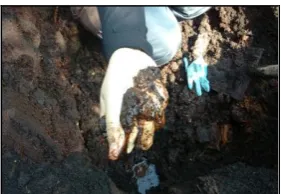
Sampling of peat was carried out in Parit Nipah, Batu Pahat, Johor. For the sampling purpose, excavation of disturbed samples was done below the top soil in order to avoid disruption of samples from visible root and branches. Ground water table was found to be about 0.5 m from the ground surface. The surrounding location is mostly planted with pineapple and palm tree. Visual inspection of peat soil were indicating that it has a very high water retention capacity, dark brown in colour and it also very spongy when step on their surface. A Von post classification test was conducted to identify its decomposition level by squeezing the peat soil as shown in Fig. 1. It releases very muddy dark water with a small amount of peat passed through the fingers and really sticky. Hence, this Parit Nipah peat soil can be classified as H5 which is hemic peat with a moderate decomposition. In order to maintain its properties and moisture content, the disturbed samples were kept in a controlled humid room that available at RECESS, UTHM. This controlled room used to avoid any fungus grows on the surface of the soil since peat soil itself is formed by decayed of wood and root.
Fig. 1 Von Post Classification Test
3.2
Sample Preparation
Larger material such as isolated roots, large fibre and stones were removed from peat soil. The moisture content of peat was reduced till the formation process can be conducted easily. In this study, repetition process has been performed to obtain the suitable method and moisture content that can be used to mix peat with the polymer. The reduction of 10% of its original moisture content were considered as the minimum amount of moisture that able to form the soil sample. The sample was dried in the oven (105°C) and also at the room temperature (29 °C). The time taken to reduce the moisture content until the suitable value was recorded. It is important to know the length of time taken to reduce the moisture content since this is a part of method of sample formation that needs to be repeated. All samples were prepared in a good condition without any peat was peeled off on surface or remained on the mould.
39
obtained were uniformly distributed throughout the soil as shown in Fig. 2.
Fig. 2 Sample Preparation
Next, peat sample was filled and tamped for three layers in a mould of 50 mm internal diameter and 100 mm height as shown in Fig. 3.The density of each layers were controlled at 1147kg/m3. These samples then were cured for 1, 7, 14 and 28 days. The results obtained were analysed. The amount of water was added in VAAC is in a ratio of 1 VAAC to 3 water (1:3). The reason of dilution process is to reduce the cost and to control amount of VAAC used.
Fig. 3 Mould for Sample Formation
3.3
Geotechnical Tests
The disturbed samples were used to determine moisture content, organic content, particle size distribution, specific gravity, pH and other related properties. Unconfined compression test was used to identify the strength difference between the original and peat-polymer stabilization. The shrinkage characteristic for both conditions of peat was identified.
4.
Results and Discussion
4.1
Properties of Parit Nipah Peat Soil
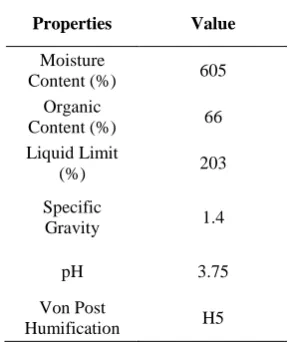
Laboratory tests have been conducted to find the moisture content, specific gravity, organic content, pH and liquid limit. The Von post humification and core cutter was done at the site. The core cutter test was conducted to identify the unit weigth of the peat. The soil use for this test was peat soil and the basic material properties are presented in Table 1. These data were compared with the values investigated by past researchers. Peat shows unique geotechnical properties in comparison with those of inorganic soils such as clay and sandy soils which are made up of only soil particles.
Table 1 Properties of Peat Soil in Parit Nipah
Properties Value
Moisture
Content (%) 605 Organic
Content (%) 66 Liquid Limit
(%) 203
Specific
Gravity 1.4
pH 3.75
Von Post
Humification H5
4.2
Curing Method
Air curing time is a technique to expose the mixture of peat and VAAC to the air without any external water intruding into the stabilized samples. This air curing techniques was adopted as the natural water content of the peat was very high. During the mixing process of VAAC and peat, there was no water added to the natural peat, as the high water content in peat also helps in stabilization process, as in stabilization soils enough moisture content is essential not only for the hydration process to proceed but also for efficient compaction. An air curing technique is used to strengthen the stabilized peat soil samples by gradual moisture content reduction, instead of the usual curing technique or water submerged method. In this study, two curing techniques used to cure the stabilized peat soil by leaving it in normal room temperature (UW) and in control box with temperature 29 °C (W). These two techniques were selected to identify the ability of VAAC to bind the particle with and without exposed to the moisture changes.
Usually the technique of maintaining the moisture temperature is used to control the cementing particle process without loss of moisture. Hence, any changes in strength is because of the effectiveness of the VAAC acts in peat. All the samples were wrapped in plastic sleeves as soon as the stabilized peat samples were formed. These samples were kept in temperature 29 °C and out of water intrusion during the curing period. Water added in the box, to maintain the humidity of the surrounding. Hence, it reduces the effect of loss in moisture content of stabilized peat.
40
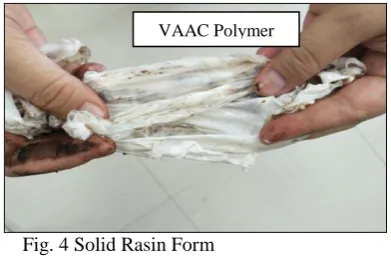
allowed unwrapped in a rack for drying purpose to allowthe formation of solid rasin form.
Fig. 4 Solid Rasin Form
4.3
Strength Properties of Peat
In order to identify the effectiveness of using VAAC in peat soil, two different conditions have been used for curing process which was wrapped and unwrapped. These samples then tested on its strength by using unconfined compression test. Hence, the strength obtained from this test were recorded. Results of the original peat strength for 1, 7, 14 and 28 days of curing period are as shown in Table 2. It can be seen that, the optimum strength obtained at 14 days for wrapped condition and 28 days for unwrapped condition
.
Table 2 Optimum Strength of UCT for Original Peat
Conditions
Unconfined Compressive Strength (kPa)
1day 7days 14days 28days
Wrapped 16.58 18.39 25.8 14.66 Unwrapped 46.25 224.7 284.3 393.4
These peat samples then were stabilized by using 10%, 20%, 30%, 40%, 50%, 60% and 70% of VAAC. Fig. 5 shows the strength of stabilized peat is lower than the strength of original peat in a wrapped condition. The pattern of strength changes from day 1 until day 28 is almost similar where it is increased till the day 14 and then decreased after that. It shows that, without loss of moisture in peat, the VAAC did not well performed. Means that, the changes of moistures is needed for this types of polymer to let the sample dry and increase the VAAC - P strength or in other comprehension, this polymer is only suitable for the soil surface stabilization process.
Fig. 5 Strength Changes in Wrapped Condition
The longer the curing time, the higher strength gained, but until a certain time, the strength was decreased. The optimum strength obtained at 14 days and after that the strength decreased. Fig. 6 shows strength increase after 24 hours curing time. The VAAC-P becomes stronger at 14 days and after that the strength slowly decreased. Unconfined compression test (UCT) also conducted to see the strength obtained at 56 day. Results show that the strength decreased.
From the strength obtained for the different percentage of VAC in peat stabilization, the suitable percentage of VAAC-P was selected based on optimum strength that obtained which is 70%. In Fig. 7, it can be seen clearly that the strength gained for sample cured for 14 days is higher than the sample cured for 28 days.
Fig. 6 Strength Changes (UW)
Fig. 7 Strength at Same Curing Period (UW)
41
performed for the sample that stabilize with 70% of VAAC added with binder material such as sand, lime and cement in order to determine their new unconfined compressive strength and shrinkage. 30%, 50% and 70% of sand was added (as a replacement in weight of solid) to the original peat, peat stabilized with 20% of VAAC and peat stabilized with 70% of VAAC. Then, sand was replaced with lime and cement, but the amount of lime and cement added into peat is same. As a comparison, peat stabilized with 20% of VAAC and added with the binders was conducted. All the samples were conducted at 14 days curing period.
The results is as shown in Fig.8. It can be described that the increasing of percentages (30% and 70%) of sand in the original sample and also in the mixtures of 20% VAAC and 70% VAAC in peat, the strength obtained was decreased. The same results obtained when replaced the sand with the lime and cement. But for the 50% of all binders shows the flunctuated results. It might be because of the reaction between the VAAC and the binders.
Fig. 8 Effect of 30%, 50% and 70% of binder in VAAC-P stabilization.
Cement, lime and sand were considered as a material that can increased the strength of peat based on some research conducted by [20] which is used sand and cement together with bentonite and calcium chloride as an additive in their model for the construction of soil – cement columns for peat stabilization. Results show that, the unconfined compression strength of the peat increased significantly after the stabilization process.
However, by comparing the results of strength obtained from VAAC-P with and without binder, it clearly shows the drop of strength after added some binder in the mixtures of VAAC and peat. It is because of the existence of VAAC in peat itself. The solid rasin bond between peat and VAAC was bonded well without any additional of binder. So, the presence of binders was disturbed the cementing bonding between the particles, thus, reduced the strength in soil.
From the observation, the VAAC have a greate mechanism to agglomorate the fibre together because VAAC can cementing the fibre during the dying process by forming clear plastic and resin bond. Hence, the solid bond produced the hard surface that flexible to withstand the load exerted.
5.
Conclusions
The wrap sample shows an increase in strength started from day 1 until day 14, but the strength increase was markedly less than seen with unwrap sample. There are limited study on stabilization of peat by using a liquid polymer since the water content in peat itself is higher. As a conclusion, VAAC can be used in peat as a stabilization agent and the optimum strength obtained is at 70% of VAAC. The suggested binder in this paper has reduced the strength of the VAAC-P and reflect as not suitable for this mixture.
Acknowledgement
The authors would like to express their appreciation to all parties who have contributed to this research, directly or indirectly.
References
[1] Zainorabidin, A. and Wijeyesekera, D.C. Geotechnical Challenges With Malaysian Peat. Proceedings of The Advances Computing and Technology 2007 Conference, 23 January 2007, ed. Stephen et al., 252-261. London, United Kingdom. (2007).
[1] Haan D.E.J., Kruse G. A. M. Characterisation and engineering properties of Dutch peats. Proceedings of 2nd Int. Workshop, Singapore, Taylor & Francis, London, 2007, 3: 2101–2133. (2006).
[2] Kalantari, B., and Huat B. B.K. Load-Bearing Capacity Improvement for Peat Soil. European Journal of Scientific Research. Volume 32(2), 2009), pp 252-259.
Without binder
With binder
With binder
With binder Without binder
42
[3] Said, J. M. and Taib, S. N.L. Peat Stabilization withCarbide Lime. UNIMAS E-Journal of Civil Engineering, Vol. 1: issues 1/ August (2009). [4] Kolay, P. K., Sii, H. Y. and Taib, S.N.L. “Tropical
Peat Soil Stabilization using Class F Pond Ash from Coal Fired Power Plant”. International Journal of Civil and Environmental Engineering, (2011). [5] Viswanath, G., Pramod, K. R., and Ramesh V. Peat
Stabilization with Rice Husk Ash and Lime Powder.
International Journal of Innovation and Scientific Research. ISSN 2351-8014. Volume 9, (2014),pp 225-227.
[6] Wong, L.S., Hashim, R. & Ali, F.H. Strength and permeability of stabilized peat soil. Journal of Applied Science, Volume 8(17), (2008), pp. 1–5. [7] Abba, H.A., Sani, L., Hijab, A.M., Daud, Z. Novel
admixture for improvement of foundations on tropical expansive soils. International Journal of Integrated Engineering, Volume 9 (1), (2017), pp. 44-49.
[8] Hashim, R. and Islam, S. Engineering properties of peat soils in peninsular Malaysia. Journal of Applied Sciences, Volume 8(22), (2008), pp. 4215–4219. [9] Tang, B.L., Bakar, I. and Chan, C.M. Reutilization of
organic and peat soils by deep cement mixing. World Academy of Science, Engineering and Technology, Issue 53, 680, (2011).
[10] Long, M. & Boylan, N. In-situ testing of peat - a review and update on recent developments.
Geotechnical Engineering Journal of the SEAGS & AGSSEA, Volume 43(4), (2012), pp. 41–45.
[11] Saberian, M. and Rahgozar M. A. Geotechnical Properties of Peat Soil Stabilized with Shredded Waste Tyre Chips in Combination with Gypsum, Lime or Cement. Mires and Peat. Volume 18, Article 16, 1-16. International Mire Conservation Group and International Society, (2016).
[12] Onyelowe K. C. and Okafor F. O. A Comparative Review of Soil Modification Methods. ARPN Journal of Earth Sciences. Volume 2 (2), (2012). [13] Inyang, H. I., and Bae, S. Cohesion, adhesion, and
the durability of stabilized materials, Journal of Materials in Civil Engineering, Volume 18, (2006), pp133-134.
[14] Ali, F., Stabilization of Residual Soils using Liquid Chemical. EJGE.Vol. 17. Bund. B. (2012).
[15] Kolay, P. K., A. Pant, V. K. Puri, S. Kumar. Effect of Liquid Polymer Stabilizer on Geotechnical Properties of Fine-Grained Soil. Indian Geotechnical Conference IGC2016. 15-17 December 2016, IIT Madras, Chennai, India (2016).
[16] Chang, Ilhan; Im, Jooyoung; Cho, Gye-Chun Introduction of Microbial Biopolymers in Soil Treatment for Future Environmentally-Friendly and Sustainable Geotechnical Engineering. Sustainability. 8 (3): 251. doi:10.3390/su8030251, (2016).
[17] Brown, J.J., Brandon, T.L., Daniels, W.L., DeFazio, T.L., Filz, G.M., and Mitchell, J.K. Rapid Stabilization/Polymerization of Wet Clay Soils: Phase I Literature Review. Air Force Research Laboratory, Tyndall AFB FL, (2004).
[18] Brown, J.J., Brandon, T.L., Daniels, W.L., DeFazio, T.L., Filz, G.M., and Mitchell, J.K. Rapid Stabilization/Polymerization of Wet Clay Soils: Phase I Literature Review. Air Force Research Laboratory, Tyndall AFB FL, (2004)
[19] Tingle, J.S, and Santoni, R.L. Stabilization of Clay Soils with Nontraditional Additives.In Transportation Research Record 1819. Transportation Research Board, Washington, DC, (2003).