© 2016 IJSRST | Volume 2 | Issue 6 | Print ISSN: 2395-6011 | Online ISSN: 2395-602X Themed Section: Engineering and Technology
Wavelet Based Image Fusion
A. R. Sankaliya*1, A. D. Dobariya2Electronics and Communication Department, Government Polytechnic for Girls, Surat, Gujarat, India
ABSTRACT
Extracting more information from multi-source images is an attractive thing in remotely sensed image processing, which is recently called image fusion. In the paper, the image fusion algorithm based on wavelet transform is proposed to improve the geometric resolution of the images, in which two images to be processed are firstly decomposed into sub images with different frequency, and then the information fusion is performed using these images under certain criterion, and finally these sub-images are reconstructed into the result image with plentiful information.
Keywords: Multi-source images, Fusion, Wavelet transform, Wavelet based fusion, fused images
I.
INTRODUCTION
For the remotely-sensed images, some have good spectral information, and the others have high geometric resolution, how to integrate the information of these two kinds of images into one kind of images is a very attractive thing in image processing, which is also called the image fusion. In this paper , the image fusion algorithm based on wavelet transform is proposed to improve the geometric resolution of the images, in which two images to be processed are firstly decomposed into sub-images with the same resolution at the same levels and different resolution among different levels, and then the information fusion is performed using high-frequency sub-images under the “gradient” criterion, and finally these sub-images are reconstructed into the result image with plentiful information. Since the geometric resolution of the image depends on the high-frequency information in it, therefore this image fusion algorithm can acquire good result.
II.
METHODS AND MATERIAL
A. Wavelet Transform in Image Fusion
Multisensor fusion refers to the synergistic combination of different sources of sensory information into one representational format. The information to be fused may come from multiple sensors monitored over a common period of time or from a single sensor monitored over an extended time period. Many sensors
produce images. We use the term image fusion to denote a process generating a single image which contains a more accurate description of the scene than any of the individual source images. This fused image should be more useful for human visual or machine perception. This type of image fusion is also called pixel-level multisensory fusion. The different images to be fused can come from different sensors of the same basic type or they may come from different types of sensors. The sensors used for image fusion need to be accurately co aligned so that their images will be in spatial registration.
A. 2-D DWT
Since image is 2-D signal, we will mainly focus on the 2-D wavelet transforms. The following figures show the structures of 2-D DWT with 3 decomposition levels:
Figure 1. Pyramid hierarchy of 2-D DWT
The next level decomposition is just applied to the LL band of the current decomposition stage, which forms a recursive decomposition procedure. Thus, N-level decomposition will finally have 3N+1 different frequency bands, which include 3N high frequency bands and just one LL frequency band. The 2-D DWT will have a pyramid structure shown in the above figure. The frequency bands in higher decomposition levels will have smaller size.
B Wavelet Transform Fusion
The most common form of transform image fusion is wavelet transform fusion. In common with all transform domain fusion techniques the transformed images are combined in the transform domain using a defined fusion rule then transformed back to the spatial domain to give the resulting fused image. Wavelet transform fusion is more formally defined by considering the wavelet transforms ω of the two registered input images
I1 (x, y) and I2 (x, y) together with the fusion rule Φ _ Then, the inverse wavelet transform ω-1 is computed, and the fused image I (x, y)_ is reconstructed:
This process is depicted in fig 2.
Figure 2. Fusion of the wavelet transforms of two images
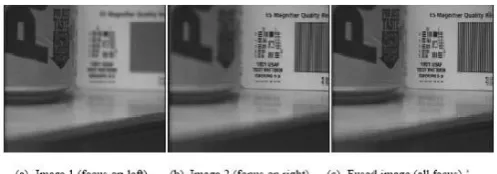
The following examples illustrate the use of image fusion in some practical applications. Fig. 3 shows a pair of digital camera images. In one image, the focus is on the Pepsi can. In the other image, the focus is on the testing card. In the fused image, the Pepsi can, the table, and the testing card are all in focus. The fused image was obtained using the method illustrated in Fig. 2, using techniques to be described in detail later in this paper.
Figure 3. Fusion Result for multi-focus images
Implementation of financial sector reforms since the early 1990s aims at ensuring that varieties of market-based financial services are available to all categories of farmers & rural.
B. Image Fusion Algorithm Based Wavelet Transform
The main idea of our algorithm is that: (1) the two images to be processed are resampled to the one with the same size; and (2) they are respectively decomposed into the sub-images using forward wavelet transform, which have the same resolution at the same levels and different resolution among different levels; and (3) information fusion is performed based on the high-frequency sub-images of decomposed sub-images;and finally the result image is obtained using inverse wavelet transform.
Let A ( x,y ) and B ( x,y ) be the images to be fused,the decomposed low-frequency sub-images of A ( x,y ) and
B( x,y ) be respectively lAJ ( x,y ) and lBJ ( x,y ) (J is the parameter of resolution), the decomposed high-frequency sub-images of A ( x ,y ) and B ( x ,y ) be respectively hAj
k
( x,y ) and hBj k
(x,y ) ( j is the parameter of resolution and j = 1,2,…,J. for every j,k = 1,2,3…),
the gradiant image generated from hAj k
( x,y ) and hBj k
(x,y ) be respectively GAj k
( x,y ) and GBj k
( x,y ) , then the fused high-frequency sub-images Fj
k
Fj k
( x ,y ) = hAj k
( x,y ) If GAj
k
( x,y ) < GBj k
( x,y ) Fj
k
( x ,y ) = hBj k
(x,y )
And the fused low-frequency sub-image Fj( x ,y ) are : Fj( x ,y ) = k1·lAJ ( x,y ) + k2· lBJ ( x,y )
When k1 and k2 are given parameters,if image B is fused into image A ,then k1 > k2 .if the decomposed high-frequency sub-images hAj
k
( x,y ) of A ( x ,y ) is replaced by be respectively Fj
k
( x ,y ) , the decomposed low-frequency sub-image lAJ ( x,y ) of A ( x ,y ) is replaced by be respectively Fj( x ,y ) ,and Fj( x ,y ) and Fj
k
( x ,y ) are used to reconstruct the image A’ ( x ,y )
using the inverse wavelet transform,then A’ ( x ,y ) not only has the low-frequency information of A ( x ,y ) and
B ( x ,y ) ,but also has the high-frequency information of
A ( x ,y ) and B ( x ,y ) at the same time.this algorithm shows that the high-frequency information fusion between two images is completed under the “gradient”criterion.
All paragraphs must be indented. All paragraphs must be justified, i.e. both left-justified and right-justified.
A. Text Font of Entire Document
The entire document should be in Times New Roman or Times font. Type 3 fonts must not be used. Other font types may be used if needed for special purposes.
Recommended font sizes are shown in Table 1.
B. Title and Author Details
Title must be in 24 pt Regular font. Author name must be in 11 pt Regular font. Author affiliation must be in 10 pt Italic. Email address must be in 9 pt Courier Regular font.
TABLEI FONT SIZES FOR PAPERS Font
Size
Appearance (in Time New Roman or Times)
Regular Bold Italic
8 table caption (in Small Caps), figure caption, reference item
reference item (partial)
9 author email address (in Courier), cell in a table
abstract body abstract heading (also in Bold)
10 level-1 heading (in Small Caps), paragraph
level-2 heading, level-3 heading, author affiliation
11 author name 24 title
All title and author details must be in single-column format and must be centered.
Every word in a title must be capitalized except for short minor words such as “a”, “an”, “and”, “as”, “at”, “by”, “for”, “from”, “if”, “in”, “into”, “on”, “or”, “of”, “the”, “to”, “with”.
Author details must not show any professional title (e.g. Managing Director), any academic title (e.g. Dr.) or any membership of any professional organization (e.g. Senior Member IEEE).
To avoid confusion, the family name must be written as the last part of each author name (e.g. John A.K. Smith).
Each affiliation must include, at the very least, the name of the company and the name of the country where the author is based (e.g. Causal Productions Pty Ltd, Australia).
Email address is compulsory for the corresponding author.
C. Section Headings
No more than 3 levels of headings should be used. All headings must be in 10pt font. Every word in a heading must be capitalized except for short minor words as listed in Section III-B.
1) Level-1 Heading: A level-1 heading must be in Small Caps, centered and numbered using uppercase Roman numerals. For example, see heading “III. Page Style” of this document. The two level-1 headings which must not be numbered are “Acknowledgment” and “References”.
3) Level-3 Heading: A level-3 heading must be indented, in Italic and numbered with an Arabic numeral followed by a right parenthesis. The level-3 heading must end with a colon. The body of the level-3 section immediately follows the level-3 heading in the same paragraph. For example, this paragraph begins with a level-3 heading.
D. Figures and Tables
Figures and tables must be centered in the column. Large figures and tables may span across both columns. Any table or figure that takes up more than 1 column width must be positioned either at the top or at the bottom of the page.
Graphics may be full color. All colors will be retained on the CDROM. Graphics must not use stipple fill patterns because they may not be reproduced properly. Please use only SOLID FILL colors which contrast well both on screen and on a black-and-white hardcopy, as shown in Fig. 1.
Figure 2. A sample line graph using colors which contrast well both on screen and on a black-and-white
hardcopy
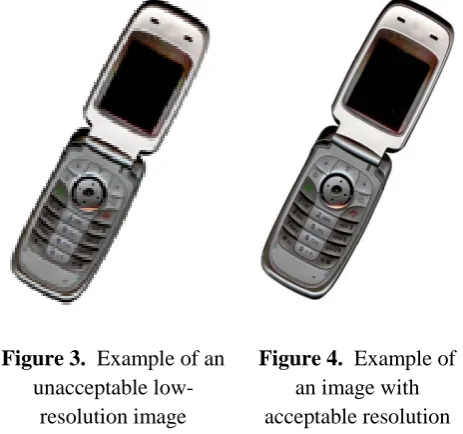
Fig. 2 shows an example of a low-resolution image which would not be acceptable, whereas Fig. 3 shows an example of an image with adequate resolution. Check that the resolution is adequate to reveal the important detail in the figure.
Please check all figures in your paper both on screen and on a black-and-white hardcopy. When you check your paper on a black-and-white hardcopy, please ensure that:
the colors used in each figure contrast well, the image used in each figure is clear,
all text labels in each figure are legible.
E. Figure Captions
Figures must be numbered using Arabic numerals. Figure captions must be in 8 pt Regular font. Captions of a single line (e.g. Fig. 2) must be centered whereas multi-line captions must be justified (e.g. Fig. 1). Captions with figure numbers must be placed after their associated figures, as shown in Fig. 1.
Figure 3. Example of an unacceptable
low-resolution image
Figure 4. Example of an image with acceptable resolution
F. Table Captions
Tables must be numbered using uppercase Roman numerals. Table captions must be centred and in 8 pt Regular font with Small Caps. Every word in a table caption must be capitalized except for short minor words as listed in Section III-B. Captions with table numbers must be placed before their associated tables, as shown in Table 1.
G. Page Numbers, Headers and Footers
Page numbers, headers and footers must not be used.
H. Links and Bookmarks
All hypertext links and section bookmarks will be removed from papers during the processing of papers for publication. If you need to refer to an Internet email address or URL in your paper, you must type out the address or URL fully in Regular font.
I. References
References section. Number the reference items consecutively in square brackets (e.g. [1]).
When referring to a reference item, please simply use the reference number, as in [2]. Do not use “Ref. [3]” or “Reference [3]” except at the beginning of a sentence, e.g. “Reference [3] shows …”. Multiple references are each numbered with separate brackets (e.g. [2], [3], [4]–[6]).
Examples of reference items of different categories shown in the References section include:
example of a book in [1]
example of a book in a series in [2] example of a journal article in [3] example of a conference paper in [4] example of a patent in [5]
example of a website in [6] example of a web page in [7]
example of a databook as a manual in [8] example of a datasheet in [9]
example of a master’s thesis in [10] example of a technical report in [11] example of a standard in [12]
III.
CONCLUSION
The version of this template is V2. Most of the formatting instructions in this document have been compiled by Causal Productions from the IEEE LaTeX style files. Causal Productions offers both A4 templates and US Letter templates for LaTeX and Microsoft Word. The LaTeX templates depend on the official IEEEtran.cls and IEEEtran.bst files, whereas the Microsoft Word templates are self-contained. Causal Productions has used its best efforts to ensure that the templates have the same appearance.
Causal Productions permits the distribution and revision of these templates on the condition that Causal Productions is credited in the revised template as follows: “original version of this template was provided by
courtesy of Causal Productions
(www.causalproductions.com)”.
IV.
ACKNOWLEDGMENT
The heading of the Acknowledgment section and the References section must not be numbered.
Causal Productions wishes to acknowledge Michael Shell and other contributors for developing and
maintaining the IEEE LaTeX style files which have been used in the preparation of this template. To see the list of contributors, please refer to the top of file IEEETran.cls in the IEEE LaTeX distribution.
V.
REFERENCES
[1] S. M. Metev and V. P. Veiko, Laser Assisted Microtechnology, 2nd ed., R. M. Osgood, Jr., Ed. Berlin, Germany: Springer-Verlag, 1998.
[2] J. Breckling, Ed., The Analysis of Directional Time Series: Applications to Wind Speed and Direction, ser. Lecture Notes in Statistics. Berlin, Germany: Springer, 1989, vol. 61.
[3] S. Zhang, C. Zhu, J. K. O. Sin, and P. K. T. Mok, “A novel ultrathin elevated channel low-temperature poly-Si TFT,” IEEE Electron Device Lett., vol. 20, pp. 569–571, Nov. 1999.
[4] M. Wegmuller, J. P. von der Weid, P. Oberson, and N. Gisin, “High resolution fiber distributed measurements with coherent OFDR,” in Proc. ECOC’00, 2000, paper 11.3.4, p. 109.
[5] R. E. Sorace, V. S. Reinhardt, and S. A. Vaughn, “High-speed digital-to-RF converter,” U.S. Patent 5 668 842, Sept. 16, 1997.
[6] (2002) The IEEE website. Online]. Available: http://www.ieee.org/
[7] M. Shell. (2002) IEEEtran homepage on CTAN. Online]. Available: http://www.ctan.org/tex-archive/macros/latex/contrib/supported/IEEEtran/ [8] FLEXChip Signal Processor (MC68175/D),
Motorola, 1996.
[9] "PDCA12-70 data sheet" Opto Speed SA, Mezzovico, Switzerland.
[10] A. Karnik, “Performance of TCP congestion control with rate feedback: TCP/ABR and rate adaptive TCP/IP,” M. Eng. thesis, Indian Institute of Science, Bangalore, India, Jan. 1999.
[11] J. Padhye, V. Firoiu, and D. Towsley, “A stochastic model of TCP Reno congestion avoidance and control,” Univ. of Massachusetts, Amherst, MA, CMPSCI Tech. Rep. 99-02, 1999. [12] Wireless LAN Medium Access Control (MAC)