A RANDOMIZED ALGORITHM FOR FAST
SEQUENCE ALIGNMENT
Akash Nag
1, Dr. Sunil Karforma
2 1Research Scholar,
2Associate Professor, Department of Computer Science,
The University of Burdwan (India)
ABSTRACT
Sequence alignment is one of the most important tools available to molecular biologists in order to find
similarities between two or more DNA or protein sequences. However, despite several advances in this field,
multiple sequence alignment (MSA) is often a slow process, and still, optimum results cannot be guaranteed.
MSA is an important prerequisite for constructing phylogenetic trees, which are often the underlying goal for
biologists to trace the evolution of closely related species. In this paper, we propose a randomized algorithm
that can produce a sufficiently good MSA, for huge datasets, in a fraction of the time taken by contemporary
MSA algorithms.
Keywords: Bioinformatics, Multiple Sequence Alignment, Randomized Algorithms, Sequence
Analysis
I. INTRODUCTION
Ever since sequence alignment gained significance, a large number of algorithms have been published. Most of these can be divided into two categories: pairwise sequence alignment algorithms and multiple sequence alignment algorithms. Pairwise sequence alignment is probably more of a theoretical interest only, as most problems deal with multiple sequences. However, we need to understand how pairwise sequence alignment works in order to proceed to multiple sequence alignment. Compared to MSA, pairwise sequence alignment algorithms can produce optimum results because of the small size of their input sequences. Several dynamic programming algorithms are available for this: the most famous being that of Needleman and Wunsch [1] and that of Smith and Waterman [2]. The former deals with global alignments while the latter with local alignments. Both of these produce the best possible alignment for the two given sequences. Several improvements in time complexity of these algorithms were made in later times, most notably by Gotoh [3] and then by Altschul and Erickson [4].
prevented this solution from being feasible. A new type of algorithm was required that could scale well to huge datasets, and the FASTA algorithm was introduced by Lipman and Pearson [5]. It was based on heuristics, and as such, it did not produce the most accurate alignments. However, it was sufficiently accurate to be used for database search. A few years later, BLAST [6], an extremely fast heuristic algorithm, replaced FASTA as the workhorse of the biological community, for database search.
II. THE PROPOSED ALGORITHM
2.1 Pairwise Sequence Alignment
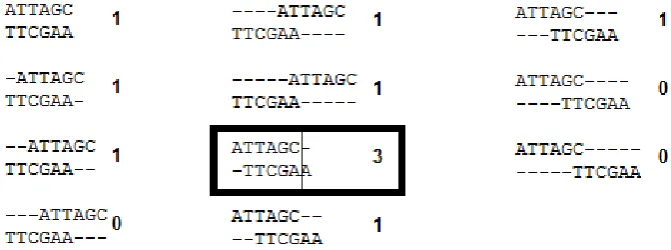
Before proceeding to discuss MSA, we need to explore a randomized pairwise sequence alignment algorithm, on which our proposed MSA is based. This pairwise sequence alignment algorithm, as presented by Nag and Karforma [7], starts off by chopping the pair of input sequences into sequences. Each such pair of sub-sequences are then aligned, and the final alignment is thus simply the concatenation of the aligned subsub-sequences. The randomness in the algorithm comes from the fact that the size of the subsequence chosen is completely random. Moreover, the lengths of the subsequences in any pair may be unequal. The alignment phase proceeds by sliding a subsequence against its counterpart, and calculating the alignment score for each such sliding configuration. The alignment pertaining to the configuration with the highest score is selected, and the process continues to the next subsequence-pair. However, with each configuration, some amount of residue from any one of the pair of subsequences may be returned back to the original, as yet unscanned, portion of the sequences. In Fig. 1, we see the various possible sliding alignments between the two DNA sub-sequences: ATTAGC and TTCGAA, which are possibly part of a pair of much larger DNA sequences. The best possible alignment has a match score of 3, and the thin line shows the residue. Anything to the right of that line will not be included in the current alignment. This constitutes the nucleotide A of the 2nd string in this case, which will be returned to the unsliced portion of the second string, and reconsidered for the next slicing into two substrings.
Fig. 1. Possible Sliding Alignments Between Two DNA Subsequences Along with Their Match
Scores. The best sliding configuration is highlighted.
The pairwise sequence alignment discussed here is important because of two reasons:
1. It has the best space complexity of any alignment algorithm. Space complexity may not be an issue in pairwise alignment, but is very important in MSA because of the large number of sequences that needs to be aligned.
2.2 The Proposed Multiple Sequence Alignment Algorithm
2.2.1 Random Shuffling
The algorithm begins by shuffling the given input sequences using the Durstenfeld-Fisher-Yates shuffle [8] algorithm, aligning each configuration, evaluating the alignment score for that particular combination, and then returning the aligned sequences with the highest score. This process is customizable in that, the user can select the number of shuffling rounds to be performed. By default, the algorithm performs the shuffling five times.
2.2.2 MSA Scoring
The scoring system used in our algorithm is the Sum-of-Pairs Score for each pairwise alignment. The score takes into account three types of penalties: periphery-gap-penalty, gap-opening-penalty, and the gap-extension-penalty. Usually, the periphery-gap-penalty is set to zero, as we are interested in local alignments only.
n
j
i
n
i
S
S
ore
PairwiseSc
Score
MSA
Penalty
S
S
B
S
S
ore
PairwiseSc
j i n i i i
,
1
)
,
(
)
,
(
)
,
(
1 2 1 2 12.2.3The Alignment Process
The alignment process follows a divide-and-conquer (DAC) approach where at each step, the set of sequences to be aligned is divided into two halves, and the MSA algorithm is applied on each set. The division into subsets continues till the number of sequences in a set reaches two. After that, the heuristic algorithm for pair-wise sequence alignment due to Nag and Karforma [7] is used for aligning the pair.
During the merging phase of DAC, a representative string is computed from each of the 2 sets – x0 and x1. A
representative of a set of sequences is the string containing the character occurring with the highest frequency at each column position. These two representatives are then aligned multiple times. The number of rounds can be customized by the user; by default, it is set to five. The best sliding-configuration or alignment is selected for which the score is the highest. It is clear that one of the shift-value (of the selected alignment) in the pair must be zero.
Each sequence in the set xi is then shifted by s places (i.e. gaps are inserted to the left) – s being the non-zero
shift-value of the selected alignment, and for each sequence in the set x1-i, gaps are inserted to the right to
equalize the lengths of the two sets. This gap insertion process is repeated for each k-mer in each set separately and not on the whole sequence. When all k-mers have been accounted for, the resulting shifted sequence sets are merged to form the complete set, whose MSA score is then calculated. The best complete-set is returned by the merging phase whose score is the maximum.
2.2.4 User Parameters and Scoring Matrix
The algorithm accepts two tunable parameters from the user: ROUNDS and RANDOM-ROUNDS. The
ROUNDS parameter is used to tune up the pair-wise alignment algorithm, while the RANDOM-ROUNDS
parameter determines the number of shuffling rounds to be used. For protein sequences, BLOSUM-62 was used as the scoring matrix.
III.
RESULTS AND DISCUSSION
quality of the alignments produced. When implemented, the algorithm successfully aligned 5000 sequences, each of average length 1000, in 1 minute on a dual-core 2.3GHz CPU.
The recurrence relation for the running time of the sequence alignment algorithm is given by:
))
(
.
(
X
T
n
O
MSA, where,
.
.
1
2
2
2
2
.
.
)
(
n
W
m
n
W
m
R
m
n
n
T
n
W
m
R
n
T
MSA MSAWhere,
n is the number of sequences to be aligned, m is the average sequence length,
R is the user-specified ROUNDS parameter, X is the user-specified RANDOM-ROUNDS parameter,
W is the average k-mer length (during subdivision)
IV. CONCLUSION
The MSA algorithm proposed in this paper can be used when fast approximate alignments are required. Our algorithm outperforms the MUSCLE [9] algorithm in terms of speed, but is not as accurate. However, in this paper, our goal is not to produce an accurate and biologically meaningful alignment. Rather, the objective of the proposed MSA algorithm is to only aid in the phylogenetic tree construction in the fastest way possible, specially for huge datasets. Such an approximate tree can then serve as a guide tree for yet another round of MSA. Since the guide tree affects the quality of MSA, it is essential that the guide-tree be sufficiently accurate, yet be fast to construct, as it is not the goal itself but an aid to help generate quality alignments. In such situations, the proposed algorithm can be used to construct a rough alignment, generate a guide-tree using that alignment, and then using that guide-tree to construct the actual MSA.
REFERENCES
[1] Needleman, Saul B., and Christian D. Wunsch. "A general method applicable to the search for similarities in the amino acid sequence of two proteins." Journal of molecular biology 48.3 (1970): 443-453.
[2] Smith, Temple F., and Michael S. Waterman. "Identification of common molecular subsequences." Journal of molecular biology 147.1 (1981): 195-197.
[3] Gotoh, Osamu. "An improved algorithm for matching biological sequences." Journal of molecular biology 162.3 (1982): 705-708.
[4] Altschul, Stephen F., and Bruce W. Erickson. "Optimal sequence alignment using affine gap costs." Bulletin of mathematical biology 48.5-6 (1986): 603-616.
[5] Lipman, David J., and William R. Pearson. "Rapid and sensitive protein similarity searches." Science 227.4693 (1985): 1435-1441.
[6] Altschul, Stephen F., et al. "Basic local alignment search tool." Journal of molecular biology 215.3 (1990): 403-410.
[8] Durstenfeld, Richard. "Algorithm 235: random permutation." Communications of the ACM 7.7 (1964): 420.