IJIRT 143334
INTERNATIONAL JOURNAL OF INNOVATIVE RESEARCH IN TECHNOLOGY159
Design of Neural Network Predictive Controller for a
Quadruple Tank System
Saranya Balachandran M.
1, T. Anitha
21
Student, Sri Ramakrishna Engineering College
2
Assistant Professor, Sri Ramakrishna Engineering College
Abstract-- The processes in most of the industries are highly non-linear and dynamic. The quadruple tank system is a benchmark system used to analyse the nonlinear effects in a multivariable process. The quadruple tank process is thus used to demonstrate coupling effects and interactions occurring in multivariable control systems. This project presents a neural network predictive controller for a quadruple tank system. The process data will be obtained from the mathematical model of the laboratory scale experimental setup. The model obtained from training the system via neural network will be used in controlling the quadruple tank by neural network predictive controller. The simulation results will be compared with the closed loop response and constrained and unconstrained model predictive control algorithm results.
Index Terms- Quadruple tank system, MPC, Neural Network
I. INTRODUCTION
Most of industrial control problems are non linear and have multiple controlled variables which in turn leads to significant uncertainties, strong interactions, and non-minimum phase behavior.[12] So it is important for control system engineers to understand the problems of industrial processes by carrying out experiments with a good laboratory apparatus. The quadruple tank setup is a well known process used as a standard experiment for students and for control related research activities. The primary application of the quadruple tank process is to study and test MIMO control, as it provides a simple non linear 2x2 system with interactions and non- minimum phase behaviours.
Model predictive control techniques are widely used in the process industries and are considered as methods that give good performance without almost any intervention. However the main reason that model predictive control is popular in industry is that it is the only technique that allows system
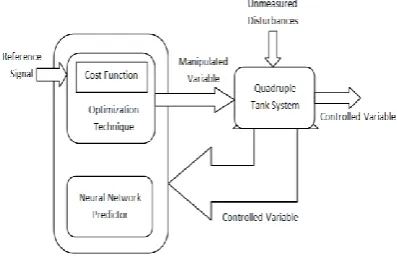
restrictions to be taken into consideration. Most of the industrial processes have non linear dynamics. But most MPC applications are based on linear models. However there are processes that can’t be represented by a linear model and require the use of non linear models. This gives rise to the use of non linear model predictive controller. In this project Neural Network based non linear model predictive controller is implemented for a quadruple tank system. The block diagram is shown in Figure 1.
Fig. 1 Block diagram of neural network predictive controller for quadruple tank system
II. PROCESS DESCRIPTION
IJIRT 143334
INTERNATIONAL JOURNAL OF INNOVATIVE RESEARCH IN TECHNOLOGY160
operate in the minimum phase or in the non-minimum phase. [5]
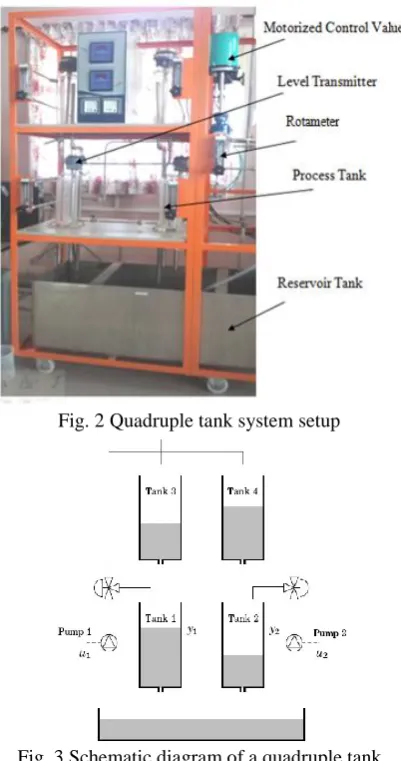
All the tanks have a discharge valve at the bottom. The discharge from tank 4 goes to tank 1 while discharge of tank 3 goes to tank 2. This interaction is a major problem in a multivariable control system. Discharge from tank1 and tank 2 goes to the reservoir tank at the bottom. [5]
Fig. 2 Quadruple tank system setup
Fig. 3 Schematic diagram of a quadruple tank system
III. NEURAL NETWORK PREDICTIVE CONTROLLER
The neural network predictive controller uses a neural network model of a plant to predict future plant performance. The controller then optimizes plant performance over a specified time horizon by calculating control input. The first step is to determine the neural network plant model. Then, the plant model is used by the controller to predict
future performance. The block diagram of neural network predictive controller is shown in Figure 4.
A. System Identification
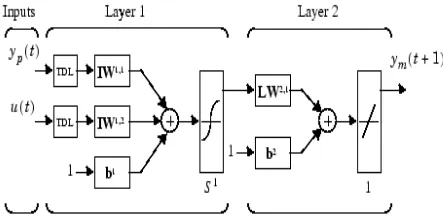
The first stage of model predictive control is to train a neural network to represent the forward dynamics of the plant. Neural network training signal is the prediction error between the plant output and the neural network output. The process is represented by the Figure 5. The neural network plant model uses previous inputs and plant outputs to predict future values of the plant output. The neural network plant model structure is given in the following Figure 6.
Fig. 4 Neural network predictive controller
Fig. 5 Neural network training
B. Predictive Control
IJIRT 143334
INTERNATIONAL JOURNAL OF INNOVATIVE RESEARCH IN TECHNOLOGY161
Fig. 6 Structure of neural network plant model
IV. RESULTS AND DISCUSSION
A. Simulation of PI Controller
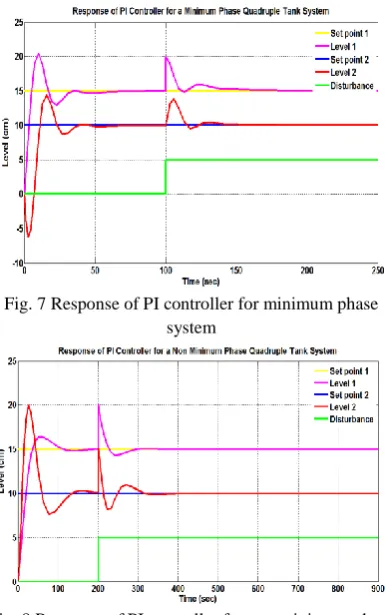
The PI controller response of quadruple tank process for a minimum phase system is obtained as shown in Figure 7. The settling time is 150 sec for both tanks while the rise time for tank 1 is 9 sec and that of tank 2 is 2 sec. Peak Overshoot of tank 1 is 44% and that of tank 2 is 140%. ISE obtained are 1794 and 2094 for tanks 1 and 2 respectively. The PI controller response of quadruple tank process for non minimum phase system is shown in Figure 8. The settling time is 220 sec for both tanks while the rise time for tank 1 is 20 sec and that of tank 2 is 10 sec. Peak Overshoot of tank 1 is 9.33% and that of tank 2 is 100%. ISE obtained are 2327 and 2831 for tanks 1 and 2 respectively.
B. Simulation of Constrained MPC
Constrained MPC is an MPC in which the constraints of the system are specified. The constrained MPC response of the quadruple tank process for minimum phase system is given in Figure 9. The settling time is 110 sec for both tanks while the rise time for tank 1 is 32 sec and that of tank 2 is 27 sec. Peak Overshoot of tank 1 is 8.6% and that of tank 2 is 6%. ISE obtained are 745 and 242 for tanks 1 and 2 respectively. The constrained MPC response of the quadruple tank process for non minimum phase system is given in Figure 10. The settling time is 150 sec for both tanks while the rise time for tank 1 is 38 sec and that of tank 2 is 34 sec. ISE obtained are 727 and 3382 for tanks 1 and 2 respectively.
C. Simulation of Unconstrained MPC
Unconstrained MPC is an MPC in which the constraints of the system are not specified. The unconstrained MPC response of the quadruple tank
process for minimum phase system is given in Figure 11. The settling time is 56 sec for both tanks while the rise time for tank 1 is 25 sec and that of tank 2 is also 25 sec. Peak Overshoot of tank 1 is 2.6% and that of tank 2 is 2.5%. ISE obtained are 396 and 188 for tanks 1 and 2 respectively. The unconstrained MPC response of the quadruple tank process for non minimum phase system is given in Figure 12. The settling time is 150 sec for both tanks while the rise time for tank 1 is 20 sec and that of tank 2 is 24 sec. Peak Overshoot of tank 2 is 10%. ISE obtained are 886 and 3111 for tanks 1 and 2 respectively.
D. Simulation of Neural Network Predictive Controller
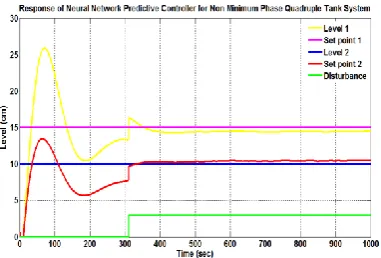
The response of a neural network predictive controller for quadruple tank process with minimum phase is given in Figure 13. The settling time is 45 sec for both tanks while the rise time for tank 1 is 2.8 sec and that of tank 2 is 2.3 sec. Peak Overshoot of tank 1 is 58% and that of tank 2 is 50%. ISE obtained are 484 and 247 for tanks 1 and 2 respectively. The response of a neural network predictive controller for quadruple tank process with non minimum phase is given in Figure 14. The settling time is 100 sec for both tanks while the rise time for tank 1 is 1.6 sec and that of tank 2 is 1.5 sec. Peak Overshoot of tank 1 is 182% and that of tank 2 is 189%. ISE obtained are 844 and 634 for tanks 1 and 2 respectively.
E. Performance Analysis
The performance of the controllers is validated by comparing the settling time, rise time, peak overshoot and Integral Square Error (ISE). The results for minimum phase and non minimum phase systems are tabulated below in Table 1. It is seen that neural network predictive controller show better performance over MPC and PI controllers.
V. CONCLUSION AND FUTURE SCOPE
IJIRT 143334
INTERNATIONAL JOURNAL OF INNOVATIVE RESEARCH IN TECHNOLOGY162
Performance comparison for both cases has been done.
It is seen that neural network based non linear model predictive controller is able to provide superior performance in case of settling time, rise time and Integral Square Error (ISE). Therefore this method can be adopted for the control of other non linear systems very efficiently compared to traditional control algorithms and linear MPC.
Fig. 7 Response of PI controller for minimum phase system
Fig. 8 Response of PI controller for non minimum phase system
Fig. 9 Response of constrained MPC for non minimum phase system
Fig. 10 Response of constrained MPC for minimum phase system
Fig. 11 Response of unconstrained MPC for minimum phase system
Fig. 12 Response of unconstrained MPC for non minimum phase system
IJIRT 143334
INTERNATIONAL JOURNAL OF INNOVATIVE RESEARCH IN TECHNOLOGY163
Fig. 14 Response of neural network predictive controller for non minimum phase system
Table 1 Performance analysis of various controllers for minimum and non minimum phase systems
Minimum Phase
Parameter PI Constrained MPC Unconstrained MPC NMPC
tank 1 tank 2 tank 1 tank 2 tank 1 tank 2 tank 1 tank 2
Settling Time (sec)
150 150 110 110 56 56 45 45
Rise time (sec) 9 2 32 27 25 25 2.8 2.3
Peak
Overshoot (%)
44 140 8.6 6 2.6 2.5 58 50
ISE 1794 2094 745 242 396 188 284 147
Non Minimum Phase
Parameter PI Constrained MPC Unconstrained MPC NMPC
tank 1 tank 2 tank 1 tank 2 tank 1 tank 2 tank 1 tank 2
Settling Time (sec)
220 220 150 150 150 150 100 100
Rise time (sec) 20 10 38 34 20 24 1.6 1.5
Peak
Overshoot (%)
9.33 100 - - - 10 182 189
IJIRT 143334
INTERNATIONAL JOURNAL OF INNOVATIVE RESEARCH IN TECHNOLOGY164
REFERENCES
[1] Ammar Ibrahem Majeed and Abduladhem Abdulkareem Ali (2004), ‘Fish School System Identification and Control Based on Artificial Neural Network’, GSTF Journal of Biosciences, pp.46 – 51.
[2] Anca Maxim, Clara M. Ionescu, Cosmin Copot, Robin De Keyser and Corneliu Lazar (2013), 'Multivariable Model-Based Control Strategies for Level Control in a Quadruple Tank Process', 17th IEEE Inte. Conf. on Syst. Theo., Cont. and Comp., Sinaia, Romania, pp. 343-348.
[3] Alvarado I., Limon D., Ferramosca A., Alamo T. and Camacho E. F. (2008), ‘Robust Tubed-based MPC for Tracking applied to the Quadruple-Tank Process’, IEEE Inte. Conf. on Cont. Appl., San Antonio, TX, pp. 305-310.
[4] Frank Allgower, Rolf Findeisen, and Zoltan K. Nagy (2004), ‘Non linear Model Predictive Control: From Theory to Application’, Journal of Chineese Institute of Chemical Engineers, vol.35, no.3, pp. 299-315.
[5] Harihara Subramaniam S. C. and Harish C. (2014), 'Fuzzy Based Model Predictive Control for a Quadruple Tank System', International Journal of Engineering Research and General Science, vol.2, no.6, pp. 777-783.
[6] Jayaprakash J., Senthil Rajan T. and Harish Babu T.(2014), ‘Analysis of modeling methods of Quadruple Tank System’, International Journal of Advanced Research in Electrical, Electronics and Instrumentation Engineering, vol. 3, no. 8, pp. 11552- 11565.
[7] Kayode Owa, Sanjay Sharma and Robert Sutton (2013), 'Non linear Model Predictive Control Strategy Based on Soft Computing Approaches and Real Time Implementation on a Coupled-Tank System', International Journal of Advanced Research in Computer Science and Software Engineering, vol.3, no. 5, pp. 1350-1359.
[8] Muthukumar N., Gomathi V., Dr. Ramkumar K. and Dr. Balasubramanian G. (2013), 'Prediction Based Optimal Control of a Quadruple Tank Process', IEEE Inte. Conf. on Circ., Powe. and Comp. Tech., Nagercoil, India, pp. 685-690.
[9] Srinivasarao P. and Subbaiah P. (2013), 'Centralized and Decentralized of Quadruple Tank Process', International Journal of Computer Applications, vol.68, no.15, pp. 21-29.
[10] Srinivasarao P. and Subbaiah P. (2013), 'Linear and Non linear Model Predictive Control of Quadruple Tank Process', International Journal of Computer Applications , vol.66, no.20, pp. 28-34.
[11] Srinivasarao P. and Dr. Subbaiah P. (2014), 'Tuning of Non linear Model Predictive Control for Quadruple Tank Process', Journal of Theoretical and Applied Information Technology, vol.67, no.2, pp. 316-326.
[12] Suja Mani Malar R. and Thyagarajan T. (2009), 'Modelling of Quadruple Tank System Using Soft Computing Techniques', European Journal of Scientific Research, vol.29, no.2, pp.249-264.
[13] Sujatha P., Dr. Bharathi M. and Dr.
Selvakumar C.(2014), ‘Tuning of
Decentralised PI(PID) Controllers for TITO Process’, International Journal of Scientific and Engineering Research, vol. 5, no. 1, pp. 1001- 1010.