A ROBUST AND COST REDUCTION TECHNIQUE BASED ON MULTI
ENHANCEMENT OF POWER SYSTEM SECURITY
T.N.V.L.N. Kumar
1Department of EEE, Geethanjali Institute of
2Department
A R T I C L E I N F O
INTRODUCTION
A Flexible AC transmission systems (FACTS), a device was introduced in 1980s in the field of power electronics and now being utilised as an efficient and low cost means to control power transfer[1]. Thus, it is widely used in an interconnected AC transmission system [1, 2]. In the conventional power system, there is very small control over the variables such as phase angles, bus voltages and line impedances. These variables control power flow and a change in an
change the power flow. The FACTS controller controls these variables, and hence the power flow gets controlled indirectly. This in turn improves the system reliability. However, in all this the main role played by FACTS devices is controlling power flow [3, 4].
Placing FACTS devices at proper location in a transmission system can result in a control of line flow and maintenance of bus voltage level at an interested level. This also achieves in improving the voltage stability margin. It is this compensating capability of the FACTS devices that helps in reducing the flow of heavily loaded lines and thus maintains voltages at desired level. The only problem with the FACTS device is its cost. Therefore, it is important that it be placed at an optimum location, so as to get the nest results regarding improvement of voltage stability margin and network security. The FACTS
International Journal of Current Advanced Research
ISSN: O: 2319-6475, ISSN: P: 2319-6505,
Available Online at www.journalijcar.org
Volume 6; Issue 10; October 2017; Page No.
DOI: http://dx.doi.org/10.24327/ijcar.2017.
Article History:
Received 15th July, 2017 Received in revised form 19th
August, 2017 Accepted 25th September, 2017 Published online 28th October, 2017
Key words:
FACTS, SVC, System security, MBFOA, IU-NTPS,GA.
Copyright©2017 T.N.V.L.N. Kumar and R.V.S. Satyanarayana
License, which permits unrestricted use, distribution, and reproduction in any medium, provided the original work is properly
*Corresponding author: T.N.V.L.N. Kumar
Department of EEE, Geethanjali Institute of Science and Technology, Nellore
AND COST REDUCTION TECHNIQUE BASED ON MULTI-OBJECTIVE SVC FOR
ENHANCEMENT OF POWER SYSTEM SECURITY
T.N.V.L.N. Kumar
1* and R.V.S. Satyanarayana
2of EEE, Geethanjali Institute of Science and Technology, Nellore artment of E.C.E , S.V.U.College of Engineering, Tirupati
A B S T R A C T
The increase in power demand has made operation and planning of large interconnected power system more complex and therefore less secure than before. Hence, the modern power systems are more prone to widespread failures. One family of device that has enhanced the safe and reliable operation of the network and has contributed to capacity augmentation is FACTS. But, they are very expensive and must be suitably sized and located to maximize the overall benefit to the system. This work aims to identify the optimal location and size of the Static Var Compensator (SVC) by optimizing the multi objective function, formulated by different factors that define the system security, namely Voltage Deviation, System Overload and Real Power Losses. The multi
optimization function has been optimized using a Modified Bacterial Foraging Optimization Algorithm (MBFOA). The results are presented and analysed for an Indian Utility Neyveli Thermal Power Station (IU-NTPS) 23 bus practical system. The results outperform the Genetic Algorithm.
A Flexible AC transmission systems (FACTS), a device was introduced in 1980s in the field of power electronics and now being utilised as an efficient and low cost means to control s widely used in an interconnected AC transmission system [1, 2]. In the conventional power system, there is very small control over the variables such as phase angles, bus voltages and line impedances. These variables control power flow and a change in any of them can change the power flow. The FACTS controller controls these variables, and hence the power flow gets controlled indirectly. This in turn improves the system reliability. However, in all this the main role played by FACTS devices is controlling the
Placing FACTS devices at proper location in a transmission system can result in a control of line flow and maintenance of bus voltage level at an interested level. This also achieves in improving the voltage stability margin. It is this compensating lity of the FACTS devices that helps in reducing the flow of heavily loaded lines and thus maintains voltages at desired level. The only problem with the FACTS device is its cost. Therefore, it is important that it be placed at an optimum o get the nest results regarding improvement of voltage stability margin and network security. The FACTS
devices have been studied to know its effect on reliability, load ability and power system security in accordance with proper control objectives [5-10].Various techniques have been discussed in various papers to determine the optimal locations for FACTS devices to enhance power system security and load ability. Proper allocation of FACTS devices have been presented to provide better results [5
As such the optimization of FACTS devices, the location can be considered as a combinational optimization problem. It has been widely used to obtain an acceptable solution with limited computational time. Some of the approaches like PSO (Particle Swam Optimization [16], Ant ACO(Ant Colony Optimization) [17], Genetic Algorithm (GA) [18], Differential Evaluation (DE) [19] and Bacterial Foraging Optimization (BFOA) [20] have been used for to solve this problem. H Sekhar et.al [21] proposed three evolutionary o
techniques to minimize the active power losses and enhance the voltage profiles in the power network. The various methods used are: Genetic algorithm (GA) and Dragonfly Algorithm (DA). Recent works in regard to optimal location of FACTS are presented here, N. Archana
Zeinhom [22] studied the UPFC for a real 38 kV, 400km double circuit tie transmission line. Earlier, we proposed Modified BFOA in [23,24].
optimization technique is used to formulate the optima location and size of UPFC in MATLAB/SIMULINK.
International Journal of Current Advanced Research
6505, Impact Factor: SJIF: 5.995
www.journalijcar.org
2017; Page No. 6467-6471
http://dx.doi.org/10.24327/ijcar.2017.6471.0948
T.N.V.L.N. Kumar and R.V.S. Satyanarayana. This is an open access article distributed under the Creative Commons Attribution License, which permits unrestricted use, distribution, and reproduction in any medium, provided the original work is properly
T.N.V.L.N. Kumar
Department of EEE, Geethanjali Institute of Science and
OBJECTIVE SVC FOR
Science and Technology, Nellore
The increase in power demand has made operation and planning of large interconnected power system more complex and therefore less secure than before. Hence, the modern to widespread failures. One family of device that has enhanced the safe and reliable operation of the network and has contributed to capacity augmentation is FACTS. But, they are very expensive and must be suitably sized and benefit to the system. This work aims to identify the optimal location and size of the Static Var Compensator (SVC) by optimizing the multi objective function, formulated by different factors that define the system security, namely em Overload and Real Power Losses. The multi-objective optimization function has been optimized using a Modified Bacterial Foraging Optimization Algorithm (MBFOA). The results are presented and analysed for an Indian NTPS) 23 bus practical system. The results
devices have been studied to know its effect on reliability, load ability and power system security in accordance with 10].Various techniques have been discussed in various papers to determine the optimal locations for FACTS devices to enhance power system security and load ability. Proper allocation of FACTS devices have been presented to provide better results [5-15].
As such the optimization of FACTS devices, the location can be considered as a combinational optimization problem. It has been widely used to obtain an acceptable solution with limited computational time. Some of the approaches like PSO mization [16], Ant ACO(Ant Colony Optimization) [17], Genetic Algorithm (GA) [18], Differential Evaluation (DE) [19] and Bacterial Foraging Optimization (BFOA) [20] have been used for to solve this problem. H [21] proposed three evolutionary optimization techniques to minimize the active power losses and enhance the voltage profiles in the power network. The various methods used are: Genetic algorithm (GA) and Dragonfly Algorithm (DA). Recent works in regard to optimal location sented here, N. Archana et.al. A. N Zeinhom [22] studied the UPFC for a real 38 kV, 400km double circuit tie transmission line. Earlier, we proposed The Genetic Algorithm (GA) optimization technique is used to formulate the optimal location and size of UPFC in MATLAB/SIMULINK.
Research Article
A Robust And Cost Reduction Technique Based On Multi
The optimization techniques used for the same are mainly GA and PSO and some other heuristic techniques. The BFOA proposed by Kevin Paso in the year 2002 has attracted many researchers towards it. This can be attributed toward its less computational time, ability to provide global convergence and capability to handle more number of objective functions when compared with other evolutionary algorithms. In specific relation to its advantage for the power system
towards the size and non-linearity of the problem. Its performance remains unaffected by the size and non
a problem like optimal location of FACTS devices can offer. It also has the ability to provide convergence where most of the analytical methods have failed. Most of the existing works employ conventional BFOA and locate the FACTS devices. Any suiTable modification and improvements in BFOA can enhance its ability to find the global solution. The very structure of BFOA provides an opportunity in optimizing the tumble directions of the bacteria so that it can be guided effectively towards the global best of the population. Similarly there is also a chance to dynamically alter the chemotactic steps resulting in wider chance of the
in reproduction view. This works aims at exploiting these two possibilities in delivering the Modified Bacterial Foraging Optimization Algorithm (MBFOA).The proposed approach is validated using IU-NTPS 23 bus system and compared with GA.
Model of Static VAR Compensator ( SVC)
This work aims at exploiting these two possibilities in delivering the Modified Bacterial Foraging Optimization Algorithm (MBFOA) [13,14,15] and use it for the sizing and optimal location Static VAR Compensator (SVC).
has salient features like voltage stability, damping of power oscillations and maintaining the voltage constant at the desired value.This work aims at exploiting these two possibilities in delivering the Modified Bacterial Foraging Optimization Algorithm (MBFOA) [13,14,15] and use it for the sizing and optimal location Static VAr Compensator (SVC). The SVC has salient features like vol
damping of power oscillations and maintaining the voltage constant at the desired value.
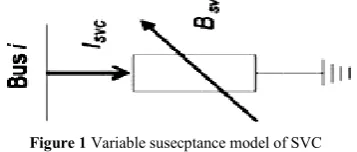
The equivalent circuit of variable susceptance model is shown in Figure 1 [26]
Figure 1 Variable susecptance model of SVC
The liberalized equation representing the total susceptance Bsvc as state variable is given by the following equation
k
svc i k
svc i k
i i
B
B
Q
Q
P
0
0
0
At each iteration (k), the variable shunt susceptance B updated
k svc k
svc k
svc
B
B
B
1
nique Based On Multi-Objective Svc For Enhancement of Power System Security
The optimization techniques used for the same are mainly GA and PSO and some other heuristic techniques. The BFOA proposed by Kevin Paso in the year 2002 has attracted many e attributed toward its less computational time, ability to provide global convergence and capability to handle more number of objective functions when compared with other evolutionary algorithms. In specific relation to its advantage for the power system is its immunity linearity of the problem. Its performance remains unaffected by the size and non-linearity, a problem like optimal location of FACTS devices can offer. It also has the ability to provide convergence where most of e analytical methods have failed. Most of the existing works employ conventional BFOA and locate the FACTS devices. Any suiTable modification and improvements in BFOA can enhance its ability to find the global solution. The very an opportunity in optimizing the tumble directions of the bacteria so that it can be guided effectively towards the global best of the population. Similarly there is also a chance to dynamically alter the chemotactic steps resulting in wider chance of the individuals in reproduction view. This works aims at exploiting these two possibilities in delivering the Modified Bacterial Foraging Optimization Algorithm (MBFOA).The proposed approach is bus system and compared with
This work aims at exploiting these two possibilities in delivering the Modified Bacterial Foraging Optimization Algorithm (MBFOA) [13,14,15] and use it for the sizing and Compensator (SVC). The SVC has salient features like voltage stability, damping of power oscillations and maintaining the voltage constant at the This work aims at exploiting these two possibilities in delivering the Modified Bacterial Foraging Optimization Algorithm (MBFOA) [13,14,15] and use it for the sizing and optimal location Static VAr Compensator The SVC has salient features like voltage stability, damping of power oscillations and maintaining the voltage
The equivalent circuit of variable susceptance model is shown
Variable susecptance model of SVC
on representing the total susceptance as state variable is given by the following equation
(1) At each iteration (k), the variable shunt susceptance Bsvc is
(2)
Based on the equivalent circuit of SVC, the current drawn by SVC is
Isvc=jBsvcVi
Reactive power drawn by SVC, which is also reactive power injected,Qsvc at bus i, is
Qsvc=QBsvc
Problem formulation
Multi-objective combinatorial optimization problems explore a finite search space for optimum and feasible solutions. These solutions should be optimum and often balance multiple objectives simultaneously. This is the fundamental challenge in different domains of
multi-objective problems are NP (Non deterministic Polynomial) time hard problems. To solve these problems, different approximation approaches tha
metaheuristic have been used over a period of time. It is important to keep in mind that while using these metaheuristic approaches is that they often identified only near optimal solutions and also suffer from parameters sensitivity. Parameter sensitivity refers to the fact that the accuracy of the result is often influenced by the parameter setting of these approaches [23,24]. In this research work one such optimization formulation has been employed. The primary goal of this formulation is to determine the optimal location and sizing of FACTS devices in a power system to enhance its security while keeping the system loses low. The proposed multi optimization problem is the representative of three different functions namely; Voltage De
Overload and Real Power Losses. The multi objective function is represented as
Min F(x) = [FV(x), FS(x), FPL(x) ]
Subject to x Є Ω, Cj(x) = 0 j = 1….n, Hk(x) 0 k = 1….p
Where F and x are the objectives and decision vectors, Ω is the solution domain.
The notations Cj(x) is equality constraint and
inequality constraint. Objective functions,
FPL (x) represents the voltage deviation, the system over load,
and real power losses.
=Ʃ
=Ʃ
= Ʃ
Where, is Nominal voltage magnitude (1 buses),Vi is the voltage magnitude for i apparent power for jth line and
apparent power for jth line. Finally, the real power at i
represented as PLi.
The proposed multi-objective function has to be optimized within certain constraints. These constraints can be very broadly classified into equality and inequality constraints. In this research work the equality constraints load flow equations for real and reactive power flo
constraints used in the generation of reactive power
Power System Security
Based on the equivalent circuit of SVC, the current drawn by
(3)
Reactive power drawn by SVC, which is also reactive power
(4)
objective combinatorial optimization problems explore a finite search space for optimum and feasible solutions. These solutions should be optimum and often balance objectives simultaneously. This is the fundamental challenge in different domains of engineering. Most of the objective problems are NP (Non deterministic Polynomial) time hard problems. To solve these problems, different approximation approaches that primarily depend on metaheuristic have been used over a period of time. It is important to keep in mind that while using these metaheuristic approaches is that they often identified only near optimal solutions and also suffer from parameters sensitivity. Parameter sensitivity refers to the fact that the accuracy of the result is often influenced by the parameter setting of these approaches [23,24]. In this research work one such optimization formulation has been employed. The primary ion is to determine the optimal location and sizing of FACTS devices in a power system to enhance its security while keeping the system loses low. The proposed multi optimization problem is the representative of three different functions namely; Voltage Deviation, System Overload and Real Power Losses. The multi objective
(x) ] (1)
Ω, Cj(x) = 0 j = 1….n, Hk(x) 0 k = 1….p
the objectives and decision vectors, Ω is
is equality constraint and Hk(x) is an
inequality constraint. Objective functions, FV(x), FS(x), and
represents the voltage deviation, the system over load,
(2)
(3)
(4)
is Nominal voltage magnitude (1pu for all load is the voltage magnitude for ith load bus, Sj is the
line and denoted as the max line. Finally, the real power at ith line is
equality and inequality constraints are also considered to evaluate Modified BFOA [23 ].
Modified Bacterial Foraging Optimization Algorithm (MBFOA)
BFOA was proposed by Kevin Passino in the year 2002 [9]. He was inspired by the social foraging behaviour of E.coli bacteria and proposed the BFOA. This algorithm has several advantages like ability to achieve global optimization, insensitivity to initial values and ability to have parallel distributed processing. Through the reproduction operation it satisfies the rule of evolution which implies the survival of fitness. The usage of elimination dispersal procedure is used to nullify the premature convergence. The bacteria generated movement in the presence of chemical attractants and repellents is referred as chemotaxis for each bacteria [9]. This process can be simulated by two distinct moves known as run or tumble. Throughout its entire life time the bacteria alternates between these two modes of operation [13,14,15]. The alteration between these two moves helps the bacteria in its search for nutrients. In the case of bacteria the reproduction step happens. During this process, the elimination and dispersal occurs so that a bacterium in a particular region is dispersed because of a particular influence. This process of elimination and dispersal can affect the chemotactic process and also assist it.
In this proposed work, our modified BFOA is employed [13,14,15]. The bacterium representing a potential solution can be denoted by (j, G). Where ‘j’ denotes the chemotaxic
loop index while ‘G’ denotes the generation cycle loop index. This generational loop can be considered as a cycle in which processes are carried out. In addition to this, a swarming process is included in chemotaxis operation. The modified BFOA includes an attracter movement within the chemotaxis process. This attracter movement is applied once within the chemotaxis loop. For the remaining steps the tumble - swim movement is used.
In addition to this, an additional swim operator is also used making the total number of swim operators to two. The two new swims are also applied within the chemotaxis process. The first operator aims to compliment the swarming operator by letting the bacteria explore other areas of search space by following randomly chosen bacteria. The second operator focuses on small movements of the bacterium in its vicinity having very small step sized values [13,14,15].
Step 1: Different BFOA parameters are initialized.
Step 2: The fitness of the objective function is evaluated.
Step 3: The chemotactic tumble or run is then initiated.
Step 4: The end of chemotactic function is checked for stopping criteria. If yes, the operation is shifted to the next step or it returns back to step 2.
Step 5: The process of reproduction is initiated.
Step 6: The process of reproduction is checked for stopping criteria. If the condition is satisfied the operation moves to step 7 or else it moves to step 2.
Step 7: The process of elimination and dispersion is initiated.
Step 8: The elimination and dispersion process is checked for its stopping criteria. If the condition is satisfied the operation moves to step 9 or else it moves to step 2.
Step 9: The optimized solution is provided.
RESULTS AND DISCUSSION
The simulated results are coded using Matlab Version 7.1 and MatPower version 5. The practical results at Neyveli Thermal Power Station (IU-NTPS) based on Modified BFOA are compared with Genetic Algorithm.
For validating the proposed approach three test cases are considered, these scenarios can be envisaged as;
Scenario 1: This is the base case with normal load in all load condition; the load flow is carried out with a load factor of 1 across all the buses.
Scenario 2: This is a critical case in which a uniform load increase of 50% is considered across all the buses.
Scenario 3: This scenario is for checking the contingency response for the highest critical line outage.
In order to validate the proposed approach, the results are compared with those achieved by other optimisation approaches namely BFOA and GA. The discussion is limited towards the optimal location and sizing for different scenarios. The influence of such placement on real power loss is also illustrated as an example to showcase the efficacy of the proposed method. The optimum location and sizing identified by different methods are incorporated in the tables of next section.
Case: Indian Utility Neyveli Thermal Power Station (IU-NTPS) 23 bus system
The study case is Indian Utility Neyveli Thermal Power Station (IU-NTPS). It is a 23 bus system. This system has 19 load buses and having 22 transmission lines. The salient feature of IU-NTPS is that it maintains the transmission lines with 4 generator buses. The bus 1 is the reference bus for determining the system data. The results are deduced for100 MVA. Outage of line 3 is considered the most critical line outages of the IU-NTPS -23 bus system. The results of size and the optimal location of SVC for all the three scenarios are listed using the Table (4) and for this placement the real power losses are calculated and tabulated using the Table (5).
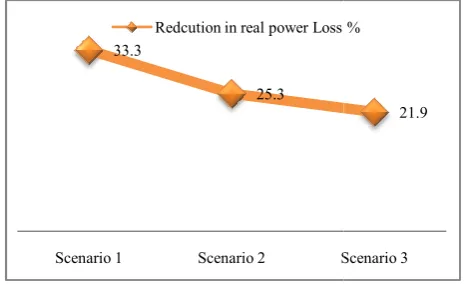
The percentage reduction in real power loss after placement of optimized size of SVC in locations identified by the algorithm is depicted using the figure (2). The percentage reduction in real power loss after placement of optimized size of SVC in locations identified by the algorithm is depicted using the figure (2)
Table 1 Optimal location and size of SVC optimized by
the proposed approach
Operating Condition
Location of SVC- Bus
Size of SVC (MVAR)
Scenario 1 13 6.13
Scenario 2 08 10.78
Scenario 3 20 9.04
Table 2 Comparison of real power loss before and after
placement of SVC
Operating Condition
Real Power loss before SVC
placement ( MW)
Real Power loss after placement
of SVC ( MW)
Scenario 1 13.5 9.0
Scenario 2 34.7 25.9
A Robust And Cost Reduction Technique Based On Multi
There is an appreciable improvement in real power losses on account of placement of SVC. For scenario 1, which is the base case the algorithm identifies bus 13
location and suggests a size of SVC to be 6.
placement results in real power losses getting reduced by 3.69 MW, which translates to a reduction of 33.3
scenario 2, the optimum size is identified to be placed at bus number 8.
Such a placement results in the reduction of real power losses from 34.7 MW to 25.9 MW. This amounts to
in real power loss. Similarly, when the critical line outage of line 3 is considered for the location of SVC placement, the optimum bus is identified to be bus number
fixed at 9.4 MVAR.
It can be inferred from the table (3) that for all the scenarios minimum voltage occurs at bus number 19. Through the location of SVC there is improvement in minimum voltage profile of these buses.
Efficacy of the proposed approach is illustrated by comparing the results of placements provided by original BFOA and GA.The results are compared with the help of table (4).
The comparative analysis of real power losses for different optimisation techniques is illustrated using the figure (3). It can be inferred from the figure the proposed approach delivers the best results in terms of reduction of real power losses.
Figure 2 Reduction in real power loss post SVC placement
33.3
25.3
Scenario 1 Scenario 2 Scenario 3 Redcution in real power Loss %
Table 3 Minimum voltage profile for different scenarios
Operating Condition
Minimum voltage occurring at Bus
number
Voltage profile before placement
of SVC(p.u)
Scenario 1 19 0.923
Scenario 2 19 0.913
Scenario 3 19 0.940
Table 4 Comparison of optimal placement and sizing
delivered by different approaches
Operating Condition
Proposed- MBFOA BFOA
Location of SVC - Bus
Size of SVC ( MVAR)
Location of SVC - Bus
Size of SVC ( MVAR)
Location
Scenario 1 13 6.13 16 6.73
Scenario 2 08 10.78 08 11.23
Scenario 3 20 9.04 13 10.01
nique Based On Multi-Objective Svc For Enhancement of Power System Security
There is an appreciable improvement in real power losses on account of placement of SVC. For scenario 1, which is the as the optimum location and suggests a size of SVC to be 6.3 MVAR. This placement results in real power losses getting reduced by 3.69 %. Similarly for scenario 2, the optimum size is identified to be 10.78 MVR
eduction of real power losses MW. This amounts to 25.3% reduction in real power loss. Similarly, when the critical line outage of is considered for the location of SVC placement, the optimum bus is identified to be bus number 20 and the size is
that for all the scenarios minimum voltage occurs at bus number 19. Through the location of SVC there is improvement in minimum voltage
Efficacy of the proposed approach is illustrated by comparing the results of placements provided by original BFOA and GA.The results are compared with the help of table (4).
The comparative analysis of real power losses for different optimisation techniques is illustrated using the figure (3). It can be inferred from the figure the proposed approach delivers the best results in terms of reduction of real power losses.
In order to have an understanding of the cost of the FACTS devices the cost is computed. The
(5) is obtained from [13,24,15].
using Table (5). It can be inferred from the Tables that for the cases, the minimum cost of SVC is obtained for placement through the proposed approach.
( ) = 0.0003 ( ) 0.3051
CONCLUSION
A modified BFOA approach for placement of SVC has been designed and presented. A multi
comprising voltage deviation, system overload and real power losses were determined and optimised using modified BFOA. For all the cases, the proposed approach delivered better results like reducing the re
increment in the voltage profile, reducing the overload and limiting the voltage deviation. The results of comparison with other optimisation approaches also testify the suitability of the present approach in identifying the loc
The performance of the proposed approach has been compared for cost and reduction in real power loss by taking Neyveli Thermal Power Station (IU
The results showed that the novel approach in achieving power system security and the reduced cost of the system.
Acknowledgements
The author is expressing sincere thanks to Neyveli Thermal Power Station (IU-NTPS) for providing the necessary data in validating the proposed approach with practical results.
References
1. N. G. Hingorani and L. Gyugyi, “Understanding FACTS: Concepts and Technology of Flexible AC Transmission System”, IEEE Press, 2000.
2. G W Stagg and A H El
Power System Analysis’, McGrawHill Book Co, 1968. Reduction in real power loss post SVC placement
21.9
Scenario 3 Redcution in real power Loss %
oltage profile for different scenarios
Voltage profile before placement
Voltage profile after placement of SVC(p.u)
1.099 0.989 0.992
Comparison of optimal placement and sizing delivered by different approaches
GA Location
of SVC - Bus
Size of SVC ( MVAR)
16 7.54 06 10.52 13 12.13
Figure 3 Plot of real power losses for different scenarios optimised by
different approaches 13.5
9 34.7
25.9 27.4
21.4
Real Power loss before SVC placement
Real Power loss after SVC placement through
MBFOA-Proposed
Scenario 1 Scenario 2
Table 5 Cost of placement of SVC as optimised by
different approaches for different test scenarios
Operating Condition
Proposed- MBFOA Size of
SVC ( MVAR)
Cost ( K US$)
Size of SVC ( MVAR)
Scenario 1 6.13 778.70456 6.73
Scenario 2 10.78 1369.41718 11.23
Scenario 3 9.04 1148.37481 10.01
Power System Security
In order to have an understanding of the cost of the FACTS devices the cost is computed. The cost function of equation is obtained from [13,24,15]. The cost analysis is tabulated . It can be inferred from the Tables that for all , the minimum cost of SVC is obtained for placement through the proposed approach.
3051 ( ) + 127.38 $ - (9)
A modified BFOA approach for placement of SVC has been designed and presented. A multi-objective function comprising voltage deviation, system overload and real power losses were determined and optimised using modified BFOA. For all the cases, the proposed approach delivered better results like reducing the real power loss, considerable increment in the voltage profile, reducing the overload and limiting the voltage deviation. The results of comparison with other optimisation approaches also testify the suitability of the present approach in identifying the location and size of SVC. The performance of the proposed approach has been compared for cost and reduction in real power loss by taking Neyveli Thermal Power Station (IU-NTPS) case.
The results showed that the novel approach in achieving ity and the reduced cost of the system.
The author is expressing sincere thanks to Neyveli Thermal NTPS) for providing the necessary data in validating the proposed approach with practical results.
. Hingorani and L. Gyugyi, “Understanding FACTS: Concepts and Technology of Flexible AC Transmission System”, IEEE Press, 2000.
G W Stagg and A H El-Abid, ‘Computer Methods in Power System Analysis’, McGrawHill Book Co, 1968.
Plot of real power losses for different scenarios optimised by different approaches
9.56 12.01 27.42 30.03
22.37 25.12
Real Power loss after Real Power loss after SVC placement through BFOA
Real Power loss after SVC placement
through GA
Scenario 2 Scenario 3
Cost of placement of SVC as optimised by different approaches for different test scenarios
BFOA GA
Size of SVC ( MVAR)
Cost ( K US$)
Size of SVC ( MVAR)
Cost ( K US$)
3. Camacho, Yuryevich Janson, “Evolutionary programming based optimal power flow algorithm.” IEEE Trans on Power Systems, 1999; 14(4): 1245-50. 4. Canizares C A and Faur Z T (1999), “Analysis of SVC
and TCSC Controllers in Voltage Collapse”, IEEE Trans. on Power Systems, Vol. 14, No. 1, pp. 158-165. 5. A. H. Sekhar and A. L. Devi, "Voltage profile improvement and power system losses reduction with multi TCSC placement in transmission system by using firing angle control model with heuristic algorithms,"
2016 International Conference on Signal Processing, Communication, Power and Embedded System (SCOPES), Paralakhemundi, 2016, pp. 295-301. 6. N. Archana and R. Vidhyapriya, "Location of
multi-type facts devices under contingency: An intelligent appproach using modified ABC," 2016 International Conference on Advances in Electrical, Electronic and Systems Engineering (ICAEES), Putrajaya, 2016, pp. 477-483.
7. I. G. Adebayo, M. A. Bhaskhar, A. A. Yusuff and A. A. Jimoh, "Optimal location identification of FACTS devices through genetic algorithm and the network structural characteristics techniques," 2016 IEEE International Conference on Renewable Energy Research and Applications (ICRERA), Birmingham, 2016, pp. 778-782.
8. A. N. Zeinhom, "Optimal sizing and allocation of Unified Power Flow Controller (UPFC) for enhancement of Saudi Arabian interconnected grid using Genetic Algorithm (GA)," 2016 Saudi Arabia Smart Grid (SASG), Jeddah, 2016, pp. 1-6.
9. A. S. Telang and P. P. Bedekar, "Systematic approach for optimal placement and sizing of STATCOM to assess the voltage stability," 2016 International Conference on Circuit, Power and Computing Technologies (ICCPCT), Nagercoil, 2016, pp. 1-6. 10. P. P. Kulkarni and N. D. Ghawghawe, "Optimal
placement and parameter setting of TCSC in power transmission system to increase the power transfer capability," 2015 International Conference on Energy Systems and Applications, Pune, 2015, pp. 735-739. 11. A. Sheth, C. D. Kotwal and S. Pujara, "Optimal
placement of TCSC for improvement of static voltage stability," 2015 5th Nirma University International Conference on Engineering (NUiCONE), Ahmedabad, 2015, pp. 1-6.
12. S. Dixit, G. Agnihotri, L. Srivastava and A. Singh, "An Overview of Placement of TCSC for Enhancement of Power System Stability," 2014 International Conference on Computational Intelligence and Communication Networks, Bhopal, 2014, pp. 1184-1187
13. Kennedy, J., Eberhart, R.: “Particle swarm optimization”. In: Proceedings of IEEE International Conference on Neural Networks, pp. 1942-1948 (1995).
14. Dorigo, M., Gambardella, L.M.: Ant Colony System: “A Cooperative Learning Approach to the Traveling Salesman Problem” IEEE Transactions on Evolutionary Computation 1(1), 53-66 (1999)
15. Holland, J.H.: “Adaptation in Natural and Artificial Systems” University of Michigan Press, Ann Harbor (1975)
16. Storm, R., Price, K.: “Differential evolution – A Simple and Efficient Heuristic for Global Optimization over Continuous Spaces “Journal of Global Optimization 11(4), 341-359 (1997)
17. Passino, K.M. “Biomimicry of Bacterial Foraging for Distributed Optimization and Control”. IEEE Control Systems Magazine, 52-67 (2002)
18. A. H. Sekhar and A. L. Devi, "Voltage profile improvement and power system losses reduction with multi TCSC placement in transmission system by using firing angle control model with heuristic algorithms,"
2016 International Conference on Signal Processing, Communication, Power and Embedded System (SCOPES), Paralakhemundi, 2016, pp. 295-301. 19. N. Archana and R. Vidhyapriya, "Location of
multi-type facts devices under contingency: An intelligent appproach using modified ABC," 2016 International Conference on Advances in Electrical, Electronic and Systems Engineering (ICAEES), Putrajaya, 2016, pp. 477-483.
20. I. G. Adebayo, M. A. Bhaskhar, A. A. Yusuff and A. A. Jimoh, "Optimal location identification of FACTS devices through genetic algorithm and the network structural characteristics techniques," 2016 IEEE International Conference on Renewable Energy Research and Applications (ICRERA), Birmingham, 2016, pp. 778-782.
21. A. N. Zeinhom, "Optimal sizing and allocation of Unified Power Flow Controller (UPFC) for enhancement of Saudi Arabian interconnected grid using Genetic Algorithm (GA)," 2016 Saudi Arabia Smart Grid (SASG), Jeddah, 2016, pp. 1-6.
22. A. S. Telang and P. P. Bedekar, "Systematic approach for optimal placement and sizing of STATCOM to assess the voltage stability," 2016 International Conference on Circuit, Power and Computing Technologies (ICCPCT), Nagercoil, 2016, pp. 1-6.
23. P. P. Kulkarni and N. D. Ghawghawe, "Optimal placement and parameter setting of TCSC in power transmission system to increase the power transfer capability," 2015 International Conference on Energy Systems and Applications, Pune, 2015, pp. 735-739. 24. A. Sheth, C. D. Kotwal and S. Pujara, "Optimal placement
of TCSC for improvement of static voltage stability,"
2015 5th Nirma University International Conference on Engineering (NUiCONE), Ahmedabad, 2015, pp. 1-6. 25. S. Dixit, G. Agnihotri, L. Srivastava and A. Singh, "An
Overview of Placement of TCSC for Enhancement of Power System Stability," 2014 International Conference on Computational Intelligence and Communication Networks, Bhopal, 2014, pp. 1184-1187
26. Selvarasu, M. Surya kalavathi.C “SVC placement for voltage constrained loss minimization using self-adaptive firefly algorithm “Archives of electrical engineering vol. 62(4), pp. 649-661 (2013)
27. Matpower Version 5.1 user manual
28. Biplab Bhattacharyya, Vikash Kumar Gupta, Sanjay Kumar, UPFC with series and shunt FACTS controllers for the economic operation of a power system, Ain Shams Engineering Journal, Volume 5, Issue 3, 2014, Pages 775-787