Volume-7 Issue-1
International Journal of Intellectual Advancements
and Research in Engineering Computations
Image steganography using LSB
Mr.S.Sambasivam, MCA, M.Phil
1, V.Logeshwaran
2, M.Nizar Ahamed
2, S.Sathana
2,
S.Sandhiya
21
Professor,
Department of MCA, Nandha Engineering College (Autonomous), Erode-52.
2Student,
Department of MCA, Nandha Engineering College (Autonomous), Erode-52.
ABSTRACT
Steganography is the technique of hiding the fact that communication is taking place, by hiding data in other data. Many different carrier file formats can be used, but digital images are the most popular because of their frequency on the Internet. For hiding secret information in images, there exist a large variety of stenographic techniques some are more complex than others and all of them have respective strong and weak points. Steganalysis, the detection of this hidden information, is an inherently diff icult problem and requires a thorough investigation so we are using “Edge detection Filter”. In this paper search how the edges of the images can be used to hiding text message in Steganography .It give the depth view of image steganography and Edge detection Filter techniques.
Keywords:
Steganography, Steganalysis, edge detection, digital image, gray image, RGB image, Binary image, 8 pixel connectivity.INTRODUCTION
The growing possibilities of Modern communication need the special mean of security on computer network. In the computer world, it is very important to keep secret information secret, private information private and protect the copyrights of data. To accomplish this task, new methods based on the principle of Image processing are being developed and used.
Method
In this paper search how the edges of the images can be used to hiding text message in Steganography. For that gray image has been presented. In this method tried to find binary value of each character of text message and then in the next stage, tried to find dark places of gray image (black) by converting the original image to binary image for labeling each object of image by considering on 8 pixel connectivity. Then these
images have been converted to RGB image in order to find dark places. Because in this way each sequence of gray color turns into RGB color and dark level of grey image is found by this way if the Gary image is very light the histogram must be changed manually to find just dark places. In the final stage each 8 pixels of dark places has been considered as a byte and binary value of each character has been put in low bit of each byte that was created manually by dark places pixels for increasing security of the main way of least Significant bit steganography. Steganalysis then used to evaluate the hiding process to ensure the data can be hidden in best possible way.
RELATED WORK
Image Processing
Image processing is any form of signal processing for which the input is an image, such as photographs or frames of video, the output of
image processing can be either an image or a set of characteristics related to the image. Now, an image is an array of numbers that represent light intensities at various points (pixels).These pixels make up the image raster data [1].
In computer vision, image processing can be done through digital images. A digital image is composed of pixels which can be thought of as small dots on the screen. A digital image is an instruction of how to colour each pixel. Each image can be divided in to number of pixels.
Image steganography
Image steganography, the covert embedding of data into digital pictures, represents a threat to the safeguarding of sensitive information and the gathering of intelligence. Steganalysis, the detection of this hidden information, is an inherently difficult problem and requires a thorough investigation. Conversely, then hider who demands privacy must carefully examine a means to guarantee stealth. A rigorous framework for analysis is required, both from the point of view of the steganalyst and the steganographer. The research concerning the technique of hiding secret message into information is usually named steganography. This is because the word “Steganography” comes from the Greek root meaning “covered writing” [2].
An image steganographic scheme is one kind of steganographic systems, where the secret message is hidden in a digital image with some hiding method. Someone can then use a proper embedding procedure to recover the hidden message from the image. The original image is called a cover image in steganography, and the message-embedded image is called a stego image
Data hiding
Background As long as people have been able to communicate with one another, there has been a desire to do so secretly. Two general approaches to covert exchanges of information have been: communicate in a way understandable by the intended parties, but unintelligible to eavesdroppers; or communicate innocuously, so no extra party bothers to eavesdrop. Naturally both of these methods can be used concurrently to enhance privacy. Naturally both of these methods can be
used concurrently to enhance privacy. The formal studies of these methods, cryptography and steganography, have evolved and become increasingly more sophisticated over the centuries to the modern digital age. Methods for hiding data into cover or host media, such as audio, images, and video, were developed about a decade Steganography generally is subjected to less vicious attacks, however much data as possible has is to be inserted [3].
The general motivation for steganalysis is to remove the veil of secrecy desired by the hider. Typical uses for steganography are for espionage, industrial or military. A steganalyst may be a company scanning outgoing emails to prevent the leaking of proprietary information, or an intelligence gatherer hoping to detect communication between adversaries.
Steganalysis is an inherently difficult problem. The original cover is not available, the number of steganography tools is large, and each tool may have many tenable parameters. However because of the importance of the problem there have been many approaches. Typically an intuition on the characteristics of cover images is used to determine a decision statistic that captures the effect of data hiding and allow discrimination between natural images and those containing hidden data. We have therefore seen an iterative process of steganography and steganalysis: a steganographic method is detected by a steganalysis tool, a new steganographic method is invented to prevent detection, which in turn is found to be susceptible to an improved steganalysis.
SYSTEM METHODOLOGY
the image suspicious. One possible solution for this problem is to select the edge-pixels of the image to hide the message. It is not noticeable when a single pixel is modified when its surrounding pixels are least like it. Once the edge pixels are selected, the edge pixels are selected randomly.
ALGORITHM AND TECHNIQUE
Connectivity of Image
Pixel Connectivity
A morphological processing starts at the peaks in the marker image and spreads throughout the rest of the image based on the connectivity of the
pixels. Connectivity defines which pixels are connected to other pixels. A group of pixels that connected based on Connectivity types called an Object [5].
Selecting Connectivity
The type of neighbourhood that may choose affects the number of objects found in an image. For example if you specify a 4-connected neighbourhood, this binary image contains three objects; if you specify an 8-connected neighbourhood, the image has one object. The gray thresh function which chooses the threshold to minimize the interclass variance of the black and white pixels.
Edge Detection
Edge detection is a problem of fundamental importance in image analysis. In typical images, edges characterize object boundaries and are therefore useful for segmentation, registration, and identification of objects in a scene. Edge detection of an image reduces significantly the amount of data and filters out information that may be regarded as less relevant, preserving the important structural properties of an image. A theory of edge detection is presented. The analysis proceeds in two parts:
Intensity changes, which occur in a natural image over a wide range of scales, are detected separately at different scales. An appropriate filter for this purpose at a given scale is found to be the second derivative of a Gaussian. Intensity changes at a given scale are best detected by finding the zero values of image. The intensity changes discovered in each of the channels are represented by oriented primitives called zero-crossing segments
. 2) Intensity changes in images arise from surface discontinuities or from reflectance or illumination Boundaries and these all have the property that they are spatially localized. Because of this, the zero crossing segments from the different channels are not independent, and rules are deduced for Combining them into a description of the image. This description is called the raw primal sketch.
Edge Detection Techniques
Edge detection aims at identifying points in a digital image at which the image brightness changes sharply
or more formally has discontinuities. Following edge detectors are handy:
Sobels Edge Detector - 3×3 gradient edge detector
Prewitt Edge Detector - 3×3 gradient edge detector.
Zero Crossing Detectors - edge detector using the Laplacian of Gaussian operator. In this paper work we are using Zero crossing detector.
Zero Crossing Detector
The zero crossing detector looks for places in the Laplacian of an image where the value of the Laplacian passes through zero --- i.e. points where the Laplacian changes sign. Such points often occur at `edges' in images --- i.e. points where the intensity of the image changes rapidly, but they also occur at places that are not as easy to associate with edges. It is best to think of the zero crossing detectors as some sort of feature detector rather than as a specific edge detector [6-10]. Zero crossings always lie on closed contours, and so the output from the zero crossing detector is usually a binary image with single pixel thickness lines showing the positions of the zero crossing points. The starting point for the zero crossing detectors is an image which has been filtered using the Laplacian of Gaussian filter. The zero crossings that result are strongly influenced by the size of
the Gaussian used for the smoothing stage of this operator. As the smoothing is increased then fewer and fewer zero crossing contours will be found, and those that do remain will correspond to features of larger and larger scale in the image.
Obtaining Image Edge
The most important features of objects in images are edges. There are several edge detection algorithms. It uses its zero-crossing property to find the location of edges. Let‟s supposed that we have the following image signal (f(t) as its describing function, with an edge it is quite clear that the gradient has a large peak centered around the edge. By comparing the gradient to a threshold value which in this case is 10 percent of the peak value, an edge can be detected if the threshold exceeds. In this case the edge has been found, but it becomes broad” due to the threshold. However, since we know the edge occurs at the peak, we can localize it by computing the one dimension and the second derivative with respect to t.
IMAGE
EMBEDDING
AND
EXTRACTING
Most steganographic systems follow the same general process for hiding and recovering data. Typically, the input for a system consists of a
most classic stenographic techniques, which embeds secret messages in a subset of the LSB plane of the image. A large number of popular steganographic tools, such as S-Tools 4, Steganos and StegoDos, are based on LSB replacement in the spatial domain. LSB steganography can be described as follows: if the LSB of the pixel value I(i, j) is equal to the message bit m to be embedded, I(i, j) remain unchanged; if not, set the LSB of I (i, j) to m. The message embedding procedure can be described using an Equation as follows;
I (i, j)-1 LSB (I(i, j))=1 and m = 0 Is ((i, j) = I(i, j) LSB (I(i, j))= m I (i, j)+1 LSB (I(i, j))≠ 0 and m = 1
In general, a p-by-q image is simply a p-by-q matrix, where each entry in the matrix is a positive integer called the pixel value, which determine the color of that pixel. For an n-bit image, these pixel values range from 0 to 2n − 1. In other words, the possible color values for each pixel in an n-bit image are the colors corresponding to the bit strings of length n. Unless there is a specific need to use the bit string representations of pixel values, we will typically use the decimal representations. In this paper, we talk primarily about 8-bit grayscale images. These images are thus p-by-q matrices of integers ranging from 0 to 255, where 0 corresponds to black, 255 to white, and the values in between form a spectrum of varying shades of gray (i.e., darker shades nearer 0 and lighter shades nearer 255). The least significant bit (LSB) is the bit corresponding to 20, that is, the bit that makes a value even or odd. Since these grayscale values form a spectrum ranging in order from dark to light, each gray value varies little from the values on either side of it. For example, the gray value 100 varies little from the gray values 99 or 101. Therefore, changing the LSB creates an imperceptible change in the image.
If pixel value = odd Then increment by 1
else if the pixel value = 255 then decrement by 1 If pixel value = odd if bit = 0
then add 1
else if pixel value = 255 if bit value = 0
then decrement by 1 else if pixel value = even if bit = 1
then increment by 1 Select the pixels of the image using the key. Increment the grey level value of the pixel by 1 if the pixel value is odd and if the value is 255 subtract it by 1. Convert the data into bit stream and compare this bit stream with the pixel values. increment pixel values by one if bit is 0 and pixel values is odd, and increase by one if bit is 1 and pixel value is even. Decrement pixel value by 1 if bit is 0 and pixel value is 255.
Least Significant Bit Extracting
Extracting is defined as the mapping pixels to image. In the image steganography the extracting process can be done on message which is the stego image. The recipient inputs the stego image, and when applicable, the steganographic key, into an extraction algorithm, which outputs the secret message. This extraction algorithm is considered the inverse of the embedding algorithm, although the embedding and extraction algorithms may be created such that the extraction algorithm is not actually the mathematical inverse of the embedding algorithm. Several factors influence the effectiveness of a steganographic system, the most important of which is the choice of the cover image. In the extraction algorithm, I have done some steps:
Initially I have stego image and key and the massage which is converted in the form of ASCII form. The hided massage is stored in Low level least significant bit.
I searched where our message is being stored, for that we set the threshold value which depends upon the cover image.
I check the stego image is even or odd then set the message bit either 0 or 1.
EXPERIMENTAL RESULT
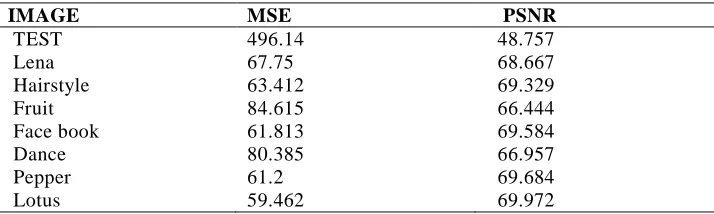
The experimental results presented in this section describe the performance of our proposed technique. For steganography we use LSB based well known embedding methods. To conduct our experiments, we have tested our scheme LSB embedding & Canny Edge Detector over more than 50 standard images of different resolutions including some of them with different images, „„Test”, „„Lena”, „„Fruit” and etc. These test images are shown in table-2. Generally, stego-image quality is considered from two aspects. First, we use the Peak Signal-to-Noise Ratio (PSNR) measurement to evaluate the difference between the stego and cover images. Second, we compare the quality of the stego image with the cover image as seen by the Human Visual System (HVS). Mean Square Error (MSE) is between the
cover and stego images. For a cover image width and height are m and n, where I denote the cover-image and K denotes the stego-cover-image MSE is defined as: The general PSNR formula is defined as: The maximum value of a pixel in grayscale image is 255. A higher PSNR indicates that the quality of the stego image is batter and more similar to the cover image. Table-5.1 shows the results of LSB method. It shows the different images with MSE and PSNR parameters. For example „Test ‟ stego-image has MSE 2.1348 and its PSNR is 44.837%, where in table-5.2 shows LSB with canny edge detector result in which images have greater PSNR and lower MSE. Table-5.3 shows the proposed method results with all above parameters. Through experimental results table-2 and 3 shows that proposed method has quite good embedding capacity.
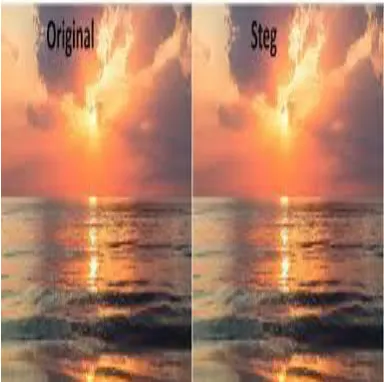
Fig 5.2 Stego Image Result of Lsb Embedding Technique
Table Lsb Embedding With Canny Edge Detector Based Results
IMAGE MSE PSNR
TEST 496.14 48.757
Lena 67.75 68.667
Hairstyle 63.412 69.329
Fruit 84.615 66.444
Face book 61.813 69.584
Dance 80.385 66.957
Pepper 61.2 69.684
Lotus 59.462 69.972
After overall comparison of all the result it is clear that LSB Embedding is simple technique but It is not robust. If an image file embedded with a secret message using LSB Coding was resample; the embedded information would be lost. It also doesn’t give clarity to the stego image which can be easily detected by human eye as shown in Fig.5.2. Robustness can be improved somewhat by using an Edge detection technique while encoding the secret message. LSB embedding with Canny edge detector gives better result as compare to the LSB technique as it gives higher PSNR value, lower MSE value and better clarity to the stego Image but still the proposed method is best among these methods. It gives highest stego image clarity with highest PSNR and lowest MSE value except in case of “TEST”& “LENA” images as given in table 5.2 & 5.3.So the objects of this paper (clarity, authentication & Security) for different kind of images is fulfilled.
CONCLUSION
A technique of information hiding using steganography, particularly edge detection filter has been presented, which is a way for labeling different color to identify dark area of image. This
approach hides the text in selected dark places but the data is not put directly in those pixels and put in low bits of each eight bit pixel. It uses the 3 advantageous approaches, which are: 1. Least significant bit insertion 2. Grey level approach with edge detection 3. Randomization The LSB insertion was used to embed the message in to the cover image. The selection of pixel to embed was crucial, since the LSB insertion modifies the pixels. Modified pixels in areas of the image where there are pixels that are most like their neighbors were much more noticeable to the normal eye. To solve this problem edge pixel were randomly selected to embed the message. The advantage of LSB is its simplicity to embed the bits of the message directly into the LSB plane of cover image. Also its perceptual transparency where the changes made to the cover-image cannot be traced by human eye. on the contrary, the LSB is very sensitive to any kind of filtering or manipulation of the stego-image. Using the edge detection approach along with least significant bit method leads to high security. Even with a little object as an image, the embedded image is just like the original one.
REFERENCES
[1]. N. F. Johnson, S. Jajodia, “Exploring Steganography: Seeing the Unseen”, Computer Journal, IEEE, 1998.
[2]. M. M. Amin, M. Salleh, S. Ibrahim, M.R.Katmin, M.Z.I. Shamsuddin , “Information Hiding using Steganography” Proceedings of 4th National Conference on Telecommunication Technology, Shah Alam, Malaysia, 2003.
[3]. N. Provos and P. honeyman, “Hide and seek : an introduction to steganography” IEEE Computer Society, 2003.
[5]. R. J. Anderson, F. A. P. Petitcolas, “On the limits of steganography”, Journal of Selected areas in communications, 16(4), 1998, 474-481.
[6]. G. J. Simmons, “The prisoner’s problem and the subliminal channel”, Proc. of CRYPTO, 1983. [7]. R. Chandramouli, M.Kharrazi, N. Memon, “Image Steganography: Concepts and Practice”, proc. Of
IWDW 2003, LNCS 2939, 2004, 35-49.
[8]. R. Radhakrishnan, K. Shanmugasundaram, N. Memon, “Data Masking: A Secure-Covert Channel Paradigm”, 2002.
[9]. D. Neeta, K. Sehal, “Implementation of LSB Steganography and its Evaluation or Various Bits”, 2004. [10]. C. Cachin, “An Information Theoretic model for steganography”, IMAGE MSE PSNR TEST 829.57