Iran J Public Health, Vol. 48, No.8, Aug 2019, pp.1395-1404
Review Article
Changes in the Paradigm of Traditional Exercise in Obesity
Therapy and Application of a New Exercise Modality: A
Narrative Review Article
Hun-Young PARK
1, Won-Sang JUNG
1, Jisu KIM
1, Hyejung HWANG
1, *Kiwon LIM
1,21. Physical Activity and Performance Institute (PAPI), Konkuk University, Seoul, Republic of Korea 2. Department of Physical Education, Konkuk University, Seoul, Republic of Korea
*Corresponding Author: Email: [email protected]
(Received 13 Mar 2019; accepted 11 May 2019)
Introduction
Obesity is caused by the accumulation of exces-sive body fat via a positive energy balance, mani-fested by a higher energy intake than energy con-sumption during resting, physical activity, and exercise (1). Obesity is recognized as an im-portant global health problem that increases the risk of death from all causes and is a major risk factor for various cardiovascular and metabolic diseases (2, 3).
Among the various methods of treating obesity, physical activity is effective in treating obesity via weight and visceral fat loss and for maintaining or increasing muscle mass (4-7). The traditional exercise modality for obesity treatment is moder-ate-intensity continuous training (MICT), which involves continuous exercise at a moderate inten-sity, without rest, for at least 30 minutes (8). High-intensity interval training (HIIT) is an exer-Abstract
Background: Obesity is recognized as an important global health problem that increases the risk of all-cause
death. It is a major risk factor for various cardiovascular and metabolic diseases.
Methods: We conducted this review through searching the related literature plus internet links.
Results: Recently, many researchers have been applying various efficient alternative exercise paradigms for treating obesity, such as high-intensity interval training, whole-body vibration training, and hypoxic therapy. Compared with moderate-intensity continuous training, high-intensity interval training involves a shorter exer-cise time but higher energy expenditure and excess post-exerexer-cise oxygen consumption via a higher exerexer-cise in-tensity and is effective for treating obesity. Whole-body vibration training effectively reduces the rate of fat production and accumulation through passive vibration of the whole body and improving the body composi-tion, muscle funccomposi-tion, and cardiovascular function of the obese population. Hypoxic therapy has been reported to improve obesity and obesity-related diseases through appetite loss, reduced dietary intake, increased energy consumption, improved glycogen storage and fatty acid oxidation, angiogenesis and left ventricle remodeling, decreased mechanical load, and reduced sarcopenia progression due to aging.
Conclusion: The new therapeutic exercise modalities, namely, high-intensity interval training, whole-body
vi-bration training, and hypoxic therapy, are practical, useful, and effective for improving obesity and various met-abolic and cardiovascular diseases induced by obesity.
cise modality involving repeated performance of high-intensity exercises and short periods of rest. Currently, HIIT is widely used as an efficient al-ternative to the traditional exercise modality be-cause of its high energy consumption and excess post-exercise oxygen consumption (EPOC) rela-tive to those during exercise (9-11). Whole-body vibration training (WBVT), which uses equip-ment to manually vibrate the whole body, is also widely used as a new form of exercise for treating obesity (12, 13). The application of WBVT in an obese population for more than 6 weeks has been reported to reduce the rate of fat production and accumulation and to improve body composition, neuromuscular function, and cardiovascular func-tion (14-19). In addifunc-tion, hypoxic therapy, which involves various forms of intermittent exercise under hypoxic conditions, is widely used as a new exercise paradigm for obesity treatment in many countries (1, 20, 21). Hypoxic therapy has been reported to improve obesity and obesity-related diseases via appetite loss, reduced dietary intake, increased energy consumption, improved glyco-gen storage and fatty acid oxidation, angioglyco-genesis and left ventricle remodeling, decreased mechani-cal load, and reduced sarcopenia progression due to aging (1, 21-24).
This review summarizes the recent evidence that suggests that the new exercise paradigms, namely HIIT, WBVT, and hypoxic therapy, can be valu-able and vivalu-able therapeutic modalities for obesity and obesity-related diseases.
Effectiveness of HIIT for treating obesity Until recently, the most commonly used exercise modality for obesity treatment has been MICT (8). Currently, HIIT is being widely used for obe-sity treatment (9, 10). HIIT is popular for treating obesity because of its high energy consumption and EPOC over the exercise time (11). HIIT has been reported to improve obesity and obesity-related diseases by reducing abdominal visceral fat, maintaining or increasing fat mass, and im-proving metabolic function (insulin sensitivity) through greater stimulation of skeletal muscles (8, 22-24).
Wewege et al (8) examined 13 previous studies that compared MICT and HIIT and reported an exercise frequency of 3.3 ± 0.7 times per week for both MICT and HIIT and an exercise dura-tion of 158.3 ± 43.0 minutes/week for MICT and 95.2 ± 46.3 minutes/week for HIIT. Accord-ing to a meta-analysis, both MICT and HIIT that involved running exercise for more than 10 weeks resulted in a similar reduction in body weight (approximately 2 kg), body fat mately 6%), and waist circumference (approxi-mately 3 cm). However, HIIT required a 40% shorter exercise time than MICT. Shuster et al. (23) reported that a 12-week exercise program reduced abdominal visceral fat by 11.1% and 19.5% in the MICT and HIIT groups, respective-ly. Zhang et al (24) examined the usefulness of MICT and HIIT for reducing general and ab-dominal fats by using computed tomography in 45 overweight women. They reported that MICT and HIIT showed the same proportions of changes in total body fat and blood lipid levels. Abdominal subcutaneous fat decreased in both groups, but HIIT showed a larger decrease, and abdominal visceral fat showed a significant de-crease only in the HIIT group (18% vs. 8% for the MICT group). Maillard et al (22) verified the effect of MICT and HIIT for 16 weeks (twice a week) on reducing general and abdominal fats in 17 menopausal women with type 2 diabetes mellitus. They found no significant difference in serum lipid levels and diabetes mellitus between the MICT and HIIT groups, but significant de-creases in abdominal (−8.3%) and visceral (−24.2%) fat percentages were observed in the HIIT group.
coronary artery disease. These results suggest that HIIT may be useful as a sustainable and long-term intervention for many overweight or obese people who spend less time on exercise training. In the future, it will be necessary to study various changes in fat mass in the whole body and local areas using methods such as computed tomogra-phy, magnetic resonance imaging, and dual-energy x-ray absorptiometry, which have a higher validity and reliability for measuring body fat. However, when HIIT is used for patients with severe obesity, a more careful approach is needed because mechanical stress may damage joints.
Effectiveness of passive exercise for treating obesity
The most commonly used passive exercise meth-od for treating obesity is WBVT, which passively vibrates the whole body. As the name implies, WBVT produces motion by applying vibrational stimulation to the whole body in different pos-tures on a vibrating platform. Generally, WBVT equipment generates vibration using rotation or vertical stimulation, which provides an exercise effect. Initially, WBVT was used primarily as an alternative form of exercise for resistance training (13). WBVT mechanically induces rapid changes in the length of the muscle-tendon complex re-sulting in repetitive eccentric-concentric muscle movement and reflexive muscle contraction (27, 28). In other words, WBVT is universally recog-nized as an alternative to resistance exercise to improve muscle activity, strength, and power as-sociated with muscle training (12, 29), and is used to improve the exercise performance of athletes and young adults (27, 30, 31).
Recently, WBVT has been reported to reduce body fat in overweight and obese people by re-ducing the rate of fat production and accumula-tion, and improve bone density, muscle strength, and cardiovascular function (14-19). WBVT for 10 weeks has been reported to induce significant weight loss in overweight and obese individuals (17, 32-36). Even if weight is not reduced, WBVT induces body composition remodeling through reduction of body and visceral fat per-centages (33, 36-40). In addition, WBVT
stimu-lates white adipose tissue through increased cen-tral sympathetic activity, increases lipolysis, proves insulin action and glucose control to im-prove blood glucose control, and promotes the release of growth hormone and metabolic stimu-lation, which leads to a decrease in body fat (13, 41-45). These mechanisms are reported to be ef-fective in postmenopausal women, especially those with increased insulin resistance and de-creased bone density due to hormonal changes (46, 47).
oste-oblasts by creating shear stress in the plasma membrane (13, 19).
Many of these studies support the claim that WBVT is a highly effective method of promoting health in a wide range of subjects, including obese patients who cannot perform traditional exercise (e.g., MICT). In conclusion, WBVT is an effective alternative exercise modality that pre-vents and improves obesity and obesity-related diseases with less burden on the back, waist, and knee joints because it generates less mechanical stress than traditional exercise methods such as MICT and HIIT. However, the use of WBVT for therapeutic purposes is still not standardized, and its potential adverse effects are uncertain (13, 40). Especially the effects of long-term vibration stimulation on the human brain have not been studied (13). Therefore, standardization is needed for the therapeutic use of WBVT in the man-agement of obesity, and a precise description of the causal relationship between vibration parame-ters (amplitude, vibration type, and vibration speed) and the results is also needed.
Effectiveness of hypoxic therapy for treating obesity
Exercise modalities such as MICT, HIIT, and WBVT usually require at least 12 weeks of exer-cise intervention for prevention and treatment of obesity, but they have the disadvantage of in-creasing appetite and dietary intake due to sus-tained exercise (1, 48). On the basis of previous studies that showed that people living at high alti-tudes have lower percent body fat, blood lipid levels, arterial pressures, and prevalence rates of obesity-related disease than people living at sea level, many advanced countries are using hypoxic condition as a new therapeutic modality for obe-sity (1, 21, 49). Exercise intervention under hy-poxic conditions, owing to various physiological mechanisms, has been reported to reduce appe-tite and dietary intake, increase blood flow in muscle tissue, increase energy consumption, re-duce mechanical load, improve glycogen storage and fat oxidation, slow sarcopenia due to aging, and induce angiogenesis and left ventricle remod-eling (1, 21, 50-53).
Hypoxia is a state of reduced oxygen supply to tissues due to decreased oxygen saturation of ar-terial blood (54). Living long-term at a high alti-tude has been reported to reduce the possibility of obesity (55), and short-term stays for 1–3 weeks at a high altitude reduce weight and arterial pressure and improve metabolic function without exercise intervention (56-63). However, it is im-possible for obese people to live in a natural high altitude, which may cause side effects such as ob-structive sleep apnea or acute mountain sickness (63, 64).
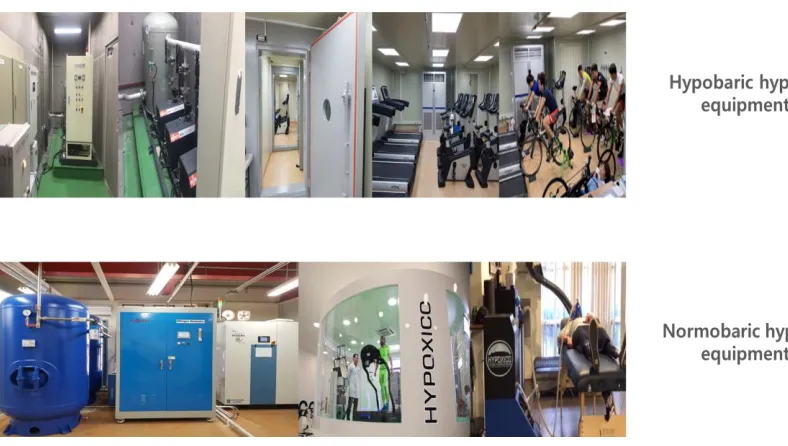
Therefore, various types of commercial equip-ment are being developed to artificially create hypobaric hypoxia and normobaric hypoxia (65). Hypobaric hypoxia is a hypoxic condition created by using a vacuum pump to reduce the air pres-sure in a rigid structure that can withstand high-pressure differentials. This method is difficult to apply to obese patients because it is inconvenient and expensive. Normobaric hypoxia is a hypoxic condition created by lowering the relative oxygen concentration through nitrogen injection using a nitrogen generator, which is inexpensive and simple to use and be can easily applied to the obese population (Fig. 1). For normobaric hy-poxia, the subject is exposed to a hypoxic condi-tion with a 15.0–12.0% fraccondi-tion of inspired oxy-gen (FIO2), simulating an altitude of 2,600–4,300 m, while breathing using a mask or staying in a specific space such as a chamber, room, or tent (50).
im-proved insulin sensitivity, decreased dietary intake and serum leptin level elevation, increased basal metabolic rate, and decreased diastolic blood pressure, thereby effectively preventing and treat-ing obesity and obesity-related diseases (57, 67). Exercise intervention in hypoxic conditions has been reported to improve obesity and obesity-associated complications through activation of the body’s immune function, strengthening
met-abolic function, reducing body weight and per-cent body fat, and strengthening the cardiovascu-lar system, even though it lowers exercise and mechanical stress (1, 20). Especially exercise in-tervention in hypoxic conditions (simulating an altitude of 2,000–3,000 m) induces specific mo-lecular adaptations that do not occur during exer-cise in normoxia (68-72).
Fig. 1: Hypobaric and normobaric hypoxic equipment
Specific molecular adaptation via exercise inter-vention in hypoxia is associated with increased secretion of norepinephrine (73), decreased plasma leptin levels (74, 75), decreased appetite (1, 76), increased number of mitochondria (21), increased glycolytic enzyme activity (77), in-creased insulin sensitivity, and dein-creased diastolic blood pressure (52, 78). The metabolic pheno-type of obese subjects seems to be improved by these physiological adaptations. In a previous study, Haufe et al (79) divided 20 healthy men into two groups that performed similar exercise training at 15% FIO2 and 21% FIO2; all subjects exercised three times weekly for 60 min for 4 weeks at a heart rate measured at 3 mmol/L lac-tate at pretraining exercise testing. They reported greater improvements in percent body fat, tri-glycerol and fasting insulin levels, area under the
subjects to either a normobaric hypoxia (FIO2 = 16.4–14.5%) or a normobaric (FIO2 = 21%) training group, and all the subjects experienced 16 hours normoxia and 6 hours hypoxia or 22 hours normoxic training weekly. They investigat-ed whether exercise intervention in normobaric hypoxic conditions combined with a low-caloric diet had an additive effect on weight loss as compared with normoxic training in obese young adults. Exercise intervention in hypoxia with a low-caloric diet additively improved body weight loss as compared with normoxic training (−6.9 kg or −7.0% vs. −4.3 kg or −4.2%). Park and Lim (52) determined the effect of aerobic exer-cise in hypoxic conditions for 6 weeks on body composition, blood pressure, arterial stiffness, and blood lipid levels in 35 obese women aged 30–60 years with a body mass index >30 kg/m2 and 30% body fat. The participants were divided into three training groups, as follows: normoxic, 16.5% O2 hypoxic, and 14.5% O2 hypoxic. They demonstrated that exercise training under hypox-ic conditions had positive effects on body com-position, blood pressure, arterial stiffness, and blood lipid levels in middle-aged obese women as compared with exercise intervention in normoxic conditions.
Given the biomechanical aspects, hypoxic condi-tions can meet the metabolic demands for obesity prevention and treatment at a lower exercise in-tensity than normoxic conditions. In other words, exercise in hypoxic conditions involves lower mechanical stress than normoxic condi-tions but results in greater weight loss and bene-fits for metabolic and cardiovascular health. Thus, exercise in hypoxic conditions is a highly effective exercise modality that reduces the risk of damage to the musculoskeletal system in obese subjects and allows them to reach their target en-ergy consumption (20). Furthermore, resistance exercise under hypoxic conditions seems to more effectively prevent sarcopenia, which progresses rapidly with aging and obesity, and is highly cor-related with cardiovascular and metabolic diseas-es, via greater hypertrophy, increased muscle strength and endurance, and increased
angiogen-esis in skeletal muscles as compared to those un-der normoxic conditions (21, 51, 80).
Taken together, combined exercise intervention and hypoxic conditions are considered effective in preventing and treating obesity and obesity-related diseases by improving various physiologi-cal mechanisms and preventing injury through lower mechanical stress and exercise intensity.
Conclusion
To date, the most common exercise modality for preventing and treating obesity has been MICT, which is a traditional exercise method involving continuous exercise at a moderate intensity with-out resting for at least 30 minutes. Currently, var-ious exercise programs such as HIIT, WBVT, and hypoxic therapy, which can reduce body weight and improve the health of obese subjects more efficiently, in accordance with the demands of the current lifestyles, are being developed. HIIT can be effective for people with limited time because of its higher energy consumption than MICT. WBVT is a form of passive exercise that can improve muscle function and bone den-sity through muscle nerve stimulation and weight loss in obese subjects. Finally, hypoxic therapy is a new exercise modality that can prevent and treat obesity and obesity-related disease via lower mechanical stress and various physiological mechanisms such as reduced dietary intake and appetite, improved body composition, and en-hanced metabolism and cardiovascular fitness.
Ethical considerations
Ethical issues (Including plagiarism, informed consent, misconduct, data fabrication and/or fal-sification, double publication and/or submission, redundancy, etc.) have been completely observed by the authors.
Acknowledgements
Conflict of interest
The authors declare no conflicts of interest.
References
1. Park HY, Kim J, Park MY, et al (2018). Expo-sure and exercise training in hypoxic condi-tions as a new obesity therapeutic modality: a mini review. J Obes Metab Syndr, 27:93-101. 2. Flegal KM, Kit BK, Orpana H, Graubard BI
(2013). Association of all-cause mortality with overweight and obesity using standard body mass index categories: a systematic review and meta-analysis. JAMA, 309:71-82.
3. Poirier P, Giles TD, Bray GA, et al (2006). Obe-sity and cardiovascular disease: pathophysiol-ogy, evaluation, and effect of weight loss. Ar-terioscler Thromb Vasc Biol, 26:968-76.
4. Chin SH, Kahathuduwa CN, Binks M (2016). Physical activity and obesity: what we know and what we need to know. Obes Rev, 17:1226-44.
5. Ohkawara K, Tanaka S, Miyachi M, Ishikawa-Takata K, Tabata I (2007). A dose-response relation between aerobic exercise and visceral fat reduction: systematic review of clinical tri-als. Int J Obes (Lond), 31:1786-97.
6. Shook RP (2016). Obesity and energy balance: What is the role of physical activity? Expert Rev Endocrinol Metab, 11:511-20.
7. Verheggen RJ, Maessen MF, Green DJ, et al (2016). A systematic review and meta-analysis on the effects of exercise training versus hy-pocaloric diet: distinct effects on body weight and visceral adipose tissue. Obes Rev, 17:664-90.
8. Wewege M, van den Berg R, Ward RE, Keech A (2017). The effects of high-intensity interval training vs. moderate-intensity continuous training on body composition in overweight and obese adults: a systematic review and me-ta-analysis. Obes Rev, 18:635-46.
9. Elliott AD, Rajopadhyaya K, Bentley DJ, Bel-trame JF, Aromataris EC (2015). Interval training versus continuous exercise in patients with coronary artery disease: a meta-analysis. Heart Lung Circ, 24:149-57.
10. Liou K, Ho S, Fildes J, Ooi SY (2016). High In-tensity Interval versus Moderate InIn-tensity Continuous Training in Patients with Coro-nary Artery Disease: A Meta-analysis of Phys-iological and Clinical Parameters. Heart Lung Circ, 25:166-74.
11. Trost SG, Owen N, Bauman AE, Sallis JF, Brown W (2002). Correlates of adults' partici-pation in physical activity: review and update. Med Sci Sports Exerc, 34:1996-2001.
12. Roelants M, Delecluse C, Verschueren SM (2004). Whole-body-vibration training in-creases knee-extension strength and speed of movement in older women. J Am Geriatr Soc, 52:901-8.
13. Zago M, Capodaglio P, Ferrario C, Tarabini M, Galli M (2018). Whole-body vibration training in obese subjects: A systemic review. PLoS One, 13:e0202866.
14. Bogaerts ACG, Delecluse C, Claessens AL, et al (2009). Effects of whole body vibration train-ing on cardiorespiratory fitness and muscle strength in older individuals (a 1-year ran-domised controlled trial). Age Ageing, 38:448-54.
15. Lohman EB, Petrofsky JS, Maloney-Hinds C, Betts-Schwab H, Thorpe D (2007). The ef-fect of whole body vibration on lower ex-tremity skin blood flow in normal subjects. Med Sci Monit, 13:CR71-6.
16. Maddalozzo GF, Iwaniec UT, Turner RT, Rosen CJ, Widrick JJ (2008). Whole-body vibration slows the acquisition of fat in mature female rats. Int J Obes (Lond), 32:1348-54.
17. Nam SS, Sunoo S, Park HY, Moon HW (2016). The effects of long-term whole-body vibra-tion and aerobic exercise on body composi-tion and bone mineral density in obese mid-dle-aged women. J Exerc Nutrition Biochem, 20:19-27.
18. Prisby RD, Lafage-Proust MH, Malaval L, Belli A, Vico L (2008). Effects of whole body vi-bration on the skeleton and other organ sys-tems in man and animal models: What we know and what we need to know. Ageing Res Rev, 7:319-29.
20. Girard O, Malatesta D, Millet GP (2017). Walk-ing in hypoxia: An efficient treatment to less-en mechanical constraints and improve health in obese individuals? Front Physiol, 8:73. 21. Urdampilleta A, González-Muniesa P, Portillo
MP, Martínez JA (2012). Usefulness of com-bining intermittent hypoxia and physical exer-cise in the treatment of obesity. J Physiol Bio-chem, 68:289-304.
22. Maillard F, Rousset S, Pereira B, et al (2016). High-intensity interval training reduces ab-dominal fat mass in postmenopausal women with type 2 diabetes. Diabetes Metab, 42:433– 41.
23. Shuster A, Patlas M, Pinthus JH, Mourtzakis M (2012). The clinical importance of visceral ad-iposity: a critical review of methods for vis-ceral adipose tissue analysis. Br J Radiol, 85:1– 10.
24. Zhang H, Tong TK, Qiu W, et al (2015). Effect of high-intensity interval training protocol on abdominal fat reduction in overweight Chi-nese women: A randomized controlled trial. Kinesiology, 47:57-66.
25. Welch N, McNaughton SA, Hunter W, Hume C, Crawford D (2009). Is the perception of time pressure a barrier to healthy eating and physical activity among women? Public Health Nutr, 12:888–95.
26. Rognmo Ø, Moholdt T, Bakken H, et al (2012). Cardiovascular risk of high- versus moderate-intensity aerobic exercise in coronary heart disease patients. Circulation, 126:1436–40. 27. Cardinale M, Bosco C (2003). The use of
vibra-tion as an exercise intervenvibra-tion. Exerc Sport Sci Rev, 31:3-7.
28. Cochrane DJ (2011). Vibration exercise: The po-tential benefits. Int J Sports Med, 32:75-99. 29. Delecluse C, Roelants M, Verschueren S (2003).
Strength increase after whole-body vibration compared with resistance training. Med Sci Sports Exerc, 35:1033-41.
30. Bosco C, Colli R, Introini E, et al (1999). Adap-tive responses of human skeletal muscle to vibration exposure. Clin Physiol, 19:183-7. 31. Jordan MJ, Norris SR, Smith DJ, Herzog W
(2005). Vibration training: an overview of the area, training consequences, and future con-siderations. J Strength Cond Res, 19:459-66. 32. Adsuar J, B Del Pozo-Cruz, Parraca J, et al
(2013). Vibratory Exercise Training Effects
on Weight in Sedentary Women with Fi-bromyalgia. Int J Med Sci Phys Act Sport, 13:295-305.
33. Milanese C, Piscitelli F, Zenti MG, et al (2013). Ten-week whole-body vibration training im-proves body composition and muscle strength in obese women. Int J Med Sci, 10:307-11.
34. Miyaki A, Maeda S, Choi Y, et al (2012). The ad-dition of whole-body vibration to a lifestyle modification on arterial stiffness in over-weight and obese women. Artery Res, 6:85-91. 35. Sañudo B, Alfonso-Rosa R, Del Pozo-Cruz B, et
al (2013). Whole body vibration training im-proves leg blood flow and adiposity in pa-tients with type 2 diabetes mellitus. Eur J Appl Physiol, 113:2245-52.
36. Vissers D, Verrijken A, Mertens I, et al (2010). Effect of long-term whole body vibration training on visceral adipose tissue: A prelimi-nary report. Obes Facts, 3:93-100.
37. Figueroa A, Alvarez-Alvarado S, Ormsbee MJ, et al (2015). Impact of l-citrulline supplementa-tion and whole-body vibrasupplementa-tion training on ar-terial stiffness and leg muscle function in obese postmenopausal women with high blood pressure. Exp Gerontol, 63:35-40. 38. Severino G, Sanchez-Gonzalez M,
Walters-Edwards M, et al (2017). Whole-body vibra-tion training improves heart rate variability and body fat percentage in obese Hispanic postmenopausal women. J Aging Phys Act, 25:395-401.
39. So R, Eto M, Tsujimoto T, Tanaka K (2014). Acceleration training for improving physical fitness and weight loss in obese women. Obes Res Clin Pract, 8:e201-e98.
40. Wilms B, Frick J, Ernst B, et al (2012). Whole body vibration added to endurance training in obese women - a pilot study. Int J Sports Med, 33:740-3.
41. Bellia A, SallõÁ M, Lombardo M, et al (2014). Effects of whole body vibration plus diet on insulin-resistance in middle-aged obese sub-jects. Int J Sports Med, 35:511-6.
42. Di Loreto C, Ranchelli A, Lucidi P, et al (2004). Effects of whole-body vibration exercise on the endocrine system of healthy men. J Endo-crinol Invest, 27:323-7.
body vibration alone or combined with squat-ting plus external load in severely obese fe-male subjects. Obes Facts, 5:567-74.
44. Sartorio A, Spada A, Morabito F, Faglia G (1988). Different GH responsiveness to re-peated GHRH administration in normal chil-dren and adults. J Endocrinol Invest, 11:727-9. 45. Snitker S, Macdonald I, Ravussin E, Astrup A
(2000). The sympathetic nervous system and obesity: role in aetiology and treatment. Obes Rev, 1:5-15.
46. Piché ME, Lapointe A, Weisnagel SJ, et al (2008). Regional body fat distribution and metabolic profile in postmenopausal women. Metabolism, 57:1101-7.
47. Premaor MO, Ensrud K, Lui L, et al (2011). Risk factors for nonvertebral fracture in obese old-er women. J Clin Endocrinol Metab, 96:2414-21. 48. Wu T, Gao X, Chen M, van Dam RM (2009).
Long-term effectiveness of diet-plus-exercise interventions vs. diet-only interventions for weight loss: a meta-analysis. Obes Rev, 10:313-23.
49. Netzer N, Strohl K, Faulhaber M, Gatterer H, Burtscher M (2013). Hypoxia-related altitude illnesses. J Travel Med, 20:247-55.
50. Hobbins L, Hunter S, Gaoua N, Girard O (2017). Normobaric hypoxic conditioning to maximize weight loss and ameliorate cardio-metabolic health in obese population: a sys-temic review. Am J Physiol Regul Integr Comp Physiol, 313:R251-R64.
51. Kayser B, Verges S (2013). Hypoxia, energy bal-ance and obesity: from pathophysiological mechanisms to new treatment strategies. Obes Rev, 14:579-92.
52. Park HY, Lim K (2017). The effects of aerobic exercise at hypoxic condition during 6 weeks on body composition, blood pressure, arterial stiffness, and blood lipid level in obese wom-en. Int J Sports Sci Med, 1:1-5.
53. Wee J, Climstein M (2015). Hypoxic training: Clinical benefits on cardiometabolic risk fac-tors. J Sci Med Sport, 18:56-61.
54. Heinonen IHA, Boushel R, Kalliokoski KK (2016). The circulatory and metabolic re-sponses to hypoxia in humans–with special reference to adipose tissue physiology and obesity. Front Endocrinol (Lausanne), 7:116. 55. Voss JD, Allison DB, Webber BJ, Otto JL, Clark
LL (2014). Lower obesity rate during
resi-dence at high altitude among a military popu-lation with frequent migration: a quasi-experimental model for investigating spatial causation. PLoS One, 9:e93493.
56. Boyer SJ, Blume FD (1984). Weight loss and changes in body composition at high altitude. J Appl Physiol Respir Environ Exerc Physiol, 57:1580–5.
57. Lippl FJ, Neubauer S, Schipfer S, et al (2010). Hypobaric hypoxia causes body weight reduc-tion in obese subjects. Obesity, 18:675–81. 58. Ri-Li G, Chase PJ, Witkowski S, et al (2003).
Obesity: associations with acute mountain sickness. Ann Intern Med, 139:253–7.
59. Schobersberger W, Schmid P, Lechleitner M, et al (2003). Austrian Moderate Altitude Study 2000 (AMAS 2000). The effects of moderate altitude (1,700 m) on cardiovascular and met-abolic variables in patients with metmet-abolic syndrome. Eur J Appl Physiol, 88:506–14. 60. Shukla V, Singh SN, Vats P, et al (2005). Ghrelin
and leptin levels of sojourners and acclima-tized lowlanders at high altitude. Nutr Neurosci, 8:161–5.
61. Westerterp KR, Kayser B, Wouters L, Le Trong JL, Richalet JP (1994). Energy balance at high altitude of 6,542 m. J Appl Physiol, 77:862–6. 62. Westerterp-Plantenga MS, Westerterp KR,
Rub-bens M, et al (1999). Appetite at “high alti-tude” [Operation Everest III (Comex-’97)]: a simulated ascent of Mount Everest. J Appl Physiol, 87:391–9.
63. Yang B, Sun ZJ, Cao F, et al (2015). Obesity is a risk factor for acute mountain sickness: a pro-spective study in Tibet railway construction workers on Tibetan plateau. Eur Rev Med Pharmacol Sci, 19:119–22.
64. Kendzerska T, Leung RS, Gershon AS, Tomlin-son G, Ayas N (2016). The interaction of obesity and nocturnal hypoxemia on cardio-vascular consequences in adults with suspect-ed obstructive sleep apnea. A historical ob-servational study. Ann Am Thorac Soc, 13:2234–41.
66. Workman C, Basset FA (2012). Post-metabolic response to passive normobaric hypoxic ex-posure in sedendary overweight males: a pilot study. Nutr Metab (Lond), 9:103.
67. Mekjavic IB, Amon M, Kölegård R, et al (2016). The effect of normobaric hypoxic confine-ment on metabolism, gut hormones, and body composition. Front Physiol, 7:202. 68. Gatterer H, Haacke S, Burtscher M, et al (2015).
Normobaric intermittent hypoxia over 8 months does not reduce body weight and metabolic risk factors–a randomized, single blind, placebo-controlled study in normobaric hypoxia and normobaric sham hypoxia. Obes Facts, 8: 200–9.
69. Kong Z, Zang Y, Hu Y (2014). Normobaric hy-poxia training causes more weight loss than normoxia training after a 4-week residential camp for obese young adults. Sleep Breath, 18:591–7.
70. Morishima T, Kurihara T, Hamaoka T, Goto K (2014). Whole body, regional fat accumula-tion, and appetite-related hormonal response after hypoxic training. Clin Physiol Funct Imag-ing, 34:90–7.
71. Netzer NC, Chytra R, Küpper T (2008). Low in-tense physical exercise in normobaric hypoxia leads to more weight loss in obese people than low intense physical exercise in normo-baric sham hypoxia. Sleep Breath, 12:129–34. 72. Wiesner S, Haufe S, Engeli S, et al (2010).
Influ-ences of normobaric hypoxia training on physical fitness and metabolic risk markers in
overweight to obese subjects. Obesity (Silver Spring), 18:116–20.
73. Calbet JA (2003). Chronic hypoxia increases blood pressure and noradrenaline spillover in healthy humans. J Physiol, 551:379–86. 74. Kelly KR, Williamson DL, Fealy CE, et al (2010).
Acute altitude-induced hypoxia suppresses plasma glucose and leptin in healthy humans. Metabolism, 59:200–5.
75. Verges S, Chacaroun S, Godin-Ribuot D, Baillieul S (2015). Hypoxic conditioning as a new therapeutic modality. Front Pediatr, 3:58. 76. Mackenzie R, Maxwell N, Castle P, et al (2011).
Acute hypoxia and exercise improve insulin sensitivity (S(I) (2*)) in individuals with type 2 diabetes. Diabetes Metab Res Rev, 27:94–101. 77. Fenkci S, Sarsan A, Rota S, Ardic F (2006).
Ef-fects of resistance or aerobic exercises on metabolic parameters in obese women who are not on a diet. Adv Ther, 23:404–13. 78. Shatilo VB, Korkushko OV, Ischuk VA,
Downey HF, Serebrovskaya TV (2008). Ef-fects of intermittent hypoxia training on exer-cise performance, hemodynamics, and venti-lation in healthy senior men. High Alt Med Bi-ol, 9:43–52.
79. Haufe S, Wiesner S, Engeli S, Luft FC, Jordan J (2008). Influences of normobaric hypoxia training on metabolic risk markers in human subjects. Med Sci Sports Exerc, 40:1939-44. 80. Millet GP, Debevec T, Brocherie F, Malatesta D,