A Three-Layer Visual Hash Function Using Adler-32
Andysah Putera Utama Siahaan
Faculty of Computer Science, Universitas Pembangunan Panca Budi, Jl. Jend. Gatot Subroto Km. 4,5 Sei Sikambing, 20122, Medan, Sumatera Utara, Indonesia
ABSTRACT
The visual integrity needs to be implemented in sending a picture. There is various image received have no originality. The small change of the pixels does not make the picture content detected by the eye. The integrity validation is very important to be applied. The picture captured by a camera has two dimensions. It is described in pixels such as Width and Length. This study is to validate all the pixels data or the color intensity of both dimensions. If there are a modification in the pixel, this method will give the wrong hash data. The validator will analyze the pixels in every layer such as red, green and blue to ensure the data transmitted is correct. Once there is a slight change in the pixels, the calculation gives the wrong value. It is very useful to compare the image before and after transmission.
Keywords: Hash Function, Adler-32, Security.
1. INTRODUCTION
Integrity is an aspect that ensures that the data must not be changed without the permission of the authorized competent [3]. For the application of digital imaging, integrity aspect is paramount. It contains the confidential information [2]. Access to data is often sought after by
intruders [6][9]. The picture that has been submitted cannot be changed by the unauthorized parties. Violation of this would result in malfunctioning of the validation. It is especially in the fields of education, medicine, military, etc. It needs to prove the originality of the content. Some of them are used as the evidence of a fact. The integrity validation is not only saving someone's life, but it can be implemented on a security side. The highly use of imaging system leads to the data exchange over the air while attaching to the international network. While communication it is imperative to verify the message so that intruder cannot replace with the fake information [5].
For example, when the computer sends the picture, the third party can intercept it in the air, modify the content of the picture and send it to its destination. We should send them with the verification or the message digest.
When the receiver checks the hash of the image, they can compare it to the hash send simultaneously. Sometimes, we do not understand what they are. The information retrieved is used directly without verification. Once we start it, it might run the script consists of some trojan or virus lines. Certain methods of checksums provide the way to verification to ensure the visual integrity [6]. Adler-32 presents to be a practical approach to help manage the originality.
2. THEORIES
2.1
Data Integrity
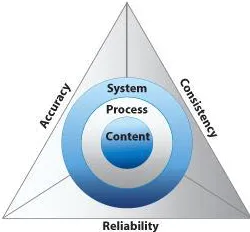
Security goals cover three points such as availability, confidentiality, and integrity [7]. A Understanding data integrity broadly refers to the confidence of resource system. Data integrity is paramount because it can ensure the data accuracy, consistency, accessibilities, and the high quality. Following the integrity rules is important. Data with integrity is identical on hold during any operation such as business transfer, storage or retrieval. In simple computer terms, data integrity is the assurance that data is consistent, certified and referenced. Data integrity means that the accuracy and correctness. Data integrity in a database system must be maintained to keep the truth of the stored data. Figure 1 illustrate the scheme of data integrity.
An Example of integrity is the relationship between parents and children. The relationship is noted in a record according to genealogy. If the parent record has one or more of the child records related to all, the database itself will take care of the referential integrity. It automatically guarantees the accuracy, consistensi and reliabily of the data, so there is no record of children raised without parents, and no parent will lose their child's records. It also ensures that no one can remove the parent record while the parents have a record of each child.
2.2
Hash Function
A way to test the integrity of the data is to provide a checksum or a sign that data is not changed. The easiest way to do is to calculate the existing characters so that if there is a change, the result will be different. A hash function is a one-way function that produces a "checksum" or "fingerprint" of the data. A message that passes to the hash function will produce output called Message Authenticated Code (MAC). Hash function mapped out a set of data into a limited smaller size. The calculation algorithms uses matrix to map the byte array [1][4]. Let us take a simple example, the mathematical modulus function. The result of the modular expression is the remainder of integer division. For example, "12 mod 5" produces a value of 2, because 12 divided by 5 to produce a value of 2 and the remainder is 2. Every day we use modulo operation to express the hours where the modulo is 12.
The mod operator cannot be used as a good hash function without integrated to the other formula. There are a few requirements to be used practically. For example, the range of the result of the hash function should be enough so that the probability of two different messages will generate the same hash function output. It should be emphasized the word "probability", because there will be two pieces of data that can generate the same hash function output. This is due to the range of hash functions is smaller than the space of the input. To make two messages are intelligible and have the same hash function output is not easy. Another requirement of a good hash function is the change of the character or single bits in the data must produce different output. This property is called avalanche effect.
2.3
Adler-32
Mark Adler invented the Adler-32 hash function. He created in 1995 and modified the Fletcher checksum. The length is same as CRC. It offers the speed of validation process. He claimed that Adler-32 is more reliable than Fletcher-16 and slightly less reliable than Fletcher-32. It is obtained by calculating two 16-bit
checksums A and B and concatenating their bits into a 32-bit integer. It runs on the hexadecimal platform. A is the sum of all bytes in the stream plus one, and B is the sum of the individual values of A from each step. At the beginning of an Adler-32 run, A is initialized to 1, B to 0. The sums are done modulo 6552. The bytes are stored in network order, B occupying the two most significant bytes [8].
The function may be expressed as
A = 1 + D1 + D2 + ... + Dn (mod 65521)
B = 1 + D1) + (1 + D1 + D2) + ... +
1 + D1 + D2 + ... + Dn) (mod 65521)
= n×D1 + (n−1)×D2 + (n−2)×D3 + ... +
Dn + n (mod 65521)
Adler-32(D) = B × 65536 + A
2.4
Image Preprocessing
The most important thing in visual hash function is the grayscale process. It is mostly done in the picture processing is changing the color image into the grayscale image, it is used to simplify the model image. The color image consists of three layers, red, green and blue. The grayscale process is to mix the layers and produce a single color layer. When there is a calculation performed using a three-layer, it will be changed by grouping the third layer becomes grayscale and the result is a grayscale image. In this image, there is no color, only the gradation of black and white. There are three ways to get the grayscale intensity.
( ) ( ) (1)
(2)
( ) ( ) ( ) (3)
The formulas above describe how to get the grayscale intensity. Formula 1 concerns to the lightness, Formula 2 concerns to the average and Formula 3 concers to the luminosity. Formula 1 is to find the highest and lowest values of the value of R, G, B, then the highest and lowest values are summed and then multiplied by 0.5. Formula 2 is adding up all the value of R, G, B, then divided by 3, to obtain an average value of R, G, and B. Formula 3 is to multiply each value of R, G, B with a certain constant predefined value, then the result of multiplying the entire value of R, G, B add up to one another.
3. PROPOSED WORK
intensities. The red, green and blue layer must be combined and averaged. The average of its color is stored in a grayscale section. We do not build three checksums. However, we combine the three layers into a single converted layer and calculate the pixels. The first step is to split the colors and build the new intensity.
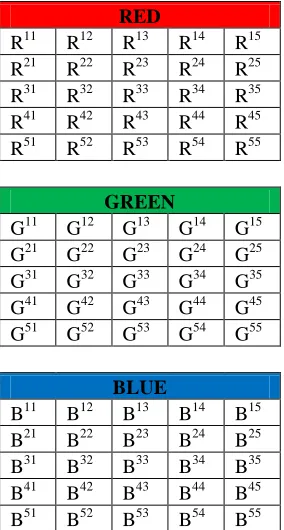
RED
R11 R12 R13 R14 R15 R21 R22 R23 R24 R25 R31 R32 R33 R34 R35 R41 R42 R43 R44 R45 R51 R52 R53 R54 R55
GREEN
G11 G12 G13 G14 G15 G21 G22 G23 G24 G25 G31 G32 G33 G34 G35 G41 G42 G43 G44 G45 G51 G52 G53 G54 G55
BLUE
B11 B12 B13 B14 B15 B21 B22 B23 B24 B25 B31 B32 B33 B34 B35 B41 B42 B43 B44 B45 B51 B52 B53 B54 B55
Fig. 2. Red, Green and Blue color intensities
The previous figure describes the extracted pixel of a 5 x 5 image length. It splits into three parts. R11 to R55 represents the red color, G11 to G55 represent to the green color while B11 to B55 represent to the blue color. Then the grayscale evaluation converts the values into a single value. We can choose one of the formulas exists. The following equation shows how it performs.
Where:
I : New Intesity R : Red Color Intensity G : Green Color Intensity B : Blue Color Intensity
GRAYSCALE I11 I12 I13 I14 I15 I21 I22 I23 I24 I25 I31 I32 I33 I34 I35 I41 I42 I43 I44 I45 I51 I52 I53 I54 I55
Figure 3. New Intensity
As we can see in Figure 3, the values inserted into the cells are obtained from the above formula. It aims to reduce the amount of hash function. If we do not combine the color intensities, we have to make the separated hash evaluation and of course, it makes the computer performance slower.
There are three formulas that calculate the Adler-32 Hash to generate the integrity value.
∑ (5)
∑ (6)
(7)
Where:
I : Grayscale Intensity A : The sum of all bytes
B : The sum of the individual values of A D : Adler-32
The Adler-32 is obtained by multiplying B to 65536. The value 65536 is derived from a 16-bit hexadecimal maximum value. It happens since Adler-32 consists of 16-bit (A) and 16-bit (B) sections. The 32 comes from 16 + 16.
4. PROPOSED WORK
This test runs a 15 x 10 pixels color image. We try to analyze the Alder-32 hash value if there is a change in color intensity. Figur 4 below shows the original image.
Let’s take an example, pixel 1 located at cell number 1 (Column = 1, Row = 1) consists of R = 192, G = 203 and B = 202. The Grayscale is = 200. This calculation continues until reach the end of the pixel or reach pixel 150 where the grayscale of the last pixel is
= 114.
Table 1: Grayscale Intensites
GRAYSCALE INTENSITIES
200 238 199 161 181 216 192 107 99 142 177 161
162 213 211 168 194 235 197 79 97 166 162 165
239 214 186 89 57 197 198 96 111 178 234 239
254 199 40 28 62 90 126 144 144 223 255 254
255 240 155 64 70 114 131 91 128 235 242 253
254 254 237 122 60 90 69 48 54 87 77 169
247 254 214 103 53 28 36 43 35 56 37 76
235 248 243 115 35 59 26 28 31 29 104 114
Tabel 1 shows the complete grayscale calculation of the previous image. This table will be the further data to find the Alder-32 value. The value is obtained by applied the earlier Alder-32 formula to these pixels value. Table 2 describes the overall process of Alder-32.
Table 2: Overall process of Alder-32
No. A B No. A B
1 1 0 38 6415 122361
2 201 201 39 6614 128975
3 439 640 40 6654 135629
4 638 1278 41 6682 142311
5 799 2077 42 6744 149055
6 980 3057 43 6834 155889
7 1196 4253 44 6960 162849
8 1388 5641 45 7104 169953
9 1495 7136 46 7248 177201
10 1594 8730 47 7471 184672
11 1736 10466 48 7726 192398
12 1913 12379 49 7980 200378
13 2074 14453 50 8235 208613
14 2236 16689 51 8475 217088
15 2449 19138 52 8630 225718
16 2660 21798 53 8694 234412
17 2828 24626 54 8764 243176
18 3022 27648 55 8878 252054
19 3257 30905 56 9009 261063
20 3454 34359 57 9100 270163
21 3533 37892 58 9228 279391
22 3630 41522 59 9463 288854
23 3796 45318 60 9705 298559
24 3958 49276 61 9958 308517
25 4123 53399 62 10212 318729
26 4362 57761 63 10466 329195
27 4576 62337 64 10703 339898
28 4762 67099 65 10825 350723
29 4851 71950 66 10885 361608
30 4908 76858 67 10975 372583
31 5105 81963 68 11044 383627
32 5303 87266 69 11092 394719
33 5399 92665 70 11146 405865
34 5510 98175 71 11233 417098
35 5688 103863 72 11310 428408
36 5922 109785 73 11479 439887
37 6161 115946 74 11726 451613
No. A B No. A B
75 11980 463593 87 13144 614009
76 12194 475787 88 13387 627396
77 12297 488084 89 13502 640898
78 12350 500434 90 13537 654435
79 12378 512812 91 13596 668031
80 12414 525226 92 13622 681653
81 12457 537683 93 13650 695303
82 12492 550175 94 13681 708984
83 12548 562723 95 13710 722694
84 12585 575308 96 13814 736508
85 12661 587969 97 13928 750436
86 12896 600865
There are 96 (12 x 8 pixels) + 1 calculations. No. 1, A = 1 and B = 0 is the inital state. The last A shows 13928 and the last B shows 750436. The calculation is not ended.
A = A % MOD_ADLER
= A % 65521 = 13928 % 65521 = 13928
B = B % MOD_ADLER
= 750436 % 65521 = 29705
AD = B . 65536 + A
= 29705 . 65536 + 13928 = 1946760808 (decimal) = 74093668 (hexadecimal)
The Adler-32 value showed above is still in decimal format. Alder-32 runs in hexadecimal. The value in hexadecimal is 74093668. It is a combination of two 16-bit value. The first section is 7409 and the last is 3668. When sending this picture to the receiver, the sender must send this Adler-32 value (74093668) simultaneously. Afterward, the recipients synchrony their hash with the sender. Once the value is different, there must be an error or interception while transmitting over the air.
What about if the content has been modified or there are a small undetected object has been inserted into the picture. It is time to prove the hash function. Assume that we modify pixel number 1. The earlier values are R = 192, G = 203 and B = 202. The new values are R = 190, G = 203, and B = 201. It is a small change. It cannot be detected by naked eyes. We just modified the red and blue colors; the green keep similar. The originality can be detected only by using the computer program. That is why the sender always sends the integrity value with the picture; it is to protect the information inside.
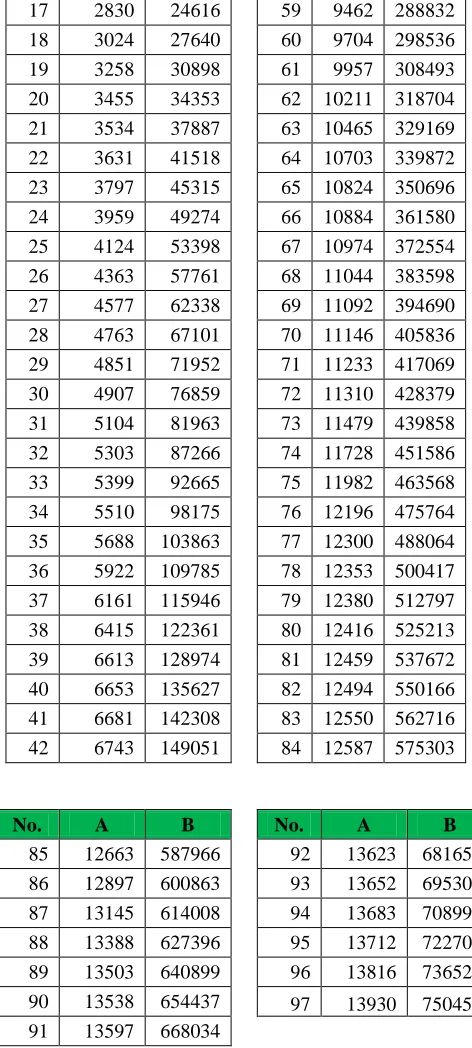
Tabel 3: The modified process
No. A B No. A B
1 1 0 43 6832 155883
2 199 199 44 6959 162842
3 438 637 45 7103 169945
4 636 1273 46 7247 177192
5 796 2069 47 7470 184662
6 978 3047 48 7725 192387
7 1195 4242 49 7979 200366
8 1387 5629 50 8234 208600
9 1494 7123 51 8474 217074
10 1593 8716 52 8629 225703
11 1735 10451 53 8693 234396
12 1912 12363 54 8763 243159
13 2073 14436 55 8877 252036
14 2237 16673 56 9008 261044
15 2451 19124 57 9099 270143
16 2662 21786 58 9227 279370
17 2830 24616 59 9462 288832
18 3024 27640 60 9704 298536
19 3258 30898 61 9957 308493
20 3455 34353 62 10211 318704
21 3534 37887 63 10465 329169
22 3631 41518 64 10703 339872
23 3797 45315 65 10824 350696
24 3959 49274 66 10884 361580
25 4124 53398 67 10974 372554
26 4363 57761 68 11044 383598
27 4577 62338 69 11092 394690
28 4763 67101 70 11146 405836
29 4851 71952 71 11233 417069
30 4907 76859 72 11310 428379
31 5104 81963 73 11479 439858
32 5303 87266 74 11728 451586
33 5399 92665 75 11982 463568
34 5510 98175 76 12196 475764
35 5688 103863 77 12300 488064
36 5922 109785 78 12353 500417
37 6161 115946 79 12380 512797
38 6415 122361 80 12416 525213
39 6613 128974 81 12459 537672
40 6653 135627 82 12494 550166
41 6681 142308 83 12550 562716
42 6743 149051 84 12587 575303
No. A B No. A B
85 12663 587966 92 13623 681657
86 12897 600863 93 13652 695309
87 13145 614008 94 13683 708992
88 13388 627396 95 13712 722704
89 13503 640899 96 13816 736520
90 13538 654437 97 13930 750450
91 13597 668034
Table 3 illustrates the process after we modify several color intensities. The modified A shows 13930 and the modified B shows 750450. Moreover, these values are completely different. The calculation is different from the earlier since there was a modification of the byte array.
A = A % MOD_ADLER
= 13930 % 65521 = 13930
B = B % MOD_ADLER
= B % 65521 = 750450 % 65521 = 29719
AD = B . 65536 + A = 29719. 65536 + 13930 = 1947678314 (decimal) = 7417366A (hexadecimal)
The hexadecimal value is 7417366A. If we compare to the previous value (74093668) or although we change only 1 bit, the hash value is entirely different. This method is used to testing the level of image originality. Every byte in array is connected each other. If we modify one of them, it affects to the rest.
5. CONCLUSION
We wish to thank Mark Adler personally for the Alder-32 checksum algorithm. This algorithm runs fast for image processing. The Adler-32 value is obtained by concatenating two 16-bit A and B. It will be a 32-bit integer. Since it does not use the complex arithmetic expression, it can be applied to the bigger picture. Alder-32 can calculate the originality of what senders send to the recipients. This research does not provide the information hiding; it is only to ensure what the senders send are what the receivers get. The picture can prove anything in real life. So it should be original if used as evidence. His feedback on this research made the algorithm can work together with the image processing.
REFERENCES
[1] A. P. U. Siahaan, “Three-Pass Protocol Concept in Hill Cipher Encryption Technique,” SNATI, Yogyakarta, 2016.
[2] A. P. U. Siahaan, “RC4 Technique in Visual Cryptography RGB Image Encryption,” International Journal of Computer Science and Engineering, vol. 3, no. 7, 2016.
[3] B. Forouzan, Cryptography and Network Security, McGraw-Hill, 2006.
[4] H. Anton dan C. Rorres, Elementary Linear Algebra, 2011: John Wiley & Sons.
[5] R. Bhanot dan R. Hans, “A Review and Comparative Analysis of Various Encryption Algorithms,” International Journal of Security and Its Applications, vol. 9, no. 4, pp. 289-306, 2015.
[6] S. K. Das, G. Sharma dan P. K. Kevat, “Integrity and Authentication using Elliptic Curve cryptography,”
Imperial Journal of Interdiscliplinary Research, vol. 2, no. 5, 2016.
[7] D. Shah, “Digital Security Using Cryptographic Message Digest Algorithm,” International Journal of Advance Research in Computer Science and Management Studies, vol. 3, no. 10, pp. 215-219, 2015. [8] M. Adler, “Wikipedia,” Wikipedia, 22 3 2016.
[Online]. Available:
https://en.wikipedia.org/wiki/Adler-32. [Diakses 8 7 2016].