A proposal to NIST for SHA-3
Ronald L. Rivest
Computer Science and Artificial Intelligence Laboratory
Massachusetts Institute of Technology
Cambridge, MA 02139
[email protected]
Benjamin Agre
Daniel V. Bailey
Christopher Crutchfield
Yevgeniy Dodis
Kermin Elliott Fleming
Asif Khan
Jayant Krishnamurthy
Yuncheng Lin
Leo Reyzin
Emily Shen
Jim Sukha
Drew Sutherland
Eran Tromer
Yiqun Lisa Yin
Abstract
This report describes and analyzes the MD6 hash function and is part of our submission package for MD6 as an entry in the NIST SHA-3 hash function competition1.
Significant features of MD6 include:
• Accepts input messages of any length up to 264−1 bits, and produces message digests of any desired size from 1 to 512 bits, inclusive, including the SHA-3 required sizes of 224, 256, 384, and 512 bits.
• Security—MD6 is by design very conservative. We aim for provable security whenever possible; we provide reduction proofs for the security of the MD6 mode of operation, and prove that standard differential attacks against the compression function are less efficient than birthday attacks for find-ing collisions. We also show that when used as a MAC within NIST recommendedations, the keyed version of MD6 is not vulnerable to linear cryptanalysis. The compression function and the mode of operation are each shown to be indifferentiable from a random oracle under reasonable assumptions.
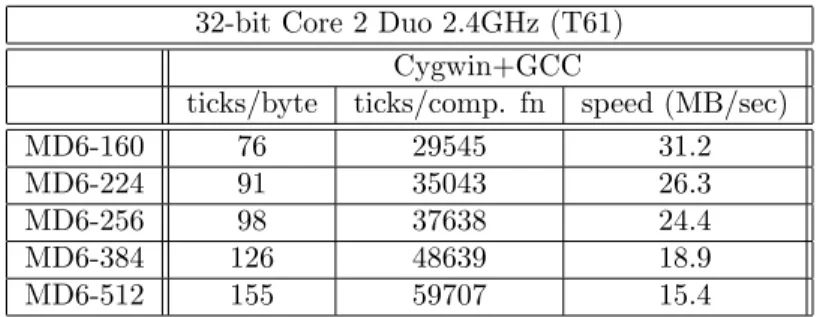
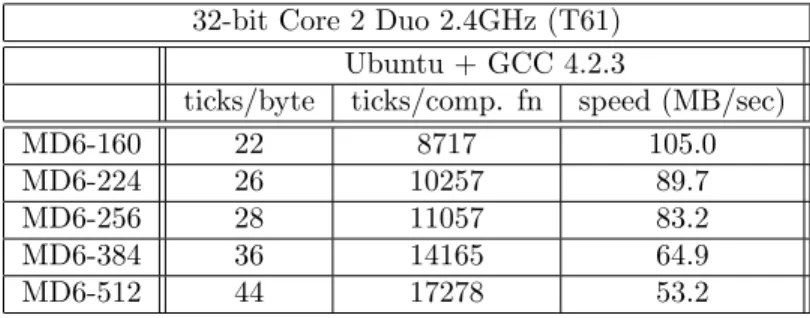
• MD6 has good efficiency: 22.4–44.1M bytes/second on a 2.4GHz Core 2 Duo laptop with 32-bit code compiled with Microsoft Visual Studio 2005 for digest sizes in the range 160–512 bits. When compiled for 64-bit operation, it runs at 61.8–120.8M bytes/second, compiled with MS VS, running on a 3.0GHz E6850 Core Duo processor.
• MD6 works extremely well for multicore and parallel processors; we have demonstrated hash rates of over 1GB/second on one 16-core system, and over 427MB/sec on an 8-core system, both for 256-bit digests. We have also demonstrated MD6 hashing rates of 375 MB/second on a typical desktop GPU (graphics processing unit) card. We also show that MD6 runs very well on special-purpose hardware.
• MD6 uses a single compression function, no matter what the desired digest size, to map input data blocks of 4096 bits to output blocks of 1024 bits— a fourfold reduction. (The number of rounds does, however, increase for larger digest sizes.) The compression function has auxiliary inputs: a “key” (K), a “number of rounds” (r), a “control word” (V), and a “unique ID” word (U).
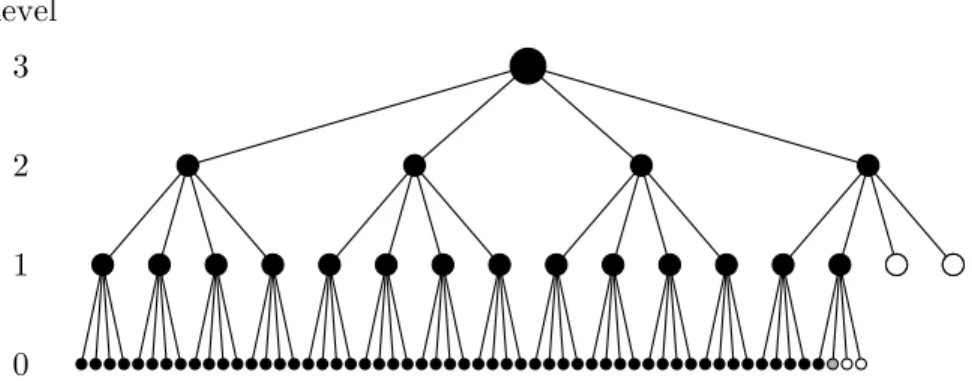
• The standard mode of operation is tree-based: the data enters at the leaves of a 4-ary tree, and the hash value is computed at the root. See Figure 2.1. This standard mode of operation is highly parallelizable.
• Since the standard MD6 mode requires storage proportional to the height of the tree, there is an alternative low-storage variant mode obtained by adjusting the optional parameter L that decreases both the storage re-quirements and the parallelizability; setting L = 0 results in a Merkle-Damg˚ard-like sequential mode of operation.
• All intermediate “chaining values” passed up the tree are 1024 bits in length; the final output value is obtained by truncating the final 1024-bit compression function output to the desired length. This “wide-pipe” design makes “internal collisions” extremely unlikely.
• MD6 automatically permits the computation of message authentication codes (MAC’s), since the auxiliary 512-bit key input (K) to the compres-sion function may be secret. The key may alternatively be set to a random value, for randomized hashing applications.
• MD6 is defined for 64-bit machines, but is very easy to implement on machines of other word sizes (e.g. 32-bit or 8-bit).
• The only data operations used are XOR, AND, and SHIFT (right and left shifts by fixed amounts); all operating on 64-bit words. There are no data-dependent table lookups or other similar data-dependent operations. In hardware, each round of the compression function can be executed in constant time–only a few gate delays.
• The compression function can be viewed as encryption with a fixed key (or equivalently, as applying a fixed random permutation of the message space) followed by truncation. The inner loop can be represented as an invertible non-linear feedback shift register (NLFSR). Security can be ad-justed by adjusting the number of compression function rounds.
• Simplicity—the MD6 mode of operation and compression function are very simple: see Figure 2.1 for the mode of operation and Figure 2.10 for the compression operation (each Figure is one page).
• Flexibility—MD6 is easily adapted for applications or analysis needing non-default parameter values, such as reduced-round versions.
Contents
1 Introduction 7
1.1 NIST SHA-3 competition . . . 8
1.2 Overview . . . 8
2 MD6 Specification 9 2.1 Notation . . . 9
2.2 MD6 Inputs . . . 10
2.2.1 MessageM to be hashed . . . 11
2.2.2 Message digest lengthd . . . 11
2.2.3 KeyK (optional) . . . 11
2.2.4 Mode controlL(optional) . . . 12
2.2.5 Number of roundsr(optional) . . . 13
2.2.6 Other MD6 parameters . . . 13
2.2.7 Naming versions of MD6 . . . 13
2.3 MD6 Output . . . 14
2.4 MD6 Mode of Operation . . . 14
2.4.1 A hierarchical mode of operation . . . 15
2.4.2 Compression function input . . . 16
2.4.2.1 Unique Node IDU . . . 18
2.4.2.2 Control WordV . . . 18
2.5 MD6 Compression Function . . . 23
2.5.1 Steps, rounds and rotations . . . 27
2.5.2 Intra-word Diffusion via xorshifts . . . 28
2.5.3 Shift amounts . . . 28
2.5.4 Round Constants . . . 28
2.5.5 Alternative representations of the compression function . 29 2.6 Summary . . . 29
3 Design Rationale 31 3.1 Compression function inputs . . . 31
3.1.1 Main inputs: message and chaining variable . . . 32
3.1.2 Auxiliary inputs: key, unique nodeID, control word . . . . 33
3.2 Provable security . . . 33
3.3 Memory usage is less of a constraint . . . 34
3.3.1 Larger block size . . . 34
3.3.2 Enabling parallelism . . . 35
3.4 Parallelism . . . 36
3.4.1 Hierarchical mode of operation . . . 37
3.4.2 Branching factor of four . . . 38
3.5 A keyed hash function . . . 38
3.6 Pervasive auxiliary inputs . . . 39
3.6.1 Pervasive key . . . 39
3.6.2 Pervasive location information: “position-awareness” . . . 39
3.6.3 Pervasive control word information . . . 40
3.7 Restricted instruction set . . . 40
3.7.1 No operations with input-dependent timing . . . 40
3.7.2 Few operations . . . 41
3.7.3 Efficiency . . . 41
3.8 Wide-pipe strategy . . . 42
3.9 Nonlinear feedback shift register . . . 42
3.9.1 Tap positions . . . 42
3.9.2 Round constants . . . 43
3.9.3 Intra-word diffusion operationg. . . 44
3.9.4 Constant VectorQ . . . 44 3.10 Input symmetry . . . 45 3.11 Output symmetry . . . 45 3.12 Relation to encryption . . . 45 3.13 Truncation . . . 46 3.14 Summary . . . 46 4 Software Implementations 47 4.1 Software implementation strategies . . . 47
4.1.1 Mode of operation . . . 47 4.1.1.1 Layer-by-layer . . . 47 4.1.1.2 Data-driven tree-building . . . 48 4.1.2 Compression function . . . 49 4.2 “Standard” MD6 implementation(s) . . . 50 4.2.1 Reference Implementation . . . 50 4.2.2 Optimized Implementations . . . 50
4.2.2.1 Optimized 32-bit version . . . 50
4.2.2.2 Optimized 64-bit version . . . 50
4.2.3 Clean-room implementation . . . 51
4.3 MD6 Software Efficiency Measurement Approach . . . 51
4.3.1 Platforms . . . 51
4.3.1.1 32-bit . . . 51
4.3.1.2 64-bit . . . 52
4.3.1.3 8-bit . . . 52
4.4 MD6 Setup and Initialization Efficiency . . . 52
4.5 MD6 speed in software . . . 53
CONTENTS 3
4.5.2 64-bit processors . . . 54
4.5.3 8-bit . . . 55
4.5.3.0.1 Whither small processors? . . . 59
4.6 MD6 Memory Usage . . . 59 4.7 Parallel Implementations . . . 60 4.7.1 CILK Implementation . . . 60 4.7.2 GPU Implementation . . . 61 4.8 Summary . . . 67 5 Hardware Implementations 68 5.1 Hardware Implementation . . . 68 5.1.1 Compression Function . . . 69
5.1.2 Memory Control Logic . . . 70
5.2 FPGA . . . 71
5.3 ASIC/Custom . . . 75
5.4 Multi-core . . . 76
5.5 Summary . . . 77
6 Compression Function Security 81 6.1 Theoretical foundations . . . 82
6.1.1 Blockcipher-based Hash Functions . . . 83
6.1.2 Permutation-based hash functions and indifferentiability from random oracles . . . 84
6.1.3 Can MD6 generate any even permutation? . . . 89
6.1.4 Keyed permutation-based hash functions . . . 89
6.1.5 m-bit ton-bit truncation . . . 90
6.2 Choice of compression function constants . . . 90
6.2.1 Constant Q . . . 90
6.2.2 Tap positions . . . 91
6.2.3 Shift amounts and properties ofg. . . 92
6.2.4 Avalanche properties . . . 92
6.2.5 Absence of trapdoors . . . 92
6.3 Collision resistance . . . 93
6.4 Preimage Resistance . . . 93
6.5 Second Preimage Resistance . . . 94
6.6 Pseudorandomness (PRF) . . . 94
6.6.1 Standard statistical tests . . . 94
6.6.1.1 NIST Statistical Test Suite . . . 95
6.6.1.2 TestU01 . . . 95
6.6.2 Other statistical tests . . . 97
6.7 Unpredictability (MAC) . . . 99
6.8 Key-Blinding . . . 99
6.9 Differential cryptanalysis . . . 101
6.9.1 Basic definitions and assumptions . . . 101
6.9.2 Analyzing the step function . . . 103
6.9.2.2 AND gate . . . 104
6.9.2.3 goperator . . . 104
6.9.2.4 Combining individual operations . . . 105
6.9.3 Lower bound proof . . . 106
6.9.3.1 Goal and approach . . . 106
6.9.3.2 Counting the number of active AND gates . . . 107
6.9.3.3 Searching for differential path weight patterns . 108 6.9.3.4 Deriving lower bounds through computer-aided search . . . 108
6.9.3.5 Related work . . . 111
6.9.4 Preliminary results related to upper bounds . . . 112
6.10 Linear cryptanalysis . . . 113
6.10.1 Keyed vs. keyless hash functions . . . 113
6.10.2 Basic definitions and analysis tools . . . 114
6.10.3 Analyzing the step function . . . 115
6.10.3.1 XOR gate . . . 115
6.10.3.2 AND gate . . . 116
6.10.3.3 goperator . . . 117
6.10.3.4 Combining individual operations . . . 117
6.10.4 Lower bound proof . . . 119
6.10.4.1 Goal and approach . . . 119
6.10.4.2 Searching for linear path and counting threads . 119 6.10.4.3 Deriving lower bounds through computer-aided search . . . 121
6.10.4.4 Related work . . . 124
6.11 Algebraic attacks . . . 124
6.11.1 Degree Estimates . . . 125
6.11.1.1 Maximum degree estimates . . . 125
6.11.1.2 Density estimates . . . 127
6.11.2 Monomial Tests . . . 127
6.11.3 The Dinur/Shamir “Cube” Attack . . . 129
6.12 SAT solver attacks . . . 129
6.13 Number of rounds . . . 133
6.14 Summary . . . 133
7 Mode of Operation Security 134 7.1 Preliminaries . . . 135 7.1.1 Definitions . . . 136 7.2 Collision-Resistance . . . 138 7.3 Preimage (Inversion) . . . 143 7.4 Second Pre-image . . . 146 7.5 Pseudo-Random Function . . . 147
7.5.1 Maurer’s Random System Framework . . . 147
7.5.1.1 Notation . . . 148
7.5.1.2 Definitions . . . 148
CONTENTS 5
7.5.2 MD6 as a Domain Extender for FIL-PRFs . . . 152
7.5.2.1 Preliminaries . . . 152 7.5.2.2 Indistinguishability . . . 154 7.6 Unpredictability . . . 158 7.6.1 Preliminaries . . . 159 7.6.1.1 Important Lemmas . . . 160 7.6.1.2 A Two-Keyed Variant of MD6 . . . 161
7.6.2 MD6 as a Domain Extender for FIL-MACs . . . 163
7.7 Indifferentiability from Random Oracle . . . 166
7.8 Multi-Collision Attacks . . . 173
7.9 Length-Extension Attacks . . . 173
7.10 Summary . . . 174
8 Applications and Compatibility 175 8.1 HMAC . . . 175
8.2 PRFs . . . 176
8.3 Randomized Hashing . . . 176
8.4 md6sum. . . 176
9 Variations and Flexibility 179 9.1 Naming . . . 179
9.2 Other values for compression input and output sizes: nandc . . 180
9.3 Other word sizes w . . . 180
9.3.1 New round constantsS . . . 180
9.3.2 New shift amountsri and`i . . . 183
9.3.3 Constant Q . . . 183
9.4 Constant Q . . . 183
9.5 Varying the number rof rounds . . . 185
9.6 Summary . . . 185 10 Acknowledgments 186 11 Conclusions 187 A Constant Vector Q 195 B Round Constants S 196 C Sample MD6 computations 200 C.1 First example . . . 200 C.2 Second example . . . 204 C.3 Third example . . . 216 D Notation 225
E Additional documents 227
E.1 Powerpoint slides from Rivest’s CRYPTO talk . . . 227
E.2 Crutchfield thesis . . . 227
E.3 Code . . . 227
E.4 KAT and MCT tests . . . 228
E.5 One-block and two-block examples . . . 228
E.6 Web site . . . 228
Chapter 1
Introduction
A cryptographic hash function h maps an input M–a bit string of arbitrary length—to an output stringh(M) of some fixed bit-length d.
Cryptographic hash functions have many applications; for example, they are used in digital signatures, time-stamping methods, and file modification detection methods.
To be useful in such applications, the hash functionhmust not only provide fixed-length outputs, but also satisfy some (informally stated) cryptographic properties:
• One-wayness, or Pre-image Resistance: It should be infeasible for an adversary, giveny, to compute any M such thath(M) =y.
• Collision-Resistance: It should be infeasible for an adversary to find distinct valuesM,M0 such thath(M) =h(M0).
• Second Pre-image Resistance: It should be infeasible for an adversary, givenM, to find a different valueM0 such thath(M) =h(M0).
• Pseudo-randomness: The function h must appear to be a “random” (but deterministic) function of its input. This property requires some care to define properly.
A history of cryptographic hash functions can be found in Menezes et al. [46, Ch. 9]; a more recent survey is provided by Preneel [58].
The purpose of this report, however, is to describe and analyze the MD6 hash function, not to survey the prior art (which is considerable).
Some readers may find it helpful to begin their introduction to MD6 by reviewing the powerpoint slides:
http://group.csail.mit.edu/cis/md6/Rivest-TheMD6HashFunction.ppt
from Rivest’s CRYPTO’08 invited talk.
1.1
NIST SHA-3 competition
This document is part of our submission of MD6 to NIST for the SHA-3 com-petition [51].
We have attempted to respond to all of the requirements and requests for information given in the request for candidate SHA-3 algorithm nominations.
This report does not contain computer code implementing MD6 or other documents relevant to our submission. These can all be found in our submission package to NIST, and on our web site:
http://groups.csail.mit.edu/cis/md6 .
Updated versions of this report, and other MD6-related materials, may also be available on the MD6 web site.
1.2
Overview
This report is organized as follows.
Chapter 2 gives a careful description of the MD6 hash function, including its compression function and mode of operation.
Chapter 3 describes the design rationale for MD6.
Chapter 4 describes efficient software implementations of MD6, including parallel implementations on multi-core processors and on graphics processing units.
Chapter 5 describes efficient hardware implementations of MD6 on FPGA’s, special-purpose multi-core chips, and ASIC’s.
Chapter 6 analyzes the security of the MD6 compression function. Chapter 7 analyzes the security of the MD6 mode of operation.
Chapter 8 discusses issues of compatibility with existing standards and ap-plications.
Chapter 9 discusses variations on the MD6 hash function; that is, how MD6 can be “re-parameterized” easily to give new hash functions in the “MD6 fam-ily”.
Appendices A and B describe the constants Q and S used in the MD6 computation.
Appendix C gives some sample computations of MD6. Appendix D summarizes our notations.
Appendix E describes the additional documents we are submitting with this proposal.
Appendix F gives information about each of the MD6 team members, in-cluding contact information.
Chapter 2
MD6 Specification
This chapter provides a detailed specification of the MD6 hash algorithm, suffi-cient to implement MD6. MD6 is remarkably simple, and these few pages give all the necessary details.
Before reading this chapter, the reader may wish to browse Chapter 3, which discusses some of the design decisions made in MD6.
Section 2.1 provides an overview of the notation we use; additional notation is listed in Appendix D.
Section 2.2 describes the inputs to MD6: the message to be hashed and the desired message digest lengthd, as well as the optional inputs: a “key” K, a ‘mode control”L, and a number of roundsr.
Section 2.3 describes the MD6 output.
Section 2.4 describes MD6’s “mode of operation”—how MD6 repeatedly uses a compression function to hash a long message in a tree-based manner.
Section 2.5 specifies the MD6 compression functionf, which maps an input of 89 64-bit words (64 data words and 25 auxiliary information words) to an output of 16 64-bit words.
2.1
Notation
Letwdenote the word size, in bits. MD6 is defined in terms of a default word size ofw= 64 bits. However, its design supports efficient implementation using other word sizes, and variant flavors of MD6 can easily be defined in terms of other word sizes (see Chapter 9).
In this document a “word” always refers to a 64-bit (8-byte) word ofw= 64 bits.
We letWdenote the set {0,1}w of allw-bit words.
If A (or any other capital letter) denotes an array of information, then a
(lower case) usually represents its length (the number of data items inA). (Our
use of W above is an exception.) We let both A[i] and Ai denote the i-th
element ofA. We use 0-origin indexing. The notationA[i..j] (orAi..j) denotes
the subarray ofAfrom A[i] toA[j], inclusive.
MD6 is defined in a big-endian way: the high-order byte of a word is defined to be the “first” (leftmost) byte. This is as in the SHA hash functions, but dif-ferent from in MD5. Big-endian is also frequently known as “network order,” as Internet network protocols normally use big-endian byte ordering. We number the bytes of a word starting with byte 0 as the high-order byte, and similarly number the bits of a byte or word so that bit 0 is the most-significant bit.
(The underlying hardware may be little-endian or big-endian; this doesn’t matter to us.)
Other more-or-less standard notation we may use includes:
⊕: denotes the bitwise “XOR” operator on words.
∧: denotes the bitwise “AND” operator on words.
∨: denotes the bitwise “OR” operator on words.
¬x: denotes the bitwise negation of wordx.
x << b: denotesxleft-shifted byb bits (zeros shifting in).
x >> b: denotesxright-shifted byb bits (zeros shifting in).
x <<< b: denotesxrotated left byb bits.
x >>> b: denotesxrotated right byb bits.
||: denotes concatenation.
0x. . .: denotes a hexadecimal constant.
Additional notation can be found in Appendix D.
2.2
MD6 Inputs
This section describes the inputs to MD6. Two inputs are mandatory, while the other three inputs are optional.
M – the message to be hashed (mandatory).
d – message digest length desired, in bits (mandatory).
K – key value (optional).
L – mode control (optional).
r – number of rounds (optional).
The only mandatory inputs are the messageM to be hashed and the desired message digest lengthd. Optional inputs have default values if any value is not supplied.
We letH denote the MD6 hash function; subscripts may be used to indicate MD6 parameters.
CHAPTER 2. MD6 SPECIFICATION 11
2.2.1
Message
M
to be hashed
The first mandatory input to MD6 is the messageM to be hashed, which is a sequence of bits of some finite lengthm, where
0≤m <264 .
In accordance with the NIST requirements, the lengthmof the input mes-sage M is measured in bits, not bytes, even though in practice an input will typically consist of some integral number (m/8) of bytes.
The lengthmdoes not need to be known before MD6 hashing can begin. The NIST API for SHA-31 provides the input message sequentially in an arbitrary number of pieces, each of arbitrary size, through anUpdate routine. A call to
Final then signals that the input has ended and that the final hash value is
desired.
MD6 is tree-based and highly parallelizable. If the entire message M is available initially, then a number of different processors may begin hashing operations at a variety of starting points within the message; their results may then be combined.
2.2.2
Message digest length
d
The second input to MD6 is the desired bit-lengthdof the hash function output, where
0< d≤512 .
The value d must be known at the beginning of the hash computation, as it not only determines the length of the final MD6 output, but also affects the MD6 computation at every intermediate operation.
Changing the value ofdshould result in an “entirely different” hash function— not only will the output now have a different length, but its value should appear to be unrelated to hash-values computed for the same message for other values ofd.
MD6 naturally supports the digest lengths required for SHA-3: d= 224,256,384 and 512 bits, as they are within the allowable range ford.
2.2.3
Key
K
(optional)
Often it is desirable to work with a family {Hd,K} of hash functions, indexed not only by the digest size dbut also by a key K drawn from some finite set. These instances should appear to be unrelated—the behavior of Hd,K should
not have any discernible relation to that ofHd,K0, forK6=K0.
The MD6 user may provide aK ofkeylen bytes, for any key lengthkeylen, where
0≤keylen≤64.
(It is convenient to use lower-casekto denote the maximum number 8 of 64-bit words in the key, so we use keylen to denote the actual number of key bytes supplied.)
There is one MD6 hash functionHd,K for each combination of digest length dand key K. The default value for an unspecified key is keynil of length 0.
Hd=Hd,nil.
The key may be a “salt,” as is commonly used for hashing passwords. The key K may be secret. Thus, MD6 may be used directly to compute message authentication codes, or MAC’s. MD6 tries to ensure that no useful information about the key leaks into MD6’s output, so that the key is protected from disclosure.
The key could also be a randomly chosen value [17], for randomized hashing applications.
Within MD6, the key is padded with zero bytes until its length is exactly 64 bytes. The original length keylen of the key in bytes is preserved and is an auxiliary input to the MD6 compression function.
The maximum key length (64 bytes) is quite long, which allows for the key to be a concatenation of subfields used for different purposes (e.g. part for a secret key, part for a randomization value) if desired.
If the desired key is longer than 512 bits, it can first be hashed with MD6, using, for example, d= 512 and K =nil; the result can then be supplied to MD6 as the key.
2.2.4
Mode control
L
(optional)
The standard mode of operation for MD6 is a tree-based and hierarchical, as illustrated in Figure 2.1.
Data from the message to be hashed is placed at the leaves of a sufficiently large 4-ary tree. Computation proceeds from the leaves towards the root. Each non-leaf node of the tree corresponds to one compression function execution, which takesn= 64 words of input and producesc= 16 words of output. The last d bits of the output produced at the root are taken as the hash function output.
It is straightforward to implement MD6 so that it uses an amount of storage no more than proportional to the height of the tree.
In some cases (such as with very simple RFID chips), the MD6 standard mode of operation may nonetheless require too much memory. In such cases, a variant of MD6 may be specified that uses less memory (but which is also less parallelizable).
This option is exercised with an optional “mode of operation parameter”L. By varyingL, MD6 varies smoothly between a low-memory Merkle-Damg˚ ard-like sequential mode of operation (L= 0) and a highly-parallelizable tree-based mode of operation (L= 64).
The standard mode of operation hasL= 64, for fully hierarchical operation. Actually, any value ofL≥27 will give a hierarchical hash;L= 64 is chosen as
CHAPTER 2. MD6 SPECIFICATION 13
the default in order to represent a value “sufficiently large” that the sequential mode of operation is never invoked.
Section 2.4 gives more details on MD6’s mode of operation.
2.2.5
Number of rounds
r
(optional)
The MD6 compression functionfhas a controllable numberrof rounds. Roughly speaking, each round corresponds to one clock cycle in a typical hardware im-plementation, or 16 steps in a software implementation.
The default value ofris
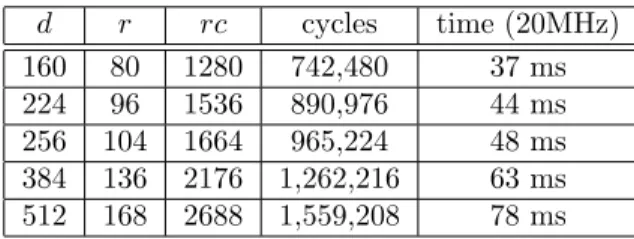
r= 40 +bd/4c; (2.1) so Hd,K,L =Hd,K,L,40+bd/4c. For d= 160, MD6 thus has a default ofr = 80
rounds; ford= 512, MD6 has a default ofr = 168 rounds. One may increase
r for increased security, or decrease r for improved performance, trading off security for performance.
However, we also require that when MD6 is used in keyed mode, thatr≥80. This provides protection for the key, even when the desired output is short (as it might be for a MAC). Thus, when MD6 has a nonempty key, the default value ofris
r= max(80,40 +bd/4c). (2.2) The round parameterris exposed in the MD6 API, so it may be explicitly varied by the user. This is done since reduced-round versions of MD6 may be of interest for security analysis, or for applications with tight timing constraints and reduced security requirements. Or, one could increaserabove the default to accommodate various levels of paranoia. Also, if there is a key, but it is non-secret, then fewer than 80 rounds could be specified if desired.
Arguably, the current need to consider a new hash function standard might have seemed unnecessary if the API for the prior standards had included a variable number of rounds.
2.2.6
Other MD6 parameters
There are other parameters to the MD6 hash function that could also be varied, at least in principle (e.g. w, Q, c, t0. . . t5, ri, `i, Si for 0 ≤i < rc). For the
purpose of defining what “MD6” means, these quantities should all be considered fixed with default values as described herein. But variant MD6 hash functions that use other settings for these parameters could be considered and studied. See Chapter 9 for a description of how these parameters might be varied.
2.2.7
Naming versions of MD6
We suggest the following approach for naming various versions of MD6. In the simplest case, we only need to specify the digest size: MD6-dspecifies the version of MD6 having digest size d. This version also has the zero-length
keynil,L= 64 (i.e. fully hierarchical operation), and a numberrof rounds that is the default for that digest size. These are the MD6 versions most relevant for SHA-3:
MD6-224 MD6-256 MD6-384 MD6-512.
Some of our experiments also consider MD6-160, as it is comparable to SHA-1. Software implementations of MD6 typically use the lower-case version of the name MD6, as in “md6sum”.
Naming non-standard variants of MD6 is discussed in Section 9.1.
The CRYPTO 2008 invited talk by Rivest also called MD6 the “pumpkin hash”, noting that the due date for SHA-3 submissions is Halloween 2008. One could thus also label the MD6 variants as PH-256, etc. ...
2.3
MD6 Output
The output of MD6 is a bit stringD of exactlydbits in length:
D=Hd,K,L,r(M) ;
D is the hash value of input message M. It is also often called a “message digest.” The “MD” in the name “MD6” reflects this terminology.
In some contexts, the MD6 output may be defined to include other parame-ters. For example, with digital signatures, a hash function needs to be applied once by the sender, and once again by the recipient, to the same message. These computations should yield the same result. For this to work, the recipient needs to know not only the message M and the message digest length d, but also the values of any of the parameters K, L, andr that have non-default values. In such applications, these parameters (other than K) could be considered as part of the hash function output. At least, they need to be communicated to the receiver along with the hash function valueD, communicated in some other way from sender to receiver, or agreed in advance to have some particular non-default settings.
2.4
MD6 Mode of Operation
A hash function is typically constructed from a “compression function”, which maps fixed-length inputs to (shorter) fixed length outputs. A “mode of oper-ation” then specifies how the compression function can be used repeatedly to enable hashing inputs of arbitrary nonnegative length to produce a fixed-length output.
CHAPTER 2. MD6 SPECIFICATION 15
• its mode of operation,
• its compression function, and
• various constants used in the computation.
The MD6 compression function f takes inputs of a fixed length (n = 89 words), and produces outputs of a fixed but shorter length (c= 16 words):
f :W89−→W16.
(Recall thatWis the set of all binary words of lengthw= 64 bits.)
For convenience, we call ac-word block a “chunk”. The chaining variables produced by MD6 are all “chunks”.
The 89-word input to the compression functionfcontains a 15-word constant
Q, an 8-word keyK, a “unique ID” wordU, a “control wordV”, and a 64-word data blockB.
SinceQis constant, the “effective” or “reduced” MD6 compression function
fQ maps 74-word inputs to 16-word outputs: fQ:W74−→W16.
via the relationship:
fQ(x) =f(Q||x).
Thus, the MD6 compression function achieves a fourfold reduction in size from data block to output—four chunks fit exactly into one data block, and one chunk is output.
The next section describes the MD6 mode of operation; Section 2.5 then describes the MD6 compression function.
2.4.1
A hierarchical mode of operation
The standard mode of operation for MD6 is tree-based. See Figure 2.1. An implementation of this hierarchical mode requires storage at least proportional to the height of the tree.
Since some very small devices may not have sufficient storage available, MD6 provides a height-limiting parameterL. When the height reachesL+ 1, MD6 switches from the parallel compression operator PAR to the sequential com-pression operatorSEQ.
The MD6 mode of operation is thus optionally parameterized by the integer
L, 0≤ L ≤64, which allows a smooth transition from the default tree-based hierarchical mode of operation (for largeL) down to an iterative mode of oper-ation (forL= 0). WhenL= 0, MD6 works in a manner similar to that of the well-known Merkle-Damg˚ard method [48, 47, 25] construction or to the HAIFA method [13]. See Figure 2.2.
In our description of the MD6 mode of operation, MD6 makes up to L
factor of four, and then performs (if necessary) a single sequential pass to finish up.
Since the input size must be less than 264 bits and the final compression function produces an output of 210 = 1024 bits (before final truncation tod
bits), there will be at most 27 such parallel passes (since 27 = log4(264/210). The default value L = 64, since it is greater than 27, ensures that by default MD6 will be full hierarchical.
Graphically, MD6 creates a sequence of 4-ary trees of height at mostL, each containing 4L leaf chunks (of c = 16 words each), then combines the values
produced at their roots (if there is more than one) in a sequential Merkle-Damg˚ard-like manner.
If 4Lis larger than the number of 16-word chunks in the input message, then
only one tree is created, and MD6 becomes a purely tree-based method. On the other hand, if L = 0, then no trees are created, and the input is divided into 48-word (three-chunk) data-blocks to be combined in a sequential Merkle-Damg˚ard-like manner. (There are now only three data chunks in a data block, since one chunk is the chaining variable from the previous compression operation at the node immediately to the left.)
For intermediate values of L, we trade off tree height (and thus minimum memory requirements) for opportunities for parallelism (and thus perhaps greater speed).
Figure 2.4 gives the top-level procedure for the MD6 mode of operation, which is described in a bottom-up, level by level manner.
First, all of the compression operations on level`= 1 are performed. Then all of the compression operations on level`= 2 are performed, etc.
MD6 is described in this manner for maximum clarity. A practical imple-mentation may be organized somewhat differently (but, of course, in a way that computes the same function). For example, operations at different levels may be intermixed, with a compression operation being performed as soon as its inputs are available. See Chapter 4 for some discussion of implementation issues.
Each such compression operation is by default performed with the PAR operation, described in Figure 2.5. ThePARoperation may be implemented in parallel (hence its name). Given the data on level`−1, it produces the data on level`, which will be only one-fourth as large. This is repeated until a level is reached where the remaining data is only 16 words long. This data is truncated to become the final hash output.
Figure 2.6 describes SEQ—it is very similar to Merkle-Damg˚ard in opera-tion. It works sequentially through the input data on the last level and produces the final hash output.
2.4.2
Compression function input
MD6’s mode of operation formats the input to the compression functionf in the following way. There aren= 89 words, formatted as follows with the default sizes. See Figure 2.7. The first four itemsQ,K, U, V, are “auxiliary inputs”, while the last itemB is the data payload.
CHAPTER 2. MD6 SPECIFICATION 17
0
1
2
3
level
Figure 2.1: Structure of the standard MD6 mode of operation (L= 64). Com-putation proceeds from bottom to top: the input is on level 0, and the final hash value is output from the root of the tree. Each edge between two nodes represents a 16 word (128 byte or 1024-bit) chunk. Each small black dot on level 0 corresponds to a 16-word chunk of input message. The grey dot on level 0 corresponds to a last partial chunk (less than 16 words) that is padded with zeros until it is 16 words long. A white dot (on any level) corresponds to a padding chunk of all zeros. Each medium or large black dot above level zero corresponds to an application of the compression function. The large black dot represents the final compression operation; here it is at the root. The final MD6 hash value is obtained by truncating the value computed there.
0
1
level
Figure 2.2: Structure of the MD6 sequential mode of operation (L= 0). Com-putation proceeds from left to right only; level 1 represents processing by SEQ. The hash function output is produced by the rightmost node on level 1. This is similar to standard Merkle-Damg˚ard processing. The white circle at the left on level 1 is the 1024-bit all-zero initialization vector for the sequential com-putation at that level. Each node has four 1024-bit inputs: one from the left, and three from below; the effective “message block size” is thus 384 bytes, since 128 bytes of the 512-byte compression function input are used for the chaining variable.
0
1
2
level
Figure 2.3: Structure of the MD6 mode of operation with an intermediate mode of operation value (L = 1). Computation proceeds from bottom to top and left to right; level 2 represents processing by SEQ. The hash function output is produced by the rightmost node on level 2. The white circle at the left on level 2 is the all-zero initialization vector for the sequential computation at that level.
Q– a constant vector (giving an approximation to the fractional part of the square root of 6) of lengthq= 15 words. See Appendix A.
K – a “key” (serving as salt, tag, tweak, secret key, etc.) of length k = 8 words containing a supplied key ofkeylen bytes.
U – a one-word “unique node ID”.
V – a one-word “control word”.
B – a data block of lengthb= 64 words. 2.4.2.1 Unique Node IDU
The “unique node ID” U is a one-word compression function auxiliary input (`, i). It uniquely specifies the particular compression function operation being performed, by giving both the level number for this operation and its index within the level. See Figure 2.9.
• `— one byte giving the level number.
• i — seven bytes giving the position within the level, with the leftmost (first) compression function operation labelled asi= 0.
For example, the very first compression operation performed always has
U = (`, i) = (1,0). A node (`, i) at level `, 1 < ` ≤ L (produced by PAR) has children at (`−1,4i), (`−1,4i+ 1),(`−1,4i+ 2), and (`−1,4i+ 3). A node (`, i) at level 1< `=L+ 1 (produced bySEQ) has children at (`−1,3i), (`−1,3i+ 1), and (`−1,3i+ 2).
2.4.2.2 Control Word V
The “control word”V is a one-word compression function auxiliary input that gives parameters relevant to the computation. See Figure 2.8.
CHAPTER 2. MD6 SPECIFICATION 19
The MD6 Mode of Operation Input:
M: A messageM of some non-negative lengthmin bits.
d: The lengthd(in bits) of the desired hash output, 1≤d≤512.
K: An arbitrary k = 8 word “key” value, containing a supplied key of keylen bytes padded on the right with (64−keylen) zero bytes.
L : A non-negative mode parameter (maximum level number, or number of parallel passes).
r : A non-negative number of rounds.
Output:
D: Ad-bit hash valueD=Hd,K,L,r(M).
Procedure: Initialize:
• Let`= 0,M0=M, andm0=m. Main level-by-level loop:
• Let`=`+ 1.
• If`=L+ 1, returnSEQ(M`−1, d, K, L, r) as the hash function output.
• LetM`=PAR(M`−1, d, K, L, r, `). Letm` denote the length ofM` in
bits.
• If m` =cw (i.e. if M` is c words long), return the last d bits of M`
as the hash function output. Otherwise, return to the top of the main level-by-level loop.
Figure 2.4: The MD6 Mode of Operation. With the default setting ofL= 64, the SEQ operation is never used; the PAR operation is repeatedly called to reduce the input size by a factor of b/c = 64/16 = 4 until a single 16-word chunk remains. On the other hand, setting L equal to 0 yields an entirely sequential mode of MD6 operation.
The MD6 PAR Operation Input:
M`−1: A message of some non-negative lengthm`−1 in bits.
d: The lengthd(in bits) of the desired hash output, 1≤d≤512.
K: An arbitrary k = 8 word “key” value, containing a supplied key of keylen bytes.
L : A non-negative mode parameter (maximum level number, or number of parallel passes).
r : A non-negative number of rounds.
` : A non-negative integer level number, 1≤`≤L.
Output:
M`: A message of lengthm` bits, wherem`= 1024·max(1,dm`−1/4096e)
Procedure: Initialize:
• Let Q denote the array of length q = 15 words giving the fractional part of√6. (See Appendix A.)
• Letfdenote the MD6 compression function mapping 89 words of input (including a 64-word data blockB) to a 16-word output chunkCusing
rrounds of computation. Shrink:
• Extend input M`−1 if necessary (and only if necessary) by appending zero bits until its length becomes a positive integral multiple ofb= 64 words. ThenM`−1 can be viewed as a sequence B0, B1, . . . ,Bj−1 of
b-word blocks, wherej= max(1,dm`−1/bwe).
• For eachb-word block Bi,i= 0,1, . . . , j−1, computeCi in parallel as
follows:
– Let pdenote the number of padding bits inBi; 0≤p≤4096. (p
can only be nonzero fori=j−1.)
– Let z = 1 if j = 1, otherwise let z = 0. (z = 1 only for the last block to be compressed in the complete MD6 computation.) – LetV be the one-word valuer||L||z||p||keylen||d(see Figure 2.8). – LetU =`∗256+ibe a “unique node ID”—a one-word value unique
to this compression function operation.
– LetCi=f(Q||K||U||V||Bi). (Ci has length c= 16 words). • ReturnM`=C0||C1||. . .||Cj−1.
Figure 2.5: The MD6 PAR operator is a parallel compression operation produc-ing level` of the tree from level `−1. With the default setting L = 64, this routine is used repeatedly at each layer of the tree to generate the next higher layer, until the value at the root is produced.
CHAPTER 2. MD6 SPECIFICATION 21
The (Optional) MD6 SEQ Operation Input:
ML: A message of some non-negative lengthmL in bits.
d: The lengthd(in bits) of the desired hash output, 1≤d≤512.
K: An arbitraryk= 8 word key value, containing a supplied key ofkeylenbytes.
L : A non-negative mode parameter (maximum tree height).
r : A non-negative number of rounds.
Output:
D: Ad-bit hash value.
Procedure: Initialize:
• Let Q denote the array of length q = 15 words giving the fractional part of√6. (See Appendix A.)
• Letf denote the MD6 compression function mapping an 89-word input (including a 64-word data blockB) to a 16-word output blockCusing
rrounds of computation. Main loop:
• LetC−1 be the zero vector of lengthc= 16 words. (This is the “IV”.)
• Extend inputMLif necessary (and only if necessary) by appending zero
bits until its length becomes a positive integral multiple of (b−c) = 48 words. Then ML can be viewed as a sequence B0, B1, . . . , Bj−1 of (b−c)-word blocks, wherej= max(1,dmL/(b−c)we).
• For each (b−c)-word blockBi,i= 0,1, . . . , j−1 in sequence, compute Ci as follows:
– Let pbe the number of padding bits in Bi; 0≤p≤3072. (pcan
only be nonzero wheni=j−1.)
– Letz= 1 ifi=j−1, otherwise letz= 0. (z= 1 only for the last block to be compressed in the complete MD6 computation.) – LetV be the one-word valuer||L||z||p||keylen||d(see Figure 2.8). – LetU = (L+ 1)·256+ibe a “unique node ID”—a one-word value
unique to this compression function operation.
– LetCi=f(Q||K||U||V||Ci−1||Bi). (Ci has lengthc= 16 words). • Return the lastdbits ofCj−1 as the hash function output.
Figure 2.6: The MD6 SEQ Operator is a sequential Merkle-Damg˚ard-like hash operation producing a final hash output value. With the default setting of
Q K UV B
0 15 2325 89
Figure 2.7: The compression function input contains 89 64-bit words: a 15-word constant vectorQ, an 8-word keyK, a one-word unique node IDU, a one-word control variableV, and a 64-word data blockB. The first four items form the auxiliary information, shown in grey.
0
r
L
z
p
keylen
d
4
12
8
4
16
8
12
Figure 2.8: Layout of the control word V. The high-order 4 bits are zero (reserved for future use). The size (in bits) of each field is given above the field.
`
i
Figure 2.9: Layout of the unique node ID word U. The high-order byte is `, the level number. The seven-byte fieldigives the index of the node within the level (i= 0,1, . . .).
CHAPTER 2. MD6 SPECIFICATION 23
• r— number of rounds in the compression function (12 bits).
• L— mode parameter (maximum level) (8 bits).
• z— set to 1 if this is the final compression operation, otherwise 0 (4 bits). In Figures 2.1, 2.3, 2.2, these final operations are indicated by the very large black circles.
• p— the number of padding data bits (appended zero bits) in the current input blockB (16 bits).
• keylen — the original length (in bytes) of the supplied keyK (8 bits).
• d— the desired length in bits of the digest output (12 bits).
2.5
MD6 Compression Function
This section describes the operation of the MD6 compression function.
The compression function f takes as input an array N of length n = 89 words. It outputs an arrayC of lengthc= 16 words.
Here f is described as having a single 89-word input N, although it may also be viewed as having a 25-word “auxiliary” input (Q||K||U||V) followed by a 64-word “data” input blockB.
The compression functionf is computed as shown in Figure 2.10.
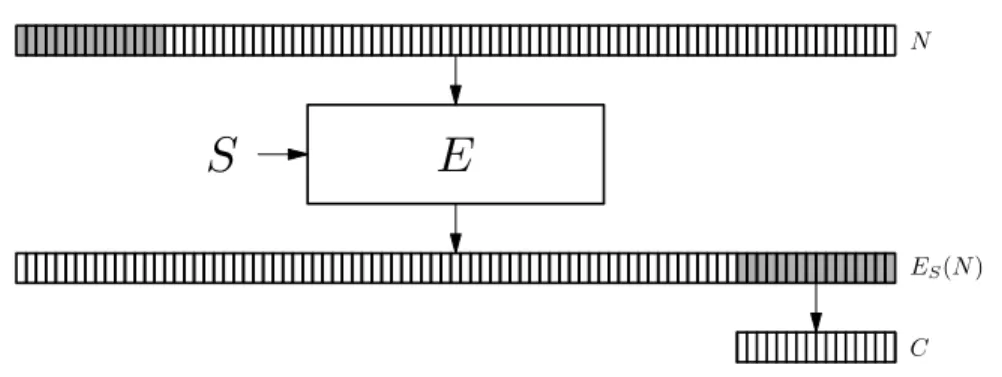
The compression function may be viewed as consisting of an encryption of
N with a fixed arbitrary keyS (which is not secret), followed by a truncation operation that returns only the last 16 words ofES(N). See Figure 2.11. Here S determines the “round constants” of the encryption algorithm.
Internally, the compression function has a main loop ofrrounds (each con-sisting ofc= 16 steps), followed by the truncation operation that truncates the final result toc= 16 words.
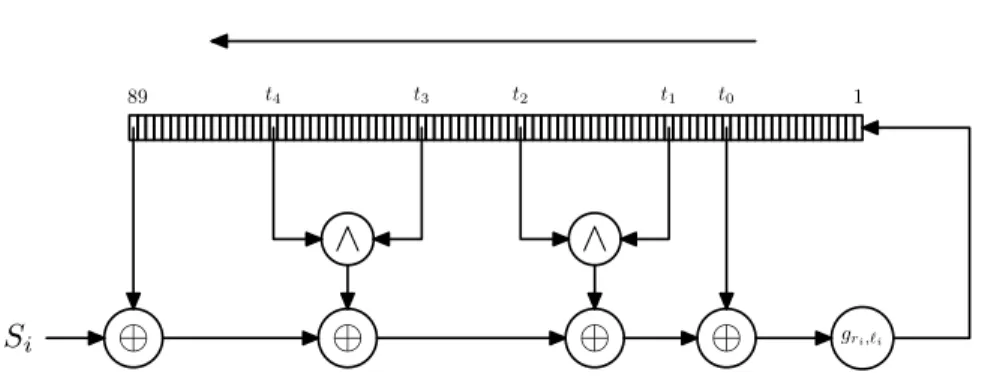
The main loop thus performs a total oft =rcsteps, where each step com-putes a one-word value. This loop can be implemented by loading the input into the first n words of an array A of length n+t, then computing each of the remainingtwords in turn. See Figure 2.12. Equivalently, this loop can be implemented as a nonlinear feedback shift register with 89 words of state. See Figure 2.14.
The truncation operation merely returns the last 16 words ofAas the com-pression function output (which we also call the “chaining variable”). The compression function always outputs c = 16 words (1024 bits) for this chain-ing variable. This is at least twice as large as any possible MD6 hash function output, in line with the “wide-pipe” strategy suggested by Lucks [40].
The compression function takes the “feedback tap positions”t0,t1,t2,t3,t4, each in the range 1 ton−1 = 88, as parameters. (Note the slight overloading for the symbolt: when subscripted, it refers to a tap position; when unsubscripted, it refers to the number of computation stepst=rc.)
The MD6 compression functionf
Input:
N: An input array N[0..n−1] of n = 89 words. (This typically consists of a 25-word “auxiliary information” block, followed by a a b = 64-word data blockB, but all inputs are treated uniformly here.)
r : A non-negative number of rounds.
Output:
C: An output arrayC[0..c−1] of lengthc= 16 words.
Parameters: c,r,t0,t1,t2,t3,t4,ri,`i,Si, where 1≤ti≤nfor all 0≤i≤4, 0< ri, `i≤w/2
for alli, and Si is aw-bit word for eachi, 0≤i < t.
Procedure:
Lett=rc. (Each round hasc= 16 steps.) LetA[0..t+n−1] be an array oft+nwords.
Initialization:
A[0..n−1] is initialized with the inputN[0..n−1]. Main computation loop:
fori=ntot+n−1: /*t steps */
x = Si−n ⊕ Ai−n ⊕ Ai−t0 [line 1]
x = x ⊕ (Ai−t1∧Ai−t2) ⊕ (Ai−t3∧Ai−t4) [line 2]
x = x ⊕ (x >> ri−n) [line 3]
Ai = x ⊕ (x << `i−n) [line 4]
Truncation and Output:
OutputA[t+n−c..t+n−1] as the output arrayC[0..c−1] of lengthc= 16.
CHAPTER 2. MD6 SPECIFICATION 25
N
ES(N)
C
S
E
Figure 2.11: The compression function f viewed as an encryption operation followed by a truncation operation. The 89-word input N (with the first 15 words shaded to indicate that they are constant) is encrypted under control of keyS to yieldES(N). The keyS is arbitrary but fixed and public. The last 16
words ofES(N) form the desired compression function outputC.
B V U K Q 0 88 i−89..i−1 i t+ 73..t+ 88 C
Figure 2.12: The compression function main loop. The array portionA[0..88] is initialized with the compression function input (Q, K, U, V, B) (See Figure 2.7). Then, for i = 89,90, . . . , t+ 88, A[i] is computed as a feedback function of
A[i−89..i−1]. The portionA[i−89..i−1] can be viewed as a “sliding window” moving left to right as the computed portion (shown in gray) grows. The last 16 words of final windowA[t..t+ 88], that isA[t+ 73..t+ 88], forms the outputC.
MD6 constants Tap positions:
t0 t1 t2 t3 t4 17 18 21 31 67
Shift amounts:
The valuesri−n,`i−nare the initial right-shift amount and the subsequent left-shift amount
within the step with indexi; the indexi−nis taken moduloc= 16.
(i−n) mod 16 0 1 2 3 4 5 6 7 8 9 10 11 12 13 14 15
ri−n 10 5 13 10 11 12 2 7 14 15 7 13 11 7 6 12
`i−n 11 24 9 16 15 9 27 15 6 2 29 8 15 5 31 9
Round constants:
The values Si−n for i ≥n are determined as follows. Because Si−n is constant within a
round, but changes from round to round,Si−n is defined in terms of an auxiliary sequence Sj0. The constantsS00 andS∗ determine the entire sequence.
Si−n =Sb0(i−n)/16c
S00 =0x0123456789abcdef
S∗=0x7311c2812425cfa0
Sj0+1= (S0j<<<1) ⊕ (S0j∧S∗).
Figure 2.13: MD6 Constants
In addition, for each i, 0 ≤ i < t, there are parameters ri, `i denoting
fixed “right-shift” and “left-shift” amounts: these are different nonzero values 0< ri, `i ≤w/2 = 32. Finally, there is a one-word “feedback constant” value Si for eachi, 0≤i < t.
Lines 1–2 of the loop in Figure 2.10 are entirely bitwise parallel, with no mixing between different bit positions. Line 1 contains the constant term Si
and the linear termsAi−n(the “end-around” term) and Ai−t0. Line 2 contains
the nonlinear “quadratic terms” (Ai−t1∧Ai−t2) and (Ai−t3∧Ai−t4).
Note that no information is lost during the compression function computa-tion until the final truncacomputa-tion to an output of sizec words. Indeed, the basic compression step is invertible, because the recurrence exclusive-orsA[i−n] with values depending only on the other input elementsA[i−1..i−n+1], and because
CHAPTER 2. MD6 SPECIFICATION 27 1 t0 t1 t2 t3 t4 89
⊕
⊕
⊕
∧
∧
⊕
gri,`iS
iFigure 2.14: The main computation loop of the compression function viewed as a nonlinear feedback shift register. Each shift register cell, each wire, and each
Si represents a 64-bit word. Because the shift register shifts from right to left,
it is convenient to number the cells from 1 on the right to 89 on the left; the cell labelled 1 in the figure corresponds to locationA[i−1] in Figure 2.10, and the cell labelled 89 here corresponds to location A[i−89]. The tap positions shown are correct fort0= 17 and for positionn= 89, but fort1. . . t4 are only illustrative (for ease of drawing). The functiongri,`iis the function described in
equation 2.3. Each 64-bit feedback word depends on oneSi word and six words
of the register.
xoring a value with a shifted version of itself is invertible. (Xoring a value with a shift of itself is known as the “xorshift” operator; it is well-known and studied in the random-number literature [41, 55].) Thus, the mapping insidef of the firstn-words ofAto the lastnwords ofAis invertible; this corresponds to the mappingπgiven in Figure 2.15.
In hardware, the basic iteration step can be implemented with constant cir-cuit depth—there are no multiplications, additions, or other operators that re-quire carry propagation or other potentially non-constant delays. This means a
hardware implementation can be extremely fast. Note that sincec≤min(t0, t1, t2, t3, t4), there is no dependence of one step on the output of another for at leastc steps.
Since the steps within a round are independent, all steps within a round can be executed simultaneously. Overall, each round requires only a single clock tick, and a complete compression function can be computed inrclock cycles.
There are no data-dependent table lookups or other operations whose timing might be data-dependent. This reduces the vulnerability to side-channel attacks.
2.5.1
Steps, rounds and rotations
Thet =rcsteps can be thought of as a sequence of rotations, each of which consists of n = 89 steps and thereby fully cycles/refills the n-word feedback shift register by computing the nextnwords of state. We note that one rotation consists ofn/c= 89/16 = 5 9/16 rounds, and two rotations correspond to nearly 11 rounds.
Each rotation produces a newn-word vector; you can view the computation asrc/nrotations, each of which produces an-word state vector invertibly from the previousn-word state vector. The input is the firstn-word state vector; the output is the lastcwords of the lastn-word state vector. (Note thatrc/nisn’t necessarily an integer. That doesn’t matter here; the description just given is still accurate.)
The compression function can also be viewed as r 16-step rounds each of which computes the next 16 words of state.
We prefer the latter view.
The MD6 feedback constants are organized in a manner that reflects the round-oriented viewpoint. The round constant Si stays the same for all 16
steps of a round and changes for the next round. The shift amountsr(·) and
`(·) vary within a round, but then have the same pattern of variation within successive rounds.
For a software implementation of MD6, it is convenient to perform 16-fold loop-unrolling, so that each round is implemented as a branch-free basic block of code.
2.5.2
Intra-word Diffusion via xorshifts
Some method is required to effect diffusion between the various bit positions within a word. This intra-word diffusion is provided by the gri,`i operator
implicit in lines 3–4 of the loop in Figure 2.10:
gri,`i(x) = { y=x ⊕ (x >> ri);
returny ⊕ (y << `i) }
(2.3)
(Here “`” andr are overloaded; `i andri refer to a shift amounts, whiler
refers to the number of rounds, and`is used in the mode of operation to refer to the level number; these distinctions should be clear from context.)
The functiong is linear and invertible (lossless).
The operators x= x ⊕ (x >> ri) and x=x ⊕ (x << `i) are known as
“xorshift” operators; their properties have been studied in [41, 55].
2.5.3
Shift amounts
The shift values are indexed modc= 16 (i.e., they repeat every round). The values given here for MD6 were the result of extensive experiments using one million randomly generated tables of such shift values. See Section 3.9.3
2.5.4
Round Constants
The round constants Sj0 provide some variability between round. Each round
j has its own constant Sj0; the steps within a round all use the same round constant.
CHAPTER 2. MD6 SPECIFICATION 29
The following recurrence generates these constants:
S00 = 0x0123456789abcdef
S∗= = 0x7311c2812425cfa0
Sj0+1 = (Sj0 <<<1) ⊕
(Sj0∧S∗). (2.4) This recurrence relation is one-to-one—from Sj0 one can determine Sj0+1, and vice versa. (See Schnorr et al. [66, Lemma 5])
2.5.5
Alternative representations of the compression
func-tion
There is another useful way of representing the compression function. Since the 15-word portionQ of the input is a fixed constant, we can define the function
fQ as
fQ(x) =f(Q||x),
wherefQ maps inputs of lengthn−q= 74 words to outputs of length c= 16
words. This representation off is useful in our security proofs of the compres-sion function in Section 6.1.2. We may refer to either f or fQ as “the MD6
compression function”; they are intimately related. It is easier to talk about
f when discussing the specification of MD6, but better to talk aboutfQ when
discussing its security. We may refer to f as the “full” compression function, andfQ as the “reduced” compresssion function.
Another relevant representation is defined as follows. If we return to the representation of Figure 2.11, wherein f is defined in terms of an encryption operation, we note that S (and thus ES(·)) is public and fixed. It may thus
be preferable to view the compression function as a fixed but randomly cho-sen public permutationπ of the input space Wn, followed by truncation to c
words. See Figure 2.15. We make use of this representation in our discussion of compression function security.
2.6
Summary
This chapter has presented the full specification of the MD6 hash function. Reference code provided with our submission to NIST for the SHA-3 competition provides a different, but equivalent, definition.
N
π(N)
C
π
Figure 2.15: An alternative view: the compression functionf viewed as a fixed public random permutationπof the input space Wn followed by a truncation operation. The 89-word inputN (with the first 15 words shaded to indicate that they are constant) is mapped byπto a random value π(N). The last 16 words ofπ(N) form the desired compression function outputC.
Chapter 3
Design Rationale
This chapter describes the considerations and reasoning behind many of the design decisions in MD6.
The landscape for designing hash functions has certainly changed in the last two decades (since MD5 was designed)! Advances in technology have provided fewer constraints, and more opportunities. Theoretical advances provide newer tools for the both the attacker and the designer.
The sections in this chapter summarize some of the considerations that went in to the design choices for MD6. A related presentation of these issues is available in Rivest’s CRYPTO’08 slides (included with this submission).
Of course, the primary objective of a cryptographic hash function is security— meeting the stated cryptographic objectives. And, to the extent possible, doing so in a provable way. Chapters 6 and 7 provide detailed proofs regarding the security properties of the MD6 compression function and mode of operation.
Some of the other significant considerations include:
• Increased availability of memory, allowing larger block sizes that include new auxiliary inputs to each compression function call.
• The forthcoming flood of multicore CPU’s, some of which may contain hundreds of cores. This consideration demands an approach that can exploit available parallelism.
• Side-channel attacks that limit the instructions that one deems “safe” in an application potentially utilizing secret keys.
The following sections document these and related considerations.
3.1
Compression function inputs
It is worthwhile to begin by revisiting the description of the inputs to a com-pression function and associated terminology.
3.1.1
Main inputs: message and chaining variable
Traditionally, compression functions have two main input ports: one for a chaining variable and one for a message block.
Such a traditional compression function can be characterized as a mapping from ac-word input chaining variable and a b-word input message block to a
c-word output chaining variable:
f :Wc×Wb→Wc (3.1) HereW denotes the set ofw-bit words. The compression function produces a single chaining variable of lengthc words as the output.
Such traditional compression functions are “hard-wired” to fit within a cer-tain mode of operation. More precisely, these input ports are dedicated to their particular use within the Merkle-Damg˚ard mode of operation.
The compression function signature (3.1) may also relate to the manner in which the compression function is constructed. For example, the chaining variable may be used as input to an encryption algorithm, as in the Davies-Meyer construction [46, Ch. 9].
To move beyond the Merkle-Damg˚ard paradigm, we need to take a some-what more general and flexible view of compression, along the lines of a general pseudo-random function with fixed input and output sizes.
Note, for example, in a tree-based hash algorithm like MD6, compression functions working on the leaves of the tree have only message data as input, while compression functions higher in the tree contain no message data, but instead consists of several chaining variables passed up from their children nodes. It thus doesn’t make sense to have a compression function with dedicated “message” and “chaining variable” inputs.
We thus consider for the moment revising our compression function signature by dropping the specificc-word “chaining variable input”, and considering the compression function to be a mapping from b words of main input toc words of output:
fB :Wb→Wc . (3.2)
(The subscriptB here indicates that we are only considering the inputs corre-sponding to theB portion–the data payload.) We’ll see in a moment that we’ll revise this signature again, slightly.
Whether thebwinput bits come from the message, or are chaining variables from previous compression function operations, will depend on the details of the mode of operation. We still call the output of a compression function compu-tation a “chaining variable,” even though the compucompu-tations may be linked in a tree-like or other manner, rather than as a chain as in Merkle-Damg˚ard.
The compression ratio of a compression function is the ratiob/cof the num-ber of main input bits to the numnum-ber of output bits. Ratios in the range 3–5 are typical; MD6 has a compression ratio of 4. For MD6 theb= 4cmain input words may consist of either message data (as for a leaf node) or four chaining variables (from child nodes) of sizecwords each.
CHAPTER 3. DESIGN RATIONALE 33
3.1.2
Auxiliary inputs: key, unique nodeID, control word
A compression function may have “auxiliary” inputs in addition to the “main” inputs described above.
A traditional compression function doesn’t have any such auxiliary inputs, but recently there have been a number of proposals (such as [13, 62]) to include such inputs. Such auxiliary inputs can have great value in defeating or reducing vulnerabilities associated with the standard Merkle-Damg˚ard mode of operation. They also facilitate proofs of security, as one can often treat restrictions of the compression function to different auxiliary inputs as, essentially, independent-drawn random functions.
MD6 makes liberal use of such auxiliary inputs, which for MD6 are:
• ak-word “key”K,
• au-word “unique node ID”U, and
• av-word “control word”V.
If the total length of such auxiliary inputs isα = k+u+v words, then the compression function has the signature:
fQ:Wα×Wb→Wc . (3.3)
(The subscriptQ here indicates that we are considering all inputs except the constant valueQ; the actual implementation of the MD6 compression function also incorporates a fixed constant “input” valueQ, but we do not need to discuss
Qfurther here, as it is constant.)
3.2
Provable security
To the extent possible while maintaining good efficiency, MD6 is based on provable security.
We provide numerous reductions demonstrating that the MD6 mode of op-eration achieves various security goals, assuming that the MD6 compression function satisfies certain properties.
We also provide strong evidence that the MD6 compression function has the desired properties. This includes not only statistical analysis and SAT-solver attacks, but also provable lower bounds on the workload required by certain differential attacks.
The tree-based MD6 mode of operation is also interesting in that certain of its proofs admit a tighter security reduction than the corresponding known results for the Merkle-Damg˚ard mode of operation.
Our results on the mode of operation security relate to pre-image resistance, collision-resistance, pseudorandomness, and indifferentiability from a random oracle.
3.3
Memory usage is less of a constraint
Continuing improvements in integrated circuit and memory technology have made memory usage much less of a concern in hash function design. While still a concern for low-end devices, the situation is overall much improved, and one can reasonably propose hash functions with significantly larger memory usage than for designs proposed in the 1990’s. Doing so can provide significant benefits in flexibility and security.
Indeed, MD5 was designed in 1991; 17 years have since passed. Since then, the memory capacity of chips has increased at about 60% per year, so such chips now have over 1000 times as much capacity. Similarly, the cost per bit of memory has decreased at rate of about 30% per year.
Even “embedded” processors may have substantial amounts of memory. An embedded processor today is typically an ARM processor: a 32-bit processor with many kilobytes of cache memory and access to potentially many megabytes of off-chip RAM. Even simple “smart card” chips have substantial memory. For example, a typical SIM card in a cell phone is a Java Card with 64KB of code, 16KB of EEPROM and 1KB RAM [20].
RFID chips are the most resource-constrained environment to consider. At the moment, they are so severely constrained that doing serious cryptography on an RFID chip is nearly impossible. But even this is evolving quickly; RFID chips with 8KB memory (ROM, not RAM) are now available. Programming a respectable hash function onto an RFID chip may soon be a realistic proposition. Thus, it is reasonable to consider hash function designs that use memory more freely than the designs of the early 1990’s.
We will thus take as a design goal that MD6 should be implementable using at most 1KB RAM.
An MD6 compression function calculation can easily be performed within 1KB of RAM, and forL= 0 the entire MD6 hash function fits well within the 1KB RAM limit. Larger systems can use more memory for increased parallelism and greater efficiency by using the default valueL= 64.
3.3.1
Larger block size
A major benefit of the increased availability of memory is the ability to use compression functions with larger inputs.
MD4 and MD5 have message+chaining sizes of 512 + 128 = 640 bits. SHA-1 has message+chaining sizes of 5SHA-12 + SHA-160 = 672 bits. The first members of the SHA-2 family (SHA-224, SHA-256) have message+chaining sizes of 512 + 256 = 768 bits, while SHA-384 and SHA-512 have message+chaining sizes of 1024 + 512 = 1536 bits.
Such input block sizes are arguably too small for what is needed for SHA-3, where we want a hash function producing 512-bit outputs. The compression function function must produce at least 512 bits of output, and preferably more. With 1536-bit inputs, we can barely get a compression factor of three. There is little room left over for auxiliary inputs, and no possibility of following the
CHAPTER 3. DESIGN RATIONALE 35
“double-width pipe” strategy suggested by Lucks [40], wherein chaining vari-ables are twice as large as the final hash function output.
Thus, MD6 chooses an input data block size of 512 bytes (i.e. 64 words, or 4096 bits), and a compression factor of four for its compression function. The compression function output size is 1024 bits—twice as large as any message digest required for SHA-3, so MD6 can follow the double-width pipe strategy.
Many benefits follow from having relatively large compression function in-puts.
First, having large inputs allows us to easily incorporate nontrivial auxiliary inputs into the compression function computation, since these auxiliary inputs then take up a smaller fraction of the compression function inputs.
Second, large inputs allows for more potential parallelism within the com-pression function computation. In MD6, all 16 steps within a single round can be computed at once in parallel.
Third, a large message input block can accommodate a small message within a single block. For example, 512 bytes is a common size for disk blocks on a hard drive; such a block can be hashed with a single compression function call. Similarly, a network packet of up to 512 bytes can be hashed with a single compression function call.
Fourth, having a larger compression function input block should make crypt-analysis (even automated cryptcrypt-analysis) more difficult, since the number of compression function computation steps also increases. For example, with a differential attack, the probability of success typically goes down exponentially with the number of computation steps. Existing hash functions have a number of computation steps that may be fewer than the number of hash function out-put bits desired, whereas MD6 has many more than 512 steps. If each such step has a probability of at most 1/2 of following a given differential path, then the large number of computation steps under MD6 makes such attacks very unlikely to succeed.
3.3.2
Enabling parallelism
A second major benefit of the increased availability of memory is the ability to enable parallel computation.
SHA-3 should be able to exploit the paral-lelism provided by the forthcoming flood of multicore processors.
Yet, a parallel approach requires more memory than a sequential approach. In the best case, a tree-based approach requires memory at least proportional to the height of the tree–that is, is, it requires memory at least proportional to the logarithm of the message size. With a branching factor of 4, a leaf size of 4096 bits, and a maximum message size of 264bits, this logarithmic factor is 26.