AN ENHANCED QOS BASED DYNAMIC ROUTING
PROTOCOL FOR WIRELESS SENSOR NETWORKS
S. Manickam
1, Dr. (Mrs.) V. Radhika
21
Research Scholar, Department of Computer Science, Sri Krishna Arts and Science College,
Coimbatore, Tamil Nadu, (India)
2
Principal, Sri Krishna Adithya College of Arts and Science, Coimbatore, Tamil Nadu, (India)
ABSTRACT
In recent times, Wireless Sensor Networks (WSNs) is extensively used in numerous applications with enormously varying requirements and uniqueness. Due to the dynamically changing topology, improving Quality of Services (QOS) in WSNs has becomes hard. WSN have several different constraints in route selection such as energy, availability, computational power, buffer space, throughput etc. In order to achieve improve throughput, many dynamic and reliable source routing protocols are introduced. However WSN suffers from a critical problem known as congestion, which causes packet loss, lower throughput, collisions and delay. Finally all these issues results in poor network performance due to its ineffective routing. This work aims to improve the network performance under varying network conditions. Ultimate goal is congestion avoidance and QOS based dynamic routing is proposed an enhanced QOS based Dynamic routing protocols (Q-DRP) for WSNs .The work extends the regional congestion avoidance approach in the network with dynamic delay calculation. Using Q-DRP every nodes weight will be calculated based on the parameters buffer Size, total delay (transmission delay, queue delay, propagation delay), hop count, and channel busy ratio, mobility along with other overhead. A Q-DRP utilizes the flowing mechanisms for finding the optimal link, a QOS- guaranteed relay selection mechanisms to meet the transmission delay and propagation delay requirements, to improve the performance against congestion distributed optimal packet scheduling algorithm (OPS) have been proposed to further reduce transmission delay, propagation delay and queuing delay. Delay computation helps to know the overall cost of the link. Three parameter delays are calculated to analyze optimal link (path) selections for better transmission.
Keywords
: WSN, Congestion Avoidance, Q-DRP, OPS, Quality of Services.
I. INTRODUCTION
Almost Worldwide in computer digital networks are used recently at same time rapidly day to day growth
Wireless Sensor Networks (WSNs) usages highly recommended improvements research areas in emerging
application real-time environmental monitoring and industrial automation, military area monitoring
,water/wastewater monitoring, passive localization and object tracking and some of home appliance in
WSNs.[6]
The main objective of the research is to improve the network performance and reliability of Wireless Sensor
Networks. The main intention is to develop congestion aware enhanced QOS based Dynamic routing protocol.
The QOS metrics like queuing, propagation, transmission delay are analyzed and used to calculate total delay
they are to find the idle path and under loaded links; and cache the packets efficiently for subsequent
transmission for congestion avoidance and implicit Hop- by-Hop Rate control. The proposed scheme not only
working on delay calculation but also weight calculations which are used to select optimal link. Once the path is
identified packets are efficiently transmitted by avoiding the congestion. For caching of packets and
Hop-by-Hop rate control methods are utilized.
Section II gives as the short notes of existing congestion mechanisms and Dynamic routing protocols.
Section III deal with the description of the proposed algorithms. Section IV is dealt with the Proposed Architecture diagram with delay and weight calculations in proposed systems. Section V gives us Performance evaluations and result. And finally Section VI gives the conclusion of the paper.
II. RELATED WORK
WSN and describes the existing approaches and techniques that have been applied to the Network for to achieve
the Quality of Service and congestion control. The review also focuses in detail on the application of Congestion
Control and QoS Routing. There are many congestion control schemes for WSN has been proposed in existing.
2.1 Congestion control Approaches
Two general approaches to control congestion are as follows
Resource management and Traffic controls [3] is Network resource management tries to extend network
resource to mitigate congestion when it occurs. In WSN, power control and multiple radio interfaces can be used
to increase bandwidth and weaken congestion. In this approach, it is necessary to guarantee precise and exact
network resource adjustment in order to avoid over provided resource or under provided resource.
There are two general methods for traffic control in WSNs:
1. The hop-by-hop congestion control: The hop-by-hop congestion control has faster response. It is usually
difficult to adjust the packet-forwarding rate at intermediate nodes mainly since packet forwarding rate is
dependent on MAC protocol and could be variable.
2. The end-to-end control: The end-to-end control can impose exact rate adjustment at each source
node and simplify the design at intermediate nodes; it results in slow response and relies highly on the
round-trip time (RTT). These approaches have been applied in various applications such as sensory
These approaches have been applied in various applications such as sensory field monitoring, structural health
monitoring, image sensing, etc.
Hull, et al [1] are developed a real time communication protocol RAP which provides two types of services:
event and query. To ensure fairness, the packets which originate farther from the sink are assigned high priority
than the ones that are originated closer to the sink node. RAP provides velocity monotonic scheduling (VMS) to
reduce deadline miss ratio. It gives support for both distance and deadline aware scheduling. Deadline aware
its distance. The greater the distance, the higher the priority is and similarly the shorter the deadline, the higher
the priority.
Wan, et al [2] examined. Congestion Detection and Avoidance (CODA) is an energy efficient congestion
control protocol. It uses buffer occupancy and channel status for congestion detection. If buffer occupancy
crosses the threshold, it samples the channel to detect congestion. It can handle both transient and persistent
congestion. Open loop hop-by-hop backpressure is used to handle transient congestion. In open loop, when
congestion is perceived, all the neighboring nodes receive a suppression message to decrease their sending rates.
Closed loop multi source regulation is used to handle persistent congestion. In closed loop, sink sends a stream
of ACKs to control the transmission rate of sources if congestion is detected. CODA provides a mechanism of
implicit priority and maintains acceptable fidelity.
The proposed scheme Q-DRP also shows improvement in performance of WSN compared with other Routing
scheme and Congestion aware Scheme.
III. PROPOSED ALGORITHM
A QOS based Dynamic Routing protocol (Q-DRP) for wireless sensor networks is proposed to mitigate traffic
congestion. Using Q-DRP every nodes weight will be calculated based on the parameters buffer Size, total delay
(transmission delay, queue delay, propagation delay), hop count, and channel busy ratio, mobility along with
other overhead.
A Q-DRP utilizes the flowing mechanisms for finding the optimal link
i. A QoS-guaranteed relay selection mechanisms to meet the transmission delay and propagation delay
requirements, to improve the performance against congestion distributed optimal packet scheduling
algorithm has been proposed to further reduce transmission delay, propagation delay and queuing delay.
ii. A segment resizing mechanism is adjusted according to the node mobility in order to reduce
transmission time which avoid. The congestion by a traffic redundant exclusion.
iii. Analysis of buffer size and traffic flow is done for effective congestion avoidance and for emergency
transmission algorithm is used to forward packet soft-deadline-based forward scheduling.
iv. A data redundancy elimination scheme used to eliminate the duplicate data for improving the reliable
transmission.
Algorithm for Q-DRP:
Step1: Start the process
Step2: send route request to all possible neighbor nodes.
Step 3: to check the space utility routing and buffer details of neighbor nodes are analyzed.
Step 4: for analysis the source node receives all the neighbor node details stored in the routing table.
Step 5: Total delay (Td) and total weight (Tw) estimated. The formula:
Total Delay = Total propagation + Total transmission + Total queuing. Td,
Weight calculation: (delay +buffer +mobility+ link capacity) Tw and packet size Sp(i) are
all analyzed.
Step 7: for each link in the sorted list packet rate Ai is allocated.
Step 8: send packets via nodes with transmission interval Sp(i) and Ai to transmit Source to Sink
Node.
IV. PROPOSED METHOD
The scheduling process begins with the weight calculation on each link in the network, for optimal scheduling
process, the system performs the following delay calculation algorithms
i. QOS-Guaranteed Relay Selection Mechanisms
ii. Distributed optimal Packet Scheduling Algorithm (optimal packet scheduling-OPS)
iii. Mobility-Based Segment Resizing Mechanisms
iv. Traffic Redundant Exclusion Mechanisms
v. Data Redundancy Elimination-Based Transmission Mechanisms
The above mechanisms and Fig 3.1 Architecture Diagram for Q-DRP discusses the algorithm and process
involved in the proposed scheme, where between the source and destination, the optimal QOS guaranteed links
have been selected. The following is the Algorithm for Q-DRP.
Fig: 1 Architecture Diagram for Q-DRP.
4.1 Delay Calculations
The aim is to find an optimal link towards the destination in terms of QOS metrics while meeting the total delay
applying delay calculation (queuing delay, propagation and transmission delay) along with other parameters,
improve the data transmission performance and thus reduces the unexpected packet loss
The following steps represent the process involved in the delay calculation. The delay, which are categorized
into three types. One is queuing delay, propagation and transmission delay over every link.
Total Delay = ∑ Total propagation +∑ Total transmission + ∑ Total queuing
4.2 Weight Calculation
The node calculates the current Weight and informs to the requested node. Based on the Weight the system will
schedules the data for transmission. The neighbor analysis shows that if the source nodes are independent and
identically distributed in a system with random packet generation rate, the nodes with the IEEE 802.11 protocol
present diversified channel utilities and Weights, which is suitable for distributed resource scheduling.
At every stage, a node has to select a best node based on cost function. This selected node acts as a relay for the
current packet. Cost depends on
NEXT HOP
Where, Energy needed to transmit a packet from i to j (E), Buffer size (B), Node failure probability (Residual
energy) (RE), Hop distance from the sink node (H), Total delay (D)
The next hop election can be based on Node cost or Link cost. In this thesis, node cost is used to compute the
next hop selection.
V. EXPERIMENTAL SETUP
NS2 simulator is used to simulate the proposed protocol. In the simulation, the channel capacity of hosts is set to
the same value 2 Mbps. The distributed coordination function (DCF) of IEEE 802.11 as the MAC layer protocol
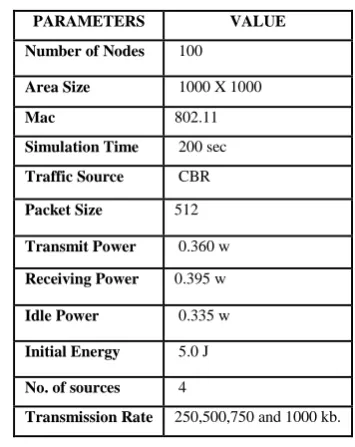
is used. In the simulation, total number of sensor nodes are 100 those nodes are randomly deployed in a 1000 x
1000 m region for 50 seconds simulation time. All nodes have the same transmission range of 250 meters. The
simulated traffic is Constant Bit Rate (CBR).
Table 1 Simulation Parameters
PARAMETERS VALUE
Number of Nodes 100
Area Size 1000 X 1000
Mac 802.11
Simulation Time 200 sec
Traffic Source CBR
Packet Size 512
Transmit Power 0.360 w
Receiving Power 0.395 w
Idle Power 0.335 w
Initial Energy 5.0 J
No. of sources 4
VI. PERFORMANCE EVALUTIONS
The following parameters are calculated using .awk files.
Fig 2: Performance Result of Proposed System
From the initial simulation, 100 nodes are taken and 5 nodes are specified as source, the optimal link selection
using Q-DRP yielded high throughput, packet delivery ratio and through put. The values are specified in the Fig
3.10. The packet delivery ratio is 100% in the first phase of simulation. This may be varying according to the
total number of nodes and its energy. The following is the average throughput, packet delivery ratio of the
proposed system.
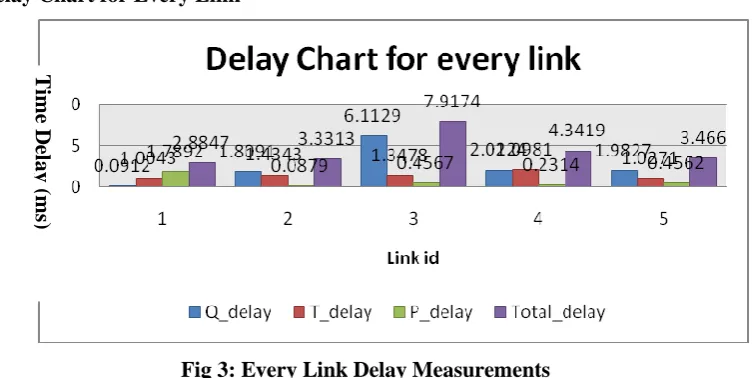
6.1 Delay Chart for Every Link
Fig 3: Every Link Delay Measurements
In the network topology, for every link the total delay will be calculated. Based on the delay, the packet will be
scheduled.
Comparative Study:
A) Throughput
It is the ratio of the total amount of data that reaches a receiver from a sender to the time it takes for the
receiver to get the last packet. When comparing the routing throughput by each of the protocols, Q-DRP has
high throughput. It measures of effectiveness of a routing protocol.
T
im
e D
el
ay
(m
Fig 4: Throughput Comparison Chart
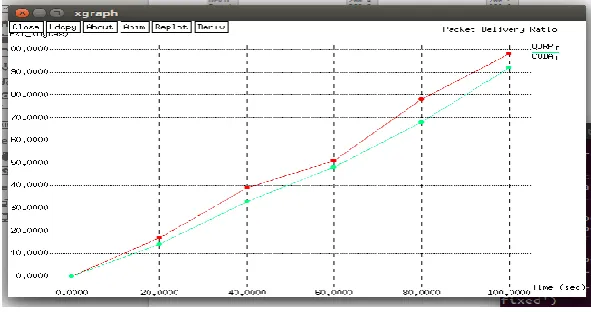
B) Packet Delivery Ratio (PDR)
The ratio of number of packets send from source and number of packets reach the destination. The ratio of the
number of packets received and the number of packets expected to be received. So the ratio is the total number
of received packets over the multiplication of the group size and the number of originated packets. The packet
delivery ratio is calculated as follows:
Fig 5: Packet Delivery Ratio (PDR) comparison chart
PDR = (No of packets Received / No of packets send) * 100
C) Delay Comparison
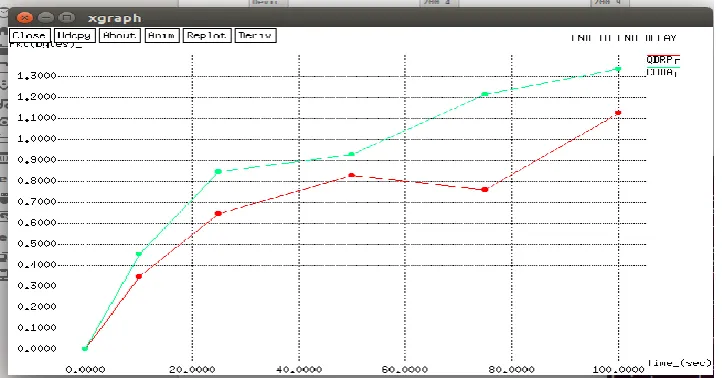
The proposed system schedules the message in optimal node and the message reach the destination in any of the
available best nodes and paths .Thus delay time of proposed system decreases when compared to the existing
system. Packet transmission delay is calculated as follows:
Fig 6: The packet transmission delay (Delivery time) comparison of proposed Q-DRP with
existing CODA approach
VII. CONCLUSION
A QOS aware dynamic routing protocol (Q-DRP) is proposed in this thesis for effective data transmission over
wireless networks. In the Q-DRP, five enhanced algorithms are proposed for the congestion free path, energy
efficient path, and delay aware path selection. This helps to perform customized QOS in the wireless network.
Q-DRP selects optimal link based on several parameters, such as total delay, node mobility, and buffer size and
congestion free links. Q-DRP also performs congestion avoidance process by applying effective optimal packet
scheduling and packet redundancy elimination algorithms. Using the above algorithms, congestion problem will
be eliminated.
REFERENCES
[1] Lu, Chenyang, et al. "Rap: A real-time communication architecture for large-scale wireless sensor
networks." Real-Time and Embedded Technology and Applications Symposium, 2002. Proceedings.
Eighth IEEE. IEEE, 2002.
[2] Wan, Chieh-Yih, Shane B. Eisenman, and Andrew T. Campbell. "CODA: congestion detection and
avoidance in sensor networks." Proceedings of the 1st international conference on Embedded networked
sensor systems. ACM, 2003.
[3] ] K. Romer and F. Mattern, “The Design Space of Wireless Sensor Networks,” IEEE Wireless
Communications, vol. 11, no. 6, pp. 54–61, Dec. 2004.
[4] T. Haenselmann, Sensornetworks. GFDLWireless Sensor Network Textbook, April 2005.
[5] S. Manickam, Dr. (Mrs.) V. Radhika Comparative Study of Mobile Ad -Hoc Networks In Reactive
Routing Protocols DSR and TORA, International Journal of Science, Technology & Management Volume
No 04, Special Issue No. 01, March 2015, ISSN (online): 2394-1537.
[6] S. Manickam, , Dr. (Mrs.) V. Radhika “A Study On Reliable Quality Of Services For Dynamic Multipath
Journal of Infinite Innovations in Engineering and Technology. Volume 2 Issue 3 July2015, ISSN
(Online): 2349-2287, ISSN (Print): 2349-2279.
AUTHORS
Manickam.S was born in Coimbatore,Tamil Nadu (TN), India, in 1990. He has received the Bachelor of Science in Computer Science degree from Caussanel College of Arts &
Science,Ramanathapuram (Dt.) which is affiliated to the Alagappa University, TN, India, in
year of 2011 and the Master of Science in Computer Science degree from Sri Krishna Arts
& Science College, affiliated to the Bharathiar University, Coimbatore, TN, India, in year of
2014. He is currently pursuing the Master of Philosophy in Sri Krishna Arts & Science
College, Coimbatore with the Department of Computer Science, which is affiliated to the
Bharathiar University, Coimbatore, TN, India,. His research interests include Advanced
Networking,Social Networking and artificial intelligence.
Radhika.V received her B.Sc (Phy) ,MCA and M.Phil degree from Bharathiar University Coimbatore, TN, India. in 1993 ,1996 and 2003 respectively. She received her PhD from
Avinashilingam university for women, Coimbatore, TN, India. at Present 2015. She is the
Principal, of Sri Krishna Adthiya College of Arts And Science, Coimbatore, TN, India. She
has 19 years of teaching experience.She has more than 27 publications at national and