26 | P a g e
A SECURE FRAMEWORK FOR PROTECTING IN
PERSONALIZED WEB SEARCH
Indarapu
Kiran
1, Bhaludra Raveendranadh Singh
2,
T. Ramyasri
3 1Pursuing M.Tech (CSE),
2Principal,
3Assistant Professor
Visvesvaraya College of Engineering and Technology (VCET), M.P Patelguda, Ibrahimpatnam (M),
Ranga Reddy, (India)
ABSTRACT
Now a Days Personalized web search (PWS) has shown its capability in attractive the nature of different search
benefits on the Internet. One of the choices accessible to consumers is personalized web aspect which displays
query item in view of the individual information of client provided to the inquiry supplier. It suggests a structure
called UPS which designs up profile in the meantime keeping up protection essentially selected by consumer
.Even so, verifications validate that consumers' hesitance to expose their private data among search has turn
into a significant difficulty for the wide development of PWS. We reflect security defense in PWS requirements
that model consumer preferences as advanced consumer profiles. We suggest a PWS system called UPS that can
adaptively sum up profiles by questions while concerning client determined protection requirements. Our
runtime assumption goes for outstanding agreement between two sensitive measurements that measure the value
of personalization and the security danger of discovery the summed up profile. We show two greedy
calculations, specifically GreedyDP and GreedyIL, for runtime assumption. We equally give an online forecast
system to choosing whether modifying a question is gainful. Broad surveys show the capability of our system.
The investigative results similarly uncover that GreedyIL basically attack from behind GreedyDP regarding
efficiency.
I. INTRODUCTION
The web internet explorer has long turn into the most dangerous appearance for normal individuals searching for
helpful data on the web. However, clients may encounter disappointment when web directories return irrelevant
results that don't meet their unaffected aims. Such insignificance is to a great level because of the incredible
mixed bag of clients' connections and foundations, and also the imprecision of literatures. Customized web look
(PWS) is a general classification of search procedures going for giving better indexed lists, which are
custom-made for individual client needs. As the cost, client data must be assembled and separated to make sense of the
client probability behind the distributed analysis.
The clarifications to PWS can normally be considered into two types
Click-log-based methods and
Profile-based methods
1.1 Click-Log-Based Methods
The clock log based techniques are direct they basically force predisposition to clicked pages in the
27 | P a g e
It can just chip away at rehashed inquiries from the same client, which is an in number constraint limitingits material.
This policy has been performance well but it work on repetitive queries from same user which is a
solidcontrol to its applicability.
1.2 Profile-Based Methods
Profile-based techniques can be possibly successful for a wide range of questions, however are accounted
for to be unpredictable under a few conditions.
Enhance the searchcontribution with entangled client awareness models created from client summarizing
procedures.
PWS has shown more feasibility in attractive the nature of web inquiry as of late, with increasing
utilization of individual and conduct data to profile its clients, which is generally accumulated definitely
from question history, scanning history, navigate information bookmarks, client records et cetera.
II. RELATED WORK
Previous works has concentrated on attractive query output on profile- based PWS. Several illustrations for
profile are available, some of them are term records/vectors or pack of words to speak to their profile while late
work make profile in various smoothed structure. The advanced representations are built with existing weighted
subject order/chart, for example, Wikipedia or the various leveled profile is produced by means of
term-repetition examination on the client information. UPS system can receive any advanced demonstration.
Two classes of security protection issues for PWS are recognized. One class regards security as unique proof of
person. Different considers information affectability as the security. Run of the mill writing works in for class
one attempt to challenge the security issue on individual levels, which includes the pseudo identity, the
gathering character, no personality, and no individual data. the main level preparation is established to delicate
and the third and fourth levels are unreasonable as a result of high cost in correspondence and cryptography. In
this manner, the current activities concentrate on the second level. Online namelessness for PWS gives secrecy
by producing a gathering profile of k clients. Utilizing this approach, the connection between the inquiry and a
solitary client is broken. The useless user profile (UUP) agreement mix questions among a gathering of clients
who issue them. Accordingly no element can profile a distinguished person. The insufficiencies of class one
organization are the high cost.
In Class two preparations, clients just belief themselves and don't undergo the introduction of their complete
profiles to insignificance server. Krause and Horvitz utilize factual methods to take in a probabilistic model, and
after that consumption this model to create the close ideal incomplete profile. Protection Attractive customized
web inquiry projected a security protection answer for PWS in light of advanced profiles. Using a client resolute
edge, a summed up profile is developed fundamentally as an established represent graphic of the complete
profile. This paper gives modified protection security in PWS. A man can designate the level of security
insurance for her/his touchy values by indicating "guarding hubs" in the scientific classification of the gentle
property. In this manner, this paper permits client to redo protection fundamentals in various smoothed client
28 | P a g e
III. PROBLEM DEFINITION
To ensure client security in profile-based PWS, scientists need to consider two opposing effects among the
search process. From one perspective, they attempt to improve the inquiry quality with the personalization
utility of the client profile. They have to covering the protection material existing in the client profile to place
the security threat under control.. Subsequently, client security can be secured without trading off the modified
inquiry quality. From one perspective, they attempt to improve the inquiry quality with the personalization
convenience of the client profile. Critical addition can be developed by personalization to the disadvantage of
just a little part of the client profile, to be specific a summed up profile .When all is said in done, there is a
tradeoff between the inquiry quality and the level of security protection accomplished from speculation.
Unfortunately, the previous works of security saving PWS are a long way from perfect.
V. METHODOLOGY
5.1 Client-Side Networking
5.1.1 Online Profiler
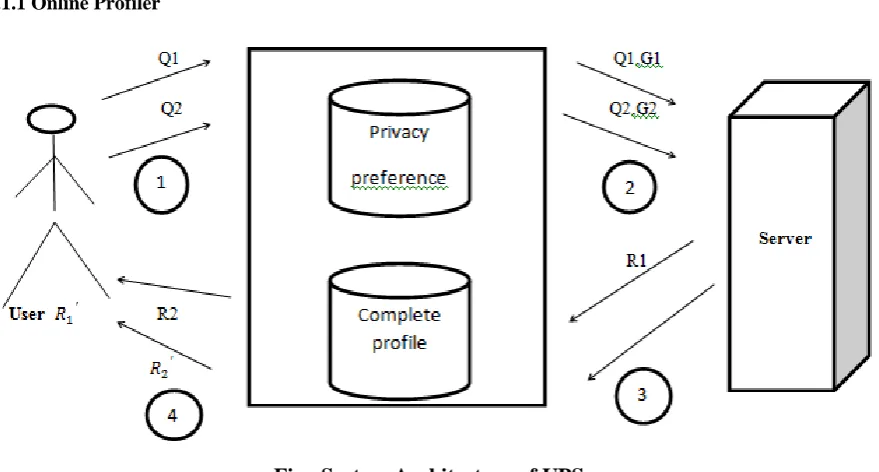
Fig. System Architecture of UPS
As shown in figure UPS comprises of number of customers/clients and a server for sufficient customers
demand. In customer’s machine, the online profiler is performed as search intermediary which keeps up clients
profile in advanced system of hubs additionally keep up the client resolute security essential as an arrangement
of sensitive hubs. There are two stage, specifically Offline and Online stage for the structure. Among Offline, a
various leveled client profile is made and client determined security condition is stamped on it.The inquiry let
go by client is taken care of in the online stage as:
At the point when client fires a question on to the customer, intermediate produces client profile in run time.
The profit is summed up client profile considering the security prerequisites. At that point, the inquiry alongside
summed up profile of client is sent to PWS server for modified web seek. The output is customized and the
reaction is sent back to question intermediary. At last, the intermediary displays the simple result or reruns them
29 | P a g e
VI. GREEDY ALGORITHM
A greedy algorithm is an algorithm that follows the problem solving experimental of making the locally ideal
choice at each stage with the hope of finding a global optimum. Greedy algorithm reflects easy to implement
and simple method and decides next step that provide valuable result. In many problems, a greedy policy does
not produce an ideal solution, but greedy inspective products locally ideal solutions that approximate a global
optimal solution in a sensible time.
VII. GREEDYDISCRIMINATING POWER (DP) ALGORITHM
This algorithm works in a bottom up manner. Starting with the leaf node, for every repetition, it chooses leaf
topic for clipping thus trying to maximize convenience of output. During repetition a best profile-so- far is
maintained satisfying the Risk constriction. The repetition stops when the root topic is reached. The best
profile-so-far is the final result. GreedyDp algorithms require recompilation of profiles which adds up to computational
cost and memory requirement.
VIII. GREEDY INFORMATION LOSS (IL) ALGORITHM
GreedyIL algorithm is advances simplification productivity. GreedyIL continues importance queue for
candidate clip leaf operator in descending order. This decreases the computational cost. GreedyIL states to
dismiss the repetition when Risk is satisfied or when there is a single leaf left. Since, there is less computational
cost compared to GreedyDP, GreedyIL outperforms GreedyDP.
IX. CONCLUSION
A client side privacy security structure called UPS i.e. User adjustable Privacy saving Search is presented in the
paper. Any PWS can adjust UPS for making client profile in various leveled scientific classification. UPS
permits client to designate the security requirement and subsequently the individual data of client profile is kept
private without trading the searchexcellence. UPS structure represents two greedy algorithms for this reason, to
be specific GreedyDP and GreedyIL.
REFERENCES
[1] Z. Dou, R. Song, and J.-R. Wen, “A Large-Scale Evaluation and Analysis of Personalized Search
Strategies,” Proc. Int’l Conf. World Wide Web (WWW), pp. 581-590, 2007.
[2] J. Teevan, S.T. Dumais, and E. Horvitz, “Personalizing Search via Automated Analysis of Interests and
Activities,” Proc. 28th Ann. Int’l ACM SIGIR Conf. Research and Development in Information Retrieval
(SIGIR), pp. 449-456, 2005.
[3] M. Spertta and S. Gach, “Personalizing Search Based on User Search Histories,” Proc. IEEE/WIC/ACM
Int’l Conf. Web Intelligence (WI), 2005.
[4] B. Tan, X. Shen, and C. Zhai, “Mining Long-Term Search History to Improve Search Accuracy,” Proc.
30 | P a g e
[5] K. Sugiyama, K. Hatano, and M. Yoshikawa, “Adaptive Web Search Based on User Profile Constructedwithout any Effort from Users,” Proc. 13th Int’l Conf. World Wide Web (WWW), 2004.
[6] X. Shen, B. Tan, and C. Zhai, “Implicit User Modeling for Personalized Search,” Proc. 14th ACM Int’l
Conf. Information and Knowledge Management (CIKM), 2005.
[7] X. Shen, B. Tan, and C. Zhai, “Context-Sensitive Information Retrieval Using Implicit Feedback,” Proc.
28th Ann. Int’l ACM SIGIR Conf. Research and Development Information Retrieval (SIGIR), 2005.
[8] F. Qiu and J. Cho, “Automatic Identification of User Interest for Personalized Search,” Proc. 15th Int’l
Conf. World Wide Web (WWW), pp. 727-736, 2006.
[9] J. Pitkow, H. Schu¨ tze, T. Cass, R. Cooley, D. Turnbull, A. Edmonds, E. Adar, and T. Breuel,
“Personalized Search,” Comm. ACM, vol. 45, no. 9, pp. 50-55, 2002.
[10] Y. Xu, K. Wang, B. Zhang, and Z. Chen, “Privacy-Enhancing Personalized Web Search,” Proc. 16th Int’l
Conf. World Wide Web (WWW), pp. 591-600, 2007.
[11] K. Hafner, Researchers Yearn to Use AOL Logs, but They Hesitate, New York Times, Aug. 2006.
[12] A. Krause and E. Horvitz, “A Utility-Theoretic Approach to Privacy in Online Services,” J. Artificial
Intelligence Research, vol. 39, pp. 633-662, 2010.
[13] J.S. Breese, D. Heckerman, and C.M. Kadie, “Empirical Analysis of Predictive Algorithms for
Collaborative Filtering,” Proc. 14th Conf. Uncertainty in Artificial Intelligence (UAI), pp. 43-52, 1998.
[14] P.A. Chirita, W. Nejdl, R. Paiu, and C. Kohlschu¨ tter, “Using ODP Metadata to Personalize Search,”
Proc. 28th Ann. Int’l ACM SIGIR Conf. Research and Development Information Retrieval (SIGIR), 2005.
[15] A. Pretschner and S. Gauch, “Ontology-Based Personalized Search and Browsing,” Proc. IEEE 11th Int’l
Conf. Tools with Artificial Intelligence (ICTAI ’99), 1999.
[16] Y. Xu, K. Wang, G. Yang, and A.W.-C. Fu, “Online Anonymity for Personalized Web Services,” Proc.
18th ACM Conf. Information and Knowledge Management (CIKM), pp. 1497-1500, 2009.
AUTHOR
DETAILS
Indarapu Kiran Pursuing M-Tech in Visvesvaraya College of Engineering and Technology (VCET), M.P Patelguda, Ibrahimpatnam (M), Ranga Reddy (D)-501510, India.
Sri Dr. Bhaludra Raveendranadh Singh working as Associate Professor & Principal in Visvesvaraya College of Engineering and Technology obtained M.Tech, Ph.D(CSE)., is a
young, decent, dynamic Renowned Educationist and Eminent Academician, has overall 20
years of teaching experience in different capacities. He is a life member of CSI, ISTE and
31 | P a g e
T. Ramyasri working as Assistant Professor in Visvesvaraya College of Engineering and Technology. She has completed bachelor of technology from Sree Visvesvaraya institute of
science and information technology and Post-graduation from Sree Visvesvaraya institute of