The Journal of Media Innovations 1.1 (2014): 52-69 © Leyla Dogruel 2014
http://www.journals.uio.no/index.php/TJMI
What is so Special about Media
Innovations?
A Characterization of the Field
Leyla Dogruel
Institute for Media and Communication Studies, Freie Universtität Berlin [email protected]
Abstract
Based on existing research in media economics, media management, as well as media history, this paper analyzes the characteristics of media innovations. These media-specific attributes help distinguish media innovation from other types of innovation and justify the necessity to establish a distinct field of research on media innovation. As a result, eight attributes are presented. These attributes refer to media innovations both as products and as processes. They characterize media innovations as multidimensional and risky products and highlight the importance of approaching media innovation development as interactive, long-term processes that go beyond the control of particular media organizations. In conclusion, implications with respect to studying media innovations from an interdisciplinary perspective are derived.
Relevance of studying media phenomena as innovations
scholars began exploring the usefulness of the innovation concept and its application for media goods (c.f. Storsul & Krumsvik, 2013). As a consequence, the management of innovation has been identified as one of the most critical areas of research in the field of media management and economics (Mierzjewska & Hollifield, 2006, p. 48).
Still, the transfer of approaches from innovation theory to media as objects of research is not straightforward. Economic innovation research follows an (at least implicit) focus on technological product and process innovation: “All schools of thought in economics have always recognized the central importance of technical [product] innovations and organizational [process] innovations for competitive performance of firms” (Freeman, 1990, p. xi, also see Fagerberg, 2005, p. 7). This focus only partly encompasses innovation originated in media sectors as they are part of the cultural or creative industries that remain a largely neglected field for traditional innovation theory (c.f. Stoneman, 2010, p. 7). This might be due to the specifics of media goods in general: as media economic research highlights, media products are characterized by distinct attributes that distinguish them from other economic goods, such as media products representing both economic and cultural goods at the same time. Furthermore, they often constitute experience goods implying a characterization of media as limited marketable goods (c.f. Caves, 2000). These features restrict the direct transfer of economic theories to the field of media economics (c.f. Doyle, 2011, 2003). While considerable work has been carried out to discuss the specifics of media products in contrast to other economic goods, the characteristics of media innovations are rarely the focus of research. Still, analyzing the specifics of media innovations is crucial to develop a distinct framework to study media innovations. This article focuses on media innovations from a theoretical point of view and elaborates on the specifics of media as innovation. The overall guiding research questions for this paper are:
What characteristics can be assigned to media innovations? How can media innovation research benefit from this distinction?
Characteristics of media innovations
The analysis of media innovations’ characteristics refers to existing approaches towards studying new media phenomena as innovation (c.f. Storsul & Krumsvik, 2013). Besides approaches in media economics and media management research (Dal Zotto & Kranenburg, 2008), as well as literature on cultural and creative industries (Caves, 2000; Hartley, 2005), the analysis of media innovation attributes further refers to studies in media history (c.f. Briggs & Burke, 2002; Winston, 1998). A broad understanding of media innovation is applied to encompass the different areas of research addressing media innovations. While media management research mainly addresses media innovations as new media products, specifically new content offerings (c.f. Habann, 2008) or focus on organizational changes and innovation on the media organization’s level (c.f. Baumann, 2013) – studies that approach media innovations from a media adoption and diffusion perspective mainly focus on new media technologies or services (for an overview see Dogruel, 2013). As well, approaches in media historical analyses follow a technology-oriented perspective on media innovations studying the socio-economic conditions of media technology’s implementations and societal impacts (Winston, 1998).
Based on existing research on these different forms of media innovations from a media economic, management and historical perspective, eight essential features for studying media innovations are outlined. Following the dual understanding of innovation as both product and process category (c.f. Fagerberg, 2005), these characteristics can be classified in (a) attributes that mainly refer to the characterization of media innovations as objects of research and (b) attributes focusing on analyzing media innovation processes.
Characteristics of media innovations as objects of research
When describing new media phenomena (e.g., new media technology, services, content, and applications) as objects of media innovation research, four characteristics can be derived.
news magazines integrating social media and direct user-feedback) or new ways of storytelling (e.g., the German TV format “Tatort+”, connecting an episode of a TV crime thriller with a parallel online game where users could investigate a fictive crime). Hence in order to study new content products as media innovations, it is important to clarify with regard to what specific aspects differentiate them from existing formats and products.
Second, with respect to a media management’s perspective, media innovations can be classified as high risk products and processes, as their development and production often require large financial investments, but bear the risk of sunk costs in the case of failure (c.f. Lobigs & Siegert, 2008; Reca, 2006). This implies two aspects: first, the media industry is often pictured as less innovative because of the high risk of sunk cost in case of a failure of a media innovation (Dal Zotto & Kranenburg, 2008b, p. xvii). The classification of media as so-called star products (Rosen, 1981) reinforces this description, as it states that only a few media products comprise a great amount of revenue. Besides books or music titles, the film industry is especially characterized by the dominance of these star products. Only a limited number of film titles yield high box offices revenues (c.f. Hennig-Thurau, Houston, & Walsh, 2006). Lowering the risk of these financial investments leads to a high significance of imitations and cross-media strategies, such as the use of presold property in media contents (c.f. Joeckel & Doebler, 2006; Musburger & Kindem, 2009). As such, movie producers often rely on media content that was already successful in the book market (e.g., the Harry Potter Series) or even video game titles (e.g., Tomb Raider) and vice versa. Secondly, related aspects of innovation processes underline the classification of media innovations as risky as well. The acceptance of media innovations mostly relies on social appropriation processes and user-sided development of use contexts (see also characteristic No. 6). This limits the organizational predictability of media innovation’s success and challenges the management of the innovation process. From an organizational perspective, managing media innovations thus requires flexible organizational approaches (e.g., unconventional work structures) to face high degrees of uncertainty and risk (Reca, 2006, pp. 195-196).
the production and delivery of journalistic products (e.g., newsrooms), and new forms of presenting journalistic content as well as new forms of revenue models (e.g., content syndication, personalized advertising, crowd funding). This leads to a limited applicability of innovation concepts from the creative industry literature, which mainly bases the innovation concept on intangible, creative aspects (c.f. Jaaniste, 2009; Stoneman, 2010). Following Stoneman (2010), it is the rate of new releases of books, films, and video game titles that indicates the innovativeness of different media sectors. Still, as noted in reference to the first attribute, the number of new media titles represents the continuous need for newness in media industries and is as such not sufficient for deriving a definition of media innovation. Instead, a concise concept of media innovation has to take into account the different dimensions that together comprise media innovations (e.g., technological, organizational, institutional aspects of media), as well as focus on their interdependency (Küng, 2013, p. 9).
In close connection to distinguishing different types of media innovations, a fourth attribute relates to media innovations as objects of research. While innovation research in economics usually follows a clear-cut differentiation between product innovation (e.g., new products or services that are introduced in relevant markets) and process innovation (e.g., new technological or organizational methods that are implemented in the organizational production or distribution process) (c.f. Edquist, 2001, p. 7; Fagerberg, 2005, p. 7), this distinction is of limited usefulness for a classification of media innovations. Especially new media technologies such as smartphones, tablet PCs or Internet-related applications such as micro-blogging services or search engines that can both be implemented in media product innovations that are introduced and adopted by media users, as well as process innovations in media organizations. With respect to news organizations, these new technologies and applications represent process innovations as they are implemented in journalistic practices. The use of the iPad, social media or micro-blogging services as new distribution channels for journalistic content (c.f. Armstrong & Gao, 2008; Deuze, 2004) demonstrate this aspect. Also, search engines as well as user-generated content represent new tools for investigations among professional journalists (c.f. Machill, Beiler, & Zenker, 2008).
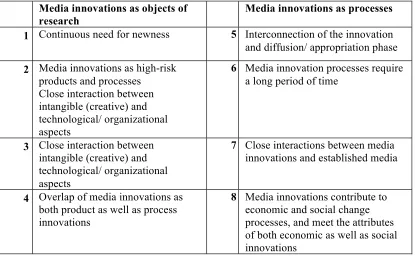
Figure 1: Media innovation characteristics
Media innovations as objects of research
Media innovations as processes
1 Continuous need for newness 5 Interconnection of the innovation and diffusion/ appropriation phase
2 Media innovations as high-risk products and processes
Close interaction between intangible (creative) and technological/ organizational aspects
6 Media innovation processes require a long period of time
3 Close interaction between intangible (creative) and technological/ organizational aspects
7 Close interactions between media innovations and established media
4 Overlap of media innovations as both product as well as process innovations
8 Media innovations contribute to economic and social change processes, and meet the attributes of both economic as well as social innovations
b) Characteristics of media innovations as processes
Whereas the prior attributes apply to the characterization of media innovations as objects of research, four additional characteristics (No. 5-8) can be highlighted that refer to studying media innovations as processes of change and transformation (for a summary see Figure 1).
innovation does not follow a strict linear order but includes feedback and recursive moments (c.f. Marinova & Phillimore, 2003; cf. Nyre, this issue). Especially media innovation processes differ from this sequential illustration as they are often characterized by an interconnection of the innovation and diffusion/ appropriation phase.
From a theoretical point of view, Kline and Rosenberg’s chain-linked model of innovation captures the development of innovation as a non-linear, interactive process. Based on examples of historical innovation, they demonstrate that “most important innovations go through rather drastic changes over their lifetimes – changes that may, and often do, totally transform their economic significance. The subsequent improvements in an invention after its first introduction may be vastly more important, economically, than the initial availability of the invention in its original form” (Kline & Rosenberg, 1986, p. 283). As a result, their chain-linked model of innovation illustrates innovation as an interactive process, including feedback loops between different stages of innovation development to capture the dynamic character of innovation and the spread of relevant knowledge across its development. From an organization’s perspective, innovation processes as such represent an enduring problem-solving activity (ibid, p. 302).
Examples of previous media innovations, such as the Sony Walkman which was previously designed for shared listening of music (du Gay, Hall, & Janes, 1997), SMS or Twitter, which was initially used as an accompanying tool for organizational communication or during conferences (c.f. MacArthur, n.d.), support the assumption that media innovations only rarely enter the market as “finalized” goods. Rather, they pass through a process of negotiation on their (physical) form, communicative functions, possible use-contexts and interpretations that lead to blurring lines between their design and diffusion phase. The media innovation process is thus not limited to media professionals, but further points to the importance of user-producer interactions and the integration of user feedbacks in innovation processes (Franke & Schreier, 2002; Habann, 2008, p. 70). This is of particular importance for media innovations, as user-sided appropriation and redesign processes can lead to radical shifts in a product’s design, positioning or use-patterns as the previous examples illustrate.
marketing literature mainly define a four-stage model of a product’s life ranging across its birth, growth, maturity and decline (c.f. Vashisht, 2005, pp. 189-129). Models of media evolution demonstrate that media innovations go through rather complex phases of development (c.f. Stöber, 2004) and point to the importance of extending the life cycle model by adding a fifth stage (adaptation) due to processes of adaption to changing environments (Lehmann-Wilzig & Cohen-Avigdor, 2004). While this seems to be obvious for the historical innovations mentioned, recent media innovations can also be characterized as time-consuming processes. The establishment of related user routines as well as (social) norms in how to integrate these media in specific communication contexts require a long time period. The appropriation of mobile phones (c.f. Katz, 2006; Wirth, 2008) but also the use of social media may serve as examples for these continuing processes. For instance, we need to keep in mind that even Facebook was launched as early as 2004, took several years to achieve worldwide success, and is still in constant change for developing a sustainable business model. The same is true for Twitter, launched in 2006.
study of intermedia effects between online and print journalism, as well as organizational and product related innovations such as new forms of news production, presentation and distribution (c.f. Ahlers, 2006; Chyi & Lasorsa, 2002; de Wall, Schönbach, & Lauf, 2005).
The eighth attribute of media innovation refers to the innovation process’s final stages, namely, of diffusion and consequences. Here, economic innovation studies focus primarily on media innovations’ economic impacts and analyze their successful exploitation (Cumming, 1998, p. 22). Still, as media industries are not only economic but also political and cultural industries (Napoli, 2009), the outcome of media innovations is not limited to economic but also social implications (c.f. Vadrot, 2011). Based on the classification of media as economic and cultural goods with multiple socio-cultural impacts (Reca, 2006, pp. 184-186), media innovations contribute to economic and social change processes and thus meet the characteristics of both economic as well as social innovations. Following Mumford (2002, p. 253), social innovations cover “the generation and implementation of new ideas about how people should organize interpersonal activities, or social interactions, to meet one or more common goals.” In short, social innovations are new ideas that enhance society’s capacity to act (Mulgan, 2012, p. 35). Besides their economic value, media innovations mainly impact a society’s, an organization’s, as well as an individual’s communication capacities.
Given this dual character of media innovations as both economic and social innovations, different patterns of innovation development occur. While for innovation in general, the definition of business models is closely connected with the development of a products’ or services’ design and functions, media innovations often do not follow this clear-cut orientation towards economic exploitation. With respect to the development of different types of social media, it can be demonstrated that in the beginning the development was focused on exploring the new media’s functions, design and use-contexts while economic utilization evolved with a time-lag – as indicated in the above mentioned examples of Facebook and Twitter. The micro-blogging platform Twitter, for instance, demonstrates that while in the beginning the development was focused on expanding the platform’s functions and use-contexts, the development of a proper business model including the integration of advertising formats was established only afterwards. This example shows that for media innovations both economic and social development patterns can occur. From a research perspective this stresses the need for approaching media innovations as both economic as well as social innovations (c.f. Storsul & Krumsvik, 2013).
Discussion and implications
to the first research question, it can be noted that the importance of user-sided appropriation processes, the combination of different innovation dimensions (e.g., organizational, technological or design related aspects), as well as media innovations’ interaction with existing media products and media institutions, thus distinguishes media innovations from other types of innovation. This supports the importance of establishing a distinct field of media innovation research, and challenges the transfer of existing frameworks from innovation theory. Consequently, researching media innovations requires an integrative framework combining theoretical and empirical approaches from economic and social innovation theory as well as media specific frameworks.
In order to determine how media innovation research can benefit from distinguishing media innovations from other types of innovation (RQ 2), four implications are outlined with respect to the above derived characteristics that contribute to the development of a theoretical and empirical framework for media innovation research.
(1) Existing approaches in media innovation management often refer to literature on creative/ cultural industries when adapting concepts on how to approach media innovations (c.f. Handke, 2008). Still, as the soft innovation concept by Stoneman (2010) indicates, this stream of research primarily focuses on the intangible or creative parts of innovations. Soft innovation is “innovation in goods and services that primarily impacts upon aesthetic or intellectual appeal rather that functional performance” (Stoneman, 2010, p. 22). Hence, he considers new books, film or video game titles as innovation (ibid, p. 110). Applying concepts primarily from a creative industry’s perspective would narrow the study of media innovations down to new content products. This, however, is in contrast to the various media innovations that media economics and management scholars consider in their studies. Also, this concept neglects the fact that media innovations oftentimes constitute interactions of tangible and intangible parts, and excludes media innovations that appeal to changes in their functional performance rather than to their new content such as new Internet-based communication applications (e.g., the case of music streaming platforms). As I have argued, however, media innovation research has to consider the different dimensions media innovations refer to, such as new technological, organizational, content-related aspects of media.
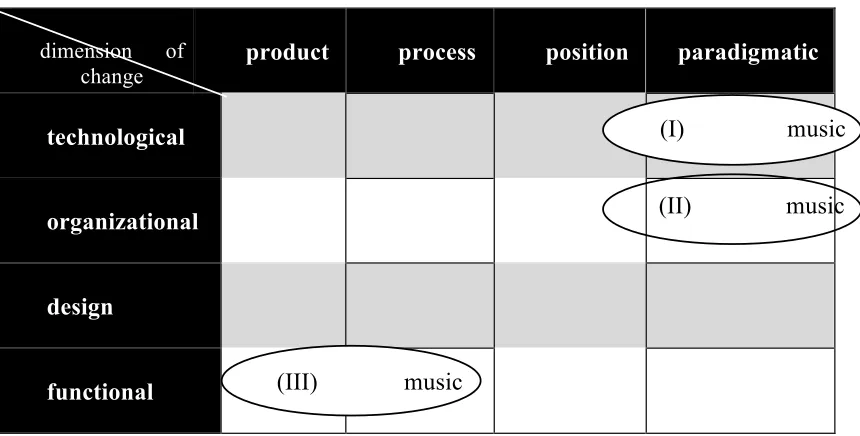
Figure 2: Matrix of dimensions of change and types of media innovation
product process position paradigmatic
technological
organizational
design
functional
The example of music streaming illustrates how a combination of the categories works out. First, (I+II) the music industry’s shift from selling distinct products (e.g., CDs) to streaming services can be classified as paradigmatic innovation from the perspective of the media industry or a media organization (Storsul & Krumsvik, 2013). The underlying changes involve both technological (I) as well as organizational (II) changes, as music streaming requires new technological infrastructure and design, as well as new business models. Second, (III) music streaming also constitutes a new media product innovation from a consumers’ perspective, bringing in new ways of consuming, discovering and sharing music (e.g., social music; Boutet, Kloudas, & Kermarrec, 2013).
(2) Given that media innovations meet the criteria of both social as well as economic innovations requires further consideration of theoretical approaches from sociology such as the social innovation frameworks (c.f. Marten & Keul, 2005; Mulgan, 2012), techno-sociological approaches (c.f. Lievrouw, 2002; Sylvie & Schmitz Weiss, 2012), as well as historical approaches (i.e., besides (mainstream) innovation theory) for analyzing media innovations. While approaches from social innovation theory allow for considering media innovations’ interaction with social (e.g., social, political) changes as well as their societal implications, techno-sociological approaches serve as a possible framework for capturing the user-sided social appropriation and interpretation processes that accompany the development of media innovations. With respect towards studying media innovation processes, interactive rather than linear models were considered as proper conceptual frameworks. Interactive process models such as the chain-linked model on innovation by Kline and Rosenberg (1986) as well as techno-sociological frameworks (Lievrouw, 2002; Williams & Edge, 1996) are particularly suitable for this endeavor as they consider feedback
dimension of change
(III) music streaming
(I) music
streaming
(II) music
processes between the different phases (design, production, diffusion, impact) of media innovation development.
(3) The importance of users taking part in the innovation process leads to another framework within innovation research that may offer a seminal perspective for the analysis of media innovation processes. Given that the development of media innovations often goes beyond (large) media organization’s borders as additional professional as well as individual actors shape its development, the open innovation concept (c.f. Chesborough, 2003; Hippel, 2005) may serve as an eligible framework for helping to capture these interactions. In contrast to “manufacturer centered models” (Hippel, 2005, p. 13) the open-innovation concept argues for a radical opening of innovation processes, one that places “external ideas and external paths to market on the same level of importance as that reserved for internal ideas and paths to market during the Closed Innovation era” (Chesborough, 2003, p.43). For media innovations based on digitization and the Internet, the open innovation concept gained considerable importance (Tuomi, 2002; West & Gallagher, 2006). Digital media innovations such as Twitter can be mentioned as an example for open innovation processes, as its initial development was largely due to external developers using the platform’s open source software. In addition to these examples of open innovation processes, initial studies support the importance of a consistent user involvement as a promising opportunity for successful innovation processes in the media industry (c.f. Habann 2008; Picot & Doeblin, 2009).
(4) A final implication refers to the intermedia effects of media innovations. Research on new media development (c.f. Lehman-Wilzig & Cohen-Avigdor, 2004) already emphasized that the study of the development as well as its implications should not be exclusively focused on the innovation itself but also consider its relationship with existing media. Integration and convergence processes (c.f. Dwyer, 2010; Jenkins, 2006) and, to a lower extent substitution (Lin, 2004) offer possible frameworks for capturing these processes. These concepts allow for studying both technological interdependences, but also take into account economic aspects (e.g., business models, media products) as well as social aspects (e.g., change in functions of media, use patterns) (c.f. Lawson-Borders, 2006).
Conclusion
processes), the importance of user involvement and their classification as both product and process innovation, and social as well as economic innovation, are outlined as distinct attributes of media innovations. Hence, media innovation research can benefit from considering different innovation types as objects of media innovations, and from addressing media innovation processes from an interdisciplinary perspective that combines both economic and sociological approaches. Furthermore, media innovation research needs to broaden its focus from examining single innovations towards analyzing media innovations’ interplay with existing media, both in their development as well as their diffusion and consequences. Acknowledging these media innovation related characteristics thus enables media innovation research to more accurately and more fruitfully analyze the fundamental changes the media landscape faces.
References
Adoni, H., & Nossek, H. (2001). The New Media Consumers: Media
Convergence and the Displacement Effect. Communications, 26(1), 59-83. Ahlers, D. (2006). News Consumption and the New Electronic Media. The
International Journal of Press/Politics, 11(1), 29-52.
Armstrong, C. L., & Gao, F. (2010). Now Tweet This: How News Organizations Use Twitter. Electronic News, 4(4), 218-235.
Bessant, J. R., & Tidd, J. (2007). Innovation and entrepreneurship. Chichester: Wiley.
Baumann, S. (2013). Adapting to the Brave New World. Innovative Organisational Strategies for Media Companies. In T. Storsul & A. H.
Krumsvik (eds.), Media Innovation. A Multidisciplinary Study of Change (pp. 77-92). Göteborg: Nordicom.
Bolter, J. D., & Grusin, R. (2000). Remediation: Understanding New Media. Cambridge, MA: MIT Press.
Boutet, A., Kloudas, K., & Kermarrec, A.-M. (2013). FStream: A Decentralized and Social Music Streamer. Networked Systems. Lecture Notes in Computer Science 7853, 253-257.
Briggs, A., & Burke, P. (2002).A Social History of the Media. From Gutenberg to the Internet. Cambridge u.a.: Polity Press.
Caves, R. E. (2000).Creative Industries: Contracts Between Art and Commerce. Cambridge: Harvard University Press.
Chesbrough, H. (2003). Open Innovation. The New Imperative for Creating and Profiting from Technology. Boston: Harvard Business School Press.
Chyi, H. I., & Lasorsa, D. L. (2002). An Explorative Study on the Market Relation Between Online and Print Newspapers. Journal of Media Economics, 15(2), 91-106.
Cumming, B. S. (1998). Innovation overview and future challenges. European Journal of Innovation Management, 1(1), 21-29.
Dal Zotto, C., & van Kranenburg, H. (eds.). (2008a). Management and Innovation in the Media Industry.Cheltenham, UK: Edward Elgar.
Dal Zotto, C., & van Kranenburg, H. (2008b). Introduction. In C. Dal Zotto & H. vanKranenburg (eds.), Management and Innovation in the Media Industry (pp. ix-xxiv). Cheltenham, UK: Edward Elgar.
De Waal, E., Schönbach, K., & Lauf, E. (2005). Online Newspapers: A Substitute or Complement for Print Newspapers and Other Information Channels? Communications, 30(1), 55-72.
Deuze, M. (2004). What is Multimedia Journalism? Journalism Studies, 5(2), 139-152.
Dogruel, L. (2013). Opening the Black Box - Conceptualizing of Media Innovation. In S. Storsul & A. H. Krumsvik (eds.), Media Innovation. A Multidisciplinary Study of Change (pp. 29-44). Göteborg: Nordicom. Doyle, G. (2011). Media economics and regulation. In R. Towse (eds.), A
Handbook of Cultural Economics, Second Edition (pp. 273-281). Cheltenham: Edward Elgar.
Doyle, G. (2003). Understanding media economics. London u.a.: SAGE.
Du Gay, P., Hall, S., & Janes, L. (1997). Doing Cultural Studies. The Story of the Sony Walkman. (Culture, Media, Identities) London: Sage.
Dwyer, T. (2010). Media Convergence. New York: Open University Press. Edquist, C. (2001). The System of Innovation Approach and Innovation Policy:
An Account of the State of the Art. Paper presented at the DRUID Conference. from http://folk.uio.no/ivai/ESST/Outline%20V05/edquist02.pdf
Fagerberg, J. (2005). Innovation. A Guide to Literature. In J. Fagerberg, D. D. Mowery & R. R. Nelson (eds.), The Oxford Handbook of Innovation (pp. 1-26). New York: Oxford University Press.
Fagerberg, J., Mowery, D. D., & Nelson, R. R. (eds.). (2005). The Oxford Handbook of Innovation. New York: Oxford University Press.
Franke, N., & Schreier, M. (2002). Entrepreneurial opportunities with toolkits for user innovation and design. International Journal on Media Management (JMM), 4(4), 225-234.
Freeman, C. (1990). Introduction. In C. Freeman (eds.), The Economics of Innovation. Aldershot: Edward Elgar.
Habann, F. (2008). Towards a Methodological Foundation of Media Innovation Research. In C. D. Zotto & H. v. Kranenburg (eds.), Management and Innovation in the Media Industry (pp. 67-86). Cheltenham, UK: Edward Elgar.
Handke, C. (2008). Promises and Challenges of Innovation Surveys: The German Record Industry. In C. D. Zotto& H. v. Kranenburg (eds.), Management and Innovation in the Media Industry (pp. 87-106). Cheltenham, UK: Edward Elgar.
Hennig-Thurau, T., Houston, M. B., & Walsh, G. (2007). Determinants of Motion Picture Box Office and Profitability: An Interrelationship Approach. Review of Managerial Science, 1(1), 65-92.
Hippel, E. v. (2005). Democratizing Innovation. Cambridge: MIT Press.
Jaaniste, L. (2009). Placing the creative sector within innovation: The full gamut. Innovation: Management, Policy & Practice, 11(2), 215-229.
Jenkins, H. (2006). Convergence culture: where old and new media collide. New York/ London: New York University Press.
Joeckel, S., & Doebler, T. (2006). The Event Movie: Marketing Filmed Entertainment for Transnational Media Corporations. In: JMM – The International Journal on Media Management, 8(2), 84-91.
Katz, J. (2006). Magic in the Air: Mobile Communication and the Transformation of Social Life New Brunswick, NJ: Transaction Publishers.
Kline, S. J., & Rosenberg, N. (1986). An Overview of Innovation. In R. Landau & N. Rosenberg (eds.), The Positive Sum Strategy: Harnessing Technology for Economic Growth (pp. 275-304). Washington, DC: National Academy Press.
Korres, G. M., Lionaki, I., & Polichronopoulos, G. (2003). The Role of Technical Change and Diffusion in the Schumpeter Lines. In J. G. Backhaus (eds.), Joseph Alois Schumpeter: Entrepreneurship, Style and Vision (pp. 293-312). Dordrecht: Kluwer Academic Publishers.
Küng, L. (2013). Innovation, Technology and Organisational Change. Legacy Media’s Big Challenges. An Introduction. In S. Storsul & A. H. Krumsvik (eds.), Media Innovation. A Multidisciplinary Study of Change (pp. 9-12). Göteborg: Nordicom.
Latzer, M. (2009). Convergence Revisited: Toward a Modified Pattern of Communications Governance. Convergence – The International Journal of Research into New Media Technologies, 15(4), 411-426.
Lawson-Borders, G. (2006). Media Organizations and Convergence: Case Studies of Media Convergence Pioneers. Mahwah, NJ: Lawrence Erlbaum Associates. Lehman-Wilzig, S., & Cohen-Avigdor, N. (2004). The Natural Life Cycle Of
New Media Evolution. Inter-Media Struggle for Survival in the Internet Age. New Media & Society, 6(6), 707-730.
Lievrouw, L. A. (2002). Determination and Contingency in New Media Development: Diffusion of Innovations and Social Shaping of Technology Perspectives. In L. A. Lievrouw & S. Livingstone (eds.), Handbook of New Media. Social Shaping and Consequences of ICTs (pp. 183-199). London: SAGE Publications.
Lobigs, F., & Siegert, G. (2008).Applying Intellectual Property Rights Theory to the Analysis of Innovation Competition in Mass Media Content Markets - A General Framework and a Theoretical Application to Media Formats. In C. DalZotto& H. vanKranenburg (eds.), Management and Innovation in the Media Industry (pp. 37-66). Cheltenham, UK: Edward Elgar.
MacArthur, A. (n.y.). The Real History of Twitter, In Brief. How the micro-messaging wars were won. Retrieved from:
http://twitter.about.com/od/Twitter-Basics/a/The-Real-History-Of-Twitter-In-Brief.htm [01.12.2013].
Machill, M., Beiler, M., & Zenker, M. (2008). Search-engine research: A
European-American overview and systematization of an interdisciplinary and international research field. Media Culture Society, 30(5), 591-608.
Marinova, D., & Phillimore, J. (2003). Models of Innovation. In L. V. Shavinina (eds.), The International Handbook on Innovation (pp. 44-53). Oxford: Elsevier.
Marshall, L. (2013). The 360 deal and the 'new' music industry. European Journal of Cultural Studies 16(1), 77-99.
Martens, B., & Keul, A. G. (eds.). (2005). Designing social innovation: planning, building, evaluating. Ashland, Ohio: Hogrefe& Huber Pub.
McQuail, D. (2010). McQuail's Mass Communication Theory. London: Sage. Mierzejewska, B. I., & Hollifield, C. A. (2006). Theoretical Approaches in Media
Management Research. In A. Albarran, S. Chan-Olmsted & M. O. Wirth (eds.), Handbook of Media Management and Economics (pp. 37-66). Mahwah, New Jersey: Lawrence Erlbaum Associates.
Mulgan, G. (2012). The Theoretical Foundations of Social Innovation. In A. Nicholls & A. Murdock (eds.), Social Innovation: Blurring Boundaries to Reconfigure Markets (pp. 33-65). London: Palgrave Macmillan.
Mumford, M. D. (2002). Social Innovation: Ten Cases From Benjamin Franklin. Creativity Research Journal, 14(2), 253-266.
Musburger, R. B., & Kindem, G. (2009). Introduction to Media Production.The Path to Digital Media Production. Burlington, MA: Elsevier.
Napoli, P. M. (2009). Media Economics and the Study of Media Industries. In J. Holt & A. Perren (eds.), Media Industries: History, Theory, and Method (pp. 161-170). West Sussex: Blackwell Publishing.
Pavitt, K. (2005). Innovation Processes. In: J. Fagerberg, D. Mowery, & R. Nelson (eds), The Oxford Handbook of Innovation. (pp.86-114). New York: Oxford University Press.
Picot, A., &Doeblin, S. (eds.). (2009). Innovationsführerschaft durch Open Innovation. Chancen für die Telekommunikations-, IT- und Medienindustrie. [Leadership trough open innovation: Chances for the telecommunication, computer and media industries]Berlin, Heidelberg: Springer.
Rosen, S. (1981).The Economics of Superstars. American Economic Review, 71(December), 845-898.
Scherer, F. (1982). Demand-Pull and Technological Invention: Schmookler Revisted. The Journal of Industrial Economics 30(3), 225-237.
Schumpeter, J. A. (1934). The theory of economic development. New Brunswick, New Jersey: Transaction Publishers.
Schweizer, T. S. (2003). Managing Interactions between Technological and Stylistic Innovation in the Media Industries. Technology Analysis & Strategic Management, 15(1), 19-41.
Shavinina, L. V. (ed.). (2003). The International Handbook on Innovation. Oxford: Elsevier.
Stoneman, P. (2010). Soft Innovation.Economics, Product Aesthetics, and the Creative Industries. Oxford: Oxford University Press.
Stoeber, R. (2004). What media evolution is.A theoretical approach to the history of new media.European Journal of Communication 19(4): 483-505.
Storsul, T., & Krumsvik, A. H. (2013). What is Media Innovation? In S. Storsul & A. H. Krumsvik (eds.), Media Innovation. A Multidisciplinary Study of Change (pp. 13-26). Göteborg: Nordicom.
Sylvie, G., & Schmitz Weiss, A. (2012). Putting the Management into Innovation & Media Management Studies: A Meta-Analysis. International Journal on Media Management, 14(3), 183-206.
Tidd, J., Bessant, J., & Pavitt, K. (2005). Managing Innovation. Integrating technological, market and organizational change. West Sussex: John Wiley & Sons, Ltd.
Tuomi, I. (2002). Networks of Innovation. Change and Meaning in the age of Internet. New York: Oxford University Press.
Turow, J. (1992). Media Systems in Society. Understanding Industries, Strategies and Power. New York: Longman.
Vadrot, A. B. M. (2011). Innovation - not just a technical and economic problem! Innovation: The European Journal of Social Science Research, 24(1-2), 1-5. Vashisht, K. (2005). A Practical Approach to Marketing Management. New
Delhi: Atlantic.
West, J., & Gallagher, S. (2006). Open Innovation. Researching a new paradigm. In H. Chesbrough, W. Vanhaverbeke, & J. West (eds.), Open Innovation. researching a new paradigm (pp. 82-108). New York: Oxford University Press.
Williams, R., & Edge, D. (1996). What is the Social Shaping of Technology. Research Policy, 25, 856-899.