Syed Asad B, et al. J Sci Res Pharm, 2019;8(6):66-71 World Inventia Publishers
Journal of Scientific Research in Pharmacy
http://www.jsrponline.com/Vol. 8, Issue 6, 2019 ISSN: 2277-9469 USA CODEN: JSRPCJ
Research Article
PANCREOPROTECTIVE AND ANTI-DIABETIC ACTIVITY OF PHYLLANTHUS AMARUS SEEDS METHANOLIC EXTRACTS IN ALLOXON INDUCED DIABETIC RATS
Syed Asad B 1 *, Rohit Saraswat 1, Md. Majid Iqbal 2
1 OPJS University, Churu, Rajasthan, INDIA.
* 2 MESCO College of Pharmacy, Hyderabad, Telangana, INDIA.
Received on: 21-04-2019; Revised and Accepted on: 11-06-2019
ABSTRACT
A
Pancreoprotective and Anti-Diabetic activity of Alloxon induced Pancreas wasreversed by using methanolic extracts of 150mg/kg and 250 mg/kg in rats. Seeds of Phyllanthus amarus extracts were found to have Pancreoprotective properties in rats with Alloxon induced Panceatic damage as judged from histopathalogical changes and Anti hyperglycemic activity of methanolic extracts of 150mg/kg and 250mg/kg in Diabetic rats. The methanolic extracts showed improvement in different parameters associated with diabetes like body weight, lipid profile and biochemical parameters. Methanolic extracts also showed improvement in regenation of β-cells of pancreas in Diabetic rats. Histopathological studies strengthen the healing of Pancreas by methanolic extracts of Phyllanthus amarus seeds showing panceoprotective and Anti-Diabetic activity.
KEYWORDS: Phyllanthus amarus, Diabetes mellitus, Pancreoprotective, Alloxon induced and Methanolic extracts.
INTRODUCTION
P
hyllanthus amarus Schum & Thonn. (Family:Euphorbiaceae) seeds were selected for assessing
Panceoprotecrive and Anti-Diabetic potential. However, till date no scientific evaluations are conducted on seeds for confirming its role as organ protective agent. Thus, the present study is
designed to investigate the activities of Phyllanthusamarus seed
extracts on Panceoprotecrive and Anti-Diabetic activity in rat models. Plant based medicaments have been employed since the dawn of civilization for prolonging the life of man for combating
various ailments [1].
Phyllanthus amarus Schum & Thonn belong to
Euphorbiaceae found in suburban areas of Thirupati town ship. Upon literature survey it was found that plant is mostly untouched. However there is report that the leaves containing lignans and flavonoids known to possess antioxidant activity. However, this plant is relatively virgin and pharmacological and phytochemical profile is incomplete. But traditionally it is being used for treating cardiovascular problems, influenza, dropsy, diabetes, jaundice, asthma and bronchial infections. In India it is
* Corresponding author:
Syed Asad B,
OPJS University, Churu, Rajasthan, INDIA.
* E-Mail: [email protected]
DOI:https://doi.org/10.5281/zenodo.3267432
used as antifungal, antibacterial and antiviral agent etc. keeping
the literature review and hypothesis of antioxidant principles
and organ protection in view the seeds of Phyllanthus amarus
was selected for assessing the pancreoprotective and anti-diabetic potential.
Pancreas is an organ of most importance not only as an exocrine organ but also as an endocrine organ of our body. Diabetes mellitus is a common metabolic disorder with micro and macro vascular complication that results in significant morbidity and mortality. It is considered as one of the leading
causes of death in the world [2, 3].Diabetes is well known all over
the world even in India it existed since prehistoric age. The practical usage of juices of various plants achieved the lowering
of blood glucose levels by 10-20% [4]. Diabetes is a big challenge
to the health in most developed countries because of their food habits. Since diabetes is the top five of the most significant
diseases and still gaining significance [5]. Hence in such
situations exploring new cures from plant sources will always give a positive approach with minimal side effects. Even though an enough work is done with the benefits of medicinal plants but still lot more work is remaining for evaluating their biological importance. Keeping in mind the severity of disease made an effort to treat with this disease which is a global problem.
In this study the prolonged effect (i.e. Up to 14 days) of
the methanolic extracts of seeds of Phyllanthusamarus in fasting
Syed Asad B, et al. J Sci Res Pharm, 2019;8(6):66-71 MATERIALS AND METHODS
Chemicals:
The toxicant Alloxon monohydrate was obtained from Sigma chemicals (St. Louis, USA). The remaining chemicals used for this study were of analytical grade.
Plant Material:
The seeds of Phyllanthusamarus Plant were collected
from local gardens of Tirupathi. The Plant was identified and authenticated by Dr. Madava Chetty, Dept. of Botany, Sri Venkateshwara University, Tirupathi, A.P, India
Preparation of Extract:
The crushed and dried seeds of Phyllanthus amarus
were extracted from methanol by Soxhlet extraction
concentrated by rotary vaccum [6] and dried by evaporation
until a semi solid mass are produced which is stored in
refrigerator below 10oC using air tight container.
Experimental Animals:
Male albino rats weighing 130-160g were obtained from animal house of Nizam Institute of Pharmacy and Research Centre, Hyderabad, Telangana. The animals were kept under standard environmental conditions in polypropylene cages. Thus animals were fed with standard pellet rat diet and water was supplied to animals ad libitum. Experimental protocols were approved by AIEC of CPCSEA.
Acute toxicity studies:
The acute oral toxicity study is determined according to the guidelines of Organization for Economic Co-operation & Development (OECD) following the up & down method (OECD guideline No. 423).
The acute toxicity for methanolic extract of Phyllanthus
amarus seeds were determined on albino mice and Wister rats,
maintained under standard conditions. Low (5 mg) and high
(2000 mg) dose was selected for the treatment [7]. Animals were
observed no death or any complications up to 28 days.
Oral Glucose Tolerance Test:
Rats were divided into six groups containing six animals in each group. All animals fasted before treatment. Group I was kept as vehicle control which received 5% Tween 80 p. o. group II received glucose only, group III received methanolic extract 150 mg/kg, group IV received methanolic extract 250 mg/kg and group V and VI received only extracts (150 mg/kg and 250 mg/kg) only in a vehicle, respectively. The rats of group III and IV were loaded with glucose (3 g/kg, p. o.) 30 minutes after drug administration. Blood samples were collected from puncturing the retro orbital sinus just prior to drug administration, and at 0, 30, 90, 150 minutes after loading glucose. Serum glucose level was measured immediately by
using glucose estimation kit [8].
Experimental Design:
Five groups of six rats in each were used in this model
[9]. The study was carried out for 14 days. Except Group-I all
groups received alloxan 150mg/kg p. o., once a day.
Group-I: Animals (-ve control) administered 1ml saline p. o.
Group-II: Animals (+ve control) administered Alloxan 150mg/kg i. p.
Group-III: Animals (Standard) administered Alloxon + Glibenclamide 5mg/kg, p. o.
Group-IV: Animals administered Alloxon + methanolic extract 150 mg/kg p. o.
Group-V: Animals administered Alloxon + methanolic extract 250 mg/kg p. o.
Plant extract, standard drug Glibenclamide (5 mg/kg) and saline were administered with the help of feeding cannula. Group I serve as normal control, which received saline for 14 days. Group II to Group V are diabetic control rats. Group III receive Glibenclamide (5 mg/kg. p. o). Group IV and Group V (which previously received alloxan) are given a fixed dose plants extract (150 mg/kg, p. o), (250 mg/kg, p. o) for 14 consecutive days.
Collection of Blood Sample and Blood Glucose Determination:
Blood samples were drawn from tail tip of rat at weekly intervals till the end of study (i.e., 2 weeks). Fasting blood glucose estimation and body weight measurement were done on day 0, 1, 7, and 14 of the study. Blood glucose estimation can be done by one touch electronic glucometer using glucose test strips.
On day 14, blood was collected from retro-orbital plexus under mild ether anesthesia from overnight fasted rats and fasting blood sugar and other bio-chemical parameters like
Cholesterol [10], HDL [11], LDL [13], Creatinine, Serum urea [14] and
Alkaline pohosphatase [15] was estimated.
After scarifying, whole pancreas of all animals were removed and collected in a solution of 10% formalin and processed by the paraffin technique for histopathological studies.
Statistical Analysis:
Results were expressed as mean ± SEM, (n=6). Statistical analysis was performed with one way analysis of variance (ANOVA) followed by Turkey-Kramer multiple comparisons test by using Graph Pad Instat software. P value less than 0.05 was considered to be statistically significant. *P<0.05, P**<0.01 and P***<0.001, when compared with control and toxicant group as applicable.
RESULTS AND DISCUSSION
Glucose Tolerance:
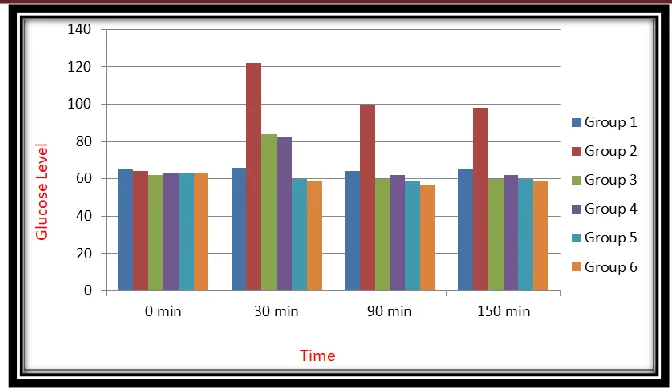
The methanolic extracts of Phyllanthus amarus seeds
(150mg/kg and 250g/kg) on glucose tolerance test are shown
in Fig. 1. The supplementation of Phyllanthus amarus seeds
Fig. 1: Effect of methanolic extract of Phyllanthus amarus seeds on Glucose tolerance test
Acute Toxicity Study:
This study showed no mortality up to the dose of 2000mg/kg body weight. Hence the extracts can be used for long term.
Blood Glucose Levels of Alloxan Induced Pancreotoxicity: The methanolic extract exhibited significant (p<0.01) anti-diabetic activity in alloxan-induced diabetic rats and improved the condition of Diabetes mellitus as indicated by parameters like body weight & lipid profile along with serum creatinine, serum urea and serum alkaline phosphatase.
In diabetic control there was a significant increase in blood glucose levels when compared to normal control
(p<0.01). Diabetic rats treated with Phyllanthus amarus seeds
extract 150mg/kg body weight showed significant decrease in blood glucose levels when compared to diabetic control (p<0.01). Diabetic rats treated with Glibenclamide showed significant decrease (p<0.05) in blood glucose levels.
Body Weight of Rats on Alloxan Induced Pancreotoxicity: Body weight decreased on administration of alloxan in group II when compared to normal control (p<0.01) and administration
of plant extracts showed an increase in body weights when
compared to diabetic control rats (p<0.01) (Table 2).
Biochemical estimations on Alloxan induced Pancreotoxicity:
It is observed that all biochemical parameters except
HDL increase in group II, but Phyllanthus amarus seedsextracts
and glibenclamide (5 mg/kg) reversed the above alloxan induced changes in group III, IV and V (Table 3).
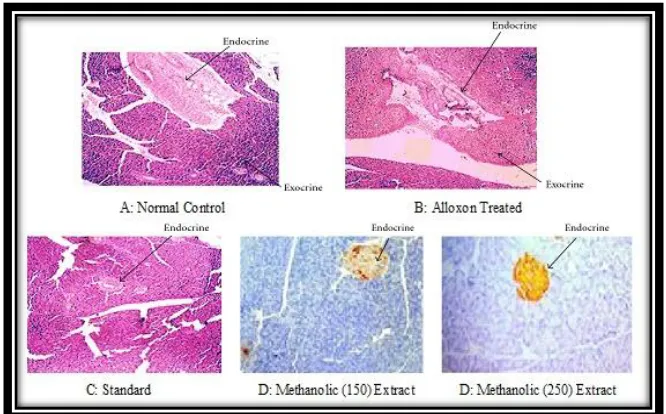
Histology of Pancreas on Alloxan induced Pancreotoxicity: Histological examination revealed extensive damage to the islets of Langerhans and reduced dimensions of islets in animals treated with alloxan only whereas partial restoration of normal cellular population and enlarged size of β-cells with hyperplasia was observed by methanolic extracts. Restoration of normal cellular population size of islets with hyperplasia by glibenclamide was also observed.
Histopathological studies reinforce the healing of
pancreas, by Phyllanthus amarus seeds extract, this shows that it
has anti-diabetic activity (Fig. 5).
Table No. 1: Blood glucose levels of different groups of animals on different days treated with Phyllanthus amarus seeds extract on Alloxan induced Pancreotoxicity
S. No 0th day 1st day 7th day 14th day GROUP I 71.33±1.20 74±5.00 75.35±3.74 79.00±5.19 GROUP II 83.35±7.42 200.15±18.5 185.00±6.05 115.00±5.05 GROUP III 77.33±1.20 183.35±7.56 130.00±1.65** 80.19±3.33** GROUP IV 82.33±12.75 194.33±20.48 145.00±15.68* 85.67±1.56*
GROUP V 88.53±12.75 198.50±19.59 155.75±19.68* 98.33±1.86
Syed Asad B, et al. J Sci Res Pharm, 2019;8(6):66-71
Fig. 2: Blood glucose levels of different groups of animals on different days treated with Phyllanthus amarus seeds extract on Alloxan induced Pancreotoxicity
Table No. 2: Body weight measurements for different groups of animals on different days treated with Phyllanthus amarus
seeds extract on Alloxan induced Pancreotoxicity
S. No 0th day 1st day 7th day 14th day GROUP I 180.33±7.08 190.33±4.49 189.30±5.23 193.00±7.64 GROUP II 204.57±1.57 182.00±2.31 174.00±3.03 149.00±15.44 GROUP III 180.00±5.77 179.00±2.33 189.59±6.23 195.00±6.79 GROUP IV 192.57±7.37 181.35±11.30 186.00±12.53* 200.67±6.36*
GROUP V 201.00±5.67 173.67±6.33 178.30±6.51** 195.00±1.20**
Values are expressed as mean ± SEM; n = 6 animals in each group; **= P≤ 0.05 (significant) Experimental groups were compared with standard; *= P ≤ 0.01 (significant) Experimental groups were compared with control
Fig. 3: Body weight measurements of different groups of animals on different days treated with Phyllanthus amarus seeds extract on Alloxan induced Pancreotoxicity
Table No. 3: Biochemical parameters measured for all groups from the blood serum treated withPhyllanthus amarus seeds extract on Alloxan induced Pancreotoxicity
S. NO. Cholestrol
(mg/dl) (mg/dl) H.D.L (mg/dl) L.D.L Creatinine (mg/dl) (mg/dl) Urea (mg/dl) ALP Group I 140.36±2.3 35.73±2.5 90.32±1.2 0.53±0.3 30.50±2.2 119±3.5 Group II 270.16±9.5 30.00±0.9 185±11.4 2.4±0.3 61.6±1.6 270.00±2.6 Group III 142.53±5.3 36.73±1.5 92.35±3.1 0.58±0.1 32.44±1.5 130.75±2.5 Group IV 155.46±5.6 35.53±2.1 95.65±2.6 0.65±0.2 33.35±2.0 135.49±5.5 Group V 186.32±2.5 36.22±3.3 120.25±1.5 0.88±0.4 43.3±4.8 146.35±4.9
Fig. 4: Biochemical parameters measured for all groups from the blood serum treated withPhyllanthus amarus seeds extract on Alloxan induced Pancreotoxicity
Fig. 5: Histopathological studies of in alloxon induced pancreotoxicity
CONCLUSION
T
he analysis of results of this study reveals thatextracts possess good pancreoprotective and anti-diabetic
activity in alloxon-induced diabetic rats. The Phyllanthus amarus
seeds methanolic extracts of 150mg/kg and 250mg/kg also showed improvement in different parameters associated with diabetes like body weight, lipid profile, histopathological studies and other biochemical parameters. Further studies are required
to explain in detail the mechanism of action of Phyllanthus
amarus seeds at cellular and molecular levels.
REFERENCES:
1. Trivedi PC. Medicinal Plants: Ethnobotanical Approach.
Shyam Printing Press Jodhpur: India; 2006;5.
2. Vats V, Yadav SP, Grover JK. Ehanolic extract of Ocimum
sanctum leaves partially attenuates streptozotocin
induced alterations in glycogen content and carbohydrate
metabolism in rats. J Ethnopharmacol 2004
;90(1):155-160.
3. Kumar GPS, Arulselvan P, Kumar DS, Subramanian SP.
Anti-diabetic activity of fruits of Terminalia chebula on
streptozotocin induced diabetic rats. J Health Sci 2006;
52(3):283-291.
4. Ivorra MD, Paya M, Villar A. A review of natural products
and plants as potential anti-diabetic drugs. J Ethno
Pharmacol 1989;27:243-275.
5. World Health Organisation. Department of Non
communicable Disease Surveillance. Definition, Diagnosis and Classification of Diabetes Mellitus and its
Complications. Geneva: WHO; 1999.
6. Friedewald WT, Levy RI, Fredricson DS. Estimation of the
concentration of low-density lipoprotein cholesterol in plasma, without use of the preparative ultracentrifuge.
Clin Chem 1972;18(6):499-502.
Syed Asad B, et al. J Sci Res Pharm, 2019;8(6):66-71
8. Annie Shirwaikar, Malini S, Chandrika Kumari S.
Protective effect of Pongamia primata flowers against
cisplatin and gentamicin induced nephrotoxicity in rats.
Ind J Exp boil 2003;41:58-62.
9. RV. Aruna, B. Ramesh and VNR. Kartha. Effect of
betacarotene on protein glycosylation in alloxan induced
diabetic rats. Ind J Exper Biol 1999;37(4):399–401.
10. P. Roeschlau, E. Bernt, and W. Gruber. Enzymatic
determination of total cholesterol in serum. Zeitschrift für
klinische Chemie und Klinische Biochemie. 1974;12(5):
226.
11. Teitz N. Fundadamentals of Clin Chem W.B. Saunders Co.
Philadelphia PA, 1976.
12. Corcosteugi R, Labeaga L, Arteche Jk, Orjales A. Protective
effect of idrosmin against cisplatin induced acute
nephrotoxicity in rats. J Pharm Pharmacol 1998
;4:465-467.
13. Type 2 Diabetes mellitus Treatment and Management,
Romesh Khardori.
http://emedicine.medscape.com/article/117853-treatment#aw2aab6b6b1aa
14. Bastyr EJ, et al. Therapy focused on lowering postprandial
glucose, not fasting glucose, may be superior for lowering
AIC. Diabetes care. 2000;23:1236-1241.
15. Aleem MA, Syed Asad B, Ibrahim M. Antidiabetic activity
of hydroalcoholic extracts of Nordostachys jatamansi in
alloxon induced diabetic rats. Brit J Med & Med Res 2014;
4(28):4665-4673.
How to cite this article:
Syed Asad B, et al. PANCREOPROTECTIVE AND ANTI-DIABETIC ACTIVITY OF PHYLLANTHUS AMARUS SEEDS METHANOLIC
EXTRACTS IN ALLOXON INDUCED DIABETIC RATS. J Sci Res Pharm 2019;8(6):66-71.
DOI:https://doi.org/10.5281/zenodo.3267432
Conflict of interest: The authors have declared that no conflict of interest exists.