Neural Generative Question Answering
Jun Yin1∗Xin Jiang2 Zhengdong Lu2, Lifeng Shang2, Hang Li2, Xiaoming Li1 1School of Electronic Engineering and Computer Science, Peking University
2Noah’s Ark Lab, Huawei Technologies
{jun.yin,lxm}@pku.edu.cn,{jiang.xin, lu.zhengdong, shang.lifeng, hangli.hl}@huawei.com
Abstract
This paper presents an end-to-end neural net-work model, named Neural Generative Ques-tion Answering (GENQA), that can generate
answers tosimple factoid questions, based on the facts in a knowledge-base. More specif-ically, the model is built on the encoder-decoder framework for sequence-to-sequence learning, while equipped with the ability to en-quire the knowledge-base, and is trained on a corpus of question-answer pairs, with their as-sociated triples in the knowledge-base. Em-pirical study shows the proposed model can effectively deal with the variations of ques-tions and answers, and generate right and nat-ural answers by referring to the facts in the knowledge-base. The experiment on ques-tion answering demonstrates that the proposed model can outperform an embedding-based QA model as well as a neural dialogue model trained on the same data.
1 Introduction
Question answering (QA) can be viewed as a special case of single-turn dialogue: QA aims at providing correct answers to the questions in natural language, while dialogue emphasizes on generating relevan-t and fluenrelevan-t responses relevan-to relevan-the messages also in narelevan-tural language (Shang et al., 2015; Vinyals and Le, 2015). Recent progress in deep learning has raised the pos-sibility of realizing generation-based QA in a purely neutralized way. That is, the answer is generated by a neural network (e.g., recurrent neural network, or
∗ The work is done when the first author worked as intern at Noah’s Ark Lab, Huawei Technologies.
RNN) based on the question, which is able to handle the flexibility and diversity of language. More im-portantly, the model is trained in an end-to-end fash-ion, and thus there is no need in building the system using linguistic knowledge, e.g., creating a semantic parser.
There is however one serious limitation of this generation-based approach to QA. It is practically impossible to store all the knowledge in a neural network to achieve a desired precision and cover-age in real world QA. This is a fundamental diffi-culty, rooting deeply in the way in which knowledge is acquired, represented and stored. The neural net-work, and more generally the fully distributed way of representation, is good at representing smooth and shared patterns, i.e., modeling the flexibility and diversity of language, but improper for representing discrete and isolated concepts, i.e., depicting the lex-icon of language.
On the other hand, the recent success of memory-based neural network models has greatly extended the ways of storing and accessing text information, in both short-term memory (e.g., in (Bahdanau et al., 2015)) and long-term memory (e.g., in (West-on et al., 2015)). It is hence a natural choice to connect a neural model for QA with a neural model of knowledge-base on an external memory, which is also related to the traditional approach of template-based QA from knowledge-base.
In this paper, we report our exploration in this di-rection, with a proposed model calledNeural Gen-erative Question Answering(GENQA).
Learning Task: We formalize generative question
answering (GENQA) as a supervised learning task or
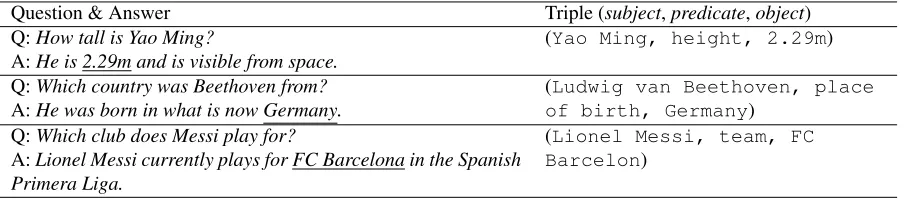
Table 1:Examples of training instances forGENQA. The KB-words in the training instances are underlined in the examples.
Question & Answer Triple (subject,predicate,object) Q:How tall is Yao Ming?
A:He is 2.29m and is visible from space. (Yao Ming, height, 2.29m) Q:Which country was Beethoven from?
A:He was born in what is now Germany. (of birth, GermanyLudwig van Beethoven, place) Q:Which club does Messi play for?
A:Lionel Messi currently plays for FC Barcelona in the Spanish Primera Liga.
(Lionel Messi, team, FC Barcelon)
more specifically a sequence-to-sequence learning task. A GENQA system takes a sequence of words as input question and generates another sequence of words as answer. In order to provide right answers, the system is connected with a knowledge-base (K-B), which contains facts. During the process of an-swering, the system queries the KB, retrieves a set of candidate facts and generates a correct answer to the question using the right fact. The generated answer may contain two types of “words”: one is common words for composing the answer (referred to as com-mon word) and the other is specialized words in the KB denoting the answer (referred to as KB-word).
To learn a GENQA model, we assume that each training instance consists of a question-answer pair with the KB-word specified in the answer. In this paper, we only consider the case of simple factoid question, which means each question-answer pair is associated with a single fact (i.e., one triple) of the KB. Without loss of generality, we mainly focus on forward relation QA, where the question is on sub-ject andpredicate and the answer points toobject. Tables 1 shows some examples of the training in-stances.
Dataset: To facilitate research on the task of gen-erative QA, we create a new dataset by collecting da-ta from the web. We first build a knowledge-base by mining from three Chinese encyclopedia web sites1.
Specifically we extract entities and associated triples (subject,predicate,object) from the structured parts (e.g. HTML tables) of the web pages. Then the ex-tracted data is normalized and aggregated to form a knowledge-base. In this paper we sometimes refer to the items of a triple as a constituent of knowledge-base. Second, we collect question-answer pairs by extracting from two Chinese community QA sites2.
1 Baidu Baike, Baike.com, Douban.com 2 Baidu Zhidao, Sogou Wenwen
Table 2:Statistics of the QA data and the knowledge-base. Community QA Knowledge-base
#QA pairs #entities #triples 235,171,463 8,935,028 11,020,656
Table 2 shows the statistics of the knowledge-base and QA-pairs.
We construct the training and test data for GEN -QA by “grounding” the -QA pairs with the triples in knowledge-base. Specifically, for each QA pair, a list of candidate triples with the subject field-s appearing in the quefield-stion, ifield-s retrieved by ufield-sing the Aho-Corasick string searching algorithm. The triples in the candidate list are then judged by a se-ries of rules for relevance to the QA pair. The basic requirement for relevance is that the answer contains theobjectof the triple, which specifies the KB-word in the answer. Besides, we use additional scoring and filtering rules, attempting to find out the triple that truly matches the QA pair, if there is any. As the result of processing, 720K instances (tuples of question, answer, triple) are finally obtained with an estimated 80% of instances being truly positive. The data are publicly available online3.
In order to test the generalization ability of the GENQA model, the data is randomly partitioned in-to training dataset and test dataset by using triple as the partition key. In that way, all the questions in the test data are regarding to the unseen facts (triples) in the training data. Table 3 shows some statistics of the datasets. By comparing the numbers of triples in Table 2 and Table 3, we can see that a large por-tion of facts in the knowledge-base are not present in the training and test data, which demonstrates the necessity for the model to generalize to unseen facts.
Table 3:Statistics of the training and test dataset forGENQA
Training Data Test Data #QA pairs #triples #QA pairs #triples
696,306 58,019 23,364 1,974
2 The Neural Model
LetQ = (x1, . . . , xTQ)andY = (y1, . . . , yTY)
de-note the natural language question and answer re-spectively. The knowledge-base is organized as a set of triples (subject, predicate, object), each de-noted as τ = (τs, τp, τo). Inspired by the work on
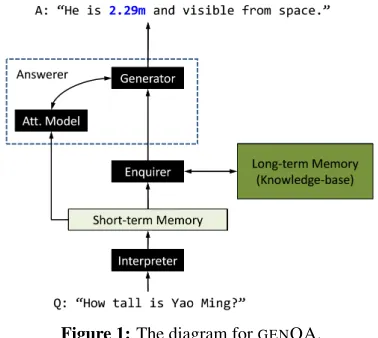
the encoder-decoder framework for neural machine translation (Cho et al., 2014; Sutskever et al., 2014; Bahdanau et al., 2015) and neural natural language dialogue (Shang et al., 2015; Vinyals and Le, 2015; Serban et al., 2015), and the work on question an-swering with knowledge-base embedding (Bordes et al., 2014b; Bordes et al., 2014a; Bordes et al., 2015), we propose an end-to-end neural network model for GENQA, which is illustrated in Figure 1.
The GENQA model consists ofInterpreter, En-quirer,Answerer, and an external knowledge-base. Answererfurther consists ofAttention Modeland Generator. Basically, Interpreter transforms the natural language question Q into a representation HQand saves it in the short-term memory.
Enquir-ertakesHQas input to interact with the
knowledge-base in the long-term memory, retrieves relevant facts (triples) from the knowledge-base, and summa-rizes the result in a vectorrQ. TheAnswererfeeds
on the question representationHQ(through the
At-tention Model) as well as the vectorrQ and
gener-ates the answer withGenerator. We elaborate each component hereafter.
Interpreter: Given the question represented as
word sequenceQ = (x1, . . . , xTQ), Interpreter
en-codes it to the array of vector representations. In our implementation, we adopt a bi-directional RN-N as in (Bahdanau et al., 2015), which process-es the sequence in forward and reverse order by using two independent RNNs (here we use gat-ed recurrent unit (GRU) (Chung et al., 2014)). By concatenating the hidden states (denoted as
(h1,· · · ,hTQ)), the embeddings of the words
(de-noted as (x1,· · ·,xTQ)), and the original one-hot
representations of the words, we obtain an array
Figure 1:The diagram forGENQA.
Figure 2:The Enquirer ofGENQA.
of vectors HQ = (˜h1,· · · ,h˜TQ), where h˜t =
[ht;xt;xt]. This array of vectors is saved in the
short-term memory, allowing for further processing by Enquirer and Answerer for different purposes.
Enquirer: Enquirer “fetches” the relevant facts
from the knowledge-base withQandHQ(as
illus-trated by Figure 2). Enquirer first performs term-level matching to retrieve a list of relevant candidate triples, denoted asTQ = {τk}KQk=1. KQ is the
num-ber of candidate triples, which is usually less than several hundreds in our data. This first round filter-ing, although fairly simple, is important in making the following step of differentiable operations (e.g., the weighting on the candidate set and the answer generation) and optimization feasible. After obtain-ingTQ, the task reduces to evaluating the relevance
of each candidate triple with the question in the em-bedded space(Bordes et al., 2014b; Bordes et al., 2014a).
[image:3.612.331.520.59.228.2]For questionQ, the scores are represented in aKQ
-dimensional vectorrQwhere thekthelement ofrQ
is defined as the probability
rQk = PKQeS(Q,τk)
k0=1eS(Q,τk0) ,
whereS(Q, τk)denotes the matching score between
questionQand tripleτk.
The probability in rQ will be further taken into
the probabilistic model in Answerer for generating a particular answering sentence. SincerQ is of
mod-est size, after the filtering step, and differentiable with respect to its parameters, it can be effective-ly optimized by the supervision signal in recovering the original answers through back-propagation.
In this work, we provide two implementations for Enquirer to calculate the matching scores between question and triples.
Bilinear Model: The first implementation simply
takes the average of the word embedding vectors in HQ as the representation of the question (with the
result denoted as x¯Q) . For each triple τ in the
knowledge-base, it takes the mean of the embed-dings of its subject and predicate as the represen-tation of the triple (denoted asuτ). Then we define
the matching score as
¯
S(Q, τ) = ¯x>
QMuτ,
whereMis the matrix parameterizing the matching between the question and the triple.
CNN-based Matching Model: The second
im-plementation employs the convolutional neural net-work (CNN) for modeling the matching score be-tween question and triple, as in (Hu et al., 2014) and (Shen et al., 2014). Specifically, the question is fed to a convolutional layer followed by a max-pooling layer, and summarized as a fixed-length vec-tor, denoted ashˆQ. Then hˆQ anduτ (again as the
mean of the embedding of the correspondingsubject
andpredicate) are concatenated as input to a multi-layer perceptron (MLP) to produce their matching score
ˆ
S(Q, τ) =fMLP([ˆhQ;uτ]).
For this model the parameters consist of both the C-NN for question representation and the MLP for the final matching decision.
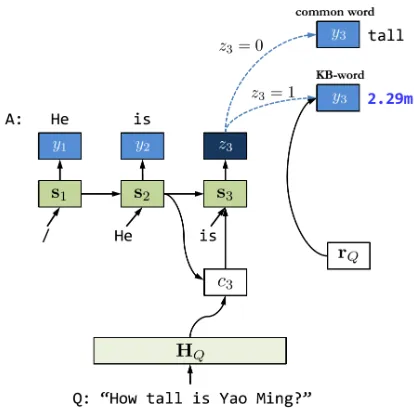
Answerer: Answerer uses an RNN to generate the
answer sentence based on the information of ques-tion saved in the short-term memory (represented by HQ) and the relevant knowledge retrieved from the
long-term memory (indexed byrQ), as illustrated in
Figure 3. The probability of generating the answer sentenceY = (y1, y2, . . . , yTY)is defined as
p(y1,· · ·, yTY|HQ,rQ;θ) =
p(y1|HQ,rQ;θ) TY
Y
t=2
p(yt|y1, . . . , yt−1,HQ,rQ;θ)
where θ represents the parameters in the GEN -QA model. The conditional probability in the RNN model (with hidden state s1,· · ·,sTY)
is specified by p(yt|y1, . . . , yt−1,HQ,rQ;θ) = p(yt|yt−1,st,HQ,rQ;θ).
In generating thetth word y
t in the answer
sen-tence, the probability is given by the following mix-ture model
p(yt|yt−1,st,HQ,rQ;θ) =
p(zt= 0|st;θ)p(yt|yt−1,st,HQ, zt= 0;θ)+
p(zt= 1|st;θ)p(yt|rQ, zt= 1;θ),
which sums the contributions from the “language” part and the “knowledge” part, with the coefficien-tp(zt|st;θ) being realized by a logistic regression
model with st as input. Here the latent variablezt
indicates whether thetth word is generated from a
common vocabulary (for zt = 0) or a KB
vocab-ulary (zt = 1). In this work, the KB vocabulary
contains all theobjects of the candidate triples as-sociated with the particular question. For any word
ythat isonlyin the KB vocabulary, e.g., “2.29m”, we havep(yt|yt−1,st,HQ, zt= 0;θ) = 0, while for
ythat does not appear in KB, e.g., “and”, we have
p(yt|rQ, zt= 1;θ) = 0. There are some words (e.g.,
“Shanghai”) that appear in both common vocab-ulary and KB vocabvocab-ulary, for which the probability contains nontrivial contributions of both bodies.
In generating common words, Answerer acts in the same way as the decoder RNN in (Bahdanau et al., 2015) with information from HQ selected
by the attention model. Specifically, the hidden s-tate attstep is computed asst =fs(yt−1,st−1, ct)
Figure 3:The Answerer ofGENQA.
wherectis the context vector computed as
weight-ed sum of the hidden states storweight-ed in the short-term memoryHQ.
In generating KB-words viap(yt|rQ, zt = 1;θ),
Answerer simply employs the model p(yt = k|rQ, zt= 1;θ) =rQk. The better a triple matched
with the question, the more likely theobjectof the triple is selected.
Training: The parameters to be learned include
the weights in the RNNs for Interpreter and An-swerer, parameters in Enquirer, and the word-embeddings which are shared by the Interpreter RN-N and the knowledge-base. GENQA, although es-sentially containing a retrieval operation, can be trained in an end-to-end fashion by maximizing the likelihood of observed data, since the mixture form of probability in Answerer provides a unified way to generate words from common vocabulary and (dy-namic) KB vocabulary. In practice the model is trained on machines with GPUs by using stochastic gradient-descent with mini-batch.
3 Experiments
3.1 Comparison Models
To our best knowledge there is no previous work on generative QA, we choose three baseline methods: a neural dialogue model, a retrieval-based QA mod-el and the embedding based QA modmod-el, respectivmod-ely corresponding to the generative aspect and the
KB-retrieval aspect ofGENQA:
Neural Responding Machine (NRM): NR-M (Shang et al., 2015) is a neural network based generative model specially designed for short-text conversation. We train the NRM model on the question-answer pairs in the training data with the same vocabulary as the vocabulary of GENQA. S-ince NRM does not access the knowledge-base dur-ing traindur-ing and test, it actually remembers all the knowledge from the QA pairs in the weights of the model.
Retrieval-based QA: the knowledge-base is in-dexed by an information retrieval system (we use Apache Solr), in which each triple is deemed as a document. At test phase, a question is used as the query and the top-retrieved triple is returned as the answer. Note that in general this method cannot gen-erate natural language answers.
Embedding-based QA: as proposed by (Bordes et al., 2014a; Bordes et al., 2014b), the model is learn-t from learn-the queslearn-tion-learn-triple pairs in learn-the learn-training dalearn-ta. The model learns to map questions and knowledge-base constituents into the same embedding space, where the similarities between questions and triples are computed as the inner product of the two embed-ding vectors.
Since we have two implementations of matching score in Enquirer of the GENQA model, we denote the one using the bilinear model asGENQA and the other using CNN and MLP asGENQACNN.
3.2 Results
We evaluate the performance of the models in terms of 1) accuracy, i.e., the ratio of correctly answered questions, and 2) the fluency of answers. In order to ensure an accurate evaluation, we randomly se-lect 300 questions from the test set, and manually remove the nearly duplicate cases and filter out the mistaken cases (e.g., non-factoid questions).
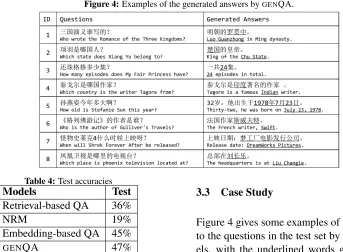
Accuracy: Table 4 shows the accuracies of the
Figure 4:Examples of the generated answers byGENQA.
Table 4:Test accuracies
Models Test
Retrieval-based QA 36%
NRM 19%
Embedding-based QA 45%
GENQA 47%
GENQACNN 52%
athlete actually plays for Spain. The retrieval-based method achieves a moderate accuracy, but like most string-matching methods it suffers from word mis-match between the question and the triples in K-B. The embedding-based QA model achieves higher accuracy on test set, thanks to its generalization a-bility from distributed representations. GENQA and GENQACNN are both better than the competitors, showing that GENQA can further benefit from the end-to-end training for sequence-to-sequence learn-ing. For example, as we conjecture, the task of gen-erating the appropriate answer may help the learning of word-embeddings of the question. Among the t-woGENQA variants,GENQACNNachieves the best accuracy, getting over half of the questions right. An explanation for that is that the convolution lay-er helps to capture salient features in matching. The experiment results demonstrate the ability of GEN -QA models to find the right answer from KB even with regard to new facts. For example, to the ex-ample question mentioned above,GENQA gives the correct answer “He plays for Spain”.
Fluency: We make some empirical
comparison-s and find no comparison-significant differencecomparison-s between NRM andGENQA in terms of the fluency of answers. In general, all the three models based on sequence gen-eration yield correct patterns in most of the time.
[image:6.612.117.460.63.315.2]3.3 Case Study
References
[Bahdanau et al.2015] Dzmitry Bahdanau, Kyunghyun Cho, and Yoshua Bengio. 2015. Neural machine translation by jointly learning to align and translate. InICLR.
[Bordes et al.2014a] Antoine Bordes, Jason Weston, and Sumit Chopra. 2014a. Question answering with sub-graph embeddings.EMNLP.
[Bordes et al.2014b] Antoine Bordes, Jason Weston, and Nicolas Usunier. 2014b. Open question answering with weakly supervised embedding models. InECML PKDD, pages 165–180.
[Bordes et al.2015] Antoine Bordes, Nicolas Usunier, Sumit Chopra, and Jason Weston. 2015. Large-scale simple question answering with memory networks. arXiv preprint arXiv:1506.02075.
[Cho et al.2014] Kyunghyun Cho, Bart Van Merri¨enboer, Caglar Gulcehre, Dzmitry Bahdanau, Fethi Bougares, Holger Schwenk, and Yoshua Bengio. 2014. Learning phrase representations using rnn encoder-decoder for statistical machine translation. EMNLP.
[Chung et al.2014] Junyoung Chung, Caglar Gulcehre, KyungHyun Cho, and Yoshua Bengio. 2014. Empir-ical evaluation of gated recurrent neural networks on sequence modeling.arXiv preprint arXiv:1412.3555. [Hu et al.2014] Baotian Hu, Zhengdong Lu, Hang Li, and
Qingcai Chen. 2014. Convolutional neural network architectures for matching natural language sentences. InAdvances in Neural Information Processing System-s, pages 2042–2050.
[Serban et al.2015] Iulian V Serban, Alessandro Sordoni, Yoshua Bengio, Aaron Courville, and Joelle Pineau. 2015. Building end-to-end dialogue systems using generative hierarchical neural network models. arX-iv preprint arXarX-iv:1507.04808.
[Shang et al.2015] Lifeng Shang, Zhengdong Lu, and Hang Li. 2015. Neural responding machine for short-text conversation. In Association for Computational Linguistics (ACL), pages 1577–1586.
[Shen et al.2014] Yelong Shen, Xiaodong He, Jianfeng Gao, Li Deng, and Gr´egoire Mesnil. 2014. Learn-ing semantic representations usLearn-ing convolutional neu-ral networks for web search. In Proceedings of the companion publication of the 23rd international con-ference on World wide web companion, pages 373– 374. International World Wide Web Conferences S-teering Committee.
[Sutskever et al.2014] Ilya Sutskever, Oriol Vinyals, and Quoc VV Le. 2014. Sequence to sequence learning with neural networks. InNIPS, pages 3104–3112. [Vinyals and Le2015] Oriol Vinyals and Quoc Le. 2015.
A neural conversational model. arXiv preprint arX-iv:1506.05869.