Proceedings of the 13th International Workshop on Semantic Evaluation (SemEval-2019), pages 571–576 571
ConvAI at SemEval-2019 Task 6: Offensive Language Identification and
Categorization with Perspective and BERT
John Pavlopoulos Ion Androutsopoulos
Department of Informatics Athens University of Economics
and Business, Greece
annis,[email protected]
Nithum Thain Lucas Dixon
Jigsaw
nthain,[email protected]
Abstract
This paper presents the application of two strong baseline systems for toxicity detection and evaluates their performance in identify-ing and categorizidentify-ing offensive language in so-cial media. Perspectiveis an API, that serves multiple machine learning models for the im-provement of conversations online, as well as a toxicity detection system, trained on a wide variety of comments from platforms across the Internet.BERTis a recently popular language representation model, fine tuned per task and achieving state of the art performance in mul-tipleNLP tasks. Perspective performed bet-ter thanBERTin detecting toxicity, butBERT was much better in categorizing the offensive type. Both baselines were ranked surpris-ingly high in the SEMEVAL-2019 OFFENS
E-VALcompetition,Perspectivein detecting an offensive post (12th) andBERTin categoriz-ing it (11th). The main contribution of this pa-per is the assessment of two strong baselines for the identification (Perspective) and the cat-egorization (BERT) of offensive language with little or no additional training data.
1 Introduction
Offensive language detection refers to computa-tional approaches for detecting abusive language, such as threats, insults, calumniation, discrimina-tion, swearing (Pavlopoulos et al.,2017b), which could be targeted (at an individual or group) or not (Waseem et al., 2017). These computational ap-proaches are often used by moderators who face an increasing volume of abusive content and would like assistance in managing it efficiently.1
Although offensive language detection is not a new task (Dinakar et al.,2011;Dadvar et al.,2013;
Kwok and Wang, 2013; Burnap and Williams,
2015;Tulkens et al.,2016), the creation of large
1See, for example,https://goo.gl/VQNDNX.
corpora (Wulczyn et al.,2017), along with recent advances in pre-training text representations ( De-vlin et al.,2018) allow for much more efficient ap-proaches. Furthermore, while new competitions and corpora are being introduced (Zampieri et al.,
2019a),2there is a need for strong baselines to as-sess the performance of more complex systems. This paper assesses two systems for the detection and categorization of offensive language, which require few or no task-specific annotated training instances.
The first baseline is a Convolutional Neural Network (CNN) for toxicity detection, trained on millions of user comments from different on-line publishers, which is made publicly available through the Perspective API.3 This model re-quires no extra training or fine tuning and can be directly applied to score unseen posts. The second strong baseline is the recently popular Bidirec-tional Encoder Representations from Transform-ers (BERT), a pre-trained model that has been reported to achieve state of the art performance in multipleNLP tasks with limited fine-tuning on task-specific training data (Devlin et al.,2018).
Section 2 below summarizes related work and Section 3discusses the SEMEVAL-2019 OFFEN -SEVALdataset we used. In Section4we describe the two proposed baselines and we report experi-mental results in Section5. Section6 concludes our work and suggests future directions.
2 Related Work
Various forms of offensive language detection have recently attracted a lot of attention (Nobata et al., 2016; Pavlopoulos et al., 2017b;Park and Fung, 2017; Wulczyn et al., 2017). Apart from the growing volume of popular press concerning
2
toxicity online, the increased interest in research into offensive language is partly due to the re-cent Workshops on Abusive Language Online,4 as well as other fora, such as GermEval for Ger-man texts,5or TA-COS6and TRAC (Kumar et al.,
2018),7. The literature contains many terms for different kinds of offensive language: toxic, abu-sive, hateful, attacking, etc. Largely, these are de-fined by different survey methods. In (Waseem et al.,2017), abusive language is divided into ex-plicit vs. imex-plicit, and directed vs. generalized. However, other researchers have created different taxonomies based on sub-kinds of toxic language (Table2).
Although some previous research has consid-ered several types of abuse and their relations (Malmasi and Zampieri, 2018), detecting vari-eties of hate has attracted more attention (Djuric et al., 2015;Malmasi and Zampieri,2017; ElSh-erief et al., 2018; Gamb¨ack and Sikdar, 2017;
Zhang et al., 2018). The first publicly avail-able dataset for hate speech detection was that of
Waseem and Hovy(2016). It contained 1607 En-glish tweets annotated for sexism and racism. A larger dataset was published by Davidson et al.
(2017), containing approx. 25K tweets collected by using a hate lexicon. Despite the popularity of hate speech detection in literature, no larger pub-licly available hate speech datasets seem to ex-ist. For recent overviews of hate speech detection, consultSchmidt and Wiegand(2017) andFortuna and Nunes(2018).
Research into the various kinds of offensive lan-guage detection is mainly focused on English, but some work in other languages also exists. Work on a large dataset of Greek moderated news por-tal comments is presented by Pavlopoulos et al.
(2017a). A dataset of obscene and offensive user comments and words in Arabic social media was presented byMubarak et al.(2017). Previous work includes a system to detect and rephrase profan-ity in Chinese (Su et al.,2017), and an annotation schema for unacceptable social media content in Slovene (Fiˇser et al.,2017).
4https://goo.gl/9HmSzc 5
https://goo.gl/uZEerk
6
http://ta-cos.org/
7https://goo.gl/DTZquU
3 Data
The SEMEVAL-2019 OFFENSEVALdataset that is available to participants contains 13240 tweets; the counts of the labels are shown in Table1. The OFFENSEVALtask consists of three subtasks, de-scribed in detail byZampieri et al.(2019b). Sub-task A aims at the detection of offensive language (OFFor NOT in Table3). Subtask B aims at cat-egorizing offensive language as targeting a spe-cific entity (TIN) or not (UNT). Subtask C aims to identify whether the target of an offensive post is an individual (IND), a group (GRP), or unknown (OTH). Table1also shows the size of the vocabu-lary per class (label), which, unsurprisingly, is pro-portional to the class size. It is worth noting that offensive tweets targeting a group are the length-ier texts, with 28 tokens on average (see Table1, column C, GRP column).
4 Baselines
We now describe the two baselines (Perspective, BERT) that we implemented and evaluated.
4.1 Perspective
We employed thePerspectiveAPI, which was cre-ated by Jigsaw and Google’s Counter Abuse Tech-nology team in Conversation-AI,8to facilitate bet-ter conversations online and protect voices in con-versations (Hosseini et al.,2017). Although open-source code is available,9 we chose to use pre-trained models, accessible through the API. For offensive language detection in Subtask A, we used theToxicitymodel, which is aCNNbased on GLOVEword embeddings,10trained over millions of user comments from publishers such as the New York Times and Wikipedia. This is a robust model, which we expect to be somewhat adaptable to dif-ferent datasets (and their labels for closely related forms of offensive language), such as the offen-sive tweets of OFFENSEVAL. For offensive lan-guage categorization in Subtask B, we employed other experimental models, also available via the PerspectiveAPI, which detect various abuse types including those of Table2.
4.2 BERT
BERT(Devlin et al.,2018) is a deep bidirectional network built using Transformers (Vaswani et al.,
8https://conversationai.github.io/ 9
https://goo.gl/yN196H
Subtask A B C
Label NOT OFF UNT TIN IND GRP OTH
Number of Tweets 8840 4400 524 3876 2407 1074 395
Class specific vocabulary size 29.2K 18.6K 3.5K 17.3K 11.5K 7.8K 3.5K
[image:3.595.85.511.61.135.2]Average number of tokens / Tweet 22 24 19 24 22 28 25
Table 1: Number of tweets, size of vocabulary, and average number of tokens per tweet, for each label (class). In Subtask A, the labels are ‘not offensive’ (NOT) or ‘offensive’ (OFF). In Subtask B, the labels are ‘not targeted threat’ (UNT) and ‘targeted insult or threat’ (TIN). In Subtask C, they are ‘targeted insult or threat towards an individual’ (IND), ‘towards a group’ (GRP), or ‘towards another target’ (OTH).
TOXICITY @user Fuck you, you fat piece of shit
INSULT Hey @user , you are disgusting.
THREAT @user Kill the traitors.
PROFANITY My wrist been fucked up for nearly a month now . This time im really going to the hospital to see what the fuck is wrong with it IDENTITY
ATTACK
Okay everyone always talks aboht the pathetic army and all the soy boy branches and gay shit and what not [...]
ATTACK ON COM -MENTER
@user You are all utterly delu-sional. If you were really pro-life” you would [...]
Table 2: The tweets with the highestPerspectivescore per abusiveness type, on a trial dataset of 320 tweets shared by the competition organizers.
2017). It is pre-trained to detect (a) a masked word from its left and right context, and (b) the next sentence. We used the publicly available BERT
-BASE version,11 with 12 Transformer layers, 768 hidden states size, which is pre-trained on a mono-lingual corpus of 3.3B words. For a particularNLP task, a task-specific layer is added on top ofBERT. In our case, the extra layer comprises dropout, a linear transformation, and softmax.12 During the task-specific ‘fine-tuning’, the extra layer is trained jointly withBERT(refining the pre-trained BERT model) on task-specific data. Previous re-search demonstrated that fine-tuning BERT leads to state of the art performance in severalNLPtasks (Devlin et al.,2018).
System F1 (macro) Accuracy
AllNOTbaseline 0.4189 0.7209
AllOFFbaseline 0.2182 0.2790
Perspective 0.7933 0.8360
BERT 0.7705 0.8163
BEST 2019 0.8290 —
Table 3: Results for Subtask A.
System F1 (macro) Accuracy
All TIN baseline 0.4702 0.8875
All UNT baseline 0.1011 0.1125
Perspective 0.4785 0.6292
BERT 0.6817 0.8708
[image:3.595.71.296.215.423.2]BEST 2019 0.7550 —
Table 4: Results for Subtask B.
5 Results
5.1 Offensive Language Detection
For Subtask A, we used the toxicity score from Perspectiveand returned the offensive label (OFF) when the returned score was above 0.5. No fine tuning was performed forPerspective. ForBERT, we split the dataset to training (10K tweets) and development (3240) subsets, and fine-tunedBERT
for 3 epochs.13
In this subtask, Perspective outperformed BERT and was ranked 12th out of 103 submis-sions. The difference from the top-ranked model was 3.5 F1 points. The performance of Perspec-tivein this subtask is particularly interesting, con-sidering that the training data for these models were not labeled for offensiveness, but rather for other attributes such as toxicity, threats, and in-sults.14 IgnoringPerspective, BERTwas ranked
11https://goo.gl/95mqhE 12
We used default values for all hyper parameters. 13
We used the uncased system with batch size 32, based on preliminary experiments.
NOT OFF
Predicted label NOT
OFF
True label
555
65
76
164
Confusion Matrix
0.0 0.1 0.2 0.3 0.4 0.5 0.6 0.7 0.8
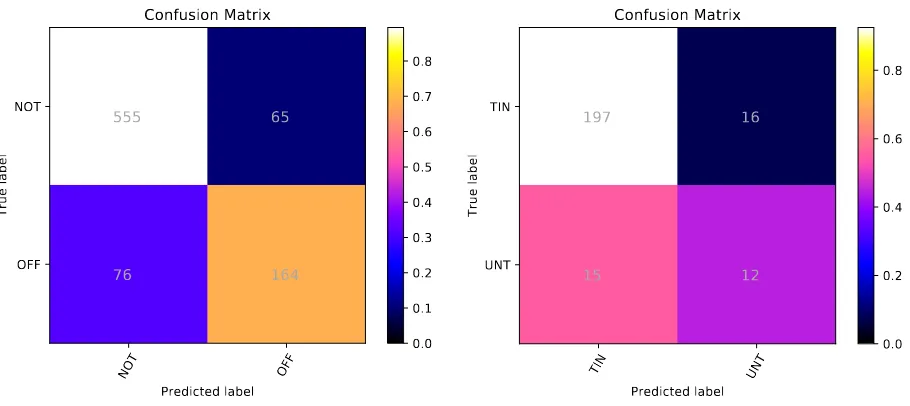
Figure 1: Confusion matrix forPerspectivein Subtask A (Offensive Language Detection).
27th. As shown in Table 3, both of our strong baselines outperform the naive majority baselines for this subtask.
The confusion matrix of Perspective is shown in Fig. 1. Both recall and precision are high for theNOTlabel (87.96% and 89.81%), but lower for OFF (68.33% and 71.62%). This is explained by the fact thatNOTis two times the size ofOFF (Ta-ble1). We also usedPerspectiveto score the train-ing data, since no fine-tuntrain-ing was performed on the training data for Perspective. Macro F1 was 78.01% (85.02% forNOT, 71% forOFF) and accu-racy was 80.24%, which are lower but close to the respective values on the test data (Table3).
5.2 Offense Type Detection
For Subtask B, we used the experimental insult,
threatandattack on commentermodels from Per-spective. We averaged insult andattack on com-menter and used this average to compare with the threat score. The Perspective baseline re-turned a targeted insult/threat (TIN) when the av-erage was greater, and untargeted (UNT) other-wise. The BERT baseline was fine-tuned on the entire dataset that was available to participants, be-cause we considered that dataset too small for a training/development split.15 BERT clearly out-performed thePerspectivebaseline (Table4) and ranked 11th in this subtask among 73 participants, whereas the best system achieved 7.8 points higher
15We used the cased system with batch size 16, based on preliminary experiments.
TIN UNT
Predicted label TIN
UNT
True label
197
16
15
12
Confusion Matrix
[image:4.595.78.533.63.266.2]0.0 0.2 0.4 0.6 0.8
Figure 2: Confusion matrix for BERT in Subtask B (Offense Type Detection).
in F1. The confusion matrix ofBERTfor this sub-task is shown in Fig. 2. The large class imbal-ance (TIN tweets are approx. 7 times than UNT, see Table1) significantly reduces both the recall (44.44%) and precision (42.86%) ofBERTfor the UNTclass, compared toTIN(92.49% and 92.92%, respectively).
5.3 Offense Target Detection
For Subtask C, Perspective has no suitable model to respond yet and theBERT-based systems sub-mitted were in an experimental phase, due to time constraints.16 We consider the results we obtained for this subtask as not relevant and leave the devel-opment and evaluation of baselines for this subtask as future work.
6 Conclusion
This paper proposed and evaluated two strong baselines, based on the Perspective API and BERT, for identifying and categorizing offensive
language in social media. Both baselines require few (BERT) or no additional task-specific train-ing data (Perspective) and this is the first work, to our knowledge, to assess their performance in the tasks we considered. ThePerspective-based baseline was ranked 12th among 103 submissions for the task of classifying a post as offensive or not. TheBERT baseline was ranked 11th among
16B
73 submissions for the task of recognizing whether an offensive post is targeted or not. Both baselines were ranked surprisingly high in the correspond-ing tasks, considercorrespond-ing that they were given no or few, respectively, additional task-specific training instances. Furthermore, the Perspective baseline, which required no fine tuning outperformedBERT
by a large margin in the task of detecting offensive language. In future work, we intend to examine stronger, yet easy to apply baselines, and release source to make it easier to use them.
References
P. Burnap and M. L. Williams. 2015. Cyber hate speech on twitter: An application of machine clas-sification and statistical modeling for policy and de-cision making. Policy & Internet, 7(2):223–242.
M. Dadvar, D. Trieschnigg, R. Ordelman, and F. de Jong. 2013. Improving cyberbullying detec-tion with user context. InEuropean Conference on Information Retrieval, pages 693–696.
T. Davidson, D. Warmsley, M. Macy, and I. Weber. 2017. Automated hate speech detection and the problem of offensive language. In ICWSM, pages 512–515, Montreal, Canada.
J. Devlin, M.-W. Chang, K. Lee, and K. Toutanova. 2018. Bert: Pre-training of deep bidirectional trans-formers for language understanding. arXiv.
K. Dinakar, R. Reichart, and H. Lieberman. 2011. Modeling the detection of textual cyberbullying. In
The Social Mobile Web, pages 11–17.
N. Djuric, J. Zhou, R. Morris, M. Grbovic, V. Ra-dosavljevic, and N. Bhamidipati. 2015. Hate speech detection with comment embeddings. InICWWW, pages 29–30.
M. ElSherief, V. Kulkarni, D. Nguyen, W. Y. Wang, and E. Belding. 2018. Hate lingo: A target-based linguistic analysis of hate speech in social media.
arXiv preprint.
D. Fiˇser, T. Erjavec, and N. Ljubeˇsi´c. 2017. Legal framework, dataset and annotation schema for so-cially unacceptable on-line discourse practices in slovene. In1st Workshop on Abusive Language On-line, Vancouver, Canada.
P. Fortuna and S. Nunes. 2018. A survey on automatic detection of hate speech in text. ACM Computing Surveys (CSUR), 51(4):85.
B. Gamb¨ack and U. K. Sikdar. 2017. Using convolu-tional neural networks to classify hate-speech. In
1st Workshop on Abusive Language Online, pages 85–90, Vancouver, Canada.
H. Hosseini, S. Kannan, B. Zhang, and R. Poovendran. 2017. Deceiving google’s perspective api built for detecting toxic comments. InarXiv preprint.
R. Kumar, A. K. Ojha, S. Malmasi, and M. Zampieri. 2018. Benchmarking aggression identification in social media. InTRAC, Santa Fe, USA.
I. Kwok and Y. Wang. 2013. Locate the hate: Detecting tweets against blacks. InAAAI, pages 1621–1622, Whasington, USA.
S. Malmasi and M. Zampieri. 2017. Detecting hate speech in social media. InRANLP, pages 467–472.
S. Malmasi and M. Zampieri. 2018. Challenges in dis-criminating profanity from hate speech. Journal of Experimental & Theoretical Artificial Intelligence, 30:1–16.
H. Mubarak, K. Darwish, and W. Magdy. 2017. Abu-sive language detection on arabic social media. In
1st Abusive Language Workshop, pages 52–56, Van-couver, Canada.
C. Nobata, J. Tetreault, A. Thomas, Y. Mehdad, and Y. Chang. 2016. Abusive language detection in on-line user content. InICWWW, pages 145–153.
J. H. Park and P. Fung. 2017. One-step and two-step classification for abusive language detection on twit-ter. In1st Workshop on Abusive Language Online, pages 41–45.
J. Pavlopoulos, P. Malakasiotis, and I. Androutsopou-los. 2017a. Deep learning for user comment mod-eration. In1st Workshop on Abusive Language On-line, pages 25–35.
J. Pavlopoulos, P. Malakasiotis, and I. Androutsopou-los. 2017b. Deeper attention to abusive user content moderation. InEMNLP, pages 1125–1135, Copeng-hagen, Denmark.
A. Schmidt and M. Wiegand. 2017. A survey on hate speech detection using natural language processing. In Workshop on Natural Language Processing for Social Media, pages 1–10, Valencia, Spain.
H.-P. Su, C.-J. Huang, H-T. Chang, and C.-J. Lin. 2017. Rephrasing profanity in chinese text. In1st Workshop on Abusive Language Online, Vancouver, Canada.
S. Tulkens, L. Hilte, E. Lodewyckx, B. Verhoeven, and W. Daelemans. 2016. A dictionary-based approach to racism detection in dutch social media. In TA-COS, Portoroz, Slovenia.
A. Vaswani, N. Shazeer, N. Parmar, J. Uszkoreit, L. Jones, A. N. Gomez, Ł. Kaiser, and I. Polosukhin. 2017. Attention is all you need. In NIPS, pages 5998–6008.
Z. Waseem and D. Hovy. 2016. Hateful symbols or hateful people? predictive features for hate speech detection on twitter. InNAACL SRW, pages 88–93, San Diego, California.
E. Wulczyn, N. Thain, and L. Dixon. 2017. Ex machina: Personal attacks seen at scale. In
ICWWW, pages 1391–1399.
M. Zampieri, S. Malmasi, P. Nakov, S. Rosenthal, N. Farra, and R. Kumar. 2019a. Predicting the Type and Target of Offensive Posts in Social Media. In
NAACL.
M. Zampieri, S. Malmasi, P. Nakov, S. Rosenthal, N. Farra, and R. Kumar. 2019b. Semeval-2019 task 6: Identifying and categorizing offensive language in social media (offenseval). InSemEval.