788
UM-IU@LING at SemEval-2019 Task 6: Identifying Offensive Tweets
Using BERT and SVMs
Jian Zhu
Department of Linguistics University of Michigan
Ann Arbor, MI, USA [email protected]
Zuoyu Tian
Department of Linguistics Indiana University Bloomington, IN, USA
Sandra K ¨ubler
Department of Linguistics Indiana University Bloomington, IN, USA [email protected]
Abstract
This paper describes the UM-IU@LING’s sys-tem for the SemEval 2019 Task 6: OffensEval. We take a mixed approach to identify and cate-gorize hate speech in social media. In subtask A, we fine-tuned a BERT based classifier to detect abusive content in tweets, achieving a macro F1score of 0.8136 on the test data, thus reaching the 3rd rank out of 103 submissions. In subtasks B and C, we used a linear SVM with selected charactern-gram features. For subtask C, our system could identify the tar-get of abuse with a macro F1score of 0.5243, ranking it 27th out of 65 submissions.
1 Introduction
With the increased influence of social media on modern society, large amounts of user-generated content emerge on the internet. Besides the ex-change of ideas, we also see an exponential in-crease of aggressive and potentially harmful con-tent, for example, hate speech. If we consider the amount of user-generated data, it is impractical to manually identify the malicious speech. Thus we need to develop methods to detect offensive speech automatically through computational mod-els. However, this task is challenging because nat-ural language is fraught with ambiguities, and lan-guage in social media is extremely noisy. Here we present our method to automatically identify-ing offensive content in tweets.
We primarily focus on detecting whether a tweet contains offensive content or not (subtask A), and then determining the target of the offen-sive content (subtask C). For subtask A, we use pre-trained word embeddings by fine-tuning the BERT model (Devlin et al.,2018) for detecting of-fensive tweets. For subtasks B and C, BERT did not perform well, either because of limited train-ing data or because we did not find the appropriate hyperparameters. Thus we use an SVM classifier
with charactern-grams as features. We acciden-tally flipped the predicted labels in our submission to subtask B, which is why we do not report results of subtask B here. Among all teams participating in OffensEval, our models ranks 3rd out of 103 on subtask A and 27th out of 65 on subtask C. (see Zampieri et al.,2019b).
2 Related Work
Detecting offensive language online is becom-ing more and more important (Schmidt and Wie-gand, 2017; Founta et al., 2018; Malmasi and Zampieri, 2018). To build an effective classi-fier, one of the major problems is to find the ap-propriate features. Normally, two types of fea-tures are utilized: surface feafea-tures like n-grams and word representations trained by neural net-work. Most offensive language classifiers are trained on different types of surface features with approaches like SVM (Malmasi and Zampieri, 2018; Arroyo-Fern´andez et al., 2018), Random Forest (Burnap and Williams, 2015), and Logis-tic Regression (Davidson et al.,2017). Recently, word embeddings trained in neural networks have been shown to achieve good performance in offen-sive language identification tasks (Badjatiya et al., 2017). Benchmarks of the first shared task on ag-gression identification (Kumar et al., 2018) show that half of the top 15 systems are trained on neural networks.
possi-ble word contexts, which may gloss over semantic nuances in representations.
Recent models like ELMo (Peters et al.,2018) and BERT (Devlin et al., 2018) significantly ad-vanced the state-of-the-art in language modeling by learning context-sensitive representations of words. ELMo goes beyond word embeddings by learning representations that are functions of the entire input sentence (Peters et al.,2018). How-ever, ELMo is still considered shallow with two bidirectional LSTM layers, and more recent trans-former based language models such as the OpenAI Generative Pre-trained Transformer (GPT) (Rad-ford et al.,2018) and Bidirectional Encoder Rep-resentations from Transformers (BERT) (Devlin et al., 2018) have been extended to a depth of up to twelve layers. The OpenAI GPT is still a unidirectional language model while BERT is trained to be bidirectional with two novel predic-tion tasks, Masked LM and Next Sentence Pre-diction. The pre-trained BERT model has been shown to give significant improvements in a se-ries of downstream tasks over ELMo and OpenAI GPT (Devlin et al.,2018).
However, identifying offensive language is not a simple task. Challenges during identification in-clude but are not limited to the fact that surface language features fail to capturing subtle semantic difference, and the shortage of undisputed anno-tated data (Malmasi and Zampieri,2018). Most of previous studies focus on distinguishing between offensive and non-offensive language (Kwok and Wang,2013;Djuric et al.,2015), which is the goal of subtask A in the current shared task. But part of challenge consists of the intertwined nature of such messages having negative connotations and profanity.Dinakar et al.(2011) show that it is im-portant to tease these two factors apart. Malmasi and Zampieri(2018) first address the issue of dis-tinguishing hate speech from general profanity.
3 Methodology and Data
The subtasks in the shared task are rather differ-ent. In subtask A, the goal is to identify offensive tweets; in subtask B and C, the aim is to distin-guish targeted and untargeted offense and to clas-sify the targeted ones into different types. Subtask A requires sensitivity to subtle changes in word meaning in context while the other subtasks are more categorical in nature. However, both suffer from data sparsity. Therefore, we decided, backed
by empirical validation on the trial data, to utilize different methods for the subtasks, namely, BERT embeddings for subtask A, and an SVM classifier for subtasks B and C.
The data collection method used to compile the dataset in OffensEval is described by Zampieri et al. (2019a). We used the official training data and trial data provided by the shared task to train the classifier. Our implmentations can be found at: https://github.com/zytian9/SemEval-2019-Task-6.
3.1 Subtask A: Identifying Abusive Content
The goal of subtask A is to identify whether a tweet contains offensive content by training a model to perform binary classification. There are 13,240 tweet instances in the training data, in which each instance has been labeled as either ’of-fensive’ (’OFF’) or ’not of’of-fensive’ (’NOT’). The model takes a tweet as input and predicts the cor-responding label of that tweet. We used the trial data as development data.
3.1.1 Model Details
For subtask A, we trained a classifier by fine-tuning a pre-trained BERT Transformer (Devlin et al.,2018) with a linear layer for text sequence classification on top.
The input sentences1 were first tokenized with the BERT basic tokenizer to perform punctuation splitting, lower casing and invalid characters re-moval. Then this was followed by WordPiece tok-enization (Wu et al.,2016) to split words into sub-word units, in accordance with the original BERT approach (Devlin et al.,2018). The maximum quence length was defined as 80, with shorter se-quences padded and longer sese-quences truncated to this length. The order of the input sequence was represented by the learned positional embeddings. The input representation for each tweet is the sum of these token, segment, and position embeddings. As only one sentence serves as input, only the sen-tence A embeddings are used as the segment em-beddings (Devlin et al.,2018).
We selected the BERTbase-uncased as the under-lying BERT model. The BERTbase consists of 12 Transformer blocks, 12 self-attention heads, and 768 hidden dimension with a total parame-ters of 110M. It was trained on the BookCorpus (800M words) and the English Wikipedia (2,500M
words). Though the BERTlargemodel was reported to outperform the BERTbase in a variety of tasks, training and fine tuning BERTlarge was too com-putationally intensive given the time limit. Thus we used BERTbase for accelerated training. The BERTbase model includes a special classification embedding[CLS]at the beginning of every sen-tence, and this token in the final layer was ex-tracted as the aggregate sequence representation for the current classification task. Then a lin-ear layer of 768 dimensions was added on top of BERTbase, using the [CLS] embeddings of the whole input sequence to predict a binary label. Bi-nary cross-entropy was used as the loss function to fine-tune the classifier.
3.1.2 Implementation
The neural network was implemented in Py-Torch (Paszke et al., 2017), and we used the tokenizer, pretrained WordPiece, and positional embeddings and pre-trained BERT from the li-brary pytorch-pretrained-bert2. Fol-lowing the recommendation for fine-tuning in the original BERT approach (Devlin et al.,2018), we trained our classifier with a batch size of 32 for 2 epochs. The dropout probability was set to 0.1 for all layers. Adam optimizer was used with a learn-ing rate of 2e-5. The trainlearn-ing was carried out on an Nvidia 1070Ti GPU; only taking about 6 minutes in total.
3.2 Subtask B: Categorizing Offense Types
For subtasks B and C, we adopted an SVM clas-sifier. For these two tasks, the BERT classifier performed close to the baseline on the trial data. This could be caused by the limited amount of the training data for these two tasks or inappropriate selection of hyperparameters. Thus, we built a lin-ear SVM classifier to identify the offense type and target.
Subtask B requires the distinction between tar-geted and untartar-geted offense. We used an SVM classifier with selected charactern gram features for subtask B. For the trial data of subtask B, the classifier achieved a macro F1score of 0.5333 and
accuracy of 0.5714; both of them considerably higher than the baseline. But since the labels of two classes were accidentally flipped in our sub-mission, our results were not competitive. We also reconstructed test F1 from the flipped confusion
2 https://github.com/huggingface/pytorch-pretrained-BERT
matrix. If the labels were not flipped, the test F1
should be 0.5946.
3.3 Subtask C: Identifying the Target of
Abuse
Subtask C requires the classifier to identify three types of offense target, ’Individual’ (’IND’), ’Group’(’GRP’) and ’Other’(’OTH’). The training set is rather imbalanced: The minority class OTH constitutes around 10 percent of all the instances, and only occurs once in the trial data. We origi-nally were planning to use the same approach as for subtasks A. However, experiments on the trial data showed a weak performance. For this reason, we decided to use a linear SVM classifier to iden-tify the offense target with three sub-classes since previous studies indicate that SVM classifiers per-form well on classification tasks and at par with deep neural networks when features are well se-lected (Founta et al., 2018; Kumar et al., 2018). For this classifier, we used the Scikit-learn (Pe-dregosa et al.,2011) implementation, and we used only the training data provided by the shared task.
3.3.1 Model Details
Given that character-level n-gram could reduce the effect of spelling errors and variations in tweets (Schmidt and Wiegand, 2017), we used a bag of character n-grams (with n ranging from 2 to 7 characters) as features in order to charac-terize the users’ language features as robustly as possible. Since in subtask C, we need to iden-tify different types of offense target, we assume that named entity information will be effective for identifying target types. Named entities informa-tion was extracted by spaCy, which is based on the entity types from OntoNotes 5 corpus3. Given that this task aims to identify three types of tar-gets, namely individual, group and other, we used the named entity information by classifying all the entity types into three major types and counting the number of each type separately. The first type only includes PERSON entities, the second type consists of entity types related to a group sense, for example ORG, NORG, and GPE, and the last type includes all occurrences of the other entity types.
Nobata et al. (2016) found that linguistic fea-tures such as tweet length, average word length,
3https://spacy.io/api/annotation#
System F1macro Accuracy
All OFF baseline 0.2182 0.2790
All NOT baseline 0.4189 0.7209
[image:4.595.83.283.63.119.2]BERTbase-uncased 0.8136 0.8570
Table 1: The official UM-IU@LING result for subtask A, in comparison to the baselines.
System F1 macro Accuracy
All OFF baseline 0.1934 0.2399
All NOT baseline 0.4319 0.7601
SVMcharacter-ngram 0.8267 0.8782
BERTbase-uncased 0.8388 0.8722 BERTbase-cased 0.8094 0.8500 BERTbase-multiling-unc. 0.4300 0.7625 BERTbase-multiling-cased 0.8179 0.8718
Table 2: Results on the trial data for subtask A.
number of punctuation, number of discourse con-nectives can be useful for detecting abusive lan-guage. In this study, we adopt 9 features from their work. Besides the n-gram features, named entity, and linguistic features, we also adopted emoji and emoticons as additional features, which have been shown to be useful in sentiment analysis tasks (Kouloumpis et al.,2011;Shiha and Ayvaz, 2017). Emoticons are extracted using the s regu-lar expressions by C. Potts4. We also added three emoji sentiment features, which consist of the pos-itive, negative, and overall sentiment scores based on the Emoji Sentiment Ranking (Novak et al., 2015).
We performed feature selection for the n-gram features using a filtering approach with informa-tion gain, which has proven to be effective in so-cial media sentiment classification (K¨ubler et al., 2018).
Our final submission is a linear SVM clas-sifier (C=0.1, squared-hinge loss function) with 1000 selected character n-grams of length 2-7. Adding linguistic and emoji features resulted in small gains on the trial data and was that not con-sidered useful for the official version.
4 Results
4.1 Subtask A
Our best result for subtask A along with the of-ficial baselines are summarized in Table 1. The
4http://sentiment.christopherpotts.net/tokenizing.html #emoticons
NOT OFF
Predicted label NOT
OFF
True label
576 44
79 161
Confusion Matrix
[image:4.595.314.516.64.243.2]0.0 0.2 0.4 0.6 0.8
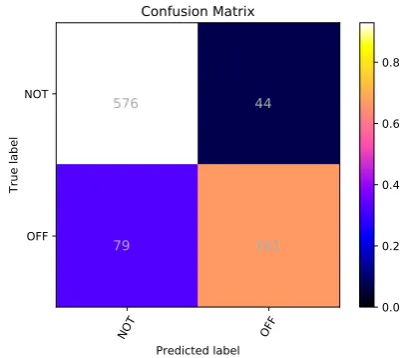
Figure 1: The UM-IU@LING confusion matrix for subtask A.
BERT classifier achieved a macro F1 score of
0.8136, clearly exceeding the baseline of 0.4189 and ranking the system 3rd out of 103 submis-sions. This demonstrates that our model can ef-fectively identify whether a given tweet contains offensive content or not. The confusion matrix in Figure 1further illustrates the error pattern of our classifier, which more often misclassified of-fensive tweets as being not ofof-fensive. One expla-nation of the results may be the classifier’s prefer-ence for the majority class. But it is possible that our classifier may not capture some of the subtle nuances in meaning and contexts. However, the results also show that the macro F1 score is only
about 4.5 percent points lower than the accuracy (0.8136 vs. 0.8570). This is a clear indication that the classifier is successful in modeling the minor-ity class of offensive tweets.
4.1.1 Ablation Analysis
We performed an ablation analysis on our BERT classifier using the training and the trial data. First, we retrained the classifier by varying the learn-ing rate. The macro F1 dropped to the baseline
of 0.4318 with a learning rate of either 8 or 2e-3, which indicates that the system is sensitive to change in learning rates.
The selection of sequence length only has a minimal influence on the final performance, with a tendency for longer sequence length to improves prediction accuracy: Setting the input sequence length to 60 reduces the macro F1 minimally to
[image:4.595.72.290.164.276.2]ID Tweet Label Prediction 50 okay but it actually sucks so much that the first year I COULD go to
every Reeperbahn Festival day, I’m in Strasbourg and can only attend the last day
NOT OFF
263 My mom just called me and said she is joining the NFL boycott. How many of yall are with us? F that league #NFLBoycott
OFF NOT
126 @User @User @User They don’t. The GOP will keep supporting rack-eteer, illegitimate Trump. They never will stop the corruption of tRump. They are in it for the money. They want to destroy American democracy.
[image:5.595.72.525.64.186.2]NOT OFF
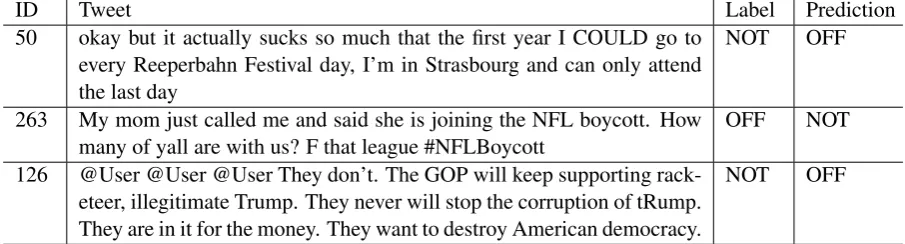
Table 3: Misclassified examples for subtask A from the trial data. Usernames are anonymized.
There are several versions of pre-trained BERTbase5. We compared the performance of these different versions of BERTbase and the re-sults are summarized in Table2. Generally, these variants of BERTbase tend to give similar perfor-mance but BERTbase-uncasedachieved the best per-formance on the trial data. It is unclear why BERTbase-multilingual-uncaseddid not learn to perform the task beyond the baseline. Additional hyper-parameter tuning might be necessary in this case. Overall, these results demonstrate that though BERT can give superior performance in detect-ing hate speech, it is somewhat sensitive to the change of hyperparameters. We also find that the SVM classifier achieved a higher accuracy on the trial data, but there is a significant drop in macro F1 when compared with the BERT model. This
shows that the BERT model performs better on the minority class.
4.1.2 Error Analysis
We show examples of misclassified tweets in Ta-ble3. In example 263, the BERT classifier failed to identify the offensive word “F”. It is com-mon for people to use euphemisms to tone down swear words in certain situations. The classifier could miss these word variants, especially when the word variant is the only offensive word in the given tweet. For tweet 50, the word “sucks” is the only word that is often used offensively. How-ever, the given tweet is not offensive because the author only describes their mood instead of insult-ing someone else. These misclassifications seem to indicate that the classifier reacts to trigger words with negative connotations but may not be capable of interpreting the words with respect to the larger context.
When examining the prediction errors, we
con-5https://github.com/google-research/bert
System F1macro Accuracy
All GRP baseline 0.1787 0.3662
All IND baseline 0.2130 0.4695
All OTH baseline 0.0941 0.1643
[image:5.595.316.519.229.298.2]SVM classifier 0.5243 0.6854
Table 4: The official UM-IU@LING results (SVM) for subtask C.
System F11macro Acc.
All IND baseline 0.3041 0.8387
All GRP baseline 0.0762 0.1290
All OTH baseline 0.0208 0.0323
SVMcharacter-ngram 0.3915 0.8065
SVMword-ngram 0.3554 0.6774
SVMchar+ling+emoji 0.3971 0.8065 SVMchar+ling+emoji+entity 0.3901 0.7742
Table 5: Results on the trial data for subtask C.
sistently noticed that the BERT classifier is highly effective in identifying tweets with words that are negative or offensive in most linguistic contexts. The real challenge is that not all tweets containing negative or potentially insulting words are offen-sive; there are subtle differences between a nega-tive opinion and an insult towards someone. How-ever, the model cannot distinguish these subtle differences in meaning in the proper cultural or socio-political contexts. Additionally, it is not ro-bust enough to detect swear word variants or atyp-ical spellings common in social media.
4.2 Subtask C
Table 4 shows our best result for subtask C in comparison to the official baselines. The macro F1 score of the SVM classifier is 0.5243, which
[image:5.595.310.522.343.454.2]classi-ID Tweet Label Prediction 17 @User Obama fed the country shit sandwiches for 8 years. Maybe Jim
just has his addled mind confused about dates and who fed who what..
GRP IND
22 @User The Catholic Church is really screwed up. Nothing new here. GRP OTH 31 @User Yeah thanks to your Nobel Emmy award winning idiot chief flip
flopping on everything from Iran to gun control.
[image:6.595.315.519.189.366.2]IND GRP
Table 6: Misclassified examples from the trial data for subtask C.
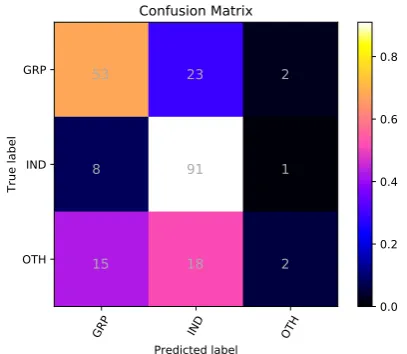
fier performed well on identifying the IND class, was effective for the GRP class, but often failed to distinguish the OTH class from the other two classes. This clearly shows that the sparsity of training data for the minority class OTH affects the performance of our classifier negatively.
The performance of the classifier with differ-ent features is shown in Table5. Since there are only 31 instances in the trial set and it is rather im-balanced, we can see that the highest accuracy is reached by classifying all examples as IND, i.e., the all IND baseline. Even though none of the classifiers outperformed the baseline in terms of accuracy, all the classifiers achieved significantly higher macro F1scores, which shows that they are
better at identifying the other two classes. After adding linguistic and emoji features, the charac-tern-gram model showed a slight improvement in macro F1 score and achieved the highest accuracy
along with the simple character n-gram model. But both macro F1and accuracy dropped when
en-tity information was added.
Table 6 presents examples of misclassified tweets in the trial set. In example 17, two per-sons are mentioned, “Obama” and “Jim’, and both of them are insulted, however not as a group but individually. The classifier labeled this exam-ple as IND. In examexam-ple 22, the classifier is mis-guided by the word ’Church’ and wrongly classi-fies it as OTH. Example 31 is similar to example 17. Here, there are two potential targets, ’Nobel Emmy award winning idiot’ and ’Iran’ that could trigger the group sense, which significantly affects the classifier’s judgment.
The errors analysis indicates that the classifier has the ability to distinguish individual and group targets, but it fails to capture the relation between different entities and sometimes misidentifies the target category of offensive language.
GRP IND OTH
Predicted label GRP
IND
OTH
True label
53 23 2
8 91 1
15 18 2
Confusion Matrix
0.0 0.2 0.4 0.6 0.8
Figure 2: Confusion matrix for the SVM classifier for subtask C.
5 Conclusion
In this study, we report our systems for OffensEval subtasks A and C. In subtask A, we trained a neu-ral network based classifier by fine-tuning the pre-trained BERTbasemodel to detect offensive tweets. In subtask C, we used a linear SVM with charac-ter n-gram features to identify the target of hate speech.
The evaluation results indicate that our sys-tem is capable of detecting offensive language ro-bustly, and it has a good chance of identifying the target. However, there is room for improvement. In the future, in order to capture subtle meaning and overcome the data sparsity, we plan to take syntactic and semantic features into consideration and investigate the combination of selected sur-face features and pre-trained word embeddings.
References
Proceed-ings of the First Workshop on Trolling, Aggression and Cyberbullying (TRAC-2018), pages 140–149.
Pinkesh Badjatiya, Shashank Gupta, Manish Gupta, and Vasudeva Varma. 2017. Deep learning for hate speech detection in tweets. In Proceedings of the 26th International Conference on World Wide Web Companion, pages 759–760, Perth, Australia.
Pete Burnap and Matthew L Williams. 2015. Cyber hate speech on twitter: An application of machine classification and statistical modeling for policy and decision making. Policy & Internet, 7(2):223–242.
Thomas Davidson, Dana Warmsley, Michael Macy, and Ingmar Weber. 2017. Automated hate speech detection and the problem of offensive language. In
Proceedings of ICWSM.
Jacob Devlin, Ming-Wei Chang, Kenton Lee, and Kristina Toutanova. 2018. BERT: Pre-training of deep bidirectional transformers for language under-standing. arXiv preprint arXiv:1810.04805.
Karthik Dinakar, Roi Reichart, and Henry Lieberman. 2011. Modeling the detection of textual cyberbully-ing. InThe Social Mobile Web, pages 11–17.
Nemanja Djuric, Jing Zhou, Robin Morris, Mihajlo Gr-bovic, Vladan Radosavljevic, and Narayan Bhamidi-pati. 2015. Hate speech detection with comment embeddings. In Proceedings of the 24th Interna-tional Conference on World Wide Web Companion, pages 29–30.
Antigoni Maria Founta, Constantinos Djouvas, De-spoina Chatzakou, Ilias Leontiadis, Jeremy Black-burn, Gianluca Stringhini, Athena Vakali, Michael Sirivianos, and Nicolas Kourtellis. 2018. Large scale crowdsourcing and characterization of twit-ter abusive behavior. InTwelfth International AAAI Conference on Web and Social Media.
Efthymios Kouloumpis, Theresa Wilson, and Johanna Moore. 2011. Twitter sentiment analysis: The good the bad and the OMG! InFifth International AAAI Conference on Weblogs and Social Media.
Sandra K¨ubler, Can Liu, and Zeeshan Ali Sayyed. 2018. To use or not to use: Feature selection for sentiment analysis of highly imbalanced data. Nat-ural Language Engineering, 24(1):3–37.
Ritesh Kumar, Atul Kr Ojha, Shervin Malmasi, and Marcos Zampieri. 2018. Benchmarking aggression identification in social media. InProceedings of the First Workshop on Trolling, Aggression and Cyber-bullying (TRAC-2018), pages 1–11.
Irene Kwok and Yuzhou Wang. 2013. Locate the hate: Detecting tweets against blacks. InTwenty-Seventh AAAI Conference on Artificial Intelligence.
Shervin Malmasi and Marcos Zampieri. 2018. Chal-lenges in discriminating profanity from hate speech.
Journal of Experimental & Theoretical Artificial In-telligence, 30:1–16.
Tomas Mikolov, Ilya Sutskever, Kai Chen, Greg S Cor-rado, and Jeff Dean. 2013. Distributed representa-tions of words and phrases and their compositional-ity. InAdvances in Neural Information Processing Systems, pages 3111–3119.
Chikashi Nobata, Joel Tetreault, Achint Thomas, Yashar Mehdad, and Yi Chang. 2016. Abusive lan-guage detection in online user content. In Proceed-ings of the 25th International Conference on World Wide Web, pages 145–153.
Petra Kralj Novak, Jasmina Smailovi´c, Borut Sluban, and Igor Mozetiˇc. 2015. Sentiment of emojis. PloS One, 10(12).
Adam Paszke, Sam Gross, Soumith Chintala, Gre-gory Chanan, Edward Yang, Zachary DeVito, Zem-ing Lin, Alban Desmaison, Luca Antiga, and Adam Lerer. 2017. Automatic differentiation in PyTorch. InNIPS-W.
Fabian Pedregosa, Ga¨el Varoquaux, Alexandre Gram-fort, Vincent Michel, Bertrand Thirion, Olivier Grisel, Mathieu Blondel, Peter Prettenhofer, Ron Weiss, Vincent Dubourg, et al. 2011. Scikit-learn: Machine learning in Python. Journal of Machine Learning Research, 12:2825–2830.
Jeffrey Pennington, Richard Socher, and Christopher Manning. 2014. GloVe: Global vectors for word representation. In Proceedings of the 2014 Con-ference on Empirical Methods in Natural Language Processing (EMNLP), pages 1532–1543.
Matthew Peters, Mark Neumann, Mohit Iyyer, Matt Gardner, Christopher Clark, Kenton Lee, and Luke Zettlemoyer. 2018. Deep contextualized word repre-sentations. InProceedings of the 2018 Conference of the North American Chapter of the Association for Computational Linguistics: Human Language Technologies, pages 2227–2237.
Alec Radford, Karthik Narasimhan, Tim Salimans, and Ilya Sutskever. 2018. Improving language understanding by generative pre-training. URL:
https://s3-us-west-2.amazonaws. com/openai-assets/research-covers/ languageunsupervised/
languageunderstandingpaper.pdf.
Anna Schmidt and Michael Wiegand. 2017. A survey on hate speech detection using natural language pro-cessing. In Proceedings of the Fifth International Workshop on Natural Language Processing for So-cial Media, pages 1–10, Valencia, Spain.
Mohammed Shiha and Serkan Ayvaz. 2017. The ef-fects of emoji in sentiment analysis. International Journal of Computer and Electrical Engineering (IJCEE.), 9(1):360–369.
Johnson, Xiaobing Liu, Lukasz Kaiser, Stephan Gouws, Yoshikiyo Kato, Taku Kudo, Hideto Kazawa, Keith Stevens, George Kurian, Nishant Patil, Wei Wang, Cliff Young, Jason Smith, Jason Riesa, Alex Rudnick, Oriol Vinyals, Greg Corrado, Macduff Hughes, and Jeffrey Dean. 2016. Google’s neural machine translation system: Bridging the gap between human and machine translation. arXiv preprint arXiv:1609.08144.
Marcos Zampieri, Shervin Malmasi, Preslav Nakov, Sara Rosenthal, Noura Farra, and Ritesh Kumar. 2019a. Predicting the Type and Target of Offensive Posts in Social Media. InProceedings of NAACL.