Proceedings of the 13th International Workshop on Semantic Evaluation (SemEval-2019), pages 75–86 75
SemEval-2019 Task 6:
Identifying and Categorizing Offensive Language in Social Media
(OffensEval)
Marcos Zampieri,1Shervin Malmasi,2Preslav Nakov,3 Sara Rosenthal,4Noura Farra,5 Ritesh Kumar6 1University of Wolverhampton, UK,2Amazon Research, USA
3Qatar Computing Research Institute, HBKU, Qatar
4IBM Research, USA,5Columbia University, USA,6Bhim Rao Ambedkar University, India
Abstract
We present the results and the main findings of SemEval-2019 Task 6 on Identifying and Cate-gorizing Offensive Language in Social Media (OffensEval). The task was based on a new dataset, the Offensive Language Identification Dataset (OLID), which contains over 14,000 English tweets. It featured three sub-tasks. In sub-task A, the goal was to discriminate be-tween offensive and non-offensive posts. In sub-task B, the focus was on the type of of-fensive content in the post. Finally, in sub-task C, systems had to detect the target of the offen-sive posts. OffensEval attracted a large num-ber of participants and it was one of the most popular tasks in SemEval-2019. In total, about 800 teams signed up to participate in the task, and 115 of them submitted results, which we present and analyze in this report.
1 Introduction
Recent years have seen the proliferation of offen-sive language in social media platforms such as Facebook and Twitter. As manual filtering is very time consuming, and as it can cause post-traumatic stress disorder-like symptoms to human annota-tors, there have been many research efforts aim-ing at automataim-ing the process. The task is usually modeled as a supervised classification problem, where systems are trained on posts annotated with respect to the presence of some form of abusive or offensive content. Examples of offensive con-tent studied in previous work include hate speech (Davidson et al., 2017; Malmasi and Zampieri,
2017,2018), cyberbulling (Dinakar et al., 2011), and aggression (Kumar et al., 2018). Moreover, given the multitude of terms and definitions used in the literature, some recent studies have investi-gated the common aspects of different abusive lan-guage detection sub-tasks (Waseem et al., 2017;
Wiegand et al.,2018).
Interestingly, none of this previous work has stud-ied both the type and the target of the offensive language, which is our approach here. Our task, OffensEval1, uses the Offensive Language Identi-fication Dataset (OLID)2 (Zampieri et al., 2019), which we created specifically for this task. OLID is annotated following a hierarchical three-level annotation schema that takes both the target and the type of offensive content into account. Thus, it can relate to phenomena captured by previous datasets such as the one byDavidson et al.(2017). Hate speech, for example, is commonly under-stood as an insult targeted at agroup, whereas cy-berbulling is typically targeted at anindividual.
We defined three sub-tasks, corresponding to the three levels in our annotation schema:3
Sub-task A: Offensive language identification (104 participating teams)
Sub-task B: Automatic categorization of offense types (71 participating teams)
Sub-task C: Offense target identification (66 par-ticipating teams)
The remainder of this paper is organized as follows: Section 2 discusses prior work, includ-ing shared tasks related to OffensEval. Section3
presents the shared task description and the sub-tasks included in OffensEval. Section4 includes a brief description of OLID based on (Zampieri et al.,2019). Section5discusses the participating systems and their results in the shared task. Fi-nally, Section6concludes and suggests directions for future work.
1
http://competitions.codalab.org/ competitions/20011
2
http://scholar.harvard.edu/malmasi/ olid
3A total of 800 teams signed up to participate in the task,
2 Related Work
Different abusive and offense language identifica-tion problems have been explored in the literature ranging from aggression to cyber bullying, hate speech, toxic comments, and offensive language. Below we discuss each of them briefly.
Aggression identification: The TRAC shared task on Aggression Identification (Kumar et al.,
2018) provided participants with a dataset contain-ing 15,000 annotated Facebook posts and com-ments in English and Hindi for training and val-idation. For testing, two different sets, one from Facebook and one from Twitter, were used. The goal was to discriminate between three classes: non-aggressive, covertly aggressive, and overtly aggressive. The best-performing systems in this competition used deep learning approaches based on convolutional neural networks (CNN), recur-rent neural networks, and LSTM (Aroyehun and Gelbukh,2018;Majumder et al.,2018).
Bullying detection:There have been several stud-ies on cyber bullying detection. For example,Xu et al. (2012) used sentiment analysis and topic models to identify relevant topics, and Dadvar et al.(2013) used user-related features such as the frequency of profanity in previous messages.
Hate speech identification:This is the most stud-ied abusive language detection task (Kwok and Wang, 2013;Burnap and Williams, 2015; Djuric et al.,2015). More recently,Davidson et al.(2017) presented the hate speech detection dataset with over 24,000 English tweets labeled as non offen-sive, hate speech, and profanity.
Offensive language: The GermEval4 (Wiegand et al.,2018) shared task focused on offensive lan-guage identification in German tweets. A dataset of over 8,500 annotated tweets was provided for a course-grained binary classification task in which systems were trained to discriminate between of-fensive and non-ofof-fensive tweets. There was also a second task where the offensive class was sub-divided into profanity, insult, and abuse. This is similar to our work, but there are three key differ-ences: (i) we have a third level in our hierarchy, (ii) we use different labels in the second level, and (iii) we focus on English.
4http://projects.fzai.h-da.de/iggsa/
Toxic comments:The Toxic Comment Classifica-tion Challenge5was an open competition at Kag-gle, which provided participants with comments from Wikipedia organized in six classes: toxic, severe toxic, obscene, threat, insult, identity hate. The dataset was also used outside of the compe-tition (Georgakopoulos et al.,2018), including as additional training material for the aforementioned TRAC shared (Fortuna et al.,2018).
While each of the above tasks tackles a par-ticular type of abuse or offense, there are many commonalities. For example, an insult targeted at an individual is commonly known as cyberbulling and insults targeted at a group are known as hate speech. The hierarchical annotation model pro-posed in OLID (Zampieri et al.,2019) and used in OffensEval aims to capture this. We hope that the OLID’s dataset would become a useful resource for various offensive language identification tasks.
3 Task Description and Evaluation
The training and testing material for OffensEval is the aforementioned Offensive Language Identi-fication Dataset (OLID) dataset, which was built specifically for this task. OLID was annotated us-ing a hierarchical three-level annotation model in-troduced inZampieri et al.(2019). Four examples of annotated instances from the dataset are pre-sented in Table1. We use the annotation of each of the three layers in OLID for a sub-task in Of-fensEval as described below.
3.1 Sub-task A: Offensive language identification
In this sub-task, the goal is to discriminate be-tween offensive and non-offensive posts. Offen-sive posts include insults, threats, and posts con-taining any form of untargeted profanity. Each in-stance is assigned one of the following two labels.
• Not Offensive (NOT): Posts that do not con-tain offense or profanity;
• Offensive (OFF): We label a post as offensive if it contains any form of non-acceptable lan-guage (profanity) or a targeted offense, which can be veiled or direct. This category in-cludes insults, threats, and posts containing profane language or swear words.
5
Tweet A B C
@USER He is so generous with his offers. NOT — —
IM FREEEEE!!!! WORST EXPERIENCE OF MY FUCKING LIFE OFF UNT —
@USER Fuk this fat cock sucker OFF TIN IND
[image:3.595.67.527.64.140.2]@USER Figures! What is wrong with these idiots? Thank God for @USER OFF TIN GRP
Table 1: Four tweets from the OLID dataset, with their labels for each level of the annotation model.
3.2 Sub-task B: Automatic categorization of offense types
In sub-task B, the goal is to predict the type of offense. Only posts labeled as Offensive (OFF) in sub-task A are included in sub-task B. The two categories in sub-task B are the following:
• Targeted Insult (TIN): Posts containing an in-sult/threat to an individual, group, or others (see sub-task C below);
• Untargeted (UNT): Posts containing non-targeted profanity and swearing. Posts with general profanity are not targeted, but they contain non-acceptable language.
3.3 Sub-task C: Offense target identification
Sub-task C focuses on the target of offenses. Only posts that are either insults or threats (TIN) arwe considered in this third layer of annotation. The three labels in sub-task C are the following:
• Individual (IND): Posts targeting an individ-ual. It can be a a famous person, a named individual or an unnamed participant in the conversation. Insults/threats targeted at indi-viduals are often defined as cyberbullying.
• Group (GRP): The target of these offensive posts is a group of people considered as a unity due to the same ethnicity, gender or sex-ual orientation, political affiliation, religious belief, or other common characteristic. Many of the insults and threats targeted at a group correspond to what is commonly understood as hate speech.
• Other (OTH): The target of these offensive posts does not belong to any of the previous two categories, e.g., an organization, a situa-tion, an event, or an issue.
NOT OFF
Predicted label NOT
OFF
True label
552 68
95 145
Confusion Matrix
0.0 0.1 0.2 0.3 0.4 0.5 0.6 0.7 0.8
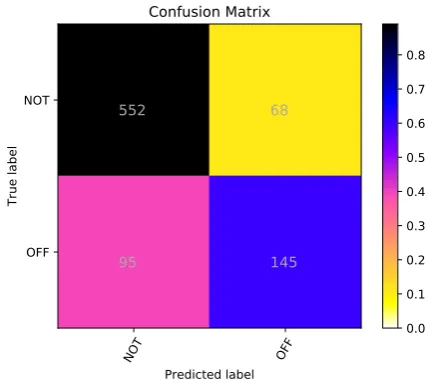
Figure 1: Example of a confusion matrix provided in the results package for team NULI, which is the best-performing team for sub-task A.
3.4 Task Evaluation
Given the strong imbalance between the number of instances in the different classes across the three tasks, we used the macro-averaged F1-score as the official evaluation measure for all three sub-tasks.
At the end of the competition, we provided the participants with packages containing the results for each of their submissions, including tables and confusion matrices, and tables with the ranks list-ing all teams who competed in each sub-task. For example, the confusion matrix for the best team in sub-task A is shown in Figure1.
3.5 Participation
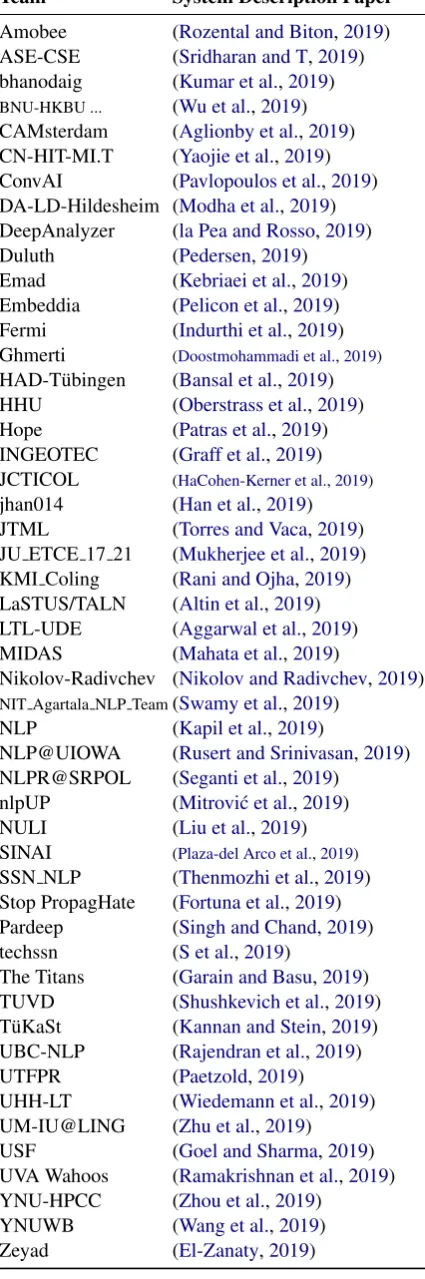
The task attracted nearly 800 teams and 115 of them submitted their results. The teams that sub-mitted papers for the SemEval-2019 proceedings are listed in Table2.6
[image:3.595.308.527.186.377.2]Team System Description Paper
Amobee (Rozental and Biton,2019) ASE-CSE (Sridharan and T,2019) bhanodaig (Kumar et al.,2019) BNU-HKBU ... (Wu et al.,2019) CAMsterdam (Aglionby et al.,2019) CN-HIT-MI.T (Yaojie et al.,2019) ConvAI (Pavlopoulos et al.,2019) DA-LD-Hildesheim (Modha et al.,2019) DeepAnalyzer (la Pea and Rosso,2019) Duluth (Pedersen,2019) Emad (Kebriaei et al.,2019) Embeddia (Pelicon et al.,2019) Fermi (Indurthi et al.,2019) Ghmerti (Doostmohammadi et al.,2019) HAD-T¨ubingen (Bansal et al.,2019) HHU (Oberstrass et al.,2019) Hope (Patras et al.,2019) INGEOTEC (Graff et al.,2019) JCTICOL (HaCohen-Kerner et al.,2019) jhan014 (Han et al.,2019) JTML (Torres and Vaca,2019) JU ETCE 17 21 (Mukherjee et al.,2019) KMI Coling (Rani and Ojha,2019) LaSTUS/TALN (Altin et al.,2019) LTL-UDE (Aggarwal et al.,2019) MIDAS (Mahata et al.,2019)
Nikolov-Radivchev (Nikolov and Radivchev,2019) NIT Agartala NLP Team(Swamy et al.,2019)
NLP (Kapil et al.,2019)
NLP@UIOWA (Rusert and Srinivasan,2019) NLPR@SRPOL (Seganti et al.,2019)
nlpUP (Mitrovi´c et al.,2019) NULI (Liu et al.,2019) SINAI (Plaza-del Arco et al.,2019) SSN NLP (Thenmozhi et al.,2019) Stop PropagHate (Fortuna et al.,2019) Pardeep (Singh and Chand,2019) techssn (S et al.,2019)
The Titans (Garain and Basu,2019) TUVD (Shushkevich et al.,2019) T¨uKaSt (Kannan and Stein,2019) UBC-NLP (Rajendran et al.,2019) UTFPR (Paetzold,2019)
UHH-LT (Wiedemann et al.,2019) UM-IU@LING (Zhu et al.,2019) USF (Goel and Sharma,2019) UVA Wahoos (Ramakrishnan et al.,2019) YNU-HPCC (Zhou et al.,2019)
YNUWB (Wang et al.,2019) Zeyad (El-Zanaty,2019)
Table 2: The teams that participated in OffensEval and submitted system description papers.
4 Data
Below, we briefly describe OLID, the dataset used for our SemEval-2019 task 6. A detailed descrip-tion of the data collecdescrip-tion process and annotadescrip-tion is presented inZampieri et al.(2019).
OLID is a large collection of English tweets an-notated using a hierarchical three-layer annotation model. It contains 14,100 annotated tweets di-vided into a training partition of 13,240 tweets and a testing partition of 860 tweets. Additionally, a small trial dataset of 320 tweets was made avail-able before the start of the competition.
A B C Train Test Total
OFF TIN IND 2,407 100 2,507
OFF TIN OTH 395 35 430
OFF TIN GRP 1,074 78 1,152
OFF UNT — 524 27 551
NOT — — 8,840 620 9,460
[image:4.595.76.289.70.711.2]All 13,240 860 14,100
Table 3: Distribution of label combinations in OLID.
The distribution of the labels in OLID is shown in Table 3. We annotated the dataset using the crowdsourcing platform Figure Eight.7 We en-sured the quality of the annotation by only hiring experienced annotators on the platform and by us-ing test questions to discard annotators who did not achieve a certain threshold. All the tweets were annotated by two people. In case of dis-agreement, a third annotation was requested, and ultimately we used a majority vote. Examples of tweets from the dataset with their annotation labels are shown in Table1.
5 Results
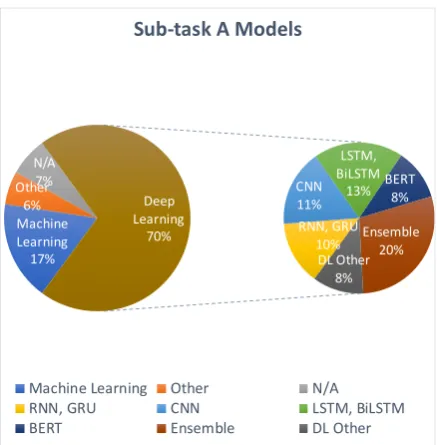
The models used in the task submissions ranged from traditional machine learning, e.g., SVM and logistic regression, to deep learning, e.g., CNN, RNN, BiLSTM, including attention mechanism, to state-of-the-art deep learning models such as ELMo (Peters et al., 2018) and BERT (Devlin et al.). Figure2 shows a pie chart indicating the breakdown by model type for all participating sys-tems in sub-task A. Deep learning was clearly the most popular approach, as were also ensem-ble models. Similar trends were observed for sub-tasks B and C.
Machine Learning 17% Other
6% N/A 7%
RNN, GRU 10% CNN 11%
LSTM, BiLSTM
13% BERT8%
Ensemble 20% DL Other
8% Deep
Learning 70%
Sub-task A Models
Machine Learning Other N/A RNN, GRU CNN LSTM, BiLSTM BERT Ensemble DL Other
Figure 2: Pie chart showing the models used in sub-task A. ‘N/A’ indicates that the system did not have a description.
Some teams used additional training data, explor-ing external datasets such as Hate Speech Tweets (Davidson et al., 2017), toxicity labels (Thain et al., 2017), and TRAC (Kumar et al., 2018). Moreover, seven teams indicated that they used sentiment lexicons or a sentiment analysis model for prediction, and two teams reported the use of offensive word lists. Furthermore, several teams used pre-trained word embeddings from FastText (Bojanowski et al., 2016), from GloVe, includ-ing Twitter embeddinclud-ings from GloVe (Pennington et al., 2014) and from word2vec (Mikolov et al.,
2013;Godin et al.,2015).
In addition, several teams used techniques for pre-processing the tweets such as normalizing the tokens, hashtags, URLs, retweets (RT), dates, elongated words (e.g., “Hiiiii” to “Hi”, partially hidden words (“c00l” to “cool”). Other techniques include converting emojis to text, removing un-common words, and using Twitter-specific tok-enizers, such as the Ark Tokenizer8(Gimpel et al.,
2011) and the NLTK TweetTokenizer,9as well as standard tokenizers (Stanford Core NLP (Manning et al.,2014), and the one from Keras.10 Approxi-mately a third of the teams indicated that they used one or more of these techniques.
8
http://www.cs.cmu.edu/˜ark/TweetNLP
9
http://www.nltk.org/api/nltk. tokenize.html
10http://keras.io/preprocessing/text/
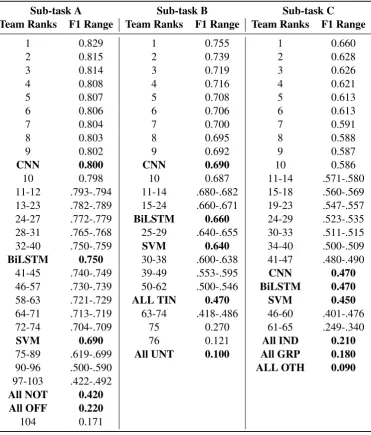
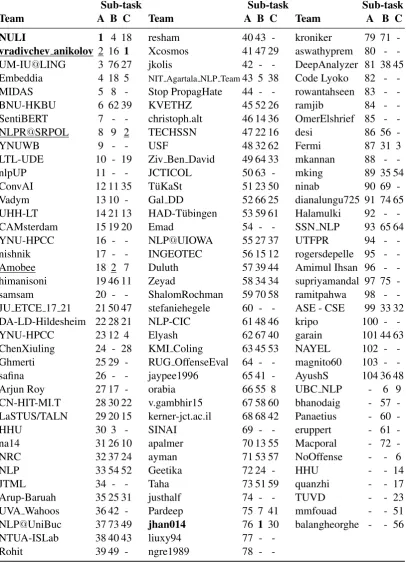
The results for each of the sub-tasks are shown in Table4. Due to the large number of submissions, we only show the F1-score for the top-10 teams, followed by result ranges for the rest of the teams. We further include the models and the baselines from (Zampieri et al.,2019): CNN, BiLSTM, and SVM. The baselines are choosing all predictions to be of the same class, e.g., all offensive, and all not offensive for sub-task A. Table 5 shows all the teams that participated in the tasks along with their ranks in each task. These two tables can be used together to find the score/range for a particular team.
Below, we describe the overall results for each sub-task, and we describe the top-3 systems.
5.1 Sub-task A
Sub-task A was the most popular sub-task with 104 participating teams. Among the top-10 teams, seven used BERT (Devlin et al.) with varia-tions in the parameters and in the pre-processing steps. The top-performing team, NULI, used BERT-base-uncased with default-parameters, but with a max sentence length of 64 and trained for 2 epochs. The 82.9% F1 score of NULI is 1.4 points better than the next system, but the differ-ence between the next 5 systems, ranked 2-6, is less than one point: 81.5%-80.6%. The top non-BERT model,MIDAS, is ranked sixth. They used an ensemble of CNN and BLSTM+BGRU, to-gether with Twitter word2vec embeddings (Godin et al.,2015) and token/hashtag normalization.
5.2 Sub-task B
A total of 76 teams participated in sub-task B, and 71 of them had also participated in sub-task A. In contrast to sub-task A, where BERT clearly dominated, here five of the top-10 teams used an ensemble model. Interestingly, the best team,
[image:5.595.72.291.59.282.2]Sub-task A Sub-task B Sub-task C Team Ranks F1 Range Team Ranks F1 Range Team Ranks F1 Range
1 0.829 1 0.755 1 0.660
2 0.815 2 0.739 2 0.628
3 0.814 3 0.719 3 0.626
4 0.808 4 0.716 4 0.621
5 0.807 5 0.708 5 0.613
6 0.806 6 0.706 6 0.613
7 0.804 7 0.700 7 0.591
8 0.803 8 0.695 8 0.588
9 0.802 9 0.692 9 0.587
CNN 0.800 CNN 0.690 10 0.586
10 0.798 10 0.687 11-14 .571-.580
11-12 .793-.794 11-14 .680-.682 15-18 .560-.569
13-23 .782-.789 15-24 .660-.671 19-23 .547-.557
24-27 .772-.779 BiLSTM 0.660 24-29 .523-.535
28-31 .765-.768 25-29 .640-.655 30-33 .511-.515
32-40 .750-.759 SVM 0.640 34-40 .500-.509
BiLSTM 0.750 30-38 .600-.638 41-47 .480-.490
41-45 .740-.749 39-49 .553-.595 CNN 0.470
46-57 .730-.739 50-62 .500-.546 BiLSTM 0.470
58-63 .721-.729 ALL TIN 0.470 SVM 0.450
64-71 .713-.719 63-74 .418-.486 46-60 .401-.476
72-74 .704-.709 75 0.270 61-65 .249-.340
SVM 0.690 76 0.121 All IND 0.210
75-89 .619-.699 All UNT 0.100 All GRP 0.180
90-96 .500-.590 ALL OTH 0.090
97-103 .422-.492
All NOT 0.420
All OFF 0.220
[image:6.595.116.488.62.498.2]104 0.171
Table 4: F1-Macro for the top-10 teams followed by the rest of the teams grouped in ranges for all three sub-tasks. Refer to Table5to see the team names associated with each rank. We also include the models (CNN, BiLSTM,
and SVM) and the baselines (All NOT and All OFF) from (Zampieri et al.,2019), shown in bold.
5.3 Sub-task C
A total of 66 teams participated in sub-task C, and most of them also participated in sub-tasks A and B. As in sub-task B, ensembles were quite successful and were used by five of the top-10 teams. However, as in sub-task A, the best team, vradivchev anikolov, used BERT after try-ing many other deep learntry-ing methods. They also used pre-processing and pre-trained word embed-dings based on GloVe. The second best team,
NLPR@SRPOL, used an ensemble of deep learn-ing models such as OpenAI Finetune, LSTM, Transformer, and non-neural machine learning models such as SVM and Random Forest.
5.4 Description of the Top Teams
The top-3 teams by average rank for all three sub-tasks wereNLPR@SRPOL,NULI, and vradi-vchev anikolov. Below, we provide a brief de-scription of their approaches:
Sub-task Sub-task Sub-task
Team A B C Team A B C Team A B C
NULI 1 4 18 resham 40 43 - kroniker 79 71
-vradivchev anikolov 2 16 1 Xcosmos 41 47 29 aswathyprem 80
-UM-IU@LING 3 76 27 jkolis 42 - - DeepAnalyzer 81 38 45
Embeddia 4 18 5 NIT Agartala NLP Team43 5 38 Code Lyoko 82
-MIDAS 5 8 - Stop PropagHate 44 - - rowantahseen 83
-BNU-HKBU 6 62 39 KVETHZ 45 52 26 ramjib 84
-SentiBERT 7 - - christoph.alt 46 14 36 OmerElshrief 85
-NLPR@SRPOL 8 9 2 TECHSSN 47 22 16 desi 86 56
-YNUWB 9 - - USF 48 32 62 Fermi 87 31 3
LTL-UDE 10 - 19 Ziv Ben David 49 64 33 mkannan 88
-nlpUP 11 - - JCTICOL 50 63 - mking 89 35 54
ConvAI 12 11 35 T¨uKaSt 51 23 50 ninab 90 69
-Vadym 13 10 - Gal DD 52 66 25 dianalungu725 91 74 65
UHH-LT 14 21 13 HAD-T¨ubingen 53 59 61 Halamulki 92
-CAMsterdam 15 19 20 Emad 54 - - SSN NLP 93 65 64
YNU-HPCC 16 - - NLP@UIOWA 55 27 37 UTFPR 94
-nishnik 17 - - INGEOTEC 56 15 12 rogersdepelle 95
-Amobee 18 2 7 Duluth 57 39 44 Amimul Ihsan 96
-himanisoni 19 46 11 Zeyad 58 34 34 supriyamandal 97 75
-samsam 20 - - ShalomRochman 59 70 58 ramitpahwa 98
-JU ETCE 17 21 21 50 47 stefaniehegele 60 - - ASE - CSE 99 33 32
DA-LD-Hildesheim 22 28 21 NLP-CIC 61 48 46 kripo 100
-YNU-HPCC 23 12 4 Elyash 62 67 40 garain 101 44 63
ChenXiuling 24 - 28 KMI Coling 63 45 53 NAYEL 102
-Ghmerti 25 29 - RUG OffenseEval 64 - - magnito60 103
-safina 26 - - jaypee1996 65 41 - AyushS 104 36 48
Arjun Roy 27 17 - orabia 66 55 8 UBC NLP - 6 9
CN-HIT-MI.T 28 30 22 v.gambhir15 67 58 60 bhanodaig 57
-LaSTUS/TALN 29 20 15 kerner-jct.ac.il 68 68 42 Panaetius 60
-HHU 30 3 - SINAI 69 - - eruppert 61
-na14 31 26 10 apalmer 70 13 55 Macporal 72
-NRC 32 37 24 ayman 71 53 57 NoOffense - - 6
NLP 33 54 52 Geetika 72 24 - HHU - - 14
JTML 34 - - Taha 73 51 59 quanzhi - - 17
Arup-Baruah 35 25 31 justhalf 74 - - TUVD - - 23
UVA Wahoos 36 42 - Pardeep 75 7 41 mmfouad - - 51
NLP@UniBuc 37 73 49 jhan014 76 1 30 balangheorghe - - 56
NTUA-ISLab 38 40 43 liuxy94 77
-Rohit 39 49 - ngre1989 78
-Table 5: All the teams that participated in SemEval-2019 Task 6 with their ranks for each sub-task. The symbol ‘-’ indicates that the team did not participate in some of the subtasks. Please, refer to Table4to see the scores based on a team’s rank. The top team for each task is inbold, and the second-place team is underlined. Note:ASE - CSE
[image:7.595.97.504.122.686.2]NULI was ranked 1st, 4th, and 18th on sub-tasks A, B, and C, respectively. They experimented with different models including linear mod-els, LSTM, and pre-trained BERT with fine-tuning on the OLID dataset. Their final submissions for all three subtasks only used BERT, which performed best during devel-opment. They also used a number of pre-processing techniques such as hashtag seg-mentation and emoji substitution.
vradivchev anikolov was ranked 2nd, 16th, and 1st on sub-tasks A, B, and C, respectively. They trained a variety of models and com-bined them in ensembles, but their best sub-missions for sub-tasks A and C used BERT only, as the other models overfitted. For sub-task B, BERT did not perform as well, and they used soft voting classifiers. In all cases, they used pre-trained GloVe vectors and they also applied techniques to address the class imbalance in the training data.
6 Conclusion
We have described SemEval-2019 Task 6 on Iden-tifying and Categorizing Offensive Language in Social Media (OffensEval). The task used OLID (Zampieri et al.,2019), a dataset of English tweets annotated for offensive language use, following a three-level hierarchical schema that considers (i) whether a message is offensive or not (for sub-task A), (ii) what is the type of the offensive mes-sage (for sub-task B), and (iii) who is the target of the offensive message (for sub-task C).
Overall, about 800 teams signed up for Of-fensEval, and 115 of them actually participated in at least one sub-task. The evaluation results have shown that the best systems used ensembles and state-of-the-art deep learning models such as BERT. Overall, both deep learning and traditional machine learning classifiers were widely used. More details about the indvididual systems can be found in their respective system description pa-pers, which are published in the SemEval-2019 proceedings. A list with references to these pub-lications can be found in Table2; note, however, that only 50 of the 115 participating teams submit-ted a system description paper.
As is traditional for SemEval, we have made OLID publicly available to the research commu-nity beyond the SemEval competition, hoping to facilitate future research on this important topic.
In fact, the OLID dataset and the SemEval-2019 Task 6 competition setup have already been used in teaching curricula in universities in UK and USA. For example, student competitions based on OffensEval using OLID have been organized as part of Natural Language Processing and Text An-alytics courses in two universities in UK: Impe-rial College London and the University of Leeds. System papers describing some of the students’ work are publicly accessible11and have also been made available on arXiv.org (Cambray and Pod-sadowski, 2019;Frisiani et al.,2019;Ong,2019;
Sapora et al., 2019; Puiu and Brabete, 2019;
Uglow et al., 2019). Similarly, a number of stu-dents in Linguistics and Computer Science at the University of Arizona in USA have been using OLID in their coursework.
In future work, we plan to increase the size of the OLID dataset, while addressing issues such as class imbalance and the small size for the test partition, particularly for sub-tasks B and C. We would also like to expand the dataset and the task to other languages.
Acknowledgments
We would like to thank the SemEval-2019 orga-nizers for hosting the OffensEval task and for re-plying promptly to all our inquires. We further thank the SemEval-2019 anonymous reviewers for the helpful suggestions and for the constructive feedback, which have helped us improve the text of this report.
We especially thank the SemEval-2019 Task 6 participants for their interest in the shared task, for their participation, and for their timely feedback, which have helped us make the shared task a suc-cess.
Finally, we would like to thank Lucia Specia from Imperial College London and Eric Atwell from the University of Leeds for hosting the Of-fensEval competition in their courses. We further thank the students who participated in these stu-dent competitions and especially those who wrote papers describing their systems.
The research presented in this paper was par-tially supported by an ERAS fellowship, which was awarded to Marcos Zampieri by the Univer-sity of Wolverhampton, UK.
11http://scholar.harvard.edu/malmasi/
References
Piush Aggarwal, Tobias Horsmann, Michael Wojatzki, and Torsten Zesch. 2019. LTL-UDE at SemEval-2019 Task 6: BERT and two-vote classification for categorizing offensiveness. InProceedings of The 13th International Workshop on Semantic Evalua-tion (SemEval).
Guy Aglionby, Chris Davis, Pushkar Mishra, Andrew Caines, Helen Yannakoudakis, Marek Rei, Ekaterina Shutova, and Paula Buttery. 2019. CAMsterdam at SemEval-2019 Task 6: Neural and graph-based feature extraction for the identification of offensive tweets. In Proceedings of The 13th International Workshop on Semantic Evaluation (SemEval).
Lutfiye Seda Mut Altin, Alex Bravo Serrano, and Ho-racio Saggion. 2019. LaSTUS/TALN at SemEval-2019 Task 6: Identification and categorization of offensive language in social media with attention-based Bi-LSTM model. In Proceedings of The 13th International Workshop on Semantic Evalua-tion (SemEval).
Flor Miriam Plaza-del Arco, Dolores Molina-Gonz´alez, Teresa Mart´ın-Valdivia, and Alfonso Ure˜na-L´opez. 2019. SINAI at SemEval-2019 Task 6: Incorporating lexicon knowledge into SVM learning to identify and categorize offensive lan-guage in social media. InProceedings of The 13th International Workshop on Semantic Evaluation (SemEval).
Segun Taofeek Aroyehun and Alexander Gelbukh. 2018. Aggression detection in social media: Us-ing deep neural networks, data augmentation, and pseudo labeling. InProceedings of the First Work-shop on Trolling, Aggression and Cyberbullying (TRAC), pages 90–97.
Himanshu Bansal, Daniel Nagel, and Anita Soloveva. 2019. HAD-T¨ubingen at SemEval-2019 Task 6: Deep learning analysis of offensive language on Twitter: Identification and categorization. In Pro-ceedings of The 13th International Workshop on Se-mantic Evaluation (SemEval).
Piotr Bojanowski, Edouard Grave, Armand Joulin, and Tomas Mikolov. 2016. Enriching word vectors with subword information.CoRR, abs/1607.04606.
Pete Burnap and Matthew L Williams. 2015. Cyber hate speech on Twitter: An application of machine classification and statistical modeling for policy and decision making. Policy & Internet, 7(2):223–242.
Aleix Cambray and Norbert Podsadowski. 2019. Bidi-rectional recurrent models for offensive tweet clas-sification.arXiv preprint arXiv:1903.08808.
Maral Dadvar, Dolf Trieschnigg, Roeland Ordelman, and Franciska de Jong. 2013. Improving cyberbul-lying detection with user context. In Advances in Information Retrieval, pages 693–696. Springer.
Thomas Davidson, Dana Warmsley, Michael Macy, and Ingmar Weber. 2017. Automated hate speech detection and the problem of offensive language. In
Proceedings of the International Conference on We-blogs and Social Media (ICWSM).
Jacob Devlin, Ming-Wei Chang, Kenton Lee, and Kristina Toutanova. BERT: Pre-training of deep bidirectional transformers for language understand-ing. In Proceedings of the Annual Conference of the North American Chapter of the Association for Computational Linguistics: Human Language Tech-nology (NAACL-HLT).
Karthik Dinakar, Roi Reichart, and Henry Lieberman. 2011. Modeling the detection of textual cyberbully-ing. InThe Social Mobile Web, pages 11–17.
Nemanja Djuric, Jing Zhou, Robin Morris, Mihajlo Gr-bovic, Vladan Radosavljevic, and Narayan Bhamidi-pati. 2015. Hate speech detection with comment embeddings. InProceedings of the Web Conference (WWW).
Ehsan Doostmohammadi, Hossein Sameti, and Ali Saf-far. 2019. Ghmerti at SemEval-2019 Task 6: A deep word- and character-based approach to offen-sive language identification. InProceedings of The 13th International Workshop on Semantic Evalua-tion (SemEval).
Zeyad El-Zanaty. 2019. Zeyad at SemEval-2019 Task 6: That’s offensive! An all-out search for an ensem-ble to identify and categorize offense in tweets. In
Proceedings of The 13th International Workshop on Semantic Evaluation (SemEval).
Paula Fortuna, Jos´e Ferreira, Luiz Pires, Guilherme Routar, and S´ergio Nunes. 2018. Merging datasets for aggressive text identification. InProceedings of the First Workshop on Trolling, Aggression and Cy-berbullying (TRAC), pages 128–139.
Paula Fortuna, Juan Soler-Company, and Nunes Srgio. 2019. Stop PropagHate at SemEval-2019 Tasks 5 and 6: Are abusive language classification results reproducible? InProceedings of The 13th Interna-tional Workshop on Semantic Evaluation (SemEval).
Nicol`o Frisiani, Alexis Laignelet, and Batuhan G¨uler. 2019. Combination of multiple deep learning archi-tectures for offensive language detection in tweets.
arXiv preprint arXiv:1903.08734.
Avishek Garain and Arpan Basu. 2019. The Titans at SemEval-2019 Task 6: Hate speech and target de-tection. In Proceedings of The 13th International Workshop on Semantic Evaluation (SemEval).
Kevin Gimpel, Nathan Schneider, Brendan O’Connor, Dipanjan Das, Daniel Mills, Jacob Eisenstein, Michael Heilman, Dani Yogatama, Jeffrey Flanigan, and Noah A. Smith. 2011. Part-of-speech tagging for Twitter: annotation, features, and experiments. InProceedings of the Annual Meeting of the Associ-ation for ComputAssoci-ational Linguistics (ACL).
Fr´ederic Godin, Baptist Vandersmissen, Wesley De Neve, and Rik Van de Walle. 2015. Multime-dia Lab @ACL WNUT NER Shared Task: Named entity recognition for Twitter microposts using dis-tributed word representations. InProceedings of the Workshop on Noisy User-generated Text.
Bharti Goel and Ravi Sharma. 2019. USF at SemEval-2019 Task 6: Offensive language detection using LSTM with word embeddings. In Proceedings of The 13th International Workshop on Semantic Eval-uation (SemEval).
Mario Graff, Sabino Miranda-Jim´enez, Eric S. Tellez, and Daniela Moctezuma. 2019. INGEOTEC at SemEval-2019 Task 5 and Task 6: A genetic pro-gramming approach for text classification. In Pro-ceedings of The 13th International Workshop on Se-mantic Evaluation (SemEval).
Yaakov HaCohen-Kerner, Ziv Ben-David, Gal Didi, Eli Cahn, Shalom Rochman, and Elyashiv Shayovitz. 2019. JCTICOL at SemEval-2019 Task 6: Classi-fying offensive language in social media using deep learning methods, word/character n-gram features, and preprocessing methods. InProceedings of The 13th International Workshop on Semantic Evalua-tion (SemEval).
Jiahui Han, Xinyu Liu, and Shengtan Wu. 2019. jhan014 at SemEval-2019 Task 6: Identifying and categorizing offensive language in social media. In
Proceedings of The 13th International Workshop on Semantic Evaluation (SemEval).
Vijayasaradhi Indurthi, Bakhtiyar Syed, Manish Shri-vastava, Manish Gupta, and Vasudeva Varma. 2019. Fermi at SemEval-2019 Task 6: Identifying and categorizing offensive language in social media us-ing sentence embeddus-ings. In Proceedings of The 13th International Workshop on Semantic Evalua-tion (SemEval).
Madeeswaran Kannan and Lukas Stein. 2019. T¨uKaSt at SemEval-2019 Task 6: something old, something neu(ral): Traditional and neural approaches to of-fensive text classification. In Proceedings of The 13th International Workshop on Semantic Evalua-tion (SemEval).
Prashant Kapil, Asif Ekbal, and Dipankar Das. 2019. NLP at SemEval-2019 Task 6: Detecting offensive language using neural networks. InProceedings of The 13th International Workshop on Semantic Eval-uation (SemEval).
Emad Kebriaei, Samaneh Karimi, Nazanin Sabri, and Azadeh Shakery. 2019. Emad at SemEval-2019 Task 6: Offensive language identification using tra-ditional machine learning and deep learning ap-proaches. InProceedings of The 13th International Workshop on Semantic Evaluation (SemEval).
Ritesh Kumar, Guggilla Bhanodai, Rajendra Pamula, and Chennuru Maheshwar Reddy. 2019. bhanodaig at SemEval-2019 Task 6: Categorizing offensive language in social media. In Proceedings of The 13th International Workshop on Semantic Evalua-tion (SemEval).
Ritesh Kumar, Atul Kr Ojha, Shervin Malmasi, and Marcos Zampieri. 2018. Benchmarking aggression identification in social media. InProceedings of the First Workshop on Trolling, Aggression and Cyber-bullying (TRAC).
Irene Kwok and Yuzhou Wang. 2013. Locate the hate: Detecting tweets against blacks. In Proceedings of the AAAI Conference on Artificial Intelligence (AAAI).
Ping Liu, Wen Li, and Liang Zou. 2019. NULI at SemEval-2019 Task 6: Transfer learning for offen-sive language detection using bidirectional trans-formers. In Proceedings of The 13th International Workshop on Semantic Evaluation (SemEval).
Debanjan Mahata, Haimin Zhang, Karan Uppal, Ya-man Kumar, Rajiv Ratn Shah, Simra Shahid, Laiba Mehnaz, and Sarthak Anand. 2019. MIDAS at SemEval-2019 Task 6: Identifying offensive posts and targeted offense from Twitter. InProceedings of The 13th International Workshop on Semantic Eval-uation (SemEval).
Prasenjit Majumder, Thomas Mandl, et al. 2018. Fil-tering aggression from the multilingual social me-dia feed. In Proceedings of the First Workshop on Trolling, Aggression and Cyberbullying (TRAC), pages 199–207.
Shervin Malmasi and Marcos Zampieri. 2017. Detect-ing Hate Speech in Social Media. InProceedings of the Conference on Recent Advances in Natural Lan-guage Processing (RANLP).
Shervin Malmasi and Marcos Zampieri. 2018. Chal-lenges in Discriminating Profanity from Hate Speech. Journal of Experimental & Theoretical Ar-tificial Intelligence, 30:1 – 16.
Christopher D. Manning, Mihai Surdeanu, John Bauer, Jenny Finkel, Steven J. Bethard, and David Mc-Closky. 2014. The Stanford CoreNLP natural lan-guage processing toolkit. InAssociation for Compu-tational Linguistics (ACL) System Demonstrations.
Jelena Mitrovi´c, Bastian Birkeneder, and Michael Granitzer. 2019. nlpUP at SemEval-2019 Task 6: a deep neural language model for offensive language detection. InProceedings of The 13th International Workshop on Semantic Evaluation (SemEval).
Sandip Modha, Prasenjit Majumder, and Daksh Patel. 2019. DA-LD-Hildesheim at SemEval-2019 Task 6: Tracking offensive content with deep learning model using shallow representation. InProceedings of The 13th International Workshop on Semantic Evalua-tion (SemEval).
Preeti Mukherjee, Mainak Pal, Somnath Banerjee, and Sudip Kumar Naskar. 2019. JU ETCE 17 21 at SemEval-2019 Task 6: Efficient machine learning and neural network approaches for identifying and categorizing offensive language in tweets. In Pro-ceedings of The 13th International Workshop on Se-mantic Evaluation (SemEval).
Alex Nikolov and Victor Radivchev. 2019. Nikolov-Radivchev at SemEval-2019 Task 6: Offensive tweet classification with BERT and ensembles. In Pro-ceedings of The 13th International Workshop on Se-mantic Evaluation (SemEval).
Alexander Oberstrass, Julia Romberg, Anke Stoll, and Stefan Conrad. 2019. HHU at SemEval-2019 Task 6: Context does matter - tackling offensive language identification and categorization with ELMo. In
Proceedings of The 13th International Workshop on Semantic Evaluation (SemEval).
Ryan Ong. 2019. Offensive language analysis us-ing deep learnus-ing architecture. arXiv preprint arXiv:1903.05280.
Gustavo Henrique Paetzold. 2019. UTFPR at SemEval-2019 Task 6: Relying on compositionality to find offense. InProceedings of the 13th Interna-tional Workshop on Semantic Evaluation (SemEval).
Gabriel Florentin Patras, Diana Florina Lungu, Daniela Gifu, and Diana Trandabat. 2019. Hope at SemEval-2019 Task 6: Mining social media language to dis-cover offensive language. In Proceedings of The 13th International Workshop on Semantic Evalua-tion (SemEval).
John Pavlopoulos, Nithum Thain, Lucas Dixon, and Ion Androutsopoulos. 2019. ConvAI at SemEval-2019 Task 6: Offensive language identification and categorization with perspective and BERT. In Pro-ceedings of The 13th International Workshop on Se-mantic Evaluation (SemEval).
Ted Pedersen. 2019. Duluth at SemEval-2019 Task 6: Lexical approaches to identify and categorize offen-sive tweets. In Proceedings of The 13th Interna-tional Workshop on Semantic Evaluation (SemEval).
Andraˇz Pelicon, Matej Martinc, and Petra Kralj Novak. 2019. Embeddia at SemEval-2019 Task 6: Detect-ing hate with neural network and transfer learnDetect-ing approaches. In Proceedings of The 13th Interna-tional Workshop on Semantic Evaluation (SemEval).
Jeffrey Pennington, Richard Socher, and Christo-pher D. Manning. 2014. GloVe: Global vectors for word representation. InEmpirical Methods in Natu-ral Language Processing (EMNLP).
Matthew E. Peters, Mark Neumann, Mohit Iyyer, Matt Gardner, Christopher Clark, Kenton Lee, and Luke Zettlemoyer. 2018. Deep contextualized word rep-resentations. InProceedings of the Annual Confer-ence of the North American Chapter of the Associ-ation for ComputAssoci-ational Linguistics: Human Lan-guage Technology (NAACL-HLT).
Gretel Liz De la Pea and Paolo Rosso. 2019. Deep-Analyzer at SemEval-2019 Task 6: A deep learning-based ensemble method for identifying offensive tweets. In Proceedings of The 13th International Workshop on Semantic Evaluation (SemEval).
Andrei-Bogdan Puiu and Andrei-Octavian Brabete. 2019. Towards NLP with deep learning: Convolu-tional neural networks and recurrent neural networks for offensive language identification in social media.
arXiv preprint arXiv:1903.00665.
Arun Rajendran, Chiyu Zhang, and Muhammad Abdul-Mageed. 2019. UBC-NLP at SemEval-2019 Task 6: Ensemble learning of offensive content with enhanced training data. InProceedings of The 13th International Workshop on Semantic Evalua-tion (SemEval).
Murugesan Ramakrishnan, Wlodek Zadrozny, and Narges Tabari. 2019. UVA Wahoos at SemEval-2019 Task 6: Hate speech identification using en-semble machine learning. In Proceedings of The 13th International Workshop on Semantic Evalua-tion (SemEval).
Priya Rani and Atul Kr. Ojha. 2019. KMIColing at SemEval-2019 Task 6: Exploring n-grams for of-fensive language detection. InProceedings of The 13th International Workshop on Semantic Evalua-tion (SemEval).
Alon Rozental and Dadi Biton. 2019. Amobee at SemEval-2019 Tasks 5 and 6: Multiple choice CNN over contextual embedding. InProceedings of The 13th International Workshop on Semantic Evalua-tion (SemEval).
Jonathan Rusert and Padmini Srinivasan. 2019. NLP@UIOWA at SemEval-2019 Task 6: Classify-ing the classless usClassify-ing multi-windowed CNNs. In
Proceedings of The 13th International Workshop on Semantic Evaluation (SemEval).
Angel Deborah S, Rajalakshmi S, Logesh B, Harshini S, Geetika B, Dyaneswaran S, S Milton Rajendram, and Mirnalinee T T. 2019. TECHSSN at SemEval-2019 Task 6: Identifying and categorizing offensive language in tweets using deep neural networks. In
Silvia Sapora, Bogdan Lazarescu, and Christo Lolov. 2019. Absit invidia verbo: Comparing deep learn-ing methods for offensive language. arXiv preprint arXiv:1903.05929.
Alessandro Seganti, Helena Sobol, Iryna Orlova, Hannam Kim, Jakub Staniszewski, Tymo-teusz Krumholc, and Krystian Koziel. 2019. NLPR@SRPOL at SemEval-2019 Task 6 and Task 5: Linguistically enhanced deep learning offensive sentence classifier. In Proceedings of The 13th International Workshop on Semantic Evaluation (SemEval).
Elena Shushkevich, John Cardiff, and Paolo Rosso. 2019. TUVD team at SemEval-2019 Task 6: Of-fense target identification. In Proceedings of The 13th International Workshop on Semantic Evalua-tion (SemEval).
Pardeep Singh and Satish Chand. 2019. Pardeep at SemEval-2019 Task 6: Identifying and categorizing offensive language in social media using deep learn-ing. InProceedings of The 13th International Work-shop on Semantic Evaluation (SemEval).
Murali Sridharan and Swapna T. 2019. Amrita School of Engineering - CSE at SemEval-2019 Task 6: Manipulating attention with temporal convolutional neural network for offense identification and classi-fication. In Proceedings of The 13th International Workshop on Semantic Evaluation (SemEval).
Steve Durairaj Swamy, Anupam Jamatia, Bj¨orn Gamb¨ack, and Amitava Das. 2019. NIT Agartala NLP Team at SemEval-2019 Task 6: An ensemble approach to identifying and catego-rizing offensive language in Twitter social media corpora. In Proceedings of the 13th International Workshop on Semantic Evaluation (SemEval).
Nithum Thain, Lucas Dixon, and Ellery Wulczyn. 2017.Wikipedia Talk Labels: Toxicity.
D Thenmozhi, Senthil Kumar B, Srinethe Sharavanan, and Aravindan Chandrabose. 2019. SSN NLP at SemEval-2019 Task 6: Offensive language identi-fication in social media using machine learning and deep learning approaches. In Proceedings of The 13th International Workshop on Semantic Evalua-tion (SemEval).
Johnny Torres and Carmen Vaca. 2019. JTML at SemEval-2019 Task 6: Offensive tweets identifica-tion using convoluidentifica-tional neural networks. In Pro-ceedings of The 13th International Workshop on Se-mantic Evaluation (SemEval).
Harrison Uglow, Martin Zlocha, and Szymon Zmys-lony. 2019. An exploration of state-of-the-art meth-ods for offensive language detection. arXiv preprint arXiv:1903.07445.
Bin Wang, Xiaobing Zhou, and Xuejie Zhang. 2019. YNUWB at SemEval-2019 Task 6: K-max pooling cnn with average meta-embedding for identifying
offensive language. InProceedings of The 13th In-ternational Workshop on Semantic Evaluation (Se-mEval).
Zeerak Waseem, Thomas Davidson, Dana Warmsley, and Ingmar Weber. 2017. Understanding abuse: A typology of abusive language detection subtasks.
arXiv preprint arXiv:1705.09899.
Gregor Wiedemann, Eugen Ruppert, and Chris Bie-mann. 2019. UHH-LT at SemEval-2019 Task 6: Su-pervised vs. unsuSu-pervised transfer learning for of-fensive language detection. InProceedings of The 13th International Workshop on Semantic Evalua-tion (SemEval).
Michael Wiegand, Melanie Siegel, and Josef Ruppen-hofer. 2018. Overview of the GermEval 2018 shared task on the identification of offensive language. In
Proceedings of the GermEval 2018 Workshop (Ger-mEval).
Zhenghao Wu, Hao Zheng, Jianming Wang, Weifeng Su, and Jefferson Fong. 2019. BNU-HKBU UIC NLP Team 2 at SemEval-2019 Task 6: Detecting offensive language using BERT model. In Proceed-ings of The 13th International Workshop on Seman-tic Evaluation (SemEval).
Jun-Ming Xu, Kwang-Sung Jun, Xiaojin Zhu, and Amy Bellmore. 2012. Learning from bullying traces in social media. InProceedings of the Annual Con-ference of the North American Chapter of the Asso-ciation for Computational Linguistics: Human Lan-guage Technology (NAACL-HLT).
Zhang Yaojie, Xu Bing, and Zhao Tiejun. 2019. CN-HIT-MI.T at SemEval-2019 Task6: Offensive lan-guage identification based on BiLSTM with double attention. InProceedings of The 13th International Workshop on Semantic Evaluation (SemEval).
Marcos Zampieri, Shervin Malmasi, Preslav Nakov, Sara Rosenthal, Noura Farra, and Ritesh Kumar. 2019. Predicting the type and target of offensive posts in social media. InProceedings of the Annual Conference of the North American Chapter of the Association for Computational Linguistics: Human Language Technology (NAACL-HLT).
Chengjin Zhou, Jin Wang, and Xuejie Zhang. 2019. YNU-HPCC at SemEval-2019 Task 6: Identifying and categorising offensive language on Twitter. In
Proceedings of The 13th International Workshop on Semantic Evaluation (SemEval).