DETERMINATION OF MECHANICAL PROPERTIES FOR DATE PALM MIDRIBS AND LEAFLETS
Hamed Elmously and
Design and Production Engineering
ARTICLE INFO ABSTRACT
This paper focuses on the determination of mechanical properties of three species of date palm midribs and leaflets. The three species are SIWI, FREHI, and GAGA date palms located at the Bahariah oases, Egypt. These results have then been compared with kno
comparison shows that Frehi midribs have the highest values of bending strength, and Young’s modulus in compression. Siwi midribs have the highest values for Young’s modulus in bending, and transverse shear strength. GAGA midribs have
longitudinal shear strength. The Frehi leaflets have the highest value of tensile strength, while Siwi leaflets have the highest value of Young’s modulus in tension.
Copyright © 2017, Hamed Elmously and Khaled Mustafa Elerian which permits unrestricted use, distribution, and reproduction
INTRODUCTION
A large number of date palms are grown in Egypt (more than 15 million (Ministry of Agriculture, Economic affairs sector, Central administration of agricultural economy, 2016. providing a large quantity of secondary products, e.g. palm midribs, spadix stems, coir, leaflets, and midrib bases (Figure 1). Figure 2 illustrates the cross section of palm midrib across its length. These products result from the annual process of pruning of the palm. Most of these products are open burnt, leading to environmental pollution. Meanwhile, these products could be used as a source of lignocellulosic materials instead of wood. The properties of palm midrib differ according to the location along its length. Across the midrib, three zones can be distinguished; the peripheral, transitional, and inner zone. In the first and second zones, the fiber sheath is thick, and the vascular bundles are numerous. The third zone is the broadest, where the bundles reach their highest diameter. The average width of the periphery and transitional zones across the midrib is 1.265 mm. Fiber tissue percent is higher in the periphery and transition zone (38%) than the inner or centeral zone (10%) (Elmously, 1995).
MATERIALS AND METHODS
Research subject
The material was selected from three species of date palms in the Baharia oases, Egypt, which are called Siwi, Frehi, and
*Corresponding author: Khaled Mustafa Elerian
Design and Production Engineering Department, Faculty of Engineering, Ain shams university.
ISSN: 0975-833X
Vol.
Article History: Received 27th August, 2017 Received in revised form 14th September, 2017 Accepted 19th October, 2017 Published online 30th November, 2017
Citation: Hamed Elmously and Khaled Mustafa Elerian Journal of Current Research, 9, (11), 61251-61258. Key words:
Natural resources, Renewable materials.
RESEARCH ARTICLE
DETERMINATION OF MECHANICAL PROPERTIES FOR DATE PALM MIDRIBS AND LEAFLETS
Hamed Elmously and
*Khaled Mustafa Elerian
Design and Production Engineering Department, Faculty of Engineering, Ain shams university
ABSTRACT
This paper focuses on the determination of mechanical properties of three species of date palm midribs and leaflets. The three species are SIWI, FREHI, and GAGA date palms located at the Bahariah oases, Egypt. These results have then been compared with kno
comparison shows that Frehi midribs have the highest values of bending strength, and Young’s modulus in compression. Siwi midribs have the highest values for Young’s modulus in bending, and transverse shear strength. GAGA midribs have the highest values of compression strength, and longitudinal shear strength. The Frehi leaflets have the highest value of tensile strength, while Siwi leaflets have the highest value of Young’s modulus in tension.
Khaled Mustafa Elerian. This is an open access article distributed under the reproduction in any medium, provided the original work is properly cited.
A large number of date palms are grown in Egypt (more than Ministry of Agriculture, Economic affairs sector, Central administration of agricultural economy, 2016.)) providing a large quantity of secondary products, e.g. palm midribs, spadix stems, coir, leaflets, and midrib bases (Figure 1). Figure 2 illustrates the cross section of palm midrib across its length. These products result from the annual process of ing of the palm. Most of these products are open-field burnt, leading to environmental pollution. Meanwhile, these products could be used as a source of lignocellulosic materials instead of wood. The properties of palm midrib differ on along its length. Across the midrib, three zones can be distinguished; the peripheral, transitional, and inner zone. In the first and second zones, the fiber sheath is thick, and the vascular bundles are numerous. The third zone is he bundles reach their highest diameter. The average width of the periphery and transitional zones across the midrib is 1.265 mm. Fiber tissue percent is higher in the periphery and transition zone (38%) than the inner or
The material was selected from three species of date palms in the Baharia oases, Egypt, which are called Siwi, Frehi, and
Khaled Mustafa Elerian,
Design and Production Engineering Department, Faculty of
GaGa, and collected by artsan, working in date palm pruning (Figure 3). Samples including date palm midribs and leaflets have been tested in the polymer lab at fa
Ain Shams University.
Selection of samples
Three date palms were selected for each type of date palms (Siwi, Frehi, GaGa), and five samples from each date palm have been tested. For date palm midribs, a selected portion of its length (2m) from the midrib base has been selected for each date palm type to take samples (2m, measured from the bigger section of the midrib).
Green Samples
The material have been kept in closed place while awaiting preparation for test, and before testing,
from the closed place and cut to cross section with dimensions (10X10mm).
Air-dried samples
When the moisture content is about 10±2% the samples have been cut to cross section of (10X10mm).
Determination of moisture content
Before mechanical characterization, the moisture content determination was performed according to (BS EN 322:1993) with the following procedure
Determination of moisture content
International Journal of Current Research Vol. 9, Issue, 11, pp.61251-61258, November, 2017
Hamed Elmously and Khaled Mustafa Elerian. 2017. “Determination of mechanical properties for date palm midribs and leaflets Available online at http://www.journalcra.com
z
DETERMINATION OF MECHANICAL PROPERTIES FOR DATE PALM MIDRIBS AND LEAFLETS
Ain shams university
This paper focuses on the determination of mechanical properties of three species of date palm midribs and leaflets. The three species are SIWI, FREHI, and GAGA date palms located at the Bahariah oases, Egypt. These results have then been compared with known wood species. The comparison shows that Frehi midribs have the highest values of bending strength, and Young’s modulus in compression. Siwi midribs have the highest values for Young’s modulus in bending, and the highest values of compression strength, and longitudinal shear strength. The Frehi leaflets have the highest value of tensile strength, while Siwi
Creative Commons Attribution License, cited.
GaGa, and collected by artsan, working in date palm pruning (Figure 3). Samples including date palm midribs and leaflets have been tested in the polymer lab at faculty of Engineering,
Three date palms were selected for each type of date palms (Siwi, Frehi, GaGa), and five samples from each date palm have been tested. For date palm midribs, a selected portion of h (2m) from the midrib base has been selected for each date palm type to take samples (2m, measured from the bigger
The material have been kept in closed place while awaiting preparation for test, and before testing, it have been removed from the closed place and cut to cross section with dimensions
When the moisture content is about 10±2% the samples have been cut to cross section of (10X10mm).
Determination of moisture content
Before mechanical characterization, the moisture content determination was performed according to (BS EN 322:1993) with the following procedure (Wood-based panels — Determination of moisture content).
INTERNATIONAL JOURNAL OF CURRENT RESEARCH
Figure 1. Palm structure [http://www.biotech-ecolo.net, Date palm (Phoenix dactylifera L.).[Cited 2013] Available from:]
Figure 2. The cross section of palm midrib
[image:2.595.360.507.227.398.2]along its length [Elmously, 1995]
Figure 3. The collected samples of date palm midribs and leaflets
Weigh before drying
Weigh each test piece in the as-sampled state to an accuracy of (0,01g). This initial weighing shall be carried out immediately after sampling or where this is impossible, precautions have been taken to avoid changes in the moisture content of the test piece after sampling.
Drying
Place the test pieces in the drying oven at a temperature of (103 ± 2)°C until constant mass has been reached. Constant mass is considered to be reached when the results of two successive weighing operations, carried out at an interval of6h, do not differ by more than0, 1% of the mass of the test piece.
Weighing after drying
[image:2.595.43.284.352.487.2]After the test pieces have been cooled to approximately room temperature in the desiccator (Figure 4), weigh each test piece to an accuracy of 0,01g, rapidly enough to avoid an increase in moisture content greater than 0.1%
Figure 4. Disiccator
RESULTS
Calculate the moisture content H of each test piece, as a percentage by mass to the nearest0,1%, in accordance with the following formula:
Where
mH is the initial mass of the test piece, in grams.
mO is the mass of the test piece after drying, in grams
Mechanical characterization
Static Bending
Three points bending test was performed by using bending standard specimens of size 10x10x152 mm supported at a span length of 142 mm and tested using an LRXPlus universal testing machine at a crosshead speed of 2.5 mm/min in compliance with ASTM D143-83.
Compression parallel to fibers Test
Compression parallel to fibers test was performed by using compression standard specimens of size 10x10x40 mm. The tests were performed using a LRXPlus universal testing machine at a crosshead speed of 0.08 mm/min in compliance with ASTM D143-83.
Shear test in longitudinal direction
The shear parallel to fibers test was performed by using shear standard specimens as shown in Figure 5.
[image:2.595.65.261.533.703.2]The test was conducted using a LRXPlus universal testing machine and a suiTable shear test apparatus at a crosshead speed of 0.6 mm/min (Figure 6) in compliance with ASTM D143-83.
Figure 5. The shear test sample
Figure 6. LRXPlus universal testing m during shear test
Shear test in transverse direction
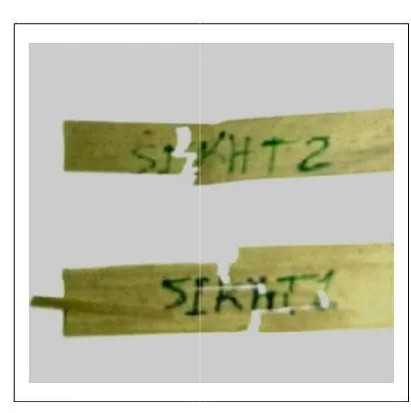
Shear perpendicular to fibers test was performed by using shear specimens from the midrib. The test was conducted using a LRXPlus universal testing machine and a sui
apparatus at a crosshead speed of 0.6 mm/min in compliance with ASTM D143-83.
Tensile test for date palm leaflets
The tensile test was performed with samples of leaflets with total length 200mm, and span length of (145mm), using a LRXPlus universal testing machine (Figure 7).
61253 International Journal of Current Research,
The test was conducted using a LRXPlus universal testing ear test apparatus at a crosshead ) in compliance with ASTM
Figure 5. The shear test sample
LRXPlus universal testing machine
Shear perpendicular to fibers test was performed by using shear specimens from the midrib. The test was conducted using a LRXPlus universal testing machine and a suiTable shear test apparatus at a crosshead speed of 0.6 mm/min in compliance
The tensile test was performed with samples of leaflets with total length 200mm, and span length of (145mm), using a LRXPlus universal testing machine (Figure 7).
Figure 7. The tensile test sample for date palm leaflets while performing tensile test
The test was conducted at a crosshead speed of 1 mm/min using a 2.5 kN load cell, in compliance with ASTM D143 5. Results and discussion
RESULTS AND DISCUSSION
Determination of moisture content
Table 1 illustrates the results of measurements of the moisture content of sample of date palm midrib specimens. The average moisture content of three species of date palm midribs is below 12% and thus is suiTable for mec
Table 1. Results of measurement of the moisture content of palm midrib samples
No Palm midrib species 1 SIWI midrib 2 FREHI midrib 3 GAGA midrib
Static bending test for midribs
Figure 8 shows the bending strength of the three species of date palm midribs (Siwi, Frehi, GaGa). The results illustrate that frehi date palm midribs has the highest bending strength, amounting to 90.54 Mpa. Figure 9 shows the Y modulus in bending of the three species of date palm midribs (Siwi, Frehi, GaGa).
Figure 8. Comparison between the bending strength for three species of date palm midribs
International Journal of Current Research, Vol. 9, Issue, 11, pp.61251-61258, November,
The tensile test sample for date palm leaflets while performing tensile test
The test was conducted at a crosshead speed of 1 mm/min in compliance with ASTM D143-83.
RESULTS AND DISCUSSION
Determination of moisture content
1 illustrates the results of measurements of the moisture content of sample of date palm midrib specimens. The average moisture content of three species of date palm midribs is below
for mechanical testing.
Results of measurement of the moisture content of palm midrib samples
Average moisture content (%) 6.648294 (0.225)
7.170348 (0.78) 6.075548 (0.58)
bending test for midribs
Figure 8 shows the bending strength of the three species of date palm midribs (Siwi, Frehi, GaGa). The results illustrate that frehi date palm midribs has the highest bending strength, amounting to 90.54 Mpa. Figure 9 shows the Young’s
modulus in bending of the three species of date palm midribs
Figure 8. Comparison between the bending strength for three species of date palm midribs
The results illustrate that Siwi date palm midribs
highest Young’s modulus in bending, amounting to 7395 Mpa. Figure 10 illustrates the pattern of failure in the static bending test.
Figure 9. Comparison between the bending Young’s modulus for three species of date palm midribs
Figure 10. The pattern of failure of static bending test for the three species of date palm midribs (splintering tension)
A comparison has been performed between the results of static bending properties average for the three date palm midribs. The results show that Frehi date palm midribs have the highest bending strength amounting to 90.54 Mpa, and Siwi date palm midribs have the highest Young’s modulus in bending amounting to 7395 Mpa as shown in (Table 2).
61254 Hamed Elmously and Khaled Mustafa Elerian
e that Siwi date palm midribs has the highest Young’s modulus in bending, amounting to 7395 Mpa. Figure 10 illustrates the pattern of failure in the static bending
Figure 9. Comparison between the bending Young’s modulus for three species of date palm midribs
10. The pattern of failure of static bending test for the three species of date palm midribs (splintering tension)
A comparison has been performed between the results of static bending properties average for the three date palm midribs. The results show that Frehi date palm midribs have the highest bending strength amounting to 90.54 Mpa, and Siwi date palm e the highest Young’s modulus in bending
2).
Table 2. The average bending strength, Young’s modulus in bending, and strain at maximum bending stress for the three
species of date palm midribs
No Date palm
midrib species
ϭb (MPa)
1 SIWI midrib 79.48 (5.5)
2 FREHI midrib 90.54 (13.46)
3 GAGA midrib 83.75 (6.4)
Compression test of midribs
Figure 11 shows the compression strength of the three species of date palm midribs (Siwi, Frehi, GaGa). The results illustrate that GaGa date palm midribs has the highest compressive strength, amounting to 42.94 Mpa. Figure 12 shows the Young’s modulus in compression of the
palm midribs (Siwi, Frehi, GaGa). The results illustrate that Frehi date palm midribs have the highest Young’s modulus in compression, amounting to 807.6 Mpa. Figure13 illustrates the compression test specimen, as well as the pattern
of the specimens.
Figure 11. Comparison between the compression strength for three species of date palm midribs
Figure 12. Comparison between the compression Young’s modulus for three species of date palms
A comparison has been performed between the results of compression properties average for the three date palm midribs. The results show that GaGa date palm midribs have the highest compressive strength, amounting to 42.94 Mpa, and Frehi date palm midribs h
modulus in compression, amounting to 807.6 Mpa as shown in (Table 3).
Khaled Mustafa Elerian, Determination of mechanical properties for date palm midribs and leaflets
Table 2. The average bending strength, Young’s modulus in bending, and strain at maximum bending stress for the three
species of date palm midribs
Eb (MPa) ᵋat ϭb
7395 (839.3) 0.016 (0.002)
90.54 (13.46) 7088.6 (1299) 0.019 (0.0016)
6527.5 (643.2) 0.018 (0.001)
compression strength of the three species of date palm midribs (Siwi, Frehi, GaGa). The results illustrate that GaGa date palm midribs has the highest compressive strength, amounting to 42.94 Mpa. Figure 12 shows the Young’s modulus in compression of the three species of date palm midribs (Siwi, Frehi, GaGa). The results illustrate that Frehi date palm midribs have the highest Young’s modulus in compression, amounting to 807.6 Mpa. Figure13 illustrates the compression test specimen, as well as the pattern of failure
Figure 11. Comparison between the compression strength for three species of date palm midribs
Comparison between the compression Young’s modulus for three species of date palms
A comparison has been performed between the results of compression properties average for the three date palm midribs. The results show that GaGa date palm midribs have the highest compressive strength, amounting to 42.94 Mpa, and Frehi date palm midribs have the highest Young’s modulus in compression, amounting to 807.6 Mpa as shown in
Figure 12. Comparison between the compression Young’s modulus for three species of date palms
Table 3. Average compression properties for three species of date palm midribs
No Date palm midrib species
Ϭc (MPa) 1 SIWI midrib 36.53 (1.74) 2 FREHI midrib 40.36 (5.23) 3 GAGA midrib 42.94 (5.6)
Shear Test of midribs
Figure 14 shows the longitudinal shear strength of the three species of date palm midribs (Siwi, Frehi, GaGa).
Figure 14. Comparison between the longitudinal shear strength for three species of date palms
61255 International Journal of Current Research,
Comparison between the compression Young’s modulus for three species of date palms
Table 3. Average compression properties for three of date palm midribs
Ec (MPa) 750.5 (37.4) 807.6 (76) 791.3 (17.8)
strength of the three species of date palm midribs (Siwi, Frehi, GaGa).
omparison between the longitudinal shear strength for three species of date palms
Figure 15. Comparison between the transverse shear strength for three species of date palms
Figure 16. The pattern of failure of shear test for the three species of date palm midribs in longitudinal direction (splintering and
shearing)
Table 4. Average shear strength for three species of date palm midribs in longitudinal and transverse directions
No Date palm midrib species
1 SIWI midrib 2 FREHI midrib 3 GAGA midrib
The results illustrate that GaGa date palm midribs have the highest longitudinal shear strength, amounting to 8.62 Mpa. Figure 15 shows the transverse shear strength of the three species of date palm midribs (Siwi, Frehi, GaGa). The results illustrate that Siwi date palm midribs have the highest transverse shear strength, amounting to 4.7 Mpa. Figure 16,17 illustrate the pattern of failure of longitudinal and transverse shear respectively.
International Journal of Current Research, Vol. 9, Issue, 11, pp.61251-61258, November
Comparison between the transverse shear strength for three species of date palms
Figure 16. The pattern of failure of shear test for the three species of date palm midribs in longitudinal direction (splintering and
shearing)
strength for three species of date palm midribs in longitudinal and transverse directions
ƮsL (MPa)
ƮsT (MPa) 6.18 (1.3) 4.7 (0.3) 7.2 (0.95) 3.32 (0.2) 8.62 (0.32) 2.65 (0.45)
The results illustrate that GaGa date palm midribs have the highest longitudinal shear strength, amounting to 8.62 Mpa. Figure 15 shows the transverse shear strength of the three species of date palm midribs (Siwi, Frehi, GaGa). The results t Siwi date palm midribs have the highest transverse shear strength, amounting to 4.7 Mpa. Figure 16,17 illustrate the pattern of failure of longitudinal and transverse
A comparison has been performed between the results of shear properties average for the three date palm midribs. The results show that GaGa date palm midribs have the highest longitudinal shear strength SL, amounting to 8.62 Mpa and Siwi date palm midribs have the highest transverse shear strength ST, amounting to 4.7 Mpa as shown in (
Table
5 illustrates the mean values of mechanical properties for the three date palm midribs species. Thisthe values of the bending strength, Young’s modulus in
Figure 17. The pattern of failure of shear test for the three species of date palm midribs in transnverse direction ( splintering and
shearing)
Table 5. Mean values of mechanical properties for the three
property Date Palm midrib species Bending strength (MPa)
Bending young’s modulus
SIWI midrib 79.48(5.5) 7395.12(839.3) FREHI midrib 90.54(13.5) 7088.6(1299) GAGA midrib 83.75(6.4) 6527.5(643.2)
Table 6. Mean values of bending properties for the two species
Property
Wood type Beech
Red European pine
Table 7. Mean values of mechanical properties for the three date palm leaflets species
Property Date Palm leaflets species Tensile strength (MPa) Green
SIWI leaflets 33.64 (9.1) FREHI leaflets 37 (7.6) GAGA leaflets 13.8 (4.3)
61256 Hamed Elmously and Khaled Mustafa Elerian
A comparison has been performed between the results of shear properties average for the three date palm midribs. The results show that GaGa date palm midribs have the highest , amounting to 8.62 Mpa and have the highest transverse shear , amounting to 4.7 Mpa as shown in (Table 4). 5 illustrates the mean values of mechanical properties for the three date palm midribs species. This
Table
includesmodulus in
Figure 17. The pattern of failure of shear test for the three species on ( splintering and
bending, compressive strength, Young’s modulus in compression, as well as longitudinal, and traverse shear strength. A comparison has been performed between the results of bending properties average for the two species of
wood (
Beech wood, and Red European pineresults show that Beech wood has the highest bending strength, amounting to142.16 Mpa and young’s modulus in bending, amounting to 1232686 Mpa as shown in (
Figure 18. Comparison of the bending strength of the three date palm species and other wood species
Figure 18. illustrates a comparison between the bending strength of the three species of palm midribs and that of Beech and Red European pine wood species. It is cle
figure that the Frehi palm midribs surpass the Red European pine (106.24%) whereas the Siwi and Gaga are near to that of the Red European pine(less than Red European pine by 6.73% and 1.72% respectively). Figure 19 illustrates a comparison between the Young’s modulus in bending of the above measured palm midribs species and that of Beech and Red European pine.
Table 5. Mean values of mechanical properties for the three date palm midribs species
Bending young’s modulus (MPa)
Compressive strength (MPa)
Compression Young’s modulus
(MPa)
7395.12(839.3) 36.53(1.74) 750.5(37.4) 7088.6(1299) 40.36(5.23) 807.6(76) 6527.5(643.2) 42.94(5.6) 791.3(17.8)
Mean values of bending properties for the two species of wood
Bending strength (MPa)
Bending young’s modulus (MPa)
142.16 (5.84) 12326.86 (629.35) 85.22 (3.65) 8484.5 (317)
Table 7. Mean values of mechanical properties for the three date palm leaflets species
Tensile strength
(MPa) Tensile young’s modulus (MPa)
Green Dry Green Dry
33.64 (9.1) 31.62 (6.7) 1733 (609.3) 2268 (325) 37 (7.6) 38.9 (6.14) 1758 (364) 2448 (193) 13.8 (4.3) 18 (4.15) 1066 (151) 2131 (177)
Khaled Mustafa Elerian, Determination of mechanical properties for date palm midribs and leaflets
, compressive strength, Young’s modulus in compression, as well as longitudinal, and traverse shear A comparison has been performed between the results of bending properties average for the two species of
Beech wood, and Red European pine wood). The results show that Beech wood has the highest bending strength, amounting to142.16 Mpa and young’s modulus in bending, amounting to 1232686 Mpa as shown in (
Table
6).Comparison of the bending strength of the three date palm species and other wood species
Figure 18. illustrates a comparison between the bending strength of the three species of palm midribs and that of Beech and Red European pine wood species. It is clear from this figure that the Frehi palm midribs surpass the Red European pine (106.24%) whereas the Siwi and Gaga are near to that of the Red European pine(less than Red European pine by 6.73% and 1.72% respectively). Figure 19 illustrates a comparison ween the Young’s modulus in bending of the above measured palm midribs species and that of Beech and Red
date palm midribs species
Compression Young’s
Shear strength (MPa)
L T
6.18 (1.3) 4.7 (0.3) 7.2 (0.95) 3.32 (0.2) 8.62 (0.32) 2.65 (0.45)
Bending young’s modulus
Table 7. Mean values of mechanical properties for the three date palm leaflets species
Dry
2268 (325) 2448 (193) 2131 (177)
Figure 19. Comparison of the bending Young’s modulus of the three date palm species and other wood species
Figure 20. Comparison between tensile strength for the three species of date palm green leaflets
Figure 21. Comparison between tensile Young’s modulus for the three species of date palm green leaflets
[image:7.595.43.283.239.385.2]61257 International Journal of Current Research,
Figure 19. Comparison of the bending Young’s modulus of the species and other wood species
between tensile strength for the three species of date palm green leaflets
[image:7.595.43.287.426.576.2]Figure 21. Comparison between tensile Young’s modulus for the three species of date palm green leaflets
Figure 22. The pattern of failure for the date palm leaflets during the tension test
It is clear from the figure that the values of Young’s modulus in bending for the Siwi, Frehi, and Gaga are near to that of the Red European pine (less than Red European pine by 12.84%, 16.45%, and 23.07% respectively).
Tensile test for date palm leaflets
Table 7 and Figure 20 show the tensile strength of the three species of date palm leaflets (Siwi, Frehi, GaGa). The results illustrate that Frehi date palm leaflets have the highest tensile strength, amounting to 37 Mpa and 38
species respectively. Table 7 and Figure 21 show the Young’s modulus in tension of the three species of date palm leaflets (Siwi, Frehi, GaGa). Results illustrate that Frehi date palm leaflets have the highest Young’s modulus in te amounting to 1758 Mpa, and 2448 Mpa for green and dry specimen respectively. Figure 22 illustrates the pattern of failure of the palm leaflets during the tension test comparison has been performed between the results of tension properties average for the three date palm leaflets. The results show that Frehi date palm leaflets have the highest tensile strength, amounting to 37 Mpa and 38.9 Mpa for green and dry species respectively, and Young’s modulus in tension, amounting to 1758 Mpa, and 2448 M
specimen respectively as shown in (
Conclusion
The Frehi midribs have the highest values of bending strength, compression Young’s modulus.
The Siwi midribs have the highest values for bending Young’s modulus, and transverse shear strength
The GAGA midribs have the highest values of compression strength, and longitudinal shear strength
The Frehi leaflets have the highest value of tensile strength, while Siwi leaflets have the highest value of tensile Young’s modulus.
All tested species of date palm midribs have bending strength values adjacent to those of Red European pine wood. Thus, the date palm midribs could be used as an alternative to wood becaus
potential.
International Journal of Current Research, Vol. 9, Issue, 11, pp.61251-61258, November,
Figure 22. The pattern of failure for the date palm during the tension test
It is clear from the figure that the values of Young’s modulus in bending for the Siwi, Frehi, and Gaga are near to that of the Red European pine (less than Red European pine by 12.84%, 16.45%, and 23.07% respectively).
test for date palm leaflets
7 and Figure 20 show the tensile strength of the three species of date palm leaflets (Siwi, Frehi, GaGa). The results illustrate that Frehi date palm leaflets have the highest tensile strength, amounting to 37 Mpa and 38.9 Mpa for green and dry 7 and Figure 21 show the Young’s modulus in tension of the three species of date palm leaflets (Siwi, Frehi, GaGa). Results illustrate that Frehi date palm leaflets have the highest Young’s modulus in tension, amounting to 1758 Mpa, and 2448 Mpa for green and dry specimen respectively. Figure 22 illustrates the pattern of failure of the palm leaflets during the tension test. A comparison has been performed between the results of tension for the three date palm leaflets. The results show that Frehi date palm leaflets have the highest tensile strength, amounting to 37 Mpa and 38.9 Mpa for green and dry species respectively, and Young’s modulus in tension, amounting to 1758 Mpa, and 2448 Mpa for green and dry specimen respectively as shown in (Table 7).
The Frehi midribs have the highest values of bending strength, compression Young’s modulus.
midribs have the highest values for bending Young’s modulus, and transverse shear strength The GAGA midribs have the highest values of compression strength, and longitudinal shear strength The Frehi leaflets have the highest value of tensile
le Siwi leaflets have the highest value of tensile Young’s modulus.
All tested species of date palm midribs have bending strength values adjacent to those of Red European pine wood. Thus, the date palm midribs could be used as an alternative to wood because of their high availability
[image:7.595.58.270.623.787.2]REFERENCES
BS EN 322:1993. Wood-based panels — Determination of moisture content.
Elmously, H.I. and Megahed, M.M. 1995. Anatomical structure of date palm leave’s midrib and its variation across and along the midrib, the IUFRO XX world Congress, project group p5. 04, August 6-12, Tempere, Finland.
http://www.biotech-ecolo.net, Date palm (Phoenix dactylifera L.).
(Cited 2013) Available from:
http://www.biotech-ecolo.net/date-palm-phoenix-dactylifera.html
Ministry of Agriculture, Economic affairs sector, Central administration of agricultural economy, 2016.
![Figure 1. Palm structure [http://www.biotech-ecolo.net, Date palm (Phoenix dactylifera L.).[Cited 2013] Available from:]](https://thumb-us.123doks.com/thumbv2/123dok_us/9107310.407953/2.595.65.261.533.703/figure-palm-structure-biotech-phoenix-dactylifera-cited-available.webp)