KNOWLEDGE BASED QUESTION ANSWERING
Michael J. Pazzani and Carl Engelman
The MITRE Corporation
Bedford, MA 01730
ABSTRACT
The n a t u r a l l a n g u a g e d a t a b a s e q u e r y system i n c o r p o r a t e d i n t h e KNOBS i n t e r a c t i v e p l a n n i n g s y s t e m c o m p r i s e s a d i c t i o n a r y d r i v e n p a r s e r , A P E - I I , and s c r i p t i n t e r p r e t e r which y i e l d a c o n c e p t u a l d e p e n d e n c y c o n c e p t u a l i z a t i o n as a r e p r e s e n t a t i o n o f t h e manning o f u s e r i n p u t . A c o n c e p t u a l i z a t i o n p a t t e r n m a t c h i n g p r o d u c t i o n s y s t e m t h e n d e t e r m i n e s and e x e c u t e s a p r o c e d u r e f o r e x t r a c t i n g t h e d e s i r e d i n f o r m a t i o n from t h e
d a t a b a s e . In c o n t r a s t to s y n t a x d r i v e n Q-A s y s t e m s , e . $ . , t h o s e b a s e d on ATH p a r s e r s , AFE-II i a d r i v e n b o t t o m - u p by e x p e c t a t i o n s a s s o c i a t e d w i t h word ~ e a n i n g s . The p r o c e s a i n K o f a q u e r y i s b a s e d on t h e c o n t e n t s o f s e v e r a l knowledge s o u r c e s i n c l u d i n g t h e d i c t i o n a r y e n t r i e s ( p a r t i a l
c o n c e p t u a l i z a t i o n s and t h e i r e x p e c t a t i o n s ) , f r a m e s r e p r e s e n t i n g c o n c e p t u a l d e p e n d e n c y p r i m i t i v e s , s c r i p t s which c o n t a i n s t e r e o t y p i c a l knowledge a b o u t p l a n n i n g t a s k s u s e d t o i n f e r s t a t e s e n a b l i n g o r r e s u l t i n g from a c t i o n s , and two p r o d u c t i o n s y s t e m r u l e b a s e s f o r t h e i n f e r e n c e o f i m p l i c i t c a s e f i l l e r s , and f o r d e t e r m i n i n g t h e r e s p o n s i v e d a t a b a s e s e a r c h . The g o a l s o f t h i s a p p r o a c h , a l l o f which a r e c u r r e n t l y a t l e a s t p a r t i a l l y a c h i e v e d , i n c l u d e u t i l i z i n g s i m i l a r r e p r e s e n t a t i o n s f o r q u e s t i o n s w i t h s i m i l a r m e a n i n g s b u t w i d e l y v a r y i n g s u r f a c e s t r u c t u r e s , d e v e l o p i n g a p o w e r f u l m e c h a n i s m f o r t h e d i s a m b i g u a t i o u of words w i t h m u l t i p l e m e a n i n g s and t h e d e t e r m i n a t i o n o f pronoun r e f e r e n t s , a n s w e r i n g q u e s t i o n s which r e q u i r e i n f e r e n c e s to be u n d e r s t o o d , and i n t e r p r e t i n g e l l i p s e s and u n B r a - - n a t i c a l u t t e r a n c e s . THE SETTING
The KNOBS [Engelman, 1980] d e m o n s t r a t i o n s y s t e m i s an e x p e r i m e n t a l e x p e r t s y s t e m p r o v i d i n g c o n s u l t a n t services to an Air Force tactical air mission planner. The KNOBS database consists of
s e v e r a l n e t s of f r a m e s , implemented w i t h i n an e x t e n s i o n of FRL [ R o b e r t s , 1977], r e p r e s e n t i n g both i n d i v i d u a l and g e n e r i c c l a s s e s of t a r g e t s ,
r e s o u r c e s , and p l a n n e d m i s s i o n s . The KNOBS s y s t e m supports a planner by checking the consistency of plan components, enumerating or ranking p o s s i b l e choices for plan components, or automatically generating a c o m p l e t e plan. Because these activities are accomplished by means of rules and constraints expressible in English, KNOBS will hopefully be a relatively easy system to learn.
For t h e same r e a s o n s , it i s a l s o b e i n g c o n s i d e r e d as an a i d t o t r a i n mission p l a n n e r s . The n a t u r a l l a n g u a g e s u b s y s t e m o f KNOBS p l a y s s e v e r a l r o l e s i n c l u d i n g t h o s e o f d a t a b a s e q u e r y , d a t a b a s e u p d a t e , co~uand l a n g u a g e , p l a n d e f i n i t i o n , and t h e a d d i t i o n o r modification of production system r u l e s
r e p r e s e n t i n g domain k n o w l e d g e . The moat d e v e l o p e d o f t h e s e i s d a t a b a s e q u e r y , upon which t h i s p a p e r w i l l f o c u s .
The b a l a n c e o f t h i s p a p e r will f i r s t o u t l i n e t h e u s e o f c o n c e p t u a l d e p e n d e n c y and m e n t i o n some p r i o r r e l a t e d work and t h e n d e s c r i b e t h e s e v e r a l knowledge s o u r c e s and t h e p a r t s t h e y p l a y i n t h e p a r s i n g o f t h e i n p u t q u e r y . F i n a l l y , i t w i l l d e s c r i b e t h e method o f d e r i v i n g t h e a p p r o p r i a t e d a t a b a s e s e a r c h and o u t p u t r e s p o n s e as w e l l a s a s c r i p t - b a s e d a p p r o a c h t o i n t e r p r e t t i n g COmmands. USE OF CONCEPTUAL DEPENDENCY
APE-If u t i l i z e s C o n c e p t u a l Dependency t h e o r y [ S c h a n k , 1972] t o r e p r e s e n t t h e m e a n i n g of
questions. Once the meaning of a question has been f o u n d , t h e q u e s t i o n i s a n s w e r e d by a r u l e b a s e d s y s t e m whose t e a t s are CD p a t t e r n s and whose a c t i o n s e x e c u t e d a t a b a s e q u e r i e s .
We f e e l i t i s i m p o r t a n t to r e p r e s e n t t h e meaning i n t h i s manner f o r s e v e r a l r e a s o n s . F i r s t , t h e c a n o n i c a l m e a n i n g r e p r e s e n t a t i o n e n a b l e s q u e s t i o n s w h i c h have d i f f e r e n t s u r f a c e e x p r e s s i o n s , b u t t h e same m e a n i n s , t o be a n s w e r e d by t h e same mechanikm. T h i s i s n o t o n l y of t h e o r e t i c a l
s i s n i f i c a n c e , b u t i s a l s o a p r a c t i c a l m a t t e r as i t r e q u i r e s l e s s e f f o r t t o p r o d u c e a r o b u s t s y s t e m .
Because p e o p l e do n o t a l w a y s s a y p r e c i s e l y what t h e y mean, i n f e r e n c e s may be r e q u i r e d to e x p l i c a t e m i s s i n g i n f o r m a t i o n . T h i s i n f e r e n c e p r o c e s s can a l s o u t i l i z e t h e c a n o n i c a l meaning r e p r e s e n t a t i o n . F i n a l l y , f i n d i n g t h e r e f e r e n t Qf a nominal which i s modified by a relative clause is, in some cases, similar to question answering although the syntactic constructions used differ. As a result of this similarity, the question answering productions can also be used for determining the referents of a relative clause. The conversation with KNOBS (whose database is fictional) i n Fig. 1 illustrates these points.
USER: Are there F-4G's at Ramatein?
KNOBS: RAMSTEIN has F-4Ga.
USER: Can i t s fighters reach the target? KNOBS: F-15e can reach SE50301 from RA~SIEIN.
F-4Ge and F-dCa can not reach BEb0301 from RA~STEIN.
USER: Which SCL which are carried by an F-dC contain ECM?
KNOBS: Sl, S7 and BB.
F~guve i. A Question Answering Interchange withi, KN08S. after resolving the pronominal reference, requires an inference to find the location from which the F-4G's will be leaving. This inference states that if the source of the object of a physical transfer is missing, then the source could be the initial location of the object. The third question can be thought of as two questions: "Which SCL (Standard Configuration Load - a predefined weapons package) are carried by an F-dC?" and "Which of those contain ECM (Electronic Counter Measures - radar jamming equipment)?". The first part requires a
s c r i p t b a s e d i n f e r e n c e : I n o r d e r f o r an SCL t o be c a r r i e d by an a i r c r a f t , t h e a i r c r a f t m u s t be c a p a b l e o f h a v i n g t h e SCL a s a p a r t . A f t e r t h e f i r s t p a r t i s a n s w e r e d a s a q u e s t i o n , t h e s e c o n d
part is answered as a second question to discover
w h i c h contain ECM.
The s y s t e m o f r e p r e s e n t a t i o n u s e d f o r n o m i n a l s ( o r p i c t u r e p r o d u c e r s ) d i f f e r s f r o m t h a t n o r m a l l y p r e s e n t i n a CD s y s t e m . T y p i c a l l y , an o b j e c t s u c h a s an F-4C w o u l d be r e p r e s e n t e d a s a p i c t u r e
producer with a TYPE case filled by VEHICLE, a SUBTYPE case filled by aircraft, and, perhaps, a MODEL case filled by F-4C. In KNOBS, the meaning representation produced by the parser is F-dC, the name of a frame. The set membership of this frame is indicated by links to other frames. F-dC is a kind of FIGHTER which is a kind of AIRPLANE which is an A I R C R ~ T which is a VEHICLE which is a PICTURE PRODUCER. We feel that representing nominals in this manner allows a finer degree of discrimination than explicitly labeled cases to denote a conceptual hierarchy.
Many o f t h e a t t r i b u t e s o f o b j e c t s i n t h e d a t a b a s e ( w h i c h a r e s t o r e d a s v a l u e f a c e t s o f s l o t s i n FRL) a r e r e p r e s e n t e d a s k i n d s o f RELATIONS i n t h e KNOBS s y s t e m . F o r e x a m p l e , t h e r e p r e s e n t a t i o n
of "Hahn's Latitude" is (LATITUDE ARGUMENT (HAHN)). Note, however, chat the representation of "Hahn's aircraft" is (AIRCRAFT LOC (AT PLACE (HAHN))).
PREVIOUS WORK
We would like to distinguish the KNOBS natural language facility from such familiar natural language query systems as LADDER [Hendrix, 1978] and LUNAR [Woods, 1972] i n both function and method. The functional model of the above systems
is that of someone with a problem to solve and a database containing information useful in its solution which he can access via a natural language interface. KNOBS, by contrast, integrates the natural language capability with multi-faceted problem solving support including critiquing and Benerating tactical plans. Our approach differs in
m e t h o d f r o m t h e s e p r e v i o u s s y s t e m s i n i t s
b o t t o m - u p , d i c t i o n a r y d r i v e n p a r s i n g w h i c h r e s u l t s i n a c a n o n i c a l r e p r e s e n t a t i o n o f t h e m e a n i n g o f t h e q u e r y , i t s a b i l i t y t o p e r f o r m c o n t e x t d e p e n d e n t i n f e r e n c e s w i t h t h i s r e p r e s e n t a t i o n d u r i n g q u e s t i o n a n s w e r i n g , a n d t h e u s e o f a d e c l a r a t i v e
r e p r e s e n t a t i o n o f t h e d o m a i n t o a s s i s t p a r s i n S , q u e s t i o n a n s w e r i n g , p l a n u p d a t i n g , a n d i n f e r e n c i n g .
A s y s t e m s i m i l a r t o A P E - I f i n b o t h i t s d i c c i o n a r y d r i v e n a p p r o a c h t o p a r s i n s a n d i c e d i r e c t a t t a c k on w o r d s e n s e d i s a m b i g u a t i o n i s t h e
Word Expert Parser (WEP) [Small, 1980]. This parser associates a discrimination net with each word to guide the meanin 8 selection process. Each word in a sentence is a pointer to a coroutine called a word expert which cooperates with
neighboring words to build a meanin S representation of the sentences in a bottom-up, i.e., data driven, fashion. At each node in the discrimination net a multiple-choice test i s executed which can query the lexical properties or expectations,
(selectional restrictions [Katz, 1963]) of
neighboring words, or proposed FOCUS, ACTIVITY, and DISCOURSE modules. The sense selection process of
WEP r e q u i r e s t h a t e a c h word know a l l o f t h e
contexts in which its senses can occur. For example, to find the meaning of "pit", the pit expert can ask if a MINING-ACTIVITY, EATING-ACTION, CAR-RACINC, or MUSIC-CONCERT-ACTION is active.
A P E - I I e v o l v e d f r o m APE (A P a r s i n g E x p e r i m e n t ) , a p a r s e r u s e d by t h e DSAM
( D i s t r i b u t a b l e S c r i p t A p p l y i n g M e c h a n i s m ) a n d ACE ( A c a d e m i c C o u n s e l i n g E x p e r t ) p r o j e c t s a t t h e
University of Connecticut [Cullingford, 1982]. APE is based on the CA parser [Birnbaum, 1981] with the addition of a word sense disambiguation algorithm.
In CA, word definitions are represented as requests, a type of test-action pair. The test part of a request can check lexical and semantic features of neighboring words; the actions create or connect CD structures, and activate or
deactivate other requests.
The method available to select the appropriate meaning of a word in CA is to use the test part of separate requests to examine the meanings of other words and co build a meaning representation as function of this local context. For example, if the objeet of "serve" is a food, the meaning is "bring to"; if the object is a ball, the meaning is "hit toward". This method works well for selecting a sense of a word which has expectations. However,
some words have no expectations and the intended
sense is the one that is expected. For example, the proper sense of "ball" in "John kicked the ball." and "John attended the ball." is the sense which the central action expects.
The word definitions of APE are also
represented as requests. A special concept called a VEL is u s e d to represent the set of possible
d i s c a r d t h o s e t h a t a r e n o t a p p r o p r i a t e . I n a d d i t i o n , APE can u s e e x p e c t a t i o n s from a c o n t e x t u a l k n o w l e d g e s o u r c e s u c h a s a s c r i p t a p p l i e r t o s e l e c t a word s e n s e . Each s c r i p t i s augmented w i t h p a r s e r e x e c u t a b l e e x p e c t a t i o n s c a l l e d named r e q u e s t s . F o r e x a m p l e , a C a c e r t a i n p o i n t i n u n d e r s t a n d i n g a r e s t a u r a n t s t o r y , l e a v i n g • t i p f o r t h e w a i t e r i s e x p e c t e d . The p a r s e r i s t h e n g i v e n a named r e q u e s t w h i c h c o u l d h e l p disambiguate the words "leave" and "tip", should t h e y a p p e a r .
APE-II
A word d e f i n i t i o n in A P E - I I c o n s i s t s o f t h e s e t o f a l l o f i t s s e n s e s . Each s e n s e c o n t a i n s • c o n c e p t , i . e . , • p a r t i a l CD s t r u c t u r e w h i c h e x p r e s s e s t h e m e a n i n g o f t h i s s e n s e , and a s e t o f c o n c e p t u a l and l e x i c a l e x p e c t a t i o u s .
A c o n c e p t u a l e x p e c t a t i o n i n s t r u c t s t h e p a r s e r t o look f o r a c o n c e p t i n s c e r t a i n r e l a t i v e p o s i t i o n w h i c h m e e t s a s e l e c t i o n a l r e s t r i c t i o n . The e x p e c t a t i o n a l s o c o n t a i n s a s e l e c t i o n a l
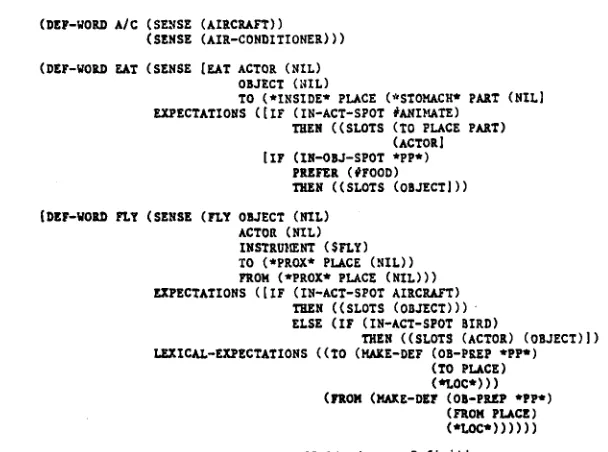
p r e f e r e n c e , a more s p e c i f i c , p r e f e r r e d c a t e g o r y f o r t h e e x p e c t e d c o n c e p t ( c f . [ W i l k g , 1 9 7 2 ] ) . I f s u c h a c o n c e p t is f o u n d , t h e e x p e c t a t i o n c o n t a i n s i n f o r m a t i o n on how i t can be combined w i t h t h e c o n c e p t w h i c h i n i t i a t e d t h e e x p e c t a t i o n . A l e x i c a l e x p e c t a t i o n i n s t r u c t s t h e p a r s e r t o l o o k f o r a c e r t a i n word and add a new, f a v o r e d s e n s e t o i t . T h i s p r o c e s s i s u s e f u l f o r p r e d i c t i n g t h e f u n c t i o n of a prepositiou [Reisbeck, 1 9 7 6 ] . The definition of a pronoun utilizes a context and focus mechanism co f i n d t h e s e t o f p o s s i b l e r e f e r e n t s w h i c h a g r e e w i t h i t i n number and g e n d e r . THE PRONOUN IS THEN TREATED LIKE A WORD WITH MULTIPLE SENSES. The definitions of the words "fly", "eat" and "A/C" are shown i n F i g . 2.
The definition of "A/C" states that it means AIRCRAFT or AIR-CONDITIONER. APE-If uses
s e l e c t i o n a l restrictions t o choose t h e proper s e n s e of "A/C" in the question "What A/C can fly from Hahn?". On the other hand, in the sentence "Send 4 A/C t o BE70701.", APE-II utilizes the facts that the OCA script is active, and that sending aircraft to a target is a scene of that script, Co determine that "A/C" means AIRCRAFT. In the question "What i s an A / C ? " , A P E - I I u s e s a w e a k e r a r g u m e n t t o r e s o l v e t h e p o t e n t i a l a m b i g u i t y . I t u t i l i z e s t h e f a c t t h a t AIRCRAFT i s an o b j e c t t h a t can p e r f o r m a r o l e in t h e OCA s c r i p t , w h i l e an AIR-CONDITIONER cannot.
The definition of "fly" states that it means FLY which is a kind of physical transfer. The expectations associated with fly state the actor of the sentence (i.e., a concept which precedes t h e action in a d~clarative sentence, follows "by" in a passive sentence, or appears in v a r i o u s p l a c e s in q u e s t i o n s , e t c . ) i s e x p e c t e d t o be an AIRCRAFT in which case it is the OBJECT of FLY or is expected to be a BIRD in which case it is both the ACTOR and the OBJECT of the physical transfer. This is the expectation which can select the intended sense of "A/C". If the word "~o"
a p p e a r s , i t m i g h t s e r v e t h e f u n c t i o n o f i n d i c a t i n g the filler of the TO case of FLY. The word "from" is given a similar definition, which would fill the FROM case with the object of the preposition which : s h o u l d be a PICTURE-PRODUCER b u t is p r e f e r r e d t o be
a LOCATION.
The definition of " e a t " c o n t a i n s an e x p e c t a t i o n with s s e l e c t i o n a l p r e f e r e n c e which i n d i c a t e s t h a t t h e o b j e c t i s p r e f e r r e d t o be f o o d . This p r e f e r e n c e s e r v e s a n o t h e r p u r p o s e a l s o . The o b j e c t w i l l be c o n v e r t e d t o a f o o d i f p o s s i b l e . For example, if the object were "chicken" then this c o n v e r s i o n w o u l d a s s e r t t h a t i t i s a dead and c o o k e d c h i c k e n .
We v i l i f i r s t d i s c u s s t h e p a r s i n g p r o c e s s a s i f s e n t e n c e s c o u l d be p a r s e d i n i s o l a t i o n and t h e n e x p l a i n how i t i s a u g m e n t e d t o a c c o u n t f o r c o n t e x t . The s i m p l i f i e d p a r s i n g p r o c e s s c o n s i s t s o f a d d i n g t h e s e n s e s o f e a c h word t o an a c t i v e memory, c o n s i d e r i n g t h e e x p e c t a t i o n s , and r e m o v i n E c o n c e p t s ( s e n s e s ) w h i c h a r e n o t c o n n e c t e d t o o t h e r c o n c e p t s .
Word s e n s e d i s a m b i g u a t i o n and t h e r e s o l u t i o n o f p r o n o m i n a l r e f e r e n c e s a r e a c h i e v e d by s e v e r a l m e c h a n i s m s . S e l e c t i o n a l r e s t r i c t i o n s can be
h e l p f u l t o r e s o l v e m - b i g u i t i e s . For e x a m p l e , many a c t i o n s r e q u i r e an a n i m a t e a c t o r . I f t h e r e a r e s e v e r a l c h o i c e s f o r t h e a c t o r , t h e i n a n i m a t e o n e s w i l l be weeded o u t . C o n v e r s e l y , i f t h e r e a r e
s e v e r a l c h o i c e s f o r t h e main a c t i o n , and t h e a c t o r h a s b e e n e s t a b l i s h e d as a n i m a t e , t h e n ~hose a c t i o n s which require an inanimate actor will be discarded. S e l e c t i o n a l p r e f e r e n c e s a r e u s e d in a d d i t i o n t o s e l e c t i o u a l r e s t r i c t i o n s . For e x a m p l e , i f " e a t " h a s an o b j e c t w h i c h i s a p r o n o u n whose possible r e f e r e n t s a r e a f o o d and a c o i n , t h e f o o d w i l l be p r e f e r r e d and t h e c o i n d i s c a r d e d a s a p o s s i b l e r e f e r e n t .
A c o n f l i c t r e s o l u t i o n m e c h a n i s m i s i n v o k e d i f more t h a n one c o n c e p t s a t i s f i e s t h e r e s t r i c t i o n s and p r e f e r e n c e s . T h i s c o n s i s t s o f u s i n g " c o n c e p t u a l c o n s t r a i n t s " t o d e t e r m i n e i f t h e CD s t r u c t u r e w h i c h would be b u i l t i s p l a u s i b l e . T h e s e c o n s t r a i n t s a r e p r e d i c a t e s a s s o c i a t e d w i t h CD p r i m i t i v e s . For e x a m p l e , t h e l o c a t i o n a l s p e c i f i e r INSIDE has a c o n s t r a i n t w h i c h s t a t e s t h a t t h e c o n t e n t s m u s t be s m a l l e r t h a n t h e c o n t a i n e r .
The d i s n m b i g u a t i o n p r o c e s s can make u s e o f t h e k n o w l e d g e s t r u c t u r e s w h i c h r e p r e s e n t s t e r e o t y p i c a l domain i n f o r m a t i o n . The c o n f l i c t r e s o l u t i o n a l g o r i t h m a l s o d e t e r m i n e s i f t h e CD s t r u c t u r e w h i c h would be b u i l t r e f e r s t o a s c e n e in an a c t i v e script and prefers to build this type of conceptualization. At the end of the parse, if there is an a m b i g u o u s nominal, the possibilities are matched against the roles of the active scripts. Nominals which can be a script role are preferred.
(DEF-WORD A/C (SENSE (AIRCRAFT)) (SENSE (AIR-CONDITIONER))) (DEF-WOED EAT (SENSE [EAT ACTOR (NIL)
OBJECT (NIL)
TO (*INSIDE I PLACE (~STOMACN ~ PART (NIL] EXPECTATIONS ([ IF (IN-ACT-SPOT #ANI}~TE)
THEN ((SLOTS (TO PLACE PART)
(ACTOR] [IF (IN-OBj-SPOT *PP*)
PREFER (#~OOO)
THEN ((SLOTS (OBJECT])) [DEF-WORD FLY (SENSE (FLY OBJECT (N~L)
ACTOR (NIL)
INSTE~NT ($IIY) TO (*PROX* PLACE (NIL)) FROM (*PROX* PLACE (NIL))) EXPECTATIONS ([IF (IN-ACT-SPOT AIRCRAFT)
THEN ((SLOTS (OSJECT))) ~ ELSE (IF (IN-ACT-SPOT BIRD)
THEN ((SLOTS (ACTOR) (OBJECT)]) LEXICAL-EXPECTATIONS ((TO (MAKE-DEF (OB-PEEP ~ppw)
(TO PLACE) (*~.oc*))) (FROM (MAKE-DEF (OS-Pg~P *PP*)
(FROH PLACE) ( * L O t * ) ) ) ) ) )
I Figure 2. APE-[I Dictionary Definitions.
none o f t h o s e c o n c e p t s can be c o n n e c t e d , o t h e r s e n s e s w i l l be a d d e d . A s i m i l a r m e c h a n i s m can be u s e d f o r p o t e n t i a l p r o n o u n r e f e r e n t s , o r g a n i z i n g c o n c e p t s a c c o r d i n g t o i m p l i c i t o r e x p l i c i t f o c u s in a d d i t i o n to t h e i r l o c a t i o n i n a c t i v e o r o p e n f o c u s
spaces (see [Grosz, 1977]).
A n o t h e r e x t e n s i o n t o A P E - I I w i l l be t h e i n c o r p o r a t i o n o f a m e c h a n i s m s i m i l a r t o t h e named r e q u e s t s o f APE. H o w e v e r , b e c a u s e t h e e x p e c t a t i o n s o f A P E - I I a r e i n a d e c l a r a t i v e f o r m a t , i t i s h o p e d t h a t t h e s e r e q u e s t s can be g e n e r a t e d f r o m t h e c a u s a l l y l i n k e d s c e n e s o f t h e s c r i p t .
QUESTION ANSWERING
A f t e r t h e m e a n i n g o f a q u e s t i o n h a s b e e n r e p r e s e n t e d , t h e q u e s t i o n i s a n s w e r e d by means o f p a t t e r n - i n v o k e d r u l e s . T y p i c a l l y , t h e p a t t e r n m a t c h i n g p r o c e s s b i n d s v a r i a b l e s t o t h e m a j o r n o m i n a l s i n a q u e s t i o n c o n c e p t u a l i z a t i o n . The r e f e r e n t s o f t h e s e n o m i n a l s a r e u s e d i n e x e c u t i n g a d a t a b a s e q u e r y w h i c h f i n d s t h e a n s w e r t o t h e u s e r ' s q u e s t i o n . A l t h o u g h t h e q u e s t i o n c o n c e p t u a l i z a t i o n and t h e a n s w e r c o u l d be u s e d t o g e n e r a t e a n a t u r a l l a n g u a g e r e s p o n s e [Goldman, 1 9 7 5 ] , t h e c u r r e n t r e s p o n s e f a c i l i t y m e r e l y s u b s t i t u t e s t h e a n s w e r and r e f e r e n t s in a c a n n e d r e s p o n s e p r o c e d u r e a s s o c i a t e d w i t h e a c h q u e s t i o n a n s w e r i n g r u l e .
The question answering rules are organized according to the context in which they are appropriate, i.e., the conversational script [Lehnert, 1978], and according to the primitive of the conceptualization and the "path to the focus" of the question. The path to the focus of a question is considered to be the path of conceptual cases which leads to the subconcept in question.
A q u e s t i o n a n s w e r i n g p r o d u c t i o n i s d i s p l a y e d i n F i g . 3 . I t i s a d e f a u l t p a t t e r n d e s i g n e d t o a n s w e r q u e s t i o n s a b o u t w h i c h o b j e c t s a r e a t a l o c a t i o n . T h i s p a t t e r n i s u s e d t o a n s w e r t h e q u e s t i o n " ~ h a t f i g h t e r s do t h e a i r b a s e e i n West Gerlmny h a v e ? " . I n t h i s e x a m p l e , t h e p a t t e r n v a r i a b l e s &LOC i s b o u n d t o t h e m e a n i n g
r e p r e s e n t a t i o n o f " t h e a i r b a s e s i n West G e r m a n y "
and &OBJECT is bound to the meaning representation of "fighters". The action is then executed and the referent of &OBJECT is found to be (FIGHTER) and the referent of &LOC is found to be (HAHN SEMBACH BITBURG). The fighters at each of these locations is found and the variable ANSWER is bound to the value of MAPPAIR:
((HAHN . (F-4C F-15)) (SEMBACH . NIL)
(BITBURG . ( F - ~ F-15))).
The response facet of the question answering production reformats the results of the action to merse locations with the same set of objects. The answer "There are none at Sembach. Hahn and Bitburg have F-4Cs and F-15s." is printed on
s u c c e s s i v e i t e r a t i o n e o f PMAPC.
The p r o d u c t i o n i n F i g . 3 i s u s e d t o a n s w e r m o s t q u e s t i o n s a b o u t o b j e c t s aC a l o c a t i o n . I t i n v o k e s a g e n e r a l f u n c t i o n w h i c h f i n d s t h e s u b s e t o f ~he p a r t s o f a l o c a t i o n w h i c h b e l o n g t o a
certain class. The OCA (offensive counter air) script used by the KNOBS system contains a more specific pattern for answering question about the defenses of a location. This production is used to answer the question "What SAMe are at BE70701?". The action of this production executes a procedure which finds the subset of the surface to air missiles whose range is greater than the distance
[image:4.612.186.490.108.334.2](DEF-Q-PAT PAT (*EXISTS w OBJECT &OBJECT
LOt (*PIOX* PLACE &LOt)) ACTION {MAPPAIR (FIND-REFEEEMTS &LOt)
(FUNCTION (LAMBDA (LOt)
(MAPCONC (FII;D-LZFERZNTS &OBJECT)
(FUNCTION (LAMBDA (TYPE)'
(FIND-OEJECTS-AT LOC TYPE] RESPONSE [PMAPC (MEEGEPAIRS ANSI~lt)
(FUNCTION (LA~SDA (LOt ITZMS) (CO~D ((NULL II7~S)
(MSG "There ere none se " (~aMZ LOC)
" . ' ) )
(TIII~J~-PERSON? "have" LOC) (~U~ ZTZMS)
m.N] q-l, OCUS (o~zcT Is-A)]
Ftoure 3. A OuestHon Answertno Production.
I n a d d i t i o n t o e x e c u t i n g a d a t a b a s e q u e r y , t h e a c t i o n o f a r u l e c a n r a c u r e i v e l y i n v o k e o t h e r q u e J C i o n a n s w e r i n g r u l e s . For e x a m p l e , t o a n s w e r t h e q u e s t i o n '*Row many a i r b a s a J h a v e F - A t ' e ? " , a g e n e r a l r u l e c o n v e r t s t h e c o n c e p t u a l i z a t i o n of t h e q u e s t i o n t o t h a t o f ' ~ h i c h a i r b a e e s h a v e F - A t ° e ? " and c o u n t s t h e r e s u l t o f a n s w e r i n g t h e l a r g e r . The q u e s t i o n a n s w e r i n g r u l e s can a l s o be u s e d t o f i n d t h e r e f e r e n t o f c o m p l e x n o m i n a l s s u c h a s " t h e a i r b a s e s w h i c h h a v e F - A C ' e " . The p a t h t o t h e f o c u s o f t h e " q u e s t i o n " i s i n d i c a t e d by t h e c o n c e p t u a l c a s e o f t h e r e l a t i v e p r o n o u n .
INFERENCE
when i m p o r t a n t r o l e s a r e n o t f i l l e d i n a c o n c e p t , " c o n c e p t u a l c o m p l e t i o n " i n f e r e n c e s a r e r e q u i r e d t o i n f e r t h e f i l l e r s o f c o n c e p t u a l c a s e s . Our c o n c e p t u a l c o m p l e t i o n i n f e r e n c e s a r e e x p r e s s e d as r u l e s r e p r e s e n t e d and o r g a n i z e d i n a m a n n e r a n a l o g o u s t o q u e s t i o n a n s w e r i n g r u l e s . The p a t h t o t h e f o c u s o f a c o n c e p t u a l c o m p l e t i o n i n f e r e n c e i e t h e c o n c e p t u a l c a s e w h i c h i t i s i n t e n d e d co e x p l i o a t e . C o n c e p t u a l c o m p l e t i o n i n f e r e n c e s a r e r u n o n l y when n e c e s s a r y , i . e . , when r e q u i r e d by t h e p a t t e r n m 4 t c h e r t o e n a b l e a q u e s t i o n a n s w e r i n g p a t t e r n ( o r e v e n a n o t h e r i n f e r e n c e p a t t e r n ) t o m a t c h s u c c e s s f u l l y ,
An example c o n c e p t u a l c o m p l e t i o n i n f e r e n c e i s i l l u s t r a t e d i n F i E . 4. I t i s d e s i g n e d t o i n f e r t h e m i s s i n g s o u r c e of a p h y s i c a l t r a n s f e r . The p a t t e r n b i n d s t h e v a r i a b l e &OBJECT co t h e f i l l e r o f t h e OBJECT r o l e and t h q a c t i o n e x e c u t e s a f u n c t i o n
which looks at the LOCATION case of &OBJECT or checks the database for the known location of the referent of &OBJECT. This inference would not be used in processin E the question "Which aircraft at Ramstein could reach the target from Hahn?" because the source has been explicitly stated. It would be
u s e d , on t h e o t h e r h a n d , i n p r o c e s s i n g t h e
q u e s t i o n , "Which a i r c r a f t a t R a m s t e i n can r e a c h t h e t a r g e t ? " . I t s e f f e c t would be t o f i l l t h e FROM s l o t o f t h e q u e s t i o n c o n c e p t u a l i z a t i o n w i t h
RAMSTEIN.
(DEF-IHFERZNCE PAT ( * P T ~ S * OBJECT &OBJECT) ACTION (F~MD-LOCATION &OBJECT) I}IlP~BJKNCB (FROM))
Ftgure 4; A Concelat Completion Inference.
If a q u e s t i o n a n s w e r i n g p r o d u c t i o n c a n n o t be f o u n d t o r e s p o n d t o a q u e s t i o n , and t h e q u e s t i o n r e f e r s Co a s c e n e i n an a c t i v e s c r i p t , c a u s a l i n f e r e n c e s a r e u s e d CO f i n d an a n s w e r a b l e q u e s t i o n v h i c h can be c o n s t r u c t e d a s a s t a t e o r a c t i o n
~ u p l i a d by t h e o r i g i n a l q u e s t i o n . T h e s e i n f e r e n c e s a r e r e p r e s e n t e d by c a u s a l links [CullinKford, 1978] w h i c h c o n n e c t t h e l C l t e l and a c t i o n s o f a
s t e r e o t y p i c a l s i t u a t i o n . The c a u s a l l i n k s u s e d f o r t h i s t y p e o f i n f e r e n c e a r e RESULT ( a c t i o n s can r e s u l t i n s t a t e c h a n g e s ) , ENABLE ( s t a t e s can e n a b l e a c t i o n ) , and EESULT-ENA3LE ( a n a c t i o n r e s u l t s i n a s t a t e w h i c h e n a b l e s an a c t i o n ) . T h i s l a s t
i n f e r e n c e i s so coumon t h a t i t i s g i v e n a s p e c i a l l i n k . I n soma c a s e s , t h e i n t e r m e d i a t e s t a t e i s u n i m p o r t a n t o r unknown. I n a d d i t i o n t o c a u s a l l i n k s , t e m p o r a l l i n k s a r e a l s o r e p r e s e n t e d t o r e a s o n a b o u t t h e s e q u e n c i n g o f a c t i o n s .
The causal inference process consists of locating a script paCtern of an active script which
r e p r e s e n t s t h e s c e n e o f t h e s c r i p t r e f e r r e d t o by a q u e s t i o n . The p a t t e r n m a t c h f n E a l g o r i t h m a s s u r e s t h a t t h e c o n s t a n t s ~n t h e p a t t e r n a r e a s u p e r - c l a s s
of the constants in the conceptual hierarchy of FRL frames. The variables in script patterns are the script roles which represent the common objects and actors of the script. The binding of script roles to subconcepts of a question conceptualization is subject to the recursive matching of patterns which indicate the common features of the roles. (This will be explained in more detail in the section on interactive script instantiation.) After the scene referenced by the user question is identified, a new question concept is constructed by substituting
r o l e b i n d i n g s i n t o p a t t e r u s r e p r e s e n t i n g s t a t e s o r
actions linked to the identified scene.
(DZF-SCRIPT-PAT
(DEF-SCRIYT-PAT
NAME At-FLY-TO-TARGET
PAT (*PTRANS* OBJECT &OCA:AIRCRAFT TO (*FROX* PLACE &0CA:TARGET) FROM (*PROX* PLACE &OCA:AIRHASE))
SCRIPT OCA
AFTER At-HIT-TARGET
RESULT-ENABLE At-HIT-TARGET RESULT At-OVER-TARGET) NAME AC-HIT-TARCET
PAT (*PROPEL* ACTOR &OCA:AIRCRAFT
TO (*LOCSPEC* PLACE &0CA:TARGET)
OBJECT &OCA:SCL)
SCRIPT OCA
[image:6.612.219.466.111.243.2]RESULT TARGET-IS-DESTROYED AFTER At-FLY-BACK)
Figure 5. Definitions of Script Patterns,
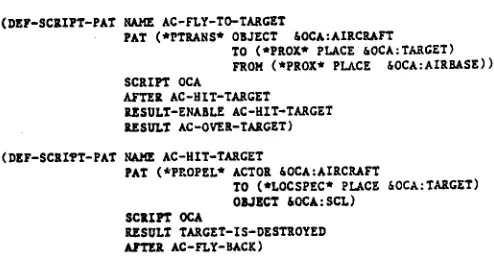
AC-FLY-TO-TARCET m a t c h e s t h e m e a n i n g o f s e n t e n c e s w h i c h r e f e r t o t h e a i r c r a f t f l y i n g t o t h e t a r g e t
f r o m an a i r b a s e . I t r e s u l t s i n t h e a i r c r a f t b e i n g o v e r t h e t a r g e t w h i c h e n a b l e s t h e a i r c r a f t t o a t t a c k t h e t a r g e t . The s c r i p t p a t t e r n
At-HIT-TARGET r e p r e s e n t s t h e p r o p e l l i n g of a w e a p o n
toward t h e t a r g e t . It r e s u l t s i n t h e d e s t r u c t i o n of
t h e t a r g e t , and i s followed by t h e a i r c r a f t f l y i n g b a c k Co t h e a i r b a s e .
The k n o w l e d g e r e p r e s e n t e d by t h e s e s c r i p t p a t t e r n s i s n e e d e d t o a n s w e r t h e q u e s t i o n "What
aircraft at Hahn can strike BE70701?". The answer produced by KNOBS, "Y-15s can reach BE70701 from Hahn.", requires a causal inference and a c o n c e p t
completion inference. The first step in producing this answer is to represent the meaning of the
s e n t e n c e . The c o n c e p t u a l i z a t i o n p r o d u c e d by A P E - I f i s shown i n F i g . 6 a . A s e a r c h f o r a q u e s t i o n
answering p a t t e r n t o answer this fails, so causal inferences are tried. The question concept is identified Co he the AC-HIT-TARGET scene of the 0CA script, and the scene which RESULT-ENABLEs it, AC-FLY-TO-TARGET is instantiafied. This new question conceptualization is displayed in Fig 6b. A question answering pattern whose focus is (OBJECT IS-A) is found which could match the inferred question (Fig. 6c). To enable this pattern to match the inferred question, the FROM case must be inferred. This is a c c o m p l i s h e d by a c o n c e p t
completion inference which produces the complete conceptualization shown in Fig. 6d. Finally, the action and response of the question answering are executed t o calculate and print ~n answer. INTERACTIVE SCRIPT INSTANTIATION
The script patterns which describe the relationships among the scenes of a situation are also used by the KNOBS system to guide a
conversation about that domain. The conversation with KNOBS in Fig. 7 illustrates the entering of plan components by interactively insCantiating script patterns.
The first user s e n t e n c e instantiaces two script patterns ( t h e flying of aircraft, and t h e s t r i k i n g of a t a r g e t ) and b i n d s t h e s c r i p t r o l e s :
TARGET Co BE70501, WING t o 109TFW, AIRCRAFT-NUMBER
t o 4 , and TIME-OVER-TARGET t o 0900. KNOB~ a s k s the u s e r t o s e l e c t t h e AIRCRAFT. B e c a u s e t h e u s e r
replied with a question whose answer is an aircraft, KNOBS asks if the user would like would like t o use c h a t aircraft am a component of the
d e v e l o p i n g p l a n . T h i s i s a c c o m p l i s h e d by a r u l e t h a t i s a c t i v a t e d when KNOBS a s k s t h e u s e r t o s p e c i f y a p l a n c o m p o n e n t . The i n t e r p r e t a t i o n o f t h e u s e r s n e g a t i v e a n s w e r i s h a n d l e d by s r u l e
a c t i v a t e d when KNOBS a s k s a y e s - n o q u e s t i o n . KNOBS c h e c k s t h e c o n s i s t e n c y of t h e u s e r ' s a n s w e r and e x p l a i n s a c o n s t r a i n c w h i c h h a s f a i l e d . T h e n , t h e u s e r c o r r e c t s t h i s p r o b l e m , and KNOBS p r o c e s s e s t h e e x t r a information s u p p l i e d by m a t c h i n g t h e m e a n i n g
of t h e u s e r ' s i n p u t t o a s c r i p t p a t t e r n .
(*PROPEL* TO (*PROX* PLACE (BE70701)) ACTOR (AIRCRAFT IS-A (*?*)
LOC (AT PLACE (HAHN))) OBJECT (NIL)
MODE (*POTENTIAL*))
Figure 6a. The Meaning Representation of "What ~ i r c r a f t at Hahn can strike BE70701?"
(*PTRANS ~ OBJECT (AIRCRAFT IS-A (*?*)
LOt (AT PLACE (HAHN)))
TO (*PROX* PLACE (BE70701))
FROM (*PROX* PLACE (alL)) , MODE (*POTENTIAL*))
Fioure 6b. The Conceot Inferred from 6a.
(What a i r c r a f t at Hahn can go to BE70701?)
( * ~ I ~ S * TO (*PROX* PLACE &TARGET) FROM (*PROX* PLACE &AIRBASE)
OBJECT &AIRCRAFT)
Fiqure 6c. A Question Answering Pattern which could Match 6b.
(*PTRANS* OBJECT (AIRCP.AFT IS-A (*?~)
LOt (AT PLACE (HAHN))) TO (*PROX* PLACE (BET0701))
FROM (*PROX ~ PLACE (HAHN)) MODE (*POTENTIALS))
Fiqure 6d. The Complete Question Conceptualization after
USER: KNOBS: USER: KNOBS:
USEI: EHOBS: USER:
Send 4 a i r c r a f t from the Logcfv co s c : i k s SE7050L at 0900. Whac a i r c r a f t do you vane to use7
What a l r c r a f c are in the I09TI~T The I09TFW has F-4Cs.
WouLd you Like to use F-4Cs for the a i r c r a f t ? NO, F - 4 G s .
The 1 0 ~ r ~ does nOC c o ~ t a i n F-4Gs.
F17 the P-4Gs out of the 126TFW s t Eamscsia. Ftaure 7. A Conversation with ~OSS.
(DEF-ROLE-PAT PAT (AIRCR£YT L0C (*pgOXt PLACE &OCA:AI/t3ASE) PART (PART ARGUMENT &OCA:WING))
SCB.IPT-NOLZ &OCA: AIRCRAFT SCIIPT OCA)
Figure 8. A Script Role Pattern.
A s c r i p t r o l e can be bound by m a t c h i n g a g a i n s t p a t t e r n s a s s o c i a t e d w i t h o t h e r s c r i p t r o l e s in
a d d i t i o n t o m a t c h i n g a g a i n s t s c r i p t p a t t e r n s . F i g . 8 shows a r o l e p a t t e r n a s s o c i a t e d w i t h t h e s c r i p t r o l e AIRCL~YT. T h i s p a t t e r n s e r v e s two p u r p o s e s : t o p r e v e n t b i n d i n g s t o t h e s c r i p t r o l e v h i c h w o u l d n o t make s e n s e ( i . e . , t h e o b j e c t w h i c h p l a y s t h e AIRCRAFT r o l e ~ s t be an a i r c r a f t ) and t o
r e c u r s i v e l y b i n d o t h e r s c r i p t r o l e s t o a t t a c h e d c o n c e p t s . I n t h i s e x e m p l e , t h e AIRBASE o r t h e ~ N C c o u l d be a t t a c h e d t o t h e AIRCRAFT c o n c e p t , e . g . ,
"F-4Cs from Hahn" or "F-dCa in the 126TFW".
The i n t e r a c t i v e s c r i p t i n t e r p r e t e r i s an a l t e r n a t i v e t o t h e menu s y s t e m p r o v i d e d by KNOBS f o r t h e e n t e r i n g o f i m p o r t a n t c o m p o n e n t s o f a p l a n Co be c h e c k e d f o r c o n s i s t e n c y . KNOBS a l s o p r o v i d e s a means of a u t o m a t i c a l l y finishing t h e c r e a t i o n of
a c o n s i s t e n t p l a n . T h i s can a l l o w an e x p e r i e n c e d m i s s i o n p l a n n e r t o e n t e r a p l a n by t y p i n g one o r two s e n t e n c e s and h i t t i n g a key w h i c h t e l l s KNOBS co c h o o s e t h e u n s p e c i f i e d c o m p o n e n t s .
TRANSFERRING DOMAINS
To d e m o n s t r a t e t h e i r domain i n d e p e n d e n c e , t h e KNOBS System and APE-II have b e e n p r o v i d e d w i t h k n o w l e d g e b a s e s t o p l a n and a n s w e r q u e s t i o n s a b o u t n a v a l "show o f f l a g " m i s s i o n s . T h i s v e r s i o n o f KNOBS a l s o u s e s FRL as a d a t a b a s e l a n g u a g e .
A l a r g e p o r t i o n o f t h e q u e s t i o n a n s w e r i n g c a p a b i l i t y was d i r e c t l y a p p l i c a b l e f o r a number o f r e a s o n s . F i r s t o f all, d i c t i o n a r y e n t r i e s f o r f r a m e s a r e c o n s t r u c t e d a u t o m a t i c a l l y when t h e y a p p e a r in a u s e r q u e r y . The d e f i n i t i o n s o f t h e a t t r i b u t e s ( s l o t s ) o f a frame w h i c h a r e r e p r e s e n t e d as RELATIONs a r e a l s o c o n s t r u c t e d when n e e d e d . The
definitions of many common words such as "be", "have", "a", "of", etc., would be useful in understanding questions in any domain. The question answering productions and concept completion inferences are separated into default and domain specific categories. Many of the simple but common queries are handled by default patterns. For example, "Which airbases have fighters?" and "What ports have cruisers?" are answered by the same default pattern. Currently, the Navy version of KNOBS has 3 domain specific question answering
p a t t e r n s , c o m p a r e d t o 22 in t h e A i r F o r c e v e r s i o n . ( T h e r e a r e 46 d e f a u l t p a t t e r n s . ) The m o s t i m p o r t a n t k n o w l e d g e s t r u c t u r e m i s s i n g i n t h e Navy domain is t h e s c r i p t s w h i c h a r e n e e d e d t o p e r f o r m c a u s a l i n f e r e n c e s and d i a l o g d i r e c t e d p l a n n i n g . T h e r e f o r e , t h e s y s t e m can a n s w e r t h e q u e s t i o n "What w e a p o n s d o e s t h e N i m i t z h a v e ? " , b u t c a n ' t a n s w e r ' ~ i h a t w e a p o n s d o e s t h e NimiCz c a r r y ? " .
CONCLUSION
We h a v e a r g u e d t h a t t h e p r o c e s s i n g o f n a t u r a l l a n g u a a e d a t a b a s e q u e r i e s s h o u l d be d r i v e n by t h e m e a n i n g o f t h e i n p u t , a s d e t e r m i n e d p r i m a r i l y by t h e e m a n i n s s o f t h e c o n s t i t u e n t w o r d s . The zuechanisms p r o v i d e d f o r word s e n s e s e l e c t i o n and f o r t h e i n f e r e n c e o f m i s s i n g m e a n i n g e l e m e n t s u t i l i z e a v a r i e t y o f k n o w l e d g e s o u r c e s . I t i s b e l i e v e d Chat t h i s a p p r o a c h w i l l p r o v e more g e n e r a l and e x t e n s i b l e t h a n t h o s e b a s e d c h i e f l y on t h e s u r f a c e s t r u c t u r e o f t h e n a t u r a l l a n g u a g e q u e r y .
ACKNOWLZDGENEI~ S
We would l i k e t o t h a n k Tom F a w c e t t , Bud F r a w l e y , F r a n k J e r n i g a n , and E t h a n S c a r l f o r t h e i r CO1vementS.
T h i s work was s u p p o r t e d by USAF E l e c t r o n i c s S y s t e m D i v i s i o n u n d e r A i r F o r c e c o n t r a c t
F 1 9 6 2 8 - 8 2 - C - 0 0 0 1 .
KEFERENCES
B i r n b a u m , L . , and S e l f r i d g e , M., " C o n c e p t u a l A n a l y s i s , " i n Ins%de A r t i f i c i a l I n t e l l i 2 e n c e : F i v e
Proera~# Plus Miniatures. Schank, R., Riesbeck, C.
K. ( w a s ) , L a w r e n c e E r l b a u m A s s o c i a t e s , N i l l s d a l e ,
NJ, 1981.
C h a r n i a k , E . , " S i x T o p i c s in S e a r c h o f a P a r s e r : An
Overview of AI Language Research," in Proceeds o_.~f th..._ee 7~h International Joint Conference o__nn
Artificial Intelli2ence, Vancouver, 1981. Cullingford, R., "Script Application: Computer Understanding of Newspaper Stories," Research Report I16, Department of Computer Science, Yale
U n i v e r s i t y , 1978.
Engelman, C., S c a r l , E., and Berg, C., " I n t e r a c t i v e Frame I n s t a n t i a t l o n , " in Proc. of The Firs~ Annual Confere~c~ on A r t i f i ; ~ a l I n t e l l i g e n ; ~ , S t a n f o r d ,
1980.
Goldman, N., "Conceptual Generation," in Conceptual Information Processing. Schank, R. (ed),
Ninth-Holland Publishing Company, 1975.
Grosz, B., "The Representation and Use of Focus in
D i a l o g Understanding," SRI T e c h n i c a l Note 151, 1977.
Hendrix, G. G., S a c e r d o t i , E. D., Sagalowicz, D., and Slocum, J . , '*Developing a Natural Language
Interface t o Complex Data." Association for Computing Machinery Transactions on Database Systems. Volume 3, Number 2, June 1978.
Katz, J . S. and Fodor, J. A., "The S t r u c t u r e of Semantic Theory," Language. 39, 1963.
Lehnert, W., Th_...ee Process of Question Answering. A Comvuter Simulation of Cognition. Lawrence Erlbaum
A s s o c i a t e s , I n c . , 1978.
Reisbeck, C., and Schank, R. Co, "Comprehension by Computer: E x p e c t a t i o n Based Analysis of Sentences
in Context," Research Report #78, Department of Computer Science Yale University, 1976.
Roberts, R. Bruce, and Goldstein, Ira P., "The FRL Manual," MIT AI Lab. Memo 409, September 1977.
Schank, R., "Conceptual Dependency: A Theory of
Natural Language Understanding," Co2nitive PsvcholoxT. Vol. 3, No. 4, 1972.
Small, S . , "Word Expert Parsing: A Theory of D i s t r i b u t e d Word-Based Natural Language Understanding," TR-954, U n i v e r s i t y of Maryland
1980.
Wilks, Y., Grammar. Meaning ~ The Machine Analysis of LanguaRe. London, 1972.
Woods, W. A., Kaplan, R. M., and Nash-Webber, B.,