638
©IJRASET: All Rights are Reserved
Capacity Achieving Forward Error Correcting
Codes
Gaurav Beniwal1, Jatin Gaur2 1Student, ECE Department
2Assistant Professor, ECE Department Bhagwan Parshuram Institute of Technology
Abstract: We present a comparative study of the performance of various polar code constructions in an additive white Gaussian noise (AWGN) channel. A polar code construction is any algorithm that selects K best among N possible polar bit-channels at the design signal-to-noise-ratio (design-SNR) in terms of bit error rate (BER). Optimal polar code construction is hard and therefore many suboptimal polar code constructions have been proposed at different computational complexities. Polar codes are also non-universal meaning the code changes significantly with the design-SNR. However, it is not known which construction algorithm at what design-SNR constructs the best polar codes. We first present a comprehensive survey of all the well-known polar code constructions along with their full implementations. We then propose a heuristic algorithm to find the best design-SNR for constructing best possible polar codes from a given construction algorithm. The proposed algorithm involves a search among several possible design-SNRs. We finally use our algorithm to perform a comparison of different construction algorithms using extensive simulations. We find that all polar code construction algorithms generate equally good polar codes in an AWGN channel, if the design-SNR is optimized.
Index Terms: Bhattacharyya bounds, bit-channels, polar codes, Encoding, Decoding
I. INTRODUCTION1
Polar codes have been the subject of active research in recent times, mainly due to the fact that they are the first ever provably capacity achieving codes, with explicit construction and very low complexity of encoding and decoding. The polar codes were introduced by Erdal Arikan[1], using a novel concept called channel polarization. Soon after, both the concept of channel polarization as well as polar codes have been extended to a number of applications and generalizations.
Let us consider a binary input discrete memoryless symmetric (BI-DMS) channel. Channel polarization is a technique by which one manufactures N polarized channels (called bit channels) out of N identical independent copies of BI-DMS channels. The channels are polarized without any loss of capacity, in the sense that they are either extremely noisy or noiseless as N → ∞. Then one can easily achieve a rate of transmission close to capacity, simply by choosing to transmit over only the good bit-channels. However, at any finite block length N and rate R , K/N, a ranking algorithm for the bit-channels according to their bit error rate (BER) becomes necessary to select K good channels out of N. Here, K is the number of information bits in each code word of length N. This selection of bit-channels completely defines a polar code and therefore is called the polar code construction[1].
The polar code construction is critical to obtain the best performance at finite block lengths. As we mentioned, the polar code construction has an explicit definition in theory.
It is challenging in practice because precise estimation of the bit channels is intractable. Therefore ,a wide range of approximate construction methods are proposed.
639
©IJRASET: All Rights are Reserved
II. CHANNELCODINGPRELIMINARIES
A. Channel Models
A channel is defined mathematically as a set of possible inputs to the channel X, a set of possible outputs to the channel Y, and a
conditional probability distribution on the set of the outputs conditioned on the set of the inputs W(y|x) [1]. The simplest class of
channels are discrete memoryless channels (DMC).
B. Parameters
We define the important parameter of symmetric B-DMC’s: Bhattacharyya parameter.
The Bhattacharyya parameter is a measure of the reliability of a channel since Z(W) is an upper bound on the probability of maximum-likelihood (ML) decision error for uncoded transmission over W.
C. Channel Combining
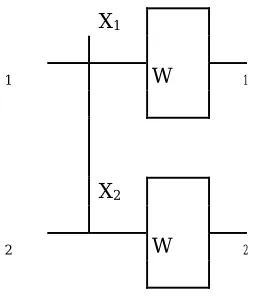
In this phase, copies of a B-DMC are combined in a recur-sive manner in n steps to form a vector channel WN , where N = 2n. The
[image:2.612.237.364.322.470.2]basic transformation used in channel combining is the following.
Fig 1: Combining of two channels
D. CHANNEL TRANSFORMATION
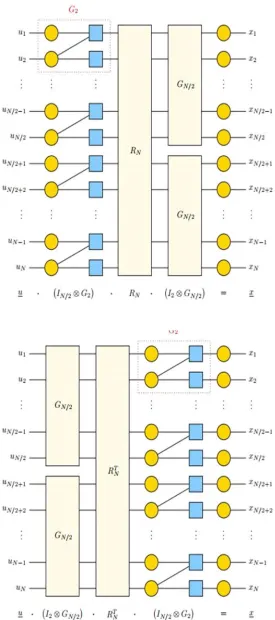
We have defined a blockwise channel combining and split-ting operation by which transformed independent copies of WN. The goal in this section is to show that this blockwise channel transformation can be broken recursively into single-step channel transformations.
Fig 2: The channel transformation process with 8 channels. 1
X1
1 W
X2
[image:2.612.205.406.565.715.2]640
©IJRASET: All Rights are Reserved
III. POLARCODES
Given any subset of indices I of elements of a vector x, we denote the corresponding sub-vector as xI. Similarly, when I denotes the indices of columns of a matrix A, the corresponding sub-matrix is denoted AI.
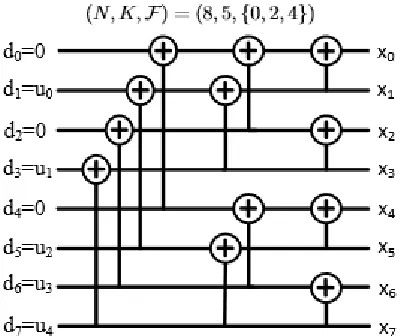
A polar code may be specified completely by (N; K; F),
where N is the length of a code word in bits, K is the number of information bits encoded per codeword, and F is a set of N K integer indices called frozen bit locations
[image:3.612.205.405.208.376.2]Encoding — For an (N,K,F) polar code we describe below the encoding operation for a vector of information bits u of length K. The rate of the code is R = K/N. Let log2(N) and F⊗n = F⊗···⊗F (n copies) be the n-fold Kronecker product of Arikan’s standard polarizing kernel[1].
Fig 3: Illustration of Arikan’s O(N log2 N) complexity encoder implementation of (2) with (N,K,F) = (8,5,{0,2,4})
Without loss of generality, we normalize the noise variace to be unity for the AWGN in all our future discussions. Successive Cancellation Decoder (SCD) — The SCD algorithm [1] essentially follows the same encoder diagram in Fig.3 using decoding operations that resemble one iteration of the classic belief propagation algorithm. The likelihoods evolve in the reverse direction from right-to-left, using a pair of likelihood transformation equations, as illustrated with an example .Then the bit decisions are made at the left end of the circuit and broadcasted to the rest of the circuit. A complete pseudocode for implementing an SCD is available . The overall complexity is only O(N log2 N). The Polar Code Construction — The choice of the set F is a critical step in polar coding (i.e. the polar code construction). This corresponds to the selection of best K bit-channels among N, in terms of the bit error rate (BER) at a given value of (REb/N0) defined as the design-SNR[2].
At first it was proposed to find the bit channels by evaluating of their full finite alphabet distributions. The algorithm becomes intractable due to the explosion of the alphabet size to a power of N by the end of n channel transformations. This problem is specifically addressed in [3] by employing a novel low complexity close-to-optimal quantizer. In addition, they provide theoretical guarantees for the loss of performance due to the quantization. Note that, some channels are better estimated by simple bounds on Bhattacharyya parameters.
The algorithm is extendable to infinite output channels by using a quantization algorithm. The initialization of the algorithm involves the AWGN channel quantization to µ symbols, which takes an additional O(µ) complexity. Overall, this algorithm has the second largest complexity. For AWGN channels, the estimation of bit-channels based on Gaussian approximation is proposed. This enables to use the Gaussian distribution approximations on the intermediate likelihoods. This was found to well-approximate the actual bit-channels of polar codes[2].
The Gaussian approximation algorithm takes a complexity of O(N) function computations (excluding the selection of K best among N metrics obtained) similar to the Bhattacharyya bounds based algorithm, but involves relatively higher complexity function computations. Overall, this construction algorithm enjoys the second least complexity.
641
©IJRASET: All Rights are Reserved
IV. THECODINGALGORITHM
The coding algorithm for the Bhattacharyya parameters is being stated where when the rate is high enough, the construction works well, since the good channels are always chosen for the information transmission. This avoids the need of any comparison among the good channels. On the other hand, when the rate is very low, the choice will only be among channels that tend to be very good. In that case, any choice would result in approximately the same performance.
V. CHANNELENCODING
Polar codes are linear codes, i.e., any linear combination of codewords is another codeword of the code. The polar transform is to apply the transform G2⊗n the nth Kronecker power of G2 to the block of N = 2n bits U[4].
[image:4.612.186.429.448.609.2]The encoder chooses a set of NR rows of the matrix Gn to form a NR×N matrix which is used as the generator matrix in the encoding procedure[5]. The way this set is chosen is dependent on the channel W and uses a phenomenon called channel polarization which is described later. Using the fast transform methods in signal processing, it is easy to show that the complexity of the polar encoder is O(N logN).
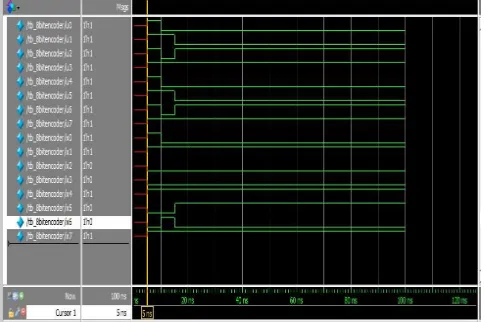
Fig 4: Output waveform for channel encoder
VI. CHANNELDECODING
The decoder generates an estimate uN by observing the channel output yN. The decoder takes N decisions for each u
i. If ui is a frozen bit, the decoder will fix ui to its known value[6][8]. If ui is an information bit, the decoder waits to estimate all the previous bits, and then computes it.The decoder has an complexity of O(N logN) [7][9].
642
[image:5.612.185.460.90.710.2]©IJRASET: All Rights are Reserved
643
[image:6.612.183.425.77.225.2]©IJRASET: All Rights are Reserved
Figure 6: Factor graph for polar decoding
As there exists a considerable gap between the error probability of the SC decoder and the MAP decoder. Unfortunately, the complexity of a MAP decoder in general (except for the BEC) is exponential in block-length. Therefore, an important question is that whether one can modify the SC decoder such that this gap decreases while we still have a low-complexity decoder[11].
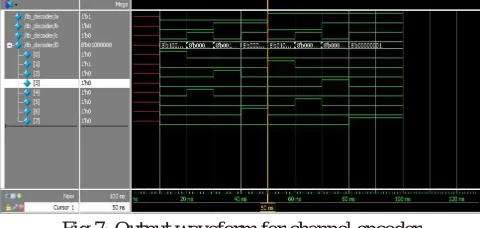
The waveform obtained for the channel decoder for various inputs is depicted in figure 7.
Fig 7: Output waveform for channel encoder
VII. CONCLUSION
A fascinating aspect of Shannon’s proof of the noisy channel coding theorem is the random-coding method that he used to show the existence of capacity-achieving code sequences without exhibiting any specific such sequence. Explicit construction of provably capacity-achieving code sequences with low encoding and decoding complexities has since then been an elusive goal.
It has been seen that polar codes help in achieving capacity of the channel. The preliminary conclusion of this is that polar codes can outperform the FEC currently used in communications systems. Polar codes may also be able to outperform other codes that could be used to replace the current codes. Polar codes are more likely to be useful at higher data rates. Further research is needed to test polar codes, using more realistic models of systems and their RF environments.
REFERENCES
[1] E. Arıkan, “Channel Polarization: A Method for Constructing Capacity-Achieving Codes for Symmetric Binary-Input Memoryless Channels,” IEEE Trans. Inf. Theory, vol. 55, no. 7, pp. 3051–3073, Jul. 2009
[2] S. B. Korada, “Polar Codes for Channel and Source Coding,” Ph.D. dissertation, EPFL, Lausanne, Switzerland, Jul. 2009 [3] I. Tal and A. Vardy, “How to Construct Polar Codes,” talk given in Information Theory Workshop, Dublin, Aug. 2010.
[4] S. H. Hassani, S. B. Korada, and R. Urbanke, “The Compound Capacity of Polar Codes,” Proceedings of Allerton Conference on Communication, Control and Computing, Allerton, Sep. 2009
[5] R. Mori and T. Tanaka, “Performance and Construction of Polar Codes on Symmetric Binary-Input Memoryless Channels,” Proceedings of ISIT, Seoul, South Korea, Jul. 2009, pp. 1496–1500
[6] T. Richardson and R. Urbanke, “Modern Coding Theory,” Cambridge University Press, 2008
[7] E. Arıkan, E. Telatar, “On the Rate of Channel Polarization,” Proceedings of IEEE International Symposium on Information Theory, Seoul, Jul. 2009. [8] R. E. Blahut, Theory and Practice of Error Control Codes. Reading, MA: Addison-Wesley, 1983
[9] I. Reed, “A class of multiple-error-correcting codes and the decoding scheme,”IRETrans.Inf.Theory,vol.IT-4,no.3,pp.39–44,Sep.1954. [10] S. Lin and D. J. Costello, Jr., Error Control Coding, 2nd ed. Upper Saddle River, N.J.: Pearson, 2004.
[image:6.612.186.426.301.415.2]