L F P : A LOGIC FOR LINGUISTIC DESCRIPTIONS AND
AN ANALYSIS OF ITS COMPLEXITY
William C. R o u n d s
Electrical Engineering and Computer Science Department University of Michigan
Ann Arbor, MI 48109
We investigate the weak expressive power of a notation using first-order logic, augmented with a facility for recursion, to give linguistic descriptions. The notation is precise and easy to read, using ordinary conventions of logic. Two versions of the notation are presented. One, called CLFP, speaks about strings and concatenation, and generates the class EXPTIME of languages accepted by Turing machines in time 2 c" for some c > 0. The other, called ILFP, speaks about integer positions in strings, and generates the class PTIME of languages recognizable in polynomial time. An application is given, showing how to code Head Grammars in ILFP, showing why these grammars generate only polynomial time languages.
1 FIRST-ORDER LOGIC AS A TOOL FOR SYNTACTIC DESCRIPTION
In this paper we investigate the properties of a new notation for specifying syntax for natural languages. It is based on the simple idea that first-order logic, though inadequate as a semantics for natural language, is quite adequate to express relations between syntactic constit- uents. This is the insight behind definite clause gram- mars (DCGs) (Pereira and Warren 1980) and, in fact, our notation is in some ways a generalization of that nota- tion. However, we have tried to keep our formalism as much as possible like that of standard textbook first- order logic. There are actually two versions of our notation. The first works with strings of symbols and uses concatenation as a primitive operation. The second works with integers and takes the standard arithmetic operations as primitive. These integers can be regarded as indexing positions of morphemes in a sentence, but the sentence itself is not explicitly referenced. Both versions allow the recursive definition of predicates over strings and integers. This capacity for recursive definition is what gives our grammars their generative ability, and our notation has this feature in common with DCGs. However, we liberate DCGs from the Horn clause format, and we do not base the semantics of our notation on the semantics for Prolog or for logic pro- grams. We hope that making the logic more familiar and readable will encourage more people to use logic as a means for specifying desired syntactic relations be-
tween sentential constituents in grammars. Anyone knowing the standard conventions of first-order logic should be able to read or to specify a grammar in our notation.
We also provide a precise semantics for our two notations. This involves using the least-fixed-point op- erator from denotational semantics for programming languages to explain the recursive definition of predi- cates. It involves as well using restricted universal and existential quantification to restrict the class of defin- able predicates (sets of strings). We prove a complexity theoretic characterization for both grammar formal- isms: (1) the formalism using strings and concatenation defines exactly the class EXPTIME of formal languages recognizable by deterministic Turing machines within time T ( n ) = 2 en for some positive c; and (2) the formalism using integers defines exactly the class PTIME of languages recognizable in time T ( n ) = n k for some integer k.
As an application of the second notation we sketch a natural way to write Head Grammars (Pollard 1984). Because these grammars can be expressed in this way, we immediately obtain the result that head languages can be recognized in polynomial time. We even obtain an estimate of the degree of the polynomial that is required, derived directly from the form of the gram- matical description. Unfortunately, the estimated de- gree is at least twice as large as is actually necessary if one uses the algorithm of Pollard (1984), or Vija-
Copyright 1988 by the Association for Computational Linguistics. Permission to copy without fee all or part of this material is granted provided that the copies are not made for direct commercial advantage and the CL reference and this copyright notice are included on the first page. To copy otherwise, or to republish, requires a fee and/or specific permission.
0362-613X/88/01001-9503.00
William C. Rounds LFP: A Logic for Linguistic Descriptions and an Analysis of its Complexity
yashanker and Joshi (1985). We conjecture that in fact, this factor of (2) can be removed.
Our complexity theoretic characterizations are ver- sions of theorems already appearing in the literature. Shapiro (1984) characterizes the class of languages definable by logic programs with a linear space restric- tion as the class EXPTIME. The proof of our first theorem is very much like his. Our second theorem characterizing PTIME can be viewed as a specialization of the results of Chandra and Harel (1982), Immerman (1982), and Vardi (1982), who show that the class of sets of finite mathematical structures definable by formulas of first-order logic augmented with a least-fixed-point operator is just the class of sets of structures recogniz- able in polynomial time. We prove both of our results in the same way, and thus show how these apparently unconnected theorems are related. The proof uses the notion of alternating Turing machines, and thereby explains the significance of this idea for the science of formal linguistics.
We should also note that our notation will not find immediate application in current linguistic theory, be- cause it does not allow structural descriptions to be described. We are in the process of extending and modifying the notation for this purpose. However, we think it is important to explicate the properties of the individual operations used in building strings and struc- tures. Our first attempt is therefore to understand how concatenation of strings can be expressed in a restricted logic. We can then consider other predicates or func- tions on both strings and treelike structures in the same uniform way.
2 C L F P GRAMMARS" GRAMMARS BASED ON CONCATENATION THEORY
2.1 SYNTAX OF CLFP
We present a standard version of the first-order theory of concatenation, augmented with the least-fixed-point operator. Before proceeding with the formal descrip- tion, we give an example to illustrate the scheme we have in mind. Consider the following context-free frag- ment, adapted directly from Johnson (1985).
S --~ NP VP NP --~ Det Noun VP--> V NP
Det--> NP[+Gen] [ the
Here is the corresponding CLFP fragment: S(x) <:~ : 4 y z . N P [ - G e n ] ( y ) A VP(z) /k x = yz;
N P [ c a s e ] ( x ) <:~ :lyz.Det(y) /k Noun[case](z) /k x = yz;
VP(x) ¢:~ 3 y z . V ( y ) /k N P [ - G e n ] ( z ) /k x = yz;
Det(x) <:> N P [ + G e n ] ( x ) V x = the.
In this formulation, x , y , and z range over strings of symbols (morphemes) and N P , V P , etc. are predicates over strings. The second clause is here an abbreviation for two clauses, where case can take two values, namely + Gen and - G e n . At present we do not treat the problem of calculating complex feature structures, but there seems to be no reason that the notation cannot be suitably extended.
This; example illustrates the most complex case of a CLFP formula. It is a recursion scheme, which assigns to predicate variables, S , N P , etc. certain formulas (the right-hand sides of the corresponding clauses in the definition). The whole scheme is understood as the simultaneous recursive definition of the predicate vari- ables in the left sides of the definition. To handle the fact that string variables occur on the left-hand side of each clause, we will understand each clause as a func- tion assigning both the formula on its right and the set of individual variables mentioned on the left to the given predicate symbol.
We now proceed with the formal definition of CLFP. Let Ivar be a set {Xo,X i . . . . } of individual variables ranging over strings. Let ~ be a finite set of terminal symbols. These are the constants of our theory. A is another constant denoting the null string. Terms are built from variables and constants using the binary operation of concatenation. We also require a set Pvar of predicate variables, listed as the set {PI,PE . . . . }. Each predicate variable P is equipped with an arity ar(P), indicating the number of individual arguments that a relation assigned to this variable will have. (The example CLFP scheme given above employs only unary predicate variables S , N P , V P , and Det.) The set of CLFP formulas is given by the following inductive clauses.
1. If P ~ Pvar and (x I . . . x n) is a sequence of Ivar with length n = ar(P) then P(x~ . . . xn) is in CLFP; 2. If t~ and t a are terms, then t I = t a is in CLFP; 3. If x E Ivar and ~b is in CLFP then 3x~b and Vx~b are
in CLFP;
4. The usual Boolean combinations of CLFP formulas are in CLFP.
5. This clause requires more definitions. Let f i be a finite nonempty subset of Pvar with a distinguished element S ~ fit. Let (I) : f i --) ~'(Ivar) x C L F P . ((I)(R) is going to be the defining clause for the predicate R.) If (9(R) = (X,~b), then we define B ~ ( R ) = X , and C(I~(R) = (h- We require that
IB~(R)I
= at(R) and thus be a finite set of individual variables. Now we say that the whole map (I) is a recursion scheme iff each P E f i occurs only positively in cI)(R) for any R E fi; that is, within the scope of an even number of negation signs. Finally, condition 5 states that if (I) is a recursion scheme, with distinguished variable S, t h e n / z S ~ (the least fixed point of ~) is in CLFP. Example 1. Consider the following scheme, which de- fines a regular language.William C. Rounds LFP: A Logic for Linguistic Descriptions and an Analysis of its Complexity
S ( x ) ¢~ 3 y ( ( x = a y /~ (S(y)) V (x = b y A T(y))) V x = a
T(v) ¢~ 3 w ( v = c w A S(w)).
In this example, fit = {S, T}, BOP(S) = {x}, and
COP(S) = 3 y ( ( x = a y A ( S ( y ) ) V (x = b y / ~ T(y)))
k~/X :-- a . Similarly, BOP(T) = {v}, and COP(T) is the second formula in the scheme.
In the example, we have written our recursion scheme in a conventional style to emphasize its direct connection to the usual grammatical presentations. Thus the variable x is bound by the left-hand side of (1), so this clause has been written with S ( x ) on the left to make this fact apparent. Also, the use of the <:¢, sign is conventional in writing out OP. In our example, the first clause is taken as defining the distinguished predicate S of our scheme. Finally, there are no occurrences of free predicate variables in this example, but there are in our first example (e.g., n o u n ) .
The usual rules for calculating free individual varia- bles apply; if Fvar(qb) is the set o f free variables of ~b, then F l v a r ( P ( x l . . . xn)) = {xl . . . x,,}. The quantifier and Boolean cases are handled as in standard text presentations. However, if OP is a recursion scheme then
Flvar(/zSOP) will be calculated as follows. For each R fit, find Fvar(COP(R)). R e m o v e from this set any varia- bles in BOP(R). The union o f the resulting sets for each R E fit is defined to be the set Flvar(/zSOP).
The rules for free predicate variables are a bit sim- pler. In the atomic formula P(x~ . . . x , ) , P is a free predicate variable. In a recursion scheme OP with do- main fit, the set FPvar(/zSOP)) is the union of the sets
F P v a r ( / z S O P ( R ) ) ) , minus the set fit.
A final remark on notation: we will use the notation ~ t ~ , . . . , t,) to stand for the formula
3 x l . . . 3 x , ( ~ x l . . . xn) A x l = tl A . . . A x~ = t , )
where the ti are terms, and the xl are individual variables not appearing in any ts. This will not affect our com- plexity results in any way.
2.2 SEMANTICS FOR CLFP
We borrow some notation from the Oxford school of denotational semantics to help us explain the meaning of our logic grammars. I f X and Y are sets, then IX--> Y] is the set o f functions from X to Y. L e t A = [Ivar ~ ~*] be the set of assignments of values to individual varia- bles. We wish to define when a given assignment, say or, satisfies a given C L F P formula ~b. This will depend on the meaning assigned to the free predicate variables in ~b, so we need to consider such assignments. L e t P A be the set of maps p from Pvar to the class of relations on I£* such that the arity of p(P) is a r ( P ) . We are now ready to define for each formula ~b and predicate assignment p, the set At[[~b]]p C A of individual assignments satisfying ~b with respect to p.
1. ~ e ( x , , . . . , x , ) n p = (~ I (a(x,) . . .
a(x,,)) ~
p(e)};2. A~t, = t21]O = ( a l tl a = t2a}, where t a is the evaluation of t with variables assigned values by a; 3. ~t[[3x~b]lp = {a[ 3u E E* : a ( x / u ) ~ ~tff~bl]p}, and
similarly for universal quantification;
4. kt[dpVqJ]] p = At[[4~]]pUAt[[~b]]p, and similarly for other Boolean connectives.
5. a~/zs~p = {a I (ak)(~ e ~c~k(s)~p)}
where, for each k, opk is a recursion scheme with the same domain fit as OP, and is defined as follows by induction on k. First, we stipulate that for each P e fit, the set BOPr(P) = BOP(P). Then we set
COP°(P) = COP(P)[R * - F A L S E : R ~ fit]; COPk+t(P) = COP(P)[R ~ COPk(R) : R E fit]
where the notation ~ R ~ 0(R) : R E fit] denotes the simultaneous replacement of atomic subformulas
R ( w l . . . wk) in q, (where R is a free occurrence) by the formula O(R)(wl . . . wk), in such a way that no free occurrences of other variables in 0(R) are captured by a quantifier or a/z-operator in ~b. (We m a y always change the bound variables of qJ first, to accomplish this.)
This definition appears much more clumsy than it really is, and we continue our example to illustrate it. Refer to the example of a regular grammar in the previous section. In the clause for S we are required to substitute the formula F A L S E for occurrences of both S and T. This gives, after simplification,
COP°(S)(x) = (x = a).
Similarly, substitution of F A L S E into the clause for T gives OP°(T)(v) = F A L S E . N o w substitution of these new formulae for S and T into OP gives (after simplifica- tion):
COPI(S)(x) = 3 y ( x = a y A x = a) V x = a; COPI(T)(v) = 3 w ( v = c w A w = a).
It is easy to see that continuing this process will simulate all possible derivations in the grammar, and also that it explains the meaning of the scheme OP in terms of the meaning of subformulas.
Some remarks are in order to explain w h y we use the term "least-fixed-point", and to explain why, in a recursion scheme, all occurrences of recursively called predicates are required to be positive. L e t OP : fit ---> C L F P be a recursion scheme. Define the map /~OP] :
P A --> P A as follows. If R E fit, then
(u~ . . . u,,> ~ ~qopIlo(R) ¢~ (3,~ ~ ,,~op(R)~p)(a(x~)
= ui)
where (xl . . . x,) is the sequence of variables in
BOP(R), listed in increasing order of subscripts. If R fit, then ~OP]p(R) = p(R). Next, let
~/~/zROP]]p = k->["Jl I~OP]](k)(P[R ~'- O : R ~ fit])
William C. Rounds LFP: A Logic for Linguistic Descriptions and an Analysis of its Complexity
where unions are coordinatewise, F ~k) is the k-th iterate of F, and p[R <--- ~ : R ~ ~ ] is p with the e m p t y relation assigned to each predicate variable in fit. This formula is just the familiar least-fixed-point formula Uk_>~ F(~)(-1-) from denotational semantics. Then we can c h e c k that ~tzSgP]]p is in P A , and is the least fixed point of the continuous map ~qb]~. It is then possible to prove that
J C [ ~ S ~ p = ( ~ S , ~ p ) ( S )
where S is the distinguished predicate variable in fit. If we had no conditions on negative formulas in recursion schemes, then we could entertain schemes like
S(x) ~ 7 S(x)
which, although they would receive an interpretation in our first definition, would give a T which was not continuous, or e v e n monotonic. We therefore exclude such cases for reasons o f smoothness.
N e x t we c o m e to the definition o f the language or relation d e n o t e d by a formula. A k-ary relation P on E* is said to be definable in C L F P iff there is a C L F P formula th with no free predicate variables such that
(Ul . . . /'/k) E P <:~ 3 a E kt[[th]]:(a(x0 . . . a(xk)) = (ul . . . Uk), w h e r e xl . . . xk is the list o f free variables in ~b arranged in increasing o r d e r o f subscript. (Notice that the p a r a m e t e r p has been omitted since there are no free predicate variables in ~b.)
So far, we have not restricted quantification in our formulas, and e v e r y r.e. predicate is definable. We need to add one o t h e r p a r a m e t e r to the definition o f J(, which will limit the range o f quantification. This will be an integer n, which will be the length o f an input sentence to be recognized. T h e o c c u r r e n c e s o f the formula .~t[[~b]p will thus be changed e v e r y w h e r e in the a b o v e clauses to At[~b]pn. The only change in the substance of the clauses is in the rule for existential and universal quantification.
~t~3x~b]pn = {~ I 3 u ~ :~* : [ul -< n A ,~(x/u)
A predicate P is said to be boundedly definable iff for some 4~:
(Ul . . . uk) ~ P ¢:> 3 a E kt~¢]]n : (a(x 0 . . . a(xk)) = (ul . . . u~)
w h e r e n = max([uiD. (To abbreviate the right-hand condition, we write (ul . . . uk) ~ ~b). Our first t h e o r e m can now be stated.
T h e o r e m 1. A language (unary predicate) is bound- edly definable in C L F P iff it is in E X P T I M E . We defer the p r o o f to the next section.
3 E X P T I M E AND C L F P
3.1 ALTERNATION
Before proving T h e o r e m 1, we need to discuss the m e t h o d o f p r o o f both for this result and for the Integer L F P characterization o f P T I M E in the next section.
This material is repeated from the fundamental article of Chandra, K o z e n , and S t o c k m e y e r (1981). T h e i r paper should be consulted for the full details o f what we state here.
An alternating Turing machine can be regarded as a Turing machine with u n b o u n d e d parallelism. In a given state, and with given tape contents, the machine can spawn a finite n u m b e r o f successor configurations ac- cording to its transition rules. T h e s e configurations are thought of as separate processes, each of which runs to completion in the same way. A completed process is one which is in a special accepting state with no successors. The results of the spawned processes are reported back to the parent, which combines the results to pass on to its own parent, and so forth. H o w the parent does this depends on the state o f the finite control. T h e s e states are classified as being either existential (OR), universal (AND), negating (NOT), or accepting. If the parent is in an existential state, it reports back the logical OR of the results of its off- spring. If it is in a universal state, it reports back the logical AND; if the state is negating, the parent reports the negation of its one offspring. An accepting state generates a logical 1 (TRUE) to be r e p o r t e d back. Thus a nondeterministic TM can be regarded as an alternating T M with purely existential states.
An alternating TM is defined as a tuple in a standard way. It has a read-only input tape with a head capable of two-way motion. It also has a fixed n u m b e r of work tapes. The input tape contains a string u E E*, while the work tapes can use a tape alphabet F. The transition relation 6 is defined as for ordinary nondeterministic TMs. The state set is partitioned as described a b o v e into universal, existential, negating, and accepting states. The relation 6 is constrained so that existential and universal states have at least one successor, negat- ing states have exactly one successor, and accepting states have no successors. A configuration is then just a tuple describing the current state, positions o f the heads, and tape contents as is familiar. The initial configuration is the one with the machine in its initial state, all the work tapes empty, and the input head at the left end of the input u. The successor relation I- between configurations is defined again as usual.
T o determine whether or not a configuration is ac- cepting, we p r o c e e d as follows. Imagine the configura- tions that succeed the given one arranged in a tree, with the given configuration at the root. At each node, the immediate descendants o f the configuration are the successors given by F. The tree is truncated at a level determined by the length o f the input tape (this trunca- tion is not part o f the general definition but will suffice for our results.) The leaf nodes o f this tree are labeled with (0) if the configuration at that node is not accept- ing, and with (1) if the configuration is accepting. The tree is then evaluated according to the description given above. The configuration at the root is accepting iff it is labeled (1) by this method. Thus an input is a c c e p t e d by
William C. Rounds LFP: A Logic for Linguistic Descriptions and an Analysis of its Complexity
the machine iff the initial configuration with that input is accepting. In our application, it will always suffice to cut off the tree at level 2 on, where n is the length of the input string, and c is a positive constant depending only on the description o f the machine.
We say that an alternating T M is S(n) space bounded iffin the above tree, for any initial configuration labeling the root, no auxiliary tape length ever exceeds S(n) where n is the length o f the input. We are c o n c e r n e d only with the functions S(n) = log n and S(n) = n in this paper. We let the class A S P A C E ( S ( n ) ) be the class of languages a c c e p t e d by space-bounded ATMs in this way. We then have the following t h e o r e m (Chandra, K o z e n , S t o c k m e y e r 1987):
L e m m a 1. If S(n) >- log n, then
A S P A C E ( S ( n ) ) = [,.J D T I M E ( 2 cs¢m) c > 0
where DTIME(T(n)) is the class o f languages accepted deterministically by ordinary Turing machines within T(n) steps.
Our problem in the rest o f this section is to show how linear space bounded A T M s and C L F P grammars sim- ulate each other. T o facilitate the construction o f the next section, it is c o n v e n i e n t to add one feature to the definition o f alternating Turing machines. L e t U be the name o f a k-ary relation on E*. We allow machines to have oracle states o f the form U?(i I . . . ik), where the ij are tape numbers. If now the predicate U is interpreted by an actual relation on E*, then when M executes such an instruction, it will accept or reject according to w h e t h e r the strings on the specified tapes are in the relation U. We will need such states to simulate recur- sive invocations o f recursion schemes. It is not hard to modify the definition o f a c c e p t a n c e for ordinary ATMs to that for oracle ATMs. T h e language or relation accepted by the A T M will now o f c o u r s e be relative to an assignment p o f relations to the predicate names U. The next subsections contain our constructions for the C L F P characterizations. Then, in Section 4 we will treat Integer L F P grammars and show how these gram- mars and logspace b o u n d e d ATMs simulate each other. As a c o n s e q u e n c e o f the above lemma, we will then have our main results.
3.2 PROOF OF THEOREM 1
Our first task is to show that if a language L is (boundedly) CLFP-definable, then it can be recognized by a linear space b o u n d e d ATM. The idea is simple. Given an input string, o u r machine will try to e x e c u t e the logical description of the grammar. Its states will c o r r e s p o n d to the logical structure o f the C L F P for- mula. If that formula is, for example, the logical A N D o f two subformulas, then the part of our machine for that formula will have an A N D state. A recursion scheme will be e x e c u t e d with states corresponding to the pred- icate variables involved in the recursion, and so forth.
T o give an explicit construction o f an A T M corre-
sponding to a formula 4, o f C L F P we need to be precise about the n u m b e r o f work tapes required. This will be the sum of the n u m b e r o f free individual variables o f 4,, and the number of " d e c l a r a t i o n s " o f bound variables in 4,. A " d e c l a r a t i o n " is either the o c c u r r e n c e of a univer- sal or existential quantifier in 4,, or one o f the individual variables bound on the left side o f a (non-S) clause in a recursion scheme. If that clause defines the predicate R, then the number of variables declared at that point is ar(R) = [Bqb(R)l. We thus define the n u m b e r /3(4,) o f declarations o f bound variables in 4' by induction as follows:
1. ]3(R(x I . . . Xn)) = 0, 2. 13(/1 = /2) = 0,
3. /3(4,Vq,) = /3(4,A~) = /3(4,) + /3(qJ); 4. /3(q4,) = /3(4,);
5. /3(3x4,) =/3(Vx4,) = 1 +/3(4,);
6. fl(tzS~) = ~ ( C ~ ( S ) ) + En~\{s~(ar(R ) + [3(C~(R))).
The n u m b e r 7(4,) counts the maximum n u m b e r o f tapes needed, and is defined to be/3(4,) + IFivar(4,) I + 1.
We can now state the inductive lemma which allows the construction o f ATMs.
L e m m a 2. L e t 4, be a C L F P formula, with IFlvar(4,)l = k, and T:Flvar(4,) ~ {1 . . . k}. L e t m = y(4,). Then we may construct an m-tape A T M M(4,,T) having the following properties: (i) M has oracle states P? for each free predicate variable of 4,, and (ii) F o r any a:Flvar(4,) ---> Z*, and any environment p, we have the following. L e t n = max{[a(xi)[}. Then M with oracle states for the p(P), started with a(xO on tape T(x,) . . . and a(xk) on tape T(xk), and the other tapes blank, will accept without ever writing more than n symbols on any tape, if and only if (a(x l) . . . e~(xk)) E Jl4.[[4,]]pn.
Proof: This lemma formalizes the intuitive idea, stated above, that to calculate the membership o f a string x in the language defined by a recursion scheme, it suffices to execute the scheme recursively. The full p r o o f would use the formal definition of the semantics o f ATMs, which themselves are given by least-fixed-point defini- tions. We have chosen not to give the full proof, because the amount of explanation would be over- whelming relative to the actual content of the proof. Instead we give a reasonably complete account o f the inductive construction involved, and illustrate with the regular set example of the previous section.
T o start the induction o v e r formulas 4,, suppose that 4, is R(x~ . . . xk). Then we may take M to be a machine with k = 7(4,) tapes, with one oracle state P, and the single instruction P?(T(x0 . . . T(xk)).
If 4, is t~ = tz, then we let M be a simple machine evaluating t~ and t z, using perhaps an extra tape for bookkeeping. It does a letter-by-letter comparison, so that it n e v e r has to c o p y more than the m a x i m u m length o f any one tape.
If 4, is ~ 0 , then M(4,) consists o f adding a negating
William C. Rounds LFP: A Logic for Linguistic Descriptions and an Analysis of its Complexity
state before the initial state o f M(q,), and transferring control to that initial state.
If ~b is qq V ~02, we construct MI and M2 by inductive hypothesis. T h e n M(~b) is constructed by having disjoint instruction sets corresponding to each M;, prefixed by an OR state which transfers control to either o f the two formerly initial states. The free individual "variables o f the disjunction are those occurring free in either dis- junct. L e t T be an assignment o f tapes to the free variables o f the disjunction. T h e n we construct MI with a T~ such that Tl(x) = T(x), and similarly for M 2, where x is a free individual variable. Otherwise, any tapes r e f e r e n c e d in M~ are distinct from any tapes referenced in M2. In o t h e r words, the machine M has shared storage for the free variables, and private storage for variables bound in either disjunct. The oracle states in the two pieces o f code are not made disjoint, however, because a predicate variable is free in the disjunction iff it is free in either disjunct. It is clear that the n u m b e r o f tapes o f the ~ V
1~2
is just~(I]/I V 1~2).
F o r the case o f th = ~ l / k ~b,, we make exactly the same construction, only using an AND state as the new initial state.If ~b is 3x~b, and T is a tape assignment for the free variables o f ~b, then we construct M(~,) using the ex- tended tape assignment which assigns a new tape k + 1 to the variable x, and otherwise is the same as T. N o w M is c o n s t r u c t e d to go through an initial loop of exis- tential states, which fills tape k + l with a string no longer than the m a x i m u m length o f any string on tapes 1 through k. It then transfers control to the initial state of M(~,). T h e same construction is used for the universal quantifier, using an initial loop o f universal states.
Finally, we need to treat the case o f a recursion scheme/.~Sqb. Suppose that • has domain ~ , and let T be a tape assignment for/xSqb. F o r each clause CO(Q), where Q E ~ , we construct a machine M(Q) by induc- tive hypothesis. T h e global free variables o f each M(Q) will have tapes assigned by T. H o w e v e r , we construct the M(Q) all in such a way that the local tape numbers do not overlap the tape numbers for any o t h e r M(R). This p r o c e d u r e will give tape numbers to all the varia- bles in the set Bdp(Q). L e t this set be {zl . . . Zk} in increasing order. Define TQ(Zi) to be the tape assigned to zi in M(Q).
T h e machine M(lxSd~) will consist of the code for the M(Q), arranged as blocks; the initial state o f each such block will be labeled Q. In all the blocks, recursive oracle calls to Q? will be replaced by statements trans- ferring control to Q. Thus, consider an oracle call Q?(il . . . ik), in any block M(R). Replace this call by code which copies tape i z to tape TQ(ZO . . . and tape i k to tape TQ(Zk). Insert code that empties all o t h e r tapes local to M(Q), and insert a statement " g o to Q . "
This completes the construction, and we now illus- trate it with an example. Consider the recursion scheme introduced in the first section.
S(x) ~',, 3y((x = ay A (S(y)) V (x = by A T(y))) V x = a
T(v) ¢~ 3w(v = cw A S(w)).
We construct the machine M(S) as follows :l tape 1 : x
tape 2 : y (initially blank)
Initially : guess a value o f y, such that
lyl
-<Ixl,
and store y on tape 2; go to (ql or q2 or q7);ql : go to (q3 and q4);
q3 : c h e c k x = ay on tapes I and 2, and accept or reject as appropriate;
q4 : S?(tape 2)
q2 : go to (q5 and q6);
q5 : check x = by on tapes 1 and 2, and a c c e p t or reject as appropriate;
q6 : T?(tape 2)
q7 : c h e c k x = a and accept or reject.
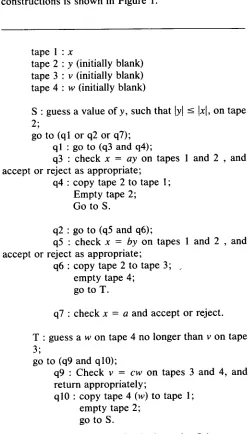
Similarly, we can construct a machine M(T) for the T clause. Then the result o f pasting together the two constructions is shown in Figure 1.
tape 1 : x
tape 2 : y (initially blank) tape 3 : v (initially blank) tape 4 : w (initially blank)
S : guess a value o f y, such that
lyl ~ Ixl,
on tape 2;go to (ql or q2 or q7); q l : go to (q3 and q4);
q3 : c h e c k x = ay on tapes 1 and 2 , and accept or reject as appropriate;
q4 : c o p y tape 2 to tape I; E m p t y tape 2;
Go to S.
q2 : go to (q5 and q6);
q5 : c h e c k x = by on tapes 1 and 2 , and accept or reject as appropriate;
q6 : c o p y tape 2 to tape 3; e m p t y tape 4;
go to T.
q7 : c h e c k x = a and accept or reject.
T : guess a w on tape 4 no longer than v on tape 3;
go to (q9 and ql0);
q9 : C h e c k v = cw on tapes 3 and 4, and return appropriately;
q l 0 : c o p y tape 4 (w) to tape 1; e m p t y tape 2;
go to S.
Figure 1. ATM Program for the Recursion Scheme.
[image:6.612.310.560.297.731.2]William C. Rounds LFP: A Logic for Linguistic Descriptions and an Analysis of its Complexity
As we remarked, we cannot give a full proof of the correctness of our construction. However, the con- struction does correspond to the formal semantics of CLFP. In particular, the semantics of recursion corre- sponds to the iterated schemes O k. Iterating the scheme k times roughly corresponds to developing the compu- tation tree of the ATM to k levels, and replacing the oracle states at the leaves of the k-level tree with rejecting states corresponds to substituting FALSE into the kth iteration.
With these remarks, the proof is complete.
Lemma 3. Suppose L is accepted by a S(n) = n-bounded ATM. Then there is a CLFP formula ~b such that for all u E ~*, we have u E L ¢:> u ~ ~b. Proof: We may assume that M is an ATM with one work tape, if we allow M to print symbols in an auxiliary tape alphabet F. By a result in Chandra, Kozen, and Stock- meyer (1981) M has no negating states. We show how to construct a formula ~b, which has constants ranging over F, but which has the property stated in the conclusion of the lemma: for each string x over ~, M accepts x iffx ~b. The formula ~b will be given as a recursion scheme /xS~. Each state q of M will become a binary predicate variable q(x,y) in ~ . The meaning of q(u, v), where u and v are specific strings in F*, is that M is in state q, scanning the first symbol of v, and that u and v are the portions of the work tape to the left and the right of the head, respectively.
We give a perfectly general example to illustrate the construction of ~. In this example, the tape alphabet F is {a,b}. Suppose that q is a universal state of M and that 8(q,a) = {(r,b,right),(s,a,left)}, and 8(q,b) = {(p,b,left),(q,a,right)}. T h e n dp(q)(x,y) is the following formula:
/ ~ V w t [ ( x = wtr A y = at ~ r(xb,t) A s(w,o~at)) o~{a,b}
A ( x = wtr /~ y = bt ~ p(w,trbt) /~ q(xa,t))]
The distinguished element of 2~ is qo, the start state of M. Notice that all predicate variables in R occur posi- tively in ~ , and that the search for w and t is limited to strings no longer than the length of the original input to M. If q is an accepting state of M, then we have a clause in ~ of the form q(x,y) <==> TRUE, where TRUE is some tautology.
Technically speaking, the explicit substitutions r(xb,t) are not allowed in our formulas, but these can be expressed by suitable sentences like (3z)(z = x b /~ r(z,t)), as remarked in the first section. The cases for q(x,y) when x and y are null must also be handled separately because M fails if it tries to leave the original region.
Finally, we can obtain a formula over the constant alphabet E by a more complicated construction. If we encode F into E by a homomorphic mapping, then a machine N can be constructed to simulate M. N will have tape alphabet E, but will have a number n of work tapes bounded linearly by the constant involved in the
encoding. We now make a formula corresponding to N, but the predicates will have to be 2n-ary, one pair of arguments for each tape of N. With these remarks, the proof of the lemma is complete.
Theorem I follows immediately from the above lem- mas.
4 I L F P : GRAMMARS WITH INTEGER INDEXING
4.1 SYNTAX OF ILFP
Our characterization of the defining power of CLFP relied on the result E X P T I M E = A S P A C E ( n ) . We also know that P T I M E = A S P A C E ( I o g n). Is there a similar logical notation that gives a grammatical characteriza- tion of PTIME? This section is devoted to giving an affirmative answer to this question. As stated in the introduction, this result is already known (Immerman 1982, Vardi 1982), but the result fits well with the CLFP theorem, and may in the linguistic domain have some real applications other than ours to Head Grammars. To explain the logic, it helps to consider acceptance by a logspace bounded ATM. In this case, the machine has a read-only input tape, which can be accessed by a two-way read head. Writing is strictly disallowed on the input tape, in contrast to the linear space bounded ATMs of the previous section. There is also a number k of work tapes on which computation occurs. Suppose that these work tapes use a binary alphabet. If their size always is less than or equal to I-log2 n-I, then they are always capable of representing the numbers from 0 through n - 1. We thus think of the contents of the work tapes as indices of specific positions in the read-only input string, though in fact they may not serve this purpose in an arbitrary computation. Since the input is off-line, substrings of the input will not be quantified. Instead, we quantify over the integer subscripts, and the input simply becomes a global parameter appearing in the semantics. Instead of having equations between strings as atomic formulas, we will have equations between integer terms. In order to access the input, we will have, for each symbol a E E, an atomic predicate symbol a(i) of one argument, which will be true iff in the given input x, the symbol x(i) at position i is a. (We number the positions from 0 through n - 1). We allow individual constant symbols 0,1, and last, which will be interpreted as 0, 1, and n - 1, respectively, when the input has size n. As primitive arithmetic operations we allow addition and subtraction, and multiplication and integer division by 2. All of these operations are inter- preted modulo n when the input is given.
We need not give the formal definition of ILFP formulas, as it is the same as for CLFP, except that individual variables come from a set {io,i ~ . . . . }, terms are formed as above from arithmetic combinations of individual variables and constants, and the unary pred- icates a(/) are atomic formulas.
Example 2. Consider the CFG S---> aSb
[ b S a [ SS [ab
[ baWilliam C. Rounds LFP: A Logic for Linguistic Descriptions and an Analysis of its Complexity
This is represented in I L F P as follows: S(id) ¢~ a(i) A S(i + 1,j - 1) A bq) V b(i) A S(i + I j - 1) A a(]) V 3 k < j : S ( i , k ) / ~ S(k + ld)
V J = i + 1 A ((a(i) A bq)) V (b(i) A aq))
(Again, the explicit substitution of terms for variables is not officially allowed but can be introduced by defini- tion.)
The meaning o f the above scheme should be clear. The predicate S(id) is intended to mean that node S dominates positions i through j in the input. Thus the assertion S(0,1ast), with no free variables, will be satis- fied by a string x iff x is generated by the given CFG. The relation of this descriptive formalism to the C K Y algorithm for context-free recognition should also sug- gest itself.
Our definition of the meaning function At[[4']] is like that in Section 2, except that the parameter n is replaced by a string x E X*. Thus
1. At~p(i I . . . ik)]px = {t~ [ (a(i 0 . . . . a(ik) ) ~ /9(/9)}; 2. At~a(i)]px = {a I x(a(i)) = a};
3..~t~t 1 = tz]pX = {a I tl°t = tEa};
4. At~3i4']px = {a [ ( 3 m <
Ixl)(~(i/m)
~ ~q4']px)}; 5. Boolean combinations are as before;6. At~SdP]px = {a I (3k)(a E At[C~pk(S)]px)}
The schemes qb k are defined for recursion schemes as above.
If 4' is a formula of I L F P with no free individual or predicate variables then S[4']]px is either A, the set of all individual assignments, or 0, independent of p, but depending o n x . We say t h a t x ~ 4'iffS~4'~px is all of A. A language L _C X* is ILFP-definable iff for some 4' in I L F P , L = {x I x D 4'}. Our objective is now
Theorem 2. A language is ILFP-definable iff it is in P T I M E .
The proof appears in the next subsection.
4.2 P R O O F OF T H E O R E M 2
The idea of our proof is the same as that for Theorem 1, and only a sketch of the proof is necessary. We first restate L e m m a 2 for I L F P , using the same definition for /3 and %
L e m m a 4. L e t 4' be an I L F P formula, with IFIvar(4')] = k, and T : Flvar(4') ---> {1 . . . k}. Let m = 7(4'). Then we m a y construct an m-tape ATM M(4',T) having the following properties: (i) M has oracle states P? for each free predicate variable of 4', and (ii) For any x ~ E*, any a mapping Flvar(4') to natural numbers, and any environment p, we have the fol- lowing: M with oracle states for the p(P), started with x on the input tape, binary representations of the integers a(il) on tape T(il) . . . and a(ik) on tape T(ik), and the other tapes blank, will accept without ever writing a v a l u e j > I x [ on any tape, if and only if (ot(iO . . . t~(ik)) E At[4']pX.
Proof: The proof is almost identical to that of L e m m a 2. To evaluate equations M may have to use an extra tape, because otherwise the given nonblank tapes would be overwritten by the arithmetic operations. If 4' is a(i) (the only case not covered in (2), then tape 1 is used as a counter to Mcate the input head at the position of the contents of tape 1. Since arithmetic is modulo Ixl, the machine never writes too great a value in these cases. The other cases are proved exactly as in (2), so this completes the proof.
L e m m a 5. If L ~ A S P A C E ( I o g n), then L is ILFP- definable.
Proof: We may assume that L is accepted by an ATM with p binary work tapes and one input tape. (If the tape alphabet is not binary, encode with a homomorphism and expand the number of tapes as necessary.) We m a y further assume that the machine M never writes a string longer than L..log2(n)__] - 1 on any work tape (remember one bit on each tape in finite control if necessary). Each work tape, or portion thereof, is thus guaranteed to represent a binary number strictly less than n in value, where n is the length of the input string.
We now proceed as in the proof of L e m m a 3, but coding the contents of the work tapes as binary num- bers. We need a number h, which tells the position of the input head. We also have two numbers l and r, which are the binary values of the tape contents to the left and right of the work tape head (here we describe the case of just one work tape). The number r will actually be the binary value of the reversal of the string to the right of the tape head, because this makes the operation of shifting the head a simple multiplication or division by 2. Since a string m a y have leading zeroes, we also need to keep two auxiliary numbers II and rr, which are the actual lengths o f the strings to the left and right of the head. For each state q of the ATM we thus have a predicate q(h,l,r, ll, rr) of five integer variables. The reader should have no difficulty in encoding the transition rules of M exactly as in L e m m a 3. F o r example, a test as to whether the scanned symbol on the work tape is 0 or 1 becomes a test of the parity of r, and so on. Finally, it can be seen that the case of p work tapes requires 4p + l-ary predicates. This completes the proof of our lemma and thus the theorem.
4.3 W H I C H POLYNOMIAL?
We can get a rough estimate of the degree of the polynomial time algorithm, which will recognize strings in the language defined by an I L F P grammar. We saw in the proof of L e m m a 4 that if a scheme 4' has 7(4') = P, then an ATM with p + 1 binary work tapes can be constructed to recognize the associated language. The number of configurations of each tape is thus log n *
2log n+l If there are p + 2 tapes, this gives O(logp+ln *
n p+IIP
:=O(n p+2)
possible tape configurations. Multiply- ing by n for the position of the input head gives O(n p+3) possible ATM configurations. F r o m an analysis of the proof of L e m m a 1 in Chandra, Kozen, and StockmeyerWilliam C. Rounds LFP: A Logic for Linguistic Descriptions and an Analysis of its Complexity
(1981), we c a n see that the p o l y n o m i a l in o u r determin- istic T M algorithm is b o u n d e d b y the square o f the n u m b e r o f A T M configurations. This leads to an O(n 2p+6) recognition algorithm. Since this bound would give an O(n ~2) algorithm for c o n t e x t - f r e e language rec- ognition, we conjecture that the general estimate c a n be i m p r o v e d . In particular, We would like to r e m o v e the factor o f 2 f r o m 2p.
5 APPLICATIONS TO HEAD GRAMMARS
In this section we e x p r e s s head g r a m m a r s (Pollard 1984) in I L F P , and thus s h o w that head languages can be recognized in p o l y n o m i a l time. Since the class o f head languages is the s a m e as the class o f tree adjunct languages (Vijayashankar, Joshi 1985), we get the s a m e result f o r this class. W e will actually give only a simplified version o f head g r a m m a r s to m a k e o u r I L F P formulas e a s y to write. This version c o r r e s p o n d s ex- actly to the Modified H e a d G r a m m a r s o f V i j a y a s h a n k a r and Joshi (1985), and differs only f r o m the original version in that it does not treat the e m p t y string. (Roach (1988) has an e x t e n d e d discussion o f head languages.)
We define a h e a d g r a m m a r as a tuple G = (N,~,,P,S), w h e r e N and E are finite n o n t e r m i n a l and terminal alphabets, P is a finite set o f productions, and S is the start nonterminal. T h e p r o d u c t i o n s are o f the f o r m C Op(A,B), w h e r e A , B , and C are nonterminals and Op is c h o s e n f r o m a fixed set o f head-wrapping operations.
Productions can also h a v e the f o r m C ~ (x,y), where x and y are terminal strings.
W e view n o n t e r m i n a l s in N as deriving pairs o f strings (u, v). In the original formulation, this m e a n t that the head o f the string uv o c c u r r e d at the end o f u. T h e w r a p p i n g o p e r a t i o n s c o m e f r o m the set { L L I , L L 2 , L C ~, LC2}. W e c o n s i d e r L L 2 and L C ! as e x a m p l e s . We define LL2((w,x),(u,v)) = (wu, vx). T h u s if A derives (w,x) and B derives (u, v), and C ~ LL2(A,B) is a production, then C derives (wu,vx). Similarly, LCl((W,X),(u,v)) = (w,xuv), so in the c o r r e s p o n d i n g case, we would h a v e C derives (w,xuv) if C ~ L C I ( A , B ) w e r e a production. A string t is in L(G) iff for s o m e u and v, t = uv and S derives (u,v).
G i v e n a h e a d g r a m m a r , we write an I L F P recursion s c h e m e as follows. F o r e a c h nonterminal C, we intro- duce a p r e d i c a t e C ( i j , k,l). W e think o f these four integers as indexing the positions o f s y m b o l s in a string, starting at the left with 0. T h e n C ( i j , k,l) m e a n s that the nonterminal s y m b o l C can derive the pair o f substrings o f the input string b e t w e e n i and j , and b e t w e e n k and l inclusive. Thus, if C ~ LL2(A,B) is a production, o u r s c h e m e would include a clause
C ( i j , k,l) ¢:~ (3pq)(A(i,p,q + 1,l) A B(p + ld',k,q))
Similarly, if C --~ L C I ( A , B ) w e r e a p r o d u c t i o n , we would h a v e
C ( i j , k,l) ¢~ ( 3 p q ) ( A ( i j , k,p) /~ B(p + 1,q,q + 1,/)) Finally, if C--* (a, b b ) w e r e a terminating production, we would h a v e
C ( i j , k,l) ¢:~ a(i) /~ i = j / ~ k = i + 1 / ~ b(k) A b ( k + l) A l = k + 1
T h e g r a m m a r would be defined b y the recursion s c h e m e and the assertion 3 j S ( 0 j j + 1 ,last), w h e r e S is the start s y m b o l o f G.
It can be seen f r o m this formulation that e v e r y head g r a m m a r can be written as an I L F P s c h e m e with at m o s t six total variables. Section 4 thus gives us an O(n 18) algorithm. H o w e v e r , the algorithm o f V i j a y a s h a n k e r and Joshi (1985) is at m o s t n 6. It would s e e m that a rule o f t h u m b for the order o f the p o l y n o m i a l algorithm is to use the n u m b e r y(th) for the I L F P s c h e m e th, but we h a v e no p r o o f for this conjecture.
ACKNOWLEDGMENT
Research supported by NSF Grant MCS-8301022.
REFERENCES
Chandra, A.K. and Harel, D. 1982 Structure and Complexity of Relational Queries. Journal of Computer Systems Science 25: 99- 128.
Chandra, A.K.; Kozen, D.C.; and Stockmeyer, L.J. 1981 Alterna- tion. Journal of Associated Computer Machines 28:114-133. Immerman, N. 1982 Relational Queries Computable in Polynomial
Time. In Proceedings of the 14th ACM Symposium on Theory of Computing: 147-152.
Johnson, M. 1985 Parsing with Discontinuous Constituents. In Pro- ceedings of the 23rd Annual Meeting of the Association for Computational Linguistics, Chicago, IL: 127-132.
Pereira, F.C.N. and Warren, D.H.D. 1980 Definite Clause Grammars for Language Analysis--A Survey of the Formalism and a Com- parison with Augmented Transition Networks. Artificial Intelli- gence 13: 231-278.
Pollard, C. 1984 Generalized Phrase Structure Grammars, Head Grammars, and Natural Language. Ph.D thesis, Stanford Univer- sity, Stanford, CA.
Roach, K. (1988) Formal Properties of Head Grammars. Manuscript, Stanford University. In Manaster-Ramer, A. (ed.) Mathematics of Language. John Benjamins, Amsterdam, Holland.
Shapiro, E.Y. 1984 On the Complexity of Logic Programs. Journal of Logic Programming 1.
Vardi, M. 1982 The Complexity of Relational Query Languages. In Proceedings of the I4th ACM Symposium on Theory of Comput- ing: 137-146.
Vijayashankar, K. and Joshi, A.K. 1985 Some Computational Prop- erties of Tree Adjoining Languages. In Proceedings of the 23rd Meeting of the Association for Computational Linguistics, Chi- cago, IL: 82-93.
NOTE
1. Notice that the machines are presented in ATMGOL, a syntacti- cally ill-defined variant of ATM transition functions. Also, ATMs and ATNs are not to be confused.