A model and specification for development
of enterprise application frameworks
A. van Oostrum
Department of Computer Science, University of Twente,
The Netherlands.
I Copyright notice
II
III
ACKNOWLEDGMENT
The following people played a (significant) role in helping to finish this thesis:
University of Twente, The Netherlands:
dr. M.M. Fokkinga - first supervisor dr.ir. W.K. Havinga
dr.ir. M. van Keulen - second supervisor
MASER Engineering, The Netherlands:
ing. W.J.K. Kemper - external supervisor ing. C.T.A. Revenberg - external supervisor
NextSelect, The Netherlands:
IV
PREFACE
Hereby I present my graduation thesis on the subject “A model and specification for
development of enterprise application frameworks”. Finishing this thesis was probably one of the most challenging projects I have ever experienced. It required about one and a halve year for me to finish, were it should normally take about halve a year (one semester). Basically the delay was caused by the fact that I also had to keep my own company running while carrying out the research for this thesis. I could not step out of my company, not even for a short time, as this would have a negative impact on the continuity of the company.
When I started this research I had a rather naïve thought that with enough effort I would finish this thesis a lot sooner and at the same time run my company. Looking back now I realize that I underestimated the amount of time required to finish research subjects and to complete the thesis. Furthermore, when I was working for my company the thesis was always in the back of my mind and vice versa, which felt like a huge burden. I would not recommend this to anyone as it had a negative influence on the research and also on the company, for which I had to pay the price.
I have learned a lot and gained knowledge from this project. I am convinced that the results are going to help NextSelect build better software and as a result help to support the processes of MASER Engineering. The next step is to actually start building a new framework based on the finding in this report.
I would like to express my gratitude to Maarten Fokkinga. Not only for his wisdom and guidance, but also for his patience during the project. I would also like to thank Hans Kemper and Kees Revenberg for providing the research project and the means to perform the research. Furthermore I would like to thank the NextSelect staff for helping me with the designs and development of the prototypes, and making sure that the continuity of the company was maintained, it was not an easy period. At the end of the project Maurice van Keulen helped finishing the thesis, my gratitude goes out to him for the clean insight he provided. At last, I would like the thank my family and friends for their morale support, this gave me hope and courage to finish this thesis.
Alex van Oostrum
V
ABSTRACT
Every software engineer knows that development of relatively large software packages without a good and preconceived plan to manage them is asking for a headache when these packages need further development, especially when the development is done by different software engineers. Frameworks are of key importance for developing large-scale object-oriented software systems. They promise higher productivity and shorter time-to-market through design and code reuse. However, many projects report that this promise is hard to fulfill: the design of object-oriented frameworks is all but well understood [1].
In this thesis a conceptual framework is represented that is intended to solve the problems of the software engineering company NextSelect in cooperation MASER Engineering. The
framework is abstract by design and accompanied with a set of rules and specifications required to implement a concrete and deployable version of the framework. The design and
specifications of the framework are driven by a unique philosophy which makes this conceptual framework also unique.
VI
CONTENTS
ACKNOWLEDGMENT ... III
PREFACE ... IV
ABSTRACT ... V
CONTENTS ... VI
1. INTRODUCTION ... 8
1.1. BACKGROUND ... 10
1.2. HYPOTHESIS ... 11
1.3. APPROACH ... 12
1.4. DOCUMENT STRUCTURE ... 14
2. ANALYSIS & OBJECTIVES ... 15
2.1. PROBLEM ANALYSIS ... 16
2.2. RESEARCH OBJECTIVES ... 23
2.3. HPOTHESIS AND RESEARCH QUESTIONS ... 28
3. THE FRAMEWORK ... 30
3.1. PHILOSOPHY ... 31
3.2. ARCHITECTURE ... 37
3.3. DETAILED DESIGN... 41
3.4. RULES AND SPECIFICATIONS ... 47
4. VALIDATION ... 63
4.1. PROOF OF CONCEPT... 65
4.2. SCALABILITY ... 66
4.3. MAXIMIZING CODE REUSABILITY ... 74
5. CONCLUSIONS AND RECOMMENDATIONS ... 76
5.1. THE RESULTS ... 77
5.2. HYPOTHESIS AND RESEARCH QUESTIONS ... 78
5.3. HOW CAN THIS BE APPLIED AT NEXTSELECT ... 80
5.4. RECOMMENDATIONS AND FUTURE WORK ... 81
6. REFERENCES ... 83
6.1. OTHER CONSULTED RESOURCES ... 86
APPENDIX A. HOW TO IMPLEMENT MVC ... 1
A.1. RESEARCH QUESTIONS ... 2
A.2. DESIGNING THE PROTOTYPE ... 2
A.3. SCREENSHOT ... 9
A.4. DISCUSSION ... 9
VII
B.1. DESIGNING THE PROTOTYPE ... 12
B.2. WHAT ABOUT MVC? ... 14
B.3. APPLYING SECOND LEVEL DESIGN ... 14
B.4. IMPLEMENTING THE FRAMEWORK ... 16
B.5. SCREENSHOT ... 18
B.6. DISCUSSION... 18
APPENDIX C. FRAMEWORK DEPLOYMENT TEST ... 19
C.1. PRINCIPLES OF THE GAME TIC TAC TOE ... 20
C.2. DESIGNING THE PROTOTYPE ... 20
C.3. APPLYING SECOND LEVEL DESIGN... 21
C.4. IMPLEMENTING THE FRAMEWORK ... 24
C.5. SCREENSHOT ... 29
C.6. OUTPUT DATA ... 30
C.7. DISCUSSION ... 31
APPENDIX D. DEALING WITH MULTIPLE INHERITANCE ... 34
D.1. ASPECTS OF MULTIPLE INHERITANCE ... 35
D.2. PARENT CLASS REUSE BY USING DELEGATION ... 37
D.3. INTERFACE CONFORMANCE ... 38
D.4. SIMULATING MULTIPLE INHERITANCE... 38
D.5. LIMITATIONS OF THE INTERFACE-DELEGATION TECHNIQUE ... 39
D.6. USING SIMULATION OF MULTIPLE INHERITANCE ... 40
D.7. DISCUSSION ... 43
APPENDIX E. EXISTING BROKER ARCHITECTURES ... 44
E.1. RESEARCH QUESTIONS ... 45
E.2. CORBA ... 45
E.3. WEB SERVICES ... 49
E.4. CORBA VS. WEB SERVICES ... 50
E.5. DISCUSSION ... 50
APPENDIX F. ENTERPRISE APPLICATION EXAMPLE ... 55
F.1. RESEARCH QUESTIONS ... 56
F.2. INTRODUCTION ... 56
F.3. REQUIRED EXTENSIONS AND MODULES ... 60
F.4. EXTENSION: CONFIGURATIONMANAGER ... 61
F.5. EXTENSION: DATALAYERMYSQL ... 62
F.6. EXTENSION: SECTIONMANAGER ... 64
F.7. EXTENSION: DATAHANDLER ... 66
F.8. EXTENSION: TEMPLATEMANAGER ... 70
F.9. MODULE: CONFIGURATION ... 71
F.10. UML REPRESENTATION OF PROTOTYPE ... 73
F.11. INTERNAL COMMUNICATIONS ... 75
F.12. DISCUSSION ... 77
8
1.
INTRODUCTION
Every software engineer knows that development of relatively large software packages without a good and preconceived plan to manage them is asking for a headache when these packages need further development, especially when the development is done by different software engineers. Furthermore, the development of new code can take a lot of time that could be shortened if parts of the software code could be reused. However, creating reusable software is difficult, and there are many barriers that impede progress [16]. The use of a good and well constructed framework might make the development process shorter and easier and it is therefore appreciated. Frameworks are designed with the intent of facilitating software
development and they have the goal to make the software development process simpler. This is achieved because a framework automates details and it offers common structure and better communication. Designers and programmers are therefore able to spend more time on meeting software requirements because they are dealing less with the more tedious low levels details of providing a working system.
The word ‘framework’ knows many definitions and it is used in many contexts. The term has been used more like a ‘buzzword’, especially in a software context. For example, the Java collections framework is not a software framework, but a library. For this research the following definition is used:
“A software framework is a re-usable design for a software system (or subsystem). A
software framework may include support programs, code libraries, a scripting
language, or other software to help develop and glue together the different components
of a software project.”[2]
NextSelect is a company with a core business of developing enterprise applications. Having built several large enterprise applications NextSelect experiences difficulties of managing and further developing them. The enterprise applications make use of a framework which should be
9 In our opinion other software development companies experience (partly) the same problems. Especially companies that also develop enterprise applications. With this in mind the research is broadened and not narrowed down by the boundaries of NextSelect. For the research
NextSelect is used as a representative case.
10
1.1.
BACKGROUND
It all started in 2002 when NextSelect had built it first enterprise application for a company called MASER Engineering. From that point on MASER and NextSelect collaborated in the software development of this enterprise application. The application, called MIDS (MASER Intranet Database System), grew and evolved to a huge and complex application managing a lot of the business processes of MASER. Some example modules: human resource management (HRM), customer relation management (CRM), project management with detailed planning tool, quotation and order management, shipping and package traceability.
Why put effort in designing and building a system where other (big) companies, like SAP and Oracle, already have solutions available? One of the reasons is that these (large) software packages probably fit perfectly within a large number of companies using a common business process. But there are companies that have a (slightly) different business process or their business process often changes caused, for example, by the growth of the company. At this point costs could raise significantly to adapt the software, which could make the required adjustments unfeasible. As a result the company has to adapt its processes to the software instead of the software being adjusted to the processes. NextSelect uses a different approach; in this approach the business process has the main focus and the software is built around the business process.
In the first stages, of the development of MIDS, some design and implementation choices have been made that nowadays can be seen as ‘ugly’ and ‘not done’. For example: no separation of business logic and framework code, no separation of application logic, model and presentation and the lack of a good object oriented design. As time passed MIDS evolved, however parts of the implementation of MIDS did not evolve and remained the same. So the customer (MASER) received a good working application, but underwater some parts were still a mess. There are mainly two reasons why certain development choices were made that leaded to the problems; first: the incompetence of NextSelect or lack of knowledge in the early stages of development; and secondly: tight budget and time limitations, which resulted that the bad code for the most part remained within the application.
As MIDS evolved so did NextSelect, it became competent and the development process of MIDS evolved. This resulted in nicer, more structured and better reusable code. However, code still remained and this complicated the development of MIDS.
11 framework was custom built for MASER. As a result the MASER code was stripped out and replaced by business logic of the new customer. For a software developer two things are horribly wrong:
1. The existing framework contained business logic resulting in a customer specific framework that is not reusable.
2. By putting customer specific code in the two existing frameworks they automatically became two different versions, two versions that needed to be maintained.
The problem aggravated when more business applications had to be built for different customers. All the business applications share almost same framework but these framework contain business logic which make them different. Due to the number of frameworks the complexity of maintaining them increases, also the implementation time required to add a new feature or to resolve a problem increases. Rapidly building applications is becoming harder and NextSelect could lose its competitive advantage to the big companies like SAP.
A new framework with development guidelines is required which can be deployed for different applications and different customers. MASER and NextSelect started a collaboration to build a new framework with the ultimate goal to build a new version of MIDS using the new framework.
1.2.
HYPOTHESIS
In anticipation of the results described chapter 2, this is the main research hypothesis:
Does the framework design, sketched in Figure 1.1, offer a solution for the problems
section in section 2.1 ?
12 Separating business logic from the framework is one of the most important objectives of this research project, see section 2.2 for all the objectives. In Figure 1.1 this is depicted by the vertical dashed line. Within the modules requirements and specifications of a customer are translated into business logic. A module contains no functionality other than telling the
framework ‘what to do’. It is the responsibility of the Framework Core to locate the appropriate extensions and execute the requests issued by the modules. Extensions are tools that have the responsibility to facilitate the Framework Core and other extensions.
1.3.
APPROACH
The research starts with the analysis of NextSelect business processes and a detailed problem analysis of the existing enterprise applications at a programming level. The option of using existing available frameworks has been exploited but rejected as it seemed that no existing framework met the research objectives. Furthermore, MASER and NextSelect prefer not to use third party software, due to the fact that they want to have full control over the software and not be dependent of a third party.
A framework philosophy is derived from the problem analysis and the wishes of NextSelect. This philosophy is translated into an the architecture shown in Figure 1.1. Details about this
derivation, the philosophy and the architecture itself can be found in subsection 2.3.4.
Prototypes are implemented to refine the design of the framework. During the development of these prototypes two important aspects emerge; the design of the framework is abstract and it does not state anything about the type of application it is going to be deployed for. Because of the abstract design the framework is deployable for a wide range of applications. A secondary design is required that specifies the concrete implementation of a specific framework. This
Module 1 Module 2
Module N
Framework Core
Extension 1 Extension 2
Extension N (Enterprise) application
Framework (application logic) Business logic
13 secondary design reduces the range of applications the framework can be deployed for, due to the fact that the concrete design of the framework is made for a specific type of application. Among other objectives, that can be found in section 2.2, three are used for validation to demonstrate the usefulness and feasibility of the framework. The design of the framework is validated by a prototype that implemented a small part of MIDS (section 4.1). It is reasonable to assume that the framework will grow with functionality in time, how this affects the scalability is tested with a scalability prototype (section 4.2). Another important issue with an growing framework is code reuse. Implementations should not be (partly) duplicated and code reuse has to be maximized. With a growing framework it becomes harder and harder to maintain the reuse of code due to the fact that a programmer has to know that a piece of code exist and, more importantly, the programmer has to be able to find this piece of code. A method for maximizing code reusability with the use of code retrieval is presented (section 4.3).
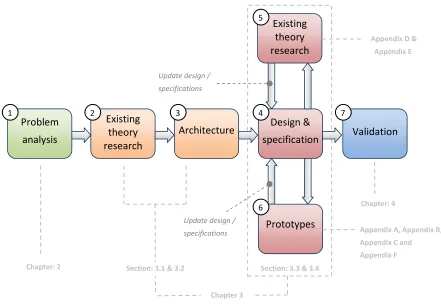
In Figure 1.2 the research model, followed during this research project, is illustrated. It gives an overview of the main activities during the project and where to locate the results within this document. Problem analysis Existing theory research Design &
specification Validation Architecture Prototypes Existing theory research Chapter: 2 Chapter: 4
[image:15.595.94.535.359.663.2]Section: 3.3 & 3.4
Figure 1.2: Research model used: Start with problem analysis using NextSelect case (1). Acquire knowledge from existing research theories (2). Design the framework architecture using the obtained knowledge (3). Produce a detailed design of the framework based on the architecture (4). Acquire additional knowledge (repeated) about isolated framework issues and update the framework design and specification if required (5). Build prototypes (repeated) that test isolated framework issues and framework design and update the framework design and specification if required (6). Validation of the framework design and specification conform the research objectives (7).
Appendix D & Appendix E
Appendix A, Appendix B, Appendix C and Appendix F
Update design /
specifications
Update design /
specifications
1 2 3 4
5
6
7
14
1.4.
DOCUMENT STRUCTURE
This thesis report holds a typical research structure. Chapter 2 it starts with a problem analysis of NextSelect and states the objectives and research questions that lead the research. For this research the NextSelect case is used as a basis.
In chapter 3 the results of the research is presented, a model and specification for development of enterprise application frameworks. This chapter starts with the philosophy which forms the basis of the research and makes, to the best of our knowledge, this framework unique. Derived from the philosophy, problems, and research questions, an architecture and a detailed design of the framework are presented. However, the architecture and the detailed design of the
framework do not completely cover the philosophy, therefore a set of rules and specifications are also provided.
In chapter 4 the results are validated. Validation is required to ensure that the objectives from section 2.2 are guaranteed. However, due to time limitations not all objectives could be validated. Furthermore, some objectives are hard, if not impossible, to validate.
During the development of the framework design tests and research was performed on certain aspects of the framework. For some prototypes had to be built to test a certain requirement of the framework design. In other cases some research had to be performed.
Appendix A: In the early stages of the framework design, a design pattern called Model View Controller (MVC), was assumed to be necessary in the basic abstract design of the framework. In this appendix this is tested with an implemented prototype.
Appendix B: The framework design needs to be platform independent. In this appendix the design with MVC from appendix A is used for a prototype developed a Java. The test showed that the design can be used in other object oriented programming languages.
Appendix C: The design of the framework needed a ‘real’ application to show its usefulness. A prototype framework has been developed to make Tic Tac Toe games. The design of the framework is further developed.
Appendix D: An important design issue about multiple inheritance, discussed in subsection 3.3.1, has been tested this appendix. The issue is that not all programming languages support multiple inheritance, a solution from Tempero et al. [13]. is used to resolve the issue.
Appendix E: The Framework Core needed a more facilitation role for the modules, like a façade. The behavior had resemblance to CORBA and Web Services that have broker architecture. In this appendix research is performed to see what the resemblances are and if the framework concept is not reinventing the wheel.
Appendix F: With the design of the framework finished, a prototype is built to test the
15
2.
ANALYSIS & OBJECTIVES
Creating reusable software is difficult and there are a lot of barriers that need to be breached. To design a new framework, that will solve the problems of NextSelect, these barriers must first be identified. The enterprise application for MASER, called MIDS, and other enterprise
applications built by NextSelect, are used as research cases for this thesis. Furthermore, the assumption is made that the identified problems are also common for other software
development companies. The new framework should not be limited for use by NextSelect only. To identify the problems this chapter starts by looking back into the history of NextSelect, focusing on the software development (subsection 2.1.1), why certain choices have been made that resulted in the current problems and how these problems make future software
development difficult (subsection 2.1.2). Some attempts have be made to resolve certain issues; unfortunately they have all failed (subsection 2.1.3). NextSelect learned from its mistakes and in cooperation with MASER a solution is presented (subsection 2.1.4).
16
2.1.
PROBLEM ANALYSIS
The first version of MIDS was released in the year 2002. Compared to the current version it was less complex, however this first version is still forms the basis of the current versions and even the new applications that were built later on for different customers. Due to design flaws and certain implementation choices, problems remained for the development of MIDS and other applications managed by NextSelect.
2.1.1.HISTORY
MIDS is a fully web-based application. This means that the client has to use a web browser, i.e. Internet Explorer and Firefox, to access the application. The application itself is located at a central server and is accessible via the intranet or the internet. MIDS is developed in the language PHP, MySQL is used for data storage and retrieval and Apache is used for web server, illustrated in the following figure.
The advantage of using a web based system is the fact that the application itself is centrally located. This makes updating the system easier because the clients do not have to be updated individually. The application will also run on any system that has a internet or intranet
connection and a web browser.
During the early stages of the development of MIDS a lot of code duplication was discovered. This code duplication was mainly formed in the generation of the web based form (a form in HTML) to store new or modify existing data. Duplication of code was time consuming and sensitive for errors. If a mistake or bug was discovered it had to be replaced in different locations. Not the best software development approach and in fact a design flaw. Fortunately this was at the very beginning of the development and a new design was made to make a system that would allow the reuse of code to generate these forms. The first version of the MIDS
framework was born, with an important philosophy of code reusability.
As good as the intentions of the first framework were, now looking back to the design of the framework with the current knowledge of software development and the issues involved with
Server
MySQL database Apache web server
PHP Engine Internet or
intranet
Figure 2.1: Schematic view of web based system. A client accesses a web based application by using a web browser. The client’s requests are sent by the web browser through the internet or intranet to a server. The web server ‘Apache’ with the programming language PHP will process the request and send the output back to the client. PHP is able to use a database called ‘MySQL’ for data storage and retrieval.
Client using a web
17 this project, it has a poor design. Due to inexperience, not knowing that the system would grow to a large and complex enterprise application and of course time limitations, the first version of the MIDS framework was implemented with poor design. It was partly object oriented and the parts that were built using an object oriented approach did not apply the object oriented paradigm correctly. Aside from the lack of object oriented code, a much larger mistake was the fact that the framework was not built to be used for other applications, i.e. customer specific code and framework core were merged. For MIDS development this was no problem and as the years passed and MIDS grew, so did the framework. Unfortunately the problems grew also as more customer specific code was placed into the framework. Due to the fact that issues needed to be resolved quickly it often proved easiest to implement the customer specific code directly into the framework. Due to the fact that the framework already contained customer specific code which required a simple expansion or the bad design of the framework, it was time consuming to implement a new feature in a ‘nice’ manner (what is nice will be discussed later on).
In the year 2006, after about four years of ‘wrong’ development, NextSelect had to build a new enterprise application for a new customer. With the knowledge that the existing MIDS code had a poor design, the most proper method was to build a new framework with a better design which would not contain any customer specific code. As honorable as this idea was, the MIDS framework was so large and complex that a rebuilt of the framework would take a considerable amount of time and the costs for the customer would rise significantly. Without a proper budget from the customer it was impossible to build a new framework from scratch. So only one option remained: take the existing framework and rebuild the parts that were built specifically for MASER.
The MIDS framework was actually copied for the new application. All the containing MIDS code was removed or replaced by code for the new application which still kept the framework dirty. This resulted in two versions of the framework, essentially the same but different due to the customer specific code. Because the two versions co-existed both had their own development path making the differences between the two frameworks bigger. After some time the first real problems emerged, a bug was discovered that existed in both frameworks. The solution was first implemented in the MIDS framework , but the same solution could not be used for the second framework because it was not compatible due to the fact that part of the framework had a different implementation caused by the different development paths.
Having two versions of the framework already formed problems, this got even worse when more customers required new enterprise applications. With the same reasons as the second
18
2.1.2.THE PROBLEMS
The main problem originated with the first version of the framework. It was partly developed using an object oriented approach with a poor design. The framework was filled with customer specific code which made it impossible to easily separate the framework from the application to use it for other applications for other customers. Due to this improper framework a new
framework had to be copied and adapted to be deployable for new enterprise applications. This resulted in different versions of the same framework which needed further development and maintenance as the enterprise applications required new functionality.
Beside the fact that the framework consisted of customer specific code, it has another problem. There is no clear separation between application logic, model and presentation. Due to the fact that the framework is written to be used for web based applications, it has to output its
presentation in HTML (Hyper Text Markup Language). This HTML output is sent back to the browser of the client which is able to render the HTML to a graphical environment for the client. Without going into much detail about HTML and web based principles, the problem is that HTML output code is spread throughout the framework and application code. Changing the output due to customer specifications or a new specification of HTML (e.g. XHTML) requires changes not only in the framework, but also throughout the whole application. This is also a time consuming job which increases the change of making errors. As for the model, most of the data is stored in a database; however, to access this data different methods are used throughout the application. If, for example, another type of database is required it would require changes throughout the application and framework.
To summarize the problems:
• Poor, partly object oriented, design of frameworks and applications;
• Existing frameworks contain customer specific code (business logic);
• No separation between application logic, model and presentation;
• Multiple versions of the framework exist, requiring development and maintenance; Application 1
Framework 1
Application N Framework N
Due to adaptations not the same any more
Application 2 Framework 2
Copied and
adapted
Figure 2.2: Problem origination. For every new application built the existing framework was copied to the new application (1). However, the copied framework was further developed for the new application making it a different version. More application were built resulting in more different versions of the framework (2). All applications are continuously in development, in result the corresponding frameworks also are in continuous development making the differences between the frameworks larger.
1
19 As a consequence, the problems lead to:
• Inefficient software development;
• Difficult maintenance of the software product.
2.1.3.ATTEMPTS TO RESOLVE THE PROBLEMS
Having different enterprise applications for different customers resulted in different versions of the framework. Managing these frameworks takes precious time which could be spent more efficiently. A new approach is required.
Two attempts have been made already. The first involved the integration of the second developed framework into the first enterprise application, MIDS. However, the integration did not go smoothly; the new framework differed a lot from the old framework in MIDS. As a result a lot of time would be required to replace the old framework and fully deploy the new
framework. Unfortunately there was not enough budget to completely replace the old framework. In consultation with the customer (MASER) a compromise was made to use two frameworks next to each other and replace the old framework in phases. This process of replacing the old framework with the newer framework in phases is still active. The new
framework has a better design, more functionality and new HTML support. For the MASER this is a good thing; the application is upgraded and supports more features. In spite of this, looking at a software developer’s point of view, this approach made things more complicated. The
framework should remain compatible with the application it came from, with the goal that MIDS and the other application could share the same framework instead of two different versions. Due to the fact that the new copied framework could not be fully deployed, the result was that the new framework required adaptations to make it compatible with MIDS and a second framework (the old framework which remained in MIDS). Due to these adaptations the new copied framework directly became a different version compared to the version it was copied from, i.e. again two versions of the framework were created.
20 With the first attempt failing a second attempt was made. Like the first attempt a new
framework is copied from a newer application to replace an older framework from a older application. However, in this case the old framework did not differ a lot from the new
framework. This made it possible to replace the old framework with the new framework with a considerable small amount of adjustments. The second attempt was a success and the intended situation, just like Figure 2.4, was achieved.
MIDS Application X
New framework Old framework
New different
framework The copied framework transformed into a new version due to required adaptations
Figure 2.5: Current situation: due to insufficient budget the new framework could not be fully deployed at once. The customer agreed with the option to divide the deployment of the new framework into phases. However, the new framework required adaptations for this deployment in phases. As a result, the framework became different compared to the framework from application X. Furthermore, the software developers now have to manage two frameworks for the MIDS application until the deployment of the new framework is complete.
Not the same
and not
interchangeable
Application X MIDS
New framework New framework
Copy the new framework and replace
the old framework
Figure 2.4: Intended situation: The older framework, used for the MIDS application, is replaced by the newer framework from application X. MIDS and application X share the same framework. Result: software development and maintenance is easier due to the fact that only one framework has to be managed.
MIDS
Old framework
Application X New framework
New and better framework First and outdated framework
21 Unfortunately this success did not hold very long. The design flaws that still existed in the
frameworks made maintenance and further development inefficient and time consuming. This, and the fact that no actual development plan was formulated to maintain the frameworks, had the result that the two identical frameworks eventually split up into two different versions. The second attempt achieved the intended situation where two applications shared the same framework. However, after a certain period of time they got back to the situation illustrated in Figure 2.3 (only different applications). It appears that due to the existing problems of the framework , it is impossible to maintain one framework for multiple applications.
2.1.4.THE REQUIRED SOLUTION
It is clear that walking the old path with the existing framework becomes more difficult as more enterprise applications have to be built. With two earlier attempts to merge different versions of the framework failing, one solution remained: build a completely new framework.
Rebuilding the framework must not be underestimated; it has to be deployable for different and complex enterprise applications. It has to be designed and built in such a way that the issues discussed in subsection 2.1.2 will not cause problems again.
NextSelect turned to MASER to discuss a possible solution. The choice to go to MASER was simple: MASER and NextSelect share the longest history compared to the other customers of NextSelect. Furthermore, the application ‘MIDS’ is the most complex of all applications developed by NextSelect but holds the oldest framework. It could be said that MIDS is in ‘desperate’ need of an ‘upgrade’.
22
2.1.5.EXISTING FRAMEWORKS
Most of the problems described in subsection 2.1.2 are not uncommon in the software development projects. Every good programmer wants to produce good, stable and reusable code. Before just starting to build a new framework it is important to perform some research to check if software exists that resolves (part of) the problems. This has two reasons: first, it easier to reuse somebody else’ research instead of reinventing the wheel. Secondly, looking at other work and research, even if it will not resolve the problems directly, can give good insights about certain subjects and may prevent making mistakes.
During this research a lot of frameworks and even whole ‘high level’ programming languages were discovered to build applications. Research has been performed to identify those
frameworks that could satisfy the objectives. One framework in particular was examined, Ruby on Rails. According to Ruby et al. [3] Ruby on Rails is a framework that makes it easier to develop, deploy, and maintain web-based applications. According to Smith et al. [4] it is possible to use Ruby on Rails to build enterprise applications. If the principles of Ruby are followed it will meet a lot of the objectives discussed in section 2.2 and it therefore might solve a lot of
problems. However, a few objectives are not met; Ruby on Rails is not platform independent, Ruby is the programming language that is running on Rails. So there are two dependencies; the programming language Ruby and Rails as a programming framework.
Although not all the objectives are met, Ruby on Rails is still a high level programming language, however the framework in this research is of higher level. The philosophy is that an (enterprise) application is not programmed but ‘scripted’ (discussed in section 3.1), Ruby on Rails requires programming to build a complex application. However, due to the philosophy of Ruby on Rails it makes it a very good candidate to be used to implement a concrete implementation of the framework.
Due to the fact no existing framework could be found that satisfies the high level needs of MASER and NextSelect, the choice was made to build a new framework which will be managed by NextSelect. Beside the fact that none existing framework could satisfy the needs, MASER and NextSelect feel that having full control over the framework outweighs the advantages of a third party providing a framework.
23
2.2.
RESEARCH OBJECTIVES
The main goal is to design a framework that solves the problems described in subsection 2.1.2. By analyzing the derived problems and the required solution the following objectives are formulated.
Design a new framework that is:
• separating business logic and application logic; (2.2.1)
• object oriented by design; (2.2.2)
• completely modular built; (2.2.3)
• directed through a high level interface; (2.2.4)
• deployable for a wide range of applications; (2.2.5)
• system and platform independent; (2.2.6)
• fast and scalable; (2.2.7)
• maximizing code reusability; (2.2.8)
• able to rapidly build applications; (2.2.9)
• easy to extend or modify. (2.2.10)
With these objectives almost all the software development issues in the world are solved. For obvious reasons there are limitations to this research; the framework research focuses on enterprise application development and specifically enterprise applications built by NextSelect.
2.2.1.SEPARATING BUSINESS LOGIC AND APPLICATION LOGIC
In this thesis business logic and application logic mean two different things: business logic is a translation of customer demands and specifications. Application logic contains all functionality that facilitates business logic in order to meet the customer demands. In other words: different customers want the same application but have different parameters on which the application should operate.
In most applications business logic and application logic are mixed together because by some interpretations they are the same. However, do to the fact that in this framework business logic has to be separated from the actual implemented functionality that forms the application logic, i.e. the framework (see Figure 3.1), the two terms have different meanings.
24
2.2.2.OBJECT ORIENTED BY DESIGN
Using an object oriented paradigm gives several advantages compared to non object oriented approaches. According to Riehle [1] object-oriented frameworks promise higher productivity and shorter time-to-market of application development through design and code reuse.
One of the major problems with non object oriented approaches is that functions are given a higher priority than data, whereas data should be more important. Data can easily get corrupted because it is accessible throughout all the functions, even in functions that actually do not have any rights to access the data.
Using the Object Oriented paradigm these drawbacks are taken away. In this approach the data has the first priority. This is realized by packing the data and the functions, which are supposed to have access to the data, into one object. Unauthorized access of data and chances to corrupt data are limited, this is called encapsulation. Objects can be reused within the application or by other applications. This increases the code reusability that is one of the objectives of this framework (to maximize code reusability).
Lots of design patterns exist for the Object Oriented paradigm. This makes the development, future extending and modifications of the framework easier, especially when this is done by different programmers. An Object Oriented approach seems the best suited solution for this project.
2.2.3.COMPLETELY MODULAR BUILT
The main idea is that the application is split into two parts. The first part consists of all the modules that contain the business logic. The second part is the actual framework. Modules can be inserted into the framework and thus forming the application.
The framework itself is also split into two parts. The first part contains the framework core and the second part contains all the extensions. Extensions can be seen as tools that have the responsibility to facilitate the framework with reusable functionality and provide a high level interface for the modules. The framework core can be seen as a central hub that manages all communication between modules and extensions.
2.2.4.DIRECTED THROUGH A HIGH LEVEL INTERFACE
25 commands the application can be put together which will save the developer time (see
subsection 2.2.9) . Please note that if functionality does not exist within the framework this has to be implemented first.
There is no direct link between a request and a function within an extension. The framework is more flexible as it has to find the appropriate extension that offers the feature which can be done in several ways depending on the concrete implementation of the framework. More on this subject in section 3.1 and 3.2.
2.2.5.DEPLOYABLE FOR A WIDE RANGE OF APPLICATIONS
As stated in subsection 2.1.4, it is likely that other software development companies endure the same problems as described in subsection 2.1.2. For this research project the framework concept is therefore broadened to take into account that the framework has to be deployable for a wide range of applications. The design of the framework must therefore be abstracted to the point that there is no relation with the abstract design and a application.
Abstracting the design supports the wide range application deployment of the framework. However, it should be noticed that the main goal is to develop a framework that resolves the issues of NextSelect. Although the design makes the framework deployable for a wide range of applications, the research will be focused on enterprise applications and especially enterprise applications for NextSelect.
2.2.6.SYSTEM AND PLATFORM INDEPENDENT
If the framework has to be deployable for a wide range of applications, it should not be limited to any system or platform. Therefore the framework design has to be system and platform independent.
The design has to take into consideration that it might be used in different programming languages on different platforms. However, by the object oriented nature of the framework it can only be used in programming languages that support the object oriented paradigm. This is a limitation due to the objective described in subsection 2.2.2.
Furthermore, the current framework is currently web-based; the design of the new framework should not be limited to the choice if it is going to be a web-based or normal application.
2.2.7.FAST AND SCALABLE
26 Taken into account the NextSelect case, the same framework should be used for different applications and different customers. In this way only one framework has to be maintained and further developed. Looking back to the history of NextSelect it is a known fact that the
framework stays the same after a release. New applications will be built for new different customers and existing customers will ask for changes and/or new features. Due to this the framework will always increase in numbers of extensions instead of decreasing.
If the framework grows it is likely that the framework gets slower. Of course the concrete implementation of the framework has a great influence on the performance; nevertheless, the framework abstract design must be scalable. If adding new extensions or features leads to exponentially slowing down the framework, it means the framework is not scalable and therefore not fast and not usable.
In this thesis tests have been performed to test the scalability of the abstract framework. Due to the fact that it is not possible to benchmark an abstract design, a concrete implementation has been chosen that is based on the web based applications built by NextSelect. These tests are based on a concrete implementation of the framework that is web based and uses the same framework design found in Appendix F.
The speed of the framework is not tested due to the fact that such a test requires a concrete framework with actual functionality. Furthermore, this test would only be valid for that specific concrete framework and will not say much about the abstract design in this thesis.
Details about the scalability test can be found in section 4.2.
2.2.8.MAXIMIZING CODE REUSABILITY
With the same reasons mentioned in subsection 2.2.7, it is most likely that a concrete
implementation will grow in numbers of extensions and functionality. This will be the case for NextSelect. To keep the framework ‘clean’, i.e. never implement (parts of) functionality more than once, it is important to maximize code reusability.
Imagine that a concrete implementation of the framework consist of hundreds of extensions that offer thousands of features. When a programmer has to implement a new feature how can he know if the features already exists in the framework ? Somebody that implemented all the features might know it, but humans tend to forget thing. Furthermore, what if new
programmers have to implement new features to an existing framework.
27 To minimize code repetition, code reusability must be maximized. With code reusability two aspects are important; The first aspect plays a role when a new feature is designed. The design must take into account that the new functionality within the feature might be reused. For example: if all functionality of an feature is placed in one function, other features are unable to make use of that functionality and code will most probably be repeated. It is the responsibility of the software developer to take this into account when designing and implementing a new feature.
The second aspect is finding functionality or ‘code retrieval’. If a new feature requires functionality it might be possible that this functionality is already implemented somewhere. Finding code is hard and falls under the information retrieval domain. In section 4.3 a possible solution is presented, however it requires future research.
2.2.9.ABLE TO RAPIDLY BUILD APPLICATIONS
Due to the problems described in subsection 2.1.2, development and maintenance of the current enterprise software is inefficient and time consuming. It is a must requirement for NextSelect that the new framework resolves this. The new framework has to make it possible to easily translate business logic into the modules without a lot of programming when a new enterprise application has to be developed. This forms the basis of the philosophy of the framework, which is discussed in section 3.2.
Besides this must requirement of NextSelect this objective is also useful for other software companies that might want to use the framework. However, it must be noted that this objective depends on the actual concrete implementation of the framework. Therefore rules have to be defined beside the abstract design, this is discussed in section 3.4.
2.2.10.EASY TO EXTEND OR MODIFY
This objective is a direct result from the previous objective discussed in subsection 2.2.9 (Able to rapidly build applications). The framework not only has to facilitate rapid building of new
enterprise applications, it must also be easy to modify existing business logic and to add or modify features for the framework itself.
28
2.3.
HPOTHESIS AND RESEARCH QUESTIONS
The research hypothesis is formulated as following:
Does the framework design, sketched in Figure 1.1 and repeated below, offer a solution
for the problems described in section 2.1?
Besides the fact that this formulation of the hypothesis may look attractive, closer inspection and investigation raises a number of questions that need to be answered, they are listed in the following subsections. Some low level research questions are stated and elaborated in the appendices.
2.3.1.QUESTION Q1
Is it possible to apply the framework design to other platforms, programming languages
and non web-based applications?
This research question discussed in all of Appendix B. The answer is summarized in subsection 5.2.2.
Module 1 Module 2
Module N
Framework Core
Extension 1 Extension 2
Extension N (Enterprise) application
Framework (application logic) Business logic
29
2.3.2.QUESTION Q2
The CORBA and Web Service architectures show resemblance to the current
framework architecture, is the framework concept - or parts of - the same as the
architecture of CORBA and/or web services?
One of the first questions that came up: “what is on the market?”. In other words, are there existing systems available? This research question is discussed in Appendix E. The answer is summarized in subsection 5.2.3.
2.3.3.QUESTION Q3
How are modules and extensions implemented and how are they going to
communicate?
This research question is discussed in Appendix F and subsection 3.4.6, subsection 3.4.7. A summary of the answer is in subsection 5.2.4.
2.3.4.QUESTION Q4
What is the usefulness of the Framework Core and why is it required?
30
3.
THE FRAMEWORK
Our philosophy:
“Making (enterprise) applications has to be done fast and easy. A developer simply has
to script or configure his whishes in simple calls without knowing much about the
underlying implementations. The framework will take care of everything. One
framework for multiple applications.”
This philosophy of the framework is based on the NextSelect case that provides problems and whishes, which in turn lead to the objectives and research questions. The framework philosophy tells the ‘why, what and how’ about the framework and makes this framework unique. To the best of our knowledge, no other framework exists in the world that satisfy the needs.
The framework consists of modules, Framework Core and extensions. Modules contain only business logic (i.e. whishes and demands of the customer) in a high level scripting language what tells the framework what to do and when to do it. Extensions can be seen as tools that have the responsibility to facilitate the framework with reusable functionality and provide a high level interface for the modules. The Framework Core can be seen as a central hub that manages all communication between modules and extensions.
The architecture and detailed design of the framework do not completely establish the
philosophy, therefore a set of rules and specifications are provided in section 3.4. The success of the framework, i.e. resolving the issues described in subsection 2.1.2, depends completely on these rules and specifications. The design of the framework is abstract, this means that a
concrete version of the framework has to be implemented; if the rules and specifications are not correctly applied during the implementation of a framework, the objectives (section 2.2) are not guaranteed.
31
3.1.
PHILOSOPHY
What makes this framework unique is the philosophy behind it; it forms the foundation of the framework. The philosophy is derived from the problems and whishes that came out of the NextSelect case and is supported by the required objectives. The problems, described in subsection 2.1.2, lead to inefficient software development and difficult maintenance. The wishes of NextSelect, also found in the objectives in section 2.2, evolved from the
experiences obtained during development and/or maintenance of the existing frameworks and applications. The very first framework for MIDS was developed due to massive repetition of code. The first framework resolved a lot; however, due to a poor design and a lack of knowledge a lot was still repeated unnecessary. During the development of the latest application of
NextSelect some important changes were implemented that resolved again a lot of code repetition, at that moment the philosophy was born. However, due to the poor design of the framework and application it would require building a new framework, leading to this research. The enterprise applications that NextSelect builds and maintains should make use of one framework. This framework holds all functionality that any of the enterprise applications could offer to a customer. One framework means one framework to maintain and upgrade, hence saving time.
Customer demands have to be translated into business logic, which will only consist out of high level calls telling the framework what to do and when to do it. The implemented business logic may not contain any functionality except for some handling ‘when’ to tell the framework what to do. The philosophy is illustrated in Figure 3.1.
Business logic Framework (application logic) (Enterprise) application
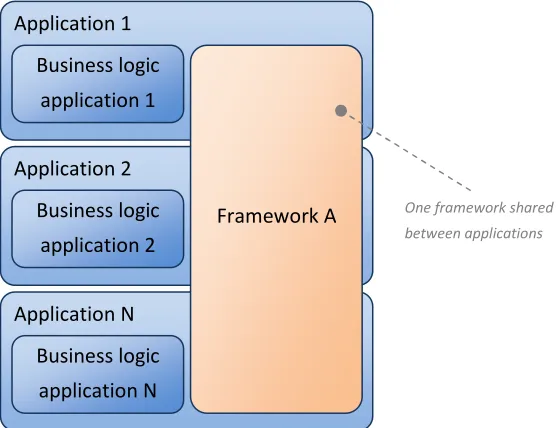
32 Two situations are possible in the context of applications making use of one framework. The first situation is illustrated Figure 3.2; multiple applications share the same instance of a framework. This means that the framework itself is centrally located and the application business logic can access it. Similar applications can make use of shared libraries, these applications make use of a shared framework.
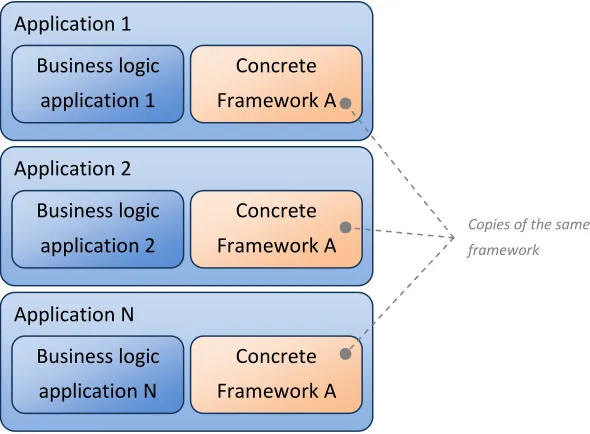
In the second situation multiple applications exist that operate completely stand alone. This might be the case when the software needs to be located at the customer or even by the simple
Application 1 Business logic
application 1
Application 2 Business logic
application 2
Application N Business logic
application N
Framework A
Framework A
Framework A
Copies of the same
[image:34.595.204.483.169.383.2]framework
Figure 3.3: Applications have a copy of the same framework. Sharing a framework is either not possible or by customer demand that every application is working stand alone. In this philosophy example N applications exist that have their own instance of the framework. If a new version of the framework is released it should replace all the older versions of all applications, keeping all applications updated and ensuring that all applications have the same framework.
Application 1 Business logic
application 1
Application 2 Business logic
application 2
Application N Business logic
application N
Framework A
Figure 3.2: Applications share the framework. In this example N applications exist that share the same instance of the framework. The framework is located on a central place and only one instance of the framework exists. This gives the advantage only to have to update one version of the framework. Disadvantage is the fact that all application have to share a server that provides the framework; this is not always possible and it is possible that customers simply do not want it.
One framework shared
33 reason that a customer might demand it. In any case, it is not allowed to update a framework instance for one application. Some kind of framework management has to be applied to ensure that all the applications continue to have the same framework (see subsection 3.4.3).
Framework management is necessary, otherwise it is possible that multiple different versions of the framework exist and the problems start all over again.
The philosophy goes further; customer demands have to be translated into business logic and business logic consists of scripts telling the framework what to do and when to do it. Only having to script makes development of a new enterprise application or updating an existing enterprise application easier and faster; due to the fact that the developer is limited by the scripting rules and does not have the freedom of a programming language. Making programming errors and bugs are therefore limited and, for the most part, only exist in the framework itself.
The framework has to offer a means to fast and easy ‘implement’ (i.e. script) business logic of a customer. This is different from other existing frameworks (see subsection 2.1.5) because the framework offers a form of high level programming language; with a few simple commands an complex application can be built. NextSelect core business process consists of analyzing and possibly optimizing customer business processes and translate this into enterprise software. Due to common changes in the business processes of customers the software often requires changes or new features. The framework philosophy optimizes the NextSelect business process by making the software development of enterprise application easier and faster. Furthermore, as the problems of NextSelect are assumed to be common for other software development companies, this philosophy can also optimize development processes of other companies. The business logic of the customer can hold a lot of information. To keep the application well-ordered it is required to split the business logic up in to modular parts; which are called
34 A module may only consist of business logic and it should not contain any functionality in terms of application logic. If it does, the philosophy is broken; due to the fact that maximizing code reusability cannot be guaranteed any more. Functionality placed in a module is not reusable for other applications that utilize the same framework (modules are not shared, only the framework with extensions). If one of those applications require the same functionality it has to be
implemented again, hence leading to code duplication. To make the building of (enterprise) applications easier a module does not communicate directly to the extensions. It asks the framework to do ‘something’ in a plain and simple request. Examples are presented in subsection 3.2.1. The framework has to handle the request and transfer it to the extension responsible for the feature.
Splitting up the application into modules and just a ‘framework’ is not enough and does not comply with the objective that the framework has to be modular built (see subsection 2.2.3). Therefore the framework itself is split into two parts: the Framework Core and a unlimited amount of extensions, illustrated in Figure 3.5.
Module 1 Module 2
Module N Business logic
35 Features are split up into modular parts called extensions. An extension can be seen as tool that has the responsibility to facilitate the framework and modules with reusable functionality. The framework may consist of an unlimited amount of extensions.
The Framework Core controls the framework and the extensions. The Framework Core is required due to the fact that modules communicate with the framework via a high level interface (see subsection 2.2.4) and the Framework Core takes care of this communication. Modules do not know anything about the underlying implementation that exists in the extensions. This has two reasons; modules are scripted not programmed and secondly, if no direct calls to extensions are used it is easier to modify the framework and maintain
compatibility with older modules from older applications (see subsection 3.4.3).
To summarize the philosophy: the application is split into two parts: business logics and the framework, which can also be used by other applications. Business logic is divided into an unlimited amount of modules. Application logic in terms of features and functionality, without any business logic, is placed into an unlimited amount of framework extensions. Extensions hold the reusable part of the functionality offered. The Framework Core will manage the modules and extensions, and their communication. Modules tell the framework what to do without
communicating directly to the extensions. A module is scripted, not programmed, it can be seen as a configuration part of the framework. A software developer only has to script or configure his whishes and the framework will take care of the rest.
Keep in mind that achieving this philosophy depends on the actual implementation of the framework. If the framework is not well equipped with functionality the philosophy can fail. Furthermore, a developer cannot be forced to follow the philosophy. However, rules and specifications to implement the framework are provided. An application satisfies the objectives Figure 3.5: Modular framework. The framework is split into two parts. The first consists of the Framework Core and the second part contains all the framework extensions. The extensions contain all reusable functionality and can be seen as tools that have the responsibility to facilitate the framework and modules. The Framework Core manages the extensions and communication with the application.
Framework Core
Extension 1 Extension 2
36 if the developer follows the philosophy, design (section 3.2 and 3.3) and rules and specification (section 3.4).
3.1.1.REAL LIFE EXAMPLE
Before more details about the architecture are discussed, a real life example is given next for a better insight about the frameworks philosophy:
Example:
Imagine a DVD player, it has a lot of features, but most the important feature is playing a DVD. The device itself can be seen as a framework; the internal components provide high level features, such as playing a DVD or CD. These internal components can be seen as the extensions of the framework which are controlled by some sort of CPU, the Framework Core.
The device itself does not operate automatically, it needs to be told what to do and when to do it. In this case a person has to operate the device, hence a person can be seen as a module. This person does not care how the device is working internally and how the internal components are communicating with each other. The person expects a high level interface (eject, play, rewind, etc.) to make use of the features offered by the device. If some high level input is given, the device has to process the request and deliver it to the appropriate components. Under water a high level request, such as ‘play’, results in a lot of low level internal calls between the CPU of the device (Framework Core) and internal components (extensions), e.g. read block from DVD, decode block, send video frame to output buffer, etc.
Now this person bought a new Blu-ray disc and wants to play it in the DVD player.
However, this DVD player does not support reading the new Blu-ray discs, hence it lacks a feature that the person wants to have. Of course the person is not going to read the Blu-ray disk itself (i.e. features may not be implemented at the module side), the person has to buy a new device that does provide the feature (i.e. the framework gets replaced by a newer version). This new device can still play the DVD’s and CD’s, but adds a new feature of playing Blu-ray’s.
37
3.2.
ARCHITECTURE
The architecture of the framework is based on the problems, the whishes and most of all: the philosophy of the framework. According to the philosophy the application consists of two main parts: the customer specific business logic and the framework that can be used for multiple applications (see Figure 3.1). The part holding the business logic is split up into an unlimited amount of modules, each module representing a piece of the business logic. The framework part consists of a Framework Core and an unlimited amount of extensions. This is translated into the following architecture:
Modules do not contain functionality and are scripted by a software developer using simple calls that will tell the framework what to do and when to it. A module can also be seen as controller with a certain configuration that controls the framework. The Framework Core acts as a façade (software design pattern), transferring module request to the extensions responsible. A
response may return from the framework; however, it will not contain complex data due to fact that modules may not contain functionality and can therefore not handle it (discussed in section 3.4).
Extensions contain all the features and reusable functionalities of an application. If the same concrete version of a framework is deployed in multiple applications (as illustrated in Figure 3.3) it is possible that certain features are not used. Features could be disabled or could be left aside, this is the choice of the software developer. In any case, the Framework Core has to know which extensions are available and the functionality they offer. Hence it is possible to transfer module calls to the responsible extensions.
The Framework Core controls the modules and extensions. It has the responsibility to process requests from the modules and find the right functionality in the features offered by the
Module 1 Module 2
Module N
Framework Core
Extension 1 Extension 2
Extension N (Enterprise) application
Framework (application logic) Business logic
38 extensions. How the Framework Core has to find functionality depends on the concrete
implementation of the framework. This can be done in a simple way, e.g. finding a functionality by name, or in a very complex way where the module communicates in a natural language that the Framework Core can ‘understand’. In any case, modules will not communicate directly with extensions, the Framework Core processes the requests of the modules and tries to find the required functionality within the extensions.
3.2.1.SIMPLE EXAMPLE
To demonstrate the framework a simple example is presented in Figure 3.7 and Figure 3.8. Although the request in this example does not represent a high level enterprise application request that the framework should handle, it gives a clear perception how the framework operates. For an example using a part of the enterprise application MIDS see Appendix F. The module Person has two operations for the framework. The first operation is illustrated in the Figure 3.7, the second operation in Figure 3.8.
This example framework has two extensions: Config and Age Calcucation. The Config extension is able to store a birth date. Note: actual storage is not shown in the figure only a function to set the birth date. The second extension Age Calculator (inactive in this example, therefore grayed out) offers functionality to calculate an age with a birth date that has been set in the Config
extension.
In the first operation the Person module tells the framework to set the birth date to ‘29-11-1980’. This request is processed by the Framework Core which tries to locate the appropriate extension that holds the functionality to actually set the birth date. In this case it is the Config
extension. The request is delivered to the Config extension which will store the birth date in a local variable (not shown). The extension can send a response back to the Framework Core
Person Framework Core Config
(Enterprise) application
Framework (application logic) Business logic
f->setBirthDate(’29-11-1980’); Process request set_birth_date(date)
Age Calculator
calculate_age()
Process response Deliver request
Figure 3.7: Small example (part 1). A module called ‘Person’ tells (1) the framework to execute ‘setBirthDate()’ with a given date. The Framework Core processes (2) the request, locates the appropriate extension (3) ‘Config’ and delivers (4) the request. The extension executes the request (5), An optional response from the extension is sent back to the Framework Core(6) and module (7). The Framework Core’s responsibility to load and register the extensions and module is not shown.
Optional response, in this case not more than a Boolean.
f->calculateAge();
1 2
3 4
5
39 which in turn can also send a response back to the module. This depends on the concrete
implementation of the Framework Core and the extensions. A response back to the module has to be simple due to the fact that a module may not contain any application logic to process the returned data. In this example it could be a Boolean telling that the operation succeeded or failed.
In Figure 3.8 the second operation of the Person module is illustrated. In this case the module tells the framework to calculate the age, the framework already knows the birth date from the first operation.
Important to see in the example is that the request (calculateAge) sent by the module Person
does not correspond directly to the functionality offered in the extensions, e.g. the module requests ‘calculateAge’ and the request is executed by the function ‘calculate_age’. The
Framework Core is responsible to find functionality offered by an extension and deliver the request. A module does not have to know what happens ‘under water’ and which functions are used within the extensions, it only cares if the high level request is executed. In another
scenario (discussed in subsection 3.2.2) it is even possible that multiple age calculation functions exist and the Framework Core has to figure out which one to use.
Also important to see is the implementation of the module. The module only has some simple requests for the framework. The framework has all the functionality to form an application, it just needs a module or multiple modules to tell it what to do.
In this example nothing is done with the actual age that is calculated. A third extension that offers the functionality to print values to a console or other output device could be added. The module could in a third operation tell the framework to output the calculate age. For a more complex and high level example see Appendix F for more details.
Person Framework Core Config
(Enterprise) application
Framework (application logic) Business logic
f->setBirthDate(’29-11-1980’); Process request set_birth_date(date) <