warwick.ac.uk/lib-publications
Original citation:
Macken, Bill, Taylor, John C., Kozlov, Michail D., Hughes, Robert W. and Jones, Dylan M..
(2016) Memory as embodiment : the case of modality and serial short-term memory.
Cognition, 155 . pp. 113-124
Permanent WRAP URL:
http://wrap.warwick.ac.uk/81269
Copyright and reuse:
The Warwick Research Archive Portal (WRAP) makes this work of researchers of the
University of Warwick available open access under the following conditions.
This article is made available under the Creative Commons Attribution 4.0 International
license (CC BY 4.0) and may be reused according to the conditions of the license. For more
details see:
http://creativecommons.org/licenses/by/4.0/
A note on versions:
The version presented in WRAP is the published version, or, version of record, and may be
cited as it appears here.
Original Articles
Memory as embodiment: The case of modality and serial short-term
memory
q
Bill Macken
a,⇑, John C. Taylor
a, Michail D. Kozlov
a, Robert W. Hughes
b, Dylan M. Jones
aaSchool of Psychology, Cardiff University, United Kingdom b
Department of Psychology, Royal Holloway, University of London, United Kingdom
a r t i c l e i n f o
Article history:
Received 11 August 2015 Revised 19 June 2016 Accepted 22 June 2016 Available online 1 July 2016
Keywords:
Short-term memory Serial recall Modality effect Embodied cognition
a b s t r a c t
Classical explanations forthe modality effect—superior short-term serial recall of auditory compared to visual sequences—typically recur to privileged processing of information derived from auditory sources. Here we critically appraise such accounts, and re-evaluate the nature of the canonical empirical phenom-ena that have motivated them. Three experiments show that the standard account of modality in mem-ory is untenable, since auditmem-ory superiority in recency is often accompanied by visual superiority in mid-list serial positions. We explain this simultaneous auditory and visual superiority by reference to the way in which perceptual objects are formed in the two modalities and how those objects are mapped to speech motor forms to support sequence maintenance and reproduction. Specifically, stronger obligatory object formation operating in the standard auditory form of sequence presentation compared to that for visual sequences leads both to enhanced addressability of information at the object boundaries and reduced addressability for that in the interior. Because standard visual presentation does not lead to such object formation, such sequences do not show the boundary advantage observed for auditory presenta-tion, but neither do they suffer loss of addressability associated with object informapresenta-tion, thereby afford-ing more ready mappafford-ing of that information into a rehearsal cohort to support recall. We show that a range of factors that impede this perceptual-motor mapping eliminate visual superiority while leaving auditory superiority unaffected. We make a general case for viewing short-term memory as an embodied, perceptual-motor process.
Ó2016 The Authors. Published by Elsevier B.V. This is an open access article under the CC BY license (http:// creativecommons.org/licenses/by/4.0/).
1. Introduction
The cognitive approach to explaining behavior addresses itself, at heart, to processes involved with the generation and transfor-mation of representations cleft both from the perceptual processes whereby the represented objects and events are transduced and the motor processes wherein their ultimate effects shape the actions of the organism. Constraints arising from perceptual and motor processes are typically cast as subsidiary to those operating at the core of the cognitive system. A classic instance of this relates to the role of modality of presentation in short-term memory per-formance, the investigation of which dates back to the origins of
the cognitive approach to short-term memory (e.g., Conrad & Hull, 1968; Crowder & Morton, 1969), and continues to form part of the empirical canon to which theorizing in short-term memory addresses itself (e.g.,Burgess & Hitch, 2006; Grossberg & Pearson, 2008; Henson, 1998; Page & Norris, 1998).
The received narrative of the role of presentation modality in serial term memory is succinctly captured thus: ‘‘For short-term memory, auditory presentation is consistently superior to visual presentation, with the difference restricted to recently pre-sented items.” (Penney, 1975, p. 68). Similarly, the view is encap-sulated from the outset of investigation of thismodality effectin the ‘idealized’ serial position functions depicted byCrowder and Morton (1969, p. 366)in which visual and auditory serial position functions are identical for early and mid portions, with audition emerging superior towards the end. Nearly 50 years of theorizing about the basis of this effect has followed the classical cognitive scheme described above, involving the separation of perceptual processing from the core, modality-independent cognitive system supporting short-term serial memory (see e.g., Hurlstone, Hitch, & Baddeley, 2014). Here we revisit the role of modality in
http://dx.doi.org/10.1016/j.cognition.2016.06.013
0010-0277/Ó2016 The Authors. Published by Elsevier B.V.
This is an open access article under the CC BY license (http://creativecommons.org/licenses/by/4.0/).
qAuthor notes: This research was supported by a grant to Macken, Hughes and
Jones from the Economic and Social Research Council of the U.K. (Grant No. ES/ I028919/1). Bill Macken is an honorary affiliate of the Department of Psychology, Umeå University.
⇑ Corresponding author at: School of Psychology, Cardiff University, Cardiff CF10 3AT, United Kingdom.
E-mail address:[email protected](B. Macken).
Contents lists available atScienceDirect
Cognition
short-term memory and find not only that its empirical character has been misconstrued, but that, despite the way in which it has been incorporated into mainstream cognitive theorizing, it poses a fundamental challenge to that way of explaining performance.
1.1. Classical approaches to the Modality Effect (ME)
The modality-specific aspect of performance in serial recall is most usually framed in terms of processes or representational forms which confer an advantage for auditory verbal over visual verbal information. An early approach invoked a bespoke limited-capacity store dedicated to the exclusive retention of acoustic input, the Precategorical Acoustic Store (PAS;Conrad & Hull, 1968; Crowder, 1970; Crowder & Morton, 1969). In this view, superior recall of auditory items stems from the fact that the PAS holds input in a more durable form than does a store containing precategorical representations of visual stimuli. At the point of recall, representations of pre-recency items within such precate-gorical memory stores (both visual and acoustic) will have decayed or have been overwritten by later items. However, recent auditory items enjoy a recall advantage over visual items due to the greater durability of PAS compared to the precategorical visual store. While specific aspects of the PAS account have fallen out of favor in the ensuing decades, the notion of a dedicated auditory input store still figures in many contemporary accounts of the role of modality (see e.g.,Hurlstone et al., 2014).
Other theories eschew modality-specific stores but still invoke constructs in which auditory input is afforded a special status, enjoying either greater positional (Henson, 1998) or temporal (Glenberg & Swanson, 1986) resolution, or requiring less attention-dependent maintenance processes (Penney, 1989). Still other approaches assume that representations of auditory items are inherently richer than those of visual items with memory items represented as a mixture of modality-dependent (physical) fea-tures and modality-independent feafea-tures (e.g., Nairne, 1990; Neath, 2000). Auditory items are assumed to have more modality-dependent features than visually presented items mak-ing them less prone to interference.
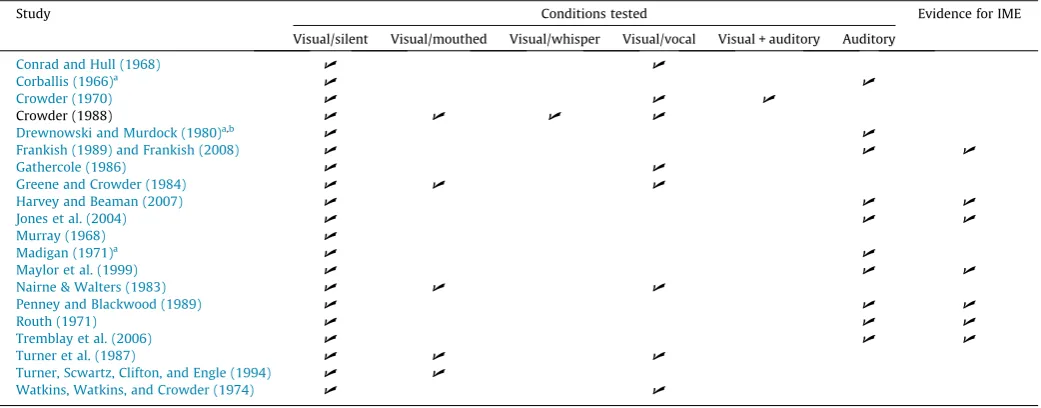
Despite the differences in these classical approaches, a major stumbling block for all of them, and the empirical starting point for our re-appraisal, is the rarely remarked-upon observation that the superiority of recall of auditory items at recency can be accom-panied simultaneously by visual superiority at pre-recency: an inverse modality effect(IME; e.g.,Beaman, 2002). The idea of intrin-sically superior memory representations or processes for auditory (over visual) stimuli cannot easily explain such an effect. Although only commented upon relatively recently (Beaman, 2002), it tran-spires that there are many instances—although the picture is not universally consistent—in which evidence for an IME is present when an auditory-alone presentation (i.e., with no concurrent visual presentation) is contrasted with a visual-silent presentation (Baddeley & Larsen, 2007; Frankish, 1989, 2008; Harvey & Beaman, 2007; Jones, Macken, & Nicholls, 2004; Maylor, Vousden, & Brown, 1999; Penney & Blackwood, 1989; Routh, 1971; Tremblay, Parmentier, Guérard, Nicholls, & Jones, 2006).Table 1gives a list of studies and their outcomes in which we simply note whether or not visual recall was superior to auditory recall in mid list serial position curves, since the relevant papers don’t actually statisti-cally test for such effects.
A further anomaly for the classical cognitive approach arises when a survey of the literature reveals that there are in fact rela-tively few studies in which audition and vision are compared directly. While the term ‘modality effect’ connotes a contrast between auditory and visual presentation, in many relevant stud-ies, the ‘auditory’ items are not in fact presented auditorily. As shown in Table 1, the ostensible ‘auditory’ condition often
comprises visually presented sequences that are read aloud simul-taneously by the participant. For clarity, we propose that such con-ditions are better described as beingvisual-vocalized, rather than auditory. Arguably, the properties of simultaneously read and spo-ken material derive as much from the fact that they involve artic-ulatory control processes as from their auditory characteristics. It is not unreasonable therefore to question the extent to which such a comparison is a reflection of modality as it is typically construed. Indeed, scrutiny of such studies poses further questions. Although vocalized lists show enhanced recency relative to visual-silent lists (and so appear functionally similar to direct auditory presentation), it is not clear whether this is wholly or even partly due to the auditory properties of the setting. For example,
Crowder (1970)compared the serial recall of silent, visual-vocalized and bimodal (auditory and visual) digit sequences. Recall in recency was superior for both the vocalized and the bimodal conditions compared to the visual-silent condition, suggesting that superior recall in recency does indeed derive from the presence of an auditory signal. However, in another study (Crowder, 1986) comparing visual-silent lists with vocalized, whispered or mouthed lists, recency effects of equal magnitude were obtained for all three articulation condition (see also Greene & Crowder, 1984) all of which suggests that it may be misleading to ascribe recency effects in visual-vocalized sequences to the action of the auditory character of the input.
While not providing hard statistical evidence, since relevant tests were not conducted,Table 1is suggestive of the historical presence of an IME in terms of numerically superior visual versus auditory recall in pre-recency. When a ‘true’ auditory vs. visual contrast is made, those cases in which IME is lacking (i.e., numer-ically equivalent performance in mid-list positions) may be due to features of the experimental design that deviate from the usual requirement for forward serial output of the whole sequence. For example, in the serial position curves reported by Drewnowski and Murdock (1980), where no IME was observed, the to-be-remembered sequence-length was varied on a trial-by-trial basis and participants were not asked for a fixed number of responses on each trial. Participants conceivably may have strategized, trun-cating their responses for the longer sequences. Empirically—and in addition to the absence of an IME in pre-recency—there were no significant recency effects for either auditory or visual sequences, as evaluated using a correct-in-position scoring regime (see Fig. 3 ofDrewnowski & Murdock, 1980). In other words, no modality effect of any sort was observed using a strict serial recall criterion. Furthermore, in that study, presentation modality was manipulated between participants (see also, Corballis, 1966; Madigan, 1971), raising the possibility that early-list differences are additionally masked by group differences in overall performance.
The IME, therefore, poses a fundamental problem for the classi-cal approach to the role of modality in memory: any account that explains the effect of modality by reference to inherent properties of the information derived from that modality—by virtue of it being so derived—cannot be applied consistently and coherently through-out the serial position function that has been the focus of so much theorizing about the nature of memory.
1.2. An embodied approach
Our approach to the question of modality in short-term ory derives from a radically different approach to short-term mem-ory itself. Bluntly, we regard short-term memmem-ory as a perceptual-motor task setting, in the same way that, for example, the goal-directed manual apprehension and manipulation of a solid object may be regarded as a perceptual-motor task setting. In the latter case, the task involves processes that render object-oriented visual perceptual representations that may provide control programs for the manual interaction with the object in order to accomplish the task-specific goals. In the case of short-term serial recall, the object of concern is the sequence of verbal material presented for repro-duction, and the motor system adopted for manipulation of this object is the articulatory control system involved in the production of speech. Overall performance in the setting is an outcome of per-ceptual and motor processes and the interactions between them. From this perspective, modality of presentation comes into play with respect to object formation processes as they operate in visual and auditory presentation, and how the perceptual representations so formed afford, to greater or lesser degrees, facile manipulation of those objects and their constituents in the speech motor system. Key to this account are both the nature and the consequences of perceptual object formation. While objects are fundamental func-tional units for both vision and audition, there are important differ-ences between modality in how they are formed. As a generalization, processes of auditory object formation play out with respect to the temporal dimension, where extended acoustic events are grouped together over time, on the basis of gestalt-like properties of similarity and continuity of frequency, timbre, rhythm, and so on (e.g.,Bregman, 1990). Visual object formation can also be characterized in terms of gestalt grouping cues, but
in this case, spatial extent provides the substrate (see e.g.,Scholl, 2001). This distinction is important for our account of modality effects in serial recall. Auditory presentation of a sequence – ema-nating from a single spatial location at a regular rate, in a spectrally consistent voice – means that there is a strong tendency for that sequence to form a coherent object. On the other hand, the forces of object formation are considerably weaker for the corresponding visual presentation where successive visual events are presented discretely over time in the same spatial location.
This difference in the way in which object formation plays out in the different modalities means that the consequences of object formation impact differently depending on modality. The conse-quence of importance here is that the fate of the nominal content of an object is determined by its being incorporated into an object; specifically, given the key role that boundary (or contour) process-ing plays in object formation (e.g.,Wagemans et al., 2012), content that resides at or near the boundary of the object is relatively highly resolved, while content in the interior is less so. So, in con-stituting the boundary of an object, information acquires percep-tual salience, making that information readily addressable, whereas the strong binding of individual list items within an object means that they lose salience and their individual identity becomes less addressable. Critically for our account, these conse-quences stem from object formation, not from the particular modality of presentation, per se.
[image:4.595.43.564.95.299.2]Such functional consequences of auditory object formation are demonstrated in a range of settings involving the processing of sequences of auditory events, verbal or otherwise. For example, while participants are able to make judgements about rapid sequences of sounds (e.g., a tone, a click, a vowel, a buzz, at a rate of less than 200 ms per sound) in terms of whether successive sequences contain those sounds in the same or a different order, the ability to actually report the order of individual elements, or to identify which if any elements have changed order, only emerges at slower rates of presentation, such as would weaken the tendency for those sounds to cohere into a single object, con-comitantly making them more addressable with respect to, for example, verbal labelling (see e.g.,Warren, 1999for an overview). Similarly, the ability to judge whether the order of a pair of tones differing in frequency is the same or different on two presentations Table 1
Summary of studies investigating the effects of modality, indicating which presentation conditions were compared and indicating when evidence of an IME— numerically superior recall for visual over auditory presentation in medial portion of the serial position curve—was present in the reported data.
Study Conditions tested Evidence for IME
Visual/silent Visual/mouthed Visual/whisper Visual/vocal Visual + auditory Auditory
Conrad and Hull (1968) U U
Corballis (1966)a U U
Crowder (1970) U U U
Crowder (1988) U U U U
Drewnowski and Murdock (1980)a,b U U
Frankish (1989) and Frankish (2008) U U U
Gathercole (1986) U U
Greene and Crowder (1984) U U U
Harvey and Beaman (2007) U U U
Jones et al. (2004) U U U
Murray (1968) U
Madigan (1971)a U U
Maylor et al. (1999) U U U
Nairne & Walters (1983) U U U
Penney and Blackwood (1989) U U U
Routh (1971) U U U
Tremblay et al. (2006) U U U
Turner et al. (1987) U U U
Turner, Scwartz, Clifton, and Engle (1994) U U
Watkins, Watkins, and Crowder (1974) U U
a
Modality effect only compared between subjects.
is impeded by the presence of single flanker tones, in a similar fre-quency range to the target tones, immediately preceding and suc-ceeding those target tones. That this impact is due to the binding of those target tones into an object with the flanker tones, thereby reducing their individual addressability (rather than, for example, some sort of pro- or retroactive masking), is demonstrated by the fact that the addition of further sequences of tones preceding and succeeding the flanker tones at the same frequency actually restores performance, by capturing the flanker tones into a differ-ent object, thereby perceptually isolating again the target tones (Bregman & Rudnicky, 1975).
The lineaments of perceptual object formation can similarly be observed in more typical verbal short-term memory settings. For example, in relatively short (i.e., lasting less than 5 or 6 s) verbal sequences, an advantage for auditory over visual verbal presenta-tion is evident especially at initial and terminal boundaries – i.e., at primacy and recency – while in longer sequences, the auditory advantage tends to be restricted to the recency portion (i.e., the classical ME) (see e.g., Jones, Hughes, & Macken, 2006; Macken, Taylor, & Jones, 2014; Maidment & Macken, 2012). That this advan-tage is due the stronger object formation processes – and therefore increased boundary salience – in the auditory compared to visual presentations is indicated by the way in which redundant prefixes and suffixes impact on the pattern of serial recall. The occurrence of a redundant end of list suffix eliminates or attenuates the ME (e.g.,Crowder & Morton, 1969; Nicholls & Jones, 2002), however a redundant prefix also reduces the auditory advantage in those cases when it appears in primacy in shorter sequences (Jones et al., 2006). Furthermore, in both cases, prefixes and suffixes have their effect to the extent that they are perceptually incorporated into the auditory object corresponding to the memory sequence, thereby displacing the initial and terminal items from their privi-leged boundary positions; the addition of further redundant, task irrelevant auditory material that serves to ‘capture’ the suffix or the prefix into a separate object (in a manner analogous to the
Bregman & Rudnicky, 1975, findings described above), restores serial recall performance for those initial and/or terminal items by, we argue, restoring those items to their boundary position within the auditory object corresponding to the to-be-remembered sequence. In one illustration (seeNicholls & Jones, 2002), the addition of the redundant (i.e., not to be recalled) spo-ken word ‘go’ at the end of a random sequence of to-be-recalled digits eliminated the ME. However, the further addition of a con-current sequence of the spoken word ‘go’, in such a way that the suffix is incorporated into the object corresponding to that sequence, rather than the memory sequence, restores the auditory advantage in recency, even though the original suffix is still in exactly the same temporal and spectral relation to the end of the memory sequence (see alsoMaidment & Macken, 2012).
The typical form of auditory presentation in serial recall, then, affords stronger obligatory object formation than does the typical form of sequential visual presentation. The consequences of such object formation are that information at or near boundaries is well-resolved and readily addressable, while information in the interior of the object is less well resolved and the identity of the individual constituents – the list items – becomes less addressable. Such effects are not restricted to the formation of auditory objects, since analogous outcomes are observed in visual object formation where information in the interior of visual objects loses spatial res-olution compared to information at or near the boundaries (e.g.,
Katshu & D’Avossa, 2014; Manassi, Sayim, & Herzog, 2012). On the other hand, because the typical form of presentation for visual-verbal serial recall does not lead to the sequence forming a coherent object, not only does such presentation not lead to the type of boundary salience that is evidenced in auditory recency, neither do items within the sequence lose their individual
addressability which would occur due to being bound into a single object corresponding to the whole sequence. Again, the critical point here is that object formation – rather than modality, per se – determines how the list content is represented.
These outcomes of object formation then enter into the process of subvocal rehearsal that underlies aspects of performance in serial recall. This involves the cumulative assembly of a rehearsal cohort incorporating successive items as the sequence unfolds, a process that we conceive of here as the mapping of the perceptual form onto the motor control processes which allow for the manip-ulation – i.e., the maintenance and reproduction in whatever form – of the sequence. Importantly, this assembly is subject to the real time constraints involved in subvocal motor processing (see e.g.,
Taylor, Macken, & Jones, 2015; Warren, 1999) so that assembly and iterative maintenance of a progressively longer motor control programme comes into conflict with the process of perceptual-motor mapping as the sequence unfolds. For this reason, subvocal rehearsal is most effective in supporting serial recall of the earlier parts of the sequence. While such processing normally takes place covertly in a serial recall setting, these inferences are supported by the findings of just such a pattern of behavior when overt rehearsal is required (Tan & Ward, 2000; Ward, 2002).
However, the efficacy of this process of mapping from percep-tual to motor form is influenced not only by the real-time con-straints on motor processing but also by the extent to which the perceptual form accords with the task-specific requirement to reproduce the sequence in terms of its serial constituents. For example, an auditory sequence that alternates on successive items from one voice to another is less well recalled than a sequence pre-sented in a single voice, and this detriment arises because the alternating presentation leads to the formation of two perceptual objects, one corresponding to each of the voices, neither of which corresponds to the form of sequence required by the task (i.e., each item in its original successive order) (Hughes, Marsh, & Jones, 2009, 2011). The relevance of this here is that because the items bound within an object lose addressability with respect to their individual identity, the incorporation of that item information into the rehearsal cohort is compromised compared to a situation in which the items are not so bound. Specifically, given the argument about differences in object formation for visual and auditory sequences presented above, visual presentation will afford more ready incorporation into the rehearsal cohort of the sort of detailed item-by-item sequential articulatory specification that best sup-ports serial recall performance (e.g., Acheson & MacDonald, 2009; Macken & Jones, 1995; Taylor et al., 2015; Woodward, Macken, & Jones, 2008) and therefore lead to an advantage with visual presentation for those items whose recall is sustained by subvocal rehearsal. As such, the strong tendency for the auditory sequence to form a coherent object leads via the same process to bothenhancedperformance for boundary information andreduced performance for interior information compared to visual presenta-tion, while the weaker such tendency for visual presentation has precisely the opposite consequences.
the requirement to vocalize or mouth, if that effect resides in the ready incorporation of successive list items into such a rehearsal cohort in the earlier part of list presentation for visual presenta-tion. At the same time, the requirement to incorporate each list item means that the participant has to convert the whole list into a motor object, but this motor object will be critically different from the one corresponding to the rehearsal cohort assembled under normal conditions. Rather than being cumulative and itera-tive, it will instead form a motor object that is an analogue of the list and therefore it will constitute an object bounded by initial and terminal points corresponding to those of the list, with the concomitant salience and recall advantage conferred for the infor-mation at those boundaries. On the other hand, not only does the cumulative nature of unconstrained rehearsal mean that the termi-nal boundary of an object so formed is constantly updated, given that such rehearsal cohort formation might only be deployed strategically for the early part of the list (see e.g.,Grenfell-Essam, Ward, & Tan, 2013; Tan & Ward, 2000; Ward, 2002), the terminal item might never even enter into a motor object, and so would only benefit if perceptual object formation processes were operating on the list, that is, for auditory but not visual presentation. In the experiments that follow, we test this embodied account by manip-ulating a range of factors that may be expected to impact on the object formation and perceptual-motor mapping processes that we propose give rise to the impact of modality on serial recall.
2. Experiment 1
Given the sort of methodological and empirical variability, described above within investigations of the role of modality in memory we begin by establishing within a single experiment the pattern of performance across the serial position curve associated with ‘pure’ auditory and visual presentation, as well as both silently mouthed and vocalized articulation of each successive list item on its presentation.
2.1. Method
2.1.1. Participants
Twenty-two1Cardiff University Psychology undergraduates (19 female) aged 18–26 years (Mean: 19.5 years) participated in exchange for course credit. All had normal or corrected-to-normal vision and hearing. Ethical approval for all experiments reported here was received from the Cardiff University, School of Psychology Ethics Committee in accordance with British Psychological Society ethics guidelines.
2.1.2. Materials
The stimuli were random permutations of seven consonants (R, X, H, Y, L, Q, K) presented either visually or auditorily. No items were repeated within a sequence and each sequence was unique. Visual stimuli were presented in 60 pointArialfont. Auditory stim-uli were recorded in a female voice (16-bit, 48 kHz) using a con-denser microphone and Audacity (v. 1.3.12) audio workstation software (http://audacity.sourceforge.net) and digitally edited to 250 ms in length.
2.1.3. Design
A 4 (presentation mode: auditory, silent, visual-mouthed; visual-vocalized)7 (serial position), within-participant design was employed. Presentation mode was blocked
and block-order was randomized across participants. Each block comprised 30 trials, preceded by two practice trials. In the auditory condition, to-be-remembered sequences were presented via head-phones. In the visual conditions, stimuli were presented centrally on a computer monitor. In the visual-vocalized condition, partici-pants were instructed to read the items aloud as they were pre-sented. In the visual–mouthed condition, participants mouthed the sequence items silently. In the visual-silent condition, partici-pants were instructed to read the items silently. With the permis-sion of the participants, compliance with instructions relating to the visual-vocalized and visual-mouthed conditions was moni-tored, respectively, via a sound and video link.
2.1.4. Procedure
The experiment was conducted in a sound-attenuating booth. Prior to commencement, participants were told that their task would be to remember the order in which seven letters were pre-sented. At the beginning of each block, participants were informed as to the modality of the stimuli in the upcoming trials (auditory or visual) and whether or not there was a requirement to vocalize or mouth the stimuli during visual presentation. Each trial began with a blank screen (1 s) followed by sequential presentation of the stimuli (250 ms duration, 750 ms ISI). At the end of each trial, the seven letters were re-presented on screen in a random permu-tation. Participants were instructed to use the mouse-pointer to click the letters in the order in which they had been presented. As each letter was selected, it disappeared from the array of avail-able letters and was added to the reconstructed sequence. Each item could only be selected once and all items had to be selected before the next trial was initiated. Each trial commenced automat-ically on completion of the previous trial. The duration of the experiment was approximately 60 min.
2.2. Results and discussion
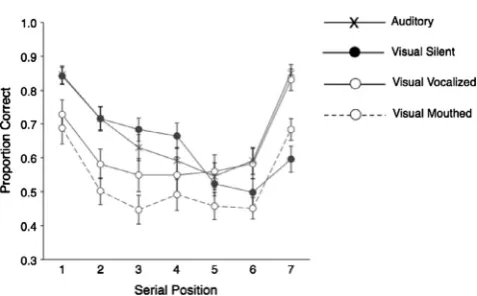
Serial position curves for each presentation-mode are shown in
Fig. 1. Several patterns can be identified in these data. Comparison between the visual-silent and auditory conditions reveals the pres-ence both of an ME in recency (auditory superiority) and an IME in mediacy (visual superiority). Further, both the visual-vocalized and visual-mouthed conditions reduce performance in pre-recency (compared to both the auditory and visual-silent conditions) while exhibiting strong recency effects (relative to the visual-silent con-dition), of a similar magnitude to that seen for auditory presentation.
These impressions were confirmed statistically. A 4 (presenta-tion mode)7 (serial position) repeated measures ANOVA revealed significant main effects of serial position, F(6, 126) = 41.48, p <0.001,
gp
2= 0.66 and presentation mode, F(3, 63) = 10.58, p< 0.001,gp
2= 0.35, and a significant interaction, F (18, 378) = 11.69, p <0.001,gp
2= 0.36, indicating different effects of presentation mode across serial position.In order to examine these different effects, we separately con-trasted visual-silent with the other three presentation modes. Paired simple effects comparisons between the auditory and visual-silent modes confirm the impression given by Fig. 1, that while there was superior performance for auditory items in recency, overall, there was no significant difference between audi-tory and visual-silent performance, F(1, 21) = 2.63, p =0.12,
gp
2= 0.11. A significant presentation mode by serial position inter-action,F(6, 126) = 18.99,p <0.001,g
p2= 0.48, indicates that the MEin recency is offset by the IME in pre-recency with significantly better visual compared to auditory recall at serial position 4, t (21) = 2.85, p= 0.010, and auditory superiority at serial positions 6 and 7,t(21) = 2.57,p= 0.018;t(21) = 7.06,p< 0.001,respectively 1 Sample sizes used in the experiments reported here are typical of those that have
(nonsignificantpvalues for serial positions 1, 2, 3, and 5 = 0.910. 0.965, 0.117 and 0.485 respectively).
Comparing visual-vocalized and visual-silent modes (i.e., the effect of vocalization), the main effect of serial position was signif-icant,F(6, 126) = 26.08,p< 0.001,
gp
2= 0.55, with no main effect of presentation mode,F(1, 21) = 1.07,p =0.21,gp
2= 0.05, and a signif-icant interaction,F(6, 126) = 24.04,p< 0.001,gp
2= 0.53. Thus, rela-tive to the visual-silent condition, the large recency effect observed in the visual-vocalized presentation mode (Fig. 1) is again offset in recency. Vocalization therefore impedes performance in pre-recency while enhancing it in pre-recency.Finally, the comparison between the mouthed and visual-silent conditions (i.e., the effect of articulation, in the absence of vocalization) revealed significant main effects of both presentation mode (silent > vocalized),F(1, 21) = 12.88,p= 0.002,
gp
2= 0.38 and of serial position,F(6, 126) = 35.56,p< 0.001,g
p2= 0.63, and asig-nificant interaction,F(6, 126) = 13.86,p< 0.001,
gp
2= 0.39. There-fore, even in the absence of auditory feedback, the act of articulation serves to boost recency while impeding recall perfor-mance in pre-recency (relative to visual-silent presentation in both cases).Although performance on visual-mouthed lists appears to be generally inferior to the remaining conditions,Fig. 1suggests that mouthing the list enhances recency to the same extent as listening to items or vocalizing visual items. To corroborate this, a further ANOVA was carried out, to assess the effect of presentation mode on recency, defined as the difference between performance on the last item in a list and the average performance on the remaining items (Greene & Crowder, 1984). There was a significant main effect of presentation mode, F(3, 63) = 22.33, p <0.001,
gp
2= 0.52. but apart from visual-silent leading to reduced recency compared to visual-mouthed, visual-vocalized and auditory modes,t(21) = 4.59, p <0.001,t(21) = 5.7,p <0.001, andt(21) = 6.01,p <0.001, respec-tively, the other presentation modes were undifferentiated in recency,F(2, 42) = 1.99,p =0.15,gp
2= 0.09. To summarize, the effect of modality is neutral in primacy, negative (visual silent > auditory) in medial sequence locations and positive (auditory > visual silent) in recency. In contrast, both vocalization and articulation exert neg-ative effects in primacy (vocalized < silent; visual-mouthed < visual-silent) and positive effects in recency (visual-vocalized > visual-silent, visual-mouthed > visual silent).The results of Experiment 1, then provide statistical evidence of the existence of the IME, supplementing the more impressionistic evidence gleaned from the historical review presented above. Recall performance at medial sequence locations in visual-silent sequences was higher than all other presentation modes, critically, including auditory. This IME was abolished by both vocalization and silent mouthing of visual sequences which reduced recall in
early and medial parts of the list while at the same time leading to equivalent recency effects to that of auditory presentation. The abolition of the IME in the visual-vocalized and visual-mouthed conditions undermines accounts invoking the recruitment of visual codes (e.g.,Baddeley & Larsen, 2007; Beaman, 2002) since such codes should be available in for visual-silent and visual-vocalized presentation. We propose instead that the IME arises due to the more facile perceptual-motor mapping involved in incorporation of visually-presented list items into a rehearsal cohort, under stan-dard visual presentation conditions, due to their being less strongly bound into a coherent perceptual object compared to their audi-tory counterparts. Disrupting this perceptual-motor mapping elim-inates the IME.
The same constraints that impede recall of visual-vocalized and visual-mouthed sequences at pre-recency enhance recall later in the sequence: The emergence of a large recency effect in both these conditions is in line with our expectation that the obligatory artic-ulation through to the end of the sequence serves to emphasize the salience of the sequence endpoint via motor object formation pro-cesses analogous to those found with auditory perceptual object formation. Finally, the equivalent effects on recency of silent mouthing and overt vocalization of visual sequences indicates an effect of vocalization that is not due to concomitant auditory input. Effects of modality, then, are malleable and heterogeneously determined. Overall we have shown that the IME found when com-paring standard visual and auditory presentation can be abolished by impeding the assembly of a rehearsal cohort via forced-pace articulation of list items, while at the same time, the auditory advantage over visual presentation in recency can be abolished by requiring articulatory embodiment of the whole sequence in a form corresponding to its presentation order. The equivalent recency effect under mouthed and vocalized articulation points to a motor, rather than perceptual, basis for recency effects for visually presented sequences. We explore this proposal further in Experiment 2.
3. Experiment 2
If, as we have claimed, the pattern of modality effects emerges not from inherent coding differences between auditory and visual information, but from the combined and distinct operation of object formation processes operating on the sequence and perceptual-motor mapping processes involved in rehearsal cohort formation, any task that interferes with just one of these processes should abolish only ‘modality’ dependent recall differences that are attributable to that process. Articulatory suppression has been widely used as a means of impeding subvocal rehearsal (e.g.,
Baddeley, 1986; Baddeley, Lewis, & Vallar, 1984; Macken & Jones, 1995; Nairne, 1990) and as such represents an ideal candidate for probing the articulatory determinants of modality effects which we are proposing reside in the perceptual-motor mapping process. In Experiment 2, we compared visual and auditory serial recall with and without articulatory suppression. As with overt vocaliza-tion and silent mouthing, we predict that articulatory suppression will abolish the IME by impeding rehearsal cohort formation. How-ever, we predict that the ME will be left unaffected by articulatory suppression since, as argued above, this effect is due to obligatory object formation processes operating on the auditory sequences that do not obtain for visual presentation.
3.1. Method
3.1.1. Participants
[image:7.595.39.278.60.208.2]Twenty-four Cardiff University Psychology undergraduates, (20 female) were recruited as described for Experiment 1.
3.1.2. Materials
The materials were identical to those used in Experiment 1.
3.1.3. Design
A 2 (modality: auditory, visual)2 (articulatory suppression: control, suppression)7 (serial position), within-participant design was employed. Modality and articulatory suppression con-ditions were blocked and block order was counterbalanced across participants. Each block comprised 16 trials, preceded by two prac-tice trials. As in Experiment 1, to-be-remembered auditory sequences were presented via headphones while visual stimuli were presented centrally on a computer monitor.
3.1.4. Procedure
The procedure was the same as for Experiment 1 except for the following details: At the beginning of each block, participants were informed as to the modality of the stimuli in the upcoming trials (auditory or visual) and whether or not there was a requirement to engage in articulatory suppression. In the control condition, par-ticipants were instructed to attend to the stimuli silently. In the suppression condition, participants were to begin whispering the number sequence ‘8, 9, 10’ at a rate of 3 items/s as soon as the instruction screen appeared. A fixation cross was then presented for 1 s followed by sequential presentation of the to-be-remembered stimuli. In the suppression condition, participants were required to continue suppressing until the offset of the last to-be-remembered item. With their permission, participants were monitored by the experimenter via a microphone relayed from the testing booth in order to ensure compliance with the articulatory suppression instruction.
At the end of each trial, the seven letters were re-presented on screen in a random permutation along with an additional ‘don’t know’ response option, in the form of a question mark [?]. Partic-ipants were instructed to use the mouse-pointer to click the letters in the order in which they had been presented as described in Experiment 1. The procedure lasted approximately 30 min.
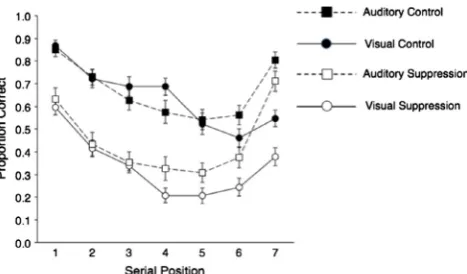
3.2. Results and discussion
Serial position curves for the four conditions of Experiment 2 are shown inFig. 2. Under control conditions, the pattern of perfor-mance replicates that of Experiment 1, with an advantage for audi-tory over visual items in recency (i.e., the ME) contrasting with an opposing advantage for visual items at medial sequence positions (i.e., the IME). Crucially, articulatory suppression abolishes the visual advantage in mediacy, without abolishing the auditory advantage in recency. These impressions were confirmed statisti-cally with a 2 (modality)2 (suppression)7 (serial position) repeated measures ANOVA. The main effects of modality, articula-tory suppression and serial position were all significant: modality (auditory > visual),F(1, 23) = 6.83,p= 0.016,
gp
2= 0.23; articulatory suppression (control > suppression), F(1, 23) = 124.3, p< 0.001,gp
2= 0.84; and serial position, F(6, 138) = 58.63, p< 0.001,gp
2= 0.72.The crucial three-way interaction of modality by articulatory suppression by serial position was significant, F(6, 138) = 2.67, p= 0.018,
gp
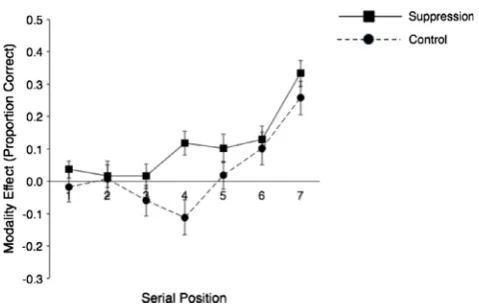
2= 0.10 confirming that articulatory suppression mod-ulates the effect of modality on recall performance but not uni-formly across serial positions. Specifically, the recall advantage for visually presented sequences in pre-recency is abolished by articulatory suppression, whereas the advantage for auditory sequences in recency is unaffected. The interaction between modality and suppression across serial position is illustrated inFig. 3, where the effect of modality – the difference between audi-tory and visual presentation – is plotted for each serial position. The effect of modality on recall diverges markedly in medial
sequence positions, such that the negative deflection in the control condition (corresponding to the IME) is completely abolished—and indeed reversed—under articulatory suppression. In order to con-firm this statistically, pairedt-tests were undertaken, comparing the effect of modality at each serial position.
Only the comparison at serial position 4 was significant,t(23) = 3.65, p= 0.001, confirming both the abolition of the IME and the survival of the ME under articulatory suppression.
Articulatory suppression, then, abolishes the IME while leaving the ME unaffected, again supporting the idea that the IME is artic-ulatory in origin and that the mid-list recall advantage found with visually presented sequences arises as a result of the opportunity for greater facility in the perceptual-motor mapping process involved with rehearsal cohort formation for visual compared to auditory lists. Furthermore, the survival of the ME under articula-tory suppression indicates that it instead results from the obliga-tory object formation processes operating on the audiobliga-tory sequence, (e.g., Jones et al., 2004; Maidment & Macken, 2012; Nicholls & Jones, 2002) bolstering the claim made in Experiment 1 that modality effects are functionally as well as mechanistically heterogeneous.
4. Experiment 3
If articulatory suppression eliminates the IME, as we have claimed, by impeding the real time assembly of a rehearsal cohort during list presentation, then the same effect should be achieved by introducing constraints on the time available to implement such rehearsal cohort assembly. In Experiment 3, we test this by manip-ulating presentation rate, both halving and doubling it relative to the 750 ms used in Experiments 1 and 2.
4.1. Method
4.1.1. Participants
Thirty-six Cardiff University Psychology undergraduates, (32 female) were recruited as escribed in Experiment 1.
4.1.2. Materials
The materials were identical to those used in Experiment 1. Only ISI (offset to onset) was changed in order to manipulate rate.
4.1.3. Design
[image:8.595.321.555.65.202.2]formed six blocks. Each block comprised 16 trials, preceded by two practice trials.
4.1.4. Procedure
Apart from the rate manipulation, the procedure was the same as for the control conditions of Experiment 2 and lasted approxi-mately 45 min.
4.2. Results and discussion
Serial position curves for the six conditions of Experiment 3 are shown in Fig. 4. Two patterns are apparent: First, the IME is affected by stimulus presentation rate. The performance advantage for visual stimuli in pre-recency at a rate of 750 ms/item (Fig. 4b. cf. Experiments 1 and 2) is abolished for the faster rate of 375 ms/item (Fig. 4a), and when the presentation rate is halved to 1500 ms/item, the IME is still present although it appears atten-uated in its extent (Fig. 4c). Secondly, the ME in recency is unaf-fected by the rate manipulation. Data were initially subjected to a 3 (rate)2 (modality)7 (serial position), repeated measures ANOVA. The main effect of serial position was significant, F (1, 33) = 94.3, p< 0.001,
gp
2= 0.74. The main effects of rate and modality were not significant, F(2, 66) = 0.93, p= 0.40,gp
2= 0.03 and F(6, 198) = 0.01, p= 0.91,gp
2< 0.01, respectively. The two-way interactions with serial position were significant: rateserial position, F(12, 396) = 3.40, p< 0.001,gp
2= 0.09 and modal-ityserial position,F(6, 198) = 20.4,p< 0.001,gp
2= 0.38. However, the two-way interaction between modality and rate and the three-way interaction were not significant F(2, 66) = 0.88, p= 0.42,gp
2= 0.03 andF(12, 396) = 0.35,p= 0.98,gp
2= 0.01, respectively. To test our specific predictions, pairwise comparisons were con-ducted across the serial position curve. There was no effect of modality at serial position 1 for any of the rate conditions (all ps > 0.05). Conversely, the usual auditory superiority was observed at serial position 7 in all conditions: 375 ms,t(33) = 4.94,p< 0.001; at 750 ms, t(33) = 2.95, p= 0.06; and at 1500 ms, t(33) = 4.29, p< 0.001. As such, the ME is immune to the rate manipulation. However, in medial positions, pairedt-tests comparing auditory to visual recall performance at serial positions 2–6 reveals the influence of rate of presentation on the IME. At 375 ms/item, there was no effect of modality on performance in these positions (all ps > 0.05). However, at 750 ms/item (as in Experiments 1 and 2), visual presentation was superior to auditory at serial position 3 and 4, t(33) = 2.12, p= 0.042 and t(33) = 2.39, p= 0.023, respec-tively, while the remaining comparisons were not significant (ps > 0.05). Finally, for the slowest 1500 ms/item condition, the IME was evident only at serial position 3,t(33) = 3.62,p= 0.001.Unlike the ME, then, the IME depends on the rate at which the sequence is presented, specifically, rates such as are likely to impede the opportunity for the real-time assembly of the list into a rehearsal cohort eliminate the advantage for visual presentation. These findings converge with those of Experiments 1 and 2 in pointing to the heterogeneity of modality effects in serial recall. Specifically, the IME arises in situations where sub-vocal rehearsal is afforded by relatively slow presentation rates. When the rate is doubled (relative to Experiments 1 and 2), the IME is abolished. Such an effect, along with the other manipulations designed to impede goal-oriented articulatory processes implemented in Experiments 1 and 2, implicates as the basis for the IME those time-limited articulatory control processes utilized to convert the perceptual form of the presented sequence into a rehearsal cohort to enable maintenance of the material. That slower rates (than those used in Experiments 1 and 2) also appear to attenuate the extent of the IME suggests that, even given the obligatory nature of auditory object formation, extending the time over which such objects are formed may begin to afford opportunity for successful incorporation of the sort of detailed articulatory coding that sus-tains serial recall and which is already more readily available for visual presentation at equivalent rates.
5. General discussion
Our findings may be summarized as follows. In Experiment 1, comparison between visual-silent and auditory sequences con-firmed the existence of two contrasting modality effects in serial recall, the classical effect in recency (i.e., the ME) and the opposite effect in the mid-list (i.e., the IME). Two concurrent articulatory tasks—vocalizing and mouthing the visual stimuli on presenta-tion—each abolished the IME, while simultaneously improving recency to the same magnitude as that seen with auditory presen-tation. In Experiment 2, the IME was eliminated by articulatory suppression, while the ME was left unaffected. In Experiment 3, the IME was abolished when presentation rate was doubled (rela-tive to that employed in Experiments 1 and 2), while the ME was unaffected. This finding is consistent with our interpretation of Experiments 1 and 2: the IME arises due to the different con-straints involved in assembling sequences of visual and auditory origin into a subvocal rehearsal cohort. On this basis, it seems clear that the pre-recency superiority of visual over auditory serial recall has an articulatory (or rather, sub-vocal articulatory) basis; the IME is abolished when the task is undertaken along with articula-tory suppression and when the rate of presentation is so rapid as to impede the timely assembly of the visual list content into an inte-grated articulatory programme in order to subsume subvocal rehearsal. That impeding such assembly via the requirement for both item-by-item vocalization and mouthing of the sequence on presentation also abolishes the advantage of visual presentation lends further weight to this conclusion.
The immunity of auditory recency to all these factors is consis-tent with the view that it arises due to obligatory perceptual object formation, rather than deliberate perceptual-motor mapping pro-cesses (e.g.,Jones et al., 2004, 2006; Maidment & Macken, 2012; Nicholls & Jones, 2002). On the face of it, the preservation of audi-tory recency in Experiment 3 even at the longest ISI might seem an anomalous with this view; since timing is a key factor affording the formation of coherent, bounded auditory objects, it might be expected, therefore, that the slower presentation rate would weaken that coherence, thereby necessarily reducing the bounded-ness of the object therefore diminishing the salience of the infor-mation at that boundary.
[image:9.595.39.279.63.216.2]However, in this respect, it is important to recollect that timing is just one of several cues that affect perceptual organization. The Fig. 3.The effect of modality (auditory minus visual presentation) on serial recall
reciprocal relationship between rate and physical similarity is well established (see e.g.,Bregman, 1990) wherein segregation into sep-arate streams of alternating high and low tone bursts requires fas-ter rates when the tones are closer in frequency than when they are further apart. Along with frequency similarity, a range of other acoustic factors, such as spectral similarity, temporal regularity, and so on, all combine to determine perceptual outcomes in any auditory environment (see e.g.,Bregman, 1990), and in the current setting, the auditory sequences are acoustically coherent along many such dimensions such that perceptual objects may be formed even at the slower rates. Indeed, there is evidence that the auditory system may form objects over timescales consider-ably larger than those examined in typical psychoacoustic and per-ceptual settings. For example, the deviant, or oddball, effect whereby an unexpected auditory event captures attention is object-based, in that the occurrence of a novel auditory event is not in itself sufficient to lead to attentional capture, but rather, the deviance is computed with respect to the structure of the audi-tory objects within the environment (e.g.,Hughes, Vachon, & Jones, 2005, 2007; Sussman, 2005). So, it is when a perceptual object, or stream, deviates from a trajectory defined by its past behavior that attention is captured. For current concerns, a key aspect of this effect is that it can be elicited not only by deviations on a relatively local timescale (e.g., a change of voice on one item in an otherwise
homogeneous auditory sequence in a serial recall trial: Hughes et al., 2007) but also by deviations with respect to structure defined by regularities in acoustic change over many successive trials spanning minutes, rather than seconds (Vachon, Hughes, & Jones, 2012).
[image:10.595.85.518.64.451.2]this sense), while at an increased scale, even those elements within a coherent object will become more manipulable in themselves. However, if the elements are not bound into an object in the first place, then their availability for manipulation will be afforded at both the smaller and larger scales. Our speculation as to the basis of the precise interaction between rate, modality and serial posi-tion demonstrated here, then, is that if the temporal scale over which an auditory object is formed is sufficiently great as to allow for temporally constrained articulatory control processes to ‘ma-nipulate’ elements of that object—that is, to convert them into articulatory gestures—then the detrimental effect of object forma-tion will be ameliorated for those within-object elements, while the benefits accruing to object boundaries remain.
The idea that the enhanced recency for articulated visual lists depends on accompanying acoustic input is ruled out, since the enhancement is equivalent for vocalized and silently mouthed con-ditions. This finding highlights another broad issue, namely that quantitatively or functionally similar patterns of behavior—in this case, enhanced recency for auditory, mouthed and vocalized sequences—is not always evidence of common underlying mecha-nisms. In this respect, performance differences between visually and auditorily presented sequences have much in common with those found between auditory and lip-read material (Maidment, Macken, & Jones, 2013). Firstly, lip-read recency, while superfi-cially identical to auditory recency under control conditions, is eliminated by articulatory suppression, suggesting that like the mid-list advantage for visual sequences examined here, it has an articulatory rather than perceptual basis. Secondly, a heterogeneity of process is indicated by evidence that cross-modal interactions between auditory and read sequences and auditory and lip-read suffixes differ in their mode of action depending on whether or not the suffix is bound to its auditory complement: Functionally identical performance effects emerge via fundamentally different mechanisms, dependent on the detailed context of sequence pre-sentation. An analogous picture is apparent in the current data. We found no evidence that recency in visual-vocalized sequences was dependent on the presence of an auditory complement. Con-versely, auditory recency was unaffected by concurrent articula-tory demands.
If different manifestations of supposedly identical effects are shown to derive from fundamentally different mechanisms, then this has considerable theoretical implications for the understand-ing of short-term memory and its place within a broader cognitive architecture. In particular, these data suggest that it is appropriate to ask precisely what is meant by ‘modality’. It is implicitly assumed by both decay-based (e.g., Baddeley, 2003; Crowder & Morton, 1969; Henson, 1998) and interference-based (e.g.,
Nairne, 1990; Neath, 2000) accounts of short-term memory that modality is an intrinsic stimulus feature and, as such, modality effects arise because such a priori features define the route by which verbal material gains access to a temporary storage system or give stimuli more or less protection from interference. Our data suggest instead that what underlies modality effects in particular, and recall performance more generally, is the way in which each presentation-mode affords perceptual object formation and the impact of that on mapping to a motor form that serves to maintain and reproduce the material. Modality effects thus represent the outcome of an interaction between and within the physical proper-ties of the stimulus (visual, auditory, articulatory) and processes governing perceptual-motor integration, as well as the particular demands of a given task as they unfold within the task setting (Macken et al., 2015).
The modality effect is, therefore, one of a series of canonical effects in verbal short-term memory that have been reconstrued within an embodied framework; others include the word-length effect (e.g.,Baddeley, Thomson, & Buchanan, 1975), the
phonolog-ical similarity effect (Baddeley, 1968; Conrad & Hull, 1964), the lexicality effect (Gathercole, Pickering, Hall, & Peaker, 2001; Hulme, Maughan, & Brown, 1991; Roodenrys, Hulme, & Brown, 1993), the irrelevant speech effect (Macken, Phelps, & Jones, 2009; Macken et al., 2015), the talker variability effect (Hughes et al., 2009), as well as articulatory suppression and the suffix effect (e.g., Baddeley, Lewis & Vallar, 1985; Jones et al., 2004; Maidment & Macken, 2012) The classical conceptualization of each has been the subject of renewed scrutiny from an embodied, perceptual-motor perspective suggesting that short-term memory performance can be accounted for without the classical cognitive gesture of cleaving the perceptual and motor domains from the core cognitive system.
For example, the word-length effect—the better recall of lists of long compared to short words—arises not from the decay of item representations in temporary storage (e.g., Baddeley, 1986) but rather from the confounding effect of longer words being typically of increased articulatory complexity (Service, 1998). The phonolog-ical similarity effect—the poorer recall of similar (e.g., ‘‘b, g, c. . .”) compared to dissimilar items (e.g., ‘‘r, j, q. . .”)—emerges from the combined and distinct influence of auditory-perceptual and articu-latory processes (Jones et al., 2004, 2006; Maidment & Macken, 2012). Finally, and of particular relevance to the characterization of modality effects, lexicality effects—superior serial recall as a function of the items’ lexical status (or word-likeness)—operate via distinct mechanisms depending both on the presentation mode of the stimulus and the specific demands of the task (Macken et al., 2014). Thus, the absence of a lexicality effect in auditory serial recognition contrasts with a robust lexicality effect in both audi-tory and visual serial recall. It was long argued that this difference was due to the reduced burden on item memory in recognition, compared to recall, and therefore the obviation of processes whereby long-term linguistic/phonological knowledge could be utilized to bolster the integrity of volatile short-term representa-tions (e.g., Gathercole et al., 2001; Jefferies, Frankish, & Ralph, 2006). On this basis, since no overt recall is demanded by serial recognition, no lexicality effect is predicted and for auditory sequences at least, none is found. However, a robust lexicality effect is found for visual serial recognition and, crucially, it is abol-ished by articulatory suppression (Macken et al., 2014). The pres-ence or abspres-ence of lexicality effects then, like modality effects, is not simply determined by the properties of the stimulus (in this case its lexical status), but instead will have an articulatory basis where performance is measured using a task that affords or requires sub-vocal rehearsal (such as is the case in visual serial recognition) or an auditory perceptual basis when measured by a task that facilitates auditory pattern matching, such as is the case in auditory serial recognition. We propose, therefore, that the mul-tiplicity of modality effects reported here and their immunity or otherwise in the face of a range of manipulations presents further evidence for the centrality of domain-general perceptual and motor processes in short-term memory (Hughes et al., 2009, 2011; Jones et al., 2004, 2006; Maidment et al., 2013).
approach, and cognitive psychology is replete with instances that ascribe various kinds of superiority to the auditory over the visual. What we have shown here is that the empirical basis for this is unsound, and so the question of modality and its effect on short-term memory performance raises general questions about how to construe such performance, and about the viability of a cognitive approach in general.
Appendix A. Supplementary material
Supplementary data associated with this article can be found, in the online version, at http://dx.doi.org/10.1016/j.cognition.2016. 06.013.
References
Acheson, D. J., & MacDonald, M. C. (2009). Verbal working memory and language production: Common approaches to the serial ordering of verbal information. Psychological Bulletin, 135, 50–68.
Arenberg, D. (1968). Input modality in short-term retention of old and young adults. Journal of Gerontology, 23, 462–465.
Baddeley, A. D. (1968). How does acoustic similarity influence short-term memory? The Quarterly Journal of Experimental Psychology, 20, 249–263.
Baddeley, A. D. (1986).Working memory. Oxford: Clarendon Press.
Baddeley, A. D. (2000). The episodic buffer: A new component of working memory? Trends in Cognitive Sciences, 4, 417–432.
Baddeley, A. D. (2003). Working memory: Looking back and looking forward.Nature
Reviews Neuroscience, 4, 829–839.
Baddeley, A. D., & Larsen, J. D. (2007). The phonological loop unmasked? A comment
on the evidence for a ‘‘perceptual-gestural” alternative.The Quarterly Journal of
Experimental Psychology, 60, 497–504.
Baddeley, A. D., Lewis, V., & Vallar, G. (1984). Exploring the phonological loop. Quarterly Journal of Experimental Psychology, Section A – Human Experimental Psychology, 36, 233–252.
Baddeley, A. D., Thomson, N., & Buchanan, M. (1975). Word length and the structure
of short-term memory. Journal of Verbal Learning and Verbal Behavior, 14,
575–589.
Beaman, C. P. (2002). Inverting the modality effect in serial recall.Quarterly Journal
of Experimental Psychology, 55, 371–389.
Bregman, A. (1990).Auditory scene analysis: The perceptual organization of sound.
Cambridge, Mass.: MIT Press.
Bregman, A. S., & Rudnicky, A. I. (1975). Auditory segregation: Stream or streams? Journal of Experimental Psychology, Human Perception and Performance, 1,
263–267.
Burgess, N., & Hitch, G. J. (2006). A revised model of short-term memory and
long-term learning of verbal sequences. Journal of Memory and Language, 55,
627–652.
Conrad, R., & Hull, A. J. (1964). Information, acoustic confusion and memory span. British Journal of Psychology, 55, 429–432.
Conrad, R., & Hull, A. J. (1968). Input modality and the serial position curve in
short-term memory.Psychonomic Science, 10, 135–136.
Corballis, M. C. (1966). Rehearsal and decay in immediate recall of visual recall of
visually and aurally presented items.Canadian Journal of Psychology, 20, 43–50.
Crowder, R. G. (1970). The role of one’s own voice in immediate memory.Cognitive
Psychology, 1, 157–178.
Crowder, R. G. (1986). Auditory and temporal factors in the modality effect.Journal
of Experimental Psychology: Learning Memory and Cognition, 12, 268–278.
Crowder, R. G., & Morton, J. (1969). Precategorical acoustic storage (PAS).Perception and Psychophysics, 5, 365–373.
Drewnowski, A., & Murdock, B. A. (1980). The role of auditory features in memory
span for words.Journal of Experimental Psychology: Human Learning and Memory,
6, 319–322.
Frankish, C. (1989). Perceptual organization and precategorical acoustic storage. Journal of Experimental Psychology: Learning Memory and Cognition, 15, 469–479.
Frankish, C. (2008). Precategorical acoustic storage and the perception of speech. Journal of Memory and Language, 58, 815–836.
Gathercole, S. E. (1986). The modality effect and articulation.Quarterly Journal of
Experimental Psychology, 38, 461–474.
Gathercole, S. E., Pickering, S. J., Hall, M., & Peaker, S. M. (2001). Dissociable lexical
and phonological influences in serial recognition and serial recall.Quarterly
Journal of Experimental Psychology, 54A, 1–30.
Glenberg, A. M., & Swanson, N. G. (1986). A temporal distinctiveness theory of
recency and modality effects. Journal of Experimental Psychology: Learning,
Memory and Cognition, 12, 3–15.
Greene, R. L., & Crowder, R. G. (1984). Modality and suffix effects in the absence of
auditory stimulation. Journal of Verbal Learning and Verbal Behavior, 23,
371–382.
Grenfell-Essam, R., Ward, G., & Tan, L. (2013). The role of rehearsal on the output
order of immediate free recall of short and long lists.Journal of Experimental
Psychology: Learning Memory and Cognition, 39, 317–347.
Grossberg, S., & Pearson, L. R. (2008). Laminar cortical dynamics of cognitive and motor working memory, sequence learning and performance: Toward a unified
theory of how the cerebral cortex works. Psychological Review, 115,
677–732.
Harvey, A. J., & Beaman, C. P. (2007). Input and output modality effects in immediate
serial recall.Memory, 15, 693–700.
Henson, R. N. A. (1998). Short-term memory for serial order: The start-end model. Cognitive Psychology, 36, 73–137.
Hughes, R. W., Marsh, J. E., & Jones, D. M. (2009). Perceptual–gestural (mis)mapping
in serial short-term memory: The impact of talker variability. Journal of
Experimental Psychology: Learning, Memory, and Cognition, 35, 1411–1425.
Hughes, R. W., Marsh, J. E., & Jones, D. M. (2011). Role of serial order in the impact of talker variability in short-term memory: Testing a perceptual
organization-based account.Memory & Cognition, 39, 1435–1447.
Hughes, R. W., Vachon, F., & Jones, D. M. (2005). Auditory attentional capture during serial recall: Violations at encoding of an algorithm-based neural model? Journal of Experimental Psychology: Learning, Memory, and Cognition, 31,
736–749.
Hughes, R. W., Vachon, F., & Jones, D. M. (2007). Disruption of short-term memory by changing and deviant sounds: Support for a duplex-mechanism account of
auditory distraction.Journal of Experimental Psychology: Learning, Memory, &
Cognition, 33, 1050–1061.
Hulme, C., Maughan, S., & Brown, G. D. (1991). Memory for familiar and unfamiliar words: Evidence for a long-term memory contribution to short-term memory
span.Journal of Memory and Language, 30, 685–701.
Hurlstone, M. J., Hitch, G. J., & Baddeley, A. D. (2014). Memory for serial order across domains: An overview of the literature and directions for future research. Psychological Bulletin, 140, 339–373.
Jefferies, E., Frankish, C. R., & Ralph, M. A. L. (2006). Lexical and semantic influences on item and order memory in immediate serial recognition: Evidence from a
novel task.Quarterly Journal of Experimental Psychology, 59, 949–964.
Jones, D. M., Hughes, R. W., & Macken, W. J. (2006). Perceptual organization masquerading as phonological storage: Further support for a
perceptual-gestural view of short-term memory. Journal of Memory and Language, 54,
265–281.
Jones, D. M., Macken, W. J., & Nicholls, A. P. (2004). The phonological store of
working memory: Is it phonological and is it a store?Journal of Experimental
Psychology: Learning, Memory, and Cognition, 30, 656–674.
Katshu, M., & D’Avossa, G. (2014). Fine-grained, local maps and coarse, global
representations support human spatial working memory. PLoS One, 9(9),
e107969.
Macken, W. J., & Jones, D. M. (1995). Functional characteristics of the inner voice
and the inner ear: Single or double agency?Journal of Experimental Psychology:
Learning, Memory, and Cognition, 21, 436–448.
Macken, W. J., Phelps, F. G., & Jones, D. M. (2009). What causes auditory distraction? Psychonomic Bulletin & Review, 16, 139–144.
Macken, B., Taylor, J., & Jones, D. M. (2014). Language and short-term memory: The
role of perceptual-motor affordance. Journal of Experimental Psychology:
Learning, Memory, and Cognition, 40, 1257–1270.
Macken, B., Taylor, J., & Jones, D. (2015). Limitless capacity: A dynamic
object-oriented approach to short-term memory.Frontiers in Psychology, 6.
Madigan, S. A. (1971). Modality and recall order interactions in short-term memory for serial order.Journal of Experimental Psychology, 87, 294–296.
Maidment, D. W., & Macken, W. J. (2012). The ineluctable modality of the audible.
Perceptual determinants of auditory verbal short-term memory. Journal of
Experimental Psychology: Human Perception and Performance, 38, 989–997.
Maidment, D. W., Macken, B., & Jones, D. M. (2013). Modalities of memory: Is
reading lips like hearing voices.Cognition, 129, 471–493.
Manassi, M., Sayim, B., & Herzog, M. H. (2012). Grouping, pooling, and when bigger is better in visual crowding.Journal of Vision, 12, 1–14.
Maylor, E. A., Vousden, J. I., & Brown, G. D. A. (1999). Adult age differences in
short-term memory for serial order: Data and a model.Psychology and Aging, 14,
572–594.
Murray, D. J. (1968). Articulation and acoustic confusability in short-term memory. Journal of Experimental Psychology, 78, 679–684.
Nairne, J. S. (1990). A feature model of immediate memory.Memory & Cognition, 18,
251–269.
Nairne, J. S., & Walters, V. L. (1983). Silent mouthing produces modality- and
suffix-like effects.Journal of Verbal Learning and Verbal Behavior, 22, 475–483.
Neath, I. (2000). Modeling the effects of irrelevant speech on memory.Psychonomic
Bulletin and Review, 7, 403–423.
Nicholls, A. P., & Jones, D. M. (2002). Capturing the suffix: Cognitive streaming in
immediate serial recall.Journal of Experimental Psychology: Learning Memory and
Cognition, 28, 12–28.
Page, M. P. A., & Norris, D. (1998). The primacy model: A new model of serial recall. Psychological Review, 105, 761–781.
Penney, C. G. (1975). Modality effects in short-term verbal memory.Psychological
Bulletin, 82, 68–84.
Penney, C. G. (1989). Modality effects and the structure of short-term verbal
memory.Memory and Cognition, 17, 398–422.
Penney, C. G., & Blackwood, P. A. (1989). Recall mode and recency in immediate
serial recall: Computer users beware!Bulletin of the Psychonomic Society, 27,
545–547.
Roodenrys, S., Hulme, C., & Brown, G. (1993). The development of short-term
memory span: Separable effects of speech rate and long-term memory.Journal