Abstract— As a developing country, Indonesia's economy
continue to increase and even have entered into part of the G-20. However the position of the Indonesian economy is still at the level of efficiency-driven economy and still hampered to be innovation-driven economy. So it is still difficult for Indonesia to become a developed country. Based on the score of the Global Competitiveness Index, the main obstacle factor is labor market efficiency associated with labor and technological readiness associated with the use of technological innovations in the industry. Studies have shown that the main problem that causes the low value of these two factors is the lack of a innovation culture in the educated labor force, as a result of the lack of facilities development. This article offers a center of innovation as a facility to develop innovative ideas that will strengthen the innovation culture. The innovation center will be a system that works to cultivate innovation ideas into a main product innovation based business. Through an innovation culture, an innovation center is expected to be formed, so that people can participate more in realizing the vision of Indonesia in 2025, "Creating an independent Indonesian society, progressive, just and prosperous" in accordance with the MP3EI.
Index Terms—Indonesia Vision 2025, Innovation Center, Innovation Culture
I. INTRODUCTION
n 2012 the position of the Indonesian economy is 16th order in the world and make Indonesia become one of the G-20. In 2013-2014, the Global Competitiveness Index score of Indonesia was the 38th of 148 countries [1]. The potential is greatly assist Indonesia in realizing the vision of Indonesia in 2025 according to the Master Plan for the Acceleration and Expansion of Indonesian Economic Development, "Creating an independent Indonesian society, progressive, just and prosperous". Nevertheless, the score which has been obtained by Indonesian is still far when compared with other countries like Japan, which is in the 3rd position of the world [2].
Indonesia as the country with the 4th largest population in the world has a variety of natural resources that can be utilized [3]. But the wealth of natural resources owned by Indonesia has not been able to bring the Indonesian economy in the top ranks of the world. It because the
Manuscript received December 10th, 2014; revised January 14th, 2015.
Wahyudi Sutopo is with Technology Innovation Center, Sebelas Maret University (corresponding author, email: [email protected])
Danis E. P. Wicaksana is with the Laboratory of Business and Logistic System, Industrial Engineering Department, Faculty of Engineering, Sebelas Maret University, Indonesia (e-mail: [email protected]).
M. Nizam is with Research and Development for Indonesia Electric Vehicle Consortium Team, Sebelas Maret University, Indonesia (email: [email protected])
Indonesian, in general, only sell raw products of natural resources without being processed to create a dozen or ten times value added product. For the example, bauxite has 30 times value added when it is processed to be aluminum [1].
The main obstacle owned by the Indonesian producers in providing value-added products is low initiative to innovate technology. The process in transforming raw materials into value-added products requires the support of variety factors including technological factors and human resources. While until now the quality of the human resources in Indonesia is still relatively low when compared with other countries based on the Global Competitiveness Index.
According to the World Economic Forum, Efficiency Enhancers score which is one part of the assessment of the Global Competitiveness Index, Indonesia ranks 52 out of 148 countries for the years 2013-2014. In the efficiency enhancers there are some score pillars. Two of them are technology readiness and labor market efficiency, which the score is cannot be proud, that is the 75th and 103rd of 148 countries. This shows that the technology and efficiency of the workforce in Indonesia is still low that impact on the lack of economic activity efficiency level in Indonesia.
The use of technology and innovation plays an important role in creating good and advanced economic conditions. Utilization of natural resources is not just exploit and do reselling, but through the processing to generate added value.
Currently the Indonesian economy still has many problems, especially in the field of technology innovation. To support the advancement of technological innovation, there are some problems that can be formulated. The problems are constraint in the growth of technology innovation culture and proposals that can be implemented to support the growth of technological innovation culture. This article aims to find out the problems that impede technology innovation culture and provide recommendations that can be implemented to support technology innovation culture.
A case study is defined in this article. Development of electric vehicle program in a national consortium in Indonesia will be used as the case study. Sebelas Maret University (UNS) as a member of national consortium in developing the national electric car (Mobil Listrik Nasional, will be called as Molina) has create numerous of technology in electric vehicle (EV) [4 – 5]. Some of technology is ready to enter the market. Thus some commercialization system studies have been conducted [6 – 7]. But in a product lifecycle those technology will face a decline phase if there is no continue innovation. So that this article will conducts a study about the innovation culture and the way to develop it.
Putting a Technology Innovation Culture to
Realize Indonesian Vision 2025: A Case Study
Wahyudi Sutopo, Danis Eka Prasetya Wicaksana, Muhammad Nizam
Figure. 1 Part of Technology Source: [9]
Figure 2. Effect of Technology Source: [9]
II. THEORETICAL STUDY
A. Technology and Innovation Culture
Etymologically technology derived from the word "techne" which means a circuit associated with the manufacture of an object or principles or methods and art [8]. According to Mitchell F. Rice, technology is the latest knowledge from expertise, knowledge, and practices in the production, consumption and distribution of products and services in the development [9]. Meanwhile, according to Indonesian dictionary, technology means to overall things that provide tools necessary for the survival and comfort of human life [10].
In his book [9] illustrates that the technology consists of three parts, namely knowledge, abilities, and practices. The third section has an output in the development, production, distribution, consumption, and service. Of the outputs, everything boils down to economic growth as shown in Figure 1.
The basic concept of engineering began to blaze in the Stone Age when man began to build the ancient buildings of stone. Then since the time humans use more metal or engineering techniques in their daily lives through the discovery of metal processing techniques. This age is often called as the beginning of the technological age [11]. Since the 17th century technology has a very fast growing time that is signed by the patented steam engine by James Watt in 1785 [11]. Large manufacturing companies began to emerge and began to produce large and heavy items. At this time the industrial revolution began to appear which originated in England [9].
The industrial revolution has changed the direction of the technology development to become sophisticated and rapidly increasing. In the 1990s and information communication technology developed by leaps and bounds. Even the mobile wireless communication devices undergo a drastic change from 1990 to 2000 [12]. Entering the 20th century, many technologies developed in the digital engineering and industrial automation field. Holographic technology and teleportation have been found [13].
The changes and developments in technology and equipment used by humans indicate continued growth in technology. Technology growth is influenced by natural resources, science, and cultural and social environment factors that is constantly changing and is also influenced by the growth of technology [9]. These factors make people think to make new breakthroughs in order to adjust to changing conditions. Ideas or breakthroughs are called with the technology innovation idea. According to Indonesian
dictionary, innovation means new discovery of existing or previously known. In addition to solving existing problems, technology innovation also aims to improve the well-being that is based on social culture, natural resources, environment and research and development [9].
Tahid and Nurcahyanie in his book mention that the development or technology innovation will have an impact on the economic growth of a country. If the technology innovation is well done, it will create significant economic growth. Figure 2 shows that the economic growth will attract the attention of other countries to adopt the technology [9].
B. Innovation Facility
One of the main strategies of MP3EI is strengthening human resources and national science and technology capabilities. This is due to the importance of product innovation to support economic growth in the era of knowledge-based economy, so that the Indonesian economy should be encouraged to become innovation-based economy (innovation-driven) [3].
Innovation initiatives: 1-747 is a key driver of economic transformation process changes into innovation-based economy. The process requires 1 percent fund of GDP and will continue increasing. Implementation is done through 7 step improvement innovation ecosystem, while the process is carried out with 4 vehicle acceleration of economic growth. So 7 Indonesian Vision 2025 targets in the field of human resources and science and technology can be achieved [3]. Table 1 contains a more detailed explanation about innovation initiatives: 1-747.
To support innovation initiatives: 1-747 it is necessary to strengthen the operation of the national innovation system. Strengthening the national innovation system or SINas
TABLE 1
INNOVATION INITIATIVE: 1-747
On 25 April 2012, has signed the Joint Regulation of the Minister of Research and Technology and Minister of Home Affairs No. 03 of 2012 and No. 36 of 2012 on Strengthening Regional Innovation Systems (SIDA). According to the Deputy of the Ministry of Science and Technology Institutional Research and Technology, the purpose of strengthening SIDA is to increase the capacity of local governments, regional competitiveness, and support the implementation of MP3EI 2011-2025, in accordance with Presidential Decree No. 32 of 2011. Strengthening Regional Innovation System is supported by the presence of most large organizations Research and Development Agency (BPPD) or other entity that has the same function [15].
The innovation center is one of the 7 step improvement innovation system contained in innovation initiatives: 1-747. Step 3 of 7 steps to improve the innovation system is the development of innovation centers to support SMEs [3]. According to the Agency for the Assessment and Application of Technology (BPPT), the center of innovation is an organization or organizational unit that functions as a node, hub or gateway of a network of partners who provide services to develop innovative businesses, particularly SMEs.
C. Intellectual Property Rights (IPR)
Intellectual property rights are the exclusive rights granted by the government of the results obtained from human intellectual activity and as a sign that is used in business activities, intangible and economic value. IPR is a form of tribute to the innovators of the work, which will motivate others to join work [16]. IPRs are also expected to encourage SME entrepreneurs to create and make an innovation in product, production technology and management [17].
Intellectual Property Rights consists of two general forms; they are Copyright and Industrial Property Rights. Industrial property includes patents, industrial design, trademark and trade secrets. Institute for Research and Community Services (LPPM) UNS through IPR Management Services Unit (ULP HKI) provide facilities to the academic community UNS who have innovative work to
get their IPR.
III. METHODOLOGY
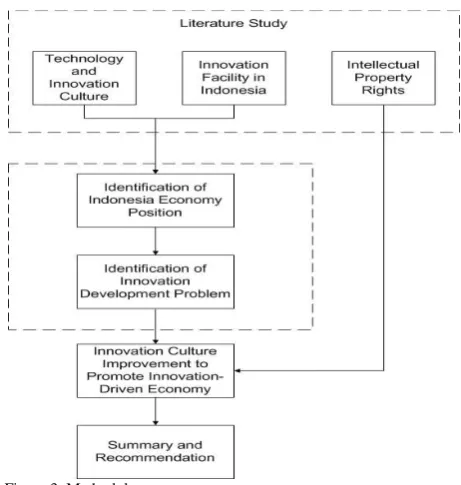
This article is preceded by studying the literature on theories and concepts related to the themes discussed. They were the technology and innovation culture, innovation means in Indonesia and Intellectual Property Rights. Articles continued to identify issues related to knowledge-based economy or innovation in Indonesia. Identification of innovation-based economic problems in Indonesia made more deeply about the lack of innovation initiatives in Indonesia. After the problems are found, an innovation center is proposed to develop an innovation culture as the solving. The last step in writing this paper is to make conclusions to answer the purpose of the study and provide recommendations for the better system. Figure 3 shows the methodology used in this paper.
IV. RESULT AND ANALYSIS
A. Identification of Indonesia Economy Position
Although there is a grouping of developed countries and developing countries, global economic competition involve all countries without exception that resulting concept of global competition. Each country has a value of each competition called the Global Competitiveness Index. The Global Competitiveness Index consists of three key consisting of basic requirements, efficiency enhancers and innovation and sophistication factors. Each key is composed of 12 pillars. In 2013-2014, the Global Competitiveness Index of Indonesia was the 38th of 148 countries in the world. Basic requirements Indonesia is in position 45th, efficiency enhancers are in position 52nd and innovation and sophistication factors are in position 33rd of 148 countries in the world [18].
Figure 4. Global Competitiveness Index Score in Indonesia
• Institution (67) • Infrastructure (61)
• Macroeconomic Environment (26) • Health & Primary Education (72)
Basic Requirements
(45)
• Higher Education and Training (64) • Goods Market Efficiency (50) • Labor Market Efficiency (103) • Financial Market Development (60) • Technological Readiness (75) • Market Size (15)
Efficiency Enhancer (52)
• Business Sophistication (37) • Innovation (33)
Innovation and Sophistication
Factors (33)
production process for efficiency of wage labor costs that can be raised.
Increasing the efficiency of the production process can be carried out through six key pillars compiler efficiency enhancers, namely higher education and training, goods market efficiency, labor market efficiency, financial market development, technological readiness and market size. From the six pillars, only market size pillars whose position is quite encouraging, which is located at position 15th in the world. Another fifth pillars which become a key constituent efficiency driven in Indonesia is still relatively low. Score of technological readiness in Indonesia only be in a position 75th even value the labor market efficiency Indonesia is in position 103rd [18]. This indicates that the level of technology used by the Indonesian industry is still low so does the value of efficiency.
The explanation above indicates that the current Indonesian economy is still entering the efficiency-driven stage yet be innovation-driven. Majority, factors supporting the efficiency-driven in Indonesia was still low. A very important factor to note is technological readiness and labor market efficiency, two lowest factors.
In the Global Competitiveness Index, labor is one of the
12 competitive advantage pillars that is the labor market efficiency. Based on figure 4 the score of the labor market Indonesian efficiency is in position 103rd of 148 countries in the world.
Judging from educational background, approximately 50% of the workforce in Indonesia only has an educational background in elementary school or did not finish school. Workers with a high school education background of about 40%. The rest of the existing workforce, which is only about 10%, is the workers with an educational background in upper secondary school or college. The data indicate that labor absorbed in Indonesia is dominated by low-educated workforce [1].
Education is an important part of the workforce quality. Educated workforces have more capital to create innovation-based economy. Education is also one of the supporting pillars of the Global Competitiveness Index, namely higher education and training which included in the key efficiency enhancers.
The labor education level in Indonesia is still low. Workers with higher educational backgrounds also tend to choose to work as employee. Low education levels are causing Indonesia is still at the level of efficiency-driven economies. To reach the level of innovation-driven economy, Indonesian workers who have high educational background should be added and used to not just work as an employee for someone else, but as a pioneer of innovation-driven economy.
Based on figure 5, the innovation-driven economy level will shift Indonesia advantage from comparative advantage to competitive advantage. Figure shows the general idea of [3]. Economic capabilities will also increase from natural resource based economy to innovation based economy [3].
B. Identification of Innovation Development Problem
[image:4.595.54.283.593.777.2] [image:4.595.310.550.620.778.2]Innovation-based economy requires human resources that have a high mastery of science and technology that is expected to create technological innovations that can be applied in industrial and business field. Indonesia has the potential of human resources capable of creating the creation of technological innovation, but many of these creations are not facilitated, and only stopped as discourse. Constraints which often encountered are the absence of funding and resources to develop such innovations. The absence of those who helped take care of the problem as well as the development of the work of the award in the form of intellectual property rights to the inventors become Figure 3. Methodology
Figure 6. Role of Innovation Center
another obstacle for the inventors to develop his invention. Innovation center as a service provider agency in the development of innovation-based business has an important role as aiding the inventors in providing management regarding the results of their work. Innovation centers also play a role in providing services for inventors to use their invention in the business world to establish technology-based businesses. The role of innovation center is needed especially for the inventors to develop their work and eventually realized a new business based on technology as shown in Figure 6.
UNS as a member of national consortium in development of national electric car has a lot of research about the electric car. But not all of the research is continue to be developed. Lack of the facility in the university often make the research just become a reference in library. Inhibition of this innovation process inhibits the growth of innovation culture.
C. Innovation Culture to Promote Innovation-Driven Economy Realization
To support innovative ideas that will encourage the formation of innovation-based economy in Indonesia, the technology innovation culture needs to be improved. Increasing technology innovation culture must be accompanied with the facility to develop innovations, innovation center. With the existing of innovation center in universities are expected to facilitate the academics to further develop the innovation. Expected outcome is the establishment of a new business based on technology innovations. Based on Figure 7 can also be seen that through innovation center academics can play a role in realizing the vision of Indonesia in 2025 in accordance with the MP3EI.
Based on figure 8 it can be seen that the more ideas collected, the selection of ideas that will be developed will be intense. The results issued by the innovation center will be more qualified. Technology innovation culture by academics will experience acceleration, which in turn
contributed to the acceleration of economic growth in accordance MP3EI.
Academics can develop an innovation based business through technology innovation center. In addition, inventors will also receive IPRs in recognition of his work. There is no consideration for academics not to develop innovation in the innovation center. By forming an innovation culture through the innovation center, then an academic has an active role to realize the independent Indonesian society, progressive, just and prosperous. Strengthening a culture of innovation can be done as in the process shown in Figure 8.
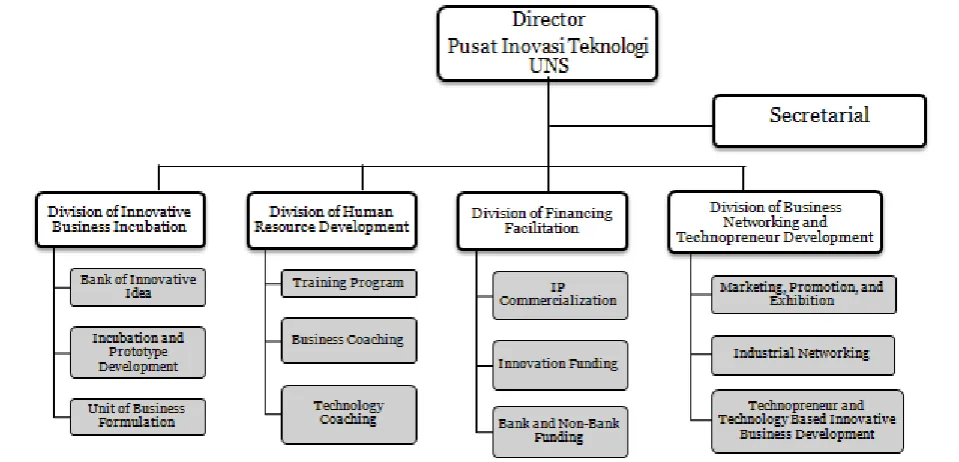
Innovation Centre owned by UNS (Pusat Inovasi Teknologi and will be called PIT) play a role in the development of an innovation culture at the UNS. Through divisions owned by PIT, PIT assist academics in developing innovative research that support an innovation culture that indirectly support the realization of the vision of Indonesia in 2025 by MP3EI. Through innovative business incubation division, innovative ideas from academia will be accommodated and will be assisted to develop into a prototype. Division of Human Resources Development will assist academics in managing technology and improve entrepreneurial skills. Division facilitation of financing will assist in the financing of the process in technology innovation development and technology-based start up. The company's development will be aided by the business networking development and technopreneurship division. The division in PIT can be seen in figure 9.
V. SUMMARY
Indonesian economy is currently at the level of efficiency-driven and still hampered for leading innovation-driven level. The greatest obstacles viewed from the position of Indonesian score compared with countries in the world are the labor market efficiency and technology readiness aspect. Aspect of labor market efficiency is caused by the low of educational background of Indonesian workers. Aspect of technology readiness is caused by the small number of universities which have a center of innovation to support the innovation system of Indonesia.
[image:5.595.315.549.619.758.2]Figure 7. Academician Role in Innovation Center
[image:5.595.51.284.657.777.2]Technology innovation culture in higher education must be improved through the innovation center as the main facility in college. Each innovative idea have to get into the innovation center system as the primary input that is expected to produce new technology innovation based business as the outcome. With increasing of technology innovation culture in higher education, higher education will be able to play an active role in realizing the vision of Indonesia 2025.
It is important to explain the process in innovation center in more detail as the facility to improve the innovation culture. Study about the other factor to develop the innovation culture can be used as a future research.
ACKNOWLEDGMENT
This work is supported by program of Electric Vehicle Development, FY 2014 under ‘Program Riset Molina Afirmasi LPDP, Contract No:PRJ-933/LPDP/2014, August 17, 2014).
REFERENCES
[1] Coordinating Ministry for Economic Affairs, “The Importance of Developing Nations Children's Technology Innovation Works”, Explained In Public Lecture: Technopreneur Course Socialization, February 2014.
[2] World Bank, “World Development Indicators 2014”, Washington DC: World Bank Publisher, 2011.
[3] Coordinating Ministry for Economic Affairs, “Masterplan of Acceleration and Expansion of Indonesia Economic Development 2011 – 2025”, Jakarta, 2011.
[4] Final Report of Molina Program FY 2012 [5] Final Report of Molina Program FY 2013
[6] W. Sutopo, R. W. Astuti, A. Purwanto, M. Nizam, “Commercialization Model of New Technology Lithium Ion Battery: A Case Study for SmarT Electric Vehicle”, in Proceeding Joint International Conference on Rural Information & Communication Technology and Electric Vehicle Technology, 2013.
[7] W. Sutopo, A. Erliza, Suyitno, T. D. D. D. Prija, “A Methodology to Design Commercialization Scheme for Development Body’s Electric Vehicle Smart”, ”, in Proceeding Joint International Conference on Rural Information & Communication Technology and Electric Vehicle Technology, 2013.
[8] E. Suharyadi, http://alamtekno.blogspot.com/2013 /05/pengertian-teknologi.html. Retrieved February 16, 2014, from alamtekno.blogspot.com, 2013.
[9] S. Tahid, Y. D. Nurcahyanie, “Technology Concept In Indutrial Product Development”, Jakarta: Kencana Prenada Media Group, 2007.
[10] Ministry of Education, “Kamus Besar Bahasa Indonesia Dalam Jaringan” [online] available at http://pusatbahasa.kemdiknas. go.id/kbbi/, retrieved at February 15th 2014.
[11] E. A. Sosiawan, [online], available at http://edwi.upnyk.ac.id /PTK.1.05.pdf retrieved at January 29th, 2014
[12] W. Rusli, “Penemuan Teknologi Komunikasi”, [online] available at http://communication4ourlife.blogspot.com/2012/09/penemuan-teknologi-komunikasi-tahun.html. retrieved at January 29th 2014.
[13] Anonymous, “11 Penemuan Paling Penting Di Bidang Teknologi Selama Dekade Terakhir”, [online] available at http://namakuddn.wordpress.com/2012/01/12/11-penemuan-paling-penting-di-bidang-teknologi-selama-dekade-terakhir/ retrieved at January 29th, 2014.
[14] Ministry of Research and Technology, “Guidelines for the National Innovation System Research Incentive 2014”, Jakarta, 2013. [15] Ministry of Research and Technology; Ministry of Intern, “Guidelines
Facilitation Capacity Building Research and Development Agency (BPPD) As SIDa Strengthening Coordinator 1st Edition”, Jakarta, 2013.
[16] K. Diharjo, W. Sutopo, K. A. Sambowo, Purwanto, Musyawaroh, Paryanto, Yuniaristanto, R. Karyanda, H. Suryanto, N. Sudarisman, Kewirausahaan Berbasis Teknologi (Technopreneurship), UNS Press, 2014.
[17] Ministry of Industry, “Government Policy In Intellectual Property Rights Protection and Professional Services Trade Liberalization in the Field of Law”, Jakarta, 2007.
[image:6.595.41.521.47.278.2][18] World Economic Forum, “The Global Competitiveness Report 2013-2014 Full Data Edition”, Geneva, 2013.
![Figure 2. Effect of Technology Source: [9]](https://thumb-us.123doks.com/thumbv2/123dok_us/451470.543109/2.595.57.541.643.776/figure-effect-of-technology-source.webp)