Abstract—Grouping problems are an important class of computational problems where the objective is to group, cluster or partition members of a set into desired sub sets. The grouping genetic algorithm is an extension of genetic algorithm that is heavily modified to model the structure of grouping problems. Since its inception, grouping genetic algorithms has been applied to several types of grouping problems. This paper presents an exploratory and chronological review of the grouping genetic algorithm approach. First, a survey of articles on grouping genetic algorithm approaches and its applications is presented. Second, a chronological review and analysis of research activities on the grouping genetic algorithm approach is presented. Third and finally, future trends and further research prospects are visualized and outlined.
Index Terms—Genetic algorithms, grouping, grouping genetic algorithms, exploratory study, chronological review
I. INTRODUCTION
significant number of combinatorial problems arising in industry consist in grouping, clustering, or partitioning a given set U of objects into a collection of mutually disjoint subsets Ui of U, such that,
Ui U (1)
and,
Ui Uj , i j (2)
This can also be visualized as problems where the objective is to group the members of the set U into one or more groups of objects, where each object is exactly in one group [1] [2]. In most cases, not all possible groupings are allowable, and the solution to the problem should satisfy all the hard constraints [1] [2] [3]. However, it is generally
Manuscript received June 05, 2017; revised July 30, 2017. This work was supported in part by the Namibia University of Science and Technology, Windhoek, Namibia.
M. Mutingi a Senior Lecturer with the Faculty of Engineering, Namibia University of Science and Technology, Namibia. He is also a Visiting Senior Research Fellow with the Department of Quality and Operations Management, Faculty of Engineering and the Built environment, University of Johannesburg, South Africa. (phone: 264-61 207 2569; fax: 264-61 207 9569; e-mail: [email protected]).
C. Mbohwa is an established Researcher and Professor with the Department of Quality and Operations Management, Faculty of Engineering and the Built environment, University of Johannesburg, South Africa (email: [email protected]).
H. Musiyarira is an Associate Professor with the Faculty of Engineering, Namibia University of Science and Technology, Windhoek, Namibia (email: [email protected]).
assumed that the order of groups is not relevant [2] [3]. Usually, the objective of the grouping is to optimize a specific cost function that is defined over the set of all the valid groups. Some of the well-known combinatorial grouping problems are graph coloring problem [4], line-balancing problem [5], cell formation problem [6] [7] [9] [10] [11] [12], bin packing problem [8], equal piles problem[13], batch–machine scheduling problem [3], packing/partitioning problems [3], timetabling problem [4], pickup and delivery problem [14], home healthcare scheduling [15] [16] [17], flexible job shop scheduling [18], team formation [19], modular product design [20] [21] [22], among others [2] [3] [5] [23] [24-48].
These grouping problems are characterized by objective functions that are a function of the composition of the groups, rather than individual members of the group. In other words, when one object is taken in isolation, this has no significance.
Grouping problems can be classified in various forms. For example, these problems may be grouped into constant and variable grouping problems [3] [5]:
1) Constant grouping problems, where the number of groups is a constant input to the problem, such as the identical or non-identical parallel-machine scheduling problem; and,
2) Variable grouping problems, where the number of groups is not known a priori and the algorithm has to determine the optimum number members in the groups, such as bin packing and graph coloring problems. In addition to the above, grouping problems can be classified into those with identical groups and those with non-identical groups [3]. For identical groups, all groups have similar characteristics, and swapping of groups does not change anything. For non-identical groups, different groups are identified by different features, where swapping of groups results in a grouping different from the original one [3] [5].
Since its inception in the early 90s [1] [2], the grouping genetic algorithms approach has received significant attention. Several extensions to the algorithms have appeared in the literature, and have been applied to several types of problems [5]. It will be interesting to make a chronological literature survey of the algorithm, beginning from the 90s.
In light of the above discussions, the purpose of this research was to make an explorative and chronological review of the grouping genetic algorithm approach and its applications. Therefore, the research focuses on the
Grouping Genetic Algorithms: An Exploratory
Study
Michael Mutingi, Member, IAENG, Charles Mbohwa, and Harmony Musiyarira
following specific objectives:
1) To make a survey of the articles on grouping genetic algorithms and its applications;
2) To make a chronological review analysis of research on the grouping genetic algorithm approach; and,
3) To visualize and derive future trends and further research prospects.
The rest of the paper is structured as follows: Section II presents an overview of the grouping genetic algorithms. Section III outlines the research methodology followed in this research. Section IV presents the results and discussions. Section V discusses future research trends. Finally, Section VI concludes the paper.
II. GROUPING GENETIC ALGORITHMS: AN OVERVIEW In 1993, Falkenauer [1] originated the grouping genetic algorithm, the term coined to refer to a genetic algorithm that applies the group encoding and the associated genetic operators for solving grouping problems. This development was motivated by the need to improve the performance of genetic algorithms on grouping problems. In their classical representation (coding) schemes, classical genetic algorithms suffer from high redundancy among chromosomes and context insensitivity [1] [2]. The algorithm can primarily be described in terms of its group encoding, group crossover, mutation and inversion operators.
A. Group encoding
The encoding scheme for grouping problems can be illustrated as in Fig. 1. Three groups 1, 2, 3, contain items {4,5}, {2,3,6}, and {1,7}, respectively. According to Falkenauer [1], each group represents a gene, and the order of items in a group is insignificant. Unlike the classical approach, the group encoding scheme does not suffer from redundancy [1] [2].
Items : 4,5 2,3,6 1,7 Groups: 1 2 3
Fig. 1. Group encoding scheme
Following the group encoding step, the group crossover operator is executed.
B. Group Crossover
Crossover is the main operator which facilitates guided information exchange between chromosomes. Its major purpose is to produce new chromosomes without adverse disruption of the group structure of the current chromosomes.
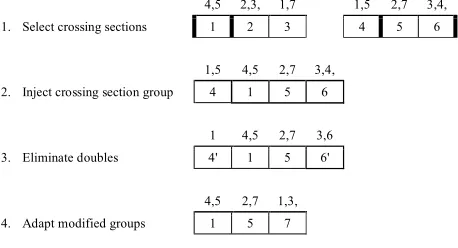
1) Select two cross-points in any two chromosomes, and select a crossing section from first parent, which is labelled 1 in Fig. 2.
2) Inject the crossing section into the second parent, which yields a new offspring likely to contain repeated item, called doubles.
3) Knock out repeated items, while avoiding newly-injected items. Some of the genes in the second parent are modified, e.g., genes 4 and 6 are modified to 4' and
6', respectively.
4) The modified genes are adapted using problem-specific heuristic, which yields gene 7.
5) Interchange the roles of the two parent chromosomes: parent 1 and 2.
6) Repeat steps 2 to 4 until the required number of offspring are generated.
In the actual implementation, the algorithm repeats until the desired population of new offspring is created. Consider two randomly selected parent chromosomes, (i) chromosome [ 1 2 3], which contains groups of items {4,5}, {2,3,6}, {1,7}, and (ii) chromosome [4 5 6] which contains groups of items {1,5}, {2,7}, {3,4,6}. The crossover operation for the two chromosomes is presented in the figure (Fig. 2). The final offspring obtained are chromosomes [4' 1 5 6'] and [1 5 7].
1. Select crossing sections
4,5 2,3, 1,7 1,5 2,7 3,4, 1 2 3 4 5 6
2. Inject crossing section group
1,5 4,5 2,7 3,4, 4 1 5 6
3. Eliminate doubles
1 4,5 2,7 3,6 4' 1 5 6'
4. Adapt modified groups
[image:2.612.312.541.253.377.2]4,5 2,7 1,3, 1 5 7
Fig. 2. An illustration of the group crossover operation
After the group crossover operator, group mutation is executed.
C. Group Mutation
Group mutation must primarily works with groups, rather than items [1]. There are three general strategies for group mutation: (i) creating new groups, (ii) eliminating selected groups, and (iii) shuffling a small number of selected items among the groups. However, this will also depend on the specific problem that is to be solved. Special constructive heuristics may be used [5].
D. Inversion
The aim of inversion is to facilitate transmission of good schemata from parents to offspring, so as to ensure increased rate of sampling of those schemata that are better performing [1] [2]. As an example, the chromosome,
[1 2 3 4],
could be inverted to: [1 4 3 2],
III. RESEARCH METHODOLOGY
The research methodology used in this study comprises three steps, which lead to the chronological exploratory analysis of peer-reviewed literature on grouping genetic algorithms and the associated application areas. The first step was to carry out an initial literature search survey to explore the GGA literature found in online databases and library resources, including EBSCO Inspec, ISI Web of Science, Ei Compendex, ScienceDirect, Google Scholar and Research Gate. To limit the range of articles, specific key words containing special terms were used, particularly,
grouping genetic algorithm(s), group genetic algorithm(s),
and grouping problems.
The second step was to streamline the literature to make sure that the selected articles were strictly about grouping genetic algorithms and their applications and also that the articles were published in peer-reviewed journals, conference proceedings, book chapters, and books. Only articles published from the inception of GGA in 1993 [1] to 2017 were considered.
The third and final step was to analyze the selected articles, focusing on the chronological developments in the literature, the range of articles, the associated growth of applications, and the progression of research activities over the period. Some of the results and findings of the study are presented in the next section.
IV. RESEARCH FINDINGS
Research findings generally indicate an ever-increasing research activity. A significant number of articles were found in operations research/operations management and soft computing journals, and these areas are broadly identified with the Industrial Engineering field. More classified analyses follow.
Table I presents a classified list of articles found in the literature. Major contributions were found in journals, with a total of 34 journal articles. This was followed by conference papers and book chapters, each amounting to a total of 6 articles. In addition to these articles, 2 books were found in the literature search, whose major focus is strictly on grouping genetic algorithm [5] [24].
TABLEI
ACLASSIFIED LIST OF ARTICLES IN THE LITERATURE
Article Count
Journal article 34
Conference proceedings 6
Book chapter 6
Books 2
Table II presents a list of identified journals, ranked according to the number or count of articles published in each of the journals, particularly those with 2 or more articles. The analysis shows that most of the journals are in soft computing and operations research, with applications in production or manufacturing industries. The leading journal
is Expert Systems with Applications, which indicates that
more specialized GGA-based expert systems are expected in the near future as more grouping problems are identified.
TABLEII
IDENTIFIED ARTICLES IN SELECTED JOURNALS
No. Journal Title Count
1 Expert Systems with Applications 4 2 International Journal of Production Research 3 3 Computers & Industrial Engineering 3 4 Computers & Operations Research 2 5 Engineering Applications of Artificial Intelligence 2 6 Journal of Intelligent Manufacturing 2
Table III presents a classified list of application areas of the GGA approach. About 80% of the publications are in the first 10 application areas. Major areas include cell formation, bin packing, grouping partners for cooperative learning, home healthcare scheduling, and modular product design, with 4 or more articles. The cell formation problem emerged as the most popular problem that attracted the most attention of researchers. Interesting areas in healthcare scheduling are emerging, including home healthcare [15] [17] [45] [46], care task assignment [16], and handicapped person transportation [41]. These trends show that further specific problem areas are expected to come up in the near future.
TABLEIII
ACLASSIFIED LIST OF APPLICATION AREAS OF GGA IN THE LITERATURE No. Application Area Reference Total 1 Cell formation problem [6] [7] [9] [10] [11]
[12] [32] [47] [48] 8 2 Bin packing problem [8] [9] [10] [24] [28]
[38] [42] 7
3 Grouping partners in cooperative learning
[25] [30] [31] [35] [5] 5
4 Home healthcare scheduling [15] [17] [45] [46] 4 5 Modular product design [5][20] [21] [22] 4 6 Line Balancing [5] [24] [40] 3
7 Time tabling [4] [5] 2
8 Team formation [5] [19] 2
9 Economies of scale [23] [24] 2 10 Material cutting [37] [39] 2
11 Graph coloring [4] 1
12 Equal piles problems [13] 1
13 Pickup and delivery [14] 1
14 Care task assignment [16] 1
15 Flexible job scheduling [18] 1 16 Reviewer group construction [26] 1 17 Estimating discretionary
accruals [27] 1
18 Facility location [29] 1
19 Registration area planning [33] 1 20 Multiprocessor scheduling [34] 1 21 Microcell sectorization
problem [36] 1
22 Handicapped person
transportation [41] 1
23 Travelling salesperson [43] 1
24 Order batching [5] 1
25 Fleet size and mix vehicle
routing [5] 1
0 10 20 30 40 50 60
90-95 96-00 01-05 06-10 11-15 16-17
C
um
ul
at
iv
e
A
ri
cl
es
[image:4.612.71.294.49.174.2]Period
Fig. 3. Cumulative articles on grouping genetic algorithms till 2017
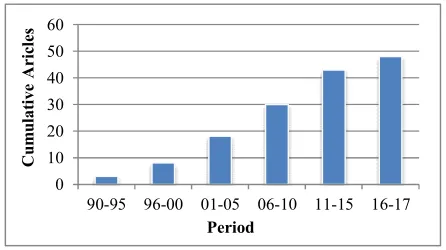
Fig. 3 presents research trends in terms of the cumulative articles on GGA, beginning from its conception in 1993 [1] till the year 2017. It can be seen from the graphical analysis that there is a significant ever-increasing trend in the research activities in the field. The graph reflects that the growth rate of the research activity is generally exponential, which highlights the importance of the algorithm and its applications. Based on the observed trends, research activities are expected to intensify in the future.
Following the first research book on genetic algorithms for grouping problems published in 1998 [24], a remarkable research book on advances in and applications of grouping genetic algorithms was published in 2017 [5]. These research reference books contain resourceful techniques for the algorithm.
V. FUTURE RESEARCH DIRECTIONS
From this review, it was realized that research activities in the field continue to increase. The areas of application of the algorithm continue to expand across various sectors, from manufacturing to service systems. With increasing number of application areas, and the complexity of the problems, researchers in the field are expected to focus on the following:
1) Develop better ways of exploiting the grouping structure of specific problems to improve efficient encoding schemes;
2) Develop advanced fine-tuning, dynamic and self-adaptive techniques to enhance computational efficiency of the genetic operators;
3) Develop genetic operators that are equipped with fuzzy theoretic techniques that can handle imprecise grouping problems; and,
4) Develop domain-specific constructive heuristics that can help to improve the efficiency and effectiveness of the algorithm.
It is hoped that these research directions will take the grouping genetic algorithms a step further in the near future.
VI. CONCLUSIONS
Grouping genetic algorithm is a development from classical genetic algorithms for solving an important class of computational problems where the objective is to group members of a set into desired sub sets. Designed to exploit the group structure of the problems, the algorithm can
address grouping problems without suffering redundancy and context insensitivity problems. Literature search survey has shown that the grouping algorithm has been applied to several grouping problems. Most of the articles in the literature are in the areas of operations research and soft computing with applications in production and manufacturing problems. Research trends indicated an ever-increasing growth in the research activities, and more research applications are expected in the field. Prospective future research directions should focus on enhancing computational efficiency of the algorithm through improved methods of exploiting grouping structures of specific problems, design of dynamic and self-adaptive genetic operators, and hybridizing with domain-specific constructive heuristics. Further research on grouping genetic algorithms and its applications is quite promising.
ACKNOWLEDGMENT
The authors would like to thank the reviewers for their valuable comments on the previous version of the paper.
REFERENCES
[1] E. Falkenauer, “The grouping genetic algorithms - widening the scope of the GAs”, Belgian Journal of Operations Research, Statistics and Computer Science 33, pp. 79-102, 1993.
[2] E. Falkenauer, “New representation and operators for GAs applied to grouping problems”, Evolutionary Computation 2, 123–144, 1994. [3] A.H. Kashan, M.H. Kashan, S. Karimiyan, “A particle swarm
optimizer for grouping problems”, Information Sciences 252, pp. 81– 95, 2013.
[4] Ö. Ülker, E. Özcan, E.E. Korkmaz, “Linear linkage encoding in grouping problems: applications on graph coloring and timetabling”, in: PATAT06, Lecture Notes in Computer Science, Springer-Verlag, , pp. 347–363, 2007.
[5] M. Mutingi, C. Mbohwa, Grouping Genetic Algorithms: Advances and Applications. Springer, Switzerland, 2016.
[6] E.V.G. Filho, A.J. Tiberti, “A group genetic algorithm for the machine cell formation problem”, International Journal of Production Economics 102, pp.1-21, 2006.
[7] P. De Lit, E. Falkenauer, A. Delchambre, “Grouping genetic algorithms: an efficient method to solve the cell formation problem”, Mathematics and Computers in Simulation 51(3–4), pp.257–71, 2000 [8] E. Falkenauer, “A hybrid grouping genetic algorithm for bin
packing”, Journal of Heuristics 2, pp. 5–30, 1996.
[9] E.C. Brown, R. Sumichrast, “CF-GGA: a grouping genetic algorithm for the cell formation problem”, International Journal of Production Research 36, pp.3651–69, 2001.
[10] T.L. James E.C. Brown, K.B. Keeling, “A hybrid grouping genetic algorithm for the cell formation problem”, Computers & Operations Research 34, pp. 2059–79, 2007.
[11] E. Vin, P. De Lit, A. Delchambre, “A multiple-objective grouping genetic algorithm for the cell formation problem with alternative routings”, Journal of Intelligent Manufacturing 16, pp. 189–205, 2005.
[12] K. Yasuda, L. Hu, Y. Yin, “A grouping genetic algorithm for the multi-objective cell formation problem”, International Journal of Production Research 43, pp. 220–230, 2005.
[13] E Falkenauer, “Solving equal piles with a grouping genetic algorithm”, Proceedings of the Sixth International Conference on Genetic Algorithms (IGGA95), L.J. Eschelman, ed., San Mateo, CA, July 1995, University of Pittsburg (Pennsylvania), Morgan Kaufman Publishers, pp. 492-497, 1995.
[14] G. Pankratz, “A grouping genetic algorithm for the pickup and delivery problem with time windows”, OR Spectrum 27, pp. 21–41, 2005.
Congress on Engineering, 2013, U.K., 3-5 July, 2013, London, UK: 721-725, 2013.
[16] M. Mutingi, C. Mbohwa, “A fuzzy grouping genetic algorithm for care task assignment”, IAENG International Conference on Systems Engineering and Engineering Management, October 2014, San Francisco, USA, pp 454-459, 2014.
[17] M. Mutingi, C. Mbohwa, “Task Assignment in Home Health Care: A Fuzzy Group Genetic Algorithm Approach”, The 25th Annual Conference of the Southern African Institute of Industrial Engineering 2013, Stellenbosch, South Africa, 2013, 9-11 July, pp. 1-9, 2013.
[18] J. C. Chen, C.C. Wu, C.W. Chen, K-H. Chen, “Flexible job shop scheduling with parallel machines using Genetic Algorithm and Grouping Genetic Algorithm”, Expert Systems with Applications 39 (2012), pp. 10016–10021, 2012.
[19] L. E. Agustın-Blas, S. Salcedo-Sanz, E.G. Ortiz-Garcıa, A. Portilla-Figueras, A.M. Perez-Bellido, S. Jimenez-Fernandez (2011) Team formation based on group technology: A hybrid grouping genetic algorithm approach. Computers & Operations Research 38, pp. 484– 495, 2011.
[20] V. B. Kreng, T. P Lee, “Modular product design with grouping genetic algorithm—a case study”, Computers & Industrial Engineering 46, pp. 443–460, 2004.
[21] M. Mutingi, P. Dube, C. Mbohwa, “A modular product design approach for sustainable manufacturing in a fuzzy environment”, Procedia Manufacturing 8, pp. 471 – 478, 2017.
[22] V.B. Kreng, T.P. Lee, “Modular product design with grouping genetic algorithm: a case study”, Computers & Industrial Engineering 46, pp. 443–460, 2004.
[23] E. Falkenauer, “Applying genetic algorithms to real-world problems”, IMA Volumes in Mathematics and Its Applications, 111, pp. 65-88, 1999.
[24] E. Falkenauer, Genetic algorithms for grouping problems. New York: Wiley, 1998.
[25] R. C. Chen, S. Y Chen, J. Y Fan, Y. T. Chen, “Grouping partners for cooperative learning using genetic algorithm and social network analysis. International Workshop on Information and Electronics Engineering (IWIEE). Procedia Engineering 29, pp. 3888 – 3893, 2012.
[26] Y. Chen, Z.P. Fan, J. Ma, S. Zeng, “A hybrid grouping genetic algorithm for the reviewer group construction problem”, Expert Systems with Applications 38, pp. 2401–2411, 2011.
[27] H. Höglund, “Estimating discretionary accruals using a grouping genetic algorithm”, Expert Systems with Applications 40, pp. 2366– 2372, 2013.
[28] Y. K. Joung, S. D. Noh, “Intelligent 3D packing using a grouping algorithm for automotive container engineering”, Journal of Computational Design and Engineering 1 (2), pp. 140-151, 2014. [29] L. Pitaksringkarn, M. A. P. Taylor, “Grouping genetic algorithm in
GIS: A facility location modelling”, Journal of the Eastern Asia Society for Transportation Studies 6, pp. 2908 - 2920, 2005. [30] A. Sukstrienwong, “Genetic algorithm for forming student groups
based on heterogeneous grouping”, Recent Advances in Information Science, pp. 92-97, 2012.
[31] Z. C. Ani, A. Yasin, M. Z. Husin, Z. A. Hamid, “A Method for Group Formation Using Genetic Algorithm”, International Journal on Computer Science and Engineering 2 (9), pp. 3060-3064, 2010. [32] L. Hu, K. Yasuda, “Minimizing material handing cost in cell
formation with alternative processing routes by grouping genetic algorithm”, International Journal of Production Research 44, pp. 145–179, 2006.
[33] T. James, M. Vroblefski, Q. Nottingham, “A hybrid grouping genetic algorithm for the registration area planning problem”, Computer Communications 30(10), pp. 2180–90, 2007.
[34] A. Singh, M. Sevaux, A. Rossi, “A hybrid grouping genetic algorithm for multiprocessor scheduling”, In Contemporary Computing 40, Communications in Computer and Information Science 1-7. Springer Verlag Berlin Heidelberg, 2009.
[35] L.E. Agustın-Blas, S. Salcedo-Sanz, E.G. Ortiz-Garcı´a, A. Portilla-Figueras, A.M. Pe´ rez-Bellido, “A hybrid grouping genetic algorithm for assigning students to preferred laboratory groups”, Expert Systems with Applications 36, pp. 7234–7341, 2009.
[36] E.C. Brown, M. Vroblefski, “A grouping genetic algorithm for the microcell sectorization problem”, Engineering Applications of Artificial Intelligence 17(6), 589–98, 2004.
[37] C. Hung, R.T. Sumichrast, E.C. Brown, “CPGEA: A grouping genetic algorithm for material cutting plan generation”, Computers & Industrial Engineering 44(4), pp. 651–72, 2003.
[38] A.S. Fukunaga, “A new grouping genetic algorithm for the multiple knapsack problem”, The IEEE Congress on Evolutionary Computation, CEC 2008, pp. 2225-2232, 2008.
[39] P.Y. Li, C.F. Wang, Y.S. Mao, “Hybrid grouping genetic algorithm for one-dimensional cutting stock problem”, Journal of Shanghai Jiaotong University 4, pp. 1015–1023, 2006.
[40] B. Rekiek, P. De Lit, F. Pellichero, T. L’Eglise, P. Fouda, E. Falkenauer, A. Delchambre, “A multiple objective grouping genetic algorithm for assembly line design”, Journal of Intelligent Manufacturing 12, pp. 467–485, 2001.
[41] B. Rekiek, A. Delchambre, H. Aziz Saleh, “Handicapped person transportation: An application of the grouping genetic algorithm”, Engineering Applications of Artificial Intelligence 19, pp. 511–520, 2006.
[42] A. Singh, A.S. Baghel, “A new grouping genetic algorithm for the quadratic multiple knapsack problem, in: Evolutionary Computation in Combinatorial Optimization”, The 7th European Conference,
EvoCOP 2007, Lecture Notes in Computer Science, Springer-Verlag,, pp. 210–218, 2007.
[43] A. Singh, A.S. Baghel, “A new grouping genetic algorithm approach to the multiple traveling salesperson problem”, Soft Computing 13, pp. 95–101, 2009.
[44] M. Mutingi, C. Mbohwa, “Fuzzy grouping genetic algorithms”, in Healthcare Staff Scheduling: Emerging Fuzzy Optimization Approaches, CRC Press, Taylor & Francis Group, Florida, pp. 39-49, 2016.
[45] M. Mutingi, C. Mbohwa, “Fuzzy grouping genetic algorithm for homecare staff scheduling”, in Healthcare Staff Scheduling: Emerging Fuzzy Optimization Approaches, CRC Press, Taylor & Francis Group, Florida, pp. 119-136, 2016.
[46] M. Mutingi, C. Mbohwa, “Home Health Care staff scheduling: Effective grouping approaches”, IAENG Transactions on Engineering Sciences - Special Issue of the International Multi-Conference of Engineers and Computer Scientists, and World Congress on Engineering, CRC Press, Taylor & Francis Group, pp. 215-224, 2014. [47] M. Mutingi, G. C. Onwubolu, “Integrated Cellular Manufacturing System Design and Layout Using Group Genetic Algorithms”, In Faieza Abdul Aziz (Ed.), Manufacturing System. InTech-Open, USA, pp. 205-222, 2012.