Hyperedge Replacement and Nonprojective Dependency Structures
Daniel Bauer and Owen Rambow Columbia University
New York, NY 10027, USA
{bauer,rambow}@cs.columbia.edu
Abstract
Synchronous Hyperedge Replacement Graph Grammars (SHRG) can be used to translate between strings and graphs. In this paper, we study the capacity of these grammars to create non-projective dependency graphs. As an example, we use languages that contain cross serial dependencies. Lexicalized hyperedge replacement grammars can derive string languages (as path graphs) that contain an arbitrary number of these dependencies so that their derivation trees reflect the correct dependency graphs. We find that, in contrast, string-to-graph SHRG that derive dependency structures on the graph side are limited to derivations permitted by the string side. We show that, as a re-sult, string-to-graph SHRG cannot capture languages with an unlimited degree of crossing dependencies. This observation has practical implications for the use of SHRG in semantic parsing.
1 Introduction
Hyperedge Replacement Grammars (HRG) are a type of context free graph grammar. Their de-rived objects are hypergraphs instead of strings. A synchronous extension, Synchronous Hyperedge Replacement Grammars (SHRG) can be used to translate between strings and graphs. To construct a graph for a sentence, one simply parses the in-put using the string side of the grammar and then interprets the derivations with the graph side to as-semble a derived graph.
SHRG has recently drawn attention in Natural Language Processing as a tool for semantic con-struction. For example, Jones et al. (2012) pro-pose to use SHRG for semantics based machine
translation, and Peng et al. (2015) describe an ap-proach to learning SHRG rules that translate sen-tences into Abstract Meaning Representation (Ba-narescu et al., 2013).
Not much work has been done, however, on understanding the limits of syntactic and seman-tic structures that can be modeled using HRG and SHRG. In this paper, we examine syntactic depen-dency structures generated by these formalisms, specifially whether they can create correct depen-dency trees for non-projective phenomena. We fo-cus on non-projectivity caused by copy language like constructions, specifically cross-serial depen-dencies in Dutch. Figure 1 shows a (classical) ex-ample sentence containing such dependencies and a dependency graph.
This paper looks at dependency structures from two perspectives. We first review HRGs that de-rive string languages as path graphs. The set of these languages is known to be the same as the lan-guages generated by linear context free rewriting systems (Weir, 1992). We consider HRG gram-mars of this type that are lexicalized (each rule contains exactly one terminal edge), so we can view their derivation trees as dependency struc-tures. We provide an example string-generating HRG that can analyze the sentence in Figure 1 with the correct dependency structure and can gen-erate strings with an unlimited number of crossing dependencies of the same type.
Fig-... omdat Wim Jan Marie de kinderen zag helpen leren zwemmen . ... because Wim Jan Marie the children saw help teach swim .
ccomp xcomp xcomp subj nsubj
dobj
dobj
det
[image:2.595.79.524.62.153.2]punc
Figure 1: Example sentence illustrating cross-serial dependencies in Dutch. English translation: “ be-cause Wim saw Jan help Marie teach the children to swim.”
ure 1, that derives the correct labeled dependency structure, but whose derivation does not resemble syntactic dependencies. Using this example, we observe an important limitation of string-to-graph SHRG: With nonterminal hyperedges of bounded type (number of incident vertices), we cannot an-alyze cross-serial dependencies with an unlimited number of crossing edges. Specifically, for a given dependency edge covering a span of words, the number of nodes outside the span that can have a dependent or parent inside the span is limited. This is because, on the input side, the grammar is a plain string CFG. In a string CFG derivation, each node must correspond to a connected subspan of the input. Because of this constraint on the deriva-tion, the dependency subgraphs constructed by the HRG must maintain a reference to all words that have a long distance dependent elsewhere in the string. These references are passed on through the derivation in the external nodes of each graph rhs of the SHRG rules. External nodes are special ver-tices at which graph fragments are connected to the surrounding graph.
To avoid this problem, instead of a plain string CFG one can use other formalisms that produce context free derivation trees, such as the string-generating HRGs we discuss in this paper or LTAG.
Semantic representations, such as Abstract Meaning Representation, resemble dependency structures. Therefore, while we do not discuss semantic graphs to skirt the issue of reentrancy, non-projective linguistic phenomena that appear in syntactic dependency structure are also relevant when translating strings into semantic represen-tations. We believe that our observations are not only of theoretical interest, but affect practical ap-plications of SHRG in semantic parsing.
The paper proceeds as follows: Section 2
pro-vides a formalization of Hyperedge Replacement Grammars and introduces necessary terminology. In section 3, we discuss string generating HRGs and illustrate how they can be used to correctly analyze cross-serial dependencies in an exam-ple. Section 4 examines string-to-graph SHRGs and observes their limitations in generating cross-serial dependencies. In section 5, we analyze this limitation in more detail, demonstrating a relation-ship between the order of a grammar (the max-imum hyperedge type) and the maxmax-imum number of edges crossing another edge. Section 6 provides an overview of related work. Finally, we conclude and summarize our findings in section 7.
2 Hyperedge Replacement Graph Grammars
A directed, edge-labeled hypergraph is a tuple H = hV, E, ℓi, where V is a finite set of ver-tices,E ⊆ V+ is a finite set of hyperedges, each of which connects a number of vertices, andℓis a labeling function with domainE. The number of vertices connected by a hyperedge is called its type.
A hyperedge replacement grammar (HRG, Drewes et al. (1997) ) is a tupleG=hN,Σ, P, Si where N is a ranked, finite set of nonterminal labels, Σ is a finite set of terminal labels such
that Σ ∩ N = ∅, S ∈ N is the designated start symbol, and P is a finite set of rules. Each rule r ∈ P is of the form (A → R, X), where A ∈ N, R = hV, E, ℓi is a hypergraph with ℓ: E → N ∪ T, andX∈V∗is a list of exter-nal nodes. We call the number of vertices|V|in a
rule rhs thewidthof the rule. The maximum type of any nonterminal hyperedge in the grammar is called theorderof the grammar.1
1We choose the term
R1: S→
N2 zag .
4 V4
R2: V4→
N2 N2 helpen
0 1 2 3
4 V4
R3: V4→
N2 leren V2
0 1 2 3 R4: V4→
zwemmen
0 1
R5: N2→
Wim
0 1 R6: N2→
Jan
0 1
R7: N2→
Marie
0 1 R8: N2→
DT2 kinderen
0 1 R9: DT2→
de
[image:3.595.77.503.47.210.2]0 1
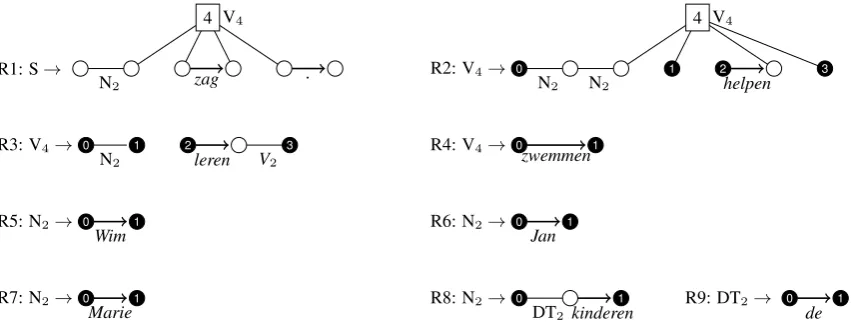
Figure 2: A ‘string-generating’ lexicalized hyperedge replacement grammar for Dutch cross serial de-pendencies. The grammar can derive the sentence in figure 1. The derivation tree for this sentence represents the correct dependency structure.
Given a partially derived graph H we can use a rule (A → R, X) to rewrite a
hyper-edge e = (v1,· · ·, vk) if e has label A and
k = length(X). In this operation,eis removed from H, a copy ofR is inserted into H and the external nodesX = (u1,· · · , uk) of the copy of R arefusedwith the nodes connected by e, such thatuiis identified withvifori= 1, . . . , k.
When showing rules in diagrams, such as Fig-ure 2, we draw external nodes as black circles and number them with an index to make their order ex-plicit. Nonterminal hyperedges are drawn as undi-rected edges whose incident vertices are ordered left-to-right.
The relationH ⇒G H′holds if hypergraphH′
can be derived from hypergraphHin a single step using the rules inG. SimilarlyH ⇒∗
G H′ holds if
H′ can be derived fromH in a finite number of steps. Thehypergraph language of a grammarG
is the (possibly infinite) set of hypergraphs that can be derived from the start symbolS. L(G) =
S
(S→H,hi)∈P
{H⇒∗G H′|H′has only terminals}
We will show examples for HRG derivations be-low.
HRG derivations are context-free in the sense that the applicability of each production depends on the nonterminal label and type of the replaced edge only. We can therefore represent derivations as trees, as for other context free formalisms. Con-text freeness also allows us to extend the formal-ism to a synchronous formalformal-ism, for example to
are used in the literature. We use the wordrankto refer to the maximum number of nonterminals in a rule right hand side.
translate strings into trees, as we do in section 4. We can view the resulting string and graph lan-guages as two interpretations of the same set of possible derivation trees described by a regular tree grammar (Koller and Kuhlmann, 2011).
3 HRG Derivations as Dependency Structures
We first discuss the case in which HRG is used to derive a sentence and examine the dependency structure induced by the derivation tree. Hyper-edge Replacement Grammars can derive string languages as path graphs in which edges are la-beled with tokens. For example, consider the path graph for the sentence in Figure 1.
Wim Jan Marie dekinderen zag helpen leren zwemmen Engelfriet and Heyker (1991) show that the string languages generated by HRG in this way are equivalent to the output languages of Deter-ministic Tree Walking Transducers (DTWT). Weir (1992) shows that these languages are equivalent to the languages generated by linear context free rewriting systems (LCFRS) and that the LCFRS languages with fan-outkare the same as the HRG string languages with order2k.
cross-serial dependencies.
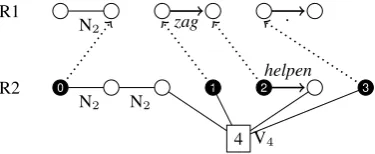
Figure 2 shows such a string generating HRG that can derive the example in Figure 1. Each rule rhs consists of one or more internally connected spans of strings paths of labeled edges. The ex-ternal nodes of each rhs graph mark the beginning and end of each span. The nonterminal labels of other rules specify how these spans are combined and connected to the surrounding string. For illus-tration, consider the first two steps of a derivation in this grammar. Rule 1 introduces the verb ‘zag’ and its subject. Rule 2 inserts ‘helpen’ to the right of ‘zag’ and its subject and direct object to the right of the subject of ‘zag’. This creates cross-ing dependencies between the subjects and their predicates in the derivation.
R1
N2 zag .
R2
N2 N2
helpen
0 1 2 3
4 V4
The partially derived graph now contains a span of nouns and a span of verbs. The nonterminal hyperedge labeled V4 indicates where to append
new nouns and where to add new verbs. Note that rule 2 (or an identical rule for a different verb) can be re-applied to generate cross-serial dependen-cies with an arbitrary number of crossings. It is easy to see that grammars of this type correspond to LCFRS almost directly.
Using the grammar in Figure 2, there is a sin-gle derivation tree for the example sentence in Fig-ure 1.
R1,zag
R2,helpen
R3,leren
R4,zwemmen R8,kinderen
R9,de R7,Marie
R6,Jan R5,Wim
This derivation tree represents the correct syntac-tic dependency structure for the sentence. This is not the case for all lexicalized ‘mildly context sensitive’ grammar formalisms, even if it is pos-sible to write grammars for languages that con-tain cross-serial dependencies. In TAG, long dis-tance dependencies are achieved using adjunction.
Both dependents are introduced by the same aux-iliary tree, stretching the host tree apart. An LTAG derivation for the example sentence would start with an elementary tree for ‘zwemmen’ and then adjoin ‘leren’. The resulting dependency structure is therefore inverted.
4 Deriving Dependency Graphs with Synchronous String-to-Graph Grammars
We now consider grammars whosederivedgraphs represent the dependency structure of a sentence. The goal is to write a synchronous context-free string-to-graph grammar that translates sentences into their dependency graphs. If the string side of the grammar is a plain string CFG, as we assume here, the derivation cannot reflect non-projective dependencies directly. Instead, we must use the graph side of the grammar to assemble a depen-dency structure.
This approach has several potential advantages in applications. In the string-generating HRG dis-cussed in the previous section, the degree of a node in the dependency structure is limited by the rank of the grammar. Using a graph grammar to derive the graph, we can add an arbitrary number of de-pendents to a node, even if the rules contributing these dependency edges are nested in the deriva-tion. This is especially important for more tically inspired representations where all seman-tic arguments should become direct dependents of a node (for example, deep subjects). We can also make the resulting graphs reentrant. In ad-dition, because HRGs produce labeled graphs, we can add dependency labels. Finally, even though the example grammar in Figure 3 is lexicalized on the string side, lexicalization is no longer required to build a dependency structure. Unfortunately, ‘decoupling’ the derivation from the dependency structure in this way can be problematic, as we will see.
[image:4.595.74.289.521.650.2]R1: S→ hV1zwemmen|
zwemmen
V
1
i R2: V1→ hV1leren|
leren xcomp
V
1
i
R3: V1→ hV2helpen|
helpen xcomp
2 V2
i R4: V2→ hN3zag|
zag ccomp
0 1
3 N3
i
R5: N3→ hWimN2| nsubj
W
im
0 1 2
3 N2
i R6: N2→ hJanN2| nsubj
Jan
N2
0 1 i
R7: N2→ hMarieN1|
dobj
Marie
N
1
0 1 i R8: N1→ hDT1kinderen|
dobj kinderen
DT
1
i
R9: DT1→ hde|
det de
[image:5.595.77.477.51.327.2]i
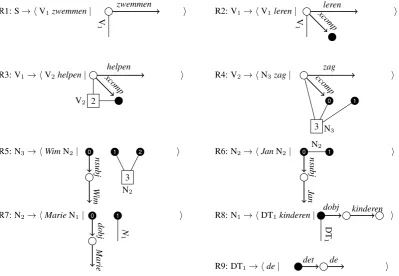
Figure 3: A synchronous string-to-graph grammar for Dutch cross-serial dependencies. The grammar can derive the sentence/dependency graph pair in in Figure 1, but the derivation tree does not reflect syntactic dependencies.
are related by a bijective synchronization relation (in case of ambiguity we make the bijection ex-plicit by indexing nonterminals when representing grammars). In a SHRG, each nonterminal label can only be used to label hyperedges of the same type. For example, V2is only used for hyperedges
of type 2. As a result, all derivations for the string side of the grammar are also valid derivations for graphs.
In the grammar in Figure 3, vertices represent nodes in the dependency structure (words). Be-cause HRGs derive edge labeled graphs but no ver-tex labels, we use a unary hyperedge (a hyperedge with one incident vertex) to label each node. For example, the only node in the rhs of rule 1 has the label ‘zwemmen’.
Nonterminal hyperedges are used to ‘pass on’ vertices that we need to attach a dependent to at a later point in the derivation. External nodes define how these nodes are connected to the surrounding derived graph. To illustrate this, a derivation using the grammar in Figure 3 could start with rule 1, then replace the nonterminal V1 with the rhs of rule 2. We then substitute the
new nonterminal V1 introduced by rule 2 with
rule 3. At this point, the partially derived string
is ‘V2 helpen leren zwemmen’ and the partially
derived graph is
helpen xcomp
leren xcomp
zwemmen 2
V2
.
The nonterminalV2 passes on a reference to two nodes in the graph, one for ‘helpen’ and one for ‘leren’. This allows subsequent rules in the deriva-tion to attach subjects and objects to these nodes, as well as the parent node (‘zag’) to ‘helpen’.
To derive the string/graph pair in Figure 1, the rules of this grammar are simply applied in order (rule 1 ⇒ rule 2 ⇒ · · · ⇒ rule 9). Clearly, the resulting derivation is just a chain and bears no re-semblance to the syntactic dependency structure.
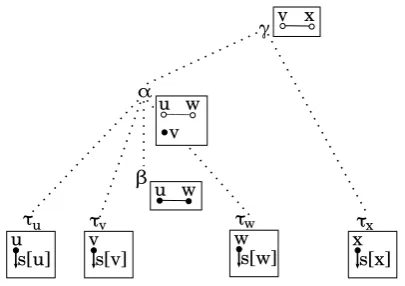
Figure 4: Sketch of the derivation tree of a syn-chronous hyperedge replacement grammar, show-ing two dependency edges(u, w) and(v, x), and u < v < w < x.The graph fragment associated with the rule at nodeαneeds to contain nodesu, w andv.vmust be an external node.
dependencies we therefore need to create special rules with nonterminal hyperedges of a larger type, as well as the corresponding rules with a larger number of external nodes. Because any grammar has a finite number of rules and a fixed order, we cannot use this type of SHRG grammar to model languages that permit an arbitrary degree of cross-ing edges in a graph. While the graph grammar can keep track of long-distance dependencies, the string grammar is still context free, so any local information needs to be encoded in the non-terminals. The penalty we pay for being able to remember a limited set of dependents through the derivation is that we need a refined alphabet of nonterminals (V1, V2, V3,· · ·; instead of just V).
5 Edge Degree and Hyperedge Type
In section 4 we demonstrate that we need an ever-increasing hyperedge type if we want to model languages in which a dependency edge can be crossed by an arbitrary number of other depen-dency edges. So far, we have only illustrated this point with an example. In this section we will demonstrate that no such grammar can exist.
It is clear that the problem is not with gener-ating the tree language itself. We could easily extend the string-generating grammar from sec-tion 3, whose derivasec-tion trees reflect the correct dependency structure, by adding a second graph rhs that derives an image of the derivation tree (potentially with dependency labels). Instead, the problem appears to be that we force grammar rules to be applied according to the string derivation.
Specifically, the partially derived string associated with each node in the derivation needs to be a con-tiguous subspan. This prevents us from assem-bling dependencies locally.
To make this intuition more formal, we demon-strate that there is a relationship between number of crossing dependencies and the the minimum hyperedge type required in the SHRG. We first look at a single pair of crossing dependency edges and then generalize the argument to multiple edges crossing into the span of an edge. For illustration, we provide a sketch of a SHRG derivation tree in Figure 4.
Assume we are given a sentence s = (w0, w1,· · ·, wn−1), and a
corre-sponding dependency graphG=hV, E, ℓiwhere V ={0,1,· · · , n−1}. We define the range of a dependency edge(u, v)to be the interval[u, v]if v > u or else[v, u]. For each dependency edge (u, v)the number of crossing dependencies is the number of dependency nodes properly outside its range, that share a dependency edge with any node properly inside its range. The degree of crossing dependencies of a dependency graph is the maximum number of crossing dependencies for any of its edges.
Given a SHRG derivation tree forsandG, each terminal dependency edge (u, w) ∈ E must be produced by the rule associated with some deriva-tion nodeβ (see Figure 4). Without loss of gen-erality, assume that u < w. String token s[u]is produced by the rule associated with some deriva-tion nodeτu ands[w] is produced by the rule of
some derivation node τw. On the graph side, τu
andτw must contain the nodes u and w because
they generate the unary hyperedges labeling these vertices. There must be some common ancestorα ofβ,τu, andτwthat contains bothuandw.uand
wmust be connected inαby a nonterminal hyper-edge, because otherwise there would be no way to generate the terminal edge (u, w) inβ (note that it is possible that α and β are the same node in which case the rule of this node does not contain a nonterminal edge).
Now consider another pair of nodes v and x such that u < v < w < x and there is a de-pendency edge(v, x) ∈ E or(x, v) ∈ E. s[v]is
generated byτvands[x]is generated byτx. As be-fore, there must be a common ancestorγofτvand
τx, in whichvandxare connected by a
αis an ancestor ofγ orγis an ancestor ofα. For illustration, we assume the second case. The case whereαdominatesγ is analogous.
Since the graph fragments of all derivation nodes on the path fromγtoτv must contain a
ver-tex that maps tov, αmust contain such a vertex. This vertex needs to be an external node of the rule attached toαbecause otherwisevcould not be in-troduced byγ.
We can extend the argument to an arbitrary number of crossing dependency edges. As be-fore, let(u, w)be a dependency edge andαbe the derivation node whose graph fragment first intro-duces the nonterminal edge betweenuandw. For all dependency edges (x, y) or (y, x) for which y is in the range of (u, w) and x is outside of the range of (u, w) (eitherx < u < y < w or u < y < w < x) there must be some path in the derivation tree that leads throughα. All graph fragments on this path contain a vertex mapped to y. As a result, the graph fragment inα needs to contain one external node for eachxthat has a de-pendency edge to some node y inside the range
(u, w). In other words,αneeds to contain as many external nodes as there are nodes outside the range
(u, w) that share a dependency edge with a node inside the range(u, w).
Because every HRG has a fixed order (the max-imum type of any nonterminal hyperedge), no SHRG that generates languages with an arbitrary number of cross-serial dependencies can exist. It is known that the hypergraph languages HRLk
that can be generated by HRGs of orderkform an infinite hierarchy, i.e. HRL1 ( HRL2 ( · · ·
(Drewes et al., 1997). Therefore, the string-to-graph grammars required to generate cross-serial dependencies up to edge degreekare strictly more expressive than those that can only generate edge degreek−1.
6 Related Work
While the theory of graph grammars dates back to the 70s (Nagl, 1979; Drewes et al., 1997), their use in Natural Language Processing is more re-cent. Fischer (2003) use string generating HRG to model discontinuous constituents in German. Jones et al. (2012) introduce SHRG and demon-strate an application to construct intermediate semantic representations in machine translation. Peng et al. (2015) automatically extract SHRG rules from corpora annotated with graph based
meaning representations (Abstract Meaning Rep-resentation), using Markov Chain Monte Carlo techniques. They report competitive results on string-to-graph parsing. Braune et al. (2014) em-pirically compare SHRG to cascades of tree trans-ducers as devices to translate English strings into reentrant semantic graphs. In agreement with the result we show more formally in this paper, they observe that, to generate graphs that contain a larger number of long-distance dependencies, a larger grammar with more nonterminals is needed, because the derivations of the grammar are limited to string CFG derivations.
Synchronous context free string-graph gram-mars have also been studied in the framework of Interpreted Regular Tree Grammar (Koller and Kuhlmann, 2011) using S-Graph algebras (Koller, 2015). In the TAG community, HRGs have been discussed by Pitsch (2000), who shows a construc-tion to convert TAGs into HRGs. Finally, Joshi and Rambow (2003) discuss a version of TAG in which thederivedtrees are dependency trees, sim-ilar to the SHRG approach we present here.
To use string-generating HRG in practice we need a HRG parser. Chiang et al. (2013) present an efficient graph parsing algorithm. However, their implementation assumes that graph frag-ments are connected, which is not true for the grammar in section 3. On the other hand, since string-generation HRGs are similar to LCFRS, any LCFRS parser could be used. The relationship be-tween the two parsing problems merits further in-vestigation. Seifert and Fischer (2004) describe a parsing algorithm specificaly for string-generating HRGs.
7 Conclusion
In this paper we investigated the capability of hy-peredge replacement graph grammars (HRG) and synchronous string-to-graph grammar (SHRG) to generate dependency structures for non-projective phenomena. Using Dutch cross-serial dependen-cies as an example, we compared two different ap-proaches: string-generating HRGs whose deriva-tion trees can be interpreted as dependency struc-tures, and string-to-graph SHRGs, whose can cre-ate dependency structures as their derived graphs. We provided an example grammar for each case. The derivation tree of the HRG adequately reflected syntactic dependencies and the example grammar could in principle generate an arbitrary number of crossing dependencies. However, these derivation trees are unlabeled and cannot be ex-tended to represent deeper semantic relationships (e.g semantic argument structure and coreference). For the string-to-graph SHRG, we saw that the de-rived graph of our grammar represented the correct dependencies for the example sentence, while the derivation tree did not.
The main observation of this paper is that, unlike the string-generating HRG, the string-to-graph SHRG was only able to generate a limited number of crossing dependencies. With each ad-ditional crossing edge in the example, we needed to add a new rule with a higher hyperedge type, increasing the order of the grammar. We argued that the reason for this is that the synchronous derivation for the input string and output graph is constrained to be a valid string CFG deriva-tion. Analyzing this observation more formally, we showed a relationship between the order of the grammar and the maximum permitted number of edges crossing into the span of another edge.
An important conclusion is that, unless the cor-rect syntactic dependencies are already local in the derivation, HRGs cannot derive dependency graphs with an arbitrary number of cross-serial dependencies. We take this to be a strong ar-gument for using lexicalized formalisms in syn-chronous grammars for syntactic and semantic analysis, that can process at least a limited degree of non-projectivity, such as LTAG.
In future work, we are aiming to develop a lex-icalized, synchronous string-to-graph formalisms of this kind. We would also like to relate our results to other measures of non-projectivity dis-cussed in the literature. Finally, we hope to expand
the results of this paper to other non-projective phenomena and to semantic graphs.
References
Laura Banarescu, Claire Bonial, Shu Cai, Madalina Georgescu, Kira Griffitt, Ulf Hermjakob, Kevin Knight, Philipp Koehn, Martha Palmer, and Nathan Schneider. 2013. Abstract meaning representation for sembanking. In Linguistic Annotation Work-shop.
Fabiene Braune, Daniel Bauer, and Kevin Knight. 2014. Mapping between english strings and reen-trant semantic graphs. In Proceedings of LREC,
Reykjavik, Iceland.
David Chiang, Jacob Andreas, Daniel Bauer, Karl-Mortiz Hermann, Bevan Jones, and Kevin Knight. 2013. Parsing graphs with hyperedge replacement grammars. InProceedings of ACL, Sofia, Bulgaria.
Frank Drewes, Annegret Habel, and Hans-J¨org Kre-owski. 1997. Hyperedge replacement graph gram-mars. In Grzegorz Rozenberg, editor,Handbook of Graph Grammars and Computing by Graph Trans-formation, pages 95–162. World Scientific.
Joost Engelfriet and Linda Heyker. 1991. The string generating power of context-free hypergraph gram-mars. Journal of Computer and System Sciences,
43(2):328–360.
Ingrid Fischer. 2003. Modeling discontinuous con-stituents with hypergraph grammars. In Interna-tional Workshop on Applications of Graph Transfor-mations with Industrial Relevance (AGTIVE), pages
163–169.
Bevan Jones, Jacob Andreas, Daniel Bauer, Karl-Moritz Hermann, and Kevin Knight. 2012. Semantics-based machine translation with hyper-edge replacement grammars. In Proceedings of COLING, Mumbai, India. First authorship shared.
Aravind Joshi and Owen Rambow. 2003. A formal-ism for dependency grammar based on tree adjoin-ing grammar. Proceedings of the Conference on Meaning-Text Theory, pages 207–216.
Alexander Koller and Marco Kuhlmann. 2011. A gen-eralized view on parsing and translation. In Pro-ceedings of the 12th International Conference on Parsing Technologies, pages 2–13. Association for
Computational Linguistics.
Alexander Koller. 2015. Semantic construction with graph grammars. InProceedings of the 11th Inter-national Conference on Computational Semantics (IWCS), pages 228–238.
Marco Kuhlmann. 2010. Dependency Structures and Lexicalized Grammars: An Algebraic Approach,
Manfred Nagl. 1979. A tutorial and bibliographical survey on graph grammars. In Proceedings of the International Workshop on Graph-Grammars and Their Application to Computer Science and Biology,
pages 70–126, London, UK, UK. Springer-Verlag.
Xiaochang Peng, Linfeng Song, and Daniel Gildea. 2015. A synchronous hyperedge replacement gram-mar based approach for amr parsing. InProceedings of CONLL.
Gisela Pitsch. 2000. Hyperedge replacement and tree adjunction. In Anne Abeill`e and Owen Rambow, editors,Tree Adjoining Grammars. CSLI.
Owen Rambow and Aravind Joshi. 1997. A formal look at dependency grammars and phrase-structure grammars, with special consideration of word-order phenomena. In Leo Wanner, editor, Recent Trends in Meaning-Text Theory, pages 167–190. John
Ben-jamins, Amsterdam and Philadelphia.
Sebastian Seifert and Ingrid Fischer. 2004. Pars-ing strPars-ing generatPars-ing hypergraph grammars. In
International Conference on Graph Transforma-tions(ICGT), pages 352–367.
David J. Weir. 1992. Linear context-free rewriting systems and deterministic tree-walking transducers. In Proceedings of ACL, pages 136–143, Newark,