Novel Derivatives of 2-Pyridinemethylamine as Selective, Potent, and Orally
Active Agonists at 5-HT
1AReceptors
Bernard Vacher,*
,†Bernard Bonnaud,
†Philippe Funes,
†Nathalie Jubault,
†Wouter Koek,
‡Marie-Bernadette Assie´,
‡Cristina Cosi,
‡and Mark Kleven
‡Pierre Fabre Research Center, 17 avenue Jean Moulin, 81106 Castres Cedex, France
Received December 9, 1998
The aim of this work was to improve the oral bioavailability of a recently discovered, novel
structural class of 5-HT
1Areceptor agonists: aryl-
{
[4-(6-R-pyridin-2-ylmethyl)-amino]-methyl
}
-piperidin-1-yl-methanone. Incorporation of a fluorine atom in the
β-position to the amino
function in the side chain led to analogues that exhibited, in general, enhanced and
long-lasting 5-HT
1Aagonist activity in rats after oral administration. Location of the fluorine atom
at the C-4 position of the piperidine ring was the most favorable, and among the various
substituents tested, the ability of the fluorine was unique in improving the oral activity of this
family of ligands. Thus, the derivatives 39, 46, and 61 bound with higher affinity and selectivity
to 5-HT
1Areceptors (versus dopaminergic D
2and adrenergic
R
1receptors) and displayed more
potent 5-HT
1Aagonist activity in vitro and in vivo than their C-4 desfluoro analogues. To
examine the relationship between the conformation of the pharmacophore and the level of
agonistic activity of this type of ligand, we synthesized a series of
3-chloro-4-fluorophenyl-(4-fluoro-4
{
[(5-(H or CH
3)-6-R-pyridin-2-ylmethyl)-amino]-methyl
}
-piperidin-1-yl-methanone
de-rivatives and found that the combination of a 5-methyl and a 6-methylamino substituent on
the pyridine ring synergistically affected their 5-HT
1Aagonist properties. Thus, the
3-chloro-4-fluorophenyl-(4-fluoro-4
{
[(5-methyl-6-methylamino-pyridin-2-ylmethyl)-amino]-methyl
}
-pi-peridin-1-yl-methanone 40 behaved as a more potent 5-HT
1Areceptor agonist in vitro and in
vivo than its 5-unsubstituted analogue 38. The antidepressant potential of the lead compounds
40, 45, and 54 was examined by means of the forced swimming test (FST) in rats. The results
indicated that, after a single oral administration, these compounds inhibited immobility in
the FST more potently and more extensively than the clinically used antidepressant imipramine.
Thus, 40, 45, and 54 are potent, orally active 5-HT
1Areceptor agonists with marked
antidepressant potential.
Introduction
Many studies have focused on specific alterations of
monoaminergic neurotransmission in depression.
1The
role of central serotoninergic (5-HT) systems, and in
particular of 5-HT
1Areceptor subtype-mediated
neu-rotransmission, has attracted special interest over the
last two decades.
2However, the antidepressant effects
of 5-HT
1Apartial agonists, such as buspirone and
ipsapirone, do not exceed those of currently available
treatments, neither in terms of clinical efficacy
3nor in
terms of rapidity of onset.
4It is conceivable that their
limited clinical efficacy is related to their low level of
intrinsic activity at 5-HT
1Areceptors.
5Thus, our
re-search efforts are guided by the hypothesis that the
antidepressant efficacy of 5-HT
1Aagonists is a direct,
positive function of their intrinsic activity, and therefore,
aimed at discovering 5-HT
1Aagonists with a high level
of intrinsic activity.
6In a recent paper,
7we described a novel 5-HT
1Apharmacophore and reported a series of aryl-
{
[4-(6-R-pyridin-2-ylmethyl)-amino]-methyl
}
-piperidin-1-yl-meth-anones that bind with high affinity and selectivity to
5-HT
1Areceptors. Of primary interest, several members
of this series inhibited intracellular cAMP accumulation
in forskolin-stimulated HA7 cells more potently and
more extensively than the prototypical 5-HT
1Aagonist
(
(
)-8-OH-DPAT. Unfortunately, despite their promising
in vitro profiles, these compounds exerted only weak
5-HT
1Aagonist activity in vivo,
8possibly because of low
bioavailability. Attempts to enhance the brain
concen-tration of these novel 5-HT
1Aagonists led to the design
of a series of aryl-(4-fluoro-4
{
[(6-R-pyridin-2-ylmethyl)-amino]-methyl
}
-piperidin-1-yl-methanones that
exhib-ited very potent 5-HT
1Aagonist properties, not only in
vitro but also in vivo. Several of these compounds
demonstrated marked antidepressant-like effects in the
FST.
9Finally, this novel series provided further insight
into some of the structural determinants involved in the
activation of 5-HT
1Areceptors.
Chemistry
Compounds of the general formula 4 (Scheme 1, Table
7) were prepared from the appropriate
pyridine-2-carboxaldehydes 3 either by reductive amination with
primary amines of the type 1 (method A) or by an
aza-Wittig reaction with azides of the type 2 (method B).
The synthesis of amines 1a, as shown in Scheme 2,
began with acylation of the commercially available
4-piperidone-ethylene ketal by the appropriate aroyl
* To whom correspondence should be addressed. Fax: (33)5-63-71-42-99. E-mail: [email protected]. †Division of Medicinal Chemistry I.
‡Division of Neurobiology II.
1648 J. Med. Chem. 1999, 42, 1648 1660
chloride (NEt
3, CH
2Cl
2, 0 °C). After removal of the C-4
carbonyl protecting group, the oxirane function was
installed by treatment of the piperidones 5 with
di-methyloxosulfonium methylide, as described by
Fish-man
10for the epoxidation of the N-benzyl-piperidone
analogue. The spiro derivatives 6 underwent a
regiose-lective ring-opening reaction with hydrogen fluoride
-pyridine complex
11to afford the fluoro alcohol 7. The
end of the synthesis was straightforward: the primary
alcohol 7 was activated as the tosylate 8, which was
then converted to the desired primary amine 1a via the
phthalimide 9 (Gabriel synthesis). The
4-cyano-1-(3,4-dichloro-benzoyl)-piperidine-4-carboxylic acid ethyl
es-ter
12was used as the precursor to the amine 1b (Scheme
3). Thus, the ester function was first reduced to the
alcohol 10 and then transformed into the triflate 11.
Displacement of the triflate 11 by fluoride anion, under
Grieco conditions,
13provided the intermediate 12.
Sub-sequent hydrogenation of the cyano group over Raney
Ni gave the fluoromethylated amine 1b. The amine 1c
(Scheme 4) was prepared by C-methylation of the
lithium salt generated from
1-(3,4-dichloro-benzoyl)-piperidine-4-carbonitrile
14(LDA, CH
3
I) followed by
hydrogenation of the cyano group.
The azide 2a was obtained by ring-opening of epoxide
6 by NaN
3(Scheme 5). Under standard conditions (NH
4-Cl, CH
3OH/H
2O), attack of the nucleophile occurred at
the less substituted carbon exclusively. O-Methylation
of the resulting
β-hydroxyazide 14 then yielded the azide
2a. The azide 2b could be derived from the intermediate
10 by the two-step sequence shown in Scheme 6.
The preparation of the
5-unsubstituted-6-substituted-pyridine-2-carboxaldehydes used in this work has been
reported previously.
7The synthesis of the novel
5-meth-yl-6-substituted-2-pyridinecarboxaldehydes was carried
out as depicted in Scheme 7. The ester 16, obtained by
the method of Hoornaert,
15was reduced to the alcohol
17. Treatment of the latter with a large excess of methyl,
ethyl, or dimethylamine under harsh reaction conditions
led to the 6-alkylamino-5-methyl-2-pyridinemethanol
derivatives 18a
-
c in moderate yields. Displacement of
the 6-chlorine atom by amines was much more difficult
than in the 5-unsubstituted series, demonstrating that
the 5-methyl group has a pronounced effect on the
reactivity of the pyridine ring. As a consequence, the
derivative 18d, bearing a more hindered 6-diethylamino
group, was best prepared from the intermediate 19,
according to a variant also developed by Hoornaert.
16Thus, treatment of the amidine 19 with DBU and
ethanol (lactone cleavage and aromatization) gave the
6-diethylamino-5-methyl-pyridine-2-carboxylic acid
eth-yl ester (not shown in Scheme 7) which was reduced as
Scheme 1aaConditions: 1, toluene, 110 °C, then KBH
4, MeOH, 20 °C (method A), or 2, PPh3, MeOH, reflux, then KBH4, 20 °C (method B).
Scheme 2a
aConditions: (a) ArCOCl, TEA, CHCl
3; (b) HCO2H, CuSO4, 80 °C; (c) trimethylsulfoxonium iodide, HNa, DMSO; (d) HF- pyri-dine, CH2Cl2; (e) pTSCl, pyridine; (f) K-phthalimide, DMF, 150 °C; (g) NH2(CH2)2OH, 50 °C.
Scheme 3a
aConditions: (a) LiBH
4, THF, 20 °C; (b) (CF3SO2)2O, 2,4-lutidine, CH2Cl2; (c) diethylene glycol, KF, 100 °C; (d) Raney Ni, EtOH, NH4OH.
Scheme 4a
aConditions: (a) LDA, MeI, THF; (b) Raney Ni, EtOH, NH
4OH.
Scheme 5a
aConditions: (a) NaN
3, NH4Cl, MeOH, H2O, reflux; (b) HNa, MeI, THF.
Scheme 6a
aConditions: (a) pTSCl, pyridine; (b) NaN
described above (16
f
17) to afford the expected
6-diethylamino-5-methyl-2-pyridinemethanol 18d in
mod-est overall yield. The primary alcohols 18a
-
d were
subsequently oxidized to the target
pyridine-2-carbox-aldehydes 3a
-
d (MnO
2/CHCl
3).
17The synthetic sequence had to be modified slightly
for the synthesis of the
6-pyrazol-1-yl-5-methyl-2-py-ridinecarboxaldehyde 3e. Thus, the alcohol 17 was first
oxidized and then the aldehyde function protected as
the dioxolane 20.
18Reaction of 20 with the sodium salt
of pyrazole yielded the intermediate 21, which upon
removal of the protecting group, afforded the desired
6-pyrazolo-5-methyl-pyridine-2-carboxaldehyde
deriva-tive 3e.
Pharmacology
Binding affinities for the different receptors were
determined by means of ligand competition assays using
the conditions summarized in the Experimental Section
(Table 8). All experiments were performed in triplicate.
IC
50values were determined using nonlinear regression.
K
ivalues were calculated using the equation K
i)
IC
50/1
+
[C]/K
D, and the results are expressed as mean pK
ivalues
(
SEM of three independent determinations.
The HeLa cell line permanently transfected with the
human 5-HT
1Areceptor gene and permanently
express-ing the 5-HT
1Areceptor protein (HA7) as described by
Fargin
19was obtained commercially (Duke University,
Durham, NC). Concentration
-
effect relationships are
expressed as
-
log [M] of the test compound versus the
cAMP content expressed as a percentage of
forskolin-stimulated cAMP control values. IC
50values for
com-pounds were estimated by linear interpolation between
the logarithms of the concentrations that inhibited
forskolin-stimulated cAMP with amounts bordering 50%
of the maximal inhibition observed with the compound.
The potency and maximal inhibition values represent
the mean of 2
-
4 independent determinations (each
performed in triplicate) for all compounds, except (
(
)-8-OH-DPAT whose values represent the mean of five
determinations.
The methods used to examine the ability of
com-pounds to produce lower lip retraction (LLR) in rats
were the same as those described previously.
20Rats
were observed at two time points, centered at 15 and
60 min after the injection and each lasting 10 min.
During a 10 min period, an animal was observed once
every minute for 10 s and the presence (1) or absence
(0) of LLR was recorded. Because an animal was
observed 10 times during a 10 min period, the incidence
of LLR could vary from 0 to 10. Dose
-
response functions
were determined from the percentage of rats (n at least
2 per dose) showing LLR scores of 1 or more. This
criterion was based on the incidence of LLR observed
in control animals treated with saline, fewer than 5%
of which had an LLR score of 1 or more; drugs were
therefore considered to produce an effect in an
indi-vidual animal when scores higher than zero were
obtained. ED
50estimates are obtained by linear
inter-polation. Because the pharmacological studies were
conducted using doses differing by factor 4, the range
of doses which encompassed the interpolated ED
50values could not exceed this factor. Further, the
coef-ficient of dispersion (i.e, ED
50×
100/range) varied from
43 to 138%.
The forced swimming test was conducted in a manner
similar to that described by Porsolt:
21the procedure
involved placing a rat in a cylinder (height: 45 cm,
diameter: 20 cm) containing 17 cm water (25 °C) for
15 min on the first day of the experiment and again in
the cylinder 24 h later for 5 min. The duration of
immobility during the 5 min period was measured by
an observer who was unaware of the treatment
condi-tions. Each animal was treated (volume: 10 mL/kg) with
vehicle after the session on day 1 and, on day 2, with a
particular dose of a test compound (n
)
10 per dose) or
its vehicle control, given p.o. 60 min before placement
in the cylinder. For each dose, the percentage inhibition
of immobility was calculated by expressing the
differ-ence between the median immobility times of vehicle
controls (i.e., 204 s) and of drug-treated animals as a
percentage of the median immobility time of vehicle
controls. In addition, dose
-
response functions were
determined from the percentage of rats with an
im-mobility time less than 138 s. Imim-mobility times shorter
than this criterion value occurred in less than 5% of the
vehicle controls and were therefore considered
signifi-cant. ED
50estimates are obtained by linear
interpola-tion.
Results and Discussion
Oxidative N-debenzylation is known to be a major
biotransformation pathway for biogenic amines and
nitrogen-containing xenobiotics.
22Thus, we assumed
that the pyridin-2-yl-methylamine fragment in
struc-tures such as 4 (Scheme 1; R
2)
H) may be a likely
target for redox active enzymes (cytochrome P 450’s,
MAO’s ...). This assumption was supported by the
finding that electron rich pyridine derivatives, even
though being more potent to inhibit adenyl-cyclase in
vitro than their electron deficient pyridine counterparts,
displayed, in general, much weaker 5-HT
1Aagonist
Scheme 7aaConditions: (a) DBU, EtOH, THF; (b) NaBH
activity in vivo.
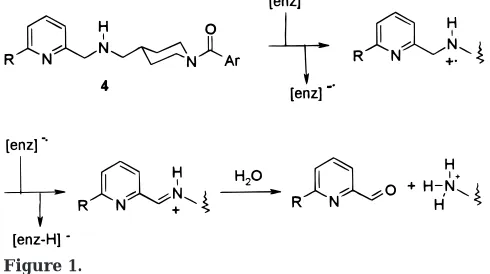
23The mechanism postulated for the
benzylic C
-
N bond cleavage in compounds of type 4,
catalyzed by oxido-reductases, involved a nitrogen
radi-cal cation in the first step (Figure 1). Thus, we reasoned
that an electronegative fluorine atom
24in the
β
-position
to the benzylic amino function should (1) retard the
oxidation-dependent processes by raising the redox
potential of the secondary amino function (E
N••/
N+•) and
(2) facilitate absorption by reducing the pK
aof the
secondary amine
25and increasing the lipophilicity of the
ligand.
26There were two options available for introducing a
fluorine atom in a suitable position relative to the
secondary amino function: either at the C-4 of the
piperidine ring or, in a vinylogous fashion, at C-3 of the
pyridine nucleus. We examined the influence of fluorine
incorporation in either of these positions.
27The binding affinities of compounds 32 and 33 were
only marginally improved by incorporation of a fluorine
atom in either position (compared with 22 in Table 1).
In contrast, 5-HT
1Aagonist potency in vivo (ED
50to
induce LLR) increased markedly after i.p. and p.o.
administration of the fluorinated derivative 32 as
compared with the desfluoro compound 22. In
particu-lar, fluorine substitution for hydrogen at the Csp
3-4 of
the piperidine ring (32) provided a clear advantage in
terms of in vivo activity (LLR, i.p. and p.o.) over its
Csp
2-3 location (33). These findings prompted us to
extend the Csp
3-4 replacement of hydrogen by fluorine
to other ligands of this family.
7The compounds shown in Table 2 could be separated
into two groups: (1) derivatives bearing an aliphatic
amino substituent in the 6-position of the pyridine ring
and (2) those having a five-membered heteroaromatic
ring in this position. Within the first group (23
-
25, 39,
46, 52), fluorine incorporation enhanced 5-HT
1Arecep-tors binding whereas the affinity for D
2and
R
1receptors
remained in the micromolar range. The selectivity of the
fluorinated ligands for 5-HT
1Abinding sites (versus D
2and
R
1), therefore, improved over that of the desfluoro
analogues.
28aIn addition, the fluoro derivatives were,
in general, more potent (39 and 46), and at least as
efficacious at inhibiting forskolin-stimulated cAMP
ac-cumulation in HA7 cells than their desfluoro
counter-parts (23 and 24, respectively). Of particular interest,
they showed clear superiority over their desfluoro
analogues in terms of their ability to induce LLR in rats
after i.p or p.o administration (39, 46, 52 compared with
23, 24, 25). In the second group (53
-
57, 26
-
30, 61),
the selectivity of the fluorinated ligands also improved,
but mainly because of further decreases of their D
2and
R
1affinity.
28bAlthough the influence of the C-4 fluorine
on the oral performance of the compounds shared the
positive trend seen in the first group, there were marked
differences among members of this group in terms of
their in vitro potency (pEC
50). Thus, depending on the
type of the heterocycle in the 6-position, the presence
of the C-4 fluorine was either deleterious (56 and 57
versus 29 and 30), neutral (53 and 55 versus 26 and
27), or advantageous (61 versus 28). Such broad
varia-tions in potency data (over more than 1 log unit)
suggested that the pattern of interactions used by these
molecules to activate 5-HT
1Areceptors may not overlap,
notwithstanding they are structurally closely related.
The LLR activity of the desfluoro derivatives listed
in Table 2, except for 24, was sustained at 60 min after
i.p. injection. Moreover, the ED
50’s to produce LLR were
not, in general, dependent on the route of
administra-tion (26, 27, 29, and 30). Given these results, we
assumed that low brain exposure was the major factor
limiting the central activity of the C-4 desfluoro
ago-nists. In this regard, ligands displaying comparable in
vitro profiles but different in vivo activities,
irrespec-tively of the nature of the C-4 substituent (H or F), told
us about the pharmacokinetic input of the C-4 fluorine
atom (e.g., 25 compared with 52, 28 versus 61, 26 versus
53, and 27 versus 55). Thus, it became clear that a C-4
fluorine has the ability to enhance concentration of the
compound into the brain. Improved pharmacokinetics
would be also one of the features that would,
qualita-tively, account for the greater in vivo effects produced
in the more hydrophilic 6-amino ligands (e.g., 23, 24,
25 compared with 39, 46, 52, respectively). As discussed
below, the contribution of the C-4 fluorine to the
pharmacological profile of the ligand is, however,
prob-ably multifactorial. At present, even the possibility of
specific metabolic activation of the fluorinated
com-pounds cannot be ruled out.
29Having identified several orally active 5-HT
1Aago-nists, we investigated various substituents at C-4
posi-tion to refine our understanding of the role of the
fluorine atom. Depending on the nature of the R group
at C-4, the affinity and the potency of compounds varied
over 1 order of magnitude (Table 3). Various C-4
substitutents led to ligands with substantial affinity for,
and agonist potency at, 5-HT
1Areceptors (e.g., 31, 58,
65, 67, 68, and 69). Among them, however, only a
[image:4.612.53.298.51.188.2]Figure 1.
Table 1. Effects of a Fluorine Atom and Its Position on 5-HT1A Affinity and on 5-HT1AAgonist Activity in Vivo
5-HT1Aagonist activity LLR,dED
50e
compd X X1
5-HT1A
affinity pKib,c i.p. 15 min p.o. 60 min
22a H H 7.58 (0.15) 0.89 5.0
32 H F 8.29 (0.10) 0.11 1.3
33 F H 7.82 (0.08) 0.62 5.0
aDerivative described in ref 7 whose appropriate
pharmacologi-cal data have been completed.bSee Experimental Section for
details.cEach value is the mean(SEM of three determinations.
dLLR)lower lip retraction.eED
fluorine atom was able to confer an in vivo activity to
the compound exceeding that of the corresponding C-4
unsubstituted derivative (LLR of 58 versus 31).
More-over, changing the piperidine moiety by a
tetrahydro-pyridine (69) was detrimental for recognition and
activation of 5-HT
1Areceptors, despite the fact that a
Csp
2-4 produced minimal steric hindrance, and
gener-ated a negative electrostatic potential around the C-4
region of the molecule which could mimic that of a
fluorine atom. The contribution of the R group to 5-HT
1Abinding is, therefore, best understood in terms of
con-formational distribution effects rather than in terms of
specific interactions of the C-4 substituent with the
receptor protein. Thus, if we assume that the variation
of the affinity constants (K
i), throughout the
homoge-neous set of compounds shown in Table 3, reflects the
differences in the relative populations of molecules
achieving active conformation(s), then it appears that
the C-4 fluorine atom is able to select conformer(s)
energetically close to the bioactive conformation(s) of the
ligand. When R is small (R
)
H; 31), or not sterically
too demanding and inducing a strong permanent dipole
moment (R
)
F; 58), it tends to be axially oriented on
the piperidine.
30As a result, the piperidine ring is locked
in (a) conformation(s) where the C-4 methylamino chain
occupies an equatorial position.
31Apparently, an intramolecular hydrogen bond
be-tween the fluorine atom and one of the vicinal
am-monium protons did not participate in binding when the
fluorine is directly attached to C-4 of the piperidine
32(58 compared with 31). On the other hand, there may
be some entropic contributions to binding of such a
hydrogen bond in the higher homologue 68 (compared
with 64).
The synergy seen in the desfluoro series,
7between a
few combinations of meta
-
para benzamide
substitu-ents, no longer occurred in the fluorinated series (Table
4). Nonetheless, a 3-chloro, 4-fluoro-benzamide group
(45) still had the best overall profile, in vitro and in vivo.
To examine the relationship between the
conforma-tion of the pharmacophore and the level of agonist
activity, we prepared 5-methylated congeners of several
6-alkylamino and 6-heteroaromatic derivatives (Table
5). It was expected that, because of the presence of the
5-methyl group, the size of the 6-substituent would
control the degree of planarity of the
6-substituent-pyridine system: a n-π
or p-π
overlap should be allowed
if the 6-substituents are small, but should become less
favored as the size of the 6-substituents increases.
Incorporation of a 5-methyl substituent in the
6-pyrazol-Table 2. Fluorinated and Nonfluorinated Derivatives: Comparisons of Their Receptor Binding Profiles and Their Potencies at
5-HT1AReceptors in Vitro (cAMP) and in Vivo (LLR)
5-HT1Aagonist activity
ED50(mg/kg) to produce LLRe
receptor affinity (pKi)b,c i.p p.o
compd A X Y 5-HT1A D2 R1 cAMPdpEC50 15 min 60 min 60 min
23a CH
3NH H Cl 8.76 (0.06) 5.51 (0.05) 6.87 (0.04) 7.66 (0.12) 5.0 5.0 >10
39 CH3NH F Cl 9.67 (0.15) 6.40 (0.18) 6.92 (0.03) 8.18 (0.06) 0.11 0.23 0.32
24a (CH
3)2N H Cl 8.85 (0.11) 6.28 (0.04) 6.92 (0.03) 7.69 (0.14) 0.08 7.0 5.0
46 (CH3)2N F Cl 9.61 (0.07) 6.48 (0.22) 6.76 (0.04) 8.53 (0.09) 0.62 0.45 0.32
25a azetidino H Cl 9.43 (0.05) 6.22 (0.13) 6.64 (0.04) 8.15 (0.02) 1.30 3.60 >10
52 azetidino F Cl 9.70 (0.12) 6.51 (0.09) 6.35 (0.05) 7.97 (0.14) 0.32 0.45 0.45
26a furan-2-yl H Cl 9.14 (0.06) 6.34 (0.08) 6.71 (0.07) 8.28 (0.35) 1.30 1.30 1.30
53 furan-2-yl F Cl 8.98 (0.04) 5.92 (0.07) 6.39 (0.04) 8.58 (0.07) 0.16 0.23 0.32
54 furan-2-yl F F 9.55 (0.04) 5.65 (0.13) 6.12 (0.05) 8.46 (0.05) 0.08 0.11 0.32
27a thien-2-yl H Cl 8.86 (0.04) 6.54 (0.07) 6.76 (0.05) 8.24 (0.06) 1.30 1.30 5.0
55 thien-2-yl F Cl 8.91 (0.04) 6.34 (0.08) 6.72 (0.07) 7.92 (0.25) 0.32 0.32 1.30
28a pyrazol-3-yl H Cl 9.27 (0.10) 6.01 (0.03) 6.66 (0.07) 8.52 (0.11) 5.0 5.0 >10
61 pyrazol-3-yl F Cl 9.52 (0.07) 5.39 (0.17) 6.10 (0.04) 8.95 (0.08) 0.32 0.32 1.30
29a oxazol-5-yl H Cl 9.03 (0.01) 6.06 (0.04) 6.55 (0.02) 8.70 (0.01) 0.45 0.89 1.30
56 oxazol-5-yl F Cl 9.33 (0.14) 5.65 (0.14) 5.90 (0.03) 8.05 (0.01) 0.32 0.32 1.30
30a thiazol-2-yl H Cl 9.46 (0.08) 5.47 (0.07) 6.75 (0.02) 8.30 (0.13) 0.32 1.30 5.0
57 thiazol-2-yl F Cl 9.10 (0.08) 5.47 (0.23) 6.26 (0.07) 7.64 (0.14) 0.45 0.89 1.30
a-cSee footnotes of Table 1.dForskolin-stimulated cAMP levels in HA7 cells were inhibited by (()-8-OH-DPAT (pEC50)7.60 (0.17),
[image:5.612.56.556.68.326.2]Emax)71%(4.3%) and to a greater extent (Emax>80%) by all compounds reported in the table (data not shown).eLLR)lower lip retraction.
Table 3. Effect of the Nature of the C-4 Piperidine Substituent
on Affinity, and Agonist Potency at 5-HT1AReceptors in Vitro (cAMP) and in Vivo (LLR)
5-HT1Aagonist activity
compd R
5-HT1A
affinity pKib,c cAMP pEC50d
LLReED
50 (mg/kg)f
31a H 8.78 (0.09) 7.51 (0.09) 5.0
58 F 8.77 (0.09) 7.55 (0.12) 1.30
64 CH3 7.43 (0.06) NT NT
65 CN 8.16 (0.10) 6.79 (0.40) >10
66 OCH3 7.52 (0.07) NT NT
67 OH 8.79 (0.03) 7.40 (0.02) >10
68 CH2F 8.04 (0.05) 6.51 (0.18) >10
69 8.22 (0.16) 6.57 (0.15) >10
3-yl-pyridine derivative 63 significantly decreased its
5-HT
1Aaffinity and potency (compared with 62). In
contrast, the N-bound isomer 60 showed a
pharmaco-logical profile very similar to that of the 5-unsubstituted
control 59. Thus, intriguingly, either the conformation
of the pharmacophore plays a different role in C-bound
(63) than in N-bound (60) aromatic 6-substituted ligands
or the 5-methyl group reduces the steric tolerance in
the region occupied by the 6-substituent only in C-bound
6-substituted derivatives. In all cases, the binding mode
of the C-versus N-bound aromatic 6-substituted ligands
at 5-HT
1Areceptors is likely to be different.
The impact of an additional 5-methyl group in the
nonaromatic 6-substituted series was more encouraging.
For instance, the 5-methylated derivative 34 (Table 5)
had 10 times higher affinity than its 5-unsubstituted
congener 32 (Table 1). Thus, clearly, the methyl group
in the 5-position on the pyridine nucleus interacts with
the receptor protein through hydrophobic effects.
When the methyl group was moved around the
pyridine ring, affinity for 5-HT
1Areceptors was retained
but potency and in vivo activity were reduced markedly
(47 and 48 compared with 49). In addition, in the
6-dialkylamino series, incorporation of a 5-methyl group
did not seem to affect the in vitro responses of the
corresponding ligands (49 and 51 compared with 45 and
50, respectively). This suggests that, in the
5,6-disub-stituted series, the gain in free energy of stabilization
of the receptor
-
ligand complex, provided by the
5-meth-yl effects, is partially offset by a less favorable
contribu-tion of the 6-substituents as compared to the
6-mono-substituted series, possibly for steric reasons.
Evidence in favor of such a scheme came from the
5-methyl-6-methylamino pyridine derivative 40. In this
compound the 5- and the 6-substituents act
synergisti-cally, as shown by the substantial improvement of all
the 5-HT
1Aparameters over those of the 5-unsubstituted
and the 6-dimethyl congeners (38 and 49, respectively).
Table 4. Effect of the Nature of the Para Substituent on Receptor Affinity Profile and on 5-HT1AAgonist Activity in Vitro (cAMP) and in Vivo (LLR)
5-HT1Aagonist activity
ED50(mg/kg)eto produce LLRf
receptor affinity (pKi)b,c i.p. p.o.
compd R 5-HT1A D2 R1 cAMPdpEC50 15 min 60 min 60 min
43 H 10.01 (0.04) 6.21 (0.04) 6.81 (0.03) 8.00 (0.45) 0.08 0.11 0.32
44 CH3 9.57 (0.05) 6.89 (0.15) 6.86 (0.06) 8.24 (0.22) 0.08 0.08 0.32
45 F 9.92 (0.09) 6.56 (0.06) 6.68 (0.09) 8.44 (0.09) 0.29 0.11 0.16
46 Cl 9.61 (0.07) 6.48 (0.22) 6.76 (0.04) 8.53 (0.09) 0.62 0.45 0.32
b-dSee footnotes of Table 2.eED
[image:6.612.55.557.263.523.2]50values were obtained by linear interpolation.fLLR)lower lip retraction.
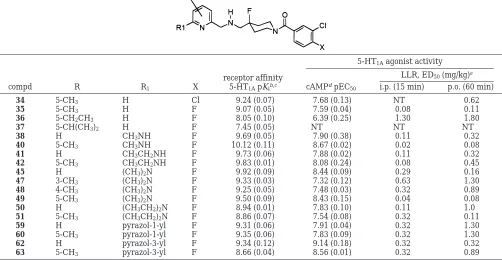
Table 5. 5-Unsubstituted and -Substituted Derivatives: Comparisons of Their Affinity and Agonist Activity at 5-HT1AReceptors in Vitro (cAMP) and in Vivo (LLR)
5-HT1Aagonist activity
LLR, ED50(mg/kg)e
compd R R1 X
receptor affinity
5-HT1ApKib,c cAMPdpEC50 i.p. (15 min) p.o. (60 min)
34 5-CH3 H Cl 9.24 (0.07) 7.68 (0.13) NT 0.62
35 5-CH3 H F 9.07 (0.05) 7.59 (0.04) 0.08 0.11
36 5-CH2CH3 H F 8.05 (0.10) 6.39 (0.25) 1.30 1.80
37 5-CH(CH3)2 H F 7.45 (0.05) NT NT NT
38 H CH3NH F 9.69 (0.05) 7.90 (0.38) 0.11 0.32
40 5-CH3 CH3NH F 10.12 (0.11) 8.67 (0.02) 0.02 0.08
41 H CH3CH2NH F 9.73 (0.06) 7.88 (0.02) 0.11 0.32
42 5-CH3 CH3CH2NH F 9.83 (0.01) 8.08 (0.24) 0.08 0.45
45 H (CH3)2N F 9.92 (0.09) 8.44 (0.09) 0.29 0.16
47 3-CH3 (CH3)2N F 9.33 (0.03) 7.32 (0.12) 0.63 1.30
48 4-CH3 (CH3)2N F 9.25 (0.05) 7.48 (0.03) 0.32 0.89
49 5-CH3 (CH3)2N F 9.50 (0.09) 8.43 (0.15) 0.04 0.08
50 H (CH3CH2)2N F 8.94 (0.01) 7.83 (0.10) 0.11 1.0
51 5-CH3 (CH3CH2)2N F 8.86 (0.07) 7.54 (0.08) 0.32 0.11
59 H pyrazol-1-yl F 9.31 (0.06) 7.91 (0.04) 0.32 1.30
60 5-CH3 pyrazol-1-yl F 9.35 (0.06) 7.83 (0.09) 0.32 1.30
62 H pyrazol-3-yl F 9.34 (0.12) 9.14 (0.18) 0.32 0.32
63 5-CH3 pyrazol-3-yl F 8.66 (0.04) 8.56 (0.01) 0.32 0.89
Hence, not only do the 5- and the 6-substituents in 40
(fully) cooperate in the stabilization of the receptor
-ligand complex (i.e., gain in affinity) but, of prime
interest, they seem to cooperate in the stabilization of
a G-protein coupled state(s) of the receptor (i.e., gain in
efficacy). Also consistent with the scheme proposed
above, the steric constraints imposed on each component
of the 5,6-pair are very tight. Thus, the synergistic effect
between the 5- and the 6-groups vanished when the size
of one of them was larger than a 5-methyl or a
6-methylamino group: the derivatives 36, 37, and 42
suffered marked losses in affinity and potency at 5-HT
1Areceptors.
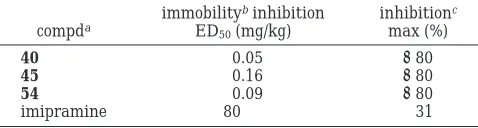
Compounds 40, 45 (Table 5), and 54 (Table 2), which
emerged as the most active derivatives in each group,
were then assessed in the FST. As summarized in Table
6, all three compounds potently decreased immobility
after a single administration, and maximal effects were
greater than that of the tricyclic antidepressant
imi-pramine. These novel 5-HT
1Areceptor agonists have,
therefore, the potential to exert antidepressant effects
in humans.
33Currently, these compounds, and others within this
series, are being evaluated further in various preclinical
models.
Conclusion
The present study is part of an effort to improve the
in vivo properties of a recently described, novel class of
5-HT
1Areceptor agonists. Here, we reported the
prepa-ration of, and discussed pharmacological results
ob-tained with, a series of aryl-[4-fluoro-4-(
{
[5-H or CH
3,
6-substituted-pyridin-2-ylmethyl]-amino
}
-methyl)-pip-eridin-1-yl]-methanones. These compounds have, in
general, high affinity for and selectivity at 5-HT
1Areceptors (versus D
2and
R
1). Among them, several
inhibited forskolin-stimulated cAMP accumulation in
HA7 cells more potently than the prototypical agonist
(
(
)8-OH-DPAT. Importantly, their 5-HT
1Aagonist
ac-tivity, when administered i.p. and p.o. to rats, was
superior to that of the aryl-[4-(
{
[5-H or CH
3,
6-substi-tuted-pyridin-2-ylmethyl]-amino
}
-methyl)-piperidin-1-yl]-methanone analogues. Furthermore, their ability to
reduce immobility in the FST after a single oral
administration, compared with that of imipramine
(tricyclic antidepressant), suggests that they have marked
antidepressant potential.
From a structural standpoint, a Csp
3-4 fluorine atom
proved unique in its ability to enhance the central
5-HT
1Aactivity of the ligands when administered orally.
This effect may result from improved pharmacokinetics,
possibly combined with some stereoelectronic
contribut-ing factors, rather than increased agonist properties of
the fluorinated ligand at 5-HT
1Areceptors. From a
conformational standpoint, we proposed that the chain
linked at C-4 on the piperidine ring assumed an
equato-rial or a pseudoequatoequato-rial orientation in the bioactive
conformation(s) of the ligand.
The outstanding in vitro and in vivo profile of several
compounds in this series, together with the novelty of
their structures, warrants a further examination of their
properties in other preclinical models. Already, these
derivatives and analogues will provide innovative tools
that could contribute to a better understanding of the
therapeutic significance of 5-HT
1Areceptors.
Experimental Section
Melting points were determined on a Bu¨ chi 530 melting point apparatus and were not corrected.1H NMR spectra were
recorded on a Bruker AC200 (200 MHz) instrument. Chemical shifts are reported in δvalue (ppm) relative to an internal standard of tetramethylsilane in CDCl3or DMSO-d6. Infrared
(IR) spectra were obtained on a Nicolet FT 510 P spectra photometer. Microanalyses were obtained on a Fison EA 1108/ CHN analyzer, and the results obtained were(0.4% of the theoretical values. Analytical thin-layer chromatography was carried out on precoated plates (silica gel, 60 F 254 Merck). SDS silica gel (0.040-0.063 mm) was used for flash chroma-tography. Organic extracts were dried over MgSO4 unless
otherwise noted.
Method A. N-(3-Chloro-4-fluorobenzoyl)-4-fluoro-4-[(5- methyl-6-dimethylaminopyridyl-2)-methylamino-meth-yl]-piperidine (49). A solution of amine 1aa (1.43 g, 4.95
mmol), aldehyde 3c (0.68 g, 4.14 mmol), and toluene (50 mL) was heated under reflux for 2 h with water separation by a Dean-Stark trap. The solvent was removed under reduced pressure, the residue was taken up in MeOH (25 mL) and cooled to 0-5 °C, and KBH4(0.45 g, 8.28 mmol) was added
portionwise. Stirring was continued at room temperature for 18 h. The mixture was concentrated, extracted with CH2Cl2,
washed with water and brine, and then dried and filtered. Evaporation of the solvent gave a pale yellow oil which was purified by flash chromatography, MeOH-CH2Cl2 (1:9), to
afford 1.56 g of 49 (86%) as a pale yellow oil. The oxalate salt of 49 was crystallized from MeOH-Et2O to give 1.46 g of a
white solid: mp 204-206 °C;1H NMR (DMSO-d
6)δ1.75 (m,
1H), 1.84 (m, 2H), 1.99 (m, 1H), 2.25 (s, 2H), 2.82 (s, 6H), 3.07 (m, 1H), 3.18 (d, 2H), 3.25 (m, 1H), 3.44 (m, 1H), 4.08 (s, 2H), 4.30 (m, 1H), 6.89 (d, 1H), 7.46 (m, 3H), 7.66 (dd, 1H); Anal. (C22H27ClF2N4O‚C2H2O4) C, H, N, and Cl.
N-(3-Chloro-4-fluorobenzoyl)-piperidine-4-one (5a). To
a cooled solution of piperidin-4-one ethyleneketal (82.05 g, 0.573 mol), TEA (160 mL, 1.15 mol), and chloroform (300 mL) was added dropwise a solution of 3-chloro-4-fluorobenzoyl chloride (110.6 g, 0.573 mol) in anhydrous chloroform (100 mL). After stirring for 17 h at room temperature, the solution was washed successively with 1 N HCl, H2O, aqueous NaHCO3,
and brine then dried and filtered. The solvent was evaporated under vacuum to give 172 g of the protected amide (quantita-tive) as an oil which was treated with 80% formic acid (500 mL) containing CuSO4(2 g) at 80 °C for 16 h. Formic acid was
eliminated by azeotropic distillation with toluene, and the oily residue obtained was neutralized with aqueous K2CO3. The
mixture was extracted twice with CH2Cl2, dried, and filtered,
and the solvent was evaporated to give an oil which crystal-lized on standing. Recrystallization from CH2Cl2-diisopropyl
ether afforded 105 g of 5a (71.6%): mp 118-120 °C;1H NMR
(CDCl3)δ2.50 (s, 4H), 3.86 (s, 4H), 7.20 (t, 1H), 7.37 (m, 1H),
7.55 (dd, 1H); IR (KBr, cm-1) 1635 and 1710. Anal. (C 12H11
-ClFNO2) C, H, N, and Cl.
N-(3-Chloro-4-methylbenzoyl)-piperidin-4-one (5b). This
compound was prepared in 64% yield as described for 5a using 3-chloro-4-methylbenzoyl chloride as starting material. 5b was obtained as a white solid: mp 74-75 °C;1H NMR (CDCl
[image:7.612.55.294.67.131.2]3)δ
Table 6. Effects of 40, 45, 54, and the Reference Compound
Imipramine in the Rat Forced Swimming Test
compda
immobilitybinhibition
ED50(mg/kg)
inhibitionc
max (%)
40 0.05 >80
45 0.16 >80
54 0.09 >80
imipramine 80 31
aCompounds given orally 60 min before test.bPotency to
produce a significant inhibition of immobility in 50% of the animals tested.cEstimated maximum inhibition of immobility, expressed
2.42 (s, 3H), 2.51 (s, 4H), 3.87 (s, 4H), 7.25 (d, 1H), 7.28 (d, 1H), 7.47 (s, 1H); IR (KBr, cm-1) 1626 and 1714. Anal. (C
13H14
-ClNO2) C, H, N, and Cl.
N-(3,4-Dichlorobenzoyl)-piperidin-4-one (5c). This
com-pound was prepared in 76% yield as described for 5a using 3,4-dichlorobenzoyl chloride as starting material. Compound
5c was obtained as a white solid: mp 115-117 °C;1H NMR
(CDCl3)δ2.51 (s, 4H), 3.86 (s, 4H), 7.30 (dd, 1H), 7.52 (d, 1H),
7.57 (d, 1H); IR (KBr, cm-1) 1645 and 1721. Anal. (C
12H11Cl2
-NO2) C, H, N, and Cl.
N-(3-Chlorobenzoyl)-piperidin-4-one (5d). This
com-pound was prepared in 67% yield as described for 5a using 3-chlorobenzoyl chloride as starting material. Compound 5d was obtained as a white solid: mp 62-64 °C;1H NMR (CDCl
3)
δ2.51 (m, 4H), 3.87 (m, 4H), 7.34-7.47 (m, 4H); IR (KBr, cm-1)
1638 and 1721. Anal. (C12H12ClNO2) C, H, N, and Cl.
N-(3-Chloro-4-fluorobenzoyl)-1-oxa-6-azaspiro[2,5]-octane (6a). A solution of dimethylsulfoxonium methylide was
prepared, under nitrogen, from sodium hydride (1.52 g of a 60% dispersion in mineral oil, 37.8 mmol) and trimethylsul-foxonium iodide (8.32 g, 37.8 mmol) in anhydrous DMSO (20 mL). A solution of 5a (9.21 g, 36 mmol) in DMSO (20 mL) was added in 30 min and stirring was continued at 60 °C for 3.5 h. The cooled reaction mixture was poured into ice-water and extracted twice with ethyl acetate. The combined organic layer
was washed with water and brine and then dried and concentrated. The residue was purified by a short flash chromatography on silica gel, eluting with CHCl3-EtOAc (9:
1), to give 7.68 g of 6a (79%) as an oil which crystallized on standing: mp 75-77 °C;1H NMR (CDCl
3)δ1.50 (m, 2H), 1.92
(m, 2H), 2.74 (s, 2H), 3.52 (m, 2H), 3.87 (m, 1H), 4.19 (m, 1H), 7.18 (t, 1H), 7.32 (m, 1H), 7.51 (dd, 1H); IR (KBr, cm-1) 1620.
Anal. (C13H13ClFNO2) C, H, N, and Cl.
N-(3-Chloro-4-methylbenzoyl)-1-oxa-6-azaspiro[2,5]-octane (6b). This compound was prepared in 60% yield as
described for 6a starting from 5b. Compound 6b was obtained as a white solid: mp 104-105 °C;1H NMR (CDCl
3)δ1.48 (m,
2H), 1.92 (m, 2H), 2.40 (s, 3H), 2.74 (s, 2H), 3.54 (m, 2H), 3.63 (m, 1H), 4.24 (m, 1H), 7.21 (dd, 1H), 7.27 (d, 1H), 7.42 (d, 1H); IR (KBr, cm-1) 1628. Anal. (C
14H16ClNO2) C, H, N, and Cl.
N-(3,4-Dichlorobenzoyl)-1-oxa-6-azaspiro[2,5]octane
(6c). This compound was prepared in 72% yield as described
for 6a starting from 5c. Compound 6c was obtained as a white solid: mp 95-97 °C;1H NMR (CDCl
3)δ 1.45 (m, 2H), 1.88
(m, 2H), 2.71 (s, 2H), 3.50 (m, 3H), 4.19 (m, 1H), 7.22 (dd, 1H), 7.49 (m, 2H); IR (KBr, cm-1) 1625. Anal. (C
13H13Cl2NO2) C,
H, N, and Cl.
N-(3-Chlorobenzoyl)-1-oxa-6-azaspiro[2,5]octane (6d).
[image:8.612.61.554.79.478.2]This compound was prepared in 56% yield as described for 6a starting from 5d. Compound 6d was obtained as a pale yellow
Table 7. Physical Data of Pyridin-2-ylmethylamino Derivatives
compd R R1 R2 R3 R4 method % yield formulaa mp (°C)
32 H H F Cl Cl A 60 C19H20Cl2FN3O‚C4H4O4b 161-163
33 H 3-F H Cl Cl A 78 C19H20Cl2FN3O‚C4H4O4b 155-157
34 H 5-CH3 F Cl Cl A 51 C20H22Cl2FN3O‚C4H4O4b 162-164
35 H 5-CH3 F Cl F A 49 C20H22ClF2N3O‚C4H4O4b 156-158
36 H 5-C2H5 F Cl F A 47 C21H24ClF2N3O‚C4H4O4b 153-155
37 H 5-iC3H7 F Cl F A 37 C22H26ClF2N3O‚C4H4O4b 155-157
38 CH3NH H F Cl F A 78 C20H23ClF2N4O‚C4H4O4b 164-166
39 CH3NH H F Cl Cl A 71 C20H23Cl2FN4O‚C4H4O4b 167-169
40 CH3NH 5-CH3 F Cl F A 91 C21H25ClF2N4O‚C4H4O4d 162-164
41 C2H5NH H F Cl F A 57 C21H25ClF2N4O‚C2H2O4c 173-175
42 C2H5NH 5-CH3 F Cl F A 79 C22H27ClF2N4O‚C4H4O4b 130-132
43 (CH3)2N H F Cl H A 45 C21H26ClFN4O‚C4H4O4b 152-154
44 (CH3)2N H F Cl CH3 A 61 C22H28ClFN4O‚C4H4O4b 166-168
45 (CH3)2N H F Cl F A 67 C21H25ClF2N4O‚C4H4O4b 158-160
46 (CH3)2N H F Cl Cl A 58 C21H25Cl2FN4O‚C4H4O4b 173-175
47 (CH3)2N 3-CH3 F Cl Cl A 65 C22H27Cl2FN4O‚C2H2O4c 169-171
48 (CH3)2N 4-CH3 F Cl F A 51 C22H27ClF2N4O‚C4H4O4b 140-142
49 (CH3)2N 5-CH3 F Cl F A 86 C22H27ClF2N4O‚C2H2O4c 204-206
50 (C2H5)2N H F Cl F A 77 C23H29ClF2N4O‚C2H2O4c 198-200
51 (C2H5)2N 5-CH3 F Cl F A 69 C24H31ClF2N4O‚C4H4O4b 140-142
52 6-azetidin-1-yl H F Cl Cl A 52 C22H25Cl2FN4O‚C2H2O4c 215-216
53 6-furan-2-yl H F Cl Cl A 49 C23H22Cl2FN3O2‚0.5C4H4O4b 142-144
54 6-furan-2-yl H F Cl F A 75 C23H22ClF2N3O2‚0.5C4H4O4b 158-160
55 6-thien-2-yl H F Cl Cl A 43 C23H22Cl2FN3OS‚0.5C4H4O4b 171-173
56 6-oxazol-5-yl H F Cl Cl A 75 C22H21Cl2FN4O2‚C2H2O4c 182-184
57 6-thiazol-2-yl H F Cl Cl A 62 C22H21Cl2FN4OS‚C4H4O4b 146-148
58 6-pyrazol-1-yl H F Cl Cl A 39 C22H22Cl2FN5O‚0.5C4H4O4b 138-140
59 6-pyrazol-1-yl H F Cl F A 75 C22H22ClF2N5O‚C4H4O4b 173-175
60 6-pyrazol-1-yl 5-CH3 F Cl F A 81 C23H24ClF2N5O‚C4H4O4b 171-173
61 6-pyrazol-3-yl H F Cl Cl A 51 C22H22Cl2FN5O‚C2H2O4c 150-152
62 6-pyrazol-3-yl H F Cl F A 48 C22H22ClF2N5O‚C2H2O4c 165-167
63 6-pyrazol-3-yl 5-CH3 F Cl F A 58 C23H24ClF2N5O‚C4H4O4b 172-174
64 6-pyrazol-1-yl H CH3 Cl Cl A 70 C23H25Cl2N5O‚1.5C4H4O4b 131-133
65 6-pyrazol-1-yl H CN Cl Cl B 42 C23H22Cl2N6O‚C2H2O4c 178-180
66 6-pyrazol-1-yl H OCH3 Cl Cl B 62 C23H25Cl2N5O2‚C2H2O4c 187-189
67 6-pyrazol-1-yl H OH Cl Cl Cd 56 C
22H23Cl2N5O2‚1.5C4H4O4b 191-193
68 6-pyrazol-1-yl H CH2F Cl Cl A 53 C23H24Cl2N5O‚C2H2O4c 208-210
69e 6-pyrazol-1-yl H Cl Cl A 54 C
22H21Cl2N5O‚C4H4O4b 120-125
aAnalyses for all compounds were within 0.4% of the theoretical value for C, H, and N.bFumarate.cOxalate.dMethod C involved a
oil: 1H NMR (CDCl
3)δ1.48 (m, 2H), 1.89 (m, 2H), 2.62 (s,
2H), 3.54 (m, 2H), 3.72 (m, 1H), 4.26 (m, 1H), 7.26-7.46 (m, 4H).
N-(3-Chloro-4-fluorobenzoyl)-4-fluoro-4-hydroxymeth-ylpiperidine (7a). To a solution of the epoxide 6a (11.90 g,
44.1 mmol) and anhydrous CH2Cl2(20 mL), stirred at-10 °C,
was added dropwise 70% poly(hydrogenfluoride)-pyridine (12.60 g, 441 mmol). The solution was stirred at-10 °C for 15 min and then at room temperature for 16 h. The dark-red solution was poured into ice-water and carefully neutralized with K2
-CO3, and the product was extracted three times with CH2Cl2.
The combined organic layer was washed with water, 1 N HCl, and brine and dried, and the solvent was evaporated off. The solid obtained was recrystallized from ethanol-ethyl acetate to give 6.40 g of 7a (50%) as a white solid: mp 188-190 °C;
1H NMR (CDCl
3)δ1.50 (m, 1H), 1.63 (s, 1H exchangeable),
1.70 (m, 1H), 1.99 (m, 2H), 3.30 (m, 3H), 3.61 (dd, 2H), 4.53 (m, 1H), 7.16 (t, 1H), 7.29 (m, 1H), 7.46 (dd, 1H); IR (KBr, cm-1) 3328 and 1612. Anal. (C
13H14ClF2NO2) C, H, N, and Cl.
N-(3-Chloro-4-methylbenzoyl)-4-fluoro-4-hydroxy-methylpiperidine (7b). This compound was prepared in 48%
yield as described for 7a starting from 6b. Compound 7b was obtained as a white solid: mp 148-150 °C;1H NMR (CDCl
3)
δ1.63 (m, 1H), 1.83 (s, 1H, exchangeable), 1.96 (m, 1H), 2.40 (s, 3H), 3.27 (m, 2H), 3.62 (d, 1H), 3.68 (m, 1H), 4.55 (m, 1H), 7.19 (d, 1H), 7.27 (d, 1H), 7.40 (s, 1H); IR (KBr, cm-1) 3370
and 1617. Anal. (C14H17ClFNO2) C, H, N, and Cl.
N-(3,4-Dichlorobenzoyl)-4-fluoro-4-hydroxymethylpi-peridine (7c). This compound was prepared in 46% yield as
described for 7a starting from 6c. Compound 7c was obtained as a white solid: mp 178-180 °C;1H NMR (DMSO d
6)δ1.46
-1.61 (m, 4H), 3.04 (m, 2H), 3.31 (s, 1H, exchangeable), 3.38 (dd, 2H), 4.18 (m, 1H), 4.99 (t, 1H), 7.36 (dd, 1H), 7.67 (m, 2H). Anal. (C13H14Cl2FNO2) C, H, N, and Cl.
N-(3-Chlorobenzoyl)-4-fluoro-4-hydroxymethylpiperi-dine (7d). This compound was prepared in 35% yield as
described for 7a starting from 6d. Compound 7d was obtained as a white solid: mp 130-132 °C;1H NMR (CDCl
3)δ1.62 (m,
2H), 1.93 (s, 1H exchangeable), 2.05 (m, 2H), 3.28 (m, 2H), 3.63 (m, 3H), 4.57 (m, 1H), 7.27 (m, 1H), 7.37 (m, 2H); IR (KBr, cm-1) 3365 and 1613. Anal. (C
13H15ClFNO2) C, H, N, and Cl.
N-(3-Chloro-4-fluorobenzoyl)-4-fluoro-4-(4-methylphen-ylsulfonyloxymethyl)-piperidine (8a). To a solution of 7a
(47.65 g, 0.164 mol) in anhydrous pyridine (235 mL), cooled to 0-5 °C, was added dropwise p-toluenesulfonyl chloride (34.32 g, 0.18 mol), and the solution was stirred at room temperature overnight. The suspension was poured into ice -water and extracted twice with CH2Cl2. The combined organic
layer was washed successively with 1 N HCl, water, and brine, dried, filtered, and concentrated under vacuum. Crystallization from diisopropyl ether afforded 64.40 g of 8a (83%) as a white solid: mp 90-92 °C;1H NMR (CDCl
3)δ 1.58 (m, 1H), 1.71
(m, 1H), 1.86 (m, 2H), 2.43 (s, 3H), 3.23 (m, 2H), 3.64 (m, 1H), 3.97 (d, 2H), 4.46 (m, 1H), 7.15 (t, 1H), 7.25 (m, 1H), 7.34 (d, 2H), 7.44 (dd, 1H), 7.76 (d, 2H); IR (KBr, cm-1) 1622. Anal.
(C20H20ClF2NO4S) C, H, N, and Cl.
N-(3-Chloro-4-methylbenzoyl)-4-fluoro-4(4-methylphen-ylsulfonyloxymethyl)-piperidine (8b). This compound was
prepared in 78% yield as described for 8a starting from alcohol
7b. Compound 8b was obtained as a white solid: mp 122
-123 °C;1H RMN (CDCl
3)δ1.62 (m, 1H), 1.88 (m, 1H), 2.40 (s,
3H), 2.46 (s, 3H), 3.13 (m, 1H), 3.31 (m, 1H), 3.64 (m, 1H), 4.01 (d, 2H), 4.54 (m, 1H), 7.16 (d, 1H), 7.26 (d, 1H), 7.38 (m, 3H), 7.79 (d, 2H); IR (KBr, cm-1) 1618. Anal. (C
21H23ClFNO4S)
C, H, N, and Cl.
N-(3,4-Dichlorobenzoyl)-4-fluoro-4-(4-methylphenyl-sulfonyloxymethyl)-piperidine (8c). This compound was
prepared in 81% yield as described for 8a starting from alcohol
7c. Compound 8c was obtained as a white solid: mp 142
-144 °C;1H NMR (CDCl
3)δ1.61 (m, 2H), 1.85 (m, 2H), 2.45 (s,
3H), 3.26 (m, 2H), 3.60 (m, 1H), 4.01 (d, 2H), 4.51 (m, 1H), 7.20 (dd, 1H), 7.35 (d, 2H), 7.48 (m, 2H), 7.78 (d, 2H).
N-(3-Chlorobenzoyl)-4-fluoro-4-(4-methylphenylsulfo-nyloxymethyl)-piperidine (8d). This compound was
pre-pared in 85% yield as described for 8a starting from alcohol
7d. Compound 8d was obtained as a pale yellow oil: 1H NMR
(CDCl3)δ1.63 (m, 2H), 1.89 (m, 2H), 2.46 (s, 3H), 3.12 (m,
1H), 3.34 (m, 1H), 3.63 (m, 1H), 4.02 (d, 2H), 4.56 (m, 1H), 7.25 (d, 1H), 7.37 (m, 5H), 7.79 (d, 2H).
N-(3-Chloro-4-fluorobenzoyl)-4-fluoro-4-phthalimido-methylpiperidine (9a). The mixture of 8a (60 g, 0.0135 mol),
K-phthalimide (32.4 g, 0.175 mol), and anhydrous DMF (500 mL) was stirred at 150 °C for 7 h. The cooled suspension was poured into ice-water and extracted twice with CH2Cl2. The
combined organic layer was washed with brine, dried, and filtered through a pad of silica. Evaporation of the solvent gave an oil which crystallized upon addition of a mixture of diisopropyl ether-cyclohexane. Filtration of the solid gave 49.32 g of 9a (87%): mp 123-125 °C;1H NMR (CDCl
3) 1.85
(m, 4H), 3.16 (m, 1H), 3.34 (m, 1H), 3.65 (m, 1H), 3.91 (d, 2H), 4.56 (m, 1H), 7.18 (t, 1H), 7.29 (m, 1H), 7.49 (dd, 1H), 7.76 (m, 2H), 7.88 (m, 2H); IR (KBr, cm-1) 1776, 1720 and 1623. Anal.
(C21H17ClF2N2O3) C, H, N, and Cl.
N-(3-Chloro-4-methylbenzoyl)-4-fluoro-4-phthalimi-domethylpiperidine (9b). This compound was prepared in
85% yield as described for 9a starting from 8b. Compound 9b was obtained as a white solid: mp 149-151 °C; 1H NMR
(CDCl3)δ1.62-1.95 (m, 4H), 2.39 (s, 3H), 3.13 (m, 1H), 3.32
(m, 1H), 3.63 (m, 1H), 3.90 (d, 2H), 4.56 (m, 1H), 7.18 (m, 1H), 7.25 (d, 1H), 7.39 (s, 1H), 7.76 (m, 2H), 7.88 (m, 2H); IR (KBr, cm-1) 1777, 1720, and 1625; Anal. (C
22H20ClFN2O3) C, H, N,
and Cl.
N-(3,4-Dichlorobenzoyl)-4-fluoro-4-phthalimidometh-ylpiperidine (9c). This compound was prepared in 83% yield
as described for 9a starting from 8c. Compound 9c was obtained as a white solid: mp 152-154 °C;1H NMR (CDCl
3)
δ1.60-1.90 (m, 4H), 3.22 (m, 2H), 3.62 (m, 1H), 3.90 (d, 2H), 4.58 (m, 1H), 7.25 (dd, 1H), 7.50 (m, 2H), 7.75 (m, 2H), 7.88 (m, 2H); IR (KBr, cm-1) 1776, 1723, and 1635. Anal. (C
21H17
-Cl2FN2O3) C, H, N, and Cl.
N-(3-Chlorobenzoyl)-4-fluoro-4-phthalimidomethylpi-peridine (9d). This compound was prepared in 80% yield as
described for 9a starting from 8d. Compound 9d was obtained as a white solid: mp 126-127 °C;1H NMR (CDCl
3)δ1.62
-1.99 (m, 4H), 3.13 (m, 1H), 3.34 (m, 1H), 3.63 (m, 1H), 3.90 (d, 2H), 4.59 (m, 1H), 7.26 (d, 1H), 7.36 (m, 2H), 7.76 (dd, 2H), 7.89 (dd, 2H). Anal. (C21H18ClFN2O3) C, H, N, and Cl.
N-(3-Chloro-4-fluorobenzoyl)-4-fluoro-4-aminometh-ylpiperidine (1aa). A mixture of 9a (2.60 g, 6.20 mmol) and
ethanolamine (8 mL) was stirred at 60 °C for 2 h. The cooled solution was poured into ice-water and extracted twice with CH2Cl2. The organic layers were washed with brine, dried, and
concentrated to give 1.50 g of 1aa (87%) as a pale yellow oil:
1H NMR (CDCl
3)δ1.37 (s broad, exchangeable), 1.63 (m, 2H),
1.91 (m, 2H), 2.79 (d, 2H), 3.22 (m, 2H), 3.62 (m, 1H), 4.49 (m, 1H), 7.15 (t, 1H), 7.26 (m, 1H), 7.45 (dd, 1H).
N-(3-Chloro-4-methylbenzoyl)-4-fluoro-4-aminometh-ylpiperidine (1ab). This compound was prepared from 9b
(90%) using the same procedure as described for the prepara-tion of 1aa. Compound 1ab was obtained as a pale yellow oil:
1H NMR (CDCl
3)δ1.23 (s broad, exchangeable), 1.59 (m, 2H),
1.95 (m, 2H), 2.40 (s, 3H), 2.83 (d, 2H), 3.14 (m, 1H), 3.37 (m, 1H), 3.64 (m, 1H), 4.56 (m, 1H), 7.19 (d, 1H), 7.26 (m, 1H), 7.39 (d, 1H).
N-(3,4-Dichlorobenzoyl)-4-fluoro-4-aminomethylpipe-ridine (1ac). This compound was prepared from 9c (82%)
using the same procedure as described for the preparation of
1aa. Compound 1ac was obtained as a pale yellow oil: 1H
NMR (CDCl3)δ 1.32 (s broad, exchangeable), 1.64 (m, 2H),
1.94 (m, 2H), 2.81 (d, 2H), 3.27 (m, 2H), 3.59 (m, 1H), 4.52 (m, 1H), 7.26 (m, 1H), 7.48 (m, 2H).
N-(3-Chlorobenzoyl)-4-fluoro-4-aminomethylpiperi-dine (1ad). This compound was prepared from 9d (87%) using
the same procedure as described for the preparation of 1aa. Compound 1ad was obtained as a pale yellow oil: 1H NMR
(CDCl3)δ1.35 (s broad, exchangeable), 1.61 (m, 2H), 1.93 (m,
N-(3,4-Dichlorobenzoyl)-4-cyano,
4-hydroxymethylpi-peridine (10). To a mixture of KBH4(0.92 g, 17 mmol), LiCl
(0.73 g, 17.2 mmol), and anhydrous THF (30 mL) under a nitrogen atmosphere was added dropwise at room temperature a solution of N-(3,4-dichlorobenzoyl)-4-cyano, 4-ethoxycarbo-nylpiperidine12(5.48 g, 15.4 mmol) and THF (20 mL). Stirring
was continued at room temperature for 18 h. The mixture was concentrated under vacuum, and water was added. The product was extracted with EtOAc, washed with water and brine, dried, and filtered, and the solvent was evaporated under vacuum. The crude product was crystallized from diisopropyl ether to give 3.19 g (66%) of 10 as a white solid: mp 188-190 °C;1H NMR (DMSO-d
6)δ1.51 (dt, 2H), 1.87 (m,
2H), 2.96 (m, 1H), 3.17 (m, 1H), 3.46 (d, 2H), 3.65 (m, 1H), 4.44 (m, 1H), 5.49 (t, 1H), 7.36 (d, 1H), 7.41 (d, 1H), 7.70 (dd, 1H). Anal. (C14H14Cl2N2O2) C, H, N.
N-(3,4-Dichlorobenzoyl)-4-cyano,
4-Trifluoromethyl-sulfonyloxymethylpiperidine (11).
Trifluoromethanesulfon-ic anhydride (1.08 mL, 6.4 mmol) was added dropwise to an ice-cold mixture of 10 (1.60 g, 5.1 mmol), 2,6-dimethylpyridine (1 mL, 8.6 mmol), DMAP (62 mg, 0.51 mmol), and anhydrous CH2Cl2(15 mL). Stirring was continued for 1 h at 0 °C and
for 3 h at room temperature. The suspension was successively washed with water, aqueous citric acid solution, and water. The organic layer was dried and filtered, and the solvent was removed under vacuum to give 2.16 g (95%) of 11 as an oil which crystallized on standing: mp 120-122 °C; 1H NMR
(CDCl3)δ1.60 (m, 2H), 2.08 (m, 2H), 3.32 (m, 2H), 3.97 (m,
1H), 4.46 (s, 2H), 4.80 (m, 1H), 7.21 (d, 1H), 7.25 (d, 1H), 7.51 (m, 2H).
N-(3,4-Dichlorobenzoyl)-4-cyano,
4-Fluoromethylpip-eridine (12). The solution of 11 (2.05 g, 4.6 mmol), KF (2.9 g,
50 mmol), and diethyleneglycol (12 mL) was stirred at 100
-105 °C for 1 h. The cooled mixture was poured into water and extracted with EtOAc. The organic layer was washed with water and brine, dried, and filtered, and the solvent was removed under vacuum. Purification by flash chromatography, EtOAc-CH2Cl2(1:9) gave an oil which was crystallized from
diisopropyl ether to afford 0.99 g (68%) of 12 as a white solid: mp 135-137 °C;1H NMR (CDCl
3)δ1.60 (m, 2H), 1.98 (m, 2H),
3.25 (m, 2H), 3.83 (m, 1H), 4.40 (d, 1H), 4.74 (m, 1H), 7.19 (dd, 1H), 7.49 (m, 1H). Anal. (C14H13Cl2FN2O) C, H, N.
N-(3,4-Dichlorobenzoyl)-4-aminomethyl, 4-Fluoro-methylpiperidine (1b). To a solution of 12 (0.82 g, 2.6 mmol),
methanol (20 mL), and concentrated NH4OH (0.25 mL) was
added Raney nickel (1.50 g). The suspension was stirred under hydrogen atmosphere for 4 h. The catalyst was filtered off through Celite, and the solution was concentrated under vacuum. The oily residue was taken up in chloroform and washed with water and brine, dried, and filtered. The solvent was removed in a vacuum to give 0.80 g (96%) of 1b as an yellow oil: 1HNMR (CDCl
3)δ1.13 (m, 2H), 1.52 (m, 4H), 2.76
(s, 2H), 3.39 (m, 1H), 3.68 (m, 1H), 4.38 (d, 2H), 7.21 (dd, 1H), 7.48 (m, 2H).
N-(3,4-Dichlorobenzoyl)-4-cyano, 4-Methylpiperidine
(13). LDA (2 mL, 3.9 mmol as a 2 M solution in heptane/THF/
ethylbenzene) was added to the solution of N-(3,4-dichloroben-zoyl)-4-cyanopiperidine14 (1.0 g, 3.5 mmol),
1,3-dimethyl-2-imidazolidinone (0.1 g), and anhydrous THF (30 mL) under stirring and cooling at-15 °C. Stirring was continued for 30 min in the same conditions. ICH3(0.25 mL, 3.9 mmol) was
added dropwise, and the mixture was stirred at room temper-ature for 2 h. The solvents were removed under vacuum, and the residue was taken up in CHCl3and washed with water
and brine. The organic layer was dried and filtered, and the solvent was removed under vacuum. Purification of the residue by flash chromatography, EtOAc-CHCl3 (1:9), gave 0.70 g
(66%) of 13 which crystallized on standing: mp 116-118 °C;
1H NMR (CDCl
3)δ1.42 (s, 3H), 1.50 (m, 2H), 1.93 (m, 2H),
3.25 (m, 2H), 3.70 (m, 1H), 4.64 (m, 1H), 7.21 (dd, 1H), 7.47 (m, 2H). Anal. (C14H14Cl2N2O) C, H, N.
N-(3,4-Dichlorobenzoyl)-4-aminomethyl,
4-Methylpi-peridine (1c). Compound 1c was prepared in a quantitative
yield from 13 as described for the preparation of 1b from 12
and obtained as a pale yellow oil: 1H NMR (CDCl
3)δ0.97 (s,
3H), 1.41 (m, 6H), 2.56 (m, 2H), 3.27 (m, 3H), 4.07 (m, 1H), 7.22 (m, 1H), 7.43 (m, 2H).
N-(3,4-Dichlorobenzoyl)-4-azidomethyl,
4-Hydroxypi-peridine (14). A suspension of 6 (0.50 g, 1.75 mmol), NaN3
(0.57 g, 8.7 mmol), NH4Cl (0.20 g, 3.7 mmol), MeOH (8 mL),
and H2O (1 mL) was refluxed under stirring for 5 h. The
solvent was removed under vacuum, water was added, and the product was extracted with EtOAc. The organic layer was washed with water and brine, dried, and filtered. The solvent was distilled off to give an oil which crystallized on standing: mp 115-117 °C;1H NMR (CDCl
3)δ1.62 (m, 4H), 2.01 (m, 1H),
3.30 (s, 3H), 3.46 (m, 2H), 4.43 (m, 1H), 7.20 (dd, 1H), 7.46 (m, 2H). Anal. (C13H14Cl2N4O2) C, H, N.
N-(3,4-Dichlorobenzoyl)-4-azidomethyl,
4-Methoxypi-peridine (2a). A solution of 14 (2.0 g, 6.08 mmol) and
anhydrous THF (5 mL) was added dropwise to a suspension of HNa (60% dispersion in mineral oil, 0.365 g, 9.1 mmol) and THF (10 mL) under stirring and cooling in an ice-bath. Stirring was continued for 15 min at 0 °C and for 1 h at room temperature. ICH3(0.57 mL, 9.1 mmol) was added dropwise,
and stirring was continued for 18 h at room temperature. The reaction mixture was poured in ice-water and extracted with EtOAc. The combined extracts were washed with water and brine, dried, and filtered, and the solvent was removed under vaccuum. The product was crystallized from hexane to give 1.50 g (72%) of 2a as a white solid: mp 83-85 °C;1H NMR
(DMSO-d6)δ1.44 (m, 2H), 1.71 (m, 2H), 3.0 (m, 1H), 3.17 (s,
3H), 3.26 (m, 2H), 3.37 (s, 2H), 4.13 (m, 1H), 7.35 (dd, 1H), 7.67 (m, 2H). Anal. (C14H16Cl2N4O2) C, H, N.
N-(3,4-Dichlorobenzoyl)-4-cyano,
4-p-Toluenesulfonyl-oxymethylpiperidine (15). Compound 15 was obtained from 10 and purified by flash chromatography, MeOH-CHCl3(1:
99), and then by crystallization from diisopropyl ether as a white solid (75%): mp 169-171 °C; 1 NMR (CDCl3)δ1.58 (m,
2H), 1.97 (m, 2H), 2.48 (s 3H), 3.27 (m, 2H), 3.84 (m, 1H), 4.02 (s 2H), 4.70 (m, 1H), 7.22 (dd, 1H), 7.39 (d, 2H), 7.50 (m, 2H), 7.82 (d, 2H).
N-(3,4-Dichlorobenzoyl)-4-azidomethyl,
4-Cyanopip-eridine (2b). The suspension of 15 (2.03 g, 4.34 mmol), NaN3
(0.56 g, 8.6 mmol), n-tetrabutylammoniun azide (0.07 g, 0.25 mmol), and DMSO (6 mL) was stirred at 100-105 °C for 15 h. The cooled reaction mixture was poured in ice-water and extracted with EtOAc. The combined extracts were washed with water and brine, dried, and filtered. The solvent was removed under vacuum to give 1.4 g (95%) of 2b as a thick pale yellow oil: 1H NMR (CDCl
3)δ1.52 (m, 2H), 2.01 (m, 2H),
3.25 (m, 2H), 3.50 (s 2H), 3.86 (m, 1H), 4.74 (m, 1H), 7.22 (dd, 1H), 7.49 (m, 2H).
Method B. N-(3,4-Dichlorobenzoyl)-4-methoxy-4-{ [(6-pyrazol-1-yl-pyridin-2-ylmethyl)amino]methyl} -piperi-dine (66). The mixture of 2a (0.87 g, 2.53 mmol),
6-pyrazol-1-ylpyridine-2-carboxaldehyde (0.44 g, 2.54 mmol), triphenyl-phosphine (0.67 g, 2.55 mmol), and methanol (40 mL) was refluxed under stirring for 3 h. After the mixture cooled to room temperature, KBH4(0.41 g, 7.59 mmol) was added, and
stirring was continued for 18 h. The solvent was distilled off, and the residue was poured in ice-water and extracted with CH2Cl2. The organic layer was washed with water and brine,
dried, and filtered. Purification by flash chromatography, MeOH-EtOAc (1:9), gave 0.75 g (62%) of 58 as a pale yellow oil. The oxalate salt was crystallized from EtOH-EtOAc to afford a white solid (0.60 g): mp 187-189 °C;1H NMR
(DMSO-d6)δ1.55 (m, 2H), 1.90 (m, 2H), 2.90-3.30 (m, 8H), 4.08 (m,
1H), 4.31 (s, 2H), 6.59 (t, 1H), 7.35 (dd, 1H), 7.44 (d, 1H), 7.67 (m, 2H), 7.86 (m, 2H), 8.04 (t, 1H), 8.83 (d, 1H). Anal. (C23H25
-Cl2N5O2‚C2H2O4) C, H, N.
5-Methyl-6-chloro-2-pyridinemethanol (17). To a
solu-tion of 5-methyl-6-chloro-2-pyridinecarboxylic acid ethyl ester
1615(8.80 g, 44 mmol) in ethanol (100 mL), maintained at room
temperature, was added portionwise NaBH4(2.80 g, 74 mmol),